Business Communication for Managers: Crisis Communication Analysis

Verified

Added on  2021/12/17

|10
|2163
|69
Report
AI Summary
This report analyzes two articles focused on business communication, specifically within the context of crisis management and organizational reputation. The first article, "Enhancing employee communication behaviors for sensemaking and sensegiving in crisis situations," examines the impact of two-way symmetrical and transparent communication on employee behavior during crises. The research highlights the importance of fostering employee participation and sharing organizational values to increase commitment. The second article, "The Mediating Role of Charismatic Leadership Communication in a Crisis," investigates how charismatic leadership communication influences organizational reputation during crises. The findings emphasize the role of leaders in using effective communication to mitigate crisis impacts and protect the organization's image. The report concludes by emphasizing the need for effective managerial and leadership communication to manage crises and safeguard organizational reputation, including the implementation of two-way communication channels and charismatic leadership to improve employee responsiveness and organizational resilience. The articles highlight the significance of communication in building trust, managing internal and external crises, and ensuring organizational stability.

Document Page
Running head: BUSINESS COMMUNICATION FOR MANAGERS
Business Communication for Managers
Name of the Student
Name of the University
Author’s Note
tabler-icon-diamond-filled.svg

Paraphrase This Document

Need a fresh take? Get an instant paraphrase of this document with our AI Paraphraser
Document Page
1BUSINESS COMMUNICATION FOR MANAGERS
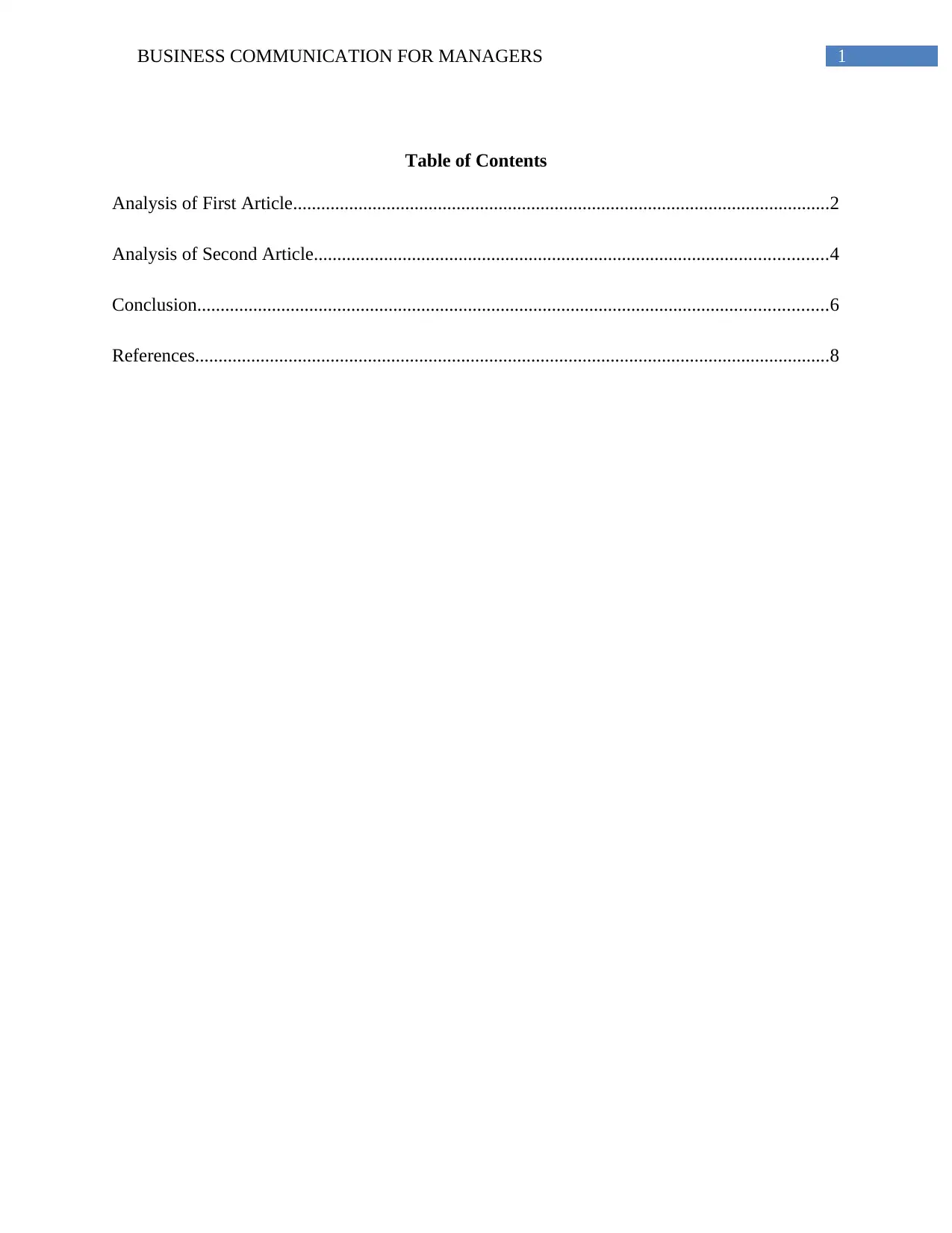
Table of Contents
Analysis of First Article...................................................................................................................2
Analysis of Second Article..............................................................................................................4
Conclusion.......................................................................................................................................6
References........................................................................................................................................8
Document Page
2BUSINESS COMMUNICATION FOR MANAGERS
Analysis of First Article
The purpose of this article named “Enhancing employee communication behaviors for
sensemaking and sensegiving in crisis situations: Strategic management approach for effective
internal crisis communication” by Young Kim is the exploration of the effectiveness of the
business organizations at the time of the internal crisis of communication in the strategic
management approach. This article also looks into the matter that whether this particular aspect
leads to the voluntary as well as positive employee communication behavior for the purposes of
sensemaking and sensegining (Kim 2018).
By considering this matter, this particular research helps in unfolding certain themes
related to employee communication; they are the development of the new communication theory
in the approach of strategic management, emphasis on the valuable assets of the companies
related to assets and the practices for handling the communication crisis situation in the
organizations (Kim 2018). Thus, with the aim of analyzing the above mentioned issues related to
employee communication, this study involves in a nationwide survey in the United States of
America among the full time employees. After conducting the dimensionality check with the
help of the analysis of confirmatory factors, this study also involves in the testing of hypothesis
and research questions with the help of ordinary least square multiple regression analysis (Albu
and Wehmeier 2014).
According to this article, the presence of two strategic communication internal factors
can be seen; they are two way symmetrical communication and transparent communication (Kim
2018). These two factors have positive impact on the process of employee communication
behavior for the purpose of both sensemaking and sensegiving under the crisis situations. This
Document Page
3BUSINESS COMMUNICATION FOR MANAGERS
article has been able in establishing a positive relationship between two-way symmetrical
communication and employee communication behavior (Claeys, Cauberghe and Leysen 2013).
In addition, the presence of a fundamental rationale can be seen in order to understand
and communicate with the employees in the time of communication crisis. This particular article
indicates towards the crucial aspect that the process of crisis management including the sharing
of organizational goals and values with the employees and encouraging them to participate in the
crisis situation helps the companies in increasing the organizational commitments after an
organizational crisis situation (Frandsen and Johansen 2016). Business organizations, with
developing and practicing a two-way communication program between the employees and
company management before a crisis situation, can expect the increased support from the
organizational employees by voluntary and valuable communication behavior for the purposes of
sensemaking and sensegiving both in the cases of internal and external crisis (Brandon et al.
2013).
Through this article, the researcher tries to provide an alert to the crisis managers of the
companies that the lack of two-way communication can result to dissatisfaction with
communication and cynicism from the employees (Kim 2018). For this reason, the crisis
managers are needed to use the strategy of listening for the identification of possible flaws along
with unrecognized obstacles in the employee communication process. In case the organizations
fail to consider the concerns and needs of the employees, the employees also fail to respond to
the organizational crisis situation (Hsiung 2012).
tabler-icon-diamond-filled.svg

Paraphrase This Document

Need a fresh take? Get an instant paraphrase of this document with our AI Paraphraser
Document Page
4BUSINESS COMMUNICATION FOR MANAGERS
Analysis of Second Article
The main aim of the article named “The Mediating Role of Charismatic Leadership
Communication in a Crisis: A Malaysian Example” by Jamilah Jamal and Hassan Abu Bakar is
the development of a model for advance research on the aspect of public organization reputation;
and this has been done by integrating the responsibility of crisis with the process of charismatic
leadership communication (Jamal and Abu Bakar 2017). On the basis of the theory of situation
crisis communication, this article involves in testing the model with the use of structural
equalities modeling. In the part of data for data analysis, the researchers obtained a sample of
383 employees from the Malaysian public organizations. According to the mediation model, the
vibrant system of charismatic leadership communication partially reconciles the relationship
between the responsibility in crisis and the perceived reputation of the organizations at the time
of crisis situation. This article indicates towards the fact that charismatic leadership
communication has a major role to play in the organizational reputation process (Jamal and Abu
Bakar 2017).
The findings of the article indicates towards the fact that at the time of crisis situation, it
is the responsibility of the crisis leaders to engage in the process of charismatic leadership
communication in the effective manner with the aim to diminish the impact of crisis so that the
organizational reputation can be strengthen (Jamal and Abu Bakar 2017). At the same time,
according to the article, the mechanism of charismatic leadership communication has major
contribution towards the organizational reputation. It indicates that there is a relation between the
process of crisis management and charismatic eldership communication (Abd-El-Salam et al.
2013).
Document Page
5BUSINESS COMMUNICATION FOR MANAGERS
According to this article, the moderate effects of apparent organizational reputation and
charismatic leadership communication support the fact that communication has a positive role to
play in the process to protect the organizational reputation (Jamal and Abu Bakar 2017). For this
reason, the employees in the organizations with charismatic leadership communication play
crucial role in protecting the reputation of their companies at the crisis time. Different
dimensions of perceived charismatic communication like communication related to
organizational tasks, enthusiasm and empathy have direct influence on the organizations (Reduan
2014). Due to this, variation can be seen in impact of crisis responsibility on the companies as
per the perception of the charismatic leadership communication (Abu Bakar and Sheer 2013).
The article also indicates towards the fact that the ability of the crisis leaders for charismatic
communication shapes the perception of the organizational employees towards reputation of the
companies (Tan 2014).
According to the findings of the research, organizational managers who shows specific
communication behavior like being positive, understand the feelings of the crisis victims,
expressing true concern are able to relate with the crisis victims at the time of crisis (Jamal and
Abu Bakar 2017). At the same time, the leaders with the appropriate body language are able to
indicate positive communication helping in the crisis situation. As per the practical implications
of the research, the dynamic leadership of charismatic leadership communication has the ability
in changing the outcomes of reputations in the direct manner; and it can also change the level of
crisis responsibility on the reputation of the business organizations (Men and Stacks 2013).
Document Page
6BUSINESS COMMUNICATION FOR MANAGERS
Conclusion
The above discussion involves in the analysis of two articles related to the
communication of the employees in the process of organizational crisis and organizational
reputation. The above discussion indicates towards the fact that the business organizations must
have proper mechanism of communication with the employees in order to tackle the crisis
situation along with the protection of organizational reputation. The above discussion involves in
the analysis of two articles related to the communication of the employees in the process of
organizational crisis and organizational reputation.
The above discussion indicates towards the fact that the business organizations must have
proper mechanism of communication with the employees in order to tackle the crisis situation
along with the protection of organizational reputation. As per the above discussion, in case the
managements of the companies want to be ready in tacking any kind of crisis situation within the
companies, they are needed to establish effective communication channel with the employees.
More specifically, the managements of the business organizations are needed to take into
consideration the establishment of effective communication channel for the purpose of crisis
management. According to the above discussion, the managements of the companies are needed
to establish two specific communication channel; they are the organizational communication
through transparent communication and organizational communication with the help of two-way
symmetrical behavior.
The above discussion also indicates towards the aspect that the managements of the
companies are needed to consider the effective communication of the organizational goals and
objectives with the employees as the employees can respond better manner in the crisis situation
due to this. At the same time, the above discussion also indicates towards the negative impact of
tabler-icon-diamond-filled.svg

Paraphrase This Document

Need a fresh take? Get an instant paraphrase of this document with our AI Paraphraser
Document Page
7BUSINESS COMMUNICATION FOR MANAGERS
the absence of two way communication channel on the employees as it can affect the employee
communication process at the time of organizational crisis. Due to this, the managers of the
companies need to adopt the organizational culture for listening to the issues and problems of the
employees with the aim to make them more responsive at the time of organizational crisis.
It can also be seen from the analysis of the above two articles that the aspect of
charismatic leadership communication is a major contributor of crisis management and
protection of organizational reputation. According to the above discussion, it is on the business
leaders to establish charismatic communication channel with the employees with the aim to
make them more responsive at the time of organizational crisis. Apart from this, the charismatic
leadership can be considered as an organizational culture that the leaders can implement with the
aim to make the employees more acceptable to the crisis situation. At the same time, it is needed
for the organizational leaders to develop communication channels with the help of various
leadership behaviors as all these behaviors show the true concern of the leaders towards their
employees. Thus, on the overall basis, it can be concluded that the presence of effective
managerial and leadership communication makes the employees able in managing crisis and
protecting organizational reputation.
Document Page
8BUSINESS COMMUNICATION FOR MANAGERS
References
Abd-El-Salam, E.M., Shawky, A.Y., El-Nahas, T. and Nawar, Y.S., 2013. The relationship
among job satisfaction, motivation, leadership, communication, and psychological
empowerment: An Egyptian case study. SAM Advanced Management Journal, 78(2), p.33.
Abu Bakar, H. and Sheer, V.C., 2013. The mediating role of perceived cooperative
communication in the relationship between interpersonal exchange relationships and perceived
group cohesion. Management Communication Quarterly, 27(3), pp.443-465.
Albu, O.B. and Wehmeier, S., 2014. Organizational transparency and sense-making: The case of
Northern Rock. Journal of Public Relations Research, 26(2), pp.117-133.
Brandon, D.M., Long, J.H., Loraas, T.M., Mueller-Phillips, J. and Vansant, B., 2013. Online
instrument delivery and participant recruitment services: Emerging opportunities for behavioral
accounting research. Behavioral Research in Accounting, 26(1), pp.1-23.
Claeys, A.S., Cauberghe, V. and Leysen, J., 2013. Implications of stealing thunder for the impact
of expressing emotions in organizational crisis communication. Journal of Applied
Communication Research, 41(3), pp.293-308.
Frandsen, F. and Johansen, W., 2016. Organizational crisis communication: A multivocal
approach. Sage.
Hsiung, H.H., 2012. Authentic leadership and employee voice behavior: A multi-level
psychological process. Journal of business ethics, 107(3), pp.349-361.
Document Page
9BUSINESS COMMUNICATION FOR MANAGERS
Jamal, J. and Abu Bakar, H., 2017. The mediating role of charismatic leadership communication
in a crisis: A Malaysian example. International Journal of Business Communication, 54(4),
pp.369-393.
Kim, Y., 2018. Enhancing employee communication behaviors for sensemaking and sensegiving
in crisis situations: Strategic management approach for effective internal crisis
communication. Journal of Communication Management, 22(4), pp.451-475.
Men, L.R. and Stacks, D.W., 2013. The impact of leadership style and employee empowerment
on perceived organizational reputation. Journal of Communication Management, 17(2), pp.171-
192.
Reduan, H., 2014. Teoh Beng Hock open verdict reversed. The New Straits Times, p.1.
Tan, Y.L., 2014. Cops urged to conduct criminal investigation into Teoh Beng Hock’s death. The
Star, p.1.
chevron_up_icon
1 out of 10
circle_padding
hide_on_mobile
zoom_out_icon
[object Object]