Analysis of Business Reports and Stakeholder Communication

Verified

Added on  2022/09/15

|4
|648
|18
Report
AI Summary
This report delves into the significance of business reports as crucial communication tools. It differentiates between informal and formal reports, emphasizing the importance of understanding the target audience. The report highlights the key characteristics of a good business report, including accuracy, conciseness, and a clear purpose. It also addresses different types of stakeholders, such as direct, indirect, and remote, and how their needs influence the report's content. The report underscores the need for business reports to be precise, rational, action-oriented, and well-targeted to effectively facilitate communication within the organization. References from authors like Paul Anderson, and others are included to support the arguments and concepts discussed in this report.
Document Page
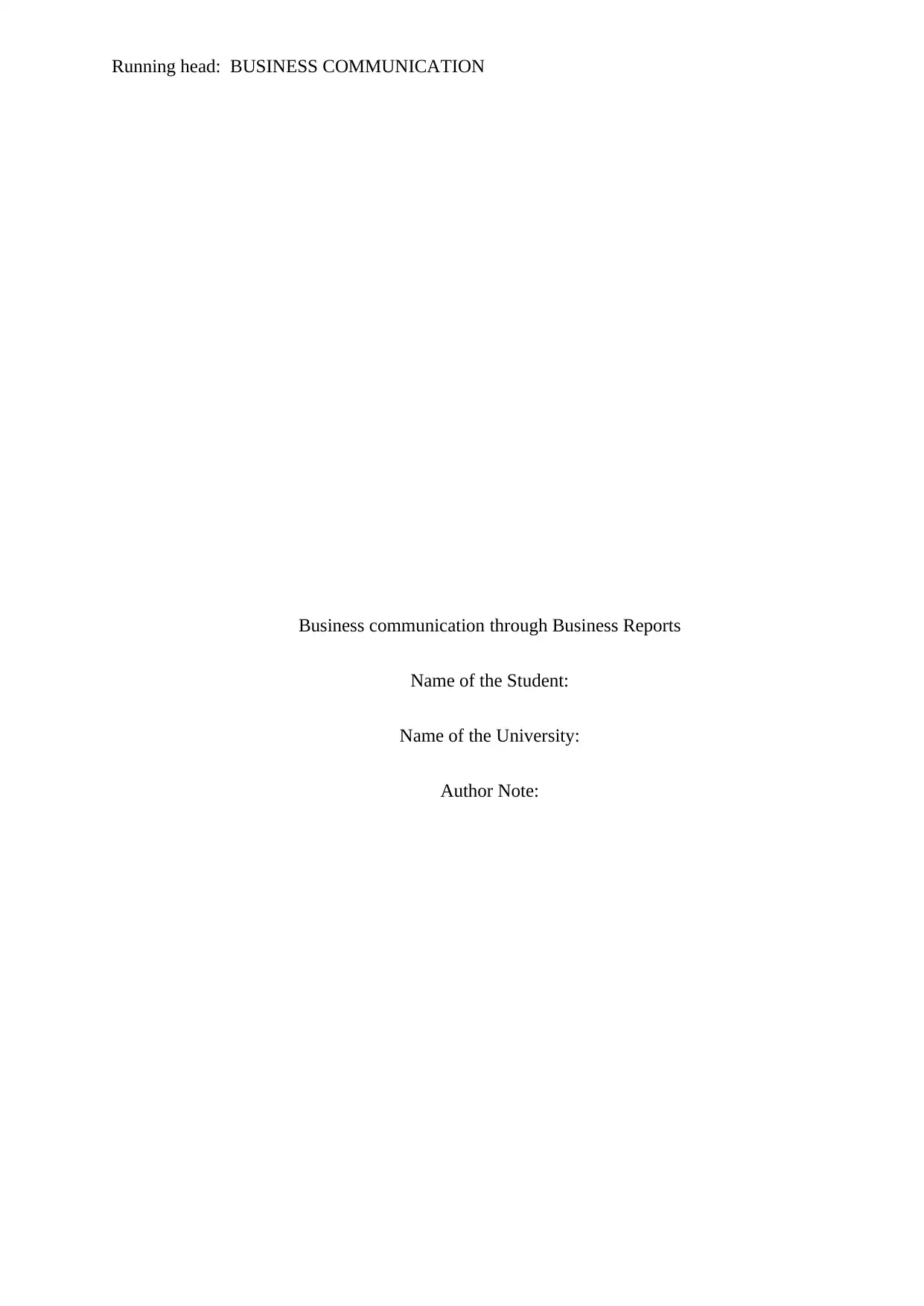
Running head: BUSINESS COMMUNICATION
Business communication through Business Reports
Name of the Student:
Name of the University:
Author Note:
tabler-icon-diamond-filled.svg

Paraphrase This Document

Need a fresh take? Get an instant paraphrase of this document with our AI Paraphraser
Document Page
1
BUSINESS COMMUNICATION
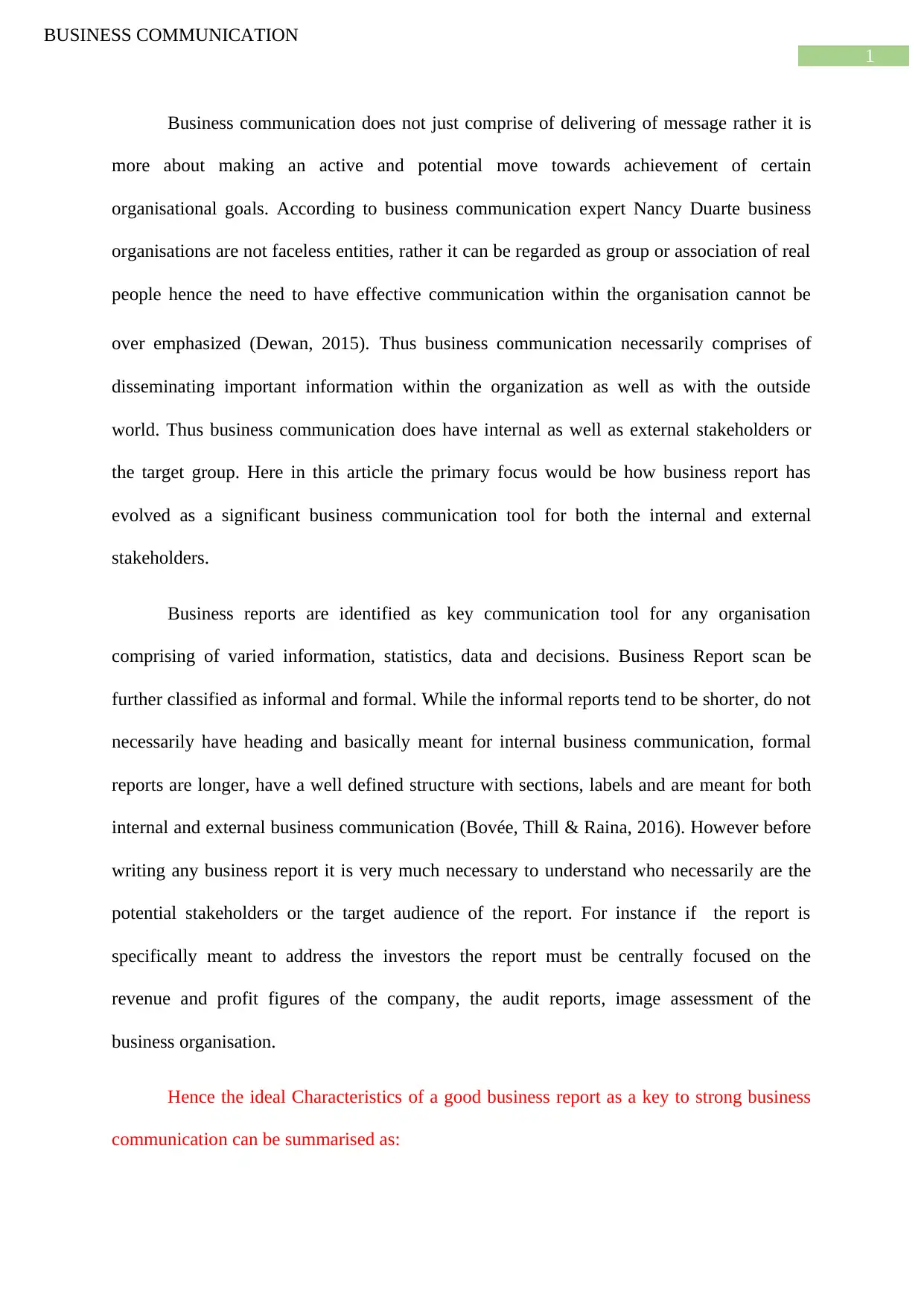
Business communication does not just comprise of delivering of message rather it is
more about making an active and potential move towards achievement of certain
organisational goals. According to business communication expert Nancy Duarte business
organisations are not faceless entities, rather it can be regarded as group or association of real
people hence the need to have effective communication within the organisation cannot be
over emphasized (Dewan, 2015). Thus business communication necessarily comprises of
disseminating important information within the organization as well as with the outside
world. Thus business communication does have internal as well as external stakeholders or
the target group. Here in this article the primary focus would be how business report has
evolved as a significant business communication tool for both the internal and external
stakeholders.
Business reports are identified as key communication tool for any organisation
comprising of varied information, statistics, data and decisions. Business Report scan be
further classified as informal and formal. While the informal reports tend to be shorter, do not
necessarily have heading and basically meant for internal business communication, formal
reports are longer, have a well defined structure with sections, labels and are meant for both
internal and external business communication (Bovée, Thill & Raina, 2016). However before
writing any business report it is very much necessary to understand who necessarily are the
potential stakeholders or the target audience of the report. For instance if the report is
specifically meant to address the investors the report must be centrally focused on the
revenue and profit figures of the company, the audit reports, image assessment of the
business organisation.
Hence the ideal Characteristics of a good business report as a key to strong business
communication can be summarised as:
Document Page
2
BUSINESS COMMUNICATION
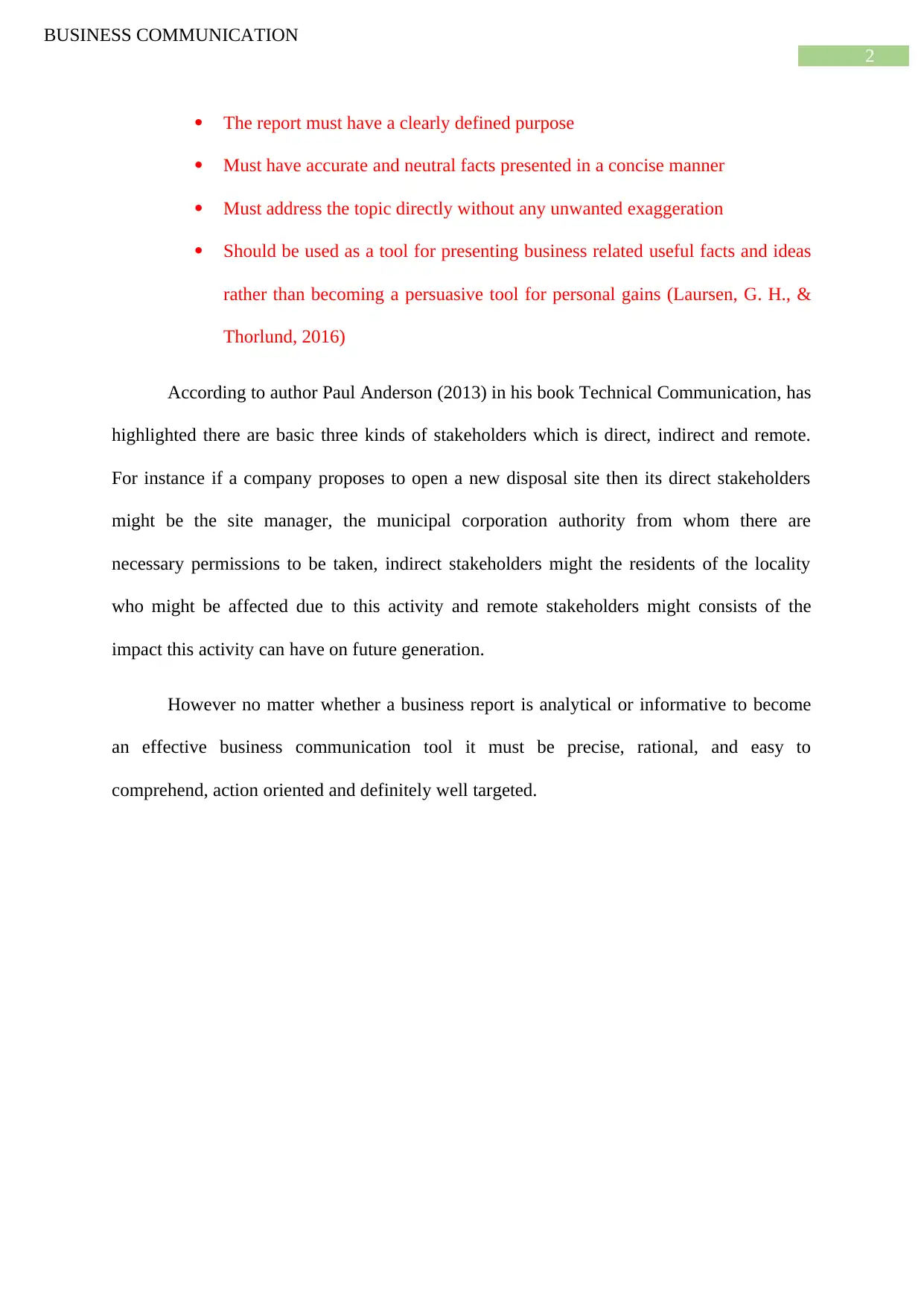
The report must have a clearly defined purpose
Must have accurate and neutral facts presented in a concise manner
Must address the topic directly without any unwanted exaggeration
Should be used as a tool for presenting business related useful facts and ideas
rather than becoming a persuasive tool for personal gains (Laursen, G. H., &
Thorlund, 2016)
According to author Paul Anderson (2013) in his book Technical Communication, has
highlighted there are basic three kinds of stakeholders which is direct, indirect and remote.
For instance if a company proposes to open a new disposal site then its direct stakeholders
might be the site manager, the municipal corporation authority from whom there are
necessary permissions to be taken, indirect stakeholders might the residents of the locality
who might be affected due to this activity and remote stakeholders might consists of the
impact this activity can have on future generation.
However no matter whether a business report is analytical or informative to become
an effective business communication tool it must be precise, rational, and easy to
comprehend, action oriented and definitely well targeted.
Document Page
3
BUSINESS COMMUNICATION
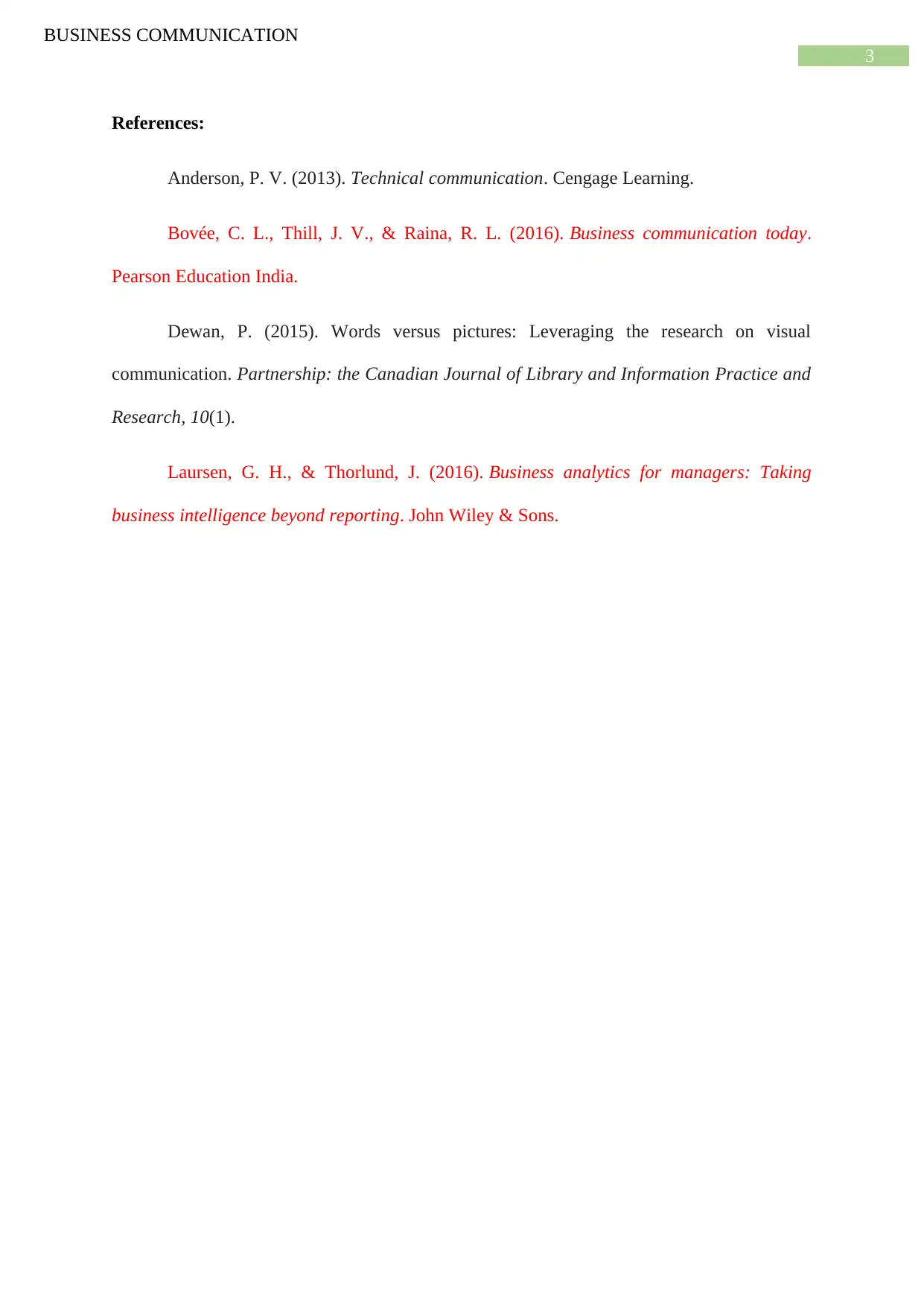
References:
Anderson, P. V. (2013). Technical communication. Cengage Learning.
Bovée, C. L., Thill, J. V., & Raina, R. L. (2016). Business communication today.
Pearson Education India.
Dewan, P. (2015). Words versus pictures: Leveraging the research on visual
communication. Partnership: the Canadian Journal of Library and Information Practice and
Research, 10(1).
Laursen, G. H., & Thorlund, J. (2016). Business analytics for managers: Taking
business intelligence beyond reporting. John Wiley & Sons.
chevron_up_icon
1 out of 4
circle_padding
hide_on_mobile
zoom_out_icon
[object Object]