MGT502 Business Communication: Digital Communication in the Workplace
VerifiedAdded on 2022/09/11
|7
|2434
|14
Report
AI Summary
This report analyzes the impact of digital communication in the workplace, drawing on multiple research studies. It explores strategies used to enhance communication, such as email, mobile texting, video conferencing, and the adoption of software like Slack. The report examines the benefits of digital communication, including increased employee motivation, improved coordination, and cost reduction. It also addresses potential issues like workforce diversity and the challenges organizations face in effectively transmitting information. The analysis considers various perspectives, from the impact on employee engagement to the financial benefits and overall organizational efficiency. The report highlights the importance of understanding the effects of digital technologies on business operations, including communication, transparency, and competitive advantage.
RUNNING HEAD: BUSINESS COMMUNICATION 0
“DIGITAL COMMUNICATION IN THE WORKPLACE”
“DIGITAL COMMUNICATION IN THE WORKPLACE”

Paraphrase This Document
Need a fresh take? Get an instant paraphrase of this document with our AI Paraphraser
BUSINESS COMMUNICATION 1
“Digital communication in the workplace”
Edirisinghe, R., & Lingard, H. (2016). Exploring the potential for the use of video to
communicate safety information to construction workers: case studies of
organizational use. Construction management and economics, 34(6), 366-376.
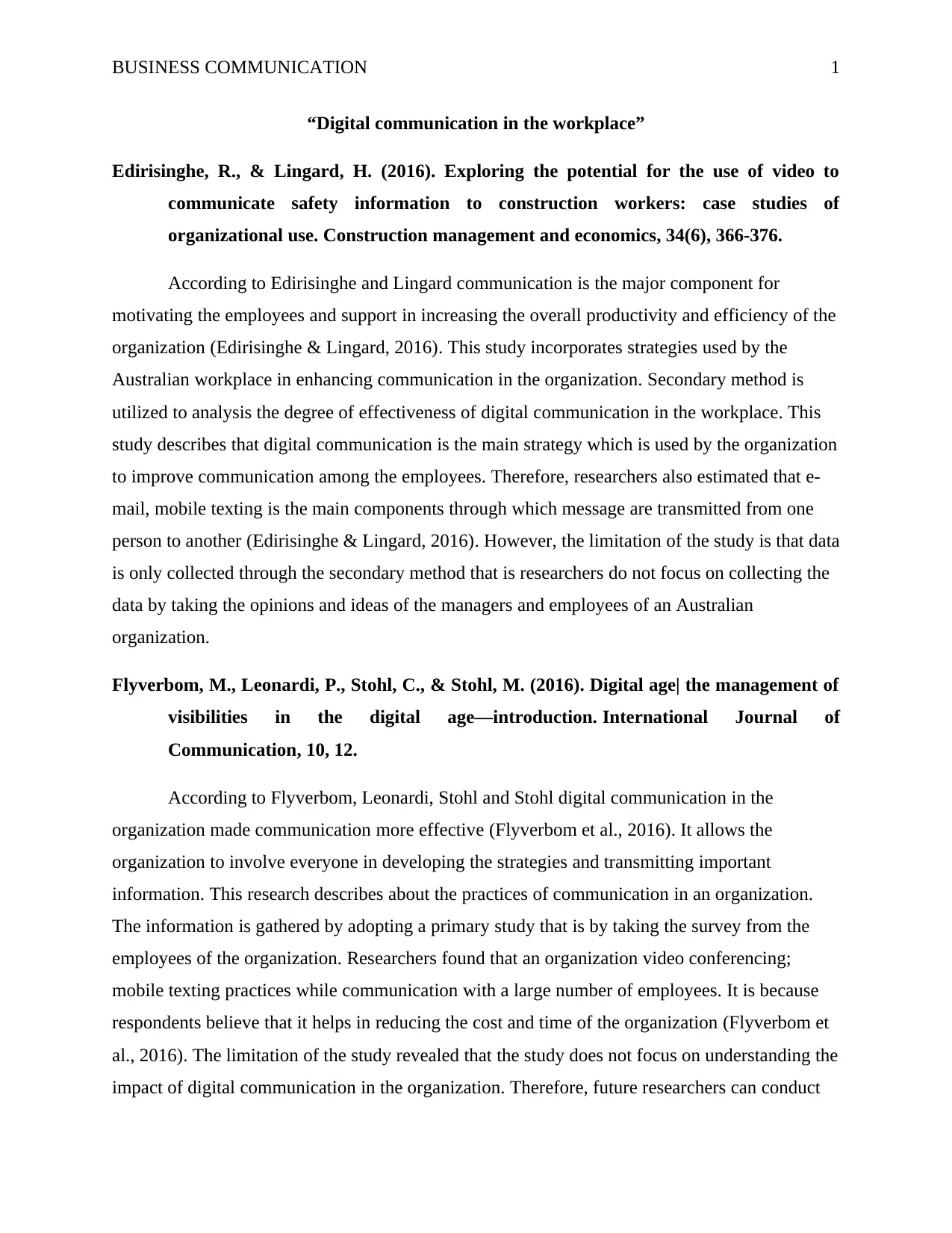
According to Edirisinghe and Lingard communication is the major component for
motivating the employees and support in increasing the overall productivity and efficiency of the
organization (Edirisinghe & Lingard, 2016). This study incorporates strategies used by the
Australian workplace in enhancing communication in the organization. Secondary method is
utilized to analysis the degree of effectiveness of digital communication in the workplace. This
study describes that digital communication is the main strategy which is used by the organization
to improve communication among the employees. Therefore, researchers also estimated that e-
mail, mobile texting is the main components through which message are transmitted from one
person to another (Edirisinghe & Lingard, 2016). However, the limitation of the study is that data
is only collected through the secondary method that is researchers do not focus on collecting the
data by taking the opinions and ideas of the managers and employees of an Australian
organization.
Flyverbom, M., Leonardi, P., Stohl, C., & Stohl, M. (2016). Digital age| the management of
visibilities in the digital age—introduction. International Journal of
Communication, 10, 12.
According to Flyverbom, Leonardi, Stohl and Stohl digital communication in the
organization made communication more effective (Flyverbom et al., 2016). It allows the
organization to involve everyone in developing the strategies and transmitting important
information. This research describes about the practices of communication in an organization.
The information is gathered by adopting a primary study that is by taking the survey from the
employees of the organization. Researchers found that an organization video conferencing;
mobile texting practices while communication with a large number of employees. It is because
respondents believe that it helps in reducing the cost and time of the organization (Flyverbom et
al., 2016). The limitation of the study revealed that the study does not focus on understanding the
impact of digital communication in the organization. Therefore, future researchers can conduct
“Digital communication in the workplace”
Edirisinghe, R., & Lingard, H. (2016). Exploring the potential for the use of video to
communicate safety information to construction workers: case studies of
organizational use. Construction management and economics, 34(6), 366-376.
According to Edirisinghe and Lingard communication is the major component for
motivating the employees and support in increasing the overall productivity and efficiency of the
organization (Edirisinghe & Lingard, 2016). This study incorporates strategies used by the
Australian workplace in enhancing communication in the organization. Secondary method is
utilized to analysis the degree of effectiveness of digital communication in the workplace. This
study describes that digital communication is the main strategy which is used by the organization
to improve communication among the employees. Therefore, researchers also estimated that e-
mail, mobile texting is the main components through which message are transmitted from one
person to another (Edirisinghe & Lingard, 2016). However, the limitation of the study is that data
is only collected through the secondary method that is researchers do not focus on collecting the
data by taking the opinions and ideas of the managers and employees of an Australian
organization.
Flyverbom, M., Leonardi, P., Stohl, C., & Stohl, M. (2016). Digital age| the management of
visibilities in the digital age—introduction. International Journal of
Communication, 10, 12.
According to Flyverbom, Leonardi, Stohl and Stohl digital communication in the
organization made communication more effective (Flyverbom et al., 2016). It allows the
organization to involve everyone in developing the strategies and transmitting important
information. This research describes about the practices of communication in an organization.
The information is gathered by adopting a primary study that is by taking the survey from the
employees of the organization. Researchers found that an organization video conferencing;
mobile texting practices while communication with a large number of employees. It is because
respondents believe that it helps in reducing the cost and time of the organization (Flyverbom et
al., 2016). The limitation of the study revealed that the study does not focus on understanding the
impact of digital communication in the organization. Therefore, future researchers can conduct
BUSINESS COMMUNICATION 2
the study in finding the influence of digital communication in the overall productivity of the
organization.
Davison, R. M., & Ou, C. X. (2017). Digital work in a digitally challenged
organization. Information & Management, 54(1), 129-137
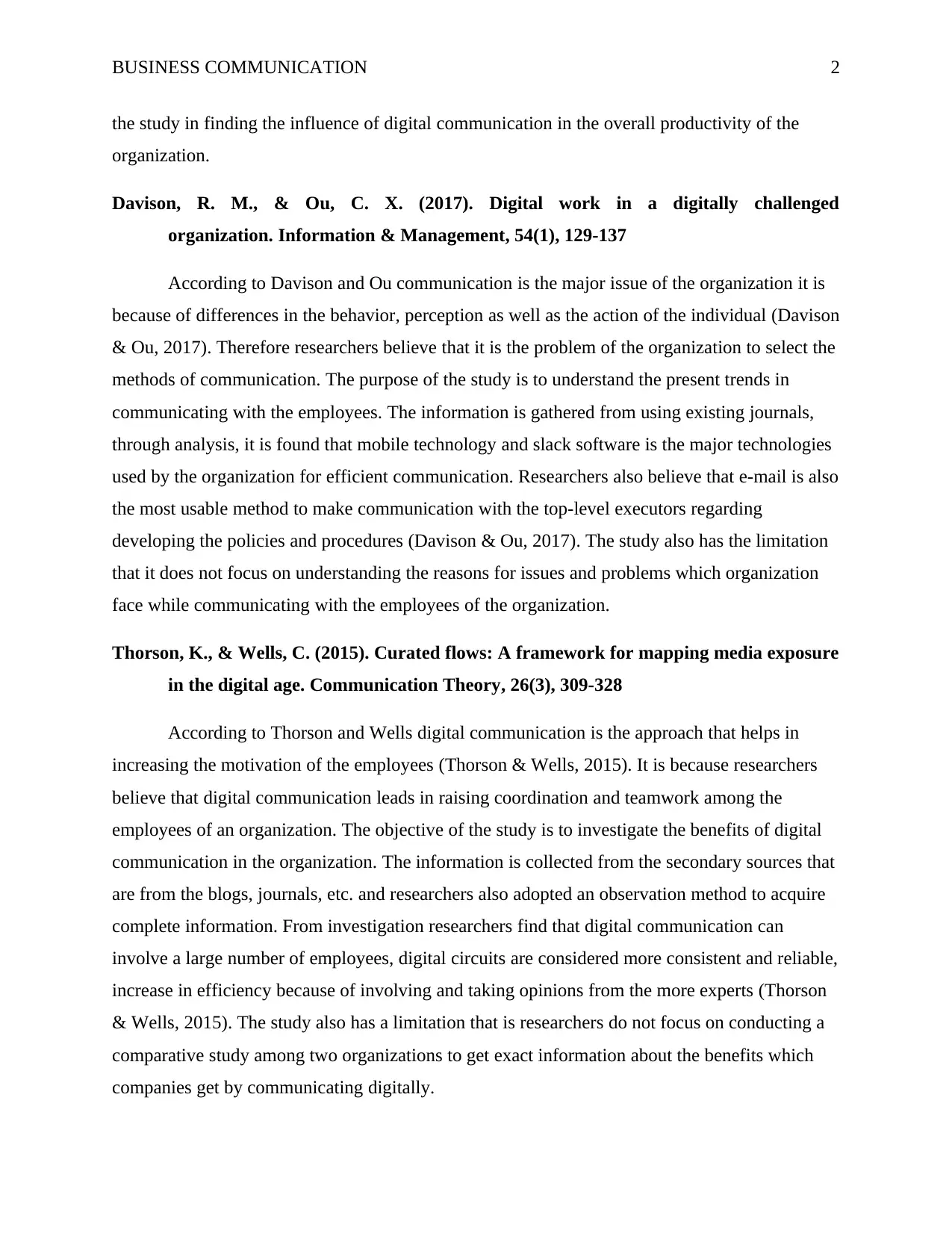
According to Davison and Ou communication is the major issue of the organization it is
because of differences in the behavior, perception as well as the action of the individual (Davison
& Ou, 2017). Therefore researchers believe that it is the problem of the organization to select the
methods of communication. The purpose of the study is to understand the present trends in
communicating with the employees. The information is gathered from using existing journals,
through analysis, it is found that mobile technology and slack software is the major technologies
used by the organization for efficient communication. Researchers also believe that e-mail is also
the most usable method to make communication with the top-level executors regarding
developing the policies and procedures (Davison & Ou, 2017). The study also has the limitation
that it does not focus on understanding the reasons for issues and problems which organization
face while communicating with the employees of the organization.
Thorson, K., & Wells, C. (2015). Curated flows: A framework for mapping media exposure
in the digital age. Communication Theory, 26(3), 309-328
According to Thorson and Wells digital communication is the approach that helps in
increasing the motivation of the employees (Thorson & Wells, 2015). It is because researchers
believe that digital communication leads in raising coordination and teamwork among the
employees of an organization. The objective of the study is to investigate the benefits of digital
communication in the organization. The information is collected from the secondary sources that
are from the blogs, journals, etc. and researchers also adopted an observation method to acquire
complete information. From investigation researchers find that digital communication can
involve a large number of employees, digital circuits are considered more consistent and reliable,
increase in efficiency because of involving and taking opinions from the more experts (Thorson
& Wells, 2015). The study also has a limitation that is researchers do not focus on conducting a
comparative study among two organizations to get exact information about the benefits which
companies get by communicating digitally.
the study in finding the influence of digital communication in the overall productivity of the
organization.
Davison, R. M., & Ou, C. X. (2017). Digital work in a digitally challenged
organization. Information & Management, 54(1), 129-137
According to Davison and Ou communication is the major issue of the organization it is
because of differences in the behavior, perception as well as the action of the individual (Davison
& Ou, 2017). Therefore researchers believe that it is the problem of the organization to select the
methods of communication. The purpose of the study is to understand the present trends in
communicating with the employees. The information is gathered from using existing journals,
through analysis, it is found that mobile technology and slack software is the major technologies
used by the organization for efficient communication. Researchers also believe that e-mail is also
the most usable method to make communication with the top-level executors regarding
developing the policies and procedures (Davison & Ou, 2017). The study also has the limitation
that it does not focus on understanding the reasons for issues and problems which organization
face while communicating with the employees of the organization.
Thorson, K., & Wells, C. (2015). Curated flows: A framework for mapping media exposure
in the digital age. Communication Theory, 26(3), 309-328
According to Thorson and Wells digital communication is the approach that helps in
increasing the motivation of the employees (Thorson & Wells, 2015). It is because researchers
believe that digital communication leads in raising coordination and teamwork among the
employees of an organization. The objective of the study is to investigate the benefits of digital
communication in the organization. The information is collected from the secondary sources that
are from the blogs, journals, etc. and researchers also adopted an observation method to acquire
complete information. From investigation researchers find that digital communication can
involve a large number of employees, digital circuits are considered more consistent and reliable,
increase in efficiency because of involving and taking opinions from the more experts (Thorson
& Wells, 2015). The study also has a limitation that is researchers do not focus on conducting a
comparative study among two organizations to get exact information about the benefits which
companies get by communicating digitally.
⊘ This is a preview!⊘
Do you want full access?
Subscribe today to unlock all pages.

Trusted by 1+ million students worldwide
BUSINESS COMMUNICATION 3
Beverungen, A., Beyes, T., & Conrad, L. (2019). The organizational powers of (digital)
media. Organization, 26(5), 621-635
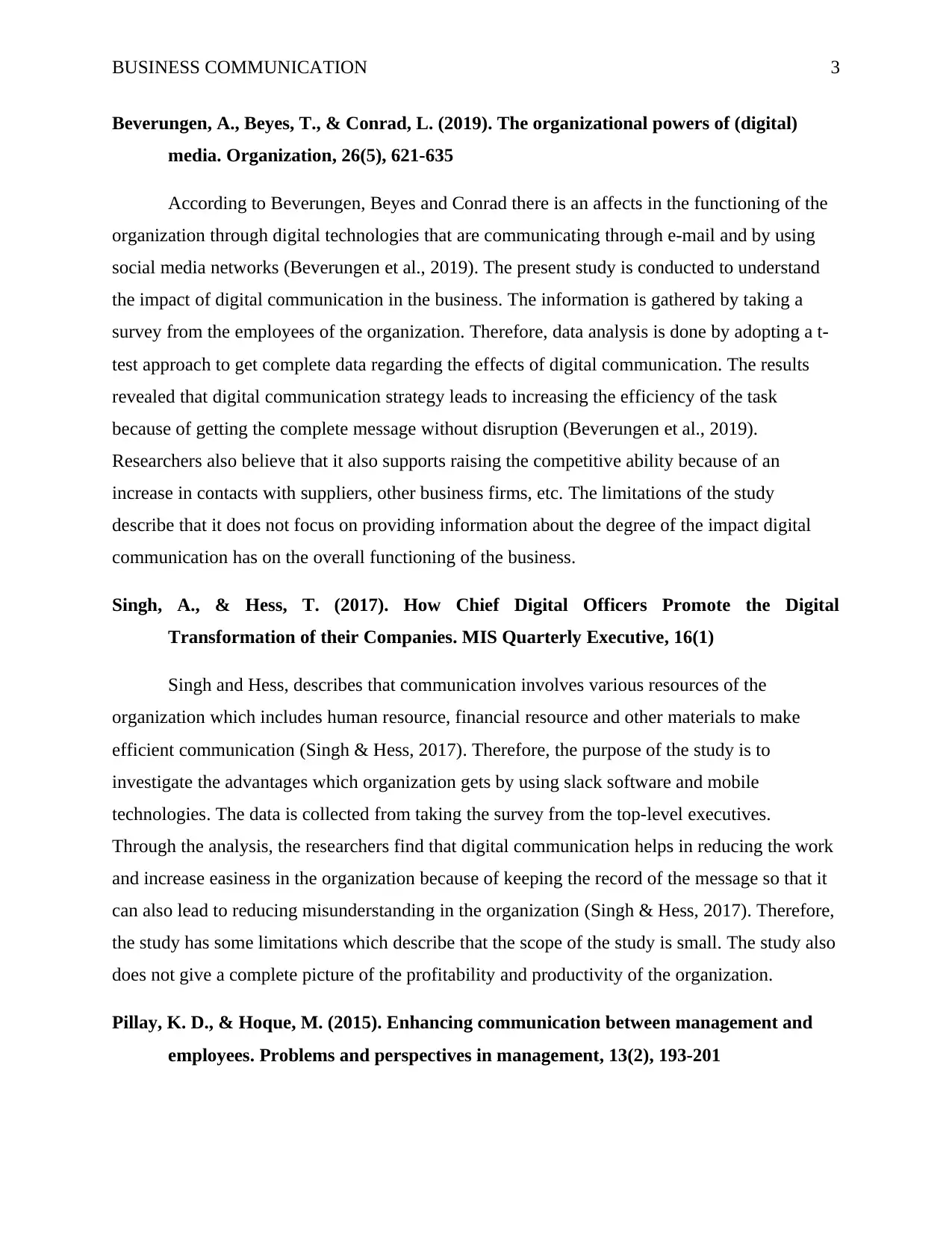
According to Beverungen, Beyes and Conrad there is an affects in the functioning of the
organization through digital technologies that are communicating through e-mail and by using
social media networks (Beverungen et al., 2019). The present study is conducted to understand
the impact of digital communication in the business. The information is gathered by taking a
survey from the employees of the organization. Therefore, data analysis is done by adopting a t-
test approach to get complete data regarding the effects of digital communication. The results
revealed that digital communication strategy leads to increasing the efficiency of the task
because of getting the complete message without disruption (Beverungen et al., 2019).
Researchers also believe that it also supports raising the competitive ability because of an
increase in contacts with suppliers, other business firms, etc. The limitations of the study
describe that it does not focus on providing information about the degree of the impact digital
communication has on the overall functioning of the business.
Singh, A., & Hess, T. (2017). How Chief Digital Officers Promote the Digital
Transformation of their Companies. MIS Quarterly Executive, 16(1)
Singh and Hess, describes that communication involves various resources of the
organization which includes human resource, financial resource and other materials to make
efficient communication (Singh & Hess, 2017). Therefore, the purpose of the study is to
investigate the advantages which organization gets by using slack software and mobile
technologies. The data is collected from taking the survey from the top-level executives.
Through the analysis, the researchers find that digital communication helps in reducing the work
and increase easiness in the organization because of keeping the record of the message so that it
can also lead to reducing misunderstanding in the organization (Singh & Hess, 2017). Therefore,
the study has some limitations which describe that the scope of the study is small. The study also
does not give a complete picture of the profitability and productivity of the organization.
Pillay, K. D., & Hoque, M. (2015). Enhancing communication between management and
employees. Problems and perspectives in management, 13(2), 193-201
Beverungen, A., Beyes, T., & Conrad, L. (2019). The organizational powers of (digital)
media. Organization, 26(5), 621-635
According to Beverungen, Beyes and Conrad there is an affects in the functioning of the
organization through digital technologies that are communicating through e-mail and by using
social media networks (Beverungen et al., 2019). The present study is conducted to understand
the impact of digital communication in the business. The information is gathered by taking a
survey from the employees of the organization. Therefore, data analysis is done by adopting a t-
test approach to get complete data regarding the effects of digital communication. The results
revealed that digital communication strategy leads to increasing the efficiency of the task
because of getting the complete message without disruption (Beverungen et al., 2019).
Researchers also believe that it also supports raising the competitive ability because of an
increase in contacts with suppliers, other business firms, etc. The limitations of the study
describe that it does not focus on providing information about the degree of the impact digital
communication has on the overall functioning of the business.
Singh, A., & Hess, T. (2017). How Chief Digital Officers Promote the Digital
Transformation of their Companies. MIS Quarterly Executive, 16(1)
Singh and Hess, describes that communication involves various resources of the
organization which includes human resource, financial resource and other materials to make
efficient communication (Singh & Hess, 2017). Therefore, the purpose of the study is to
investigate the advantages which organization gets by using slack software and mobile
technologies. The data is collected from taking the survey from the top-level executives.
Through the analysis, the researchers find that digital communication helps in reducing the work
and increase easiness in the organization because of keeping the record of the message so that it
can also lead to reducing misunderstanding in the organization (Singh & Hess, 2017). Therefore,
the study has some limitations which describe that the scope of the study is small. The study also
does not give a complete picture of the profitability and productivity of the organization.
Pillay, K. D., & Hoque, M. (2015). Enhancing communication between management and
employees. Problems and perspectives in management, 13(2), 193-201
Paraphrase This Document
Need a fresh take? Get an instant paraphrase of this document with our AI Paraphraser
BUSINESS COMMUNICATION 4
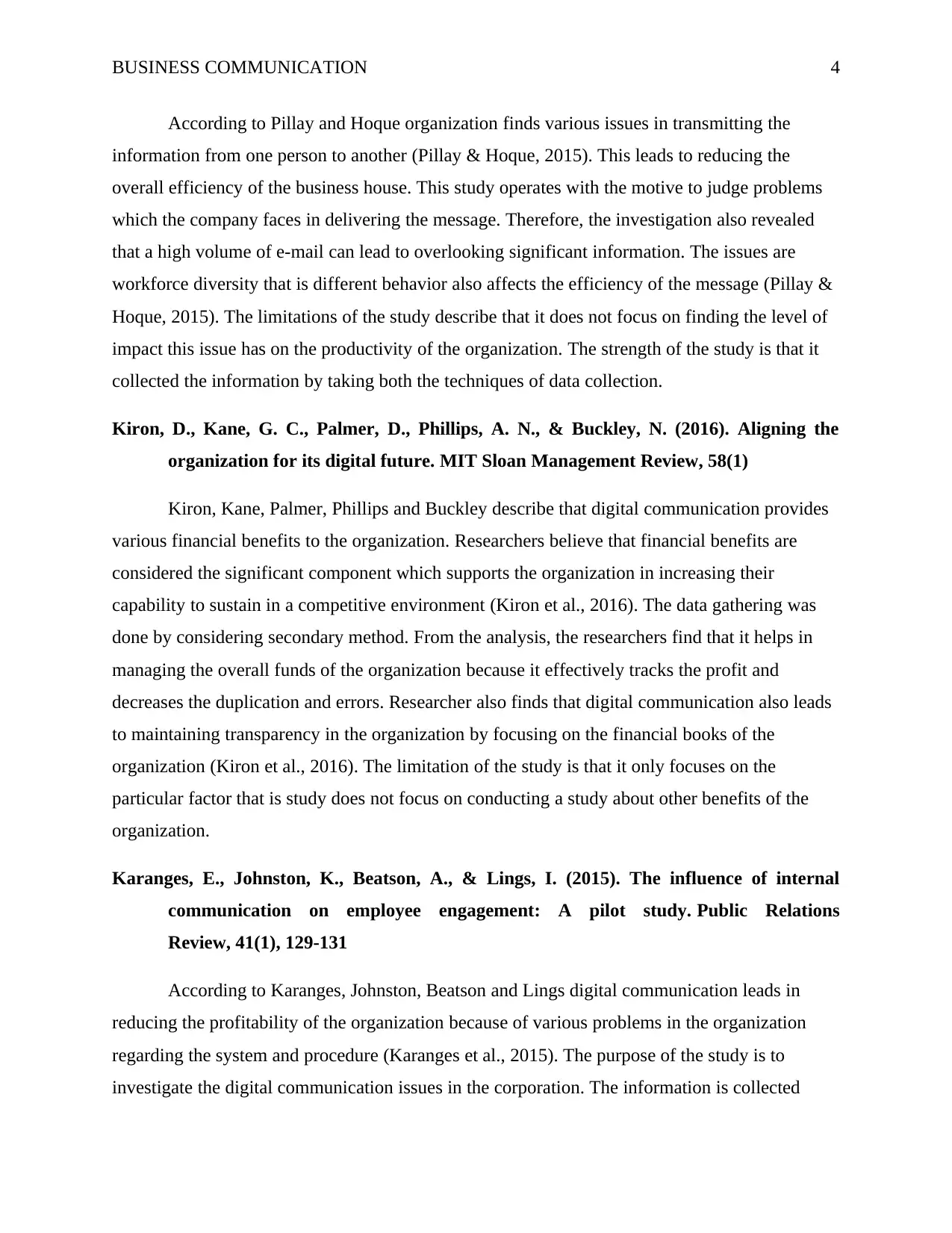
According to Pillay and Hoque organization finds various issues in transmitting the
information from one person to another (Pillay & Hoque, 2015). This leads to reducing the
overall efficiency of the business house. This study operates with the motive to judge problems
which the company faces in delivering the message. Therefore, the investigation also revealed
that a high volume of e-mail can lead to overlooking significant information. The issues are
workforce diversity that is different behavior also affects the efficiency of the message (Pillay &
Hoque, 2015). The limitations of the study describe that it does not focus on finding the level of
impact this issue has on the productivity of the organization. The strength of the study is that it
collected the information by taking both the techniques of data collection.
Kiron, D., Kane, G. C., Palmer, D., Phillips, A. N., & Buckley, N. (2016). Aligning the
organization for its digital future. MIT Sloan Management Review, 58(1)
Kiron, Kane, Palmer, Phillips and Buckley describe that digital communication provides
various financial benefits to the organization. Researchers believe that financial benefits are
considered the significant component which supports the organization in increasing their
capability to sustain in a competitive environment (Kiron et al., 2016). The data gathering was
done by considering secondary method. From the analysis, the researchers find that it helps in
managing the overall funds of the organization because it effectively tracks the profit and
decreases the duplication and errors. Researcher also finds that digital communication also leads
to maintaining transparency in the organization by focusing on the financial books of the
organization (Kiron et al., 2016). The limitation of the study is that it only focuses on the
particular factor that is study does not focus on conducting a study about other benefits of the
organization.
Karanges, E., Johnston, K., Beatson, A., & Lings, I. (2015). The influence of internal
communication on employee engagement: A pilot study. Public Relations
Review, 41(1), 129-131
According to Karanges, Johnston, Beatson and Lings digital communication leads in
reducing the profitability of the organization because of various problems in the organization
regarding the system and procedure (Karanges et al., 2015). The purpose of the study is to
investigate the digital communication issues in the corporation. The information is collected
According to Pillay and Hoque organization finds various issues in transmitting the
information from one person to another (Pillay & Hoque, 2015). This leads to reducing the
overall efficiency of the business house. This study operates with the motive to judge problems
which the company faces in delivering the message. Therefore, the investigation also revealed
that a high volume of e-mail can lead to overlooking significant information. The issues are
workforce diversity that is different behavior also affects the efficiency of the message (Pillay &
Hoque, 2015). The limitations of the study describe that it does not focus on finding the level of
impact this issue has on the productivity of the organization. The strength of the study is that it
collected the information by taking both the techniques of data collection.
Kiron, D., Kane, G. C., Palmer, D., Phillips, A. N., & Buckley, N. (2016). Aligning the
organization for its digital future. MIT Sloan Management Review, 58(1)
Kiron, Kane, Palmer, Phillips and Buckley describe that digital communication provides
various financial benefits to the organization. Researchers believe that financial benefits are
considered the significant component which supports the organization in increasing their
capability to sustain in a competitive environment (Kiron et al., 2016). The data gathering was
done by considering secondary method. From the analysis, the researchers find that it helps in
managing the overall funds of the organization because it effectively tracks the profit and
decreases the duplication and errors. Researcher also finds that digital communication also leads
to maintaining transparency in the organization by focusing on the financial books of the
organization (Kiron et al., 2016). The limitation of the study is that it only focuses on the
particular factor that is study does not focus on conducting a study about other benefits of the
organization.
Karanges, E., Johnston, K., Beatson, A., & Lings, I. (2015). The influence of internal
communication on employee engagement: A pilot study. Public Relations
Review, 41(1), 129-131
According to Karanges, Johnston, Beatson and Lings digital communication leads in
reducing the profitability of the organization because of various problems in the organization
regarding the system and procedure (Karanges et al., 2015). The purpose of the study is to
investigate the digital communication issues in the corporation. The information is collected
BUSINESS COMMUNICATION 5
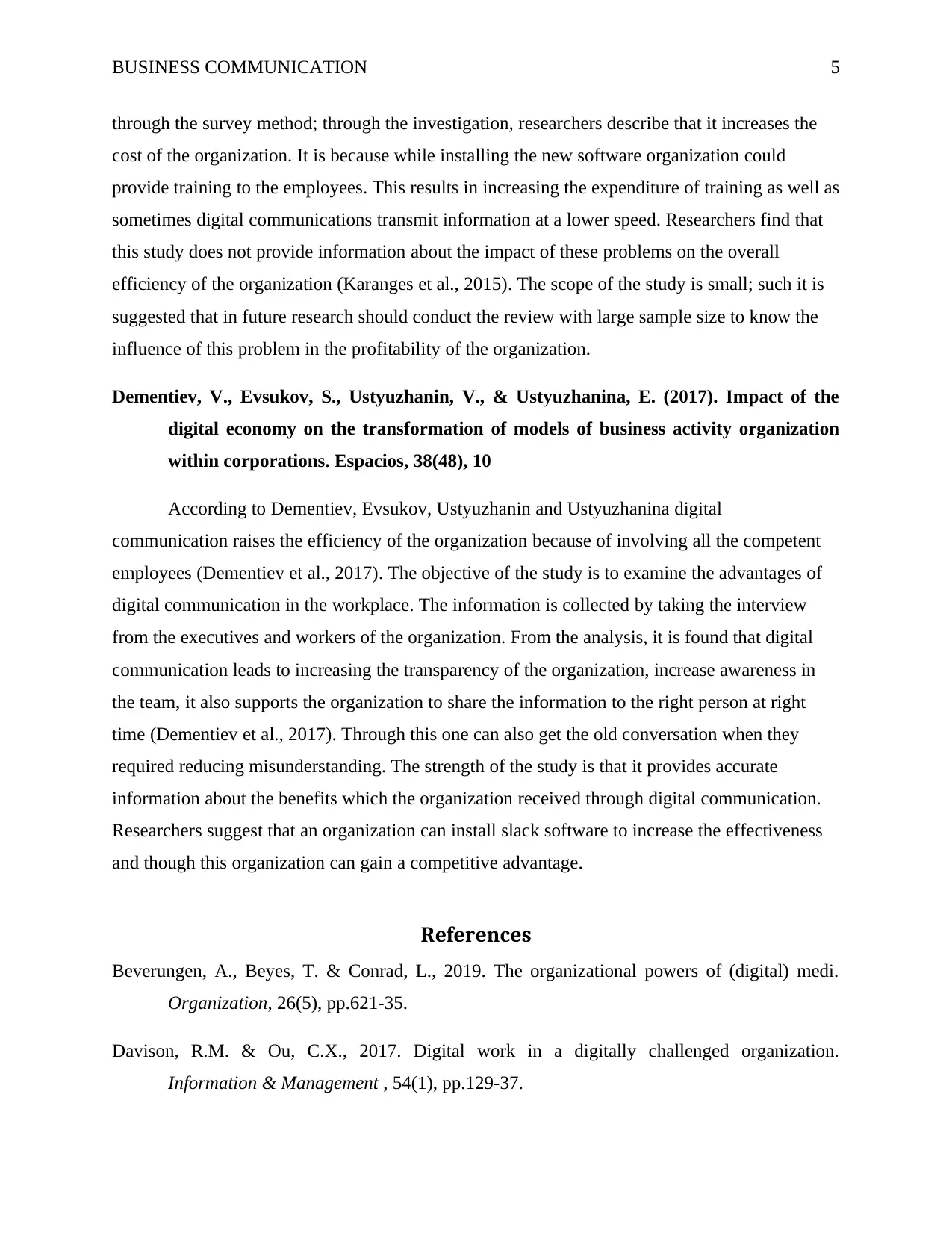
through the survey method; through the investigation, researchers describe that it increases the
cost of the organization. It is because while installing the new software organization could
provide training to the employees. This results in increasing the expenditure of training as well as
sometimes digital communications transmit information at a lower speed. Researchers find that
this study does not provide information about the impact of these problems on the overall
efficiency of the organization (Karanges et al., 2015). The scope of the study is small; such it is
suggested that in future research should conduct the review with large sample size to know the
influence of this problem in the profitability of the organization.
Dementiev, V., Evsukov, S., Ustyuzhanin, V., & Ustyuzhanina, E. (2017). Impact of the
digital economy on the transformation of models of business activity organization
within corporations. Espacios, 38(48), 10
According to Dementiev, Evsukov, Ustyuzhanin and Ustyuzhanina digital
communication raises the efficiency of the organization because of involving all the competent
employees (Dementiev et al., 2017). The objective of the study is to examine the advantages of
digital communication in the workplace. The information is collected by taking the interview
from the executives and workers of the organization. From the analysis, it is found that digital
communication leads to increasing the transparency of the organization, increase awareness in
the team, it also supports the organization to share the information to the right person at right
time (Dementiev et al., 2017). Through this one can also get the old conversation when they
required reducing misunderstanding. The strength of the study is that it provides accurate
information about the benefits which the organization received through digital communication.
Researchers suggest that an organization can install slack software to increase the effectiveness
and though this organization can gain a competitive advantage.
References
Beverungen, A., Beyes, T. & Conrad, L., 2019. The organizational powers of (digital) medi.
Organization, 26(5), pp.621-35.
Davison, R.M. & Ou, C.X., 2017. Digital work in a digitally challenged organization.
Information & Management , 54(1), pp.129-37.
through the survey method; through the investigation, researchers describe that it increases the
cost of the organization. It is because while installing the new software organization could
provide training to the employees. This results in increasing the expenditure of training as well as
sometimes digital communications transmit information at a lower speed. Researchers find that
this study does not provide information about the impact of these problems on the overall
efficiency of the organization (Karanges et al., 2015). The scope of the study is small; such it is
suggested that in future research should conduct the review with large sample size to know the
influence of this problem in the profitability of the organization.
Dementiev, V., Evsukov, S., Ustyuzhanin, V., & Ustyuzhanina, E. (2017). Impact of the
digital economy on the transformation of models of business activity organization
within corporations. Espacios, 38(48), 10
According to Dementiev, Evsukov, Ustyuzhanin and Ustyuzhanina digital
communication raises the efficiency of the organization because of involving all the competent
employees (Dementiev et al., 2017). The objective of the study is to examine the advantages of
digital communication in the workplace. The information is collected by taking the interview
from the executives and workers of the organization. From the analysis, it is found that digital
communication leads to increasing the transparency of the organization, increase awareness in
the team, it also supports the organization to share the information to the right person at right
time (Dementiev et al., 2017). Through this one can also get the old conversation when they
required reducing misunderstanding. The strength of the study is that it provides accurate
information about the benefits which the organization received through digital communication.
Researchers suggest that an organization can install slack software to increase the effectiveness
and though this organization can gain a competitive advantage.
References
Beverungen, A., Beyes, T. & Conrad, L., 2019. The organizational powers of (digital) medi.
Organization, 26(5), pp.621-35.
Davison, R.M. & Ou, C.X., 2017. Digital work in a digitally challenged organization.
Information & Management , 54(1), pp.129-37.
⊘ This is a preview!⊘
Do you want full access?
Subscribe today to unlock all pages.
Trusted by 1+ million students worldwide
BUSINESS COMMUNICATION 6
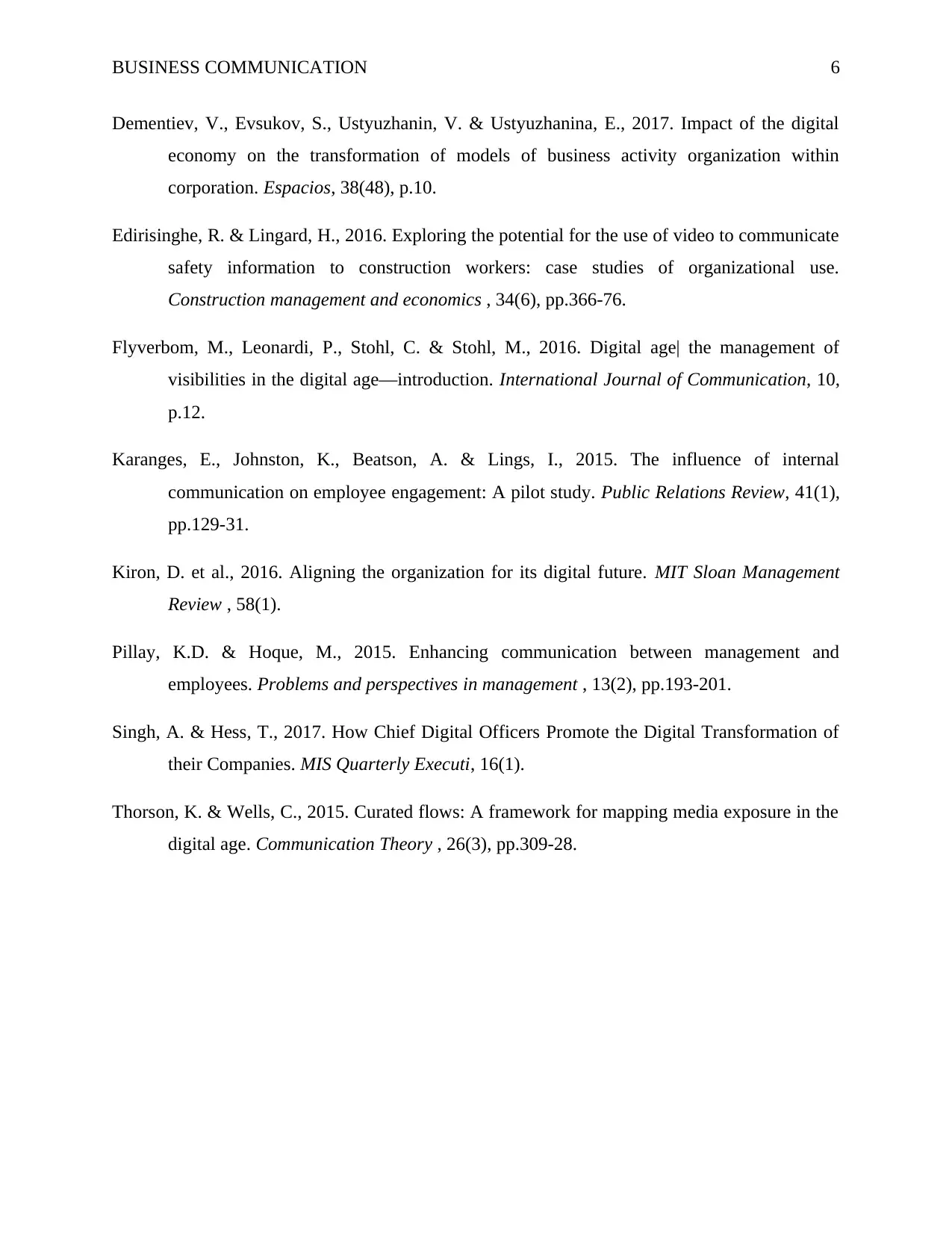
Dementiev, V., Evsukov, S., Ustyuzhanin, V. & Ustyuzhanina, E., 2017. Impact of the digital
economy on the transformation of models of business activity organization within
corporation. Espacios, 38(48), p.10.
Edirisinghe, R. & Lingard, H., 2016. Exploring the potential for the use of video to communicate
safety information to construction workers: case studies of organizational use.
Construction management and economics , 34(6), pp.366-76.
Flyverbom, M., Leonardi, P., Stohl, C. & Stohl, M., 2016. Digital age| the management of
visibilities in the digital age—introduction. International Journal of Communication, 10,
p.12.
Karanges, E., Johnston, K., Beatson, A. & Lings, I., 2015. The influence of internal
communication on employee engagement: A pilot study. Public Relations Review, 41(1),
pp.129-31.
Kiron, D. et al., 2016. Aligning the organization for its digital future. MIT Sloan Management
Review , 58(1).
Pillay, K.D. & Hoque, M., 2015. Enhancing communication between management and
employees. Problems and perspectives in management , 13(2), pp.193-201.
Singh, A. & Hess, T., 2017. How Chief Digital Officers Promote the Digital Transformation of
their Companies. MIS Quarterly Executi, 16(1).
Thorson, K. & Wells, C., 2015. Curated flows: A framework for mapping media exposure in the
digital age. Communication Theory , 26(3), pp.309-28.
Dementiev, V., Evsukov, S., Ustyuzhanin, V. & Ustyuzhanina, E., 2017. Impact of the digital
economy on the transformation of models of business activity organization within
corporation. Espacios, 38(48), p.10.
Edirisinghe, R. & Lingard, H., 2016. Exploring the potential for the use of video to communicate
safety information to construction workers: case studies of organizational use.
Construction management and economics , 34(6), pp.366-76.
Flyverbom, M., Leonardi, P., Stohl, C. & Stohl, M., 2016. Digital age| the management of
visibilities in the digital age—introduction. International Journal of Communication, 10,
p.12.
Karanges, E., Johnston, K., Beatson, A. & Lings, I., 2015. The influence of internal
communication on employee engagement: A pilot study. Public Relations Review, 41(1),
pp.129-31.
Kiron, D. et al., 2016. Aligning the organization for its digital future. MIT Sloan Management
Review , 58(1).
Pillay, K.D. & Hoque, M., 2015. Enhancing communication between management and
employees. Problems and perspectives in management , 13(2), pp.193-201.
Singh, A. & Hess, T., 2017. How Chief Digital Officers Promote the Digital Transformation of
their Companies. MIS Quarterly Executi, 16(1).
Thorson, K. & Wells, C., 2015. Curated flows: A framework for mapping media exposure in the
digital age. Communication Theory , 26(3), pp.309-28.

1 out of 7


Related Documents


Your All-in-One AI-Powered Toolkit for Academic Success.
+13062052269
info@desklib.com
Available 24*7 on WhatsApp / Email
![[object Object]](/_next/static/media/star-bottom.7253800d.svg)
Unlock your academic potential
Copyright © 2020–2026 A2Z Services. All Rights Reserved. Developed and managed by ZUCOL.