MGT502 Business Communication: Upward Communication Discussion Forum

Verified

Added on  2022/11/14

|6
|1307
|85
Discussion Board Post
AI Summary
This assignment presents a comprehensive analysis of upward communication within a business context, addressing a discussion forum with three distinct posts. The first post defines upward communication, its characteristics, advantages (such as facilitating employee feedback and better decision-making), and disadvantages (potential for distorted information due to superior-subordinate relationships), supported by relevant academic references. The second post offers a critical evaluation of a peer's contribution to the discussion, identifying strengths (adequate examples) and weaknesses (lack of detail, grammatical errors, and missing characteristics). The third post synthesizes key learnings from the discussion, emphasizing the importance of upward communication for incorporating employee suggestions, providing feedback, and making informed decisions. It also highlights the influence of organizational structure on communication styles and provides examples of how organizations can implement upward communication, such as through suggestion boxes. The analysis is supported by citations from various academic sources.

Document Page
Business communication
tabler-icon-diamond-filled.svg

Paraphrase This Document

Need a fresh take? Get an instant paraphrase of this document with our AI Paraphraser
Document Page
Post-1
Upward communication-
Upward communication refers to the flow of communication from lower level employees to
upper level management. In the upward communication employees are allowed to express
their feelings, requirement or any kind of problems regarding job or the workplace (Chang,
Park, & Cho, 2018). Upward communication is a form of communication in the modern
business. In this form of communication adopted by the organisations considered as good
source of business decision making, as it allows the thoughts, ideas and suggestions to flow
freely from lower level to the upper levels in the organisation (Bisel, & Adame, 2019). Some
of the characteristics of the upward communication are mentioned below-
It is a summarised form of communication adopted by the organisations.
Receiving feedback is also a part of this type of communication, only if there is effective
flow of downward communication.
As a negative aspect of Upward Communication, the flow of communication gets distorted
sometimes because of the superior subordinate relationship as either subordinates are not
willing to accept the orders or the superiors are very dominating in nature.
It provides better understanding of the viewpoints, ideas, advices, and requirements of the
employees.
Sometimes the upward communication leads to some negative effect in the organisation
because of the superior subordinate relationship between the employee and the employer. The
employee sometimes tends to hide information worrying about the effects it will leave on his
work and the sometimes lies to the employers about any of the issue to gain the concern or in
order to impress the superior and safeguard to any further issue occurring in the issue
(Suzuki, & Pheng, 2019). As the favourable advantage it provides free flow of
Document Page
communication, which allows flow of ideas, advices or suggestions from the lower level
employees to upper level management which often helps in the better decision making in the
organisation.
Few examples of this type of communication adopted by the organisations in order to
implement the upward communication is the use of the suggestion boxes, system that allows
to flow the ideas of the employees, and feedback is a part of the upward communication
(Nwabueze, & Mileski, 2018).
Post-2
The post provided by the peer is not much comprehensive and detailed as required, but
mentioned in brief and there were more requirements of the details on the type of
communication style undertaken. The post could have been more formal and elaborate with
proper references and details as per the requirements of the discussion forum. The examples
provided were adequate and according to the requirements but a little more discussion of the
core details was omitted (Ting, & Dorjee, 2018). The missing details were regarding the key
points learned from the discussion and the proper definition of the communication style. The
supporting statements were not proper with regard to the requirements of the examples. The
examples were mentioned according to the communication style chosen but the supporting
statements were not properly described and the main details regarding the style chosen by the
peer. The post also contained some grammatical errors. The discussion post mentioned the
importance of the communication style but proper characteristics not mentioned in the post.
Some of the examples regarding the advantages and the disadvantages of the form of
communication were missing and examples not described properly. The language used was
not formal and also the some of the informal words were used in the post. The description of
the ways in which the organisations could implement the communication style was also
missing and the as mentioned above the details of the communication was the major missing
Document Page
part of the post. As a result only the examples mentioned were adequate but the supporting
statements were not as descriptive as per the requirements of the post. Additional detailing
could have made it more analytical in terms of the implementation of the same in the
organisations. The analytical part of the post was missing which could have been covered
with a little more detailing of the post of the discussion forum also avoidance of the informal
words would contribute better with the detailing.
Post -3
The discussion allows access to more knowledge in regard with the upward communication
and also provides a better understanding about how the form is applied in the organisations
and its advantages and disadvantages. The flow of information passes from lower level to the
upper level to gain the benefits of better decision making by the application of the suggestion
and ideas provided by the subordinates in the organisation. There are other various types of
communication styles adopted by the organisations, depending upon their type of
organisation structure and their requirements (Smith, & Patmos, 2018). Generally, in large
companies or organisations upward flow is undertaken. The key points learned from the
discussion are mentioned below-
Accepting suggestions from subordinates in order to take better decisions for the
organisations.
Providing feedback in return as a part of the effective downward communication, and
implementing the flow of communication in the organisation effectively.
The communication does have certain disadvantages with regard to the type of attitude
undertaken by either the employee or the employer.
tabler-icon-diamond-filled.svg

Paraphrase This Document

Need a fresh take? Get an instant paraphrase of this document with our AI Paraphraser
Document Page
For example- this can be applied by the organisation in the form of putting up suggestion
boxes and receiving suggestions through it and considering the same as a part of decision
making process in the organisation (Quintanilla, &Wahl, 2018). The discussion proves to be
beneficial considering the ideas generated through it. The knowledge can be implemented
depending upon the type of organisation one is working.
Document Page
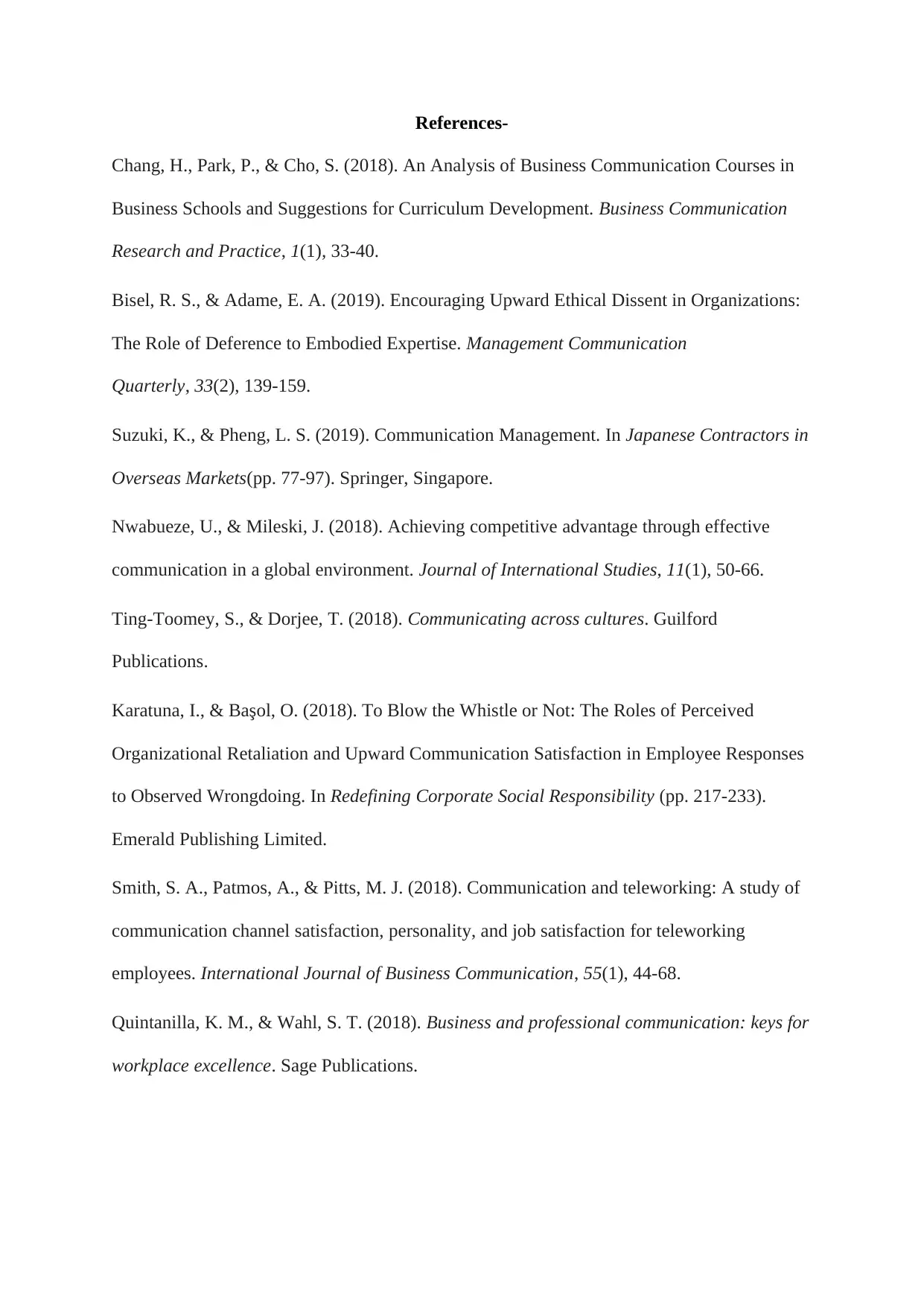
References-
Chang, H., Park, P., & Cho, S. (2018). An Analysis of Business Communication Courses in
Business Schools and Suggestions for Curriculum Development. Business Communication
Research and Practice, 1(1), 33-40.
Bisel, R. S., & Adame, E. A. (2019). Encouraging Upward Ethical Dissent in Organizations:
The Role of Deference to Embodied Expertise. Management Communication
Quarterly, 33(2), 139-159.
Suzuki, K., & Pheng, L. S. (2019). Communication Management. In Japanese Contractors in
Overseas Markets(pp. 77-97). Springer, Singapore.
Nwabueze, U., & Mileski, J. (2018). Achieving competitive advantage through effective
communication in a global environment. Journal of International Studies, 11(1), 50-66.
Ting-Toomey, S., & Dorjee, T. (2018). Communicating across cultures. Guilford
Publications.
Karatuna, I., & Başol, O. (2018). To Blow the Whistle or Not: The Roles of Perceived
Organizational Retaliation and Upward Communication Satisfaction in Employee Responses
to Observed Wrongdoing. In Redefining Corporate Social Responsibility (pp. 217-233).
Emerald Publishing Limited.
Smith, S. A., Patmos, A., & Pitts, M. J. (2018). Communication and teleworking: A study of
communication channel satisfaction, personality, and job satisfaction for teleworking
employees. International Journal of Business Communication, 55(1), 44-68.
Quintanilla, K. M., & Wahl, S. T. (2018). Business and professional communication: keys for
workplace excellence. Sage Publications.
chevron_up_icon
1 out of 6
circle_padding
hide_on_mobile
zoom_out_icon
[object Object]