Business Continuity and Disaster Recovery Management
VerifiedAdded on 2020/03/16
|14
|2801
|47
Report
AI Summary
This report discusses the critical aspects of Business Continuity and Disaster Recovery Management (BCP and DRP). It outlines the definitions, processes, and importance of BCP in mitigating risks and ensuring organizational resilience. The report covers risk assessments, control evaluations, and the significance of a well-structured disaster recovery plan. It emphasizes the need for continuous monitoring and testing of BCP to adapt to changing environments and maintain operational integrity during disruptions.
Running Head: BUSINESS CONTINUITY AND DISASTER RECOVERY MANAGEMENT
1
Business Continuity and Disaster Recovery Management
Student’s Name
Institution Affiliation
1
Business Continuity and Disaster Recovery Management
Student’s Name
Institution Affiliation

Paraphrase This Document
Need a fresh take? Get an instant paraphrase of this document with our AI Paraphraser
BUSINESS CONTINUITY AND DISASTER RECOVERY MANAGEMENT 2
Business Continuity and Disaster Recovery Management
There is a wide range of ways to describe BCP and DRP. A few organizations address
these procedures independently, while others concentrate on a constant process that intertwines
the plans. First of all, the most appropriate terms to define are a disaster and business continuity.
In the business domain, an accident can be viewed as an occasion that keeps the continuation of
necessary business capacities for a predetermined timeframe. In other words, the assessed
blackout may constrain disaster declaration. Continuity of Business is one of the ways towards
managing the operation of necessary frameworks. Business continuity’s objective is to diminish
and counteract time of blackout and optimise performance. In this case, B. C. Management is a
holistic management process that is used to identify potential impacts that are deemed as a threat
to an organization. It also gives a framework for resilience building, ensures a response that is
adequate, and safeguards its key stakeholders’ interests, reputation, brand, and value (Gregg,
2013.). This paper will expound on security issues, controls, disaster recovery and business
continuity planning.
Risk and Control Assessments
Operational risk and control evaluations are frequently the principal procedure that a firm
uses to lead executive hazard administration. The assessment is usually completed without a
functional risk management system set up and without much idea being given to high corporate
authority around the numerous interlocking procedures of executive risk management.
There are several ways of viewing risk and control assessment. The first one is a third
party review. The review utilizes a central comprehension of primary goals and procedures
together with an independent approval of evaluations. The other way is using facilitated
Business Continuity and Disaster Recovery Management
There is a wide range of ways to describe BCP and DRP. A few organizations address
these procedures independently, while others concentrate on a constant process that intertwines
the plans. First of all, the most appropriate terms to define are a disaster and business continuity.
In the business domain, an accident can be viewed as an occasion that keeps the continuation of
necessary business capacities for a predetermined timeframe. In other words, the assessed
blackout may constrain disaster declaration. Continuity of Business is one of the ways towards
managing the operation of necessary frameworks. Business continuity’s objective is to diminish
and counteract time of blackout and optimise performance. In this case, B. C. Management is a
holistic management process that is used to identify potential impacts that are deemed as a threat
to an organization. It also gives a framework for resilience building, ensures a response that is
adequate, and safeguards its key stakeholders’ interests, reputation, brand, and value (Gregg,
2013.). This paper will expound on security issues, controls, disaster recovery and business
continuity planning.
Risk and Control Assessments
Operational risk and control evaluations are frequently the principal procedure that a firm
uses to lead executive hazard administration. The assessment is usually completed without a
functional risk management system set up and without much idea being given to high corporate
authority around the numerous interlocking procedures of executive risk management.
There are several ways of viewing risk and control assessment. The first one is a third
party review. The review utilizes a central comprehension of primary goals and procedures
together with an independent approval of evaluations. The other way is using facilitated
BUSINESS CONTINUITY AND DISASTER RECOVERY MANAGEMENT 3
assessments that are done by consultants for outside the company, risk management, and
business managers. It utilizes the central comprehension to distinguish and agree on the business
dangers with the business. The viability of internal controls is additionally archived, and action
plans concur where necessary. Self-assessment is also another way, that is conducted by the
business managers. It utilizes the detailed knowledge of individuals in the business to distinguish
the business changes and to agree on their observing. Likewise, with facilitated sessions, control
viability is additionally surveyed and action plans set up to improve insufficient controls
(Blunden & Thirlwell, 2013). It is essential for everybody in the group to understand that BCP is
one of the most critical remedial authority the administration is supposed to have and to utilize
the arranging time frame into a chance in shaping it (Olson, 2014). The Business Continuity Plan
is something aside from restorative powers. It is additionally about preventive and analyst
controls
A survey can likewise be finished in a roundtable setting. Indeed, this gathering
culmination may bestow collaboration to the procedure, giving the group’s elements take into
consideration communication opening and the needed essential people would be able to arrange
and meet to examine what effect particular sorts of interruptions would have on the association.
The significance of the consideration of each must be accentuated because the administration
won't know about first critical undertakings for which they don't have direct oversight.
Risk Analysis Matrix
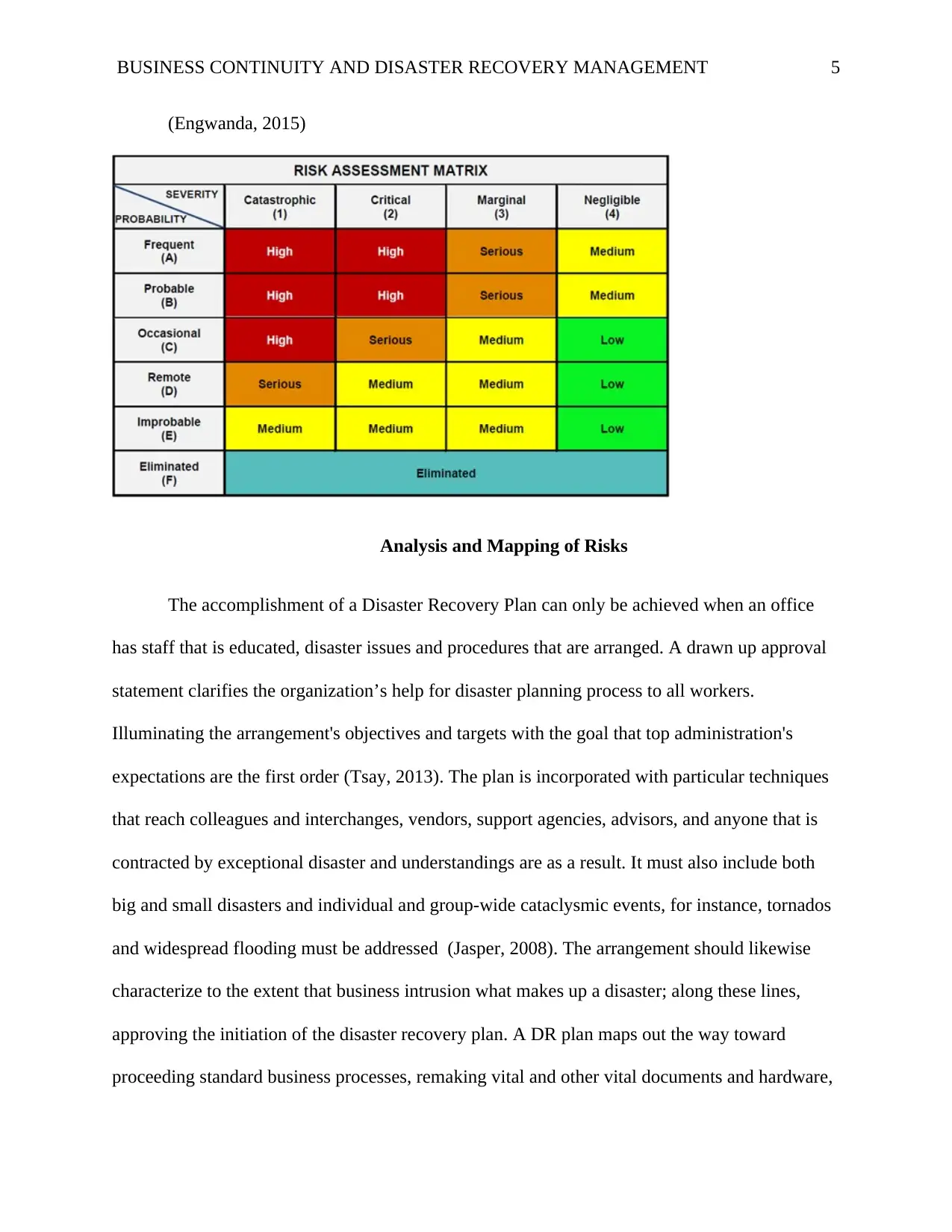
A risk assessment matrix is a diagram that plots the seriousness of an occasion happening
on one hub, and its likelihood happening on the other. One can likewise organize the model as a
table, where the hazard probability and effect are segments, and the dangers are recorded in lines.
assessments that are done by consultants for outside the company, risk management, and
business managers. It utilizes the central comprehension to distinguish and agree on the business
dangers with the business. The viability of internal controls is additionally archived, and action
plans concur where necessary. Self-assessment is also another way, that is conducted by the
business managers. It utilizes the detailed knowledge of individuals in the business to distinguish
the business changes and to agree on their observing. Likewise, with facilitated sessions, control
viability is additionally surveyed and action plans set up to improve insufficient controls
(Blunden & Thirlwell, 2013). It is essential for everybody in the group to understand that BCP is
one of the most critical remedial authority the administration is supposed to have and to utilize
the arranging time frame into a chance in shaping it (Olson, 2014). The Business Continuity Plan
is something aside from restorative powers. It is additionally about preventive and analyst
controls
A survey can likewise be finished in a roundtable setting. Indeed, this gathering
culmination may bestow collaboration to the procedure, giving the group’s elements take into
consideration communication opening and the needed essential people would be able to arrange
and meet to examine what effect particular sorts of interruptions would have on the association.
The significance of the consideration of each must be accentuated because the administration
won't know about first critical undertakings for which they don't have direct oversight.
Risk Analysis Matrix
A risk assessment matrix is a diagram that plots the seriousness of an occasion happening
on one hub, and its likelihood happening on the other. One can likewise organize the model as a
table, where the hazard probability and effect are segments, and the dangers are recorded in lines.
⊘ This is a preview!⊘
Do you want full access?
Subscribe today to unlock all pages.

Trusted by 1+ million students worldwide
BUSINESS CONTINUITY AND DISASTER RECOVERY MANAGEMENT 4
By picturing existing and potential risks along these lines, they can evaluate their impact, and
furthermore distinguish which ones are a most astounding need (Broder & Tucker, 2011). From
that point, they can arrange to react to the dangers that need the most consideration.
For one to place a risk in the assessment matrix, they put a rating to its severity and
likelihood. They then plot it in the suitable position in their chart or refer the grade in their table.
The standard classifications used when addressing severity are insignificant, minor, moderate,
critical and catastrophic issues. Likelihood classifications are strange, seldom, occasionally,
likely and definite occurrences (Broder & Tucker, 2011). After placing each risk in the matrix,
one can give it an overall ranking according to risk severity. Risks that have severe adverse
outcomes and are profoundly prone to happen get the most noteworthy rank while risks with
both low effect and low probability get the least rank. Hazard rankings consolidate effect and
likelihood evaluations to enable one to distinguish which risks represent the most significant
general risks (Hayes, Kotwica, & Correia, 2013). A few organizations utilize a numeric scale to
assign more particular risk rankings. However, most rankings fall into a couple of general
classifications, which are frequently color-coded.
By picturing existing and potential risks along these lines, they can evaluate their impact, and
furthermore distinguish which ones are a most astounding need (Broder & Tucker, 2011). From
that point, they can arrange to react to the dangers that need the most consideration.
For one to place a risk in the assessment matrix, they put a rating to its severity and
likelihood. They then plot it in the suitable position in their chart or refer the grade in their table.
The standard classifications used when addressing severity are insignificant, minor, moderate,
critical and catastrophic issues. Likelihood classifications are strange, seldom, occasionally,
likely and definite occurrences (Broder & Tucker, 2011). After placing each risk in the matrix,
one can give it an overall ranking according to risk severity. Risks that have severe adverse
outcomes and are profoundly prone to happen get the most noteworthy rank while risks with
both low effect and low probability get the least rank. Hazard rankings consolidate effect and
likelihood evaluations to enable one to distinguish which risks represent the most significant
general risks (Hayes, Kotwica, & Correia, 2013). A few organizations utilize a numeric scale to
assign more particular risk rankings. However, most rankings fall into a couple of general
classifications, which are frequently color-coded.
Paraphrase This Document
Need a fresh take? Get an instant paraphrase of this document with our AI Paraphraser
BUSINESS CONTINUITY AND DISASTER RECOVERY MANAGEMENT 5
(Engwanda, 2015)
Analysis and Mapping of Risks
The accomplishment of a Disaster Recovery Plan can only be achieved when an office
has staff that is educated, disaster issues and procedures that are arranged. A drawn up approval
statement clarifies the organization’s help for disaster planning process to all workers.
Illuminating the arrangement's objectives and targets with the goal that top administration's
expectations are the first order (Tsay, 2013). The plan is incorporated with particular techniques
that reach colleagues and interchanges, vendors, support agencies, advisors, and anyone that is
contracted by exceptional disaster and understandings are as a result. It must also include both
big and small disasters and individual and group-wide cataclysmic events, for instance, tornados
and widespread flooding must be addressed (Jasper, 2008). The arrangement should likewise
characterize to the extent that business intrusion what makes up a disaster; along these lines,
approving the initiation of the disaster recovery plan. A DR plan maps out the way toward
proceeding standard business processes, remaking vital and other vital documents and hardware,
(Engwanda, 2015)
Analysis and Mapping of Risks
The accomplishment of a Disaster Recovery Plan can only be achieved when an office
has staff that is educated, disaster issues and procedures that are arranged. A drawn up approval
statement clarifies the organization’s help for disaster planning process to all workers.
Illuminating the arrangement's objectives and targets with the goal that top administration's
expectations are the first order (Tsay, 2013). The plan is incorporated with particular techniques
that reach colleagues and interchanges, vendors, support agencies, advisors, and anyone that is
contracted by exceptional disaster and understandings are as a result. It must also include both
big and small disasters and individual and group-wide cataclysmic events, for instance, tornados
and widespread flooding must be addressed (Jasper, 2008). The arrangement should likewise
characterize to the extent that business intrusion what makes up a disaster; along these lines,
approving the initiation of the disaster recovery plan. A DR plan maps out the way toward
proceeding standard business processes, remaking vital and other vital documents and hardware,
BUSINESS CONTINUITY AND DISASTER RECOVERY MANAGEMENT 6
and becomes a guide for all decision-makers and representatives during and after a calamity
(Watters, 2014). The critical components of the arrangement fall into three classifications: the
ones that are regular to every area of the settlement; the ones that relate principally to the revival
of business operations; and the ones that link primarily to the remaking of vital information.
Risk Monitoring
Risk monitoring should be the last stage in BCP. It is supposed to make sure that the
organization's business continuity plan is executable by performing BCP tests at least yearly,
putting the BCP in the main review or audit, and keeping Business Continuity Plan up to date
based on changes to employees and the external and internal environments (Blancher, 2013). The
evolution of methodologies examination needs a choice of work concerning the test point and
recurrence expected to guarantee recovery goals may be accomplished during an interruption and
disaster.Testing procedures are supposed to give the stipulations and repeat for examining
applications and work limits, which include the aiding information handling (Leitch, 2008). The
system should join examination goals, contents, and timetables, and furthermore, oblige
reexamination and uncovering of axam results.
Administration should plainly describe what limits, systems, or techniques will be
attempted and what should constitute a substantial examination. The examination program’s goal
is to make sure that the BCP stays correct, pertinent, and in operation to opposing terms.Testing
is supposed to consolidate applications and organizational works that are perceived in the midst
of the impact investigation (Bellalah, 2010). The work influence resolution chooses the recovery
point goals and recovery time goals that by then aid in deciding the correct recovery tactics.
and becomes a guide for all decision-makers and representatives during and after a calamity
(Watters, 2014). The critical components of the arrangement fall into three classifications: the
ones that are regular to every area of the settlement; the ones that relate principally to the revival
of business operations; and the ones that link primarily to the remaking of vital information.
Risk Monitoring
Risk monitoring should be the last stage in BCP. It is supposed to make sure that the
organization's business continuity plan is executable by performing BCP tests at least yearly,
putting the BCP in the main review or audit, and keeping Business Continuity Plan up to date
based on changes to employees and the external and internal environments (Blancher, 2013). The
evolution of methodologies examination needs a choice of work concerning the test point and
recurrence expected to guarantee recovery goals may be accomplished during an interruption and
disaster.Testing procedures are supposed to give the stipulations and repeat for examining
applications and work limits, which include the aiding information handling (Leitch, 2008). The
system should join examination goals, contents, and timetables, and furthermore, oblige
reexamination and uncovering of axam results.
Administration should plainly describe what limits, systems, or techniques will be
attempted and what should constitute a substantial examination. The examination program’s goal
is to make sure that the BCP stays correct, pertinent, and in operation to opposing terms.Testing
is supposed to consolidate applications and organizational works that are perceived in the midst
of the impact investigation (Bellalah, 2010). The work influence resolution chooses the recovery
point goals and recovery time goals that by then aid in deciding the correct recovery tactics.
⊘ This is a preview!⊘
Do you want full access?
Subscribe today to unlock all pages.
Trusted by 1+ million students worldwide
BUSINESS CONTINUITY AND DISASTER RECOVERY MANAGEMENT 7
Management is also obligated to build an examination plan for each BCP test strategy
utilized. The exam plan ought to recognize quantifiable estimations of each exam goal. It is
supposed to be checked on before the examination to guarantee it will be actualized as outlined
without jeopardizing the generation condition. Management should also prepare to survey a
content for each trial before trying to recognize shortcomings which may provide inadmissible or
invalid tests. As a considerable part of the review method, the testing outline should be updated
to speak to any movements to the significant workforce, approaches, frameworks, workplaces,
equipment, outsourcing associations, traders, or different parts that influence an essential
business work (Liz Taylor, 2014). That helps to avoid any surprises in case of an actual disaster.
The testing plan’s suspicions ought to be approved to guarantee they are fit for work coherence
necessities. The approval needs the support of necessary work, performance, and innovation
faculty.
Risk Contingency Plan
The above is described as a preparation of the plan, or a course of activities, in case an
adverse risk takes place. To have an idea already in position results in the project team thinking
ahead as to the action that is supposed to be considered when a dangerous event occurs.
Contingency can likewise be shown in the venture spending plan, as a detail to ensure unforeseen
costs (Simonovic, 2012). The sum of the contingency budget is restricted to the high probability
dangers. Assessing the value if a risk happens and multiplying it by the likelihood controls it. For
instance, a hazard is evaluated to bring about an extra price which could be $50,000, and the
possibility of happening is 80%. The sum that ought to be incorporated into a financial plan for
the one thing is $40,000 (Bachar, 2017). Related to an alternate course of action, are starting and
stopping triggers. A starting trigger is an occasion that would actuate the alternative course of
Management is also obligated to build an examination plan for each BCP test strategy
utilized. The exam plan ought to recognize quantifiable estimations of each exam goal. It is
supposed to be checked on before the examination to guarantee it will be actualized as outlined
without jeopardizing the generation condition. Management should also prepare to survey a
content for each trial before trying to recognize shortcomings which may provide inadmissible or
invalid tests. As a considerable part of the review method, the testing outline should be updated
to speak to any movements to the significant workforce, approaches, frameworks, workplaces,
equipment, outsourcing associations, traders, or different parts that influence an essential
business work (Liz Taylor, 2014). That helps to avoid any surprises in case of an actual disaster.
The testing plan’s suspicions ought to be approved to guarantee they are fit for work coherence
necessities. The approval needs the support of necessary work, performance, and innovation
faculty.
Risk Contingency Plan
The above is described as a preparation of the plan, or a course of activities, in case an
adverse risk takes place. To have an idea already in position results in the project team thinking
ahead as to the action that is supposed to be considered when a dangerous event occurs.
Contingency can likewise be shown in the venture spending plan, as a detail to ensure unforeseen
costs (Simonovic, 2012). The sum of the contingency budget is restricted to the high probability
dangers. Assessing the value if a risk happens and multiplying it by the likelihood controls it. For
instance, a hazard is evaluated to bring about an extra price which could be $50,000, and the
possibility of happening is 80%. The sum that ought to be incorporated into a financial plan for
the one thing is $40,000 (Bachar, 2017). Related to an alternate course of action, are starting and
stopping triggers. A starting trigger is an occasion that would actuate the alternative course of
Paraphrase This Document
Need a fresh take? Get an instant paraphrase of this document with our AI Paraphraser
BUSINESS CONTINUITY AND DISASTER RECOVERY MANAGEMENT 8
action, while is the criteria to continue normal operations is a stopping trigger (Calder &
Watkins, 2010.). The two ought to be recognized in the Risk plan and can be inserted, for
instance; the stop trigger can be incorporated into the contingency plan field.
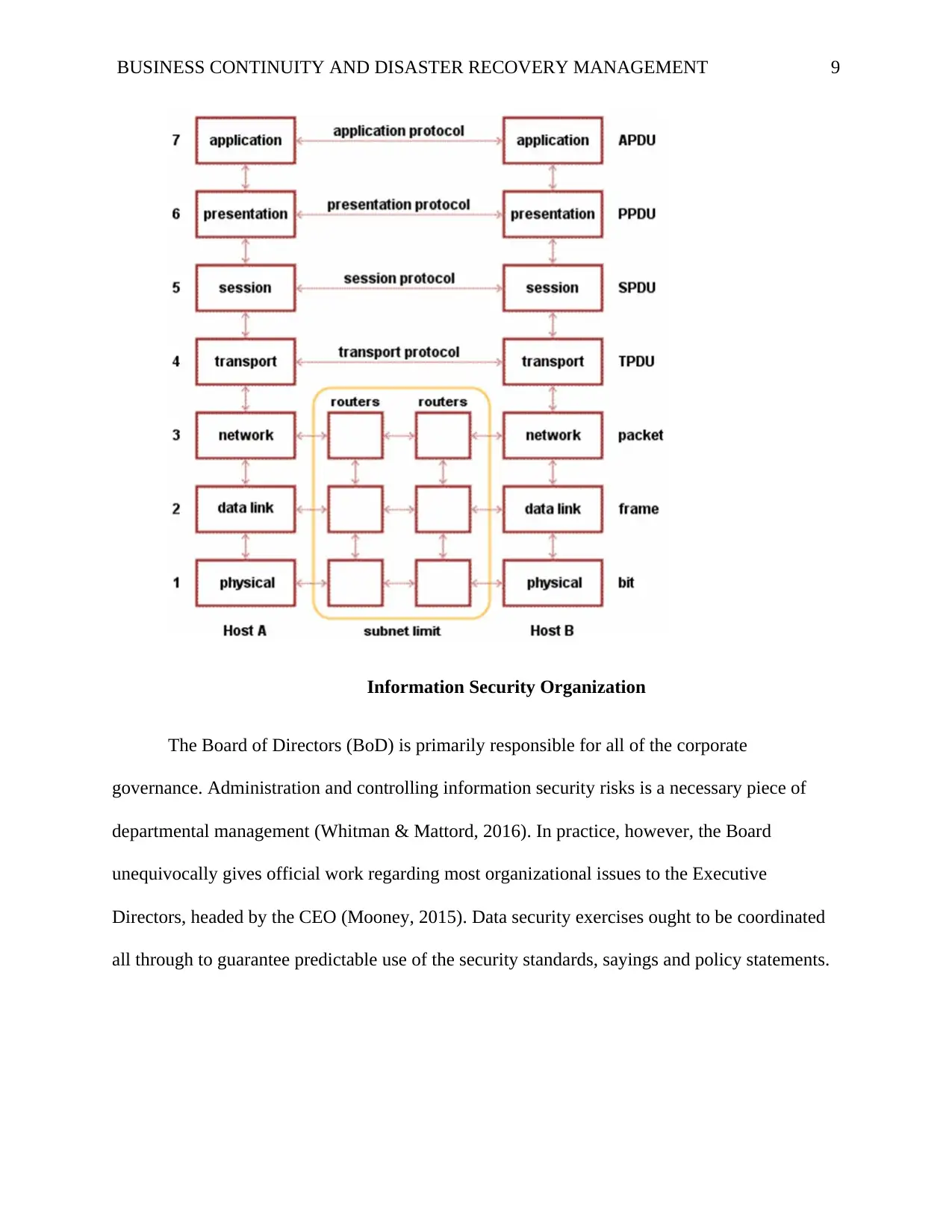
OSI model
It is an associated display that portrays and manages the relating segments of a media
transmission or dealing with framework with no regard to the essential inward structure and
progression. Its goal is the interoperability of several communication structures with standard
customs (Oshana & Kraeling, 2013). The model posts a memo framework into contemplating
sheets. The important kind of the model portrayed seven sheets. The basic impression of OSI is
the technique for communication between two points of end in a media program structure can be
secluded into seven unique social gatherings of associated points of confinement. Each passing
on client or program is a PC that gives those seven sheets of limit. So in a message between
consumers, there could be a surge of material down through the sheets in the main PC, over the
structure and after that up over the sheets in the receiving PC (Young, 2015). The seven point
sheets of confinement are specified by a mix of vocations, structures that are working, sort out
card contraption drivers and structures association apparatus that empowers a structure to put a
pennant on a structure connector out finished Wi-Fi or area network.
action, while is the criteria to continue normal operations is a stopping trigger (Calder &
Watkins, 2010.). The two ought to be recognized in the Risk plan and can be inserted, for
instance; the stop trigger can be incorporated into the contingency plan field.
OSI model
It is an associated display that portrays and manages the relating segments of a media
transmission or dealing with framework with no regard to the essential inward structure and
progression. Its goal is the interoperability of several communication structures with standard
customs (Oshana & Kraeling, 2013). The model posts a memo framework into contemplating
sheets. The important kind of the model portrayed seven sheets. The basic impression of OSI is
the technique for communication between two points of end in a media program structure can be
secluded into seven unique social gatherings of associated points of confinement. Each passing
on client or program is a PC that gives those seven sheets of limit. So in a message between
consumers, there could be a surge of material down through the sheets in the main PC, over the
structure and after that up over the sheets in the receiving PC (Young, 2015). The seven point
sheets of confinement are specified by a mix of vocations, structures that are working, sort out
card contraption drivers and structures association apparatus that empowers a structure to put a
pennant on a structure connector out finished Wi-Fi or area network.
BUSINESS CONTINUITY AND DISASTER RECOVERY MANAGEMENT 9
Information Security Organization
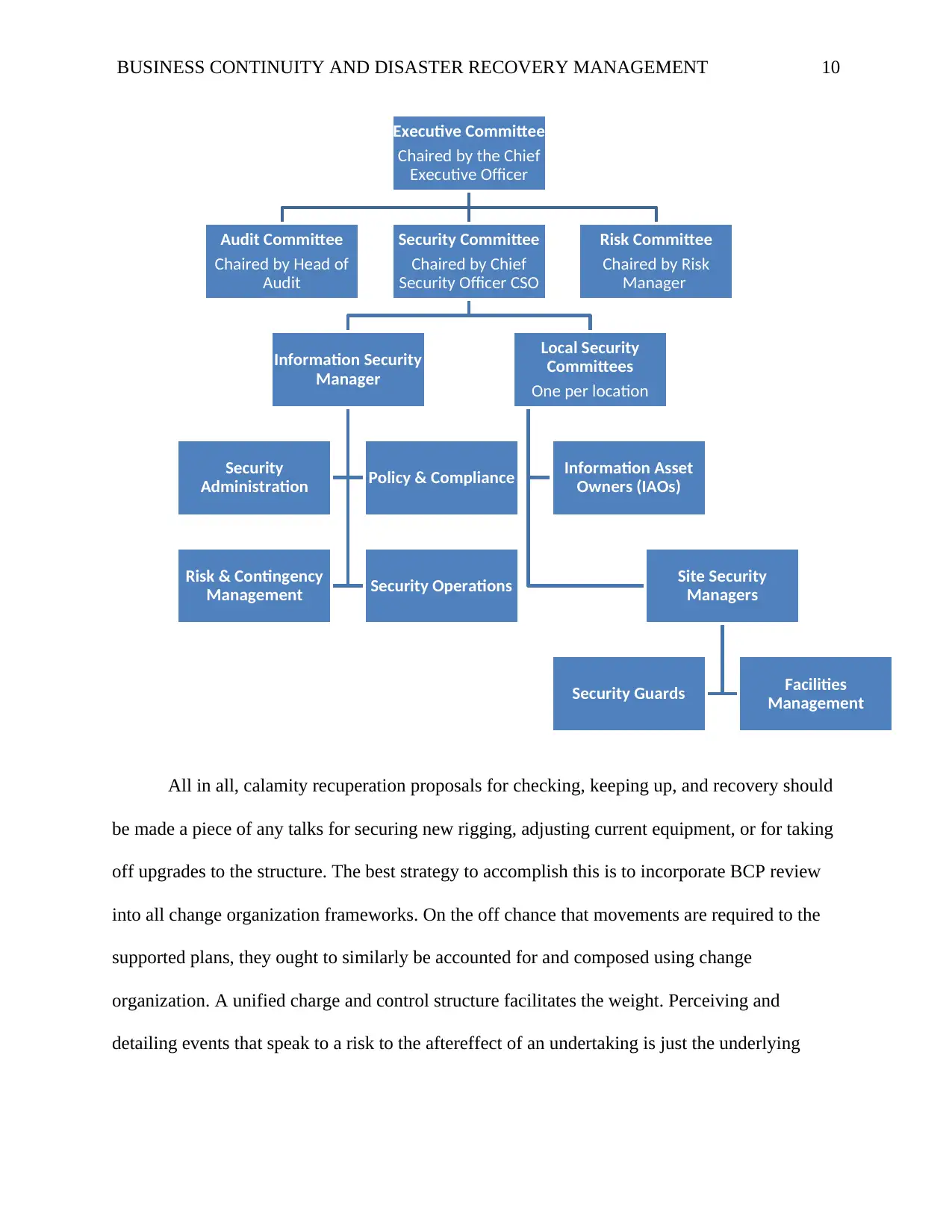
The Board of Directors (BoD) is primarily responsible for all of the corporate
governance. Administration and controlling information security risks is a necessary piece of
departmental management (Whitman & Mattord, 2016). In practice, however, the Board
unequivocally gives official work regarding most organizational issues to the Executive
Directors, headed by the CEO (Mooney, 2015). Data security exercises ought to be coordinated
all through to guarantee predictable use of the security standards, sayings and policy statements.
Information Security Organization
The Board of Directors (BoD) is primarily responsible for all of the corporate
governance. Administration and controlling information security risks is a necessary piece of
departmental management (Whitman & Mattord, 2016). In practice, however, the Board
unequivocally gives official work regarding most organizational issues to the Executive
Directors, headed by the CEO (Mooney, 2015). Data security exercises ought to be coordinated
all through to guarantee predictable use of the security standards, sayings and policy statements.
⊘ This is a preview!⊘
Do you want full access?
Subscribe today to unlock all pages.
Trusted by 1+ million students worldwide
BUSINESS CONTINUITY AND DISASTER RECOVERY MANAGEMENT 10
All in all, calamity recuperation proposals for checking, keeping up, and recovery should
be made a piece of any talks for securing new rigging, adjusting current equipment, or for taking
off upgrades to the structure. The best strategy to accomplish this is to incorporate BCP review
into all change organization frameworks. On the off chance that movements are required to the
supported plans, they ought to similarly be accounted for and composed using change
organization. A unified charge and control structure facilitates the weight. Perceiving and
detailing events that speak to a risk to the aftereffect of an undertaking is just the underlying
Executive Committee
Chaired by the Chief
Executive Officer
Audit Committee
Chaired by Head of
Audit
Security Committee
Chaired by Chief
Security Officer CSO
Information Security
Manager
Security
Administration Policy & Compliance
Risk & Contingency
Management Security Operations
Local Security
Committees
One per location
Information Asset
Owners (IAOs)
Site Security
Managers
Security Guards Facilities
Management
Risk Committee
Chaired by Risk
Manager
All in all, calamity recuperation proposals for checking, keeping up, and recovery should
be made a piece of any talks for securing new rigging, adjusting current equipment, or for taking
off upgrades to the structure. The best strategy to accomplish this is to incorporate BCP review
into all change organization frameworks. On the off chance that movements are required to the
supported plans, they ought to similarly be accounted for and composed using change
organization. A unified charge and control structure facilitates the weight. Perceiving and
detailing events that speak to a risk to the aftereffect of an undertaking is just the underlying
Executive Committee
Chaired by the Chief
Executive Officer
Audit Committee
Chaired by Head of
Audit
Security Committee
Chaired by Chief
Security Officer CSO
Information Security
Manager
Security
Administration Policy & Compliance
Risk & Contingency
Management Security Operations
Local Security
Committees
One per location
Information Asset
Owners (IAOs)
Site Security
Managers
Security Guards Facilities
Management
Risk Committee
Chaired by Risk
Manager
Paraphrase This Document
Need a fresh take? Get an instant paraphrase of this document with our AI Paraphraser
BUSINESS CONTINUITY AND DISASTER RECOVERY MANAGEMENT 11
advance. It is comparably fundamental to screen all perils on a booked commence by a hazard
administration gathering and provided details regarding in the endeavor status report.
advance. It is comparably fundamental to screen all perils on a booked commence by a hazard
administration gathering and provided details regarding in the endeavor status report.
BUSINESS CONTINUITY AND DISASTER RECOVERY MANAGEMENT 12
References
Bachar, R. (2017). Contingency plan. Toronto: Carina Press,.
Bellalah, M. (2010). Derivatives, risk management & value. Singapore: World Scientific.
Blancher, N. R. (2013). Systemic Risk Monitoring ("SysMo") toolkit -- a user guide. International
Monetary Fund.
Blunden, T., & Thirlwell, J. (2013). Mastering operational risk: a practical guide to
understanding operational risk and how to manage it. Harlow England: Pearson.
Broder, J. F., & Tucker, G. (2011). Risk Analysis and the Security Survey. Burlington: Elsevier
Science.
Calder, A., & Watkins, S. G. (2010.). Information security risk management for
ISO27001/ISO27002. Cambridgeshire : IT Governance Pub.
Engwanda, M. N. (2015). Mobile Banking Adoption in the United States: A Structural Equation
Modeling Analysis. Jones International University, Centennial, CO, USA.
Gregg, M. (2013.). CISSP exam cram. Indianapolis, Ind.: Pearson IT Certification.
Hayes, B. E., Kotwica, K., & Correia, D. (2013). Business continuity : Playbook. Boston:
Oxford.
Jasper, M. C. (2008). Protecting your business : disaster preparation and the law. New York:
Oceana Publications.
References
Bachar, R. (2017). Contingency plan. Toronto: Carina Press,.
Bellalah, M. (2010). Derivatives, risk management & value. Singapore: World Scientific.
Blancher, N. R. (2013). Systemic Risk Monitoring ("SysMo") toolkit -- a user guide. International
Monetary Fund.
Blunden, T., & Thirlwell, J. (2013). Mastering operational risk: a practical guide to
understanding operational risk and how to manage it. Harlow England: Pearson.
Broder, J. F., & Tucker, G. (2011). Risk Analysis and the Security Survey. Burlington: Elsevier
Science.
Calder, A., & Watkins, S. G. (2010.). Information security risk management for
ISO27001/ISO27002. Cambridgeshire : IT Governance Pub.
Engwanda, M. N. (2015). Mobile Banking Adoption in the United States: A Structural Equation
Modeling Analysis. Jones International University, Centennial, CO, USA.
Gregg, M. (2013.). CISSP exam cram. Indianapolis, Ind.: Pearson IT Certification.
Hayes, B. E., Kotwica, K., & Correia, D. (2013). Business continuity : Playbook. Boston:
Oxford.
Jasper, M. C. (2008). Protecting your business : disaster preparation and the law. New York:
Oceana Publications.
⊘ This is a preview!⊘
Do you want full access?
Subscribe today to unlock all pages.
Trusted by 1+ million students worldwide

1 out of 14


Related Documents


Your All-in-One AI-Powered Toolkit for Academic Success.
+13062052269
info@desklib.com
Available 24*7 on WhatsApp / Email
![[object Object]](/_next/static/media/star-bottom.7253800d.svg)
Unlock your academic potential
Copyright © 2020–2026 A2Z Services. All Rights Reserved. Developed and managed by ZUCOL.