3CO01: Business Culture and Change in Context Report - Semester 1
VerifiedAdded on 2023/02/07
|15
|4256
|44
Report
AI Summary
This report provides a comprehensive analysis of business culture and change within an organizational context, focusing on key aspects such as external influences, organizational goals, and the role of Human Resources. Task One includes a slide deck examining external influences using PESTLE analysis and discussing organizational goals, products, services, and the application of technology in HR practices. Task Two focuses on workplace culture, defining its importance and exploring how organizations function as whole systems, impacting various departments. The report also covers how people learn and develop in different ways, relating this to organizational assessment of people’s skills and capabilities, and explains the importance of planning and managing change within the workplace, including the role of HR professionals in change management, and how change can impact people. The report is a valuable resource for understanding the dynamics of business culture and change management.

3CO01
BUSINESS CULTURE
AND CHANGE
INCONTEXT
BUSINESS CULTURE
AND CHANGE
INCONTEXT

Paraphrase This Document
Need a fresh take? Get an instant paraphrase of this document with our AI Paraphraser
Table of Contents
Task One: Slide Deck for Team Day................................................................................2
AC 1.1 Examine the key external influences that impact on business environments.....2
AC 1.2: Discuss organisational goals and why it is important for organisations to plan.
.........................................................................................................................................3
AC 1.3: An explanation of an organisations products and/or services and main
customers.........................................................................................................................4
AC 1.4: review of different technologies available to people professionals and how
these can be used to improve working practices and collaboration.................................5
Task Two: Guidance Leaflet.............................................................................................6
AC 2.1 Define workplace culture in organisational settings and the importance of
fostering positive approaches towards it..........................................................................6
AC 2.2 Explain how organisations are whole systems, and how work and actions as a
people professional could impact elsewhere...................................................................6
AC2.3: Discuss how people learn and develop in different ways relating this to
organisational assessment of people’s skills and capabilities..........................................7
AC3.1: Explain the importance of planning and managing change within the
workplace.........................................................................................................................9
AC3.2: Consider the importance and role that people professionals play within change.
.........................................................................................................................................9
AC3.3: Discuss how change can impact people in different ways................................10
Bibliography.....................................................................................................................12
Task One: Slide Deck for Team Day................................................................................2
AC 1.1 Examine the key external influences that impact on business environments.....2
AC 1.2: Discuss organisational goals and why it is important for organisations to plan.
.........................................................................................................................................3
AC 1.3: An explanation of an organisations products and/or services and main
customers.........................................................................................................................4
AC 1.4: review of different technologies available to people professionals and how
these can be used to improve working practices and collaboration.................................5
Task Two: Guidance Leaflet.............................................................................................6
AC 2.1 Define workplace culture in organisational settings and the importance of
fostering positive approaches towards it..........................................................................6
AC 2.2 Explain how organisations are whole systems, and how work and actions as a
people professional could impact elsewhere...................................................................6
AC2.3: Discuss how people learn and develop in different ways relating this to
organisational assessment of people’s skills and capabilities..........................................7
AC3.1: Explain the importance of planning and managing change within the
workplace.........................................................................................................................9
AC3.2: Consider the importance and role that people professionals play within change.
.........................................................................................................................................9
AC3.3: Discuss how change can impact people in different ways................................10
Bibliography.....................................................................................................................12
Task One: Slide Deck for Team Day
AC 1.1 Examine the key external influences that impact on business environments
Organizations do not function in a vacuum; rather, they are impacted by external
influences in their respective business landscapes. To that aim, there are numerous tools
available to aid in the examination of external variables affecting business in all sectors,
including the hospitality industry, which is at the heart of our operation. The PESTLE
analysis, which stands for Political, Economic, Sociological, Technological, Legal, and
Environmental, is one of these tools. Cipd (2021) describes PESTLE analysis as a
strategic, wide fact-finding activity of external variables that may affect company
decisions by aiding in the reduction of risks and subsequent maximization of available
possibilities. The following is an examination of the elements affecting the hospitality
sector.
Political: Environmental laws, tax policies, trade restrictions, political stability,
and tariffs are all political variables that impact the sector. This was seen during
the Covid19 pandemic era, when many nations enforced travel prohibitions,
which had a detrimental impact on the industry Frue (2019). Similarly, during
presidential elections, the hotel sector is fearful that new governments would
introduce new ideas and legislation that will have an influence on the business
and disrupt operations.
Economic: Economic growth or decrease, inflation, interest rates, pay rates,
currency rate, minimum wage, working hours, cost of living, credit availability,
and unemployment are all variables that impact the sector. The strength or
weakness of a currency might impact the desirability of a holiday location in this
way. In the near term, Brexit resulted in the loss of a large number of personnel
from other EU nations (James, 2021).
Social: Cultural standards, health consciousness, career attitudes, age distribution
population growth rates, health and safety are all sociological issues. For example,
during the Covid19 pandemic era, customers were more health cautious,
prompting the business to invest in sanitizing processes for its facilities.
AC 1.1 Examine the key external influences that impact on business environments
Organizations do not function in a vacuum; rather, they are impacted by external
influences in their respective business landscapes. To that aim, there are numerous tools
available to aid in the examination of external variables affecting business in all sectors,
including the hospitality industry, which is at the heart of our operation. The PESTLE
analysis, which stands for Political, Economic, Sociological, Technological, Legal, and
Environmental, is one of these tools. Cipd (2021) describes PESTLE analysis as a
strategic, wide fact-finding activity of external variables that may affect company
decisions by aiding in the reduction of risks and subsequent maximization of available
possibilities. The following is an examination of the elements affecting the hospitality
sector.
Political: Environmental laws, tax policies, trade restrictions, political stability,
and tariffs are all political variables that impact the sector. This was seen during
the Covid19 pandemic era, when many nations enforced travel prohibitions,
which had a detrimental impact on the industry Frue (2019). Similarly, during
presidential elections, the hotel sector is fearful that new governments would
introduce new ideas and legislation that will have an influence on the business
and disrupt operations.
Economic: Economic growth or decrease, inflation, interest rates, pay rates,
currency rate, minimum wage, working hours, cost of living, credit availability,
and unemployment are all variables that impact the sector. The strength or
weakness of a currency might impact the desirability of a holiday location in this
way. In the near term, Brexit resulted in the loss of a large number of personnel
from other EU nations (James, 2021).
Social: Cultural standards, health consciousness, career attitudes, age distribution
population growth rates, health and safety are all sociological issues. For example,
during the Covid19 pandemic era, customers were more health cautious,
prompting the business to invest in sanitizing processes for its facilities.
⊘ This is a preview!⊘
Do you want full access?
Subscribe today to unlock all pages.

Trusted by 1+ million students worldwide
Technological factors, such as robots, and the velocity of change are examples of
technological factors (Cipd, 2021). To that purpose, several hotels have used
robotics to sanitize their facilities in a speedier and more effective manner. The
sector is also investing in social media and seeking to improve its ratings on travel
platforms (Frue, 2019)
Legal factors: Changes in laws concerning employment, imports/exports, access
to quotas, materials, and taxation are examples of legal factors (Cipd, 2021)
Environmental factors: Ethical sourcing, global warming, pandemics, and other
catastrophes are examples of environmental issues. According to Frue (2019), the
sector must recognize seasonal or weather fluctuations in order to price its rooms
competitively.
AC 1.2: Discuss organisational goals and why it is important for organisations to
plan.
According to Hill (2019), planning is a process that plots a route for achieving certain
company objectives. The process comprises doing an evaluation of the organization's
operations and then determining what needs to be improved in the coming year. As a
result, planning requires anticipating the objectives that an organization want to
accomplish and specifying the steps to be followed to reach the specified goals. The
outcomes might be measured in monetary terms or in other ways, such as consumer
pleasure (Hill, 2019).
According to Scott (2010), human resources workers have several duties in organizations,
including ensuring that rules are in place to guarantee that employees are accountable for
achieving organizational objectives and goals. The hospitality sector is roughly divided
into food and drinks, travel and tourism, hotel, and recreation (Novak, 2017). Their
ultimate objective is to provide a great customer experience in order to keep the customer
or maybe obtain a recommendation.
In accordance with this, HR department training and development strategies in the hotel
sector attempt to invest in imparting the necessary information and skills to workers, who
serve as the direct contact between an organization and the firm. According to Scott
technological factors (Cipd, 2021). To that purpose, several hotels have used
robotics to sanitize their facilities in a speedier and more effective manner. The
sector is also investing in social media and seeking to improve its ratings on travel
platforms (Frue, 2019)
Legal factors: Changes in laws concerning employment, imports/exports, access
to quotas, materials, and taxation are examples of legal factors (Cipd, 2021)
Environmental factors: Ethical sourcing, global warming, pandemics, and other
catastrophes are examples of environmental issues. According to Frue (2019), the
sector must recognize seasonal or weather fluctuations in order to price its rooms
competitively.
AC 1.2: Discuss organisational goals and why it is important for organisations to
plan.
According to Hill (2019), planning is a process that plots a route for achieving certain
company objectives. The process comprises doing an evaluation of the organization's
operations and then determining what needs to be improved in the coming year. As a
result, planning requires anticipating the objectives that an organization want to
accomplish and specifying the steps to be followed to reach the specified goals. The
outcomes might be measured in monetary terms or in other ways, such as consumer
pleasure (Hill, 2019).
According to Scott (2010), human resources workers have several duties in organizations,
including ensuring that rules are in place to guarantee that employees are accountable for
achieving organizational objectives and goals. The hospitality sector is roughly divided
into food and drinks, travel and tourism, hotel, and recreation (Novak, 2017). Their
ultimate objective is to provide a great customer experience in order to keep the customer
or maybe obtain a recommendation.
In accordance with this, HR department training and development strategies in the hotel
sector attempt to invest in imparting the necessary information and skills to workers, who
serve as the direct contact between an organization and the firm. According to Scott
Paraphrase This Document
Need a fresh take? Get an instant paraphrase of this document with our AI Paraphraser
(2010), HR professionals are in charge of establishing training and development
programs that improve the quality of work in a firm. This is followed by assessing
training requirements, creating manuals, delivering teaching, and ensuring that training
objectives fit with company goals. Scott (2010) cites Bureau of Labor Statistics research
indicating that providing employees with skills can improve organizational performance
and assist accomplish company goals.
AC 1.3: An explanation of an organisation’s products and/or services and main
customers
Bansal, Gaulum, Anbardar, and Kumar (n.d.) referenced Philip Kotler's definition of a
product as "a bundle of a physical service and symbolic particulars that are expected to be
useful to the customer or provide consumer happiness."
The hospitality sector includes five components of hospitality goods, one of which is core
products, which relate to the fundamental benefit provided to a guest, such as a place to
dine. The second type of product is facilitating items, which are those that are offered to a
visitor in order for them to use the core product, such as food in the case of restaurants.
As a result, tangible items relate to actual hospitality products like as television and air
conditioning in a conventional room. There are accompanying goods that are offered to
boost the value of the main product and make it unique. Last but not least, enhanced
products are those that are necessary for improving the quality of items without incurring
additional costs.
Bansal et al. (n.d.) on the other hand defined services as intangible activities that give
want fulfilment. It is also described as any action provided by one party to another that
does not result in ownership. Services may also be defined as intangible economic items
in which humans serve both the supplier and the recipient. They have various
characteristics, including the fact that they are perishable, lack physical identity, are
inseparable, have large fixed costs, and are interdependent.
According to Capozzi (2020), consumers in the hospitality business may be divided into
backpackers and single travelers who like seeing places and staying in hotels and hence
choose low pricing above services and facilities. Couples, on the other hand, are amorous
programs that improve the quality of work in a firm. This is followed by assessing
training requirements, creating manuals, delivering teaching, and ensuring that training
objectives fit with company goals. Scott (2010) cites Bureau of Labor Statistics research
indicating that providing employees with skills can improve organizational performance
and assist accomplish company goals.
AC 1.3: An explanation of an organisation’s products and/or services and main
customers
Bansal, Gaulum, Anbardar, and Kumar (n.d.) referenced Philip Kotler's definition of a
product as "a bundle of a physical service and symbolic particulars that are expected to be
useful to the customer or provide consumer happiness."
The hospitality sector includes five components of hospitality goods, one of which is core
products, which relate to the fundamental benefit provided to a guest, such as a place to
dine. The second type of product is facilitating items, which are those that are offered to a
visitor in order for them to use the core product, such as food in the case of restaurants.
As a result, tangible items relate to actual hospitality products like as television and air
conditioning in a conventional room. There are accompanying goods that are offered to
boost the value of the main product and make it unique. Last but not least, enhanced
products are those that are necessary for improving the quality of items without incurring
additional costs.
Bansal et al. (n.d.) on the other hand defined services as intangible activities that give
want fulfilment. It is also described as any action provided by one party to another that
does not result in ownership. Services may also be defined as intangible economic items
in which humans serve both the supplier and the recipient. They have various
characteristics, including the fact that they are perishable, lack physical identity, are
inseparable, have large fixed costs, and are interdependent.
According to Capozzi (2020), consumers in the hospitality business may be divided into
backpackers and single travelers who like seeing places and staying in hotels and hence
choose low pricing above services and facilities. Couples, on the other hand, are amorous
lovers looking for tranquil surroundings and high-quality bedding. Families with more
particular demands, such as on-site play spaces, discounts for kids' rooms, entertainment,
and other facilities such as booster seats, comprise the other category. The fourth type is
business travelers, who want quick internet connection, devices such as printers, and are
typically ready to spend a premium price for accommodations.
AC 1.4: review of different technologies available to people professionals and how
these can be used to improve working practices and collaboration
HR managers are being compelled to adapt to new technology that has improved their
work as the world and the workplace become increasingly digital. Technology is used to
manage information in the cloud, interact with people on social networking sites, and
work on the move via tablets and mobile devices (Barcelos, 2018). The following are
some of the technological components required by human resource specialists.
Social media sites like as Facebook, Twitter, and LinkedIn are used to publish open
positions, announce forthcoming events to the public, and assist in making hiring
choices.
Human Resources Information Software (HRIS) aids in the automation of many HR
procedures and operations, reducing human mistakes. Aside from automating HR
operations, it also facilitates the maintenance of HR documentation.
Cloud technology aids in the consolidation of business and HR data from payroll to
feedback, increasing openness and uniformity inside the organization.
Gamification approaches used in recruiting to improve talent acquisition. It is also
utilized to improve learning and growth by sharing knowledge and simulating real-
life scenarios.
(Adapted from Bercelos, 2018).
particular demands, such as on-site play spaces, discounts for kids' rooms, entertainment,
and other facilities such as booster seats, comprise the other category. The fourth type is
business travelers, who want quick internet connection, devices such as printers, and are
typically ready to spend a premium price for accommodations.
AC 1.4: review of different technologies available to people professionals and how
these can be used to improve working practices and collaboration
HR managers are being compelled to adapt to new technology that has improved their
work as the world and the workplace become increasingly digital. Technology is used to
manage information in the cloud, interact with people on social networking sites, and
work on the move via tablets and mobile devices (Barcelos, 2018). The following are
some of the technological components required by human resource specialists.
Social media sites like as Facebook, Twitter, and LinkedIn are used to publish open
positions, announce forthcoming events to the public, and assist in making hiring
choices.
Human Resources Information Software (HRIS) aids in the automation of many HR
procedures and operations, reducing human mistakes. Aside from automating HR
operations, it also facilitates the maintenance of HR documentation.
Cloud technology aids in the consolidation of business and HR data from payroll to
feedback, increasing openness and uniformity inside the organization.
Gamification approaches used in recruiting to improve talent acquisition. It is also
utilized to improve learning and growth by sharing knowledge and simulating real-
life scenarios.
(Adapted from Bercelos, 2018).
⊘ This is a preview!⊘
Do you want full access?
Subscribe today to unlock all pages.
Trusted by 1+ million students worldwide
Task Two: Guidance Leaflet
AC 2.1 Define workplace culture in organisational settings and the importance of
fostering positive approaches towards it.
Organizational workplace culture may be defined as the collection of underlying ideas,
concepts, and values that serve as the foundation of a company's management system. It
also includes the managerial behaviors and activities used to reinforce the fundamental
values (Cipd, 2020). According to Tarver (2021), corporate culture is defined as the
attitudes and behaviors that determine how employees and management interact and
perform commercial transactions. Tarver (2021) underlined that, while not explicitly
defined, corporate culture is inferred and naturally evolves over time when an
organization recruits individuals who embody it. Business hours, hiring decisions, dress
code, and consumer treatment, office setup, consumer happiness, employee perks, and
turnover all show workplace culture.
Workplace culture provides employees with an opportunity to learn about the firm, form
a network, and share a shared goal, as well as express their opinions on the organization's
aim (Cipd, 2020). Workplace culture is especially significant since it influences customer
service standards and staff retention. Furthermore, workplace culture influences overall
organizational performance, emphasizing the need of cultivating a healthy work culture
(Cipd, 2020). Accountability, expressiveness, equity, communication, and recognition are
some prevalent features or principles linked with a good workplace culture (Indeed
Editorial Team, 2021). As a result, a positive workplace culture is related with better
recruiting decisions, higher performance quality, a positive organizational reputation, and
employee happiness (Indeed Editorial Team, 2021).
AC 2.2 Explain how organisations are whole systems, and how work and actions as
a people professional could impact elsewhere.
Organizations are compared to complete systems since they are made up of several
departments that perform diverse duties but are linked by a common organizational
objective and function. According to Levinson (2018), organizational systems merely
AC 2.1 Define workplace culture in organisational settings and the importance of
fostering positive approaches towards it.
Organizational workplace culture may be defined as the collection of underlying ideas,
concepts, and values that serve as the foundation of a company's management system. It
also includes the managerial behaviors and activities used to reinforce the fundamental
values (Cipd, 2020). According to Tarver (2021), corporate culture is defined as the
attitudes and behaviors that determine how employees and management interact and
perform commercial transactions. Tarver (2021) underlined that, while not explicitly
defined, corporate culture is inferred and naturally evolves over time when an
organization recruits individuals who embody it. Business hours, hiring decisions, dress
code, and consumer treatment, office setup, consumer happiness, employee perks, and
turnover all show workplace culture.
Workplace culture provides employees with an opportunity to learn about the firm, form
a network, and share a shared goal, as well as express their opinions on the organization's
aim (Cipd, 2020). Workplace culture is especially significant since it influences customer
service standards and staff retention. Furthermore, workplace culture influences overall
organizational performance, emphasizing the need of cultivating a healthy work culture
(Cipd, 2020). Accountability, expressiveness, equity, communication, and recognition are
some prevalent features or principles linked with a good workplace culture (Indeed
Editorial Team, 2021). As a result, a positive workplace culture is related with better
recruiting decisions, higher performance quality, a positive organizational reputation, and
employee happiness (Indeed Editorial Team, 2021).
AC 2.2 Explain how organisations are whole systems, and how work and actions as
a people professional could impact elsewhere.
Organizations are compared to complete systems since they are made up of several
departments that perform diverse duties but are linked by a common organizational
objective and function. According to Levinson (2018), organizational systems merely
Paraphrase This Document
Need a fresh take? Get an instant paraphrase of this document with our AI Paraphraser
relate to a company's overall structure. In this regard, organizations as a whole system
establish the company's structure in terms of each division or department, as well as the
hierarchical structure that dictates who reports to whom and what is expected of each
division (Levinson, 2018).
Regardless of size, all organizations require a robust and well-defined system that
outlines clear protocols to which workers must comply in order to minimize workplace
misunderstanding. The workplace becomes chaotic in the absence of a solid and effective
organization (Levinson, 2018). The organizational system ensures that all employees are
assigned to the appropriate department and so contribute to the company's success.
The human resources department is critical to the development of a strong organizational
structure. According to Bianca (2019), human resource managers are in responsible of the
most important component of a successful business, which is recruiting a productive and
flourishing staff for each department in an organization. To that aim, human resource
experts regard employees as assets rather than liabilities in an organization. The human
resources department develops best practices by recruiting and hiring people with
specific skill sets that meet the organization's current and future goals, coordinating
employee benefits, and flexibly shifting employees between departments based on
employee abilities and business priorities (Bianca, 2019). When human resource
specialists are able to create a solid organizational framework, they avoid issues such as
task duplication, employee frustration, and conflict across departments or roles.
AC2.3: Discuss how people learn and develop in different ways relating this to
organisational assessment of people’s skills and capabilities
In the workplace, the phrases learning and development are frequently used
interchangeably. Learning is a work-based self-directed process that increases adaptive
capability, whereas development is a larger and longer-term process of accumulating
information and abilities (Cipd, 2021). The primary purpose of learning and development
is to improve the behavior of groups or people so that they can carry out their mandate
more effectively.
establish the company's structure in terms of each division or department, as well as the
hierarchical structure that dictates who reports to whom and what is expected of each
division (Levinson, 2018).
Regardless of size, all organizations require a robust and well-defined system that
outlines clear protocols to which workers must comply in order to minimize workplace
misunderstanding. The workplace becomes chaotic in the absence of a solid and effective
organization (Levinson, 2018). The organizational system ensures that all employees are
assigned to the appropriate department and so contribute to the company's success.
The human resources department is critical to the development of a strong organizational
structure. According to Bianca (2019), human resource managers are in responsible of the
most important component of a successful business, which is recruiting a productive and
flourishing staff for each department in an organization. To that aim, human resource
experts regard employees as assets rather than liabilities in an organization. The human
resources department develops best practices by recruiting and hiring people with
specific skill sets that meet the organization's current and future goals, coordinating
employee benefits, and flexibly shifting employees between departments based on
employee abilities and business priorities (Bianca, 2019). When human resource
specialists are able to create a solid organizational framework, they avoid issues such as
task duplication, employee frustration, and conflict across departments or roles.
AC2.3: Discuss how people learn and develop in different ways relating this to
organisational assessment of people’s skills and capabilities
In the workplace, the phrases learning and development are frequently used
interchangeably. Learning is a work-based self-directed process that increases adaptive
capability, whereas development is a larger and longer-term process of accumulating
information and abilities (Cipd, 2021). The primary purpose of learning and development
is to improve the behavior of groups or people so that they can carry out their mandate
more effectively.
Individuals and groups learn and grow in a variety of ways at work, including formal and
informal tactics, digital or face-to-face interactions, internal or external provision, direct
learning in the office or away from the workplace, and generated or curated resources
(Cipd, 2021). On-the-job training, in-house development programs, coaching and
mentoring, job rotation, secondment, project work, and shadowing are some workplace
learning and development strategies (Cipd, 2021).
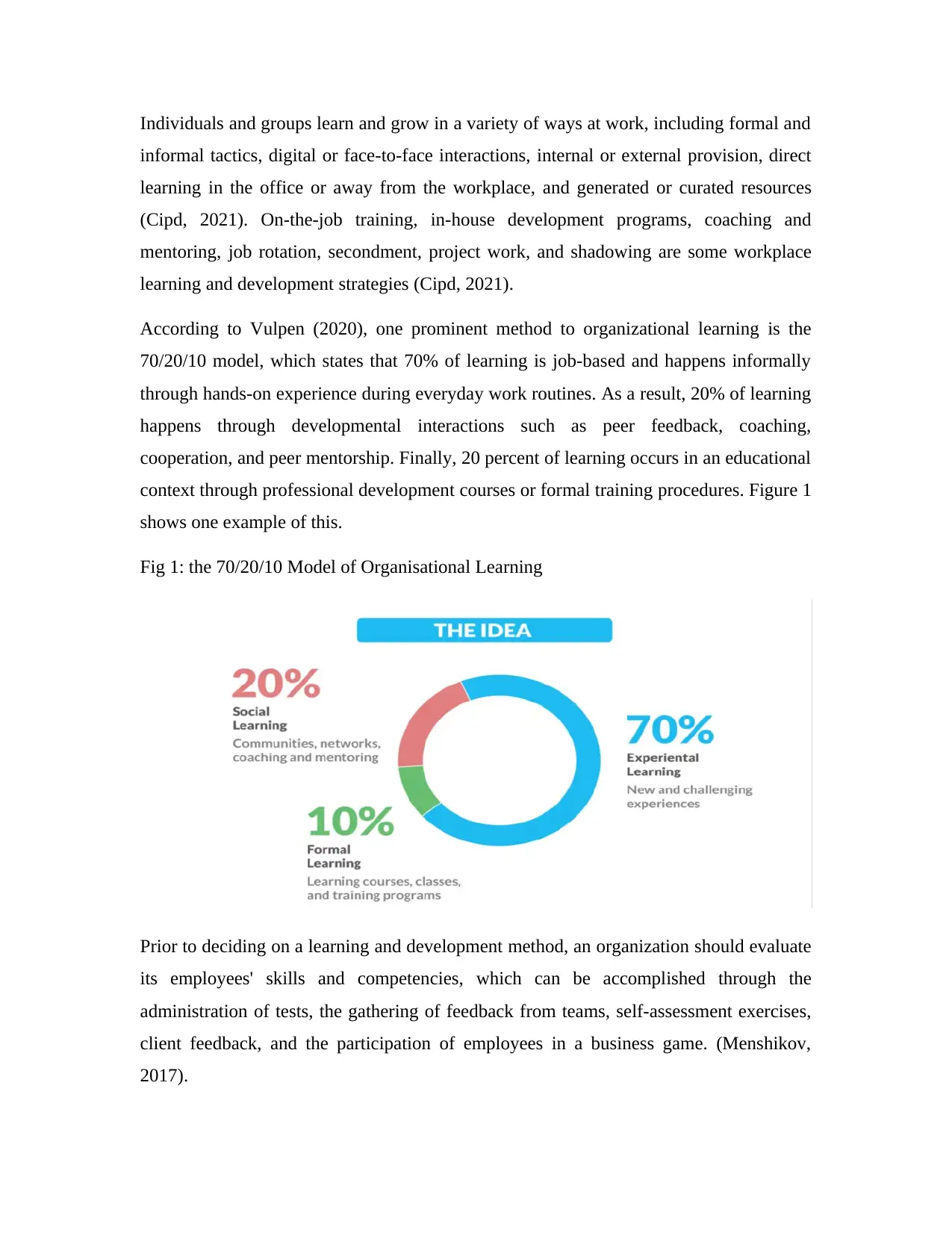
According to Vulpen (2020), one prominent method to organizational learning is the
70/20/10 model, which states that 70% of learning is job-based and happens informally
through hands-on experience during everyday work routines. As a result, 20% of learning
happens through developmental interactions such as peer feedback, coaching,
cooperation, and peer mentorship. Finally, 20 percent of learning occurs in an educational
context through professional development courses or formal training procedures. Figure 1
shows one example of this.
Fig 1: the 70/20/10 Model of Organisational Learning
Prior to deciding on a learning and development method, an organization should evaluate
its employees' skills and competencies, which can be accomplished through the
administration of tests, the gathering of feedback from teams, self-assessment exercises,
client feedback, and the participation of employees in a business game. (Menshikov,
2017).
informal tactics, digital or face-to-face interactions, internal or external provision, direct
learning in the office or away from the workplace, and generated or curated resources
(Cipd, 2021). On-the-job training, in-house development programs, coaching and
mentoring, job rotation, secondment, project work, and shadowing are some workplace
learning and development strategies (Cipd, 2021).
According to Vulpen (2020), one prominent method to organizational learning is the
70/20/10 model, which states that 70% of learning is job-based and happens informally
through hands-on experience during everyday work routines. As a result, 20% of learning
happens through developmental interactions such as peer feedback, coaching,
cooperation, and peer mentorship. Finally, 20 percent of learning occurs in an educational
context through professional development courses or formal training procedures. Figure 1
shows one example of this.
Fig 1: the 70/20/10 Model of Organisational Learning
Prior to deciding on a learning and development method, an organization should evaluate
its employees' skills and competencies, which can be accomplished through the
administration of tests, the gathering of feedback from teams, self-assessment exercises,
client feedback, and the participation of employees in a business game. (Menshikov,
2017).
⊘ This is a preview!⊘
Do you want full access?
Subscribe today to unlock all pages.
Trusted by 1+ million students worldwide
AC3.1: Explain the importance of planning and managing change within the
workplace.
Particularly in today's technology age, business settings are always evolving. To that
purpose, numerous organizations throughout the world have used change management.
Change management broadly refers to the many methods through which organizations
prepare for and implement simple or complicated changes (Indeed Editorial Team,2021).
According to Michigan State University (2019), change management can be progressive,
evolutionary, and internally led, or discontinuous, revolutionary, and externally driven.
Change management is critical in organizations since each change has an influence on all
personnel. Furthermore, good change management boosts employee morale and
encourages teamwork among employees. It also fosters a favorable climate for
continuous growth, facilitating general business transformation and allowing the
organization to readily embrace new methods and technology (Michigan State
University, 2019).
Change management is crucial because it helps each division of a company flourish in the
face of significant and minor changes in the company or business environment. Change
management also enables workers to comprehend their new tasks and, as a result, carry
out their mandates efficiently and in accordance with expectations. Change management
in organizations, in general, guarantees that firms stay viable and, as a result, continue to
expand and adapt to changing market trends (Indeed Editorial Team, 2021).
Change management is also said to minimize stress and anxiety associated with change,
lessen resistance to change, improve company cooperation and collaboration, respond to
difficulties more effectively, and manage the many costs of change (Migrator, 2000).
AC3.2: Consider the importance and role that people professionals play within
change.
People experts, according to Cipd (2020), play a significant role in managing the
transformation process in organizations. This is because they are compared to stage
directors of change who work behind the scenes and are so admired by everybody.
Because of their proximity to the people, people professionals function as change agents
workplace.
Particularly in today's technology age, business settings are always evolving. To that
purpose, numerous organizations throughout the world have used change management.
Change management broadly refers to the many methods through which organizations
prepare for and implement simple or complicated changes (Indeed Editorial Team,2021).
According to Michigan State University (2019), change management can be progressive,
evolutionary, and internally led, or discontinuous, revolutionary, and externally driven.
Change management is critical in organizations since each change has an influence on all
personnel. Furthermore, good change management boosts employee morale and
encourages teamwork among employees. It also fosters a favorable climate for
continuous growth, facilitating general business transformation and allowing the
organization to readily embrace new methods and technology (Michigan State
University, 2019).
Change management is crucial because it helps each division of a company flourish in the
face of significant and minor changes in the company or business environment. Change
management also enables workers to comprehend their new tasks and, as a result, carry
out their mandates efficiently and in accordance with expectations. Change management
in organizations, in general, guarantees that firms stay viable and, as a result, continue to
expand and adapt to changing market trends (Indeed Editorial Team, 2021).
Change management is also said to minimize stress and anxiety associated with change,
lessen resistance to change, improve company cooperation and collaboration, respond to
difficulties more effectively, and manage the many costs of change (Migrator, 2000).
AC3.2: Consider the importance and role that people professionals play within
change.
People experts, according to Cipd (2020), play a significant role in managing the
transformation process in organizations. This is because they are compared to stage
directors of change who work behind the scenes and are so admired by everybody.
Because of their proximity to the people, people professionals function as change agents
Paraphrase This Document
Need a fresh take? Get an instant paraphrase of this document with our AI Paraphraser
in organizations, making it simple to influence leadership and offer an adequate
framework that promotes change inside the workplace (Perrin, 2017).
In most organizations, the Human Resources department acts as a watchdog in
management change by facilitating the introduction of new practices. In this regard, HR
plays a monitoring function as well as ensuring that the transformation processes are
harmonic, coherent, and maintain integrity (Perrin, 2017).
People experts also play the function of communication in the change process by
clarifying messages of change and ensuring that people understand the process and the
many channels available to deliver critical messages. To that aim, HR uses their expertise
and abilities to reduce rumors by communicating via channels including as emails, formal
briefings, podcasts, and newsletters (Changeboard Team, 2016).
People experts can also diagnose and plan change because they understand the structure
of change and so have the abilities to ask the correct questions and identify difficulties
that may occur in the drive for change. Furthermore, people specialists may assist in
defining expectations and ensuring that a full strategy is spelled out, allowing the change
architecture to be questioned (Changeboard Team, 2019).
AC3.3: Discuss how change can impact people in different ways
People process and react to change in various ways. Owen (2018) highlighted this
effectively when he stated that people react to change in different ways according to their
particular motivations, taking into account how that change affects their welfare.
According to Owen (2018), some individuals thrive on change and readily accept new
methods and goods, whilst others first oppose change when the status quo is upset. In the
context of a team, change can have a detrimental impact on employees since they are
isolated from one another, reducing the team's efficiency.
Change may also cause uncertainty and anxiety, which can emerge as excessive worrying
and changes in personal behaviors such as restlessness, impatience, and trouble
concentrating. Other physical signs of anxiety include fidgeting, weariness, and difficulty
sleeping, all of which are adverse to employee productivity and performance (Owen,
framework that promotes change inside the workplace (Perrin, 2017).
In most organizations, the Human Resources department acts as a watchdog in
management change by facilitating the introduction of new practices. In this regard, HR
plays a monitoring function as well as ensuring that the transformation processes are
harmonic, coherent, and maintain integrity (Perrin, 2017).
People experts also play the function of communication in the change process by
clarifying messages of change and ensuring that people understand the process and the
many channels available to deliver critical messages. To that aim, HR uses their expertise
and abilities to reduce rumors by communicating via channels including as emails, formal
briefings, podcasts, and newsletters (Changeboard Team, 2016).
People experts can also diagnose and plan change because they understand the structure
of change and so have the abilities to ask the correct questions and identify difficulties
that may occur in the drive for change. Furthermore, people specialists may assist in
defining expectations and ensuring that a full strategy is spelled out, allowing the change
architecture to be questioned (Changeboard Team, 2019).
AC3.3: Discuss how change can impact people in different ways
People process and react to change in various ways. Owen (2018) highlighted this
effectively when he stated that people react to change in different ways according to their
particular motivations, taking into account how that change affects their welfare.
According to Owen (2018), some individuals thrive on change and readily accept new
methods and goods, whilst others first oppose change when the status quo is upset. In the
context of a team, change can have a detrimental impact on employees since they are
isolated from one another, reducing the team's efficiency.
Change may also cause uncertainty and anxiety, which can emerge as excessive worrying
and changes in personal behaviors such as restlessness, impatience, and trouble
concentrating. Other physical signs of anxiety include fidgeting, weariness, and difficulty
sleeping, all of which are adverse to employee productivity and performance (Owen,
2018). Change may also have a financial impact on workers, since team reorganization,
for example, may result in fewer overtime and hence less money.
Employees' trust and loyalty to their employer or organization are also affected by
change, which has an influence on their work satisfaction, job attitude, and organizational
attitude (Owen, 2018). This can lead to employees losing trust in management, prompting
some employees to leave the organization while others remain physically present but
psychologically exploring for possibilities in other organizations, lowering their levels of
productivity and participation (Owen, 2018).
Wickford (2019) summarized the effects of change on employees as an increase in stress
due to fear of change, increased turnover as people leave the company in search of more
stable organizations, decreased loyalty, and increased time away from work as some
employees avoid the office while looking for new jobs, while others take longer lunch
breaks and leave the office earlier. However, some employees respond by raising their
output in order to be noticed and, as a result, to be kept in the middle of the transition.
for example, may result in fewer overtime and hence less money.
Employees' trust and loyalty to their employer or organization are also affected by
change, which has an influence on their work satisfaction, job attitude, and organizational
attitude (Owen, 2018). This can lead to employees losing trust in management, prompting
some employees to leave the organization while others remain physically present but
psychologically exploring for possibilities in other organizations, lowering their levels of
productivity and participation (Owen, 2018).
Wickford (2019) summarized the effects of change on employees as an increase in stress
due to fear of change, increased turnover as people leave the company in search of more
stable organizations, decreased loyalty, and increased time away from work as some
employees avoid the office while looking for new jobs, while others take longer lunch
breaks and leave the office earlier. However, some employees respond by raising their
output in order to be noticed and, as a result, to be kept in the middle of the transition.
⊘ This is a preview!⊘
Do you want full access?
Subscribe today to unlock all pages.
Trusted by 1+ million students worldwide

1 out of 15


Related Documents


Your All-in-One AI-Powered Toolkit for Academic Success.
+13062052269
info@desklib.com
Available 24*7 on WhatsApp / Email
![[object Object]](/_next/static/media/star-bottom.7253800d.svg)
Unlock your academic potential
Copyright © 2020–2026 A2Z Services. All Rights Reserved. Developed and managed by ZUCOL.