Business Data Analysis Report: Leeds Weather and Statistics

Verified

Added on  2021/01/02

|6
|882
|114
Report
AI Summary
This report focuses on data analysis, a crucial aspect of statistics, emphasizing its significance in business decision-making. It organizes data in a tabular format, presents it visually through line and column graphs, and provides an interpretation of the Leeds weather data over a 10-day period in December 2018. The report then delves into descriptive statistics, detailing the calculation steps for mean, mode, median, standard deviation, and range. References include books, journals, and online sources that support the analysis and statistical methods used. This report aims to provide a clear understanding of data analysis techniques and their application in a business context.
Document Page
Numeracy and Data Analysis
tabler-icon-diamond-filled.svg

Paraphrase This Document

Need a fresh take? Get an instant paraphrase of this document with our AI Paraphraser
Document Page
INTRODUCTION
In the recent times, business unit lay high level of emphasis on the adoption of statistical
tools with the motive to develop suitable framework for decision making purpose. The present
report will be based on the Data and numerical analysis. Data analysis is considered as one of the
most important feature in statistics. Numerous number of statistical tools are there for evaluating
and assessing the correct data value and making accurate data analysis. This report will provide
data arrangement in a table format. Also, it will present data with the help of charts such as bar
chart, Line chart etc. At last, report will discuss about steps to be followed for calculating mean,
mode, median, standard deviation and range.
MAIN BODY
1. Arranging data in a tabular format
Date Temperature (in degree Celsius)
1-Dec-18 9
2-Dec-18 10
3-Dec-18 1
4-Dec-18 2
5-Dec-18 8
6-Dec-18 10
7-Dec-18 7
8-Dec-18 7
9-Dec-18 4
10-Dec-18 4
(Source: Past Weather in Leeds Graph, 2019)
2. Presenting data in a graphical format
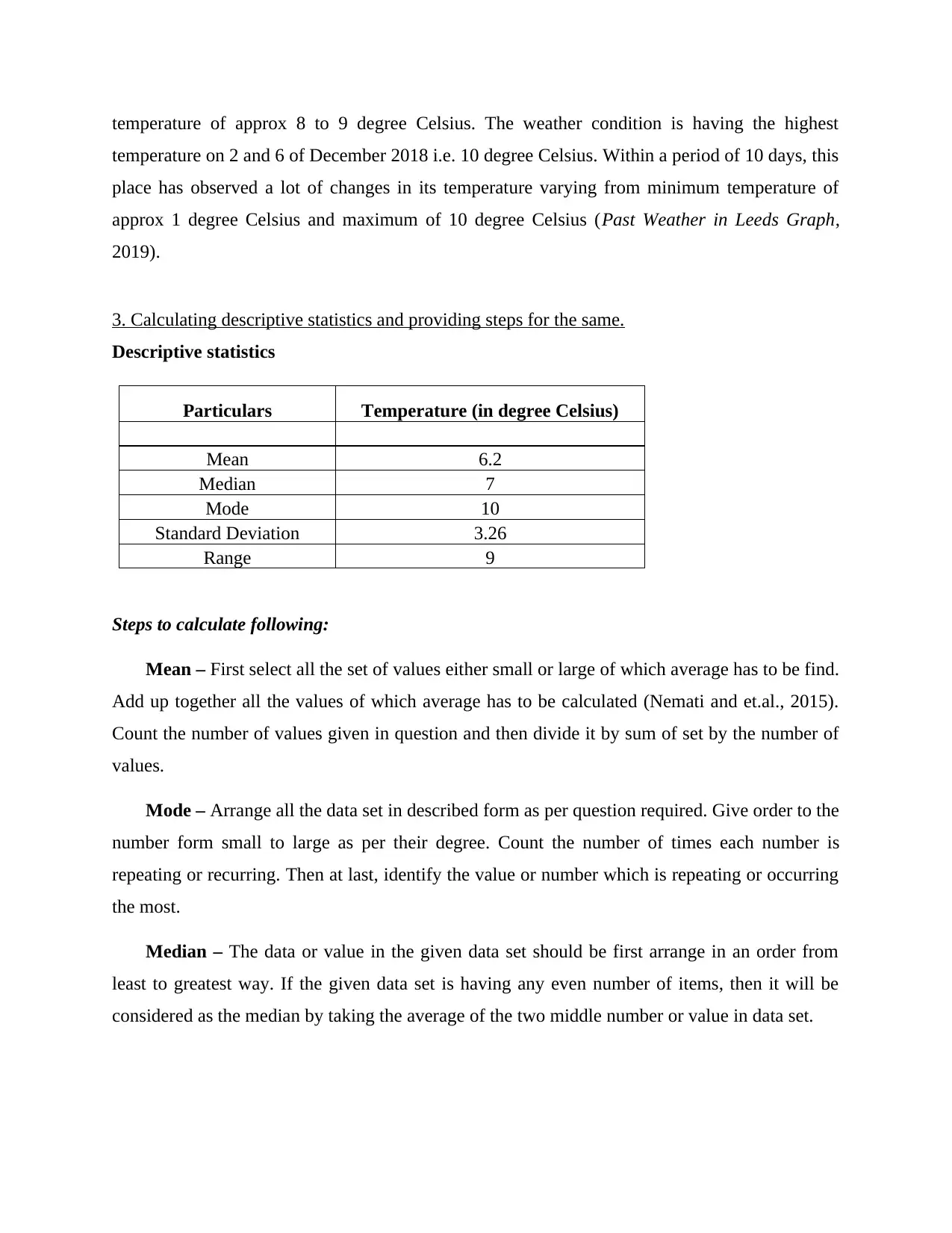
Line graph
Document Page
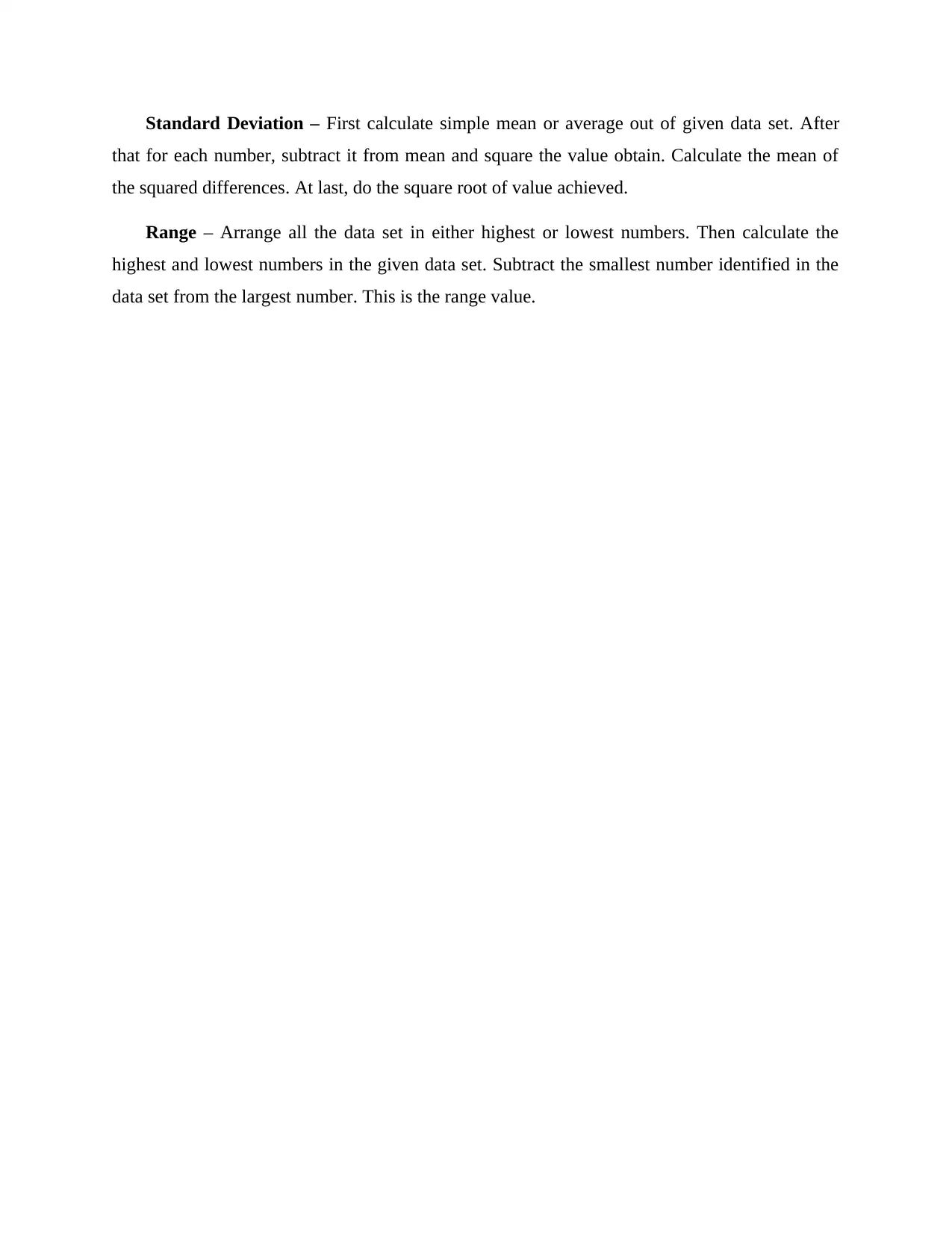
Column graph
Interpretation:
On the basis of above line graph and column graph, it can be interpreted that the weather
condition in Leeds, England during last 10 days have seen various fluctuating trends related to
the temperature and weather conditions. On first day of December 2018, Leeds is having a
Document Page
temperature of approx 8 to 9 degree Celsius. The weather condition is having the highest
temperature on 2 and 6 of December 2018 i.e. 10 degree Celsius. Within a period of 10 days, this
place has observed a lot of changes in its temperature varying from minimum temperature of
approx 1 degree Celsius and maximum of 10 degree Celsius (Past Weather in Leeds Graph,
2019).
3. Calculating descriptive statistics and providing steps for the same.
Descriptive statistics
Particulars Temperature (in degree Celsius)
Mean 6.2
Median 7
Mode 10
Standard Deviation 3.26
Range 9
Steps to calculate following:
Mean – First select all the set of values either small or large of which average has to be find.
Add up together all the values of which average has to be calculated (Nemati and et.al., 2015).
Count the number of values given in question and then divide it by sum of set by the number of
values.
Mode – Arrange all the data set in described form as per question required. Give order to the
number form small to large as per their degree. Count the number of times each number is
repeating or recurring. Then at last, identify the value or number which is repeating or occurring
the most.
Median – The data or value in the given data set should be first arrange in an order from
least to greatest way. If the given data set is having any even number of items, then it will be
considered as the median by taking the average of the two middle number or value in data set.
tabler-icon-diamond-filled.svg

Paraphrase This Document

Need a fresh take? Get an instant paraphrase of this document with our AI Paraphraser
Document Page
Standard Deviation – First calculate simple mean or average out of given data set. After
that for each number, subtract it from mean and square the value obtain. Calculate the mean of
the squared differences. At last, do the square root of value achieved.
Range – Arrange all the data set in either highest or lowest numbers. Then calculate the
highest and lowest numbers in the given data set. Subtract the smallest number identified in the
data set from the largest number. This is the range value.
Document Page
REFERENCES
Books and Journals
Nemati, H. and et.al., 2015. Mean statistics of a heated turbulent pipe flow at supercritical
pressure. International Journal of Heat and Mass Transfer. 83. pp.741-752.
Gupta, K. R. and Gupta, M. P., 2017. Business statistics. Atlantic Publishers & Distributors.
Yu, H. and et.al., 2019. Gaussian Processes, Median Statistics, Milky Way Rotation Curves.
arXiv preprint arXiv:1903.00892.
Haughton, J. and Kelly, A., 2015. Student performance in an introductory business statistics
course: does delivery mode matter?. Journal of Education for Business. 90(1). pp.31-43.
Quan, H. and et.al., 2018. Estimation of Standard Deviation for a Log-Transformed Variable
Based on Summary Statistics in the Original Scale. Statistics in Biopharmaceutical
Research.10(1). pp.30-38.
Biswas, S. and Goehring, L., 2016. Interface propagation in fiber bundles: local, mean-field and
intermediate range-dependent statistics. New Journal of Physics. 18(10). p.103048.
Online
Past Weather in Leeds Graph. 2019. [Online]. Available through:
<https://www.timeanddate.com/weather/uk/leeds/historic?hd=20190505>.
chevron_up_icon
1 out of 6
circle_padding
hide_on_mobile
zoom_out_icon
[object Object]