Analysis of Business Decision Analytics: Ray White Case Study, MGT602
VerifiedAdded on 2022/10/12
|19
|4198
|83
Case Study
AI Summary
This case study examines the business decision analytics of Ray White, Australia's largest real estate group. It begins with an introduction to the company and its operations, followed by an interpretation of data analytics from an employee survey, focusing on workforce diversity, performance metrics, and target achievement. The study then explores the effective use of decision-making tools, including SWOT analysis, feasibility studies, and brainstorming, to address organizational challenges such as employees not meeting their targets. Recommendations are provided to improve business decision-making, including training, performance monitoring, and target reviews. The analysis underscores the importance of data-driven insights and strategic tools for enhancing performance and achieving sustainable outcomes within a diverse work environment. The case study highlights the need for proactive measures to improve employee productivity and overall organizational success.
Running head: Business Decision Analytics
Topic: Business Decision Analytics, Case study of Ray white
Name of the Student:
Name of the University:
Author Note:
Topic: Business Decision Analytics, Case study of Ray white
Name of the Student:
Name of the University:
Author Note:

Paraphrase This Document
Need a fresh take? Get an instant paraphrase of this document with our AI Paraphraser
Business Decision Analytics 1
Table of Contents
Introduction:...............................................................................................................................2
Interpretation of the data analytics pertinent to a relevant contemporary organisational
challenge:...................................................................................................................................2
Discussion of the effective use of decision making tools in the contemporary organisational
situations:...................................................................................................................................7
Compare and contrast of the decision making in a range of business contexts:......................10
Evaluation of the systems and techniques to support effective decision-making in
organisations:...........................................................................................................................11
Recommendations to improve the business decision making:.................................................12
Conclusion:..............................................................................................................................13
Reference list:...........................................................................................................................14
Appendix 1:..............................................................................................................................17
Table of Contents
Introduction:...............................................................................................................................2
Interpretation of the data analytics pertinent to a relevant contemporary organisational
challenge:...................................................................................................................................2
Discussion of the effective use of decision making tools in the contemporary organisational
situations:...................................................................................................................................7
Compare and contrast of the decision making in a range of business contexts:......................10
Evaluation of the systems and techniques to support effective decision-making in
organisations:...........................................................................................................................11
Recommendations to improve the business decision making:.................................................12
Conclusion:..............................................................................................................................13
Reference list:...........................................................................................................................14
Appendix 1:..............................................................................................................................17
Business Decision Analytics 2
Introduction:
Ray White is the Australia’s largest real estate group with 60, 000 properties for sale
every year. The organisation has been operating for more than 110 years now and seeks
values to be proud of every transaction that this family owned and leading the market
leadership of Australia and New Zealand. The company’s name has become synonymous
with every property and real estate industry with an annual turnover of AU$27 billion
(Raywhite.com, 2019). One of the most value-added services is to provide the customers with
the best solution through their property network and providing the any real estate and
property service.
The aim of this report is to carry out a detailed discussion on the selection of decision
making tools and the effective use of it in order to improve the organisational performance.
Working collaboratively as a team and utilising each resource of the organisation to build up
a strong team is indeed an important factor in today’s work culture. However, as a result of
the intense diversity at the work place it is leading to certain conflicts as well. It is the role of
the managers or leaders to understand the need of the hour and come up with certain action to
overcome the conflict and at the same time make maximum utilisation of the diverse
resources working in the organisation.
Interpretation of the data analytics pertinent to a relevant contemporary organisational
challenge:
A survey had been conducted among 60 employees working in the organisation. The
idea was to understand the diversity of the workforce. There were certain parameters to get
the information, these include, employee information like gender – to know the ratio of male
to female employees, their individual ages to know about the age group of the working force.
It was found that all the employees involved in the survey were full time employees but the
Introduction:
Ray White is the Australia’s largest real estate group with 60, 000 properties for sale
every year. The organisation has been operating for more than 110 years now and seeks
values to be proud of every transaction that this family owned and leading the market
leadership of Australia and New Zealand. The company’s name has become synonymous
with every property and real estate industry with an annual turnover of AU$27 billion
(Raywhite.com, 2019). One of the most value-added services is to provide the customers with
the best solution through their property network and providing the any real estate and
property service.
The aim of this report is to carry out a detailed discussion on the selection of decision
making tools and the effective use of it in order to improve the organisational performance.
Working collaboratively as a team and utilising each resource of the organisation to build up
a strong team is indeed an important factor in today’s work culture. However, as a result of
the intense diversity at the work place it is leading to certain conflicts as well. It is the role of
the managers or leaders to understand the need of the hour and come up with certain action to
overcome the conflict and at the same time make maximum utilisation of the diverse
resources working in the organisation.
Interpretation of the data analytics pertinent to a relevant contemporary organisational
challenge:
A survey had been conducted among 60 employees working in the organisation. The
idea was to understand the diversity of the workforce. There were certain parameters to get
the information, these include, employee information like gender – to know the ratio of male
to female employees, their individual ages to know about the age group of the working force.
It was found that all the employees involved in the survey were full time employees but the
⊘ This is a preview!⊘
Do you want full access?
Subscribe today to unlock all pages.

Trusted by 1+ million students worldwide
Business Decision Analytics 3
year of service extended till 13 years. Thus, it can be said that the organisation has a mixed
group of people with good and average work experiences. These employees were working as
junior, middle tier and senior, mostly depending on the years of experience.
These people had to report to few senior members in their respective teams like
finance, technical, marketing, human resource and others. They had to work on the various
projects and had to meet their respective target as well. It has been observed that 26 of them
did not meet their quarterly target whereas 34 of them met it. Again there was a category of
performance rating to estimate the overall performance of the employees. It has been
observed from the collected data that 18 of the employees fall under the acceptable range of
performance. The other 27 of the people were performing well and the remaining 13 were
falling under the outstanding performance throughout the year.
Graphical representation of the above discussion:
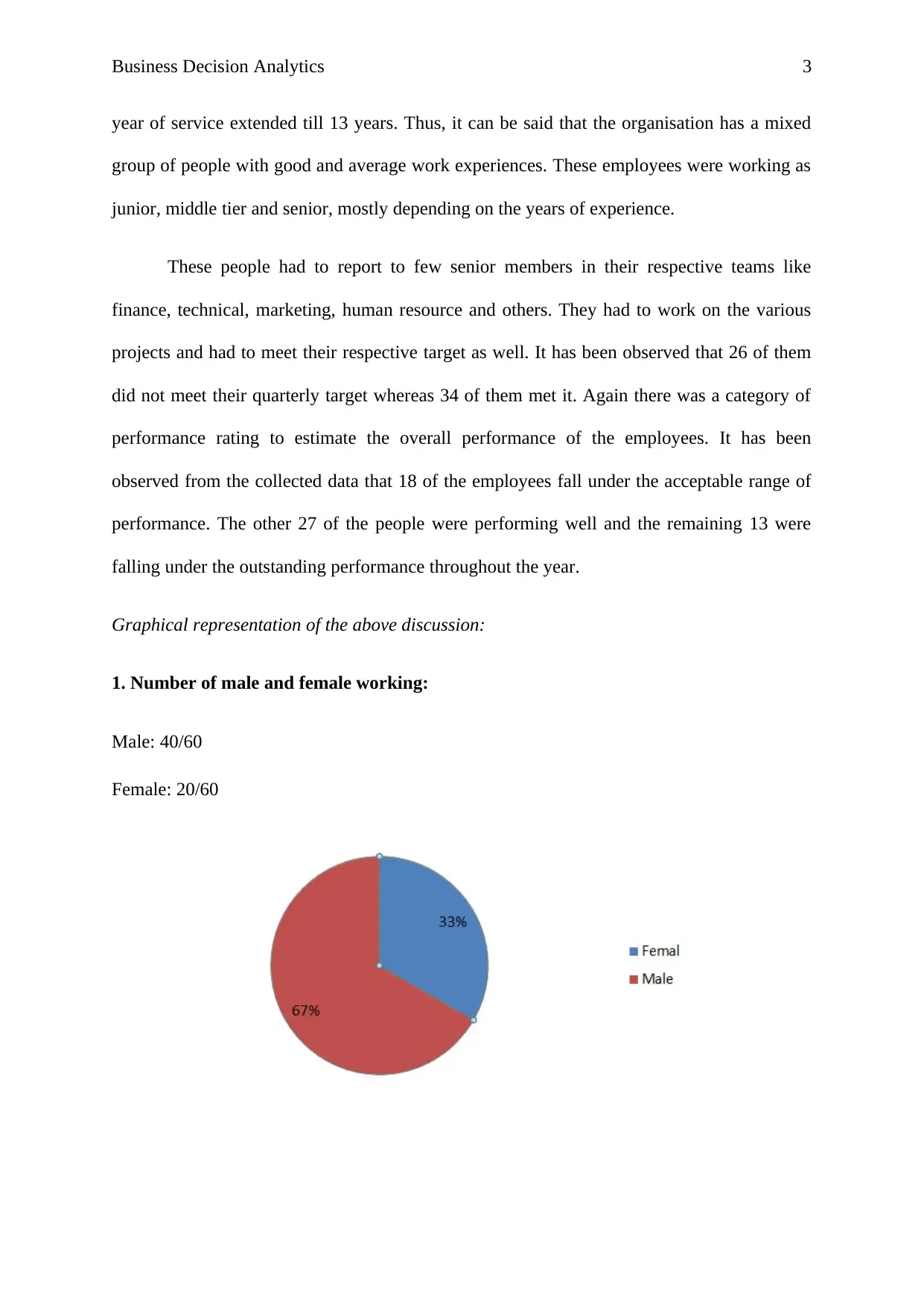
1. Number of male and female working:
Male: 40/60
Female: 20/60
year of service extended till 13 years. Thus, it can be said that the organisation has a mixed
group of people with good and average work experiences. These employees were working as
junior, middle tier and senior, mostly depending on the years of experience.
These people had to report to few senior members in their respective teams like
finance, technical, marketing, human resource and others. They had to work on the various
projects and had to meet their respective target as well. It has been observed that 26 of them
did not meet their quarterly target whereas 34 of them met it. Again there was a category of
performance rating to estimate the overall performance of the employees. It has been
observed from the collected data that 18 of the employees fall under the acceptable range of
performance. The other 27 of the people were performing well and the remaining 13 were
falling under the outstanding performance throughout the year.
Graphical representation of the above discussion:
1. Number of male and female working:
Male: 40/60
Female: 20/60
Paraphrase This Document
Need a fresh take? Get an instant paraphrase of this document with our AI Paraphraser
Business Decision Analytics 4
From the above data it is clear that the organisation has more male employees and
thus, can be dominated by the males. However, it has also been noted that the percentage is
50% when it comes to the male employees working at the senior level.
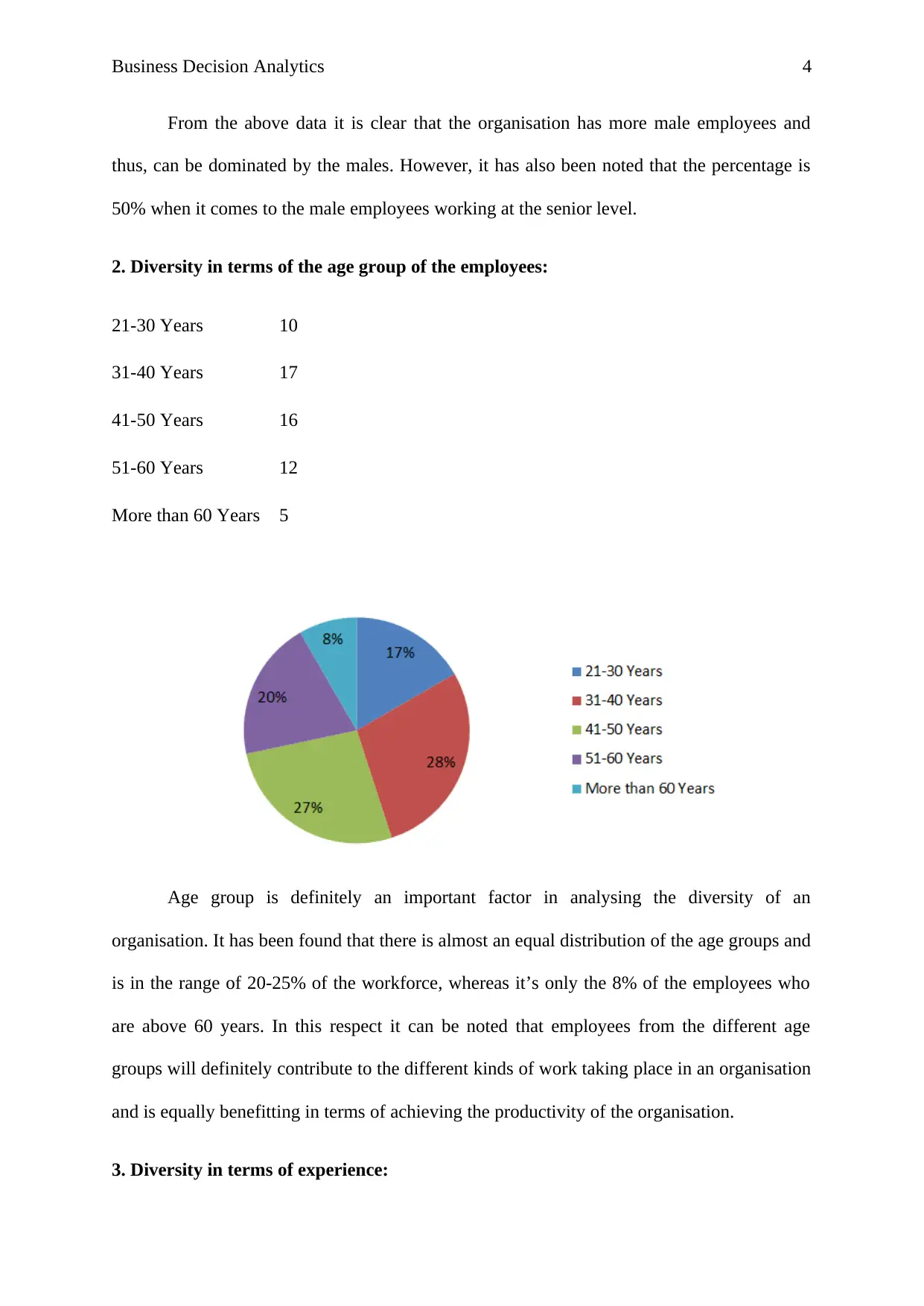
2. Diversity in terms of the age group of the employees:
21-30 Years 10
31-40 Years 17
41-50 Years 16
51-60 Years 12
More than 60 Years 5
Age group is definitely an important factor in analysing the diversity of an
organisation. It has been found that there is almost an equal distribution of the age groups and
is in the range of 20-25% of the workforce, whereas it’s only the 8% of the employees who
are above 60 years. In this respect it can be noted that employees from the different age
groups will definitely contribute to the different kinds of work taking place in an organisation
and is equally benefitting in terms of achieving the productivity of the organisation.
3. Diversity in terms of experience:
From the above data it is clear that the organisation has more male employees and
thus, can be dominated by the males. However, it has also been noted that the percentage is
50% when it comes to the male employees working at the senior level.
2. Diversity in terms of the age group of the employees:
21-30 Years 10
31-40 Years 17
41-50 Years 16
51-60 Years 12
More than 60 Years 5
Age group is definitely an important factor in analysing the diversity of an
organisation. It has been found that there is almost an equal distribution of the age groups and
is in the range of 20-25% of the workforce, whereas it’s only the 8% of the employees who
are above 60 years. In this respect it can be noted that employees from the different age
groups will definitely contribute to the different kinds of work taking place in an organisation
and is equally benefitting in terms of achieving the productivity of the organisation.
3. Diversity in terms of experience:
Business Decision Analytics 5
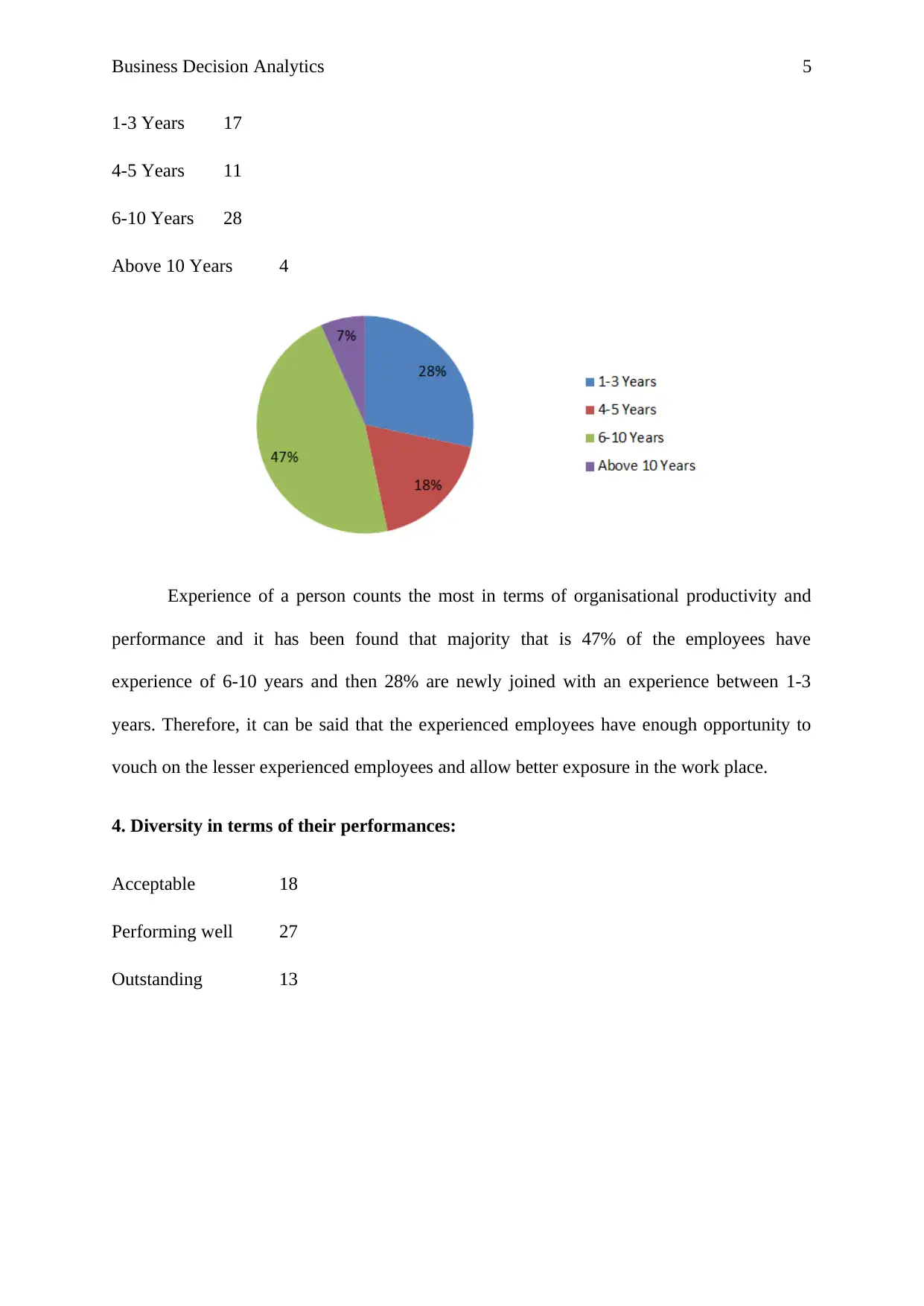
1-3 Years 17
4-5 Years 11
6-10 Years 28
Above 10 Years 4
Experience of a person counts the most in terms of organisational productivity and
performance and it has been found that majority that is 47% of the employees have
experience of 6-10 years and then 28% are newly joined with an experience between 1-3
years. Therefore, it can be said that the experienced employees have enough opportunity to
vouch on the lesser experienced employees and allow better exposure in the work place.
4. Diversity in terms of their performances:
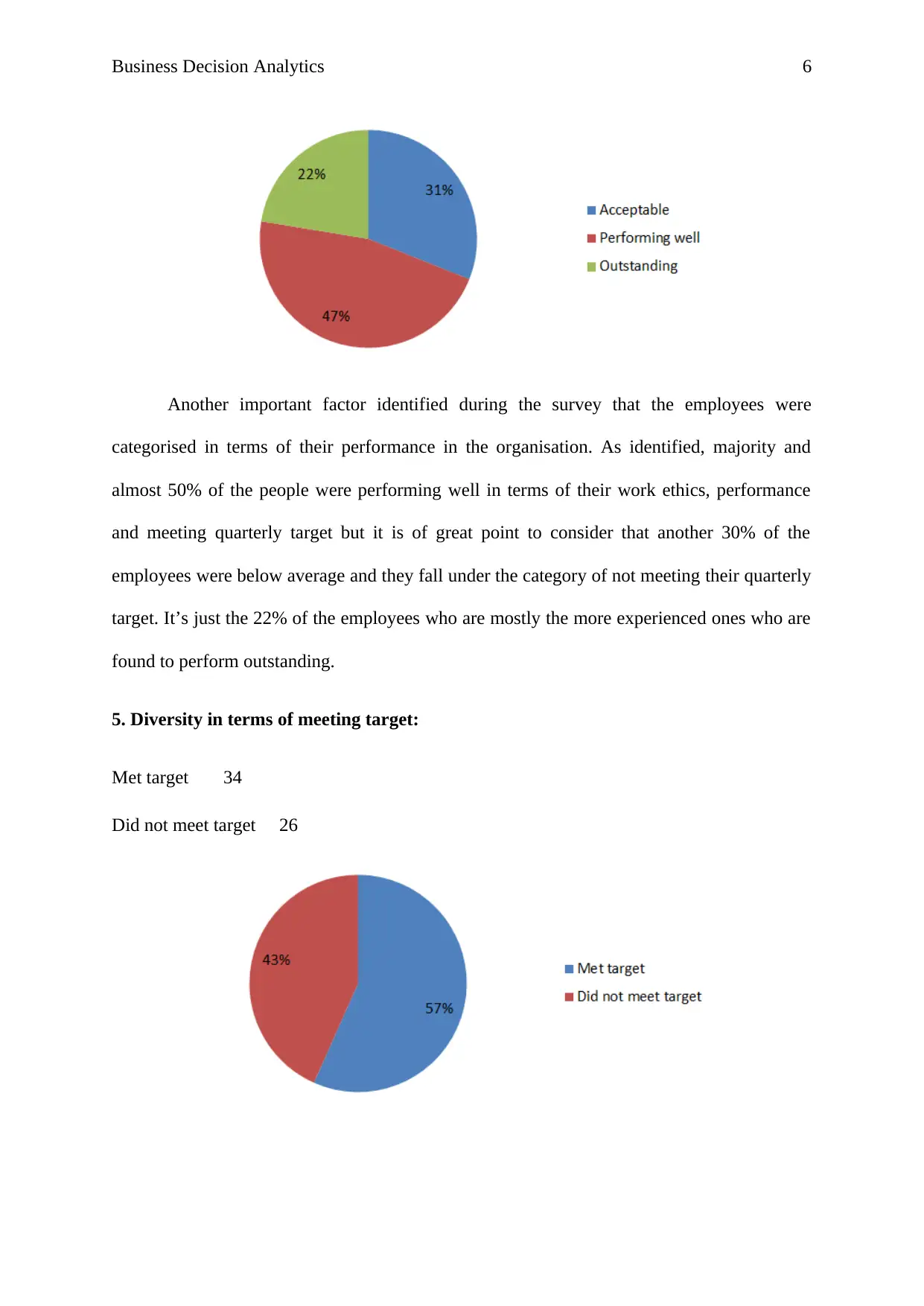
Acceptable 18
Performing well 27
Outstanding 13
1-3 Years 17
4-5 Years 11
6-10 Years 28
Above 10 Years 4
Experience of a person counts the most in terms of organisational productivity and
performance and it has been found that majority that is 47% of the employees have
experience of 6-10 years and then 28% are newly joined with an experience between 1-3
years. Therefore, it can be said that the experienced employees have enough opportunity to
vouch on the lesser experienced employees and allow better exposure in the work place.
4. Diversity in terms of their performances:
Acceptable 18
Performing well 27
Outstanding 13
⊘ This is a preview!⊘
Do you want full access?
Subscribe today to unlock all pages.
Trusted by 1+ million students worldwide
Business Decision Analytics 6
Another important factor identified during the survey that the employees were
categorised in terms of their performance in the organisation. As identified, majority and
almost 50% of the people were performing well in terms of their work ethics, performance
and meeting quarterly target but it is of great point to consider that another 30% of the
employees were below average and they fall under the category of not meeting their quarterly
target. It’s just the 22% of the employees who are mostly the more experienced ones who are
found to perform outstanding.
5. Diversity in terms of meeting target:
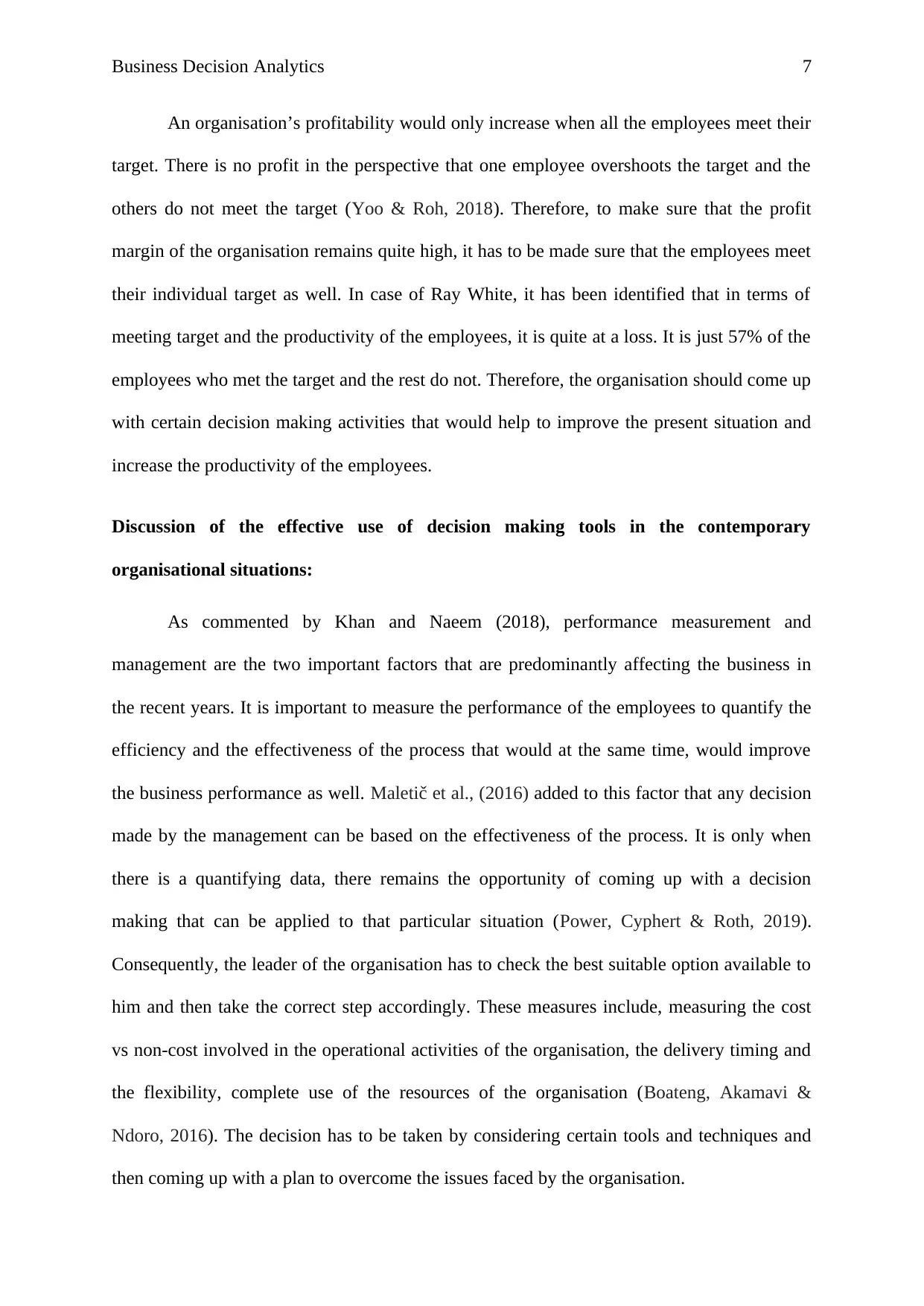
Met target 34
Did not meet target 26
Another important factor identified during the survey that the employees were
categorised in terms of their performance in the organisation. As identified, majority and
almost 50% of the people were performing well in terms of their work ethics, performance
and meeting quarterly target but it is of great point to consider that another 30% of the
employees were below average and they fall under the category of not meeting their quarterly
target. It’s just the 22% of the employees who are mostly the more experienced ones who are
found to perform outstanding.
5. Diversity in terms of meeting target:
Met target 34
Did not meet target 26
Paraphrase This Document
Need a fresh take? Get an instant paraphrase of this document with our AI Paraphraser
Business Decision Analytics 7
An organisation’s profitability would only increase when all the employees meet their
target. There is no profit in the perspective that one employee overshoots the target and the
others do not meet the target (Yoo & Roh, 2018). Therefore, to make sure that the profit
margin of the organisation remains quite high, it has to be made sure that the employees meet
their individual target as well. In case of Ray White, it has been identified that in terms of
meeting target and the productivity of the employees, it is quite at a loss. It is just 57% of the
employees who met the target and the rest do not. Therefore, the organisation should come up
with certain decision making activities that would help to improve the present situation and
increase the productivity of the employees.
Discussion of the effective use of decision making tools in the contemporary
organisational situations:
As commented by Khan and Naeem (2018), performance measurement and
management are the two important factors that are predominantly affecting the business in
the recent years. It is important to measure the performance of the employees to quantify the
efficiency and the effectiveness of the process that would at the same time, would improve
the business performance as well. Maletič et al., (2016) added to this factor that any decision
made by the management can be based on the effectiveness of the process. It is only when
there is a quantifying data, there remains the opportunity of coming up with a decision
making that can be applied to that particular situation (Power, Cyphert & Roth, 2019).
Consequently, the leader of the organisation has to check the best suitable option available to
him and then take the correct step accordingly. These measures include, measuring the cost
vs non-cost involved in the operational activities of the organisation, the delivery timing and
the flexibility, complete use of the resources of the organisation (Boateng, Akamavi &
Ndoro, 2016). The decision has to be taken by considering certain tools and techniques and
then coming up with a plan to overcome the issues faced by the organisation.
An organisation’s profitability would only increase when all the employees meet their
target. There is no profit in the perspective that one employee overshoots the target and the
others do not meet the target (Yoo & Roh, 2018). Therefore, to make sure that the profit
margin of the organisation remains quite high, it has to be made sure that the employees meet
their individual target as well. In case of Ray White, it has been identified that in terms of
meeting target and the productivity of the employees, it is quite at a loss. It is just 57% of the
employees who met the target and the rest do not. Therefore, the organisation should come up
with certain decision making activities that would help to improve the present situation and
increase the productivity of the employees.
Discussion of the effective use of decision making tools in the contemporary
organisational situations:
As commented by Khan and Naeem (2018), performance measurement and
management are the two important factors that are predominantly affecting the business in
the recent years. It is important to measure the performance of the employees to quantify the
efficiency and the effectiveness of the process that would at the same time, would improve
the business performance as well. Maletič et al., (2016) added to this factor that any decision
made by the management can be based on the effectiveness of the process. It is only when
there is a quantifying data, there remains the opportunity of coming up with a decision
making that can be applied to that particular situation (Power, Cyphert & Roth, 2019).
Consequently, the leader of the organisation has to check the best suitable option available to
him and then take the correct step accordingly. These measures include, measuring the cost
vs non-cost involved in the operational activities of the organisation, the delivery timing and
the flexibility, complete use of the resources of the organisation (Boateng, Akamavi &
Ndoro, 2016). The decision has to be taken by considering certain tools and techniques and
then coming up with a plan to overcome the issues faced by the organisation.
Business Decision Analytics 8
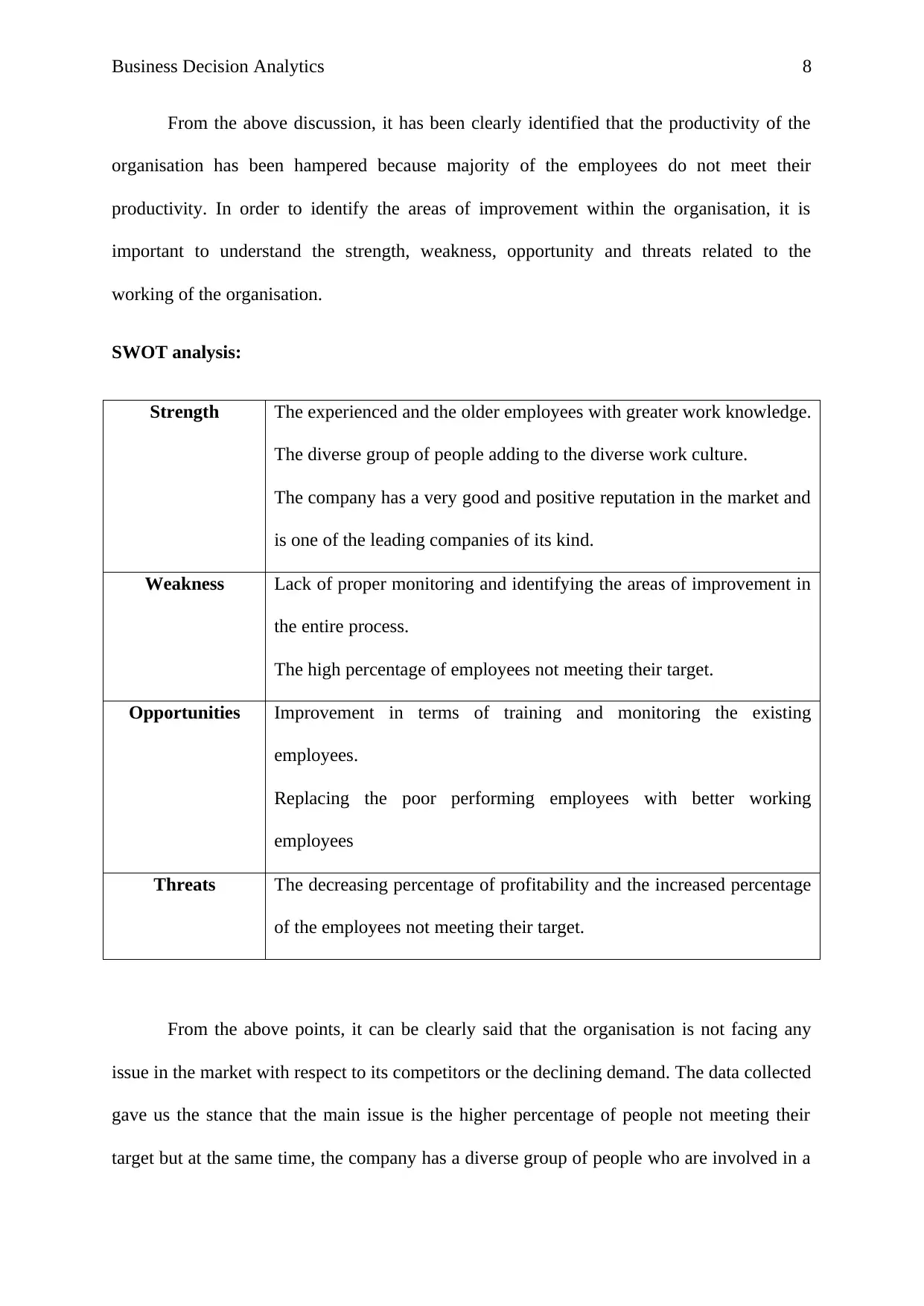
From the above discussion, it has been clearly identified that the productivity of the
organisation has been hampered because majority of the employees do not meet their
productivity. In order to identify the areas of improvement within the organisation, it is
important to understand the strength, weakness, opportunity and threats related to the
working of the organisation.
SWOT analysis:
Strength The experienced and the older employees with greater work knowledge.
The diverse group of people adding to the diverse work culture.
The company has a very good and positive reputation in the market and
is one of the leading companies of its kind.
Weakness Lack of proper monitoring and identifying the areas of improvement in
the entire process.
The high percentage of employees not meeting their target.
Opportunities Improvement in terms of training and monitoring the existing
employees.
Replacing the poor performing employees with better working
employees
Threats The decreasing percentage of profitability and the increased percentage
of the employees not meeting their target.
From the above points, it can be clearly said that the organisation is not facing any
issue in the market with respect to its competitors or the declining demand. The data collected
gave us the stance that the main issue is the higher percentage of people not meeting their
target but at the same time, the company has a diverse group of people who are involved in a
From the above discussion, it has been clearly identified that the productivity of the
organisation has been hampered because majority of the employees do not meet their
productivity. In order to identify the areas of improvement within the organisation, it is
important to understand the strength, weakness, opportunity and threats related to the
working of the organisation.
SWOT analysis:
Strength The experienced and the older employees with greater work knowledge.
The diverse group of people adding to the diverse work culture.
The company has a very good and positive reputation in the market and
is one of the leading companies of its kind.
Weakness Lack of proper monitoring and identifying the areas of improvement in
the entire process.
The high percentage of employees not meeting their target.
Opportunities Improvement in terms of training and monitoring the existing
employees.
Replacing the poor performing employees with better working
employees
Threats The decreasing percentage of profitability and the increased percentage
of the employees not meeting their target.
From the above points, it can be clearly said that the organisation is not facing any
issue in the market with respect to its competitors or the declining demand. The data collected
gave us the stance that the main issue is the higher percentage of people not meeting their
target but at the same time, the company has a diverse group of people who are involved in a
⊘ This is a preview!⊘
Do you want full access?
Subscribe today to unlock all pages.
Trusted by 1+ million students worldwide
Business Decision Analytics 9
variety of work. This diverse work force can add to greater benefit of the organisation if
utilised in a proper and significant way.
Feasibility study:
Once the opportunities to improve the condition of the organisational productivity are
identified, it is needed to identify the feasibility of applying a particular technique to improve
the situation. In this respect, it can be said that in order to increase the percentage of the
employees who have to meet their quarterly target, it is important to keep a track of the
performance of those employees and monitor them effectively (Maletič, Maletič &
Gomišček, 2016). It has been seen that these employees report to a particular team or a
person at a higher level. This person shall be responsible to evaluate and monitor the
performance of the employees working under him. This is much effective this way the
employees would be very conscious about their own productivity because failing to which
will result in higher penalties that would directly affect their pay scale as well as the
performance (Chahal, Jyoti & Wirtz, 2018). As it has been seen that Ray White is a real
estate business organisation and that the target of the employees would be more based on the
higher amount of properties sold to the customers, focus has to be made on the fact that the
employees are making the right effort to sell properties (Riratanaphong & van der Voordt,
2015). Therefore, the target can be review monthly instead of getting it reviewed once in a
quarter. IF the span of review is shortened, it will automatically increase the vigilance on the
employees regarding the target and there can be a positive improvement of the percentage of
people meeting the target.
Training the employees on each area of operation is another important and feasible
option that can be applied to improve the productivity of the organisation is by incorporating
training sessions on a regular basis among the highest defaulters or the low achievers in terms
variety of work. This diverse work force can add to greater benefit of the organisation if
utilised in a proper and significant way.
Feasibility study:
Once the opportunities to improve the condition of the organisational productivity are
identified, it is needed to identify the feasibility of applying a particular technique to improve
the situation. In this respect, it can be said that in order to increase the percentage of the
employees who have to meet their quarterly target, it is important to keep a track of the
performance of those employees and monitor them effectively (Maletič, Maletič &
Gomišček, 2016). It has been seen that these employees report to a particular team or a
person at a higher level. This person shall be responsible to evaluate and monitor the
performance of the employees working under him. This is much effective this way the
employees would be very conscious about their own productivity because failing to which
will result in higher penalties that would directly affect their pay scale as well as the
performance (Chahal, Jyoti & Wirtz, 2018). As it has been seen that Ray White is a real
estate business organisation and that the target of the employees would be more based on the
higher amount of properties sold to the customers, focus has to be made on the fact that the
employees are making the right effort to sell properties (Riratanaphong & van der Voordt,
2015). Therefore, the target can be review monthly instead of getting it reviewed once in a
quarter. IF the span of review is shortened, it will automatically increase the vigilance on the
employees regarding the target and there can be a positive improvement of the percentage of
people meeting the target.
Training the employees on each area of operation is another important and feasible
option that can be applied to improve the productivity of the organisation is by incorporating
training sessions on a regular basis among the highest defaulters or the low achievers in terms
Paraphrase This Document
Need a fresh take? Get an instant paraphrase of this document with our AI Paraphraser
Business Decision Analytics 10
of their productivity. It has to be noted that there are many experienced people working in the
organisation and they are the ones who could give training to the bottom performers of the
organisation. Moreover, the experience of these people would act as a guideline for the low
performers and the same way there can be significant improvement among the employees
working in Ray White.
Brainstorming:
The most effective factor in the decision making process is the brain storming
process. It is the process of generating ideas to overcome the issues by studying the behaviour
and the activities of a group and then coming up with a rigid plan to support the ideas and
thinking. This is done by the organisational leader who is responsible for the broadened
aspect of the organisational activities and has the responsibility to improve the productivity of
the organisation (Porcu, Del Barrio-Garcia & Kitchen, 2017). From here, it can be said that
the organisation can also come up with a plan of mentoring the existing employees who are
not performing well. There should be a leader among the different project groups who shall
be responsible to check and measure the productivity of the employees working there.
Compare and contrast of the decision making in a range of business contexts:
Comparing the decision making tools identified for Ray White with other kinds of
businesses, it has been observed that the real estate company has to come up with plans
internally within their organisational setting to make the improvement. It can be pointed out
here that the organisation is doing very good in the market where it operates but there is an
issue with the performance of the employees that is hindering the overall productivity
(Aguwa, Olya & Monplaisir, 2017). Therefore, there is lesser scope of carrying out a market
analysis to understand the customer demand and then act accordingly. Moreover, the cost
benefit analysis would help the organisation to get an idea of the money spent and what they
of their productivity. It has to be noted that there are many experienced people working in the
organisation and they are the ones who could give training to the bottom performers of the
organisation. Moreover, the experience of these people would act as a guideline for the low
performers and the same way there can be significant improvement among the employees
working in Ray White.
Brainstorming:
The most effective factor in the decision making process is the brain storming
process. It is the process of generating ideas to overcome the issues by studying the behaviour
and the activities of a group and then coming up with a rigid plan to support the ideas and
thinking. This is done by the organisational leader who is responsible for the broadened
aspect of the organisational activities and has the responsibility to improve the productivity of
the organisation (Porcu, Del Barrio-Garcia & Kitchen, 2017). From here, it can be said that
the organisation can also come up with a plan of mentoring the existing employees who are
not performing well. There should be a leader among the different project groups who shall
be responsible to check and measure the productivity of the employees working there.
Compare and contrast of the decision making in a range of business contexts:
Comparing the decision making tools identified for Ray White with other kinds of
businesses, it has been observed that the real estate company has to come up with plans
internally within their organisational setting to make the improvement. It can be pointed out
here that the organisation is doing very good in the market where it operates but there is an
issue with the performance of the employees that is hindering the overall productivity
(Aguwa, Olya & Monplaisir, 2017). Therefore, there is lesser scope of carrying out a market
analysis to understand the customer demand and then act accordingly. Moreover, the cost
benefit analysis would help the organisation to get an idea of the money spent and what they
Business Decision Analytics 11
get in return but again, there is no such surcharge involved in the operational activities that
with the help of cost-benefit analysis, the expenditure would have been reduced to meet the
company’s goal. Therefore, considering the business context of being a real estate
organisation, it can be said that the organisation has to come up with internal mechanism to
overcome the issues faced in the recent time (Vidgen, Shaw & Grant, 2017).
Evaluation of the systems and techniques to support effective decision-making in
organisations:
There has to be a number of key performance indicators to show that the proposed
changes made through the decision making tools actually works well and the company in
return gets an improve rate of productivity.
i. Measuring the productivity on monthly basis: As recommended that there has to be a
parameter for measuring the productivity, like the number or the property value that has been
sold by a particular employees that has added to the overall productivity of the organisation
(Wang & Byrd, 2017). At present the employees are working as a group and are reporting to
certain designated names but there has to be performance evaluation manager or HR who
should be closely monitoring the performance and productivity of the employees and would
focus to improve it to improve the organisational productivity.
ii. Conducting training sessions: Training the employees who are in the back drop of the
overall performance chart of the organisation, is the most suitable and actionable plan that is
needed for this organisation to improve its performance statics. As it has been found from the
collected data that around 40% of the workforce has tenure of more than 5 years working in
the company and thus, they are the ones who should be responsible for taking the
responsibility of the new joined or less tenured employees and improve the organisational
productivity (Sousa, 2018).
get in return but again, there is no such surcharge involved in the operational activities that
with the help of cost-benefit analysis, the expenditure would have been reduced to meet the
company’s goal. Therefore, considering the business context of being a real estate
organisation, it can be said that the organisation has to come up with internal mechanism to
overcome the issues faced in the recent time (Vidgen, Shaw & Grant, 2017).
Evaluation of the systems and techniques to support effective decision-making in
organisations:
There has to be a number of key performance indicators to show that the proposed
changes made through the decision making tools actually works well and the company in
return gets an improve rate of productivity.
i. Measuring the productivity on monthly basis: As recommended that there has to be a
parameter for measuring the productivity, like the number or the property value that has been
sold by a particular employees that has added to the overall productivity of the organisation
(Wang & Byrd, 2017). At present the employees are working as a group and are reporting to
certain designated names but there has to be performance evaluation manager or HR who
should be closely monitoring the performance and productivity of the employees and would
focus to improve it to improve the organisational productivity.
ii. Conducting training sessions: Training the employees who are in the back drop of the
overall performance chart of the organisation, is the most suitable and actionable plan that is
needed for this organisation to improve its performance statics. As it has been found from the
collected data that around 40% of the workforce has tenure of more than 5 years working in
the company and thus, they are the ones who should be responsible for taking the
responsibility of the new joined or less tenured employees and improve the organisational
productivity (Sousa, 2018).
⊘ This is a preview!⊘
Do you want full access?
Subscribe today to unlock all pages.
Trusted by 1+ million students worldwide

1 out of 19


Related Documents


Your All-in-One AI-Powered Toolkit for Academic Success.
+13062052269
info@desklib.com
Available 24*7 on WhatsApp / Email
![[object Object]](/_next/static/media/star-bottom.7253800d.svg)
Unlock your academic potential
Copyright © 2020–2026 A2Z Services. All Rights Reserved. Developed and managed by ZUCOL.