Business Decision Making Essay: University of Suffolk, Module 1

Verified

Added on  2023/01/07

|10
|1630
|76
Essay
AI Summary
This essay analyzes business decision-making processes, particularly within the context of capital budgeting and project selection for A&B plc, a British restaurant chain. It applies capital budgeting methods, including payback period and Net Present Value (NPV), to evaluate two projects: a dishwashing system and a software project. The essay calculates and compares the payback periods and NPVs of both projects, providing a detailed financial analysis to determine which investment is more viable. The analysis includes the advantages and disadvantages of both methods. The essay also considers financial factors like return on investment and taxation, alongside non-financial aspects such as brand image, staff morale, and legislation. The conclusion provides a recommendation based on the findings, emphasizing the importance of these techniques in making informed business decisions.

Document Page
Business Decision Making
tabler-icon-diamond-filled.svg

Paraphrase This Document

Need a fresh take? Get an instant paraphrase of this document with our AI Paraphraser
Document Page
Document Page
Contents
INTRODUCTION...........................................................................................................................................3
MAIN BODY.................................................................................................................................................3
1. Calculate payback period.....................................................................................................................3
2. Calculation of Net Present Value (NPV).............................................................................................4
3. Analysis...............................................................................................................................................5
CONCLUSION...............................................................................................................................................7
REFERENCES................................................................................................................................................8
Document Page
INTRODUCTION
A decision can be described as an outcome needlessly evaluated from some kind of number
of options to accredited businesses or operational goal and objectives. Decision-making is a
constant and imperative part of the management of every organisation or business. Decision-
makers can increase the efficiency of assessments and eventually be really instrumental in
delivering their strategic asset and benefit to the success of an organization (Akpan and Joseph,
2017) (Alpenberg and Karlsson, 2019) (Castelli and et.al, 2018) (Christ and Burritt, 2017)
(Jackowicz, Mielcarz and Wnuczak, 2017) (Kaijser, and et.al, 2018) (van der Poll and Mthiyane,
2018). To better understand of the report select the organisation A&B plc which is a British
restaurant and effectively provide services in UK and some other countries. In this report
contains apply capital budgeting methods to select the particular project for the investment and
provide the recommendations.
MAIN BODY
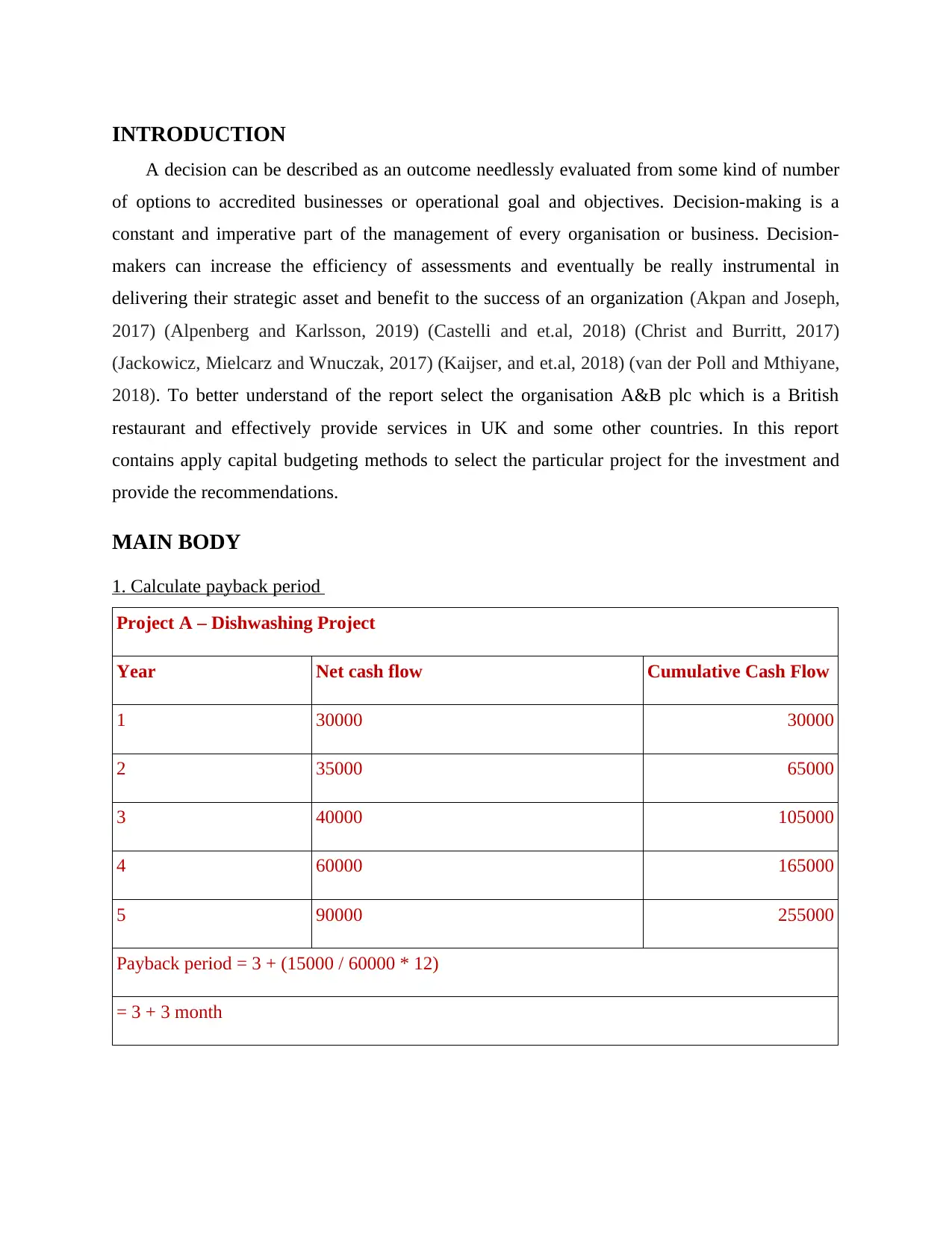
1. Calculate payback period
Project A – Dishwashing Project
Year Net cash flow Cumulative Cash Flow
1 30000 30000
2 35000 65000
3 40000 105000
4 60000 165000
5 90000 255000
Payback period = 3 + (15000 / 60000 * 12)
= 3 + 3 month
tabler-icon-diamond-filled.svg

Paraphrase This Document

Need a fresh take? Get an instant paraphrase of this document with our AI Paraphraser
Document Page
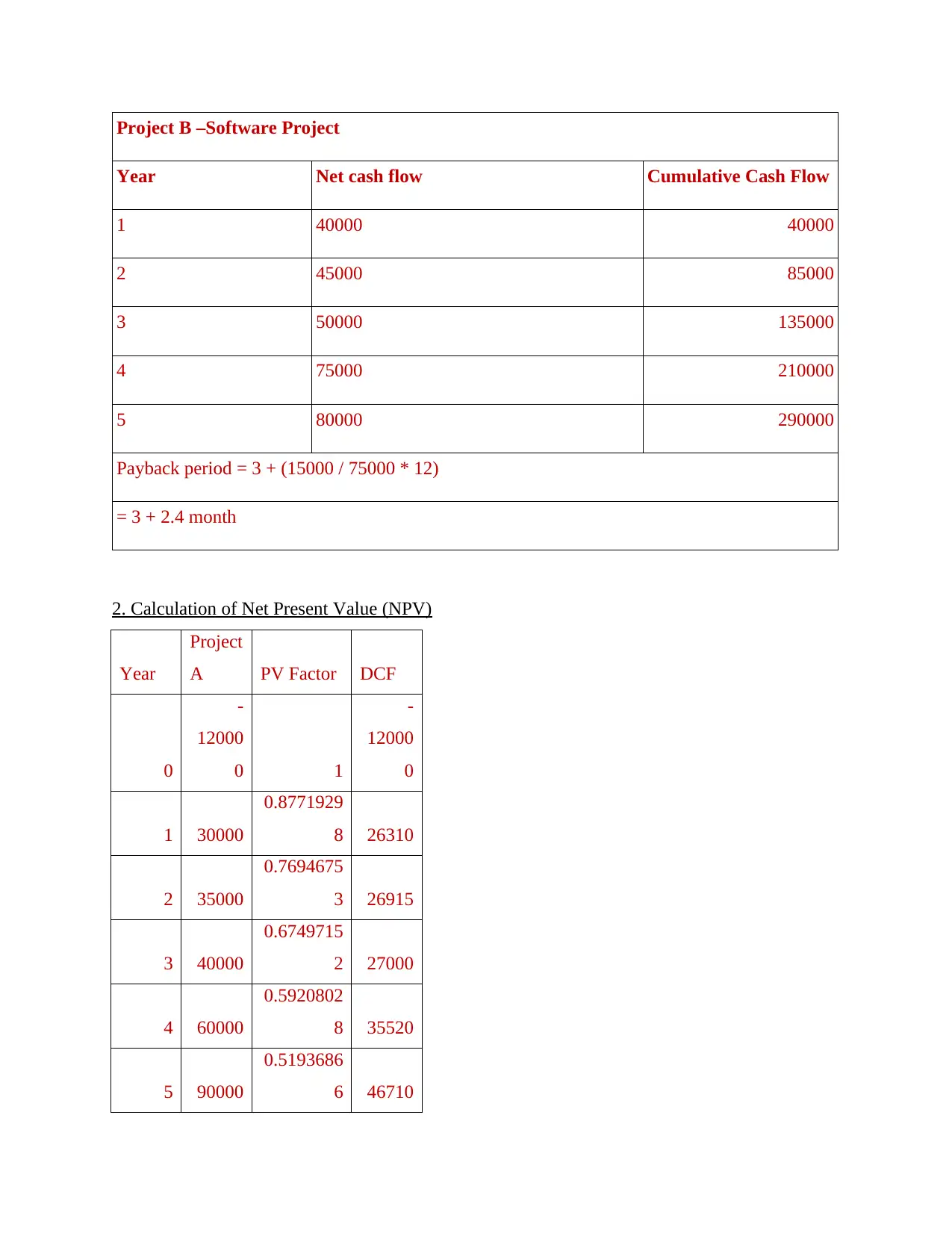
Project B –Software Project
Year Net cash flow Cumulative Cash Flow
1 40000 40000
2 45000 85000
3 50000 135000
4 75000 210000
5 80000 290000
Payback period = 3 + (15000 / 75000 * 12)
= 3 + 2.4 month
2. Calculation of Net Present Value (NPV)
Year
Project
A PV Factor DCF
0
-
12000
0 1
-
12000
0
1 30000
0.8771929
8 26310
2 35000
0.7694675
3 26915
3 40000
0.6749715
2 27000
4 60000
0.5920802
8 35520
5 90000
0.5193686
6 46710
Document Page
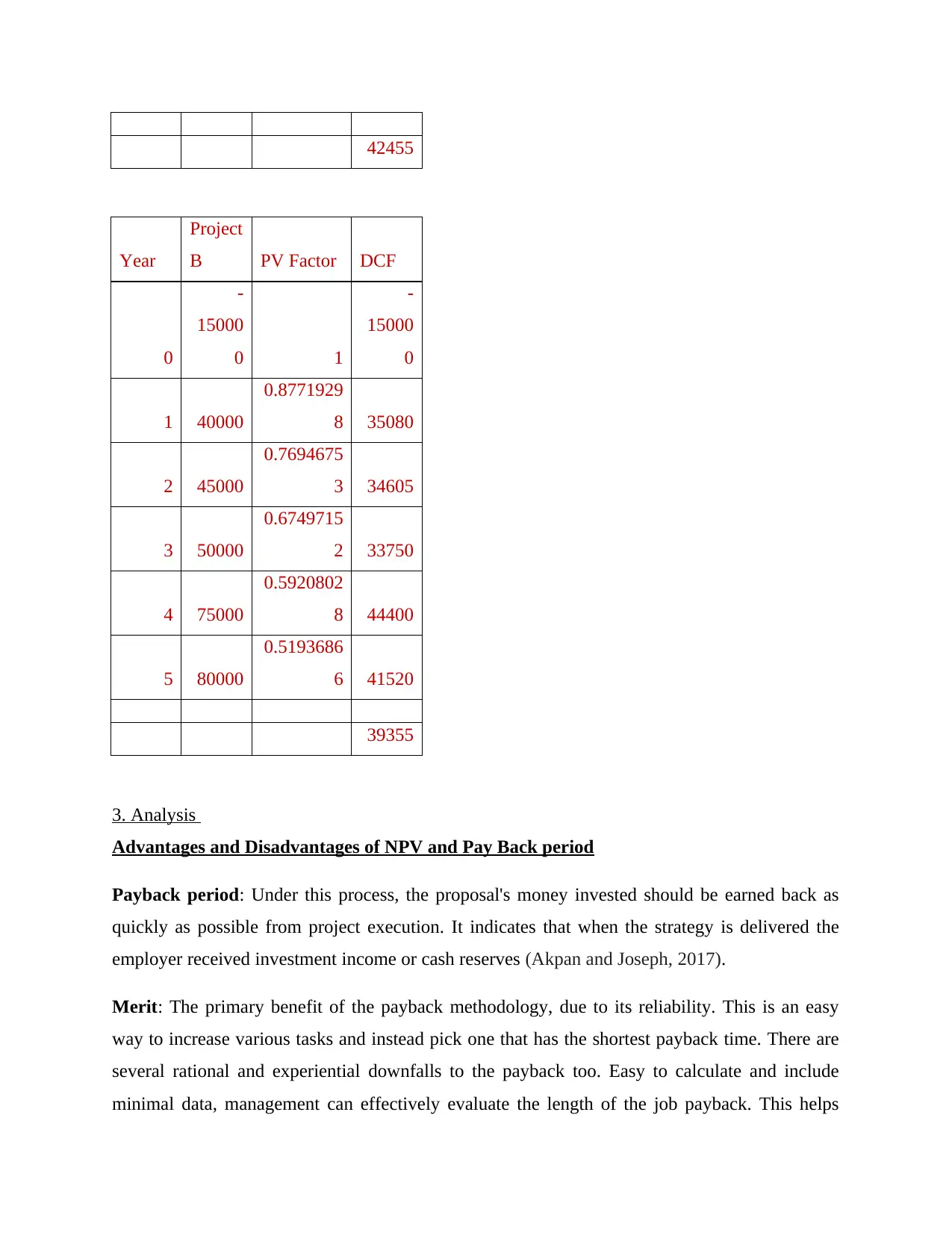
42455
Year
Project
B PV Factor DCF
0
-
15000
0 1
-
15000
0
1 40000
0.8771929
8 35080
2 45000
0.7694675
3 34605
3 50000
0.6749715
2 33750
4 75000
0.5920802
8 44400
5 80000
0.5193686
6 41520
39355
3. Analysis
Advantages and Disadvantages of NPV and Pay Back period
Payback period: Under this process, the proposal's money invested should be earned back as
quickly as possible from project execution. It indicates that when the strategy is delivered the
employer received investment income or cash reserves (Akpan and Joseph, 2017).
Merit: The primary benefit of the payback methodology, due to its reliability. This is an easy
way to increase various tasks and instead pick one that has the shortest payback time. There are
several rational and experiential downfalls to the payback too. Easy to calculate and include
minimal data, management can effectively evaluate the length of the job payback. This helps
Document Page
businesses to make solid option that are particularly requires for commodity-stricken
corporations.
Demerit: A small improvement in labour costs or operational expenses, the sales is completely
affected and the payback period is compromised. This system completely ignores the short - term
liabilities values are given or profitability. By constraining evaluation to gross income of the
venture, it dismisses capital inefficiency and economic structure.
Net present value: This approach is also known as the Net Profit or Excess Present Value
approach. To apply this strategy, they essentially consider the current valuation of an
investment's projected net cash inflows, weighted at construction expense and subtracted the
project's initial expense outlay from it. If the benefits outweigh the risks, it should be recognized
for the proposal: if it is unfavorable, it really should be refused (Alpenberg and Karlsson, 2019).
Merit: The apparent benefit of the discounted cash-value approach is that it takes into account
the simple premise that tomorrow a future dollar is valuable only about one dollar. The capital
expenditures are reduced by every amount of cost of equity in each year.
Demerit: The main downside of the net present value approach is that it needs some trial and
error about the operational cost of the business. Having an overly minimal return on equity
would result to poor development. Presuming too strong a cost of capital would contribute in too
many wise investments being overlooked (Jackowicz, Mielcarz and Wnuczak, 2017).
Financial and non financial factor:
Financial factors
Return on investment: The actual impact on revenue growth is one of the noticeable factors
which affect business decisions. They can quantify this in a multitude of ways sometimes the
easiest way is to calculate a return on investment. The return on an investment is the value of the
profit that actually gains from an operation.
Taxation policy: Taxation is the most prevalent factor that affects economic decisions as it takes
away larger slices of taxable income. A finance manager needs to bear in mind the presence of
tax subsidies when choosing to fund projects (Castelli and et.al, 2018).
tabler-icon-diamond-filled.svg

Paraphrase This Document

Need a fresh take? Get an instant paraphrase of this document with our AI Paraphraser
Document Page
State of economy: At a time because the whole manufacturing sector is in a state of confusion
and there is no sign of hope for healing in the coming months and years, and a significant degree
of cost is connected with financing, it would have been meaningful on the component of a sales
consultant
Non financial factor
Image and brand impact: Many choices that make, in where distribute or market to what rates
and organizations promote, affect the picture. Only so they can potentially boost profits with the
fifty percent off promotion doesn't suggest they can do so if the promotion sends a strong
message also that commodity won't be selling at original retail. It could be cheaper to spend that
collection and start taking a write-off industry.
Improving staff morale: Before apply the new technique in the business require improving the
morale of staff otherwise they are impact in negative manner on the project activity. For this
require to provide training to all the staff members in proper manner (Kaijser, and et.al, 2018).
Current and future legislation: Many legislation impacts on the business that related with
current and future activities. By the program of industrial licensing, the legislation intended to
guarantee that business owners in the government industry do not penetrate restricted areas.
Under those same conditions, a financial department only has to take into account the feasibility
of all those initiatives that the government allows (Christ and Burritt, 2017).
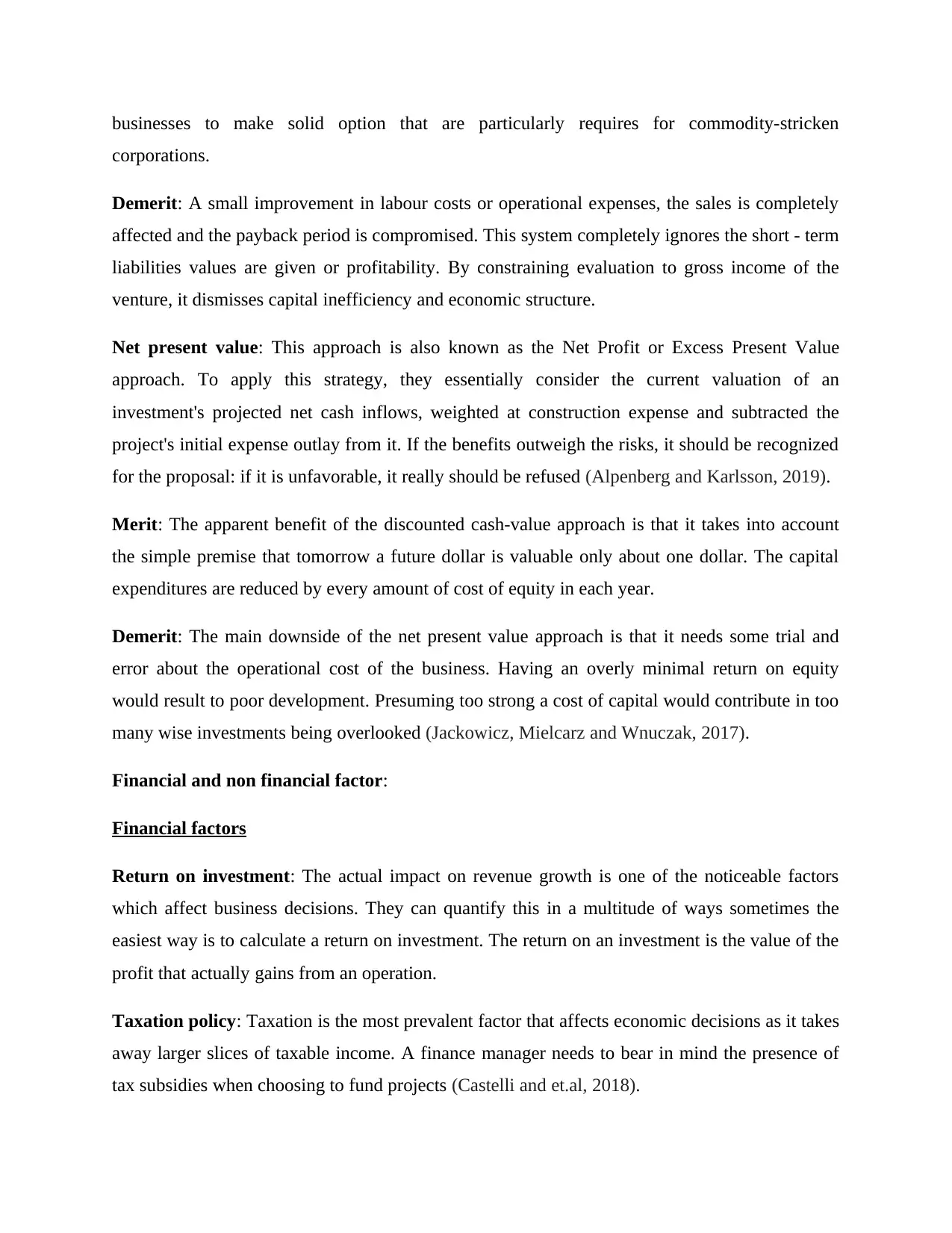
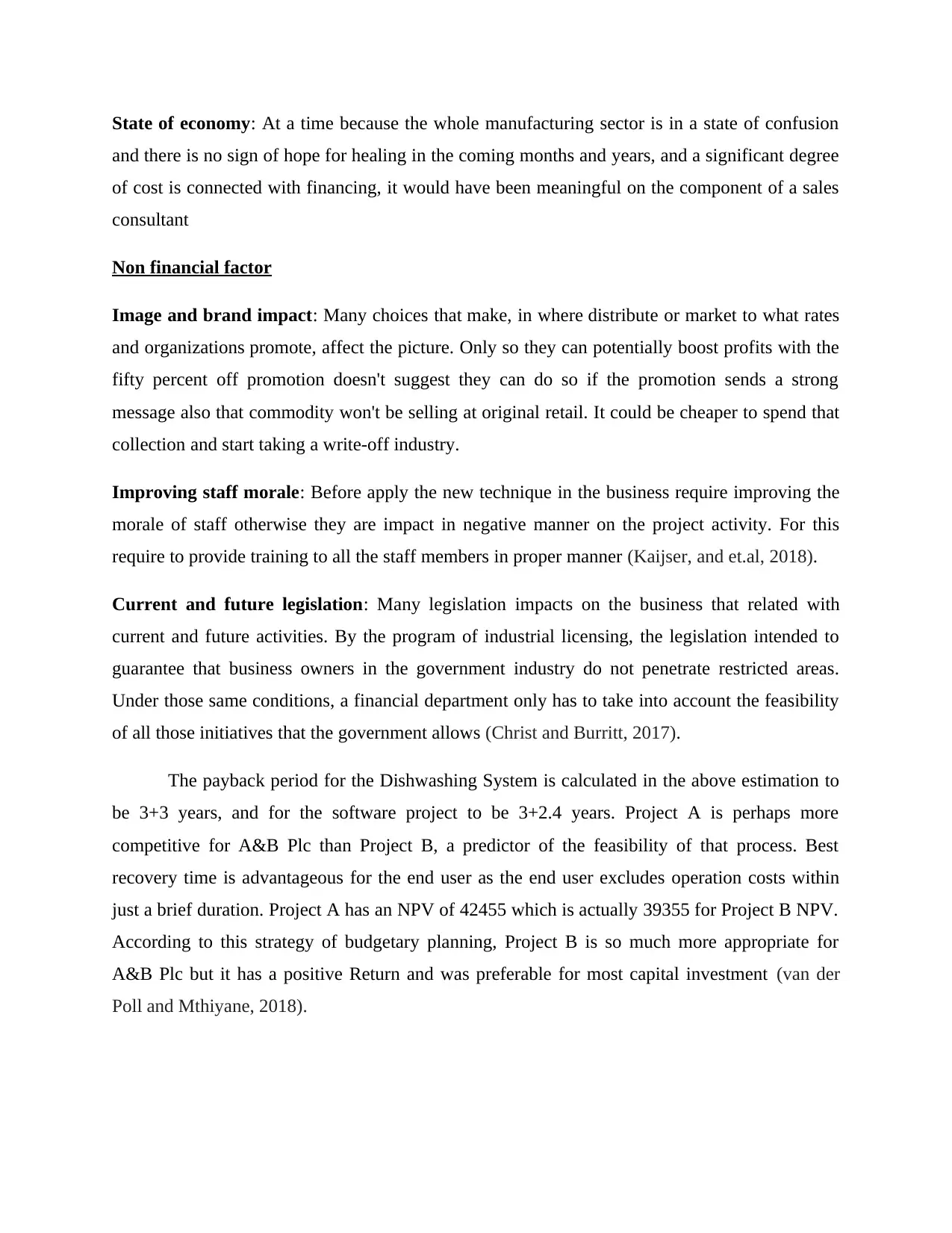
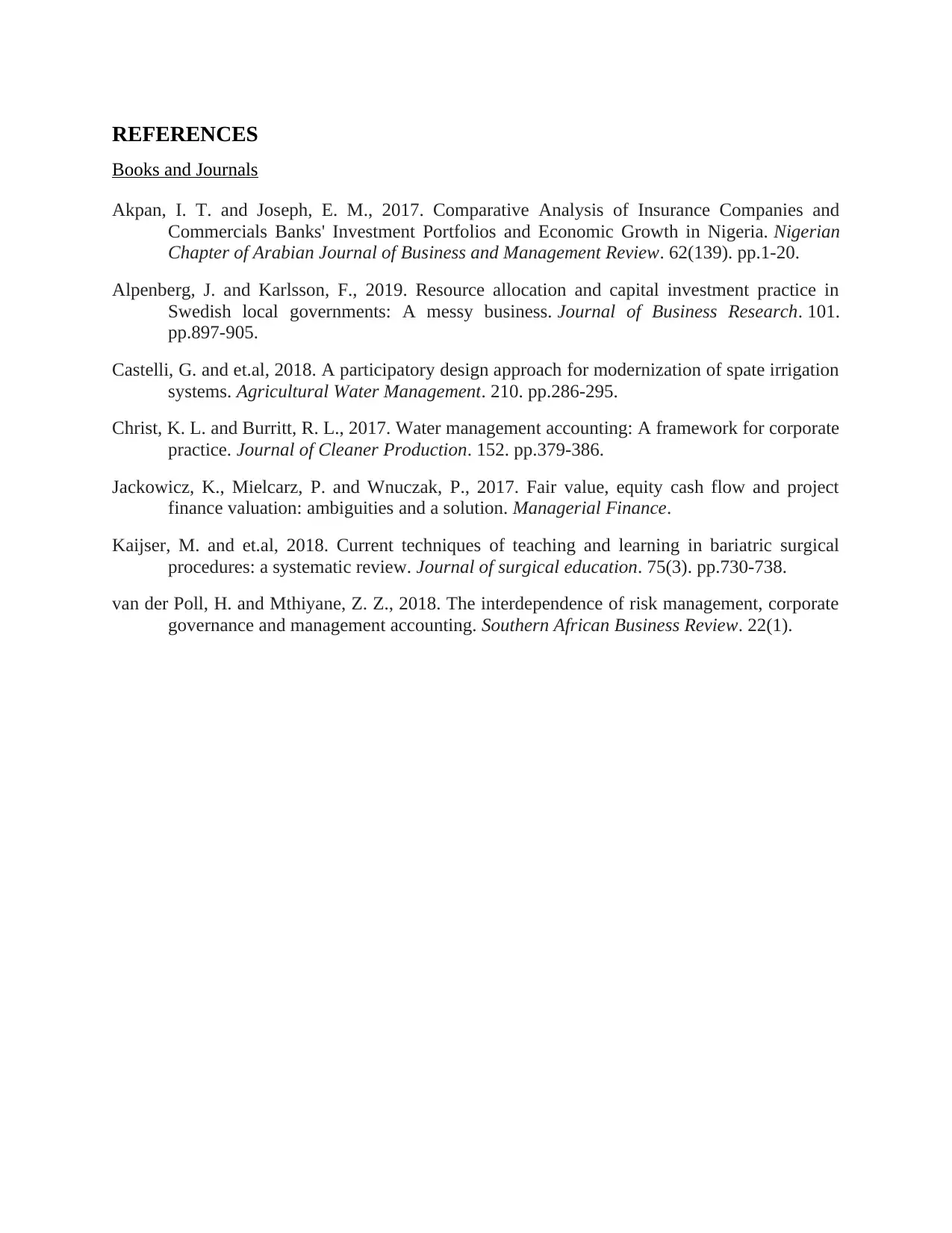
The payback period for the Dishwashing System is calculated in the above estimation to
be 3+3 years, and for the software project to be 3+2.4 years. Project A is perhaps more
competitive for A&B Plc than Project B, a predictor of the feasibility of that process. Best
recovery time is advantageous for the end user as the end user excludes operation costs within
just a brief duration. Project A has an NPV of 42455 which is actually 39355 for Project B NPV.
According to this strategy of budgetary planning, Project B is so much more appropriate for
A&B Plc but it has a positive Return and was preferable for most capital investment (van der
Poll and Mthiyane, 2018).
Document Page
CONCLUSION
It has been noted from the above report that many strategies and procedures are willing to
help the organisation pick the right correct decision to improve its revenues. The net present
value or payback period is the most significant strategy that supervisors embrace to made the
decision effectiveness of the project. It does have some strength or limitations that administrators
would need to determine before they implement this.
Document Page
REFERENCES
Books and Journals
Akpan, I. T. and Joseph, E. M., 2017. Comparative Analysis of Insurance Companies and
Commercials Banks' Investment Portfolios and Economic Growth in Nigeria. Nigerian
Chapter of Arabian Journal of Business and Management Review. 62(139). pp.1-20.
Alpenberg, J. and Karlsson, F., 2019. Resource allocation and capital investment practice in
Swedish local governments: A messy business. Journal of Business Research. 101.
pp.897-905.
Castelli, G. and et.al, 2018. A participatory design approach for modernization of spate irrigation
systems. Agricultural Water Management. 210. pp.286-295.
Christ, K. L. and Burritt, R. L., 2017. Water management accounting: A framework for corporate
practice. Journal of Cleaner Production. 152. pp.379-386.
Jackowicz, K., Mielcarz, P. and Wnuczak, P., 2017. Fair value, equity cash flow and project
finance valuation: ambiguities and a solution. Managerial Finance.
Kaijser, M. and et.al, 2018. Current techniques of teaching and learning in bariatric surgical
procedures: a systematic review. Journal of surgical education. 75(3). pp.730-738.
van der Poll, H. and Mthiyane, Z. Z., 2018. The interdependence of risk management, corporate
governance and management accounting. Southern African Business Review. 22(1).
chevron_up_icon
1 out of 10
circle_padding
hide_on_mobile
zoom_out_icon
[object Object]