University Essay: The Significance of Decision Making Process
VerifiedAdded on 2022/12/22
|7
|1490
|73
Essay
AI Summary
This essay meticulously examines the significance of the decision-making process within business organizations, emphasizing its critical role in achieving organizational objectives. The essay outlines the key steps involved, including identifying business problems and opportunities, creating data analysis plans, collecting and analyzing data, reporting findings, and recommending solutions. It highlights the importance of each step and the potential limitations. The essay underscores the continuous nature of the decision-making process, emphasizing that each decision has a significant impact on the company's path toward its goals. It also stresses the importance of considering factors like resource utilization, managerial performance evaluation, and employee motivation to ensure optimal decision-making, ultimately concluding that effective decision-making is an indispensable component of successful business management.

Running Head: SIGNIFICANCE OF DECISION MAKING PROCESS
Significance of Decision Making Process
Student Name:
University Name:
Author’s Note:
Significance of Decision Making Process
Student Name:
University Name:
Author’s Note:
Paraphrase This Document
Need a fresh take? Get an instant paraphrase of this document with our AI Paraphraser

1
SIGNIFICANCE OF DECISION MAKING PROCESS
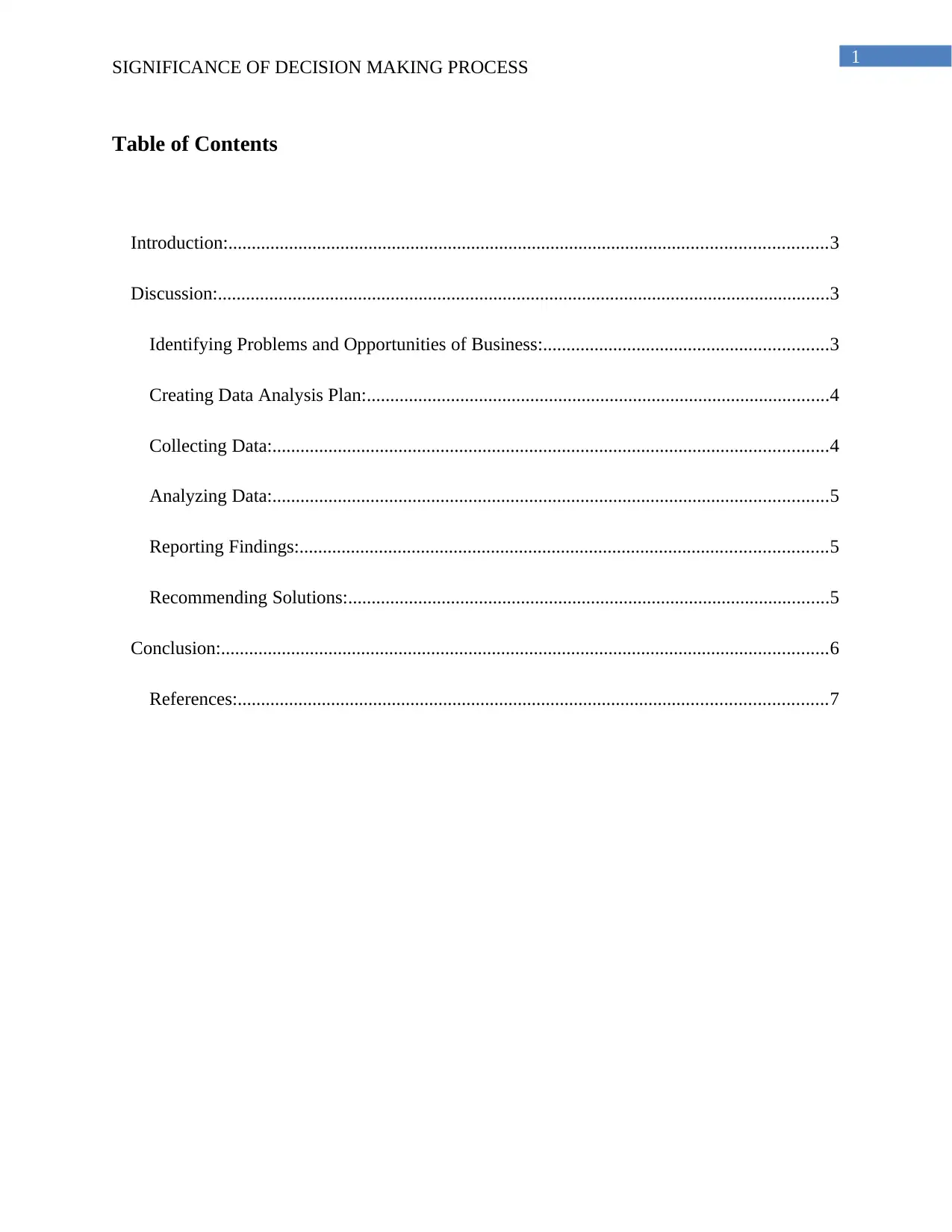
Table of Contents
Introduction:................................................................................................................................3
Discussion:...................................................................................................................................3
Identifying Problems and Opportunities of Business:.............................................................3
Creating Data Analysis Plan:...................................................................................................4
Collecting Data:.......................................................................................................................4
Analyzing Data:.......................................................................................................................5
Reporting Findings:.................................................................................................................5
Recommending Solutions:.......................................................................................................5
Conclusion:..................................................................................................................................6
References:..............................................................................................................................7
SIGNIFICANCE OF DECISION MAKING PROCESS
Table of Contents
Introduction:................................................................................................................................3
Discussion:...................................................................................................................................3
Identifying Problems and Opportunities of Business:.............................................................3
Creating Data Analysis Plan:...................................................................................................4
Collecting Data:.......................................................................................................................4
Analyzing Data:.......................................................................................................................5
Reporting Findings:.................................................................................................................5
Recommending Solutions:.......................................................................................................5
Conclusion:..................................................................................................................................6
References:..............................................................................................................................7

2
SIGNIFICANCE OF DECISION MAKING PROCESS
Introduction:
This essay take a look the importance of the decision making process in the context of a
business organization. Decisions, in all business undertakings, need to be taken at every step of
its operations. Decisions consist of the most fundamental individual units of the function of
business management. The context of decision making arises when there are two or more
available alternatives to solve a problem (Anderson et al. 2017).
In this essay, we will take a close look at the different steps or stages of an organisation’s
decision making process and determine their individual importance for the overall outcome.
Thesis statement: Each and every decision taken by the company’s management is of
paramount importance as they determine the path of the business to meet organisational
objectives.
Discussion:
An organisation’s overall decision making is a continuous process that consists of the
following steps: Identifying the problems and opportunities of the business, creating a data
analysis plan, collecting data, analyzing the data, reporting the findings and recommending
possible solutions.
Identifying Problems and Opportunities of Business:
The first step of a business decision making process is the identification of business
issues that require attention. This goes together with the search for innovative ideas and
opportunities for the growth, expansion and diversification of the business. Companies need to
pay closer attention to the demands and feedbacks of potential and existing customers.
Understanding customer requirements, listening to their challenges from using past products and
SIGNIFICANCE OF DECISION MAKING PROCESS
Introduction:
This essay take a look the importance of the decision making process in the context of a
business organization. Decisions, in all business undertakings, need to be taken at every step of
its operations. Decisions consist of the most fundamental individual units of the function of
business management. The context of decision making arises when there are two or more
available alternatives to solve a problem (Anderson et al. 2017).
In this essay, we will take a close look at the different steps or stages of an organisation’s
decision making process and determine their individual importance for the overall outcome.
Thesis statement: Each and every decision taken by the company’s management is of
paramount importance as they determine the path of the business to meet organisational
objectives.
Discussion:
An organisation’s overall decision making is a continuous process that consists of the
following steps: Identifying the problems and opportunities of the business, creating a data
analysis plan, collecting data, analyzing the data, reporting the findings and recommending
possible solutions.
Identifying Problems and Opportunities of Business:
The first step of a business decision making process is the identification of business
issues that require attention. This goes together with the search for innovative ideas and
opportunities for the growth, expansion and diversification of the business. Companies need to
pay closer attention to the demands and feedbacks of potential and existing customers.
Understanding customer requirements, listening to their challenges from using past products and
⊘ This is a preview!⊘
Do you want full access?
Subscribe today to unlock all pages.

Trusted by 1+ million students worldwide

3
SIGNIFICANCE OF DECISION MAKING PROCESS
services can help improve and personalize products and services (Jesnoewski, 2018). Studying
the market competition can also help generate ideas. Attention must be given to what
competitors are doing and also not doing to identify the exact area of opportunity. For example,
Ford Motors did a market research to determine the growing trend of self-driven and e-vehicles
in the automobile market (Noria, 2019). This step is vital as it creates a map of the different
routes the organization can take to reach its objectives.
Creating Data Analysis Plan:
The identification of problems and opportunities determines the areas, sectors or
departments within the organization which requires actions of change or improvement. Now, in
order to understand the current situation of that area or department the company needs to analyse
various data which may be related to a particular product, service, its performance, overall
customer feedback, profits, and the like. A specific data analysis plan needs to be created that
aims at collecting and studying the data of the particular issue at hand. For example, if the
objective is to improve a company or department’s work health and safety policies, the analysis
plan should be designed to determine the problems in the existing policy and how they can be
improved (Stewart, 2014). This step is the plan to determine the best route for an organization to
reach its objectives. Creating a data analysis plan can often be time consuming and difficult to
formulate. Over the actual process of data collection and analysis, the plan might face
shortcomings like data unavailability and problems in the analysis process, which requires it to
be changed.
Collecting Data:
According to the analysis plan created the concerned department must now focus on the
collection of the requisite data. This can include research conducted through questionnaires and
SIGNIFICANCE OF DECISION MAKING PROCESS
services can help improve and personalize products and services (Jesnoewski, 2018). Studying
the market competition can also help generate ideas. Attention must be given to what
competitors are doing and also not doing to identify the exact area of opportunity. For example,
Ford Motors did a market research to determine the growing trend of self-driven and e-vehicles
in the automobile market (Noria, 2019). This step is vital as it creates a map of the different
routes the organization can take to reach its objectives.
Creating Data Analysis Plan:
The identification of problems and opportunities determines the areas, sectors or
departments within the organization which requires actions of change or improvement. Now, in
order to understand the current situation of that area or department the company needs to analyse
various data which may be related to a particular product, service, its performance, overall
customer feedback, profits, and the like. A specific data analysis plan needs to be created that
aims at collecting and studying the data of the particular issue at hand. For example, if the
objective is to improve a company or department’s work health and safety policies, the analysis
plan should be designed to determine the problems in the existing policy and how they can be
improved (Stewart, 2014). This step is the plan to determine the best route for an organization to
reach its objectives. Creating a data analysis plan can often be time consuming and difficult to
formulate. Over the actual process of data collection and analysis, the plan might face
shortcomings like data unavailability and problems in the analysis process, which requires it to
be changed.
Collecting Data:
According to the analysis plan created the concerned department must now focus on the
collection of the requisite data. This can include research conducted through questionnaires and
Paraphrase This Document
Need a fresh take? Get an instant paraphrase of this document with our AI Paraphraser

4
SIGNIFICANCE OF DECISION MAKING PROCESS
surveys distributed among the concerned sample population, be it employees or customers. It can
also involve conducting personal or focus group interviews, directed at addressing a particular
issue. Broader data collection methods include conducting case studies and observation of the
sample population and creating a comprehensive report based on the observations gathered
(Stewart, 2014). Collection of data is a vital step in understanding the internal and external
factors affecting the business and determines what the following decisions should be. Data
collection involves certain limitations such as unavailability of appropriate, complete
information, and manipulation of data.
Analyzing Data:
Analysis of the data gathered from the different collection procedures serves the main
purpose of the entire process. Analysis should always be done from the perspective of the
research goals, which means, the data should be studied keeping in mind the primary objective of
the study. This will help to accordingly prioritise and sort the data and focus on the research
analysis (Stewart, 2014). For example, if the objective is to improve a program operation, the
data can be sorted according to the strengths and weaknesses of the program, followed by
suggestions of improvement. Analysis can be limited by the availability and accuracy of data
available. The selection of an inappropriate analysis methodology also affects the process.
Reporting Findings:
A complete and comprehensive data analysis report is prepared and submitted to the
managerial board for inspecting and determining the decisions required for the business to
progress. Several companies perform elaborate data analysis procedures to determine
shortcomings, study opportunities and take major company policy decisions. A major example of
this is Coca Cola’s use of artificial intelligence to monitor and analyse big data, which helped it
SIGNIFICANCE OF DECISION MAKING PROCESS
surveys distributed among the concerned sample population, be it employees or customers. It can
also involve conducting personal or focus group interviews, directed at addressing a particular
issue. Broader data collection methods include conducting case studies and observation of the
sample population and creating a comprehensive report based on the observations gathered
(Stewart, 2014). Collection of data is a vital step in understanding the internal and external
factors affecting the business and determines what the following decisions should be. Data
collection involves certain limitations such as unavailability of appropriate, complete
information, and manipulation of data.
Analyzing Data:
Analysis of the data gathered from the different collection procedures serves the main
purpose of the entire process. Analysis should always be done from the perspective of the
research goals, which means, the data should be studied keeping in mind the primary objective of
the study. This will help to accordingly prioritise and sort the data and focus on the research
analysis (Stewart, 2014). For example, if the objective is to improve a program operation, the
data can be sorted according to the strengths and weaknesses of the program, followed by
suggestions of improvement. Analysis can be limited by the availability and accuracy of data
available. The selection of an inappropriate analysis methodology also affects the process.
Reporting Findings:
A complete and comprehensive data analysis report is prepared and submitted to the
managerial board for inspecting and determining the decisions required for the business to
progress. Several companies perform elaborate data analysis procedures to determine
shortcomings, study opportunities and take major company policy decisions. A major example of
this is Coca Cola’s use of artificial intelligence to monitor and analyse big data, which helped it

5
SIGNIFICANCE OF DECISION MAKING PROCESS
determine consumer patters, demands and take decisions in the field of production such as
introducing their Sprite Cherry flavor in some markets (VK, 2019).
Recommending Solutions:
After analysing the data pertaining to the concerned area of action and understanding the
overall scenario, it is the responsibility of the leaders and management team to start devising
solutions to the problem. This can be said to be the most important step of the decision making
process as this is where the main decisions are considered and presented. Leaders need to
consider several important factors such as optimum utilization of resources, evaluating
managerial performances, proper direction towards organisational objectives and motivation of
employees to ensure that they are choosing the best possible alternative to the objective at hand
(Jesnoewski, 2018). Decision making involves a lot of risk, and leaders need to ensure that their
choice involves the least risk and maximum benefits. This is the conclusive step of the decision
making process that demarcates the route the company decides to take to reach its objectives.
Conclusion:
It can be concluded that decision making is an inevitable park of business management
and a lot of thought, energy and effort needs to be put into correct and effective decision making.
This is in line with the initial thesis statement which claims that each and every decision taken by
the company’s management is of paramount importance as they determine the path of the
business to meet organisational objectives. Each step in the decision making process has some
impact on the company’s objectives. They also come with certain limitations which need.
SIGNIFICANCE OF DECISION MAKING PROCESS
determine consumer patters, demands and take decisions in the field of production such as
introducing their Sprite Cherry flavor in some markets (VK, 2019).
Recommending Solutions:
After analysing the data pertaining to the concerned area of action and understanding the
overall scenario, it is the responsibility of the leaders and management team to start devising
solutions to the problem. This can be said to be the most important step of the decision making
process as this is where the main decisions are considered and presented. Leaders need to
consider several important factors such as optimum utilization of resources, evaluating
managerial performances, proper direction towards organisational objectives and motivation of
employees to ensure that they are choosing the best possible alternative to the objective at hand
(Jesnoewski, 2018). Decision making involves a lot of risk, and leaders need to ensure that their
choice involves the least risk and maximum benefits. This is the conclusive step of the decision
making process that demarcates the route the company decides to take to reach its objectives.
Conclusion:
It can be concluded that decision making is an inevitable park of business management
and a lot of thought, energy and effort needs to be put into correct and effective decision making.
This is in line with the initial thesis statement which claims that each and every decision taken by
the company’s management is of paramount importance as they determine the path of the
business to meet organisational objectives. Each step in the decision making process has some
impact on the company’s objectives. They also come with certain limitations which need.
⊘ This is a preview!⊘
Do you want full access?
Subscribe today to unlock all pages.

Trusted by 1+ million students worldwide

6
SIGNIFICANCE OF DECISION MAKING PROCESS
References:
Anderson, D. R., Sweeney, D. J., Williams, T. A., Camm, J. D., & Cochran, J. J. (2015). An
introduction to management science: quantitative approaches to decision making. Cengage
learning.
Jesnoewski, A. (2018). Four ways to identify more business opportunities - SmartCompany.
Retrieved 1 September 2019, from
https://www.smartcompany.com.au/startupsmart/advice/business-planning/four-ways-to-
identify-more-business-opportunities/
Noria, C. (2019). Market research drives product development at Ford. Retrieved 1 September
2019, from https://www.reliableplant.com/Read/3802/market-research-drives-product-
development-at-ford
Stewart, C. (2014). How to Identify & Solve Your Business Problems Using Market Research.
Retrieved 1 September 2019, from https://blog.marketresearch.com/how-to-identify-solve-your-
business-problems-using-market-research
VK, A. (2019). Coca-Cola Leans On Data Analytics & AI For Deeper Industry Insights.
Retrieved 1 September 2019, from https://www.analyticsindiamag.com/coca-cola-leans-on-data-
analytics-ai-for-deeper-industry-insights/
SIGNIFICANCE OF DECISION MAKING PROCESS
References:
Anderson, D. R., Sweeney, D. J., Williams, T. A., Camm, J. D., & Cochran, J. J. (2015). An
introduction to management science: quantitative approaches to decision making. Cengage
learning.
Jesnoewski, A. (2018). Four ways to identify more business opportunities - SmartCompany.
Retrieved 1 September 2019, from
https://www.smartcompany.com.au/startupsmart/advice/business-planning/four-ways-to-
identify-more-business-opportunities/
Noria, C. (2019). Market research drives product development at Ford. Retrieved 1 September
2019, from https://www.reliableplant.com/Read/3802/market-research-drives-product-
development-at-ford
Stewart, C. (2014). How to Identify & Solve Your Business Problems Using Market Research.
Retrieved 1 September 2019, from https://blog.marketresearch.com/how-to-identify-solve-your-
business-problems-using-market-research
VK, A. (2019). Coca-Cola Leans On Data Analytics & AI For Deeper Industry Insights.
Retrieved 1 September 2019, from https://www.analyticsindiamag.com/coca-cola-leans-on-data-
analytics-ai-for-deeper-industry-insights/
1 out of 7
Related Documents
Your All-in-One AI-Powered Toolkit for Academic Success.
+13062052269
info@desklib.com
Available 24*7 on WhatsApp / Email
Unlock your academic potential
Copyright © 2020–2025 A2Z Services. All Rights Reserved. Developed and managed by ZUCOL.