Report on Business Decision Making and Market Analysis for Syngenta

Verified

Added on  2023/04/22

|11
|995
|55
Report
AI Summary
This report provides an analysis of business decision-making with a focus on Syngenta, a leading global company with over 28,000 employees in approximately 90 countries. The report examines the potential launch of Amistar, a broad-spectrum fungicide, and its implications for Integrated Pest Management. It includes column and bar graphs illustrating sales, profit, and cost trends in the Japanese market from 2005 to 2015, revealing increasing sales and fluctuating profitability due to varying expenses. Trend line analysis forecasts sales and profitability for the next five years, suggesting potential expansion opportunities. The conclusion recommends launching Amistar in London, anticipating positive impacts on sales and profitability, emphasizing the importance of investment appraisal techniques for future decisions. The report references several academic sources to support its findings.

Document Page
BUSINESS DECISION
MAKING TASK 3
tabler-icon-diamond-filled.svg

Paraphrase This Document

Need a fresh take? Get an instant paraphrase of this document with our AI Paraphraser
Document Page
INTRODUCTION
Business decision making is regarded as an essential part of every
organization. This is being carried out with an aim to make selection
of suitable course of actions that can result in attainment of success
by the firm. In the present report, business decision making has
been discussed with respect to Syngenta. The firm is one of the
world's leading companies that possesses more than 28000
employees in approximately 90 countries. Main purpose of the
business is to bring plant potential to life. The company is planning
to launch new product that is Amistar which is a broad spectrum
fungicide that can be used in Integrated Pest Management.
Document Page
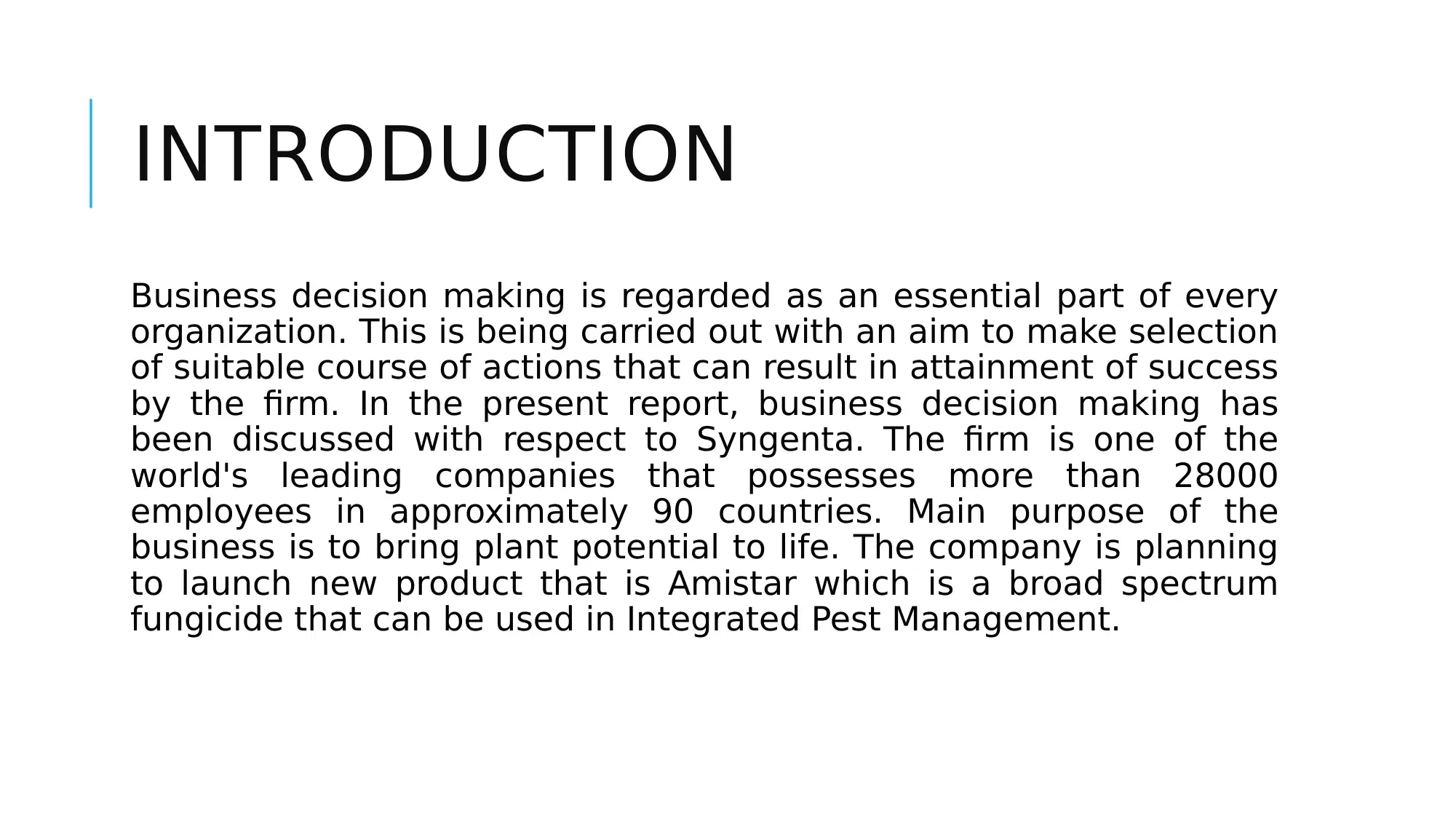
COLUMN GRAPH OF SALES,
PROFIT AND COST
Document Page
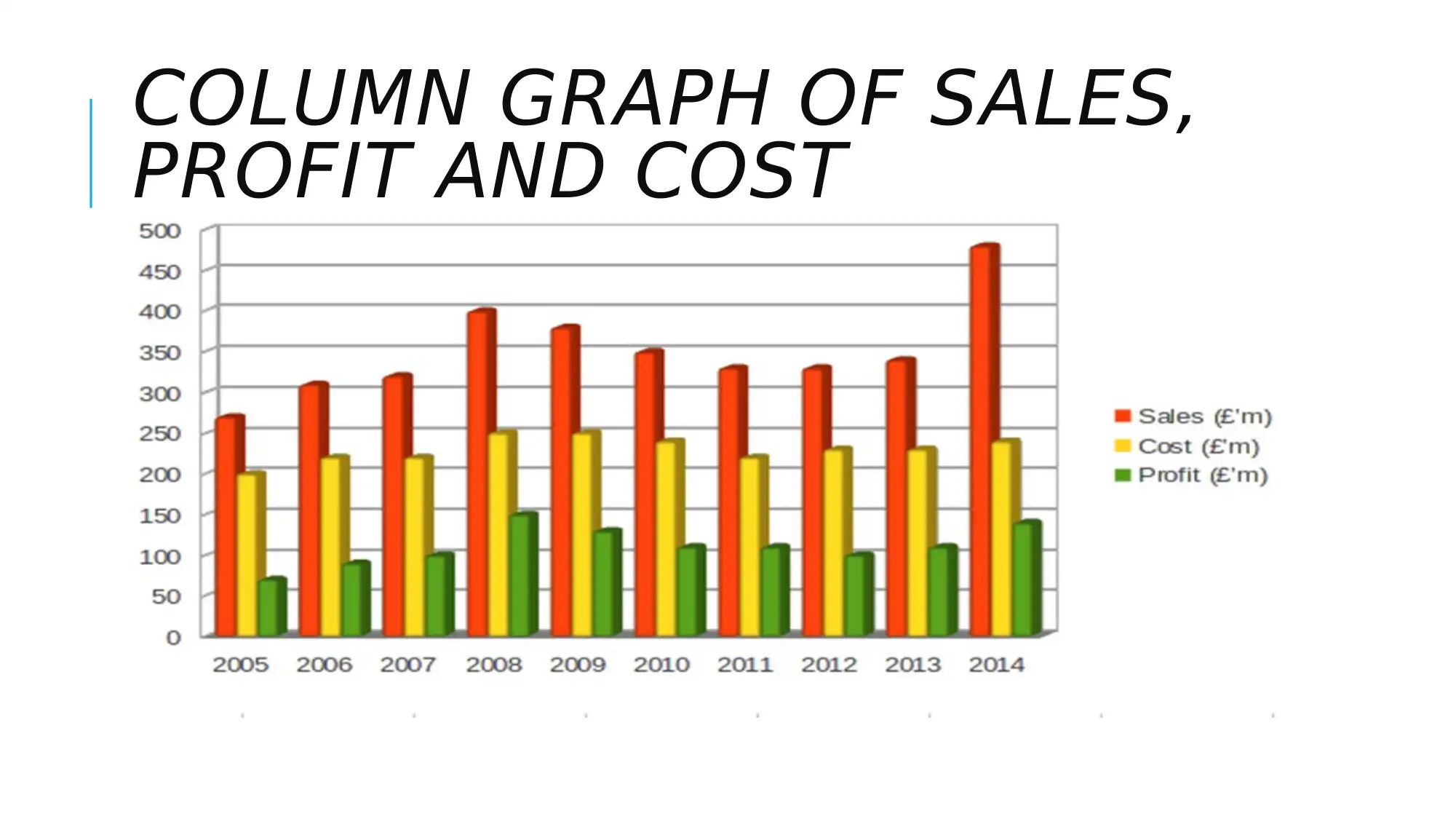
BAR GRAPH OF SALES,
PROFIT AND COST
tabler-icon-diamond-filled.svg

Paraphrase This Document

Need a fresh take? Get an instant paraphrase of this document with our AI Paraphraser
Document Page
INTERPRETATION
These figures present the column and bar graph of Sales as well as
cost and profit of Syngenta's product that is Amistar in the Japanese
market. The graph represents the data of last ten years that starts
from 2005 to 2015. This would act as an aid in making analysis of
the performance of organization in an effective manner. From the
analysis of the above column and bar graph, it has been gained that
sales of the company is increasing significantly. This is as a reason
of increasing demand for the product in the Japanese market. In
addition to this, profitability of the organization is fluctuating that
implies that it is increasing in some years while decreasing in
others.
Document Page
CONTD..
This is because of increasing expenses of the business that affects
the profitability of Syngenta in the Japanese market. But in overall,
it can be determined that revenues of the firm are increasing to a
greater extent. Another factor is cost which is also fluctuating in all
the respective years. This is due to the reason of increasing cost of
material, labor and distribution etc. that affects the overall cost of
production. This thereby results in impacting the profitability of
Syngenta's product that is Amistar to a greater extent. It is essential
for the corporation to keep a track on the expenses so as to
enhance the performance of organization to a significant level.
Document Page
TREND LINE
tabler-icon-diamond-filled.svg

Paraphrase This Document

Need a fresh take? Get an instant paraphrase of this document with our AI Paraphraser
Document Page
INTERPRETATION
Trend line is regarded as an important tool in technical analysis that
assists in both trend identification as well as confirmation. Trend line
is the line that indicates the general course or tendency of
something. It is considered as a straight line that connects two or
more points and then extends into future in order to act as line of
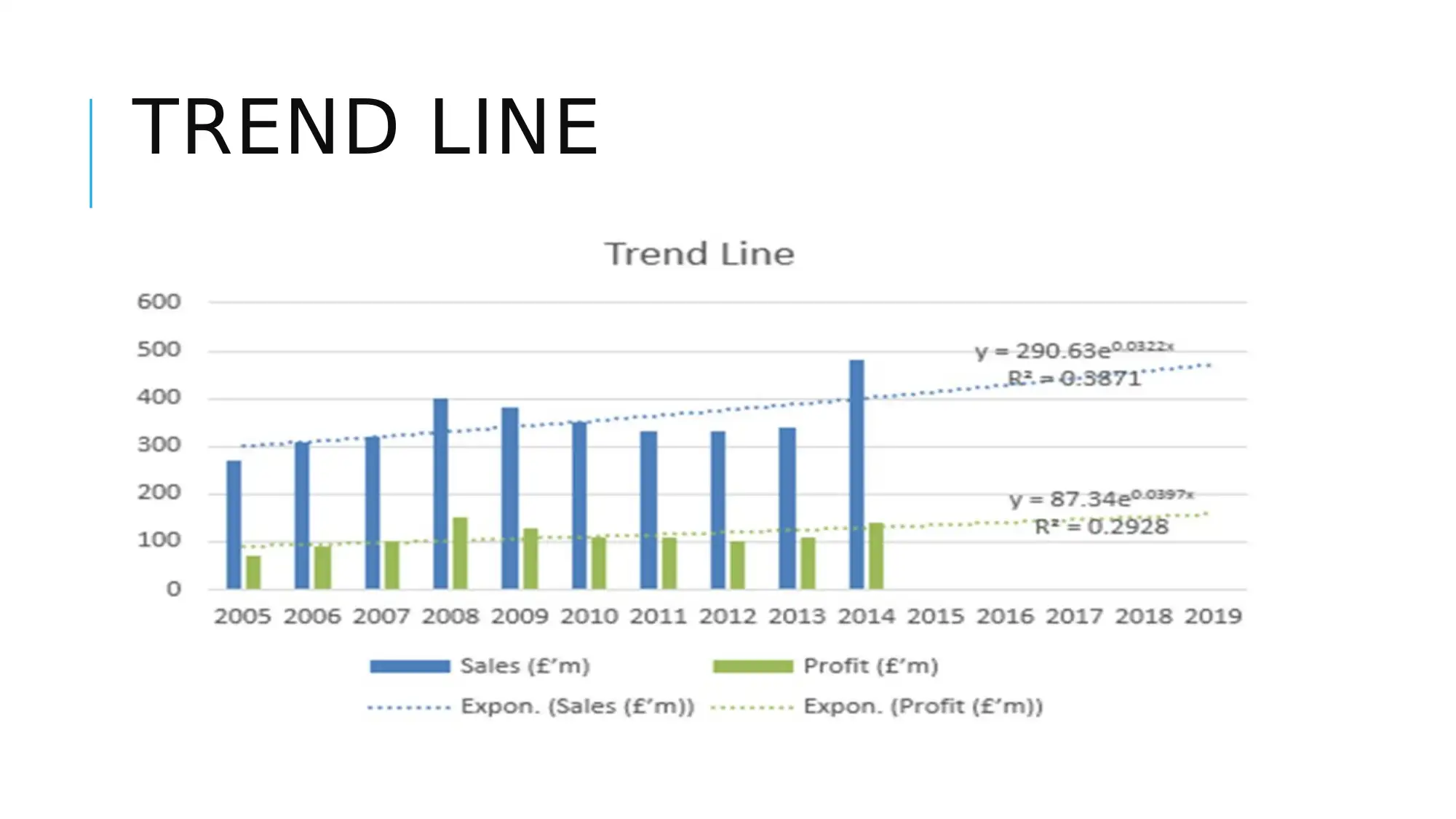
support. The above graph presents the trend line analysis of
Syngenta's product that is Amistar in the Japanese market. It is
important for the business to forecast its sales and profitability for
future so that it can manage its business activities accordingly. The
trend line above demonstrates the profit and sales for next five
years. There is existence of two types of trends.
Document Page
CONTD..
This includes upward and downward trend that act as an aid in
determining the performance of corporation to a greater extent. In
the present study, it has been examined that sales and profitability
of the company is increasing significantly for the next five years.
Thus, the organization can take appropriate decision regarding the
expansion of firm in different markets. This would result in
increasing the market share of organization through enhancement
in base of customers. It is important for the business to forecast its
future so that it can arrange all its resources in an effective manner.
In addition to this, through examination of the financials of
business, suitable decision can be taken with respect to formulation
of budget as well as investment decisions. The above analysis
presents that both sales and profitability figures are reflecting an
upward trend; therefore decision can be taken regarding the launch
of Syngenta's product that is Amistar in the London.
Document Page
CONCLUSION
It can be concluded from the study that business decision making
plays a crucial role in determining the best course of action that can
be implemented by the organization. Further, from the analysis it
has been determined that firm can plan to launch Amistar in the
London. This would result in affecting the profitability as well as
sales of Syngenta in a positive manner. It has been inferred from the
report that there is greater need with the business to examine the
return of investment proposal. This can be done with the assistance
of investment appraisal techniques. With this, organization can
effectively take decisions for the future.
tabler-icon-diamond-filled.svg

Paraphrase This Document

Need a fresh take? Get an instant paraphrase of this document with our AI Paraphraser
Document Page
REFERENCES
Black, K., 2011. Business statistics: for contemporary decision making. John Wiley & Sons.
Brennan, L. L. and Perkins, R. D., 2012. Can Virtual Mentors Add Value to Business Ethics
Education? A Case-Based Exploratory Study. Journal of Business Ethics Education. 9(2). pp.165-
192.
Bryde, J. D., 2003. Modelling project management performance. International Journal of Quality
& Reliability Management. 20(2). pp.229 – 254.
Fassin, Y., Van Rossem, A. and Buelens, M., 2011. Small-business owner-managers’ perceptions
of business ethics and CSR-related concepts. Journal of Business ethics. 98(3). pp.425-453.
Li, S., 2006. Histogram-based Mutual Information Estimation. ProQuest.
Madsen, H., 2007. Time Series Analysis. CRC Press.
Morato, A. E., 2013. Business Decision Making. eBookIt.com.
Ogilvie, J., 2008. CIMA Official Learning System Management Accounting Financial Strategy.
Elsevier.
chevron_up_icon
1 out of 11
circle_padding
hide_on_mobile
zoom_out_icon
[object Object]