Reflective Report: Design Techniques and Project Analysis
VerifiedAdded on 2023/06/04
|14
|3458
|371
Report
AI Summary
This reflective report examines the design process and its practical implementation, focusing on design techniques and tools used in business development. The report begins with an executive summary and table of contents, then delves into weekly blog reflections covering topics such as learning, designing purpose, data analysis, value chain analysis, and rapid prototyping. Each section provides a step-by-step manual of the design process, offering insights into the application of various design techniques within an organization. The report also explores the importance of data as a source of analysis, the benefits of value chain analysis, the role of rapid prototyping, and the significance of a learning launch. Through these reflections, the report aims to provide a comprehensive understanding of the design process and its impact on organizational outcomes, all while adhering to APA referencing standards and incorporating relevant literature to support the analysis.

Running Head: REFLECTIVE REPORT
REFLECTIVE REPORT
Name of the Student
Name of the University
Author Note
REFLECTIVE REPORT
Name of the Student
Name of the University
Author Note

Paraphrase This Document
Need a fresh take? Get an instant paraphrase of this document with our AI Paraphraser

1REFLECTIVE REPORT
Excuetive summary
The report mainly discusses the process of design techniques and its practical implementation
in a product or the project. The report discuss step by step manual of the process to give a
review of the techniques that is taking place in an organization.
Excuetive summary
The report mainly discusses the process of design techniques and its practical implementation
in a product or the project. The report discuss step by step manual of the process to give a
review of the techniques that is taking place in an organization.
2REFLECTIVE REPORT
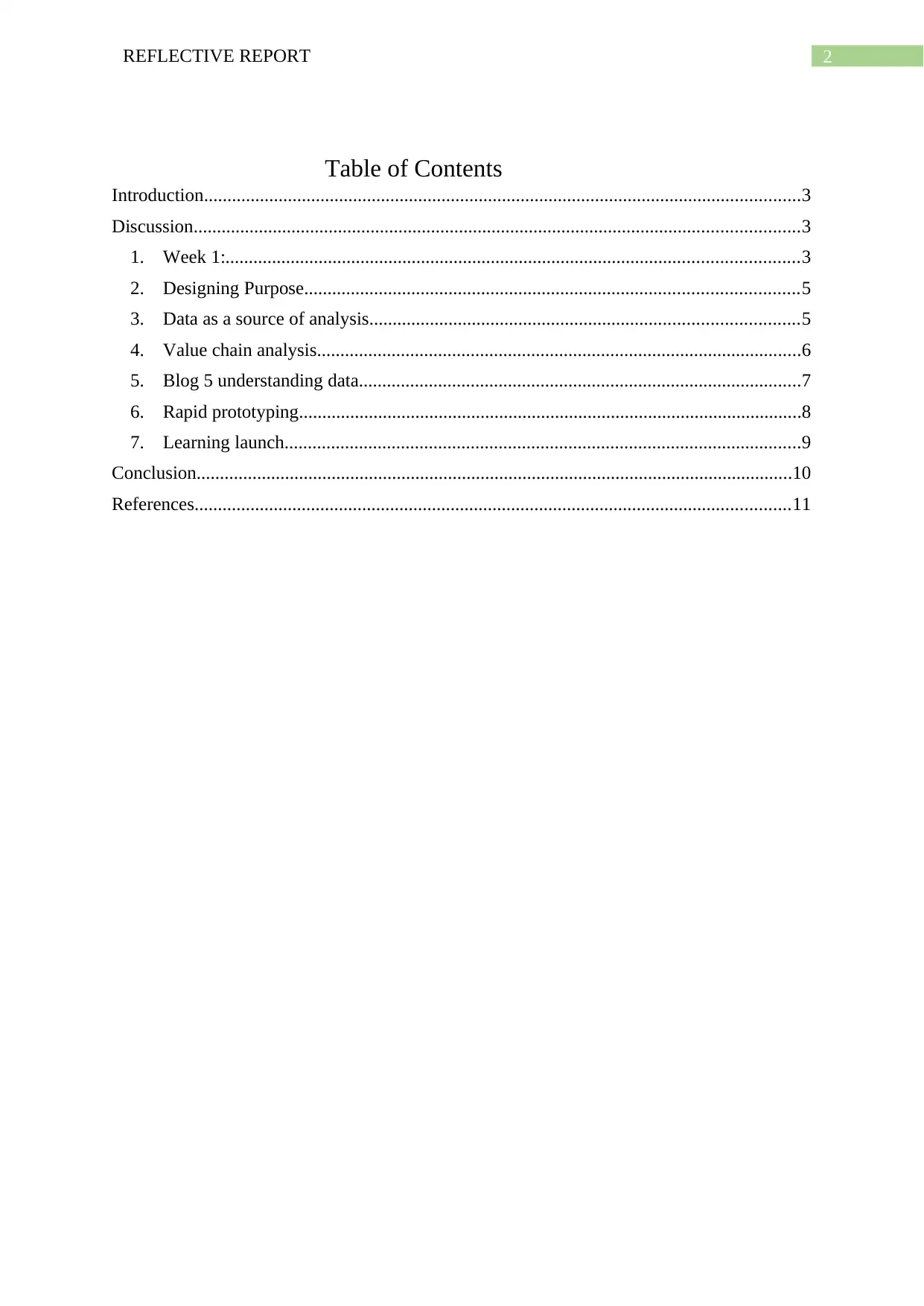
Table of Contents
Introduction................................................................................................................................3
Discussion..................................................................................................................................3
1. Week 1:...........................................................................................................................3
2. Designing Purpose..........................................................................................................5
3. Data as a source of analysis............................................................................................5
4. Value chain analysis........................................................................................................6
5. Blog 5 understanding data...............................................................................................7
6. Rapid prototyping............................................................................................................8
7. Learning launch...............................................................................................................9
Conclusion................................................................................................................................10
References................................................................................................................................11
Table of Contents
Introduction................................................................................................................................3
Discussion..................................................................................................................................3
1. Week 1:...........................................................................................................................3
2. Designing Purpose..........................................................................................................5
3. Data as a source of analysis............................................................................................5
4. Value chain analysis........................................................................................................6
5. Blog 5 understanding data...............................................................................................7
6. Rapid prototyping............................................................................................................8
7. Learning launch...............................................................................................................9
Conclusion................................................................................................................................10
References................................................................................................................................11
⊘ This is a preview!⊘
Do you want full access?
Subscribe today to unlock all pages.

Trusted by 1+ million students worldwide
3REFLECTIVE REPORT
Introduction
The design process can be termed as the systematic approach of handling problems by
breaking any work or task to manageable chunks and generating new opportunities by
implementing ideas that can both create the desirability of the product or services of a
company( Benson, J., & Dresdow, 2014). The design thinking helps the organisation to get
better by consistently redesigning the business by finding new ideas that could enhance a
better performance of any organization’s output.
The report mainly focuses on the design learning outcomes and brief understanding of
the tools that could be used in the design technique process to generate the desirable outcome
from an organisation. The weekly blogs are taken under consideration in this report to
analyse the outcomes of each tools’ application that are recorded as the reflective report to
discuss the benefits of each tools step by step to provide better understanding of the design
Introduction
The design process can be termed as the systematic approach of handling problems by
breaking any work or task to manageable chunks and generating new opportunities by
implementing ideas that can both create the desirability of the product or services of a
company( Benson, J., & Dresdow, 2014). The design thinking helps the organisation to get
better by consistently redesigning the business by finding new ideas that could enhance a
better performance of any organization’s output.
The report mainly focuses on the design learning outcomes and brief understanding of
the tools that could be used in the design technique process to generate the desirable outcome
from an organisation. The weekly blogs are taken under consideration in this report to
analyse the outcomes of each tools’ application that are recorded as the reflective report to
discuss the benefits of each tools step by step to provide better understanding of the design
Paraphrase This Document
Need a fresh take? Get an instant paraphrase of this document with our AI Paraphraser
4REFLECTIVE REPORT
tools. This is a self-analysed report that has noted all the outcomes as per an individual
perspective.
Discussion
1. Week 1:
The first blog has given a brief idea to us about how learning helps us in our daily life.
In order to work with any problem or discuss it is very important for us to know what the
problem is all about. It is only possible when we analyse the scenario on overall basis. The
process of perceiving any data is called learning. The above blog gave me a brief idea about
the word learn , which is termed as the a gain of some ideas or the process to practice a skill
and reuse the same idea in some other work is called Learning. Whatever we learn in life can
either have a negative impact on us or the positive effect.
The first day we learnt how the actually learning about an idea or skill takes place.
We know that in order to gain familiarity with any project or topic we need to follow various
process. This process could result in either positive or negative impact. The impact can be
generated from the action we perform, or through secondary sources or through experience.
Whatever actions we do perform in our daily lives will give us a result in some way or the
other. There is basic step-to-step process of learning that we were acquainted through design
process taking. The first process that we find in step of learning is called as thinking.
Thinking let us analyse and collect data through our cognitive reasoning. Thinking let us
inculcate the surrounding and act accordingly. However, as learnt through Theory of
intensity, we know that if the process cycle runs consecutively repeatedly can result in
different ways of analysis of the same process. Looking through different perspectives can
lead to better understanding and improve the mistakes that have been not noticed earlier in
the case. Mistake will help us to know that where are we lagging in and which area of the
tools. This is a self-analysed report that has noted all the outcomes as per an individual
perspective.
Discussion
1. Week 1:
The first blog has given a brief idea to us about how learning helps us in our daily life.
In order to work with any problem or discuss it is very important for us to know what the
problem is all about. It is only possible when we analyse the scenario on overall basis. The
process of perceiving any data is called learning. The above blog gave me a brief idea about
the word learn , which is termed as the a gain of some ideas or the process to practice a skill
and reuse the same idea in some other work is called Learning. Whatever we learn in life can
either have a negative impact on us or the positive effect.
The first day we learnt how the actually learning about an idea or skill takes place.
We know that in order to gain familiarity with any project or topic we need to follow various
process. This process could result in either positive or negative impact. The impact can be
generated from the action we perform, or through secondary sources or through experience.
Whatever actions we do perform in our daily lives will give us a result in some way or the
other. There is basic step-to-step process of learning that we were acquainted through design
process taking. The first process that we find in step of learning is called as thinking.
Thinking let us analyse and collect data through our cognitive reasoning. Thinking let us
inculcate the surrounding and act accordingly. However, as learnt through Theory of
intensity, we know that if the process cycle runs consecutively repeatedly can result in
different ways of analysis of the same process. Looking through different perspectives can
lead to better understanding and improve the mistakes that have been not noticed earlier in
the case. Mistake will help us to know that where are we lagging in and which area of the
5REFLECTIVE REPORT
task needs improvements. Taking example of a journey that has a destination and the source
but have different paths, travelling from same source to same destination with different paths
will let us know which path is best suited to reach the distance more quickly. The example
that I have taken here, shows that I am working on the same task but using different ideology
for the same work. The learning process is also linked with the performance. We can analyse
the performance through the result output that has been generated by products, processes and
services that grant us the permission to evaluate through compare through attributes that are
relative through goals and also by investigating the past records of any process that have been
taking place. The generation of this cycle from thinking, implementing to gaining results
gives us an alignment of the process. The alignment will help us to analyse the consistencies,
make better plans, and give better performance outputs to the system.
2. Designing Purpose
This step of design process helps us to generate process for the better problem solving
and analysing techniques. Through designing purpose, we can be provided with the actual
aim of the product to be the centre of the customer’s satisfaction. We could find the problem
solving idea or the problem that is leading in the project and it can be compensated with a
bunch of processes easily. We can make use this step in order to meet the customer’s
requirement while running an organisation. Design thinking aid us to perform to emphasize,
define, ideate, test and share a proper solution. In order to implicate a plan or design we need
to do a proper research of any topic that is required to be implemented in the topic. The
purpose of decision-making can put in one concentrated direction when we interact, observe
and implement. This define the outline of the process that has to be done by generating an
task needs improvements. Taking example of a journey that has a destination and the source
but have different paths, travelling from same source to same destination with different paths
will let us know which path is best suited to reach the distance more quickly. The example
that I have taken here, shows that I am working on the same task but using different ideology
for the same work. The learning process is also linked with the performance. We can analyse
the performance through the result output that has been generated by products, processes and
services that grant us the permission to evaluate through compare through attributes that are
relative through goals and also by investigating the past records of any process that have been
taking place. The generation of this cycle from thinking, implementing to gaining results
gives us an alignment of the process. The alignment will help us to analyse the consistencies,
make better plans, and give better performance outputs to the system.
2. Designing Purpose
This step of design process helps us to generate process for the better problem solving
and analysing techniques. Through designing purpose, we can be provided with the actual
aim of the product to be the centre of the customer’s satisfaction. We could find the problem
solving idea or the problem that is leading in the project and it can be compensated with a
bunch of processes easily. We can make use this step in order to meet the customer’s
requirement while running an organisation. Design thinking aid us to perform to emphasize,
define, ideate, test and share a proper solution. In order to implicate a plan or design we need
to do a proper research of any topic that is required to be implemented in the topic. The
purpose of decision-making can put in one concentrated direction when we interact, observe
and implement. This define the outline of the process that has to be done by generating an
⊘ This is a preview!⊘
Do you want full access?
Subscribe today to unlock all pages.
Trusted by 1+ million students worldwide
6REFLECTIVE REPORT
idea. We can define idea as the set of process that is needed to open various possibilities to do
a certain task. Through idea, we can diversify many solutions to solve one task. Idea
provides the efficiency to generate better results and opens opportunities for enhancement.
With new idea that we can generate by learning about the outcome, analysing the
environment we can implement an innovation to process and increase the productivity of the
process.
3. Data as a source of analysis
We can use the data as the source of analysis; the analysis is the basic step that we do
in order to work in a project. We can implement the data analysis by the process that can be
either qualitative, quantitative, journal review or survey or any secondary sources. The
qualitative analysis that we do are provided by the overall scenario observation and giving the
question. The scenario can be judged through articles and experiences. The collection of data
regarding a project will help us to find better information about the topic. With the basic
information about the project, we deduce that how suitable it is to implement an idea in the
environment what are the setbacks that could be faced in the implementing an idea through
design thinking. For example: in order to set a textile business, we have to analysis the basic
data about the place where the store is going to be set up, the liking of the people, nearby
culture these are basic requirement that is needed to be realised by this analysis. this analysis
will lead us to find better options regarding the market profit, the likeness of people will let
us know the choice of clothes they prefer. Our company could generate better revenues than
before and will also be able to grow exponentially. The analysis of the data can be generated
by the following action if taken under consideration. We can do the quantities analysis by
creating survey, generating interviews, observing daily lives of people in that are, looking
through journals and advertisement of the business that are engrossed in the field of same
market.
idea. We can define idea as the set of process that is needed to open various possibilities to do
a certain task. Through idea, we can diversify many solutions to solve one task. Idea
provides the efficiency to generate better results and opens opportunities for enhancement.
With new idea that we can generate by learning about the outcome, analysing the
environment we can implement an innovation to process and increase the productivity of the
process.
3. Data as a source of analysis
We can use the data as the source of analysis; the analysis is the basic step that we do
in order to work in a project. We can implement the data analysis by the process that can be
either qualitative, quantitative, journal review or survey or any secondary sources. The
qualitative analysis that we do are provided by the overall scenario observation and giving the
question. The scenario can be judged through articles and experiences. The collection of data
regarding a project will help us to find better information about the topic. With the basic
information about the project, we deduce that how suitable it is to implement an idea in the
environment what are the setbacks that could be faced in the implementing an idea through
design thinking. For example: in order to set a textile business, we have to analysis the basic
data about the place where the store is going to be set up, the liking of the people, nearby
culture these are basic requirement that is needed to be realised by this analysis. this analysis
will lead us to find better options regarding the market profit, the likeness of people will let
us know the choice of clothes they prefer. Our company could generate better revenues than
before and will also be able to grow exponentially. The analysis of the data can be generated
by the following action if taken under consideration. We can do the quantities analysis by
creating survey, generating interviews, observing daily lives of people in that are, looking
through journals and advertisement of the business that are engrossed in the field of same
market.
Paraphrase This Document
Need a fresh take? Get an instant paraphrase of this document with our AI Paraphraser
7REFLECTIVE REPORT
4. Value chain analysis
From the analysis, we can generate the overall result of the project benefits, the outcomes, the
sources, the team as a whole through one cycle of analysis. the cycle of analysis are mainly
aiding us to discuss the service quality of the product. We discuss main process that is
generated from the process of analysis. Through this chain, we know that if the process that
has been carried out to deliver the product from the manufacturer to the consumer delivers
the best quality or not. The supply chain analysis can be either Porter chain analysis. The
Porter chain analysis will provide us with the overview of working of an organisation under
all the levels. Lets take an example of the textile industry we have taken before. The textile
industry basic work is to manufacture clothes and deliver it to consumer. But performing this
process it needs a lot of work force, management, transportation, supplier of the raw
materials, logistics and calculation. If we see this collectively we will find that there is chaos
in managing this all data as a whole. The value chain analysis will aid us in solving this
problem . The value chain analysis will sort the work according to the role or department and
priority of each department according to the levels (Callahan, 2018,). The sorting of these
chunks in these level will make organization to run as chain profitably and managibly. The
selective department will work on their area and simultenous work can be done in our
organisation without any hassle. The value chain analysis will provide a much better
overview of the organisation we are actually working in. it will take care of the transaction or
revenue received by our organisation. Through value chain analysis we can keep the track of
our progress in the company we are running (Carlgren, 2013).
5. Blog 5 understanding data
The understanding of data would help us find better way for starting and generating
better result through the understanding of the data we can find a better result of profits or the
4. Value chain analysis
From the analysis, we can generate the overall result of the project benefits, the outcomes, the
sources, the team as a whole through one cycle of analysis. the cycle of analysis are mainly
aiding us to discuss the service quality of the product. We discuss main process that is
generated from the process of analysis. Through this chain, we know that if the process that
has been carried out to deliver the product from the manufacturer to the consumer delivers
the best quality or not. The supply chain analysis can be either Porter chain analysis. The
Porter chain analysis will provide us with the overview of working of an organisation under
all the levels. Lets take an example of the textile industry we have taken before. The textile
industry basic work is to manufacture clothes and deliver it to consumer. But performing this
process it needs a lot of work force, management, transportation, supplier of the raw
materials, logistics and calculation. If we see this collectively we will find that there is chaos
in managing this all data as a whole. The value chain analysis will aid us in solving this
problem . The value chain analysis will sort the work according to the role or department and
priority of each department according to the levels (Callahan, 2018,). The sorting of these
chunks in these level will make organization to run as chain profitably and managibly. The
selective department will work on their area and simultenous work can be done in our
organisation without any hassle. The value chain analysis will provide a much better
overview of the organisation we are actually working in. it will take care of the transaction or
revenue received by our organisation. Through value chain analysis we can keep the track of
our progress in the company we are running (Carlgren, 2013).
5. Blog 5 understanding data
The understanding of data would help us find better way for starting and generating
better result through the understanding of the data we can find a better result of profits or the
8REFLECTIVE REPORT
information. The understanding of data is very essential for us working on a project or
analysing as a team or even if we are working as an organisation( Ford, 2014) . The curiosity
regarding any information thrives us to do more research and gain more experience about the
project. The experience will help us improve our results and look through our lacking in the
past. Taking example of the textile industry as before, as an organisation we need
improvisation and upgradation of the industry by enhancing the products. Our organisation
will need more research work and derive an innovation through the understanding of the data.
The question why is the basic tool we will be needing to question the techniques which will
help us to k now the current situation of the company and how will aid us to find a new ways
to increase the business in its own ways. The understanding of data will help us to know the
overall scenario occurring in the project.it helps us to create a blueprint of what we want to
do and how we are going to approach the process( Glen & Baughn ,2014). The planning can
be generated only when we understand the data in our own ways and analyse them to see how
we can use them practically and then implement it to get the
results(Karlsson&Verganti,2016). The understanding of data provides us with the
methodology that which resource will be used in which work. The proper planning of the
project helps us to give better efficiency to the products and give better positive outcomes.
The understanding of data opens more opportunities for growth of the project and diversify
the application of the project .
6. Rapid prototyping
No data or idea is successful until it could be implemented in a practical way.
Through the rapid prototyping we can help the idea to be implemented in a model or the as
the draft version the prototyping can be considered as a little preview of the project that has
to be delivered by implementation(Laudon & Laudon,2016). We can promote the rapid
prototyping to implement an idea at glance. It provides the sample of idea that has to be
information. The understanding of data is very essential for us working on a project or
analysing as a team or even if we are working as an organisation( Ford, 2014) . The curiosity
regarding any information thrives us to do more research and gain more experience about the
project. The experience will help us improve our results and look through our lacking in the
past. Taking example of the textile industry as before, as an organisation we need
improvisation and upgradation of the industry by enhancing the products. Our organisation
will need more research work and derive an innovation through the understanding of the data.
The question why is the basic tool we will be needing to question the techniques which will
help us to k now the current situation of the company and how will aid us to find a new ways
to increase the business in its own ways. The understanding of data will help us to know the
overall scenario occurring in the project.it helps us to create a blueprint of what we want to
do and how we are going to approach the process( Glen & Baughn ,2014). The planning can
be generated only when we understand the data in our own ways and analyse them to see how
we can use them practically and then implement it to get the
results(Karlsson&Verganti,2016). The understanding of data provides us with the
methodology that which resource will be used in which work. The proper planning of the
project helps us to give better efficiency to the products and give better positive outcomes.
The understanding of data opens more opportunities for growth of the project and diversify
the application of the project .
6. Rapid prototyping
No data or idea is successful until it could be implemented in a practical way.
Through the rapid prototyping we can help the idea to be implemented in a model or the as
the draft version the prototyping can be considered as a little preview of the project that has
to be delivered by implementation(Laudon & Laudon,2016). We can promote the rapid
prototyping to implement an idea at glance. It provides the sample of idea that has to be
⊘ This is a preview!⊘
Do you want full access?
Subscribe today to unlock all pages.
Trusted by 1+ million students worldwide
9REFLECTIVE REPORT
implemented in the task or the project, or while conducting the research or conducting a
business with the organisation. the above activities showed how the ideas can be observed
and analysed to innovate a new technology. With the rapid prototype we provide a small
outcome showing that the idea that was initiated has been successful and can generate the
better value of the products for the organization or provide better results from the project. The
prototyping aid us to work on the ideas and generate a practical small version of the project (
Liedtka, 2014). . The synopsis of the project helps to know what are the overall work done
till date and how we can proceed with the implementation of the idea. The above example of
the textile industry we are discussing, needs to show a sample of the textile if we have to
conduct a business with the clients( Liedtka, 2015).. The rapid prototyping will let us know
that if we are ready for launching the project or the product in the market or not. The
prototype also let us test the quality of the product that has been deliver to the clients and
provides us the report of the efforts that have been taken till date. Thr prototyping can be
considered as the test that helps us to find the lack or the perks of the project that has been
implemented (Oxman,2017). The rapid prototyping will help us to find and to discuss
various applications that could served by organization till date . it gives new opportunities of
research and even influence us to create more ideas that could help people in various ways
like employment generation, growing organization, quality improvisation of the products and
the task.
The rapid prototyping helps us to be more confident about the idea that we are
implementing in real life. The idea that once theoretical is known been implemented on a
small scale but have provided much better physical version of the product(Steen, Manschot,
& Koning,2016). The prototyping boast our confidence to generate better results than before
and also generate exponential growth in personal development.
implemented in the task or the project, or while conducting the research or conducting a
business with the organisation. the above activities showed how the ideas can be observed
and analysed to innovate a new technology. With the rapid prototype we provide a small
outcome showing that the idea that was initiated has been successful and can generate the
better value of the products for the organization or provide better results from the project. The
prototyping aid us to work on the ideas and generate a practical small version of the project (
Liedtka, 2014). . The synopsis of the project helps to know what are the overall work done
till date and how we can proceed with the implementation of the idea. The above example of
the textile industry we are discussing, needs to show a sample of the textile if we have to
conduct a business with the clients( Liedtka, 2015).. The rapid prototyping will let us know
that if we are ready for launching the project or the product in the market or not. The
prototype also let us test the quality of the product that has been deliver to the clients and
provides us the report of the efforts that have been taken till date. Thr prototyping can be
considered as the test that helps us to find the lack or the perks of the project that has been
implemented (Oxman,2017). The rapid prototyping will help us to find and to discuss
various applications that could served by organization till date . it gives new opportunities of
research and even influence us to create more ideas that could help people in various ways
like employment generation, growing organization, quality improvisation of the products and
the task.
The rapid prototyping helps us to be more confident about the idea that we are
implementing in real life. The idea that once theoretical is known been implemented on a
small scale but have provided much better physical version of the product(Steen, Manschot,
& Koning,2016). The prototyping boast our confidence to generate better results than before
and also generate exponential growth in personal development.
Paraphrase This Document
Need a fresh take? Get an instant paraphrase of this document with our AI Paraphraser
10REFLECTIVE REPORT
7. Learning launch
The final step of the design thinking is learning launch . The launch of any project is
the most essential part that we need to learn as the final step of the design process (Zheng,
2018). The launch is the implementation of all the observation, analysis, research and all the
efforts that have been taken to generate a idea that could ease the live of the people in a better
way. In order to launch a product we need to advertise the perks the project or the product
shows. The proper marketing of the product will help in generating more profits of the
product and also attracts people’s attention towards the project (Vaugh & Ryan,2015). During
the project launch what we need to be keeping in mind is the product must be useful or be
customer satisfactory ,it should serves its purpose of generation in the market , the product
launch decides whether the project will be beneficial or it will be useless. So in order to make
a project or product appealing to the customer there must be a new innovative idea that
should aid the project. We can take help of the social platforms to generate more awareness
about the topic.
Conclusion
This report mainly focuses on the design process techniques that is needed to be
implemented on a real basis. The report mainly focuses on the fact that whether the design
techniques be implemented in a project or organisation can produce better results or not. The
example of textile industry is taken to show how a business can work in a much better way if
7. Learning launch
The final step of the design thinking is learning launch . The launch of any project is
the most essential part that we need to learn as the final step of the design process (Zheng,
2018). The launch is the implementation of all the observation, analysis, research and all the
efforts that have been taken to generate a idea that could ease the live of the people in a better
way. In order to launch a product we need to advertise the perks the project or the product
shows. The proper marketing of the product will help in generating more profits of the
product and also attracts people’s attention towards the project (Vaugh & Ryan,2015). During
the project launch what we need to be keeping in mind is the product must be useful or be
customer satisfactory ,it should serves its purpose of generation in the market , the product
launch decides whether the project will be beneficial or it will be useless. So in order to make
a project or product appealing to the customer there must be a new innovative idea that
should aid the project. We can take help of the social platforms to generate more awareness
about the topic.
Conclusion
This report mainly focuses on the design process techniques that is needed to be
implemented on a real basis. The report mainly focuses on the fact that whether the design
techniques be implemented in a project or organisation can produce better results or not. The
example of textile industry is taken to show how a business can work in a much better way if
11REFLECTIVE REPORT
they apply design process technique,what are the application these technique will serve and
what do we learn from these techniques. The techniques are divided according to steps to
know how the process of design technique takes place in an organisation.
References
Benson, J., & Dresdow, S. (2014). Design thinking: A fresh approach for transformative
assessment practice. Journal of Management Education, 38(3), 436-461.
Callahan, E. (2018, July). Cross-Cultural Empathy: Learning About Diverse Users in Design
Thinking Process. In International Conference on Human-Computer Interaction (pp.
236-240). Springer, Cham.
they apply design process technique,what are the application these technique will serve and
what do we learn from these techniques. The techniques are divided according to steps to
know how the process of design technique takes place in an organisation.
References
Benson, J., & Dresdow, S. (2014). Design thinking: A fresh approach for transformative
assessment practice. Journal of Management Education, 38(3), 436-461.
Callahan, E. (2018, July). Cross-Cultural Empathy: Learning About Diverse Users in Design
Thinking Process. In International Conference on Human-Computer Interaction (pp.
236-240). Springer, Cham.
⊘ This is a preview!⊘
Do you want full access?
Subscribe today to unlock all pages.
Trusted by 1+ million students worldwide

1 out of 14


Related Documents


Your All-in-One AI-Powered Toolkit for Academic Success.
+13062052269
info@desklib.com
Available 24*7 on WhatsApp / Email
![[object Object]](/_next/static/media/star-bottom.7253800d.svg)
Unlock your academic potential
Copyright © 2020–2026 A2Z Services. All Rights Reserved. Developed and managed by ZUCOL.