Business Development: Analysis of ERP Implementation Report

Verified

Added on  2023/06/03

|3
|548
|412
Report
AI Summary
This report analyzes an ERP implementation within a financial services company, focusing on the decision-making process and its implications. The report outlines the six steps of the decision-making process, starting with identifying the need for change, analyzing the problem, exploring solutions, selecting the best option, implementing the chosen solution, and evaluating the results. The report highlights the importance of employee engagement and ethical considerations in the process, drawing on academic sources to support its findings. The author emphasizes the significance of addressing employee concerns and incorporating ethical decision-making frameworks. The report concludes by discussing the need for a comprehensive approach that considers both the technical and human aspects of ERP implementation, as well as the ethical and legal considerations. The report also mentions the importance of evaluating the project's success and performance.
Document Page
BUSINESS ADMINISTRATION
Business Administration
Student Name:
Student ID:
University Name:
Author Note:
1
tabler-icon-diamond-filled.svg

Paraphrase This Document

Need a fresh take? Get an instant paraphrase of this document with our AI Paraphraser
Document Page
BUSINESS ADMINISTRATION
Discussion
At present I am associated with ABC Company, a financial service provider in California, United
States as an Assistant Marketing Manager. Over past six months the management was keen on
adopting ERP software for bringing ease within the workplace in terms of increased efficiency,
collaboration, scalability, integrated information, cost saving and streamlined processes etc. and
the final decision to adopt a suitable ERP module was taken last monthly meeting. The decision
was based on the six steps of business decision making owing to the involvement of different
activities. The company’s previous performance and periodical financial report was presented by
the COO to highlight the variation between expected and actual outcome for identifying the
reasons behind the differences eventually coinciding with the first step of decision making
process. This according to Allen, Cruz & Warburton (2017) was followed by analysing the cause
behind poor performances in consultation with the managers, which revealed it was the complex
business process further coinciding with the second step. Next, different solutions to address the
problem were tabled such as designing an in-house database system, implementing ERP software
or eliminate manual processes were evaluated coinciding with the third step followed by
selecting the best suitable option, which after discussions was chosen as ERP software fulfilling
all business requirements within an estimated budget coinciding with the fourth step. After
choosing the solution, its application was finalized by engaging an ERP consultant for
implementation and training thus, coinciding with the fifth step. After the project
implementation, feedbacks and performance was evaluated by all managers for measuring the
success of ERP solution adopted finally, coinciding with the sixth step.
According to Wisler (2018) for enhancing the outcome of the meeting it is highly recommended
that an employee interactive session is organized for making the aware about the impending
organizational change and educating them about the benefits they can reap from the project for
winning their trusts and resolving their queries besides immediately addressing their fears on
spot to help them willingly accept the change and significantly contribute in the accomplishment
of the company’s goals and objectives. However, facts related ethical issues, different legal and
regulatory requirements and stakeholder were not identified and discussed during the meeting
hence, failing to pursue the four steps of ethical decision making.
2
Document Page
BUSINESS ADMINISTRATION
References
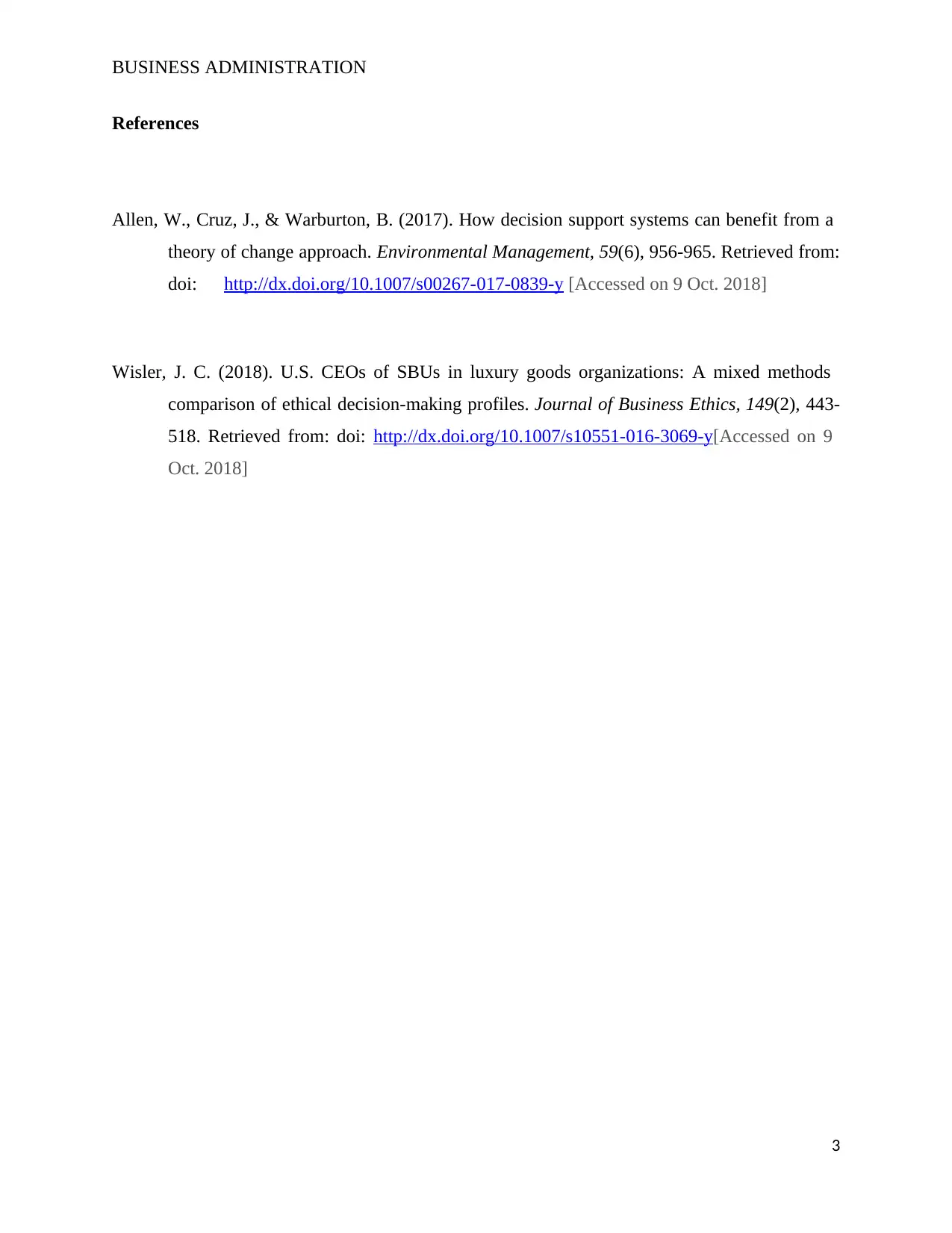
Allen, W., Cruz, J., & Warburton, B. (2017). How decision support systems can benefit from a
theory of change approach. Environmental Management, 59(6), 956-965. Retrieved from:
doi: http://dx.doi.org/10.1007/s00267-017-0839-y [Accessed on 9 Oct. 2018]
Wisler, J. C. (2018). U.S. CEOs of SBUs in luxury goods organizations: A mixed methods
comparison of ethical decision-making profiles. Journal of Business Ethics, 149(2), 443-
518. Retrieved from: doi: http://dx.doi.org/10.1007/s10551-016-3069-y[Accessed on 9
Oct. 2018]
3
chevron_up_icon
1 out of 3
circle_padding
hide_on_mobile
zoom_out_icon
[object Object]