FHI Workbook Assignment - Financial Analysis and Budgeting
VerifiedAdded on 2023/04/23
|27
|5755
|132
Homework Assignment
AI Summary
This assignment is a comprehensive workbook exploring key concepts in business finance and accounting. It begins by examining internal and external sources of funding available to businesses, followed by an evaluation of various methods for generating income, including sales revenue, subletting, commissions, sponsorships, royalties, and capital gains, with a detailed breakdown of their contributions. The assignment then delves into cost analysis, differentiating between direct and indirect costs and providing examples. Further, it explores the characteristics of fixed, variable, and semi-variable costs, accompanied by diagrams, and evaluates methods of controlling stock, including the Just-in-Time order approach. The importance of accounting notes and budgetary control is discussed, and the process and purpose of budgetary control are explained. Finally, the assignment touches upon ratio analysis, emphasizing its role in interpreting business performance, and provides an overview of profitability and liquidity ratios.
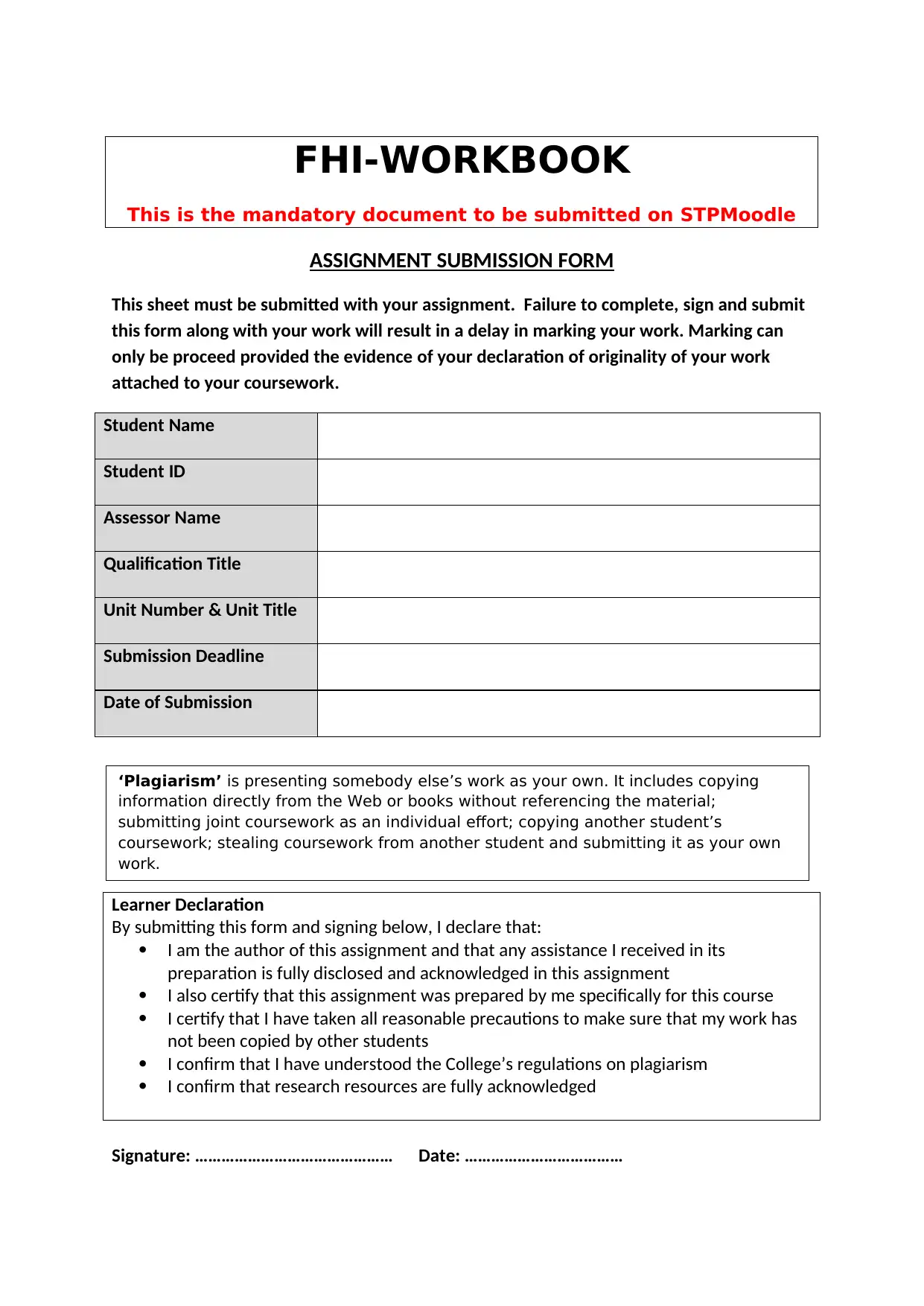
FHI-WORKBOOK
This is the mandatory document to be submitted on STPMoodle
ASSIGNMENT SUBMISSION FORM
This sheet must be submitted with your assignment. Failure to complete, sign and submit
this form along with your work will result in a delay in marking your work. Marking can
only be proceed provided the evidence of your declaration of originality of your work
attached to your coursework.
Student Name
Student ID
Assessor Name
Qualification Title
Unit Number & Unit Title
Submission Deadline
Date of Submission
Learner Declaration
By submitting this form and signing below, I declare that:
I am the author of this assignment and that any assistance I received in its
preparation is fully disclosed and acknowledged in this assignment
I also certify that this assignment was prepared by me specifically for this course
I certify that I have taken all reasonable precautions to make sure that my work has
not been copied by other students
I confirm that I have understood the College’s regulations on plagiarism
I confirm that research resources are fully acknowledged
Signature: ……………………………………… Date: ………………………………
‘Plagiarism’ is presenting somebody else’s work as your own. It includes copying
information directly from the Web or books without referencing the material;
submitting joint coursework as an individual effort; copying another student’s
coursework; stealing coursework from another student and submitting it as your own
work.
This is the mandatory document to be submitted on STPMoodle
ASSIGNMENT SUBMISSION FORM
This sheet must be submitted with your assignment. Failure to complete, sign and submit
this form along with your work will result in a delay in marking your work. Marking can
only be proceed provided the evidence of your declaration of originality of your work
attached to your coursework.
Student Name
Student ID
Assessor Name
Qualification Title
Unit Number & Unit Title
Submission Deadline
Date of Submission
Learner Declaration
By submitting this form and signing below, I declare that:
I am the author of this assignment and that any assistance I received in its
preparation is fully disclosed and acknowledged in this assignment
I also certify that this assignment was prepared by me specifically for this course
I certify that I have taken all reasonable precautions to make sure that my work has
not been copied by other students
I confirm that I have understood the College’s regulations on plagiarism
I confirm that research resources are fully acknowledged
Signature: ……………………………………… Date: ………………………………
‘Plagiarism’ is presenting somebody else’s work as your own. It includes copying
information directly from the Web or books without referencing the material;
submitting joint coursework as an individual effort; copying another student’s
coursework; stealing coursework from another student and submitting it as your own
work.

Paraphrase This Document
Need a fresh take? Get an instant paraphrase of this document with our AI Paraphraser
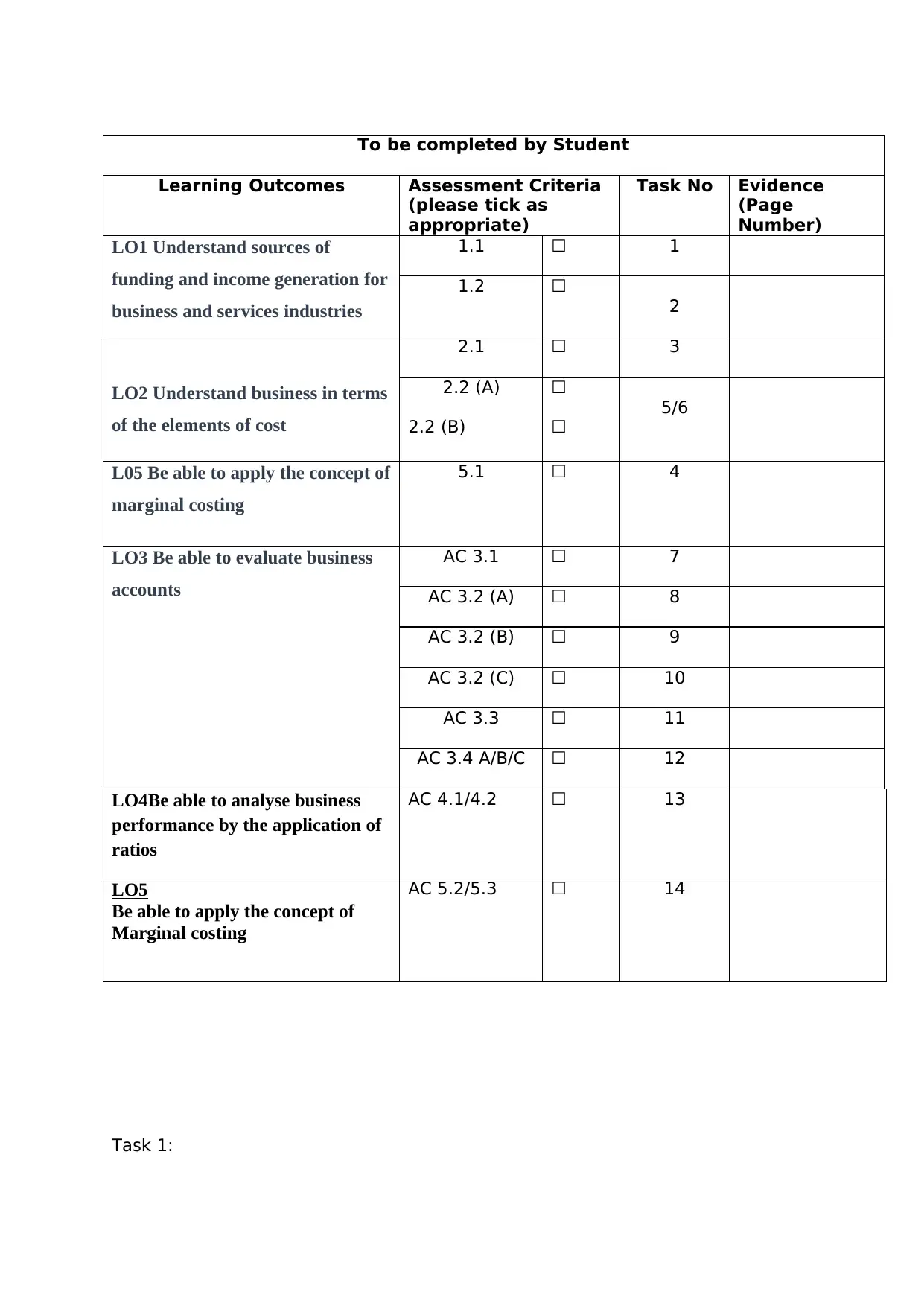
To be completed by Student
Learning Outcomes Assessment Criteria
(please tick as
appropriate)
Task No Evidence
(Page
Number)
LO1 Understand sources of
funding and income generation for
business and services industries
1.1 ☐ 1
1.2 ☐
2
LO2 Understand business in terms
of the elements of cost
2.1 ☐ 3
2.2 (A)
2.2 (B)
☐
☐
5/6
L05 Be able to apply the concept of
marginal costing
5.1 ☐ 4
LO3 Be able to evaluate business
accounts
AC 3.1 ☐ 7
AC 3.2 (A) ☐ 8
AC 3.2 (B) ☐ 9
AC 3.2 (C) ☐ 10
AC 3.3 ☐ 11
AC 3.4 A/B/C ☐ 12
LO4Be able to analyse business
performance by the application of
ratios
AC 4.1/4.2 ☐ 13
LO5
Be able to apply the concept of
Marginal costing
AC 5.2/5.3 ☐ 14
Task 1:
Learning Outcomes Assessment Criteria
(please tick as
appropriate)
Task No Evidence
(Page
Number)
LO1 Understand sources of
funding and income generation for
business and services industries
1.1 ☐ 1
1.2 ☐
2
LO2 Understand business in terms
of the elements of cost
2.1 ☐ 3
2.2 (A)
2.2 (B)
☐
☐
5/6
L05 Be able to apply the concept of
marginal costing
5.1 ☐ 4
LO3 Be able to evaluate business
accounts
AC 3.1 ☐ 7
AC 3.2 (A) ☐ 8
AC 3.2 (B) ☐ 9
AC 3.2 (C) ☐ 10
AC 3.3 ☐ 11
AC 3.4 A/B/C ☐ 12
LO4Be able to analyse business
performance by the application of
ratios
AC 4.1/4.2 ☐ 13
LO5
Be able to apply the concept of
Marginal costing
AC 5.2/5.3 ☐ 14
Task 1:
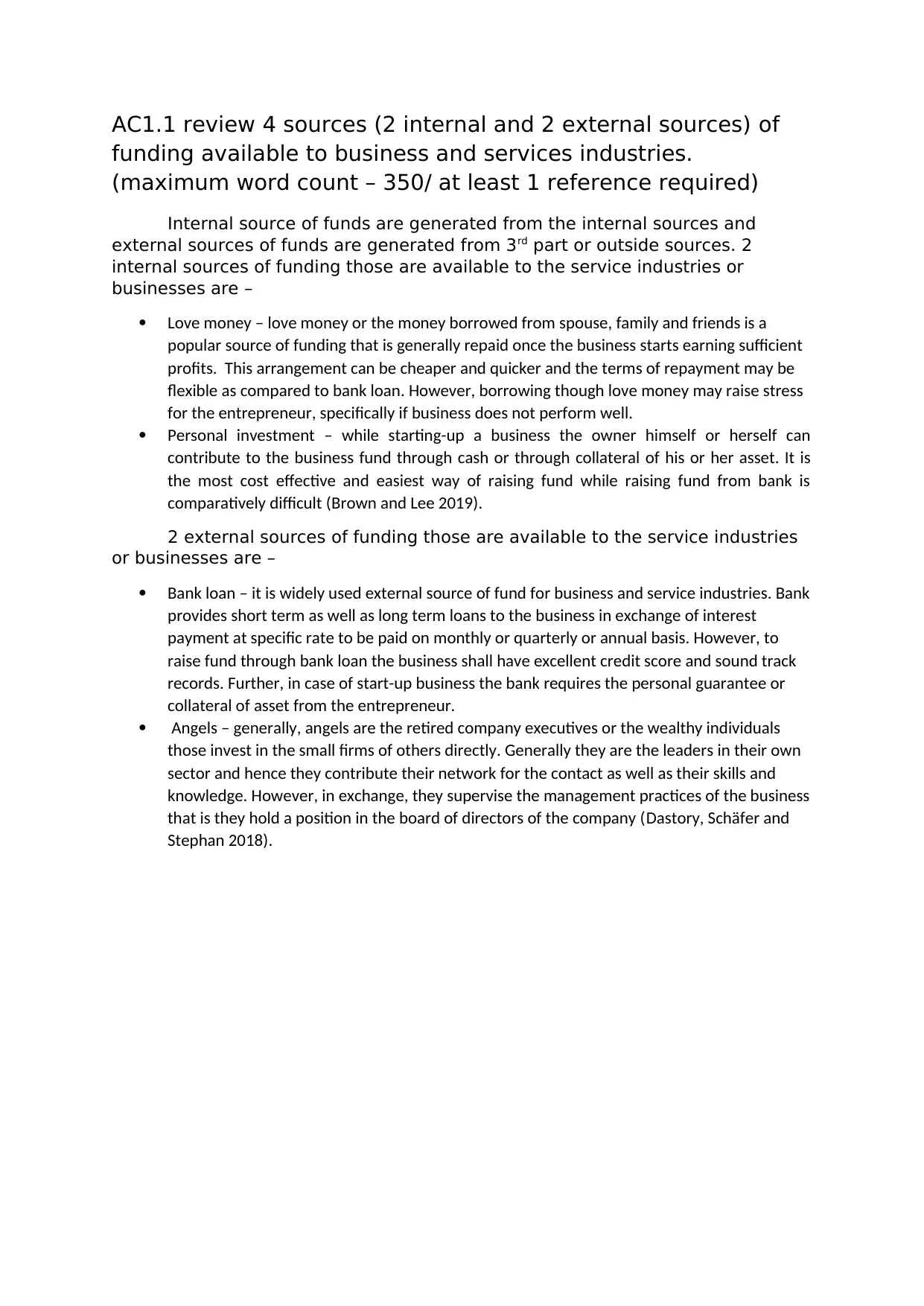
AC1.1 review 4 sources (2 internal and 2 external sources) of
funding available to business and services industries.
(maximum word count – 350/ at least 1 reference required)
Internal source of funds are generated from the internal sources and
external sources of funds are generated from 3rd part or outside sources. 2
internal sources of funding those are available to the service industries or
businesses are –
Love money – love money or the money borrowed from spouse, family and friends is a
popular source of funding that is generally repaid once the business starts earning sufficient
profits. This arrangement can be cheaper and quicker and the terms of repayment may be
flexible as compared to bank loan. However, borrowing though love money may raise stress
for the entrepreneur, specifically if business does not perform well.
Personal investment – while starting-up a business the owner himself or herself can
contribute to the business fund through cash or through collateral of his or her asset. It is
the most cost effective and easiest way of raising fund while raising fund from bank is
comparatively difficult (Brown and Lee 2019).
2 external sources of funding those are available to the service industries
or businesses are –
Bank loan – it is widely used external source of fund for business and service industries. Bank
provides short term as well as long term loans to the business in exchange of interest
payment at specific rate to be paid on monthly or quarterly or annual basis. However, to
raise fund through bank loan the business shall have excellent credit score and sound track
records. Further, in case of start-up business the bank requires the personal guarantee or
collateral of asset from the entrepreneur.
Angels – generally, angels are the retired company executives or the wealthy individuals
those invest in the small firms of others directly. Generally they are the leaders in their own
sector and hence they contribute their network for the contact as well as their skills and
knowledge. However, in exchange, they supervise the management practices of the business
that is they hold a position in the board of directors of the company (Dastory, Schäfer and
Stephan 2018).
funding available to business and services industries.
(maximum word count – 350/ at least 1 reference required)
Internal source of funds are generated from the internal sources and
external sources of funds are generated from 3rd part or outside sources. 2
internal sources of funding those are available to the service industries or
businesses are –
Love money – love money or the money borrowed from spouse, family and friends is a
popular source of funding that is generally repaid once the business starts earning sufficient
profits. This arrangement can be cheaper and quicker and the terms of repayment may be
flexible as compared to bank loan. However, borrowing though love money may raise stress
for the entrepreneur, specifically if business does not perform well.
Personal investment – while starting-up a business the owner himself or herself can
contribute to the business fund through cash or through collateral of his or her asset. It is
the most cost effective and easiest way of raising fund while raising fund from bank is
comparatively difficult (Brown and Lee 2019).
2 external sources of funding those are available to the service industries
or businesses are –
Bank loan – it is widely used external source of fund for business and service industries. Bank
provides short term as well as long term loans to the business in exchange of interest
payment at specific rate to be paid on monthly or quarterly or annual basis. However, to
raise fund through bank loan the business shall have excellent credit score and sound track
records. Further, in case of start-up business the bank requires the personal guarantee or
collateral of asset from the entrepreneur.
Angels – generally, angels are the retired company executives or the wealthy individuals
those invest in the small firms of others directly. Generally they are the leaders in their own
sector and hence they contribute their network for the contact as well as their skills and
knowledge. However, in exchange, they supervise the management practices of the business
that is they hold a position in the board of directors of the company (Dastory, Schäfer and
Stephan 2018).
⊘ This is a preview!⊘
Do you want full access?
Subscribe today to unlock all pages.

Trusted by 1+ million students worldwide
Task 2:
AC1.2 evaluate the contribution made by a range of methods of
generating income within a given business and services
operation (maximum word count – 300 excluding calculation)
Different methods of generating the income help the business to generate
earnings from other sources if any particular source is not sufficient or stops
generating any further earnings. Various forms of generating the income from
service or business operation are as follows –
Sales income or revenues – sales revenues are realized by the business through selling of the
products or providing services to the customers. For any business sales revenue is generally
the major source of income. Sales revenues are parted into gross sales that is, the total sales
and the net sales that is the sales reduced by the sales discounts, sales returns and any other
allowances.
Sub-letting – rent received from the tenant under sublease is rental income from subletting
and it shall be reported as income. If tenant pays the expenses the receiver is obliged to pay
the same pursuant to lease and the payment from tenant is considered as income.
Commission – commission income is the fees earned by the agents and brojers in making the
sales or in closing any deal. It is primary revenue account for stock brokers; real estate
brokers and insurance agencies.
Sponsorship – sponsorship income received from a sponsor is popular way of income. It
refers to the support, whether in form of finance or in form of services and goods offered by
businesses or public members.
Royalties – royalty income is the payment received in consideration of usage and
exploitation of the literary or artistic works, mineral rights or patents. It is dependent upon
the type of the business carried upon by the entity. It is generally of 2 types – royalties
received for usage of patents, trademarks or copyrights and royalties received for usage of
minerals, gas or oil (Cooper et al. 2016).
Capital gains – capital gain is increase in value of any capital asset that provides it higher
value as compared to the asset’s purchase price. However, such gain is not reported until
asset is sold. Capital gain can be long-term as well as short term. It is a common practice for
many businesses to use the business profits for the purpose of investment. There always
exists a chance that the investment will earn profit in the form of capital gains. This generally
takes place in case when the entity buys and sells the stocks, invest in mutual funds or in real
estate. It can be considered as a big source for income and the applicable tax rate on capital
gain is different as compared to regular income (Sharma and Sharma 2017).
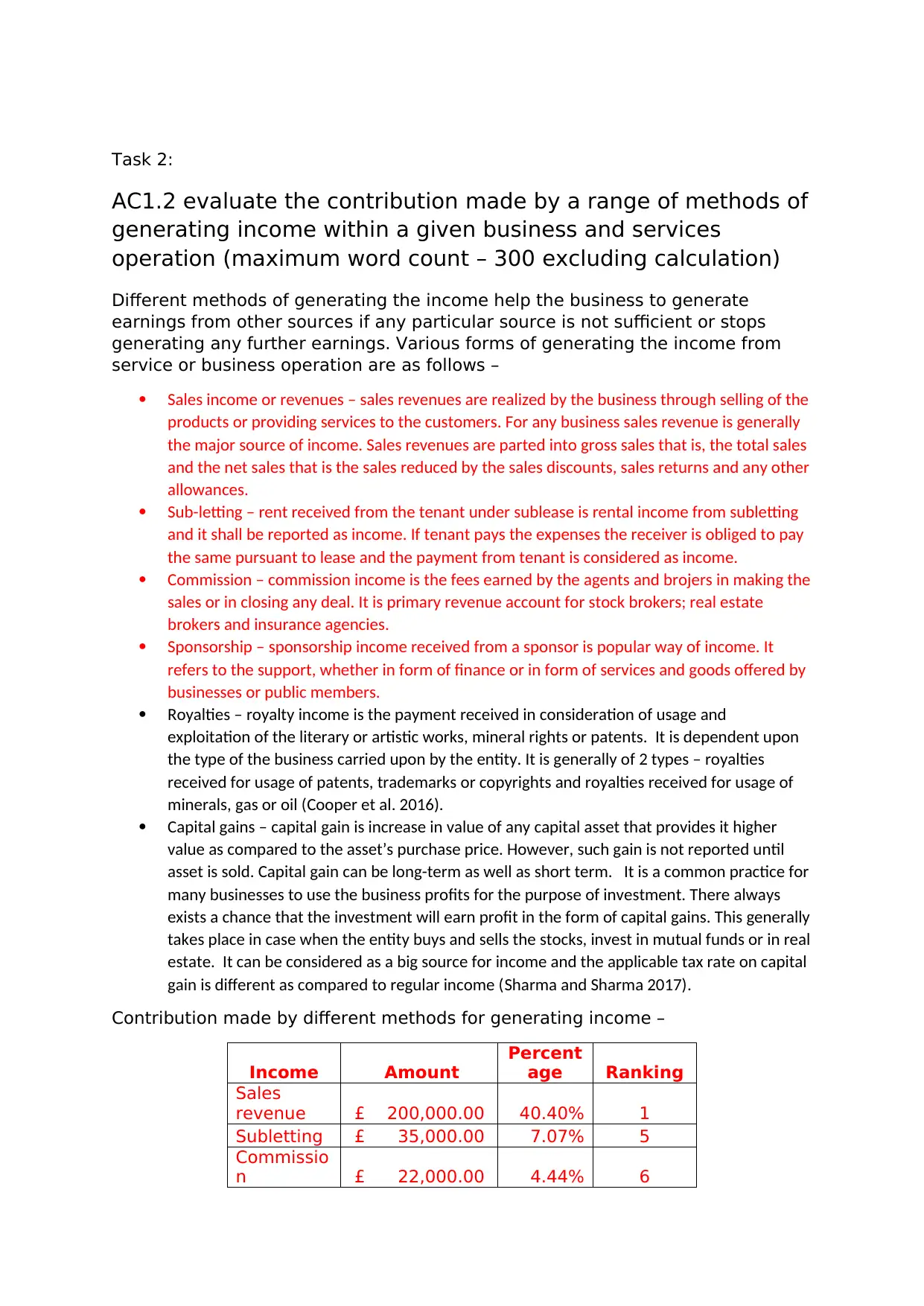
Contribution made by different methods for generating income –
Income Amount
Percent
age Ranking
Sales
revenue £ 200,000.00 40.40% 1
Subletting £ 35,000.00 7.07% 5
Commissio
n £ 22,000.00 4.44% 6
AC1.2 evaluate the contribution made by a range of methods of
generating income within a given business and services
operation (maximum word count – 300 excluding calculation)
Different methods of generating the income help the business to generate
earnings from other sources if any particular source is not sufficient or stops
generating any further earnings. Various forms of generating the income from
service or business operation are as follows –
Sales income or revenues – sales revenues are realized by the business through selling of the
products or providing services to the customers. For any business sales revenue is generally
the major source of income. Sales revenues are parted into gross sales that is, the total sales
and the net sales that is the sales reduced by the sales discounts, sales returns and any other
allowances.
Sub-letting – rent received from the tenant under sublease is rental income from subletting
and it shall be reported as income. If tenant pays the expenses the receiver is obliged to pay
the same pursuant to lease and the payment from tenant is considered as income.
Commission – commission income is the fees earned by the agents and brojers in making the
sales or in closing any deal. It is primary revenue account for stock brokers; real estate
brokers and insurance agencies.
Sponsorship – sponsorship income received from a sponsor is popular way of income. It
refers to the support, whether in form of finance or in form of services and goods offered by
businesses or public members.
Royalties – royalty income is the payment received in consideration of usage and
exploitation of the literary or artistic works, mineral rights or patents. It is dependent upon
the type of the business carried upon by the entity. It is generally of 2 types – royalties
received for usage of patents, trademarks or copyrights and royalties received for usage of
minerals, gas or oil (Cooper et al. 2016).
Capital gains – capital gain is increase in value of any capital asset that provides it higher
value as compared to the asset’s purchase price. However, such gain is not reported until
asset is sold. Capital gain can be long-term as well as short term. It is a common practice for
many businesses to use the business profits for the purpose of investment. There always
exists a chance that the investment will earn profit in the form of capital gains. This generally
takes place in case when the entity buys and sells the stocks, invest in mutual funds or in real
estate. It can be considered as a big source for income and the applicable tax rate on capital
gain is different as compared to regular income (Sharma and Sharma 2017).
Contribution made by different methods for generating income –
Income Amount
Percent
age Ranking
Sales
revenue £ 200,000.00 40.40% 1
Subletting £ 35,000.00 7.07% 5
Commissio
n £ 22,000.00 4.44% 6
Paraphrase This Document
Need a fresh take? Get an instant paraphrase of this document with our AI Paraphraser
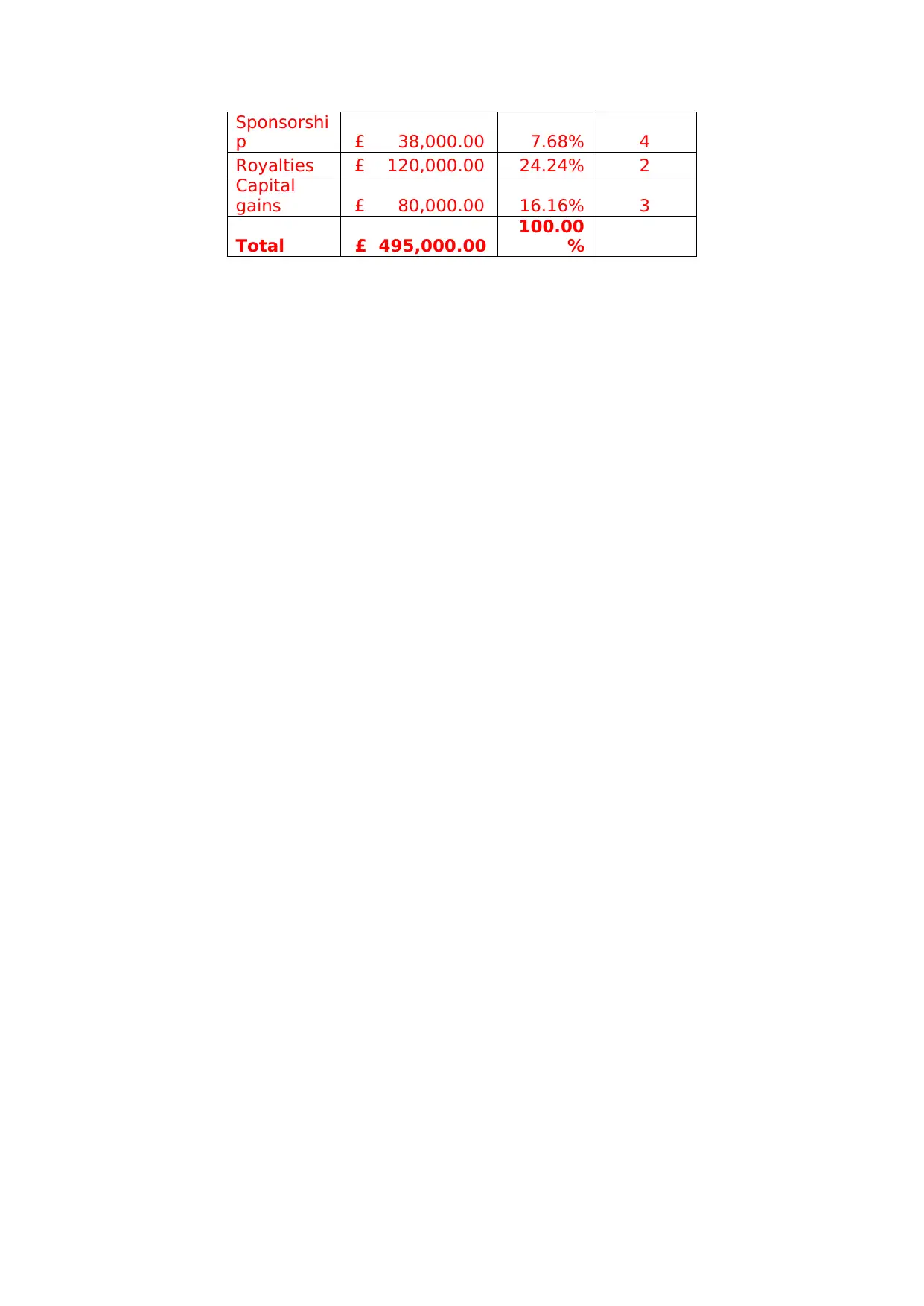
Sponsorshi
p £ 38,000.00 7.68% 4
Royalties £ 120,000.00 24.24% 2
Capital
gains £ 80,000.00 16.16% 3
Total £ 495,000.00
100.00
%
p £ 38,000.00 7.68% 4
Royalties £ 120,000.00 24.24% 2
Capital
gains £ 80,000.00 16.16% 3
Total £ 495,000.00
100.00
%
Task 3:
AC 2.1-Discuss what is meant by direct costs and indirect costs.
List all your business costs and identify which are direct costs
and which are indirect costs. (maximum word count 250)
Direct cost – Direct costs are defined as the costs those can be traced accurately
with the cost object easily. Here the cost object can be product, department or
any project. Generally the direct cost benefits the single cost object and hence,
segregation of any cost as indirect or as direct shall be done through taking into
consideration the cost object. However, any particular cost can be the direct cost
for one object whereas the same can be indirect for any other object. Most of the
direct costs are variable in nature; however, it may not be the case always. For
instance, supervisor’s salary for a particular month who only supervised
construction of a particular building is direct fixed cost that is incurred for the
building (Costabile et al. 2017).
Indirect cost – costs those cannot be allocated to any specific cost object
accurately is known as indirect cost. Indirect cost generally benefits the multiple
cost objects and hence, it is practically not possible to trace them accurately to
any individual product, department or project. Indirect costs do not differ
substantially within certain volumes of production or activities and are therefore
generally the indirect costs are of fixed nature (Thompson et al. 2016).
All the business costs of The Restaurant Group Plc include cost of sales,
administrative costs and interest cost. Here, costs of sales are direct costs and
the administrative costs and interest expenses are indirect costs.
AC 2.1-Discuss what is meant by direct costs and indirect costs.
List all your business costs and identify which are direct costs
and which are indirect costs. (maximum word count 250)
Direct cost – Direct costs are defined as the costs those can be traced accurately
with the cost object easily. Here the cost object can be product, department or
any project. Generally the direct cost benefits the single cost object and hence,
segregation of any cost as indirect or as direct shall be done through taking into
consideration the cost object. However, any particular cost can be the direct cost
for one object whereas the same can be indirect for any other object. Most of the
direct costs are variable in nature; however, it may not be the case always. For
instance, supervisor’s salary for a particular month who only supervised
construction of a particular building is direct fixed cost that is incurred for the
building (Costabile et al. 2017).
Indirect cost – costs those cannot be allocated to any specific cost object
accurately is known as indirect cost. Indirect cost generally benefits the multiple
cost objects and hence, it is practically not possible to trace them accurately to
any individual product, department or project. Indirect costs do not differ
substantially within certain volumes of production or activities and are therefore
generally the indirect costs are of fixed nature (Thompson et al. 2016).
All the business costs of The Restaurant Group Plc include cost of sales,
administrative costs and interest cost. Here, costs of sales are direct costs and
the administrative costs and interest expenses are indirect costs.
⊘ This is a preview!⊘
Do you want full access?
Subscribe today to unlock all pages.
Trusted by 1+ million students worldwide
Task 4:
AC 5.1-Discuss the characteristics of fixed, variable and semi-
variable cost with examples. Draw the labelled diagrams of
each cost. (maximum word count 150)
Fixed cost – fixed costs do not change with the changes in
production level and hence, additional computations are not
required. Examples of fixed costs are rent, salaries and
insurance.
Variable cost – variable costs changes with the changes in the
production level and hence, requires computation for each level
of production. Examples of variable costs are production
supplies, direct material, labour costs (Novák et al. 2016).
Semi variable costs – it consist the nature of both fixed cost as
well as variable cost. Part of the cost remains fixed and part of
the cost will fluctuate with the production level. For example,
salesperson commission will remain constant for a particular
level of sales and will increase thereafter (Novák et al. 2016).
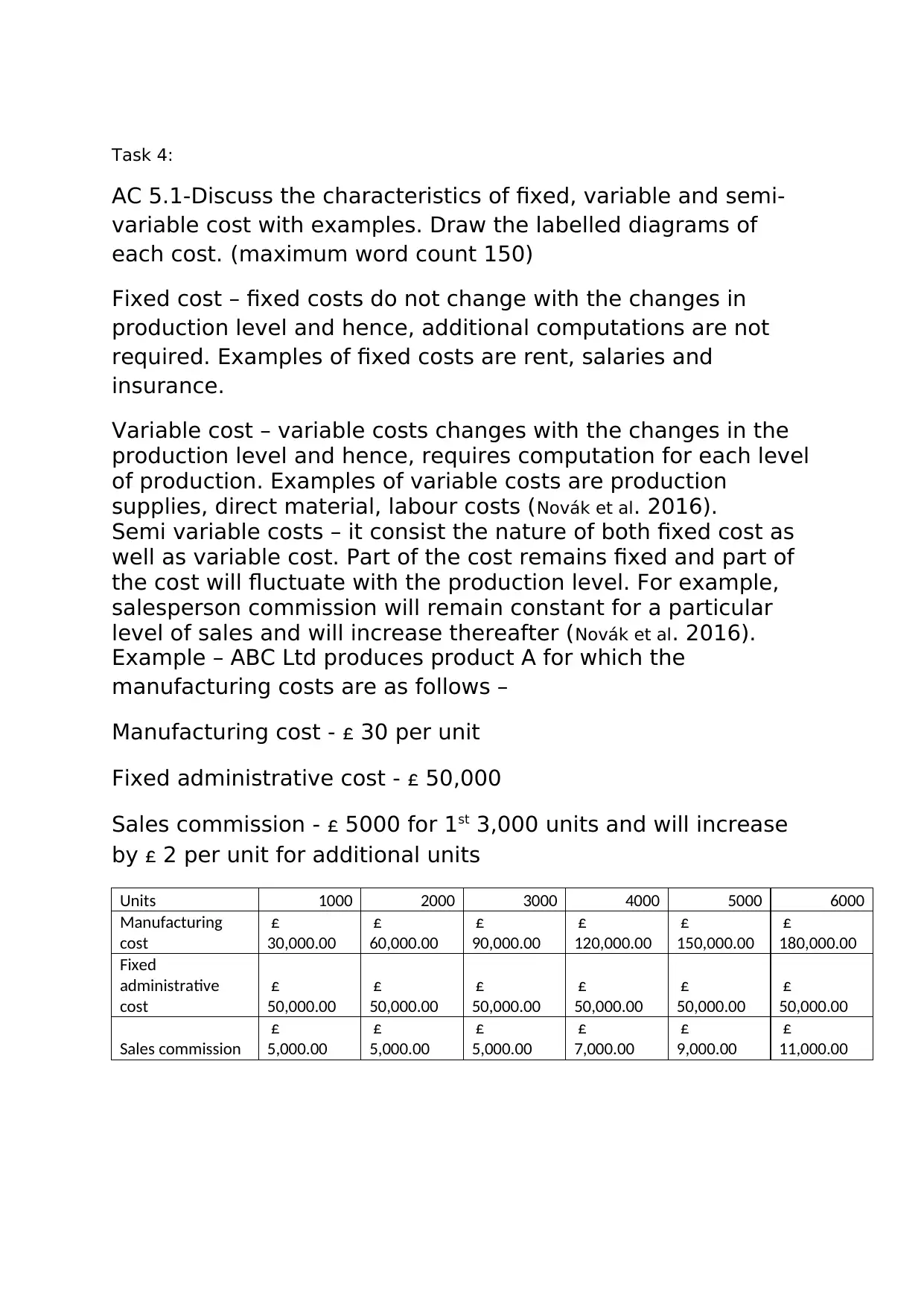
Example – ABC Ltd produces product A for which the
manufacturing costs are as follows –
Manufacturing cost - £ 30 per unit
Fixed administrative cost - £ 50,000
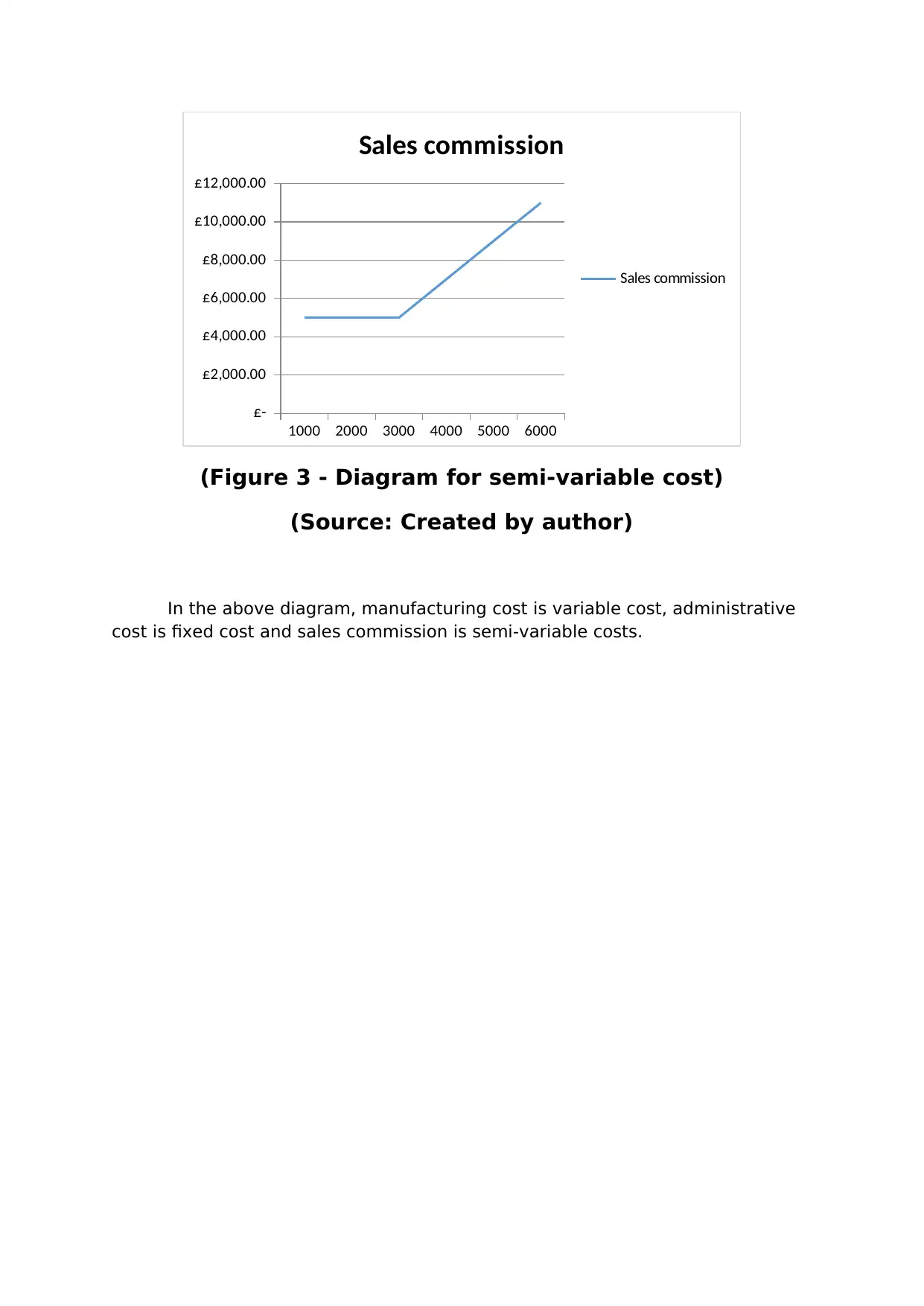
Sales commission - £ 5000 for 1st 3,000 units and will increase
by £ 2 per unit for additional units
Units 1000 2000 3000 4000 5000 6000
Manufacturing
cost
£
30,000.00
£
60,000.00
£
90,000.00
£
120,000.00
£
150,000.00
£
180,000.00
Fixed
administrative
cost
£
50,000.00
£
50,000.00
£
50,000.00
£
50,000.00
£
50,000.00
£
50,000.00
Sales commission
£
5,000.00
£
5,000.00
£
5,000.00
£
7,000.00
£
9,000.00
£
11,000.00
AC 5.1-Discuss the characteristics of fixed, variable and semi-
variable cost with examples. Draw the labelled diagrams of
each cost. (maximum word count 150)
Fixed cost – fixed costs do not change with the changes in
production level and hence, additional computations are not
required. Examples of fixed costs are rent, salaries and
insurance.
Variable cost – variable costs changes with the changes in the
production level and hence, requires computation for each level
of production. Examples of variable costs are production
supplies, direct material, labour costs (Novák et al. 2016).
Semi variable costs – it consist the nature of both fixed cost as
well as variable cost. Part of the cost remains fixed and part of
the cost will fluctuate with the production level. For example,
salesperson commission will remain constant for a particular
level of sales and will increase thereafter (Novák et al. 2016).
Example – ABC Ltd produces product A for which the
manufacturing costs are as follows –
Manufacturing cost - £ 30 per unit
Fixed administrative cost - £ 50,000
Sales commission - £ 5000 for 1st 3,000 units and will increase
by £ 2 per unit for additional units
Units 1000 2000 3000 4000 5000 6000
Manufacturing
cost
£
30,000.00
£
60,000.00
£
90,000.00
£
120,000.00
£
150,000.00
£
180,000.00
Fixed
administrative
cost
£
50,000.00
£
50,000.00
£
50,000.00
£
50,000.00
£
50,000.00
£
50,000.00
Sales commission
£
5,000.00
£
5,000.00
£
5,000.00
£
7,000.00
£
9,000.00
£
11,000.00
Paraphrase This Document
Need a fresh take? Get an instant paraphrase of this document with our AI Paraphraser
1000 2000 3000 4000 5000 6000
£-
£20,000.00
£40,000.00
£60,000.00
£80,000.00
£100,000.00
£120,000.00
£140,000.00
£160,000.00
£180,000.00
£200,000.00
Manufacturing cost
Manufacturing cost
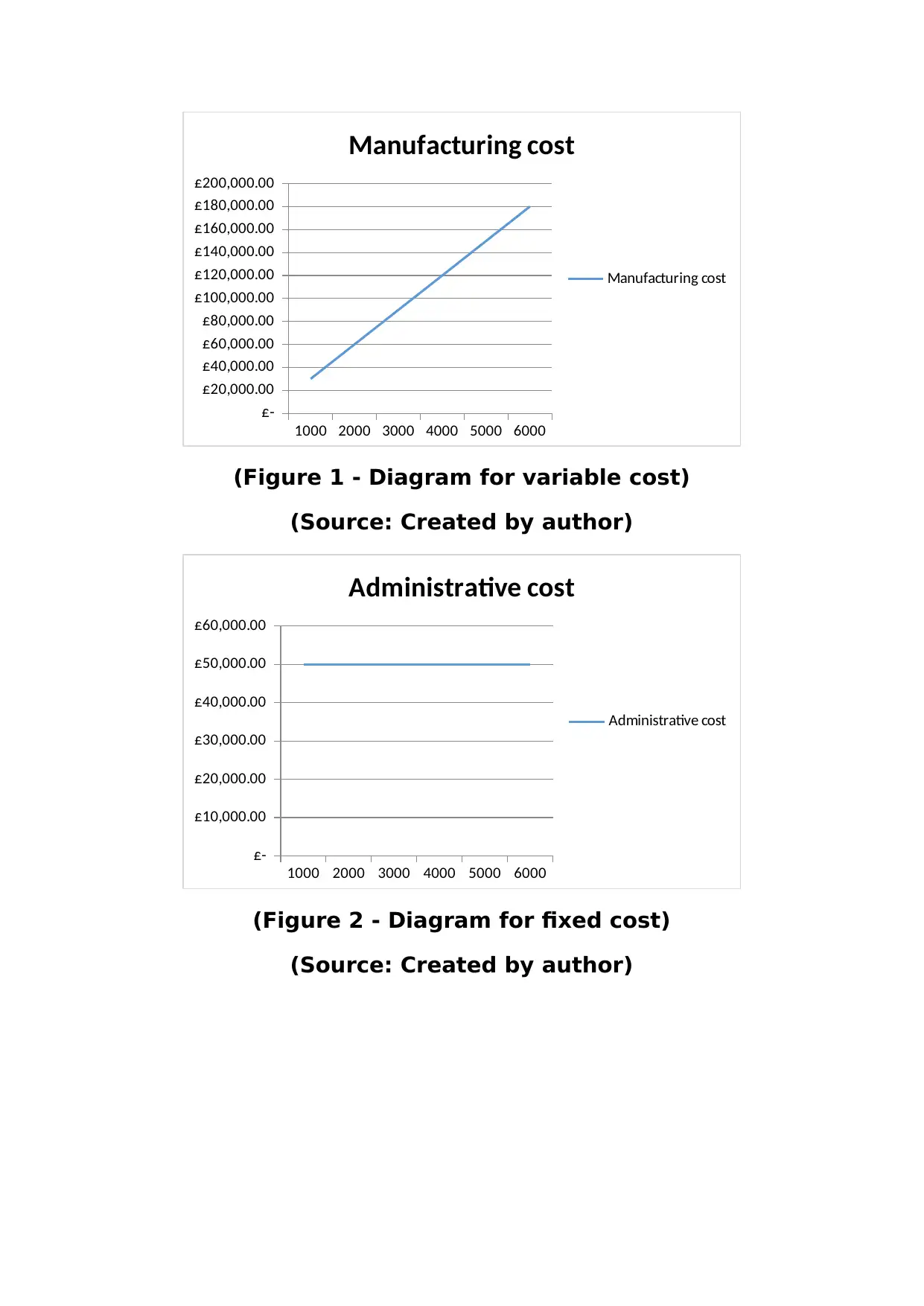
(Figure 1 - Diagram for variable cost)
(Source: Created by author)
1000 2000 3000 4000 5000 6000
£-
£10,000.00
£20,000.00
£30,000.00
£40,000.00
£50,000.00
£60,000.00
Administrative cost
Administrative cost
(Figure 2 - Diagram for fixed cost)
(Source: Created by author)
£-
£20,000.00
£40,000.00
£60,000.00
£80,000.00
£100,000.00
£120,000.00
£140,000.00
£160,000.00
£180,000.00
£200,000.00
Manufacturing cost
Manufacturing cost
(Figure 1 - Diagram for variable cost)
(Source: Created by author)
1000 2000 3000 4000 5000 6000
£-
£10,000.00
£20,000.00
£30,000.00
£40,000.00
£50,000.00
£60,000.00
Administrative cost
Administrative cost
(Figure 2 - Diagram for fixed cost)
(Source: Created by author)
1000 2000 3000 4000 5000 6000
£-
£2,000.00
£4,000.00
£6,000.00
£8,000.00
£10,000.00
£12,000.00
Sales commission
Sales commission
(Figure 3 - Diagram for semi-variable cost)
(Source: Created by author)
In the above diagram, manufacturing cost is variable cost, administrative
cost is fixed cost and sales commission is semi-variable costs.
£-
£2,000.00
£4,000.00
£6,000.00
£8,000.00
£10,000.00
£12,000.00
Sales commission
Sales commission
(Figure 3 - Diagram for semi-variable cost)
(Source: Created by author)
In the above diagram, manufacturing cost is variable cost, administrative
cost is fixed cost and sales commission is semi-variable costs.
⊘ This is a preview!⊘
Do you want full access?
Subscribe today to unlock all pages.
Trusted by 1+ million students worldwide
Task 5:
AC 2.2 (A) Evaluate methods of controlling stock (maximum
word count 350/ at least 1 reference required)
Various methods are there for controlling the stock those are
designed for providing the efficient system to decide when,
what and how much order to be placed. Based on the type of
stock any of the following or mix of 2 or more methods can be
follows –
Just-in-time order – main objective of JIT is reducing the costs
through cutting the stock to minimum. Under this system the
items are delivered when they are actually required for
production and are immediately used upon receipt. However, it
includes the risk of running out of the stock and hence, the
purchaser shall be confident enough that the supplies will be
received on time. Various advantages of JIT system are – (i) it
leads to minimum amounts for inventory obsolescence as high
rate of inventory turnover keeps inventory as idle and in turn
will become obsolete (ii) low level of inventory will reduce the
holding costs (iii) as the required level of inventory is low, the
entity is required to invest less amount of cash for inventory (Lai
and Cheng 2016).
First – in – first – out – under this method goods purchased 1st or
the goods entered into stock 1st are used 1st for and the goods
entered last are used later. This system assures that the
perishable stocks of the company are efficiently used and it
does not get deteriorated. Stocks under this method are
recognised through the receipt date and moves through each
production stage following strict order (Muller 2019).
AC 2.2 (A) Evaluate methods of controlling stock (maximum
word count 350/ at least 1 reference required)
Various methods are there for controlling the stock those are
designed for providing the efficient system to decide when,
what and how much order to be placed. Based on the type of
stock any of the following or mix of 2 or more methods can be
follows –
Just-in-time order – main objective of JIT is reducing the costs
through cutting the stock to minimum. Under this system the
items are delivered when they are actually required for
production and are immediately used upon receipt. However, it
includes the risk of running out of the stock and hence, the
purchaser shall be confident enough that the supplies will be
received on time. Various advantages of JIT system are – (i) it
leads to minimum amounts for inventory obsolescence as high
rate of inventory turnover keeps inventory as idle and in turn
will become obsolete (ii) low level of inventory will reduce the
holding costs (iii) as the required level of inventory is low, the
entity is required to invest less amount of cash for inventory (Lai
and Cheng 2016).
First – in – first – out – under this method goods purchased 1st or
the goods entered into stock 1st are used 1st for and the goods
entered last are used later. This system assures that the
perishable stocks of the company are efficiently used and it
does not get deteriorated. Stocks under this method are
recognised through the receipt date and moves through each
production stage following strict order (Muller 2019).
Paraphrase This Document
Need a fresh take? Get an instant paraphrase of this document with our AI Paraphraser
Task 6:
AC 2.2 (B) Evaluate methods of controlling cash (maximum
word count 250)
Various methods of controlling the cash flow are as follows –
Fast payment by the customers - For improving the cash
inflow, collection from the customers shall be fast and
prompt. It is possible through prompt billing and the
customers shall be informed promptly regarding the
payable amount and time by which the payment shall be
paid. Company may allow discount to the customers
making payment before due date. It will influence the
customers to make early payment (da Costa Moraes, Nagano
and Sobreiro 2015).
Decentralisation of collections – any big size firm that is
operating over the large geographical location can
enhance the cash flow through using the decentralised
system of collection. Different collection centres can be
opened under different locations rather than opening one
collection centre in one area. The idea behind this is
reducing mailing time from the customer’s despatch of the
cheques and its receipt in the company and further
reducing the collection time of cheques.
Fast conversion of the payment into cash – cash control
can be enhanced through improvement of the collection
procedure. Once a cheque is received from the customer it
shall be deposited immediately for collection. If the time
gap between collection of cheque and its collection is
reduced the cash control system will be improved (Cheung
2016).
AC 2.2 (B) Evaluate methods of controlling cash (maximum
word count 250)
Various methods of controlling the cash flow are as follows –
Fast payment by the customers - For improving the cash
inflow, collection from the customers shall be fast and
prompt. It is possible through prompt billing and the
customers shall be informed promptly regarding the
payable amount and time by which the payment shall be
paid. Company may allow discount to the customers
making payment before due date. It will influence the
customers to make early payment (da Costa Moraes, Nagano
and Sobreiro 2015).
Decentralisation of collections – any big size firm that is
operating over the large geographical location can
enhance the cash flow through using the decentralised
system of collection. Different collection centres can be
opened under different locations rather than opening one
collection centre in one area. The idea behind this is
reducing mailing time from the customer’s despatch of the
cheques and its receipt in the company and further
reducing the collection time of cheques.
Fast conversion of the payment into cash – cash control
can be enhanced through improvement of the collection
procedure. Once a cheque is received from the customer it
shall be deposited immediately for collection. If the time
gap between collection of cheque and its collection is
reduced the cash control system will be improved (Cheung
2016).
ASSIGNMENT 2
Task 7:
AC 3.1 Assess the source and structure of the trial balance
Trial balance is the bookkeeping worksheet where the balances
of all the ledgers are gathered and segregated into credit and
debit columns and the totals for debit and credit columns are
equal.
Double entry book keeping represents that for each business
transaction the amount shall be recorded in at least 2 accounts.
It also requires that for all the debit transactions there must be
equal amount of credit transaction.
Source of the information for preparing the trial balance is the
general ledger that have the below mentioned balances –
Expenses that will have debit balance
Revenue that will have credit balance
Equity that will have credit balance
Liabilities that will have credit balance
Assets that will have debit balance
Structure of trial balance –
ABC Ltd
Trial balance
December 31, 2018
Account titles Debit Credit
Cash XXX
Accounts receivable XXX
Office supplies XXX
Office equipment XXX
Bank loan XXX
Task 7:
AC 3.1 Assess the source and structure of the trial balance
Trial balance is the bookkeeping worksheet where the balances
of all the ledgers are gathered and segregated into credit and
debit columns and the totals for debit and credit columns are
equal.
Double entry book keeping represents that for each business
transaction the amount shall be recorded in at least 2 accounts.
It also requires that for all the debit transactions there must be
equal amount of credit transaction.
Source of the information for preparing the trial balance is the
general ledger that have the below mentioned balances –
Expenses that will have debit balance
Revenue that will have credit balance
Equity that will have credit balance
Liabilities that will have credit balance
Assets that will have debit balance
Structure of trial balance –
ABC Ltd
Trial balance
December 31, 2018
Account titles Debit Credit
Cash XXX
Accounts receivable XXX
Office supplies XXX
Office equipment XXX
Bank loan XXX
⊘ This is a preview!⊘
Do you want full access?
Subscribe today to unlock all pages.
Trusted by 1+ million students worldwide

1 out of 27


Related Documents


Your All-in-One AI-Powered Toolkit for Academic Success.
+13062052269
info@desklib.com
Available 24*7 on WhatsApp / Email
![[object Object]](/_next/static/media/star-bottom.7253800d.svg)
Unlock your academic potential
Copyright © 2020–2026 A2Z Services. All Rights Reserved. Developed and managed by ZUCOL.