Business Environment Analysis: Organisations, Structure and Case Study
VerifiedAdded on 2020/12/29
|12
|3925
|452
Report
AI Summary
This report delves into the multifaceted realm of the business environment, exploring both internal and external factors that shape organizational operations. It begins with an essay analyzing various organizational types, including profit, non-profit, and non-governmental entities, highlighting their distinct purposes, scopes, and the interrelationships between organizational structure and function. The report then presents a detailed case study focusing on the UK supermarket industry. This case study utilizes PESTLE and SWOT analyses to evaluate the industry's external and internal capabilities, respectively, and applies Porter's Five Forces model to assess the competitive dynamics within the sector. The analysis provides insights into the political, economic, social, technological, legal, and environmental factors influencing the industry, as well as the strengths, weaknesses, opportunities, and threats faced by UK supermarkets. The application of Porter's Five Forces further evaluates the competitive landscape, offering a comprehensive understanding of the industry's challenges and opportunities.
Business and Business
Environment
Environment

Paraphrase This Document
Need a fresh take? Get an instant paraphrase of this document with our AI Paraphraser
Table of Contents
INTRODUCTION ..........................................................................................................................1
SECTION 1 – ESSAY ....................................................................................................................1
PART 2 – CASE STUDY ...............................................................................................................5
CONCLUSION ...............................................................................................................................8
REFERENCES .............................................................................................................................9
.......................................................................................................................................................10
INTRODUCTION ..........................................................................................................................1
SECTION 1 – ESSAY ....................................................................................................................1
PART 2 – CASE STUDY ...............................................................................................................5
CONCLUSION ...............................................................................................................................8
REFERENCES .............................................................................................................................9
.......................................................................................................................................................10
INTRODUCTION
Business environment is a set of different internal and external factor which directly or
indirectly affect the operation of an organisation. In order to sustain in the contemporary
marketplace, every establishment mainly centres upon to determine these both factors for
achieving pre- determined goal. As stated earlier, success of every business depends on acquiring
itself to men environment within whit it functions (Arthanari, 2014). Hence, in globalised
scenario, business environment plays a pivotal role in most of an enterprises as it ensure them to
examine current and emerging trend for obtain maximisation of profit in an efficacious way.
Moreover, every organisation come in several forms, types (profit, non-profit and non-
governmental) and with different objectives which concern many groups like shareholders,
government, society as well as individuals. Although, every establishment is classified in several
types yet they all contribute towards to carry out business goal or objective in a trenchant and
economic manner. This report is based on an essay which include analysis of different kinds of
organization supported with their purpose and scope as well as interrelationship between
organisation structure and function. Finally, a case study on UK supermarket industry and
determine its internal and external capabilities with the usage of PESTLE, SWOT analysis as
well as application of Porter's five force model to evaluate the competitive force of any UK
supermarket is also mentioned here.
SECTION 1 – ESSAY
Understanding the environment or surrounding within which every firm operates is very
important for running a business unit successfully at any place. This is because, environmental
factors influence almost every aspect of company, be it its nature, location, distribution channel,
pricing system etc. Thus, business environment connotes internal and external forces in which
some are easily controllable by firm at the same time others are beyond the control of company
and these factors affects functioning of business enterprise ( Bashir and Verma, 2017). Apart
from this, the business environment concept is dynamic, complex and multifaceted as it differs
from place to place or region to region. Along with this, it is very difficult for company to
anticipate the exact nature of future happening as well as changes in economical or social
surroundings. However, there is close interaction between business and its environs which helps
firm in strengthening their operation by using its resources more effectively. Furthermore, in
Business environment is a set of different internal and external factor which directly or
indirectly affect the operation of an organisation. In order to sustain in the contemporary
marketplace, every establishment mainly centres upon to determine these both factors for
achieving pre- determined goal. As stated earlier, success of every business depends on acquiring
itself to men environment within whit it functions (Arthanari, 2014). Hence, in globalised
scenario, business environment plays a pivotal role in most of an enterprises as it ensure them to
examine current and emerging trend for obtain maximisation of profit in an efficacious way.
Moreover, every organisation come in several forms, types (profit, non-profit and non-
governmental) and with different objectives which concern many groups like shareholders,
government, society as well as individuals. Although, every establishment is classified in several
types yet they all contribute towards to carry out business goal or objective in a trenchant and
economic manner. This report is based on an essay which include analysis of different kinds of
organization supported with their purpose and scope as well as interrelationship between
organisation structure and function. Finally, a case study on UK supermarket industry and
determine its internal and external capabilities with the usage of PESTLE, SWOT analysis as
well as application of Porter's five force model to evaluate the competitive force of any UK
supermarket is also mentioned here.
SECTION 1 – ESSAY
Understanding the environment or surrounding within which every firm operates is very
important for running a business unit successfully at any place. This is because, environmental
factors influence almost every aspect of company, be it its nature, location, distribution channel,
pricing system etc. Thus, business environment connotes internal and external forces in which
some are easily controllable by firm at the same time others are beyond the control of company
and these factors affects functioning of business enterprise ( Bashir and Verma, 2017). Apart
from this, the business environment concept is dynamic, complex and multifaceted as it differs
from place to place or region to region. Along with this, it is very difficult for company to
anticipate the exact nature of future happening as well as changes in economical or social
surroundings. However, there is close interaction between business and its environs which helps
firm in strengthening their operation by using its resources more effectively. Furthermore, in
⊘ This is a preview!⊘
Do you want full access?
Subscribe today to unlock all pages.

Trusted by 1+ million students worldwide
order to attain high level of profitability ratio, every company should have impressive
organisation structure and function which leads them to add value to customers and enhance their
brand image. Hence, every organisation is classified into various division like profit, not for
profit and non- governmental which contains unique scope, purpose, objective, goal and together
they leads them to obtain profit maximisation within prescribed limit. Therefore, each of
business function is considered as an integral part for achieving high proficiency and
productivity (Desta and et. al., 2014).
Different kinds of organisation
An organisation is a social unit and it a formation of two or more individuals who come
together with an intent to achieve common goal of organisation. In every business firms, there
are different types of organisation and each of them has their own purpose, scope and size in
order to accomplish business goal or vision. Thus, the several kinds of organisations are profit,
non-profit and non – governmental. Hence, McDonald is considered to realise the deep
information of profit sector. McDonald is a American fast food company which is founded in the
year of 1940 and it is headquarter in Chicago, US. Along with this, it operates in over 100
countries across the globe as well as they serve around 69 million customers daily. It offers a
best quality of product or service in approximately 37,855 outlets as their products are
diversified in many ranges like hamburger, chicken and veg burger, desserts, milkshake etc.
Moreover, one of their primary purpose is to provide a healthy and tasty products which allow
them to enhance the customer satisfaction level as well as improves an overall performance of
company among industry (Glen and et. al., 2015). They are also very much passionate to enrich
firm's productivity that add value to customer demands in an trenchant way.
Moreover, to acquire a detailed knowledge about non profit organisation, National Heath
Service has taken which is commenced in the year of 1948 and it is one of the reputed healthcare
centre in London. They render several types of services such as emergency treatment, eye test,
dental care, aid for infectious diseases, ophthalmology etc. and it serve in more than 20
countries. Furthermore, their main aim is to enhance the welfare of community or society by
providing them best healthy treatment in order to keep them fit and safe. On the other hand, to
understand the concept of non- governmental industry, Oxfam is advised for this. Hence, Oxfam
is a UK based organisation which is established in the year of 1995 with an aim of providing a
good life style for community or people. Along with this, they are highly dedicated to eradicate
organisation structure and function which leads them to add value to customers and enhance their
brand image. Hence, every organisation is classified into various division like profit, not for
profit and non- governmental which contains unique scope, purpose, objective, goal and together
they leads them to obtain profit maximisation within prescribed limit. Therefore, each of
business function is considered as an integral part for achieving high proficiency and
productivity (Desta and et. al., 2014).
Different kinds of organisation
An organisation is a social unit and it a formation of two or more individuals who come
together with an intent to achieve common goal of organisation. In every business firms, there
are different types of organisation and each of them has their own purpose, scope and size in
order to accomplish business goal or vision. Thus, the several kinds of organisations are profit,
non-profit and non – governmental. Hence, McDonald is considered to realise the deep
information of profit sector. McDonald is a American fast food company which is founded in the
year of 1940 and it is headquarter in Chicago, US. Along with this, it operates in over 100
countries across the globe as well as they serve around 69 million customers daily. It offers a
best quality of product or service in approximately 37,855 outlets as their products are
diversified in many ranges like hamburger, chicken and veg burger, desserts, milkshake etc.
Moreover, one of their primary purpose is to provide a healthy and tasty products which allow
them to enhance the customer satisfaction level as well as improves an overall performance of
company among industry (Glen and et. al., 2015). They are also very much passionate to enrich
firm's productivity that add value to customer demands in an trenchant way.
Moreover, to acquire a detailed knowledge about non profit organisation, National Heath
Service has taken which is commenced in the year of 1948 and it is one of the reputed healthcare
centre in London. They render several types of services such as emergency treatment, eye test,
dental care, aid for infectious diseases, ophthalmology etc. and it serve in more than 20
countries. Furthermore, their main aim is to enhance the welfare of community or society by
providing them best healthy treatment in order to keep them fit and safe. On the other hand, to
understand the concept of non- governmental industry, Oxfam is advised for this. Hence, Oxfam
is a UK based organisation which is established in the year of 1995 with an aim of providing a
good life style for community or people. Along with this, they are highly dedicated to eradicate
Paraphrase This Document
Need a fresh take? Get an instant paraphrase of this document with our AI Paraphraser
poverty and injustice from society, for that they offer various kind of services like clothing, food,
shelter, education etc. in order to add value to customers or people.
Size and Scope of organisation
Organisations may contain different purposes and goals which they need to accomplish
while establishing business within an industry. However, some firm mainly operates their
functions to earn maximum profit while others enterprises runs to meet the requirements of
customer. Therefore, the intention of all organisation are not precisely similar. The different
types of organisation are medium, small and large and their market share and purpose is unique
from each other. However, these sector plays a vital role in an enhancement or development of
UK economy. Apart from this, a firm which is formed with less than 50 employees is referred as
small business and its turnover is under £ 10 million. To understand the same concept, Austin
Fraser is reasoned as it is a best small business firm which render recruitment services to various
industry like IT, Engineering and Life science. It is established in the year of 2006 in UK and it
has a wide scope of success as they maintain strong relationship with their customers and guide
them a best opportunity among industry which add value to its brand image. On the other hand,
medium business define as a group of 250 employees or less than that and it has high
contribution for improvement in UK economic condition. For medium size business, Unicorn
Grocery is regarded as best option (Greenwood, ed., 2016). However, it's a start up company
which delivers healthy and tasty food as well as fresh or organic fruits and vegetable, general
grocery items etc. It is England based firm that is founded in the year of 1996 and is fully
controllable by principles of co- operative organisation which enable them to earn £ 50 million
market share.
Furthermore, micro enterprises are those which is establishes with less than 10
individuals and for this concept WriteUpp is chosen. It is a software company which develops
cloud based software for healthcare and for well being professionals. It serve in 20 countries with
thousands of clinics across the worldwide and its revenue growth is 209%. However, they render
their service in very cost effective manner and also advanced clod software which allow
healthcare practices and clinics to improve their performance by adapting innovative or creative
technology. While, a firm which contain more than 250 manpower is defined as large
enterprises. Hence, McDonald is an appropriate example for this industry which is an American
fast food restaurant and its commenced in the year of 1940. One of their core principle which
shelter, education etc. in order to add value to customers or people.
Size and Scope of organisation
Organisations may contain different purposes and goals which they need to accomplish
while establishing business within an industry. However, some firm mainly operates their
functions to earn maximum profit while others enterprises runs to meet the requirements of
customer. Therefore, the intention of all organisation are not precisely similar. The different
types of organisation are medium, small and large and their market share and purpose is unique
from each other. However, these sector plays a vital role in an enhancement or development of
UK economy. Apart from this, a firm which is formed with less than 50 employees is referred as
small business and its turnover is under £ 10 million. To understand the same concept, Austin
Fraser is reasoned as it is a best small business firm which render recruitment services to various
industry like IT, Engineering and Life science. It is established in the year of 2006 in UK and it
has a wide scope of success as they maintain strong relationship with their customers and guide
them a best opportunity among industry which add value to its brand image. On the other hand,
medium business define as a group of 250 employees or less than that and it has high
contribution for improvement in UK economic condition. For medium size business, Unicorn
Grocery is regarded as best option (Greenwood, ed., 2016). However, it's a start up company
which delivers healthy and tasty food as well as fresh or organic fruits and vegetable, general
grocery items etc. It is England based firm that is founded in the year of 1996 and is fully
controllable by principles of co- operative organisation which enable them to earn £ 50 million
market share.
Furthermore, micro enterprises are those which is establishes with less than 10
individuals and for this concept WriteUpp is chosen. It is a software company which develops
cloud based software for healthcare and for well being professionals. It serve in 20 countries with
thousands of clinics across the worldwide and its revenue growth is 209%. However, they render
their service in very cost effective manner and also advanced clod software which allow
healthcare practices and clinics to improve their performance by adapting innovative or creative
technology. While, a firm which contain more than 250 manpower is defined as large
enterprises. Hence, McDonald is an appropriate example for this industry which is an American
fast food restaurant and its commenced in the year of 1940. One of their core principle which
allow them to generate 21.03 billion in which its market share is 10.8 percent share as they
identifies all possible business opportunities and implement effective strategic decision in order
to gain competitive advantage among competitors.
Organisation structure and function
This part is very crucial in every firm as it direct or provide proper guidance each
business function in order to accomplish organisational goal within prescribed limit. However,
organisation structure determines how the roles or responsibilities are assigned and provide fair
coordination among different level of an organisation (Griffith and Dimitrova, 2014). Thus,
every company follows unique structure to achieve pre determined goal in an effective manner.
In case of profit organisation i.e. McDonald, a American based restaurant as they applies
divisional organisational structure and they divided their each business responsibilities into
different departments that help them to enhance their productivity without any hindrances or
conflict of interest among employees. Whereas, National Health Organisation a famous non
profit organisation, which render healthcare service to enrich common people life standard and
they live a healthy and fit life (Williams, 2015). Moreover, they follows hierarchical
organisational structure which ensure them to manage or interact between different departments
very smoothly as well as enable them to build a best working culture which add value to their
brand reputation. On the other hand, Oxfom a non governmental organisation which is
established with an aim to eliminate poverty and inequality from the society and enhance their
lifestyle by make them feel valued or respected. They implies flat organisation structure which
assist them to make quicker or fair decision and also enable them to coordinate smoothly among
management and staff.
Each and every system undergoes through several types of complexities which sometime
result into delay in accomplishment of business mission or objectives. Some other types of
organisation are transnational, international and global. In case of transnational, they majorly
invest in foreign businesses and thus it is regarded as complex system (Haleem and Jehangir,
2017). They make decisions or strategies for enrichment of R&D function for strengthening their
market capability and also they consist corporate facility in their business operations.
International firms are importers and exporters of product or services but they do not contain any
finance outside from their home country which hindrances their functions. Whereas global
companies are benefited with investing in several countries and also they can trade their
identifies all possible business opportunities and implement effective strategic decision in order
to gain competitive advantage among competitors.
Organisation structure and function
This part is very crucial in every firm as it direct or provide proper guidance each
business function in order to accomplish organisational goal within prescribed limit. However,
organisation structure determines how the roles or responsibilities are assigned and provide fair
coordination among different level of an organisation (Griffith and Dimitrova, 2014). Thus,
every company follows unique structure to achieve pre determined goal in an effective manner.
In case of profit organisation i.e. McDonald, a American based restaurant as they applies
divisional organisational structure and they divided their each business responsibilities into
different departments that help them to enhance their productivity without any hindrances or
conflict of interest among employees. Whereas, National Health Organisation a famous non
profit organisation, which render healthcare service to enrich common people life standard and
they live a healthy and fit life (Williams, 2015). Moreover, they follows hierarchical
organisational structure which ensure them to manage or interact between different departments
very smoothly as well as enable them to build a best working culture which add value to their
brand reputation. On the other hand, Oxfom a non governmental organisation which is
established with an aim to eliminate poverty and inequality from the society and enhance their
lifestyle by make them feel valued or respected. They implies flat organisation structure which
assist them to make quicker or fair decision and also enable them to coordinate smoothly among
management and staff.
Each and every system undergoes through several types of complexities which sometime
result into delay in accomplishment of business mission or objectives. Some other types of
organisation are transnational, international and global. In case of transnational, they majorly
invest in foreign businesses and thus it is regarded as complex system (Haleem and Jehangir,
2017). They make decisions or strategies for enrichment of R&D function for strengthening their
market capability and also they consist corporate facility in their business operations.
International firms are importers and exporters of product or services but they do not contain any
finance outside from their home country which hindrances their functions. Whereas global
companies are benefited with investing in several countries and also they can trade their
⊘ This is a preview!⊘
Do you want full access?
Subscribe today to unlock all pages.
Trusted by 1+ million students worldwide
commodity with the same reputed brand which also becomes a obstacle in accomplish their goal
within prescribed time period. However, an impressive organisational structure helps the firm to
attain higher level of productivity and proficiency in an cost-efficient manner. Although, every
company consist of various departments like marketing, production, operational etc. and they
perform different roles or responsibilities yet they are interrelated with each other. For e.g. if
human resource department wishes to advertise regarding recruitment of personnel it requires
marketing function support in promoting the firm as well as in hiring best talented manpower
and vice versa (Laudon and Traver, 2016). Apart from this, this interlink role enable an
organisation to identify enormous platforms which lead them to attain high level of success and
to gain competitive advantage. Therefore, interconnection of organisational structure and
function ensures the company to monitor its business operation as well as implement productive
decision for obtaining maximisation of profit.
PART 2 – CASE STUDY
PESTLE analysis of UK supermarket industry
Business environment consist micro and macro factor which provide positive or negative
effect towards organisation as well as it influence their decision making potentiality. Moreover,
in present scenario, UK supermarket is one of the fastest growing sector and there is high level of
competition in terms of productivity and profitability ratio. Thus, PESTLE analysis is applied to
evaluate external environment which enable UK supermarkets to identify its potentiality and help
them to make impressive decision. The PESTLE analysis of UK supermarket sector is described
below:
Political Factor: It consist government policies, procedures, taxation system, political
stability etc. which directly impact on business operations and functions. Hence, UK
supermarket faced difficulties due to Brexit and i.e. UK leaving EU. Along with this, many
countries also affected as they were importing their commodity to UK and Brexit create problem
in selling their goods due to tariff rates (Remane and et. al.,2017). However, UK has stable
government which helped supermarket to carry on with importing goods to UK as well as make
them survive in UK rather than leaving EU trade zone which allow them to gain competitive
advantage.
Social Factor: This includes customers attitude, behaviour, perception, norms, value etc.
which affect firms productivity. Although, UK population is in high demand of online shopping,
within prescribed time period. However, an impressive organisational structure helps the firm to
attain higher level of productivity and proficiency in an cost-efficient manner. Although, every
company consist of various departments like marketing, production, operational etc. and they
perform different roles or responsibilities yet they are interrelated with each other. For e.g. if
human resource department wishes to advertise regarding recruitment of personnel it requires
marketing function support in promoting the firm as well as in hiring best talented manpower
and vice versa (Laudon and Traver, 2016). Apart from this, this interlink role enable an
organisation to identify enormous platforms which lead them to attain high level of success and
to gain competitive advantage. Therefore, interconnection of organisational structure and
function ensures the company to monitor its business operation as well as implement productive
decision for obtaining maximisation of profit.
PART 2 – CASE STUDY
PESTLE analysis of UK supermarket industry
Business environment consist micro and macro factor which provide positive or negative
effect towards organisation as well as it influence their decision making potentiality. Moreover,
in present scenario, UK supermarket is one of the fastest growing sector and there is high level of
competition in terms of productivity and profitability ratio. Thus, PESTLE analysis is applied to
evaluate external environment which enable UK supermarkets to identify its potentiality and help
them to make impressive decision. The PESTLE analysis of UK supermarket sector is described
below:
Political Factor: It consist government policies, procedures, taxation system, political
stability etc. which directly impact on business operations and functions. Hence, UK
supermarket faced difficulties due to Brexit and i.e. UK leaving EU. Along with this, many
countries also affected as they were importing their commodity to UK and Brexit create problem
in selling their goods due to tariff rates (Remane and et. al.,2017). However, UK has stable
government which helped supermarket to carry on with importing goods to UK as well as make
them survive in UK rather than leaving EU trade zone which allow them to gain competitive
advantage.
Social Factor: This includes customers attitude, behaviour, perception, norms, value etc.
which affect firms productivity. Although, UK population is in high demand of online shopping,
Paraphrase This Document
Need a fresh take? Get an instant paraphrase of this document with our AI Paraphraser
home delivery service as well as trendy clothes which negatively impacted supermarket.
However, UK supermarket meet this negative impact by introducing online trade system as well
as facilitate delivering products at home which highly satisfied customers as they were able to
save time, cost, money. By this, UK supermarket are enable to attain maximisation of profit with
optimum utilisation of resources.
Economical factor: This factor consist inflation, deflation rate, interest rate, economic
growth and many more which influence business in achieving goals and objectives. Hence,
recently UK undergoes with heavy recession which negatively impacted to supermarket in their
proficiency. Thus, UK supermarket managed this negative effect by providing impressive
discounts, offers and incentives which enable them to maintain customer spending and that leads
them to obtain high level of growth and development (Ricciardi, Zardini and Rossignoli, 2016).
Technological factor: Under this factor, it contains innovation, creativity, updated
technology that influence business operation and decision making. However, there is a high
preference of latest technology among UK population which impacted them in attaining high
profitability ratio. Therefore, in order to tackle with this negative affect UK supermarket
acquired all latest technologies in their business operations as well as they provide the facility of
online shopping to customers. With the help of this activity, supermarkets were enable to gain
competitive advantage in an innovative and creative style (Wang, 2014).
Legal factor: It includes laws and legislation regarding employment, reward system,
health and safety, consumer right etc. which affect organisation productivity. Therefore, there
was a implementation of rule by government regarding a monitoring over firm's working culture
as well as pricing policy which negatively influenced the supermarket. However, UK
supermarkets acquired PPG i.e. Planning Policy Guideline Note which help them to provide high
level of satisfaction to customers which add value to their brand image (Siriwichai, 2014).
Environmental factor: It consist eco friendly and environmental products which influence
business operation and function. However, UK population was in high demand of eco friendly
product which impacted supermarket drastically. Therefore, UK supermarkets overcome this
impact by introducing several environmental products like fridge, machines etc. as well as they
develops a concept of 3R i.e. reuse, recycle, reduce which enable them to improve their overall
performance and their productivity.
SWOT analysis of TESCO
However, UK supermarket meet this negative impact by introducing online trade system as well
as facilitate delivering products at home which highly satisfied customers as they were able to
save time, cost, money. By this, UK supermarket are enable to attain maximisation of profit with
optimum utilisation of resources.
Economical factor: This factor consist inflation, deflation rate, interest rate, economic
growth and many more which influence business in achieving goals and objectives. Hence,
recently UK undergoes with heavy recession which negatively impacted to supermarket in their
proficiency. Thus, UK supermarket managed this negative effect by providing impressive
discounts, offers and incentives which enable them to maintain customer spending and that leads
them to obtain high level of growth and development (Ricciardi, Zardini and Rossignoli, 2016).
Technological factor: Under this factor, it contains innovation, creativity, updated
technology that influence business operation and decision making. However, there is a high
preference of latest technology among UK population which impacted them in attaining high
profitability ratio. Therefore, in order to tackle with this negative affect UK supermarket
acquired all latest technologies in their business operations as well as they provide the facility of
online shopping to customers. With the help of this activity, supermarkets were enable to gain
competitive advantage in an innovative and creative style (Wang, 2014).
Legal factor: It includes laws and legislation regarding employment, reward system,
health and safety, consumer right etc. which affect organisation productivity. Therefore, there
was a implementation of rule by government regarding a monitoring over firm's working culture
as well as pricing policy which negatively influenced the supermarket. However, UK
supermarkets acquired PPG i.e. Planning Policy Guideline Note which help them to provide high
level of satisfaction to customers which add value to their brand image (Siriwichai, 2014).
Environmental factor: It consist eco friendly and environmental products which influence
business operation and function. However, UK population was in high demand of eco friendly
product which impacted supermarket drastically. Therefore, UK supermarkets overcome this
impact by introducing several environmental products like fridge, machines etc. as well as they
develops a concept of 3R i.e. reuse, recycle, reduce which enable them to improve their overall
performance and their productivity.
SWOT analysis of TESCO
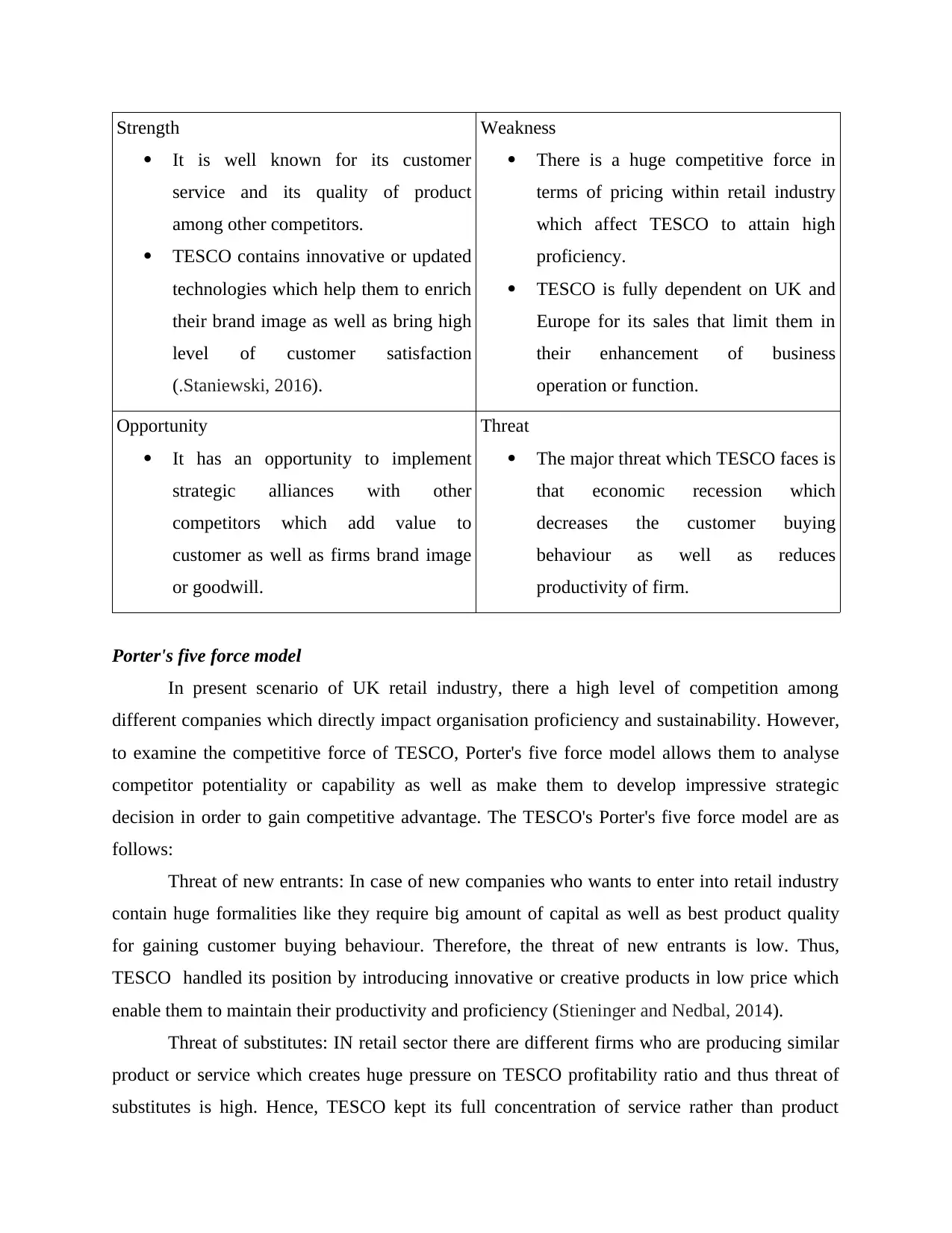
Strength
It is well known for its customer
service and its quality of product
among other competitors.
TESCO contains innovative or updated
technologies which help them to enrich
their brand image as well as bring high
level of customer satisfaction
(.Staniewski, 2016).
Weakness
There is a huge competitive force in
terms of pricing within retail industry
which affect TESCO to attain high
proficiency.
TESCO is fully dependent on UK and
Europe for its sales that limit them in
their enhancement of business
operation or function.
Opportunity
It has an opportunity to implement
strategic alliances with other
competitors which add value to
customer as well as firms brand image
or goodwill.
Threat
The major threat which TESCO faces is
that economic recession which
decreases the customer buying
behaviour as well as reduces
productivity of firm.
Porter's five force model
In present scenario of UK retail industry, there a high level of competition among
different companies which directly impact organisation proficiency and sustainability. However,
to examine the competitive force of TESCO, Porter's five force model allows them to analyse
competitor potentiality or capability as well as make them to develop impressive strategic
decision in order to gain competitive advantage. The TESCO's Porter's five force model are as
follows:
Threat of new entrants: In case of new companies who wants to enter into retail industry
contain huge formalities like they require big amount of capital as well as best product quality
for gaining customer buying behaviour. Therefore, the threat of new entrants is low. Thus,
TESCO handled its position by introducing innovative or creative products in low price which
enable them to maintain their productivity and proficiency (Stieninger and Nedbal, 2014).
Threat of substitutes: IN retail sector there are different firms who are producing similar
product or service which creates huge pressure on TESCO profitability ratio and thus threat of
substitutes is high. Hence, TESCO kept its full concentration of service rather than product
It is well known for its customer
service and its quality of product
among other competitors.
TESCO contains innovative or updated
technologies which help them to enrich
their brand image as well as bring high
level of customer satisfaction
(.Staniewski, 2016).
Weakness
There is a huge competitive force in
terms of pricing within retail industry
which affect TESCO to attain high
proficiency.
TESCO is fully dependent on UK and
Europe for its sales that limit them in
their enhancement of business
operation or function.
Opportunity
It has an opportunity to implement
strategic alliances with other
competitors which add value to
customer as well as firms brand image
or goodwill.
Threat
The major threat which TESCO faces is
that economic recession which
decreases the customer buying
behaviour as well as reduces
productivity of firm.
Porter's five force model
In present scenario of UK retail industry, there a high level of competition among
different companies which directly impact organisation proficiency and sustainability. However,
to examine the competitive force of TESCO, Porter's five force model allows them to analyse
competitor potentiality or capability as well as make them to develop impressive strategic
decision in order to gain competitive advantage. The TESCO's Porter's five force model are as
follows:
Threat of new entrants: In case of new companies who wants to enter into retail industry
contain huge formalities like they require big amount of capital as well as best product quality
for gaining customer buying behaviour. Therefore, the threat of new entrants is low. Thus,
TESCO handled its position by introducing innovative or creative products in low price which
enable them to maintain their productivity and proficiency (Stieninger and Nedbal, 2014).
Threat of substitutes: IN retail sector there are different firms who are producing similar
product or service which creates huge pressure on TESCO profitability ratio and thus threat of
substitutes is high. Hence, TESCO kept its full concentration of service rather than product
⊘ This is a preview!⊘
Do you want full access?
Subscribe today to unlock all pages.
Trusted by 1+ million students worldwide
which enable them to face their competitors in an effective manner and it enhance their
proficiency.
Bargaining power of supplier: There are many suppliers in retail sector which impact
TESCO's volume of sales and profit margin. However, TESCO adapted a strategy to tacle with
this issue as they kept permanent suppliers for their raw material which allows them to achieve
its goal and enrich their sales (Stieninger and Nedbal, 2014).
Bargaining power of buyer: In UK retail industry , buyers have various option to to
choose product that effect TESCO by decreasing their productivity. Therefore, TESCO
implemented innovative commodities or services which help them to increase their sales as well
as improves their profit margin.
Rivalry among competitors: There is a existence of high level of opposition among
competitors which puts huge pressure on TESCO's operation and function. Therefore, TESCO
generates a sustainable differentiation and collaborating with competitors which improves the
overall performance of company and help them to gain competitive advantage.
CONCLUSION
The above stated report, it has been concluded that business environment is an important
part of every organisation as it help them to identify its strength and weakness in order to
strengthening the function of company. Along with this, there are various types of firm which
contain unique purpose, size and scope and it lead them to achieve its goal in an efficacious way.
Moreover, there are several tools which enable company to examine its potentiality such as
PESTLE , SWOT and Porter's five force model and also they help them to analyse their
competitive force in an effective manner.
proficiency.
Bargaining power of supplier: There are many suppliers in retail sector which impact
TESCO's volume of sales and profit margin. However, TESCO adapted a strategy to tacle with
this issue as they kept permanent suppliers for their raw material which allows them to achieve
its goal and enrich their sales (Stieninger and Nedbal, 2014).
Bargaining power of buyer: In UK retail industry , buyers have various option to to
choose product that effect TESCO by decreasing their productivity. Therefore, TESCO
implemented innovative commodities or services which help them to increase their sales as well
as improves their profit margin.
Rivalry among competitors: There is a existence of high level of opposition among
competitors which puts huge pressure on TESCO's operation and function. Therefore, TESCO
generates a sustainable differentiation and collaborating with competitors which improves the
overall performance of company and help them to gain competitive advantage.
CONCLUSION
The above stated report, it has been concluded that business environment is an important
part of every organisation as it help them to identify its strength and weakness in order to
strengthening the function of company. Along with this, there are various types of firm which
contain unique purpose, size and scope and it lead them to achieve its goal in an efficacious way.
Moreover, there are several tools which enable company to examine its potentiality such as
PESTLE , SWOT and Porter's five force model and also they help them to analyse their
competitive force in an effective manner.
Paraphrase This Document
Need a fresh take? Get an instant paraphrase of this document with our AI Paraphraser
REFERENCES
Books and Journal
Arthanari, A., 2014. Fine-Tuning the Retail Sector in India and the Preconditions for FDI in
Retailing. IOSR Journal Of Humanities And Social Science (IOSR-JHSS) Volume. 19.
pp.71-77.
Bashir, M. and Verma, R., 2017. Why business model innovation is the new competitive
advantage. IUP Journal of Business Strategy. 14(1). p.7.
Desta, A and et. al., 2014. analysis of kaizen Implementation in Northern Ethiopia’s
Manufacturing Industries. International journal of business and commerce. 3(8). p.39.
Glen, R and et. al., 2015. Teaching design thinking in business schools. The International
Journal of Management Education. 13(2). pp.182-192.
Greenwood, J. ed., 2016. The effectiveness of EU business associations. Springer.
Griffith, D. A. and Dimitrova, B. V., 2014. Business and cultural aspects of psychic distance and
complementarity of capabilities in export relationships. Journal of International
Marketing. 22(3). pp.50-67.
Haleem, F. and Jehangir, M., 2017. Strategic Management Practices by Morrison PLC, UK.
Analysis, Lessons and Implications. Middle East Journal of Business. 12(3).
Laudon, K. C. and Traver, C. G., 2016. E-commerce: business, technology, society.
Remane, G and et. al.,2017. The business model pattern database—a tool for systematic business
model innovation. International Journal of Innovation Management. 21(01). p.1750004.
Ricciardi, F., Zardini, A. and Rossignoli, C., 2016. Organizational dynamism and adaptive
business model innovation: The triple paradox configuration. Journal of Business
Research. 69(11). pp.5487-5493.
Siriwichai, C., 2014. The influence of Japanese customers’ demographics on their perceptions of
cooperative agri-food retailers: the case of Konohana Garten. Ritsumeikan Journal of
Asia Pacific Studies, (33). pp.1-13.
Staniewski, M. W., 2016. The contribution of business experience and knowledge to successful
entrepreneurship. Journal of Business Research. 69(11). pp.5147-5152.
Stieninger, M. and Nedbal, D., 2014. Characteristics of cloud computing in the business context:
A systematic literature review. Global Journal of Flexible Systems Management. 15(1).
pp.59-68.
Stieninger, M. and Nedbal, D., 2014. Characteristics of cloud computing in the business context:
A systematic literature review. Global Journal of Flexible Systems Management. 15(1).
pp.59-68.
Wang, C. J., 2014. Do ethical and sustainable practices matter? Effects of corporate citizenship
on business performance in the hospitality industry. International Journal of
Contemporary Hospitality Management. 26(6). pp.930-947.
Williams, I., 2015. Tare-ing it up. CIWM Journal, 2015(December). pp.46-48.
Books and Journal
Arthanari, A., 2014. Fine-Tuning the Retail Sector in India and the Preconditions for FDI in
Retailing. IOSR Journal Of Humanities And Social Science (IOSR-JHSS) Volume. 19.
pp.71-77.
Bashir, M. and Verma, R., 2017. Why business model innovation is the new competitive
advantage. IUP Journal of Business Strategy. 14(1). p.7.
Desta, A and et. al., 2014. analysis of kaizen Implementation in Northern Ethiopia’s
Manufacturing Industries. International journal of business and commerce. 3(8). p.39.
Glen, R and et. al., 2015. Teaching design thinking in business schools. The International
Journal of Management Education. 13(2). pp.182-192.
Greenwood, J. ed., 2016. The effectiveness of EU business associations. Springer.
Griffith, D. A. and Dimitrova, B. V., 2014. Business and cultural aspects of psychic distance and
complementarity of capabilities in export relationships. Journal of International
Marketing. 22(3). pp.50-67.
Haleem, F. and Jehangir, M., 2017. Strategic Management Practices by Morrison PLC, UK.
Analysis, Lessons and Implications. Middle East Journal of Business. 12(3).
Laudon, K. C. and Traver, C. G., 2016. E-commerce: business, technology, society.
Remane, G and et. al.,2017. The business model pattern database—a tool for systematic business
model innovation. International Journal of Innovation Management. 21(01). p.1750004.
Ricciardi, F., Zardini, A. and Rossignoli, C., 2016. Organizational dynamism and adaptive
business model innovation: The triple paradox configuration. Journal of Business
Research. 69(11). pp.5487-5493.
Siriwichai, C., 2014. The influence of Japanese customers’ demographics on their perceptions of
cooperative agri-food retailers: the case of Konohana Garten. Ritsumeikan Journal of
Asia Pacific Studies, (33). pp.1-13.
Staniewski, M. W., 2016. The contribution of business experience and knowledge to successful
entrepreneurship. Journal of Business Research. 69(11). pp.5147-5152.
Stieninger, M. and Nedbal, D., 2014. Characteristics of cloud computing in the business context:
A systematic literature review. Global Journal of Flexible Systems Management. 15(1).
pp.59-68.
Stieninger, M. and Nedbal, D., 2014. Characteristics of cloud computing in the business context:
A systematic literature review. Global Journal of Flexible Systems Management. 15(1).
pp.59-68.
Wang, C. J., 2014. Do ethical and sustainable practices matter? Effects of corporate citizenship
on business performance in the hospitality industry. International Journal of
Contemporary Hospitality Management. 26(6). pp.930-947.
Williams, I., 2015. Tare-ing it up. CIWM Journal, 2015(December). pp.46-48.

⊘ This is a preview!⊘
Do you want full access?
Subscribe today to unlock all pages.
Trusted by 1+ million students worldwide

1 out of 12


Related Documents


Your All-in-One AI-Powered Toolkit for Academic Success.
+13062052269
info@desklib.com
Available 24*7 on WhatsApp / Email
![[object Object]](/_next/static/media/star-bottom.7253800d.svg)
Unlock your academic potential
Copyright © 2020–2025 A2Z Services. All Rights Reserved. Developed and managed by ZUCOL.