Business Environment Analysis Report: HRM/Management Unit 1 Assignment
VerifiedAdded on 2021/09/02
|20
|5097
|115
Report
AI Summary
This assignment is a comprehensive report analyzing the business environment, focusing on public, private, and voluntary sectors. The report examines organizational structures, sizes, and scopes, linking them to business objectives and service offerings. It explores the interrelationships between organizational functions and their impact on structure, including advantages, disadvantages, and complexities. Furthermore, the assignment includes a presentation component, requiring the identification and discussion of macro-environmental factors using the PESTLE model and a SWOT or TOWS analysis. The report critically evaluates the impact of micro and macro factors on decision-making processes, providing a detailed analysis of real-world examples from Hemas Holdings PLC, Sri Lanka Railway, and UNICEF Sri Lanka.
Human Resource Management Institute (HRMI)
Pearson BTEC Level 05 HND in Business – HRM / Management
Unit No/Title: Unit 1/ Business & the Business Environment
Assignment No: 1/1
Grading Opportunities Available
Outcomes/ Grade
Descriptors
P1 P2 P3 P4 P5 P6 M1 M2 M3 M4
Outcomes/ Grade
Descriptors
D1 D2
Date Set: 07th February, 2021 Due Date: 09th June, 2021
1st Late Submission: 23rd June, 2021 2nd Late Submission – 07th July, 2021
Student ID / Student Name: D. M. Imalka Hansamali
Outcomes/Grade Descriptors Achieved (Please Tick)
Outcomes/ Grade
Descriptors
P1 P2 P3 P4 P5 P6 M1 M2 M3 M4
Outcomes/ Grade
Descriptors
D1 D2
Overall Feedback from the Assessor:
Initial Submission
Redo
Assessor (Name): Date: __/__/__
Internal Verifier (IV) Comments:
IV (Name): Date: __/__/__
Pearson BTEC Level 5 HND in Business - Management / HRM
Unit 1: Business & the Business Environment
This document is to provide the feedback on student academic success.
This document is not a result sheet. Page 1 of 5
Grade
Redo Pass Merit Distinction
Pearson BTEC Level 05 HND in Business – HRM / Management
Unit No/Title: Unit 1/ Business & the Business Environment
Assignment No: 1/1
Grading Opportunities Available
Outcomes/ Grade
Descriptors
P1 P2 P3 P4 P5 P6 M1 M2 M3 M4
Outcomes/ Grade
Descriptors
D1 D2
Date Set: 07th February, 2021 Due Date: 09th June, 2021
1st Late Submission: 23rd June, 2021 2nd Late Submission – 07th July, 2021
Student ID / Student Name: D. M. Imalka Hansamali
Outcomes/Grade Descriptors Achieved (Please Tick)
Outcomes/ Grade
Descriptors
P1 P2 P3 P4 P5 P6 M1 M2 M3 M4
Outcomes/ Grade
Descriptors
D1 D2
Overall Feedback from the Assessor:
Initial Submission
Redo
Assessor (Name): Date: __/__/__
Internal Verifier (IV) Comments:
IV (Name): Date: __/__/__
Pearson BTEC Level 5 HND in Business - Management / HRM
Unit 1: Business & the Business Environment
This document is to provide the feedback on student academic success.
This document is not a result sheet. Page 1 of 5
Grade
Redo Pass Merit Distinction

Paraphrase This Document
Need a fresh take? Get an instant paraphrase of this document with our AI Paraphraser
D. M. Imalka Hansamali
Unit No/Title: Unit 1/ Business & the Business Environment
Assignment No: 1/1
Statement of Authenticity:
I certify that this is my own work. The work has not, in whole or in part, been presented or
published elsewhere. Where material has been used from other sources it has been properly
acknowledged. If this statement is untrue, I accept that I have committed an assessment
offence.
…………………………………………………………..
Registration Number / Name
…………………………………………….
Signature
Pearson BTEC Level 5 HND in Business - Management / HRM
Unit 1: Business & the Business Environment
This document is to provide the feedback on student academic success.
This document is not a result sheet. Page 2 of 5
Unit No/Title: Unit 1/ Business & the Business Environment
Assignment No: 1/1
Statement of Authenticity:
I certify that this is my own work. The work has not, in whole or in part, been presented or
published elsewhere. Where material has been used from other sources it has been properly
acknowledged. If this statement is untrue, I accept that I have committed an assessment
offence.
…………………………………………………………..
Registration Number / Name
…………………………………………….
Signature
Pearson BTEC Level 5 HND in Business - Management / HRM
Unit 1: Business & the Business Environment
This document is to provide the feedback on student academic success.
This document is not a result sheet. Page 2 of 5
Assignment Brief
Please provide your answer for LO 1, LO 2, LO 3 and LO 4 based on the following scenario:
You are a junior Business Consultant and you have been appointed to conduct a business research
project by a consultancy firm.
The following areas to be covered in your report essentially:
Part A – Caters to LO 01 and LO 02
Assignment type – Report
Word limit - 2,000 –2,500
Submission date – 07th April, 2021
1. It is required to do a thorough analysis on three different types of organizations (public,
private & voluntary) including legal structure, size and the scope and their link to the business
objectives and product and services offered by the selected organizations.
2. Explain the relationship between the different functions for one of the chosen organization
and its relation to objectives & the structure of the organization. Accordingly critical
investigation should be made upon on the following :
i. Advantages and disadvantages of interrelationships between organisational functions
and their impact that can have upon organisational structure.
ii. Complexities of different types of organization structure.
Part B - Caters to LO 03 and LO 04
Assignment type – Individual Presentation with notes
Slide limit – 25 - 30
Submission date – 09th June, 2021
You are requires to conduct a presentation to the top Management focussing on the following areas:
1. Identify and discuss the various macro environmental factors of the chosen organisation that
impact the business, highlighting the positive and negative impacts by using PESTLE model
appropriately.
2. Apply a SWOT or TOWS analysis to the selected organisation to identify their key strengths
and weaknesses. Explain the interrelationships these have with the external factors
previously discussed.
3. Critically evaluate the key findings of micro and macro analysis explain their impact on
decision-making process.
Pearson BTEC Level 5 HND in Business - Management / HRM
Unit 1: Business & the Business Environment
This document is to provide the feedback on student academic success.
This document is not a result sheet. Page 3 of 5
Please provide your answer for LO 1, LO 2, LO 3 and LO 4 based on the following scenario:
You are a junior Business Consultant and you have been appointed to conduct a business research
project by a consultancy firm.
The following areas to be covered in your report essentially:
Part A – Caters to LO 01 and LO 02
Assignment type – Report
Word limit - 2,000 –2,500
Submission date – 07th April, 2021
1. It is required to do a thorough analysis on three different types of organizations (public,
private & voluntary) including legal structure, size and the scope and their link to the business
objectives and product and services offered by the selected organizations.
2. Explain the relationship between the different functions for one of the chosen organization
and its relation to objectives & the structure of the organization. Accordingly critical
investigation should be made upon on the following :
i. Advantages and disadvantages of interrelationships between organisational functions
and their impact that can have upon organisational structure.
ii. Complexities of different types of organization structure.
Part B - Caters to LO 03 and LO 04
Assignment type – Individual Presentation with notes
Slide limit – 25 - 30
Submission date – 09th June, 2021
You are requires to conduct a presentation to the top Management focussing on the following areas:
1. Identify and discuss the various macro environmental factors of the chosen organisation that
impact the business, highlighting the positive and negative impacts by using PESTLE model
appropriately.
2. Apply a SWOT or TOWS analysis to the selected organisation to identify their key strengths
and weaknesses. Explain the interrelationships these have with the external factors
previously discussed.
3. Critically evaluate the key findings of micro and macro analysis explain their impact on
decision-making process.
Pearson BTEC Level 5 HND in Business - Management / HRM
Unit 1: Business & the Business Environment
This document is to provide the feedback on student academic success.
This document is not a result sheet. Page 3 of 5
⊘ This is a preview!⊘
Do you want full access?
Subscribe today to unlock all pages.

Trusted by 1+ million students worldwide
Assignment
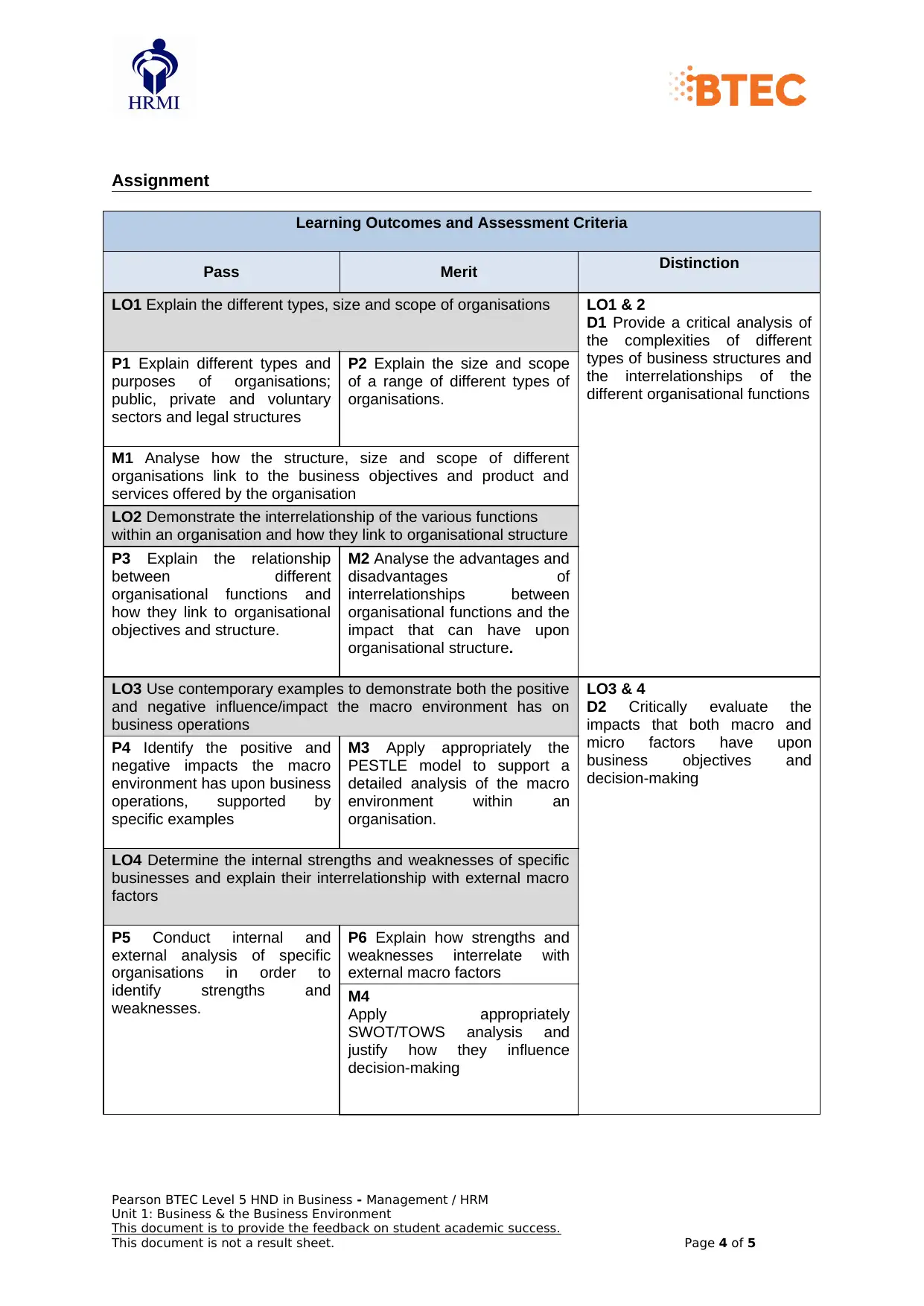
Learning Outcomes and Assessment Criteria
Pass Merit Distinction
LO1 Explain the different types, size and scope of organisations LO1 & 2
D1 Provide a critical analysis of
the complexities of different
types of business structures and
the interrelationships of the
different organisational functions
P1 Explain different types and
purposes of organisations;
public, private and voluntary
sectors and legal structures
P2 Explain the size and scope
of a range of different types of
organisations.
M1 Analyse how the structure, size and scope of different
organisations link to the business objectives and product and
services offered by the organisation
LO2 Demonstrate the interrelationship of the various functions
within an organisation and how they link to organisational structure
P3 Explain the relationship
between different
organisational functions and
how they link to organisational
objectives and structure.
M2 Analyse the advantages and
disadvantages of
interrelationships between
organisational functions and the
impact that can have upon
organisational structure.
LO3 Use contemporary examples to demonstrate both the positive
and negative influence/impact the macro environment has on
business operations
LO3 & 4
D2 Critically evaluate the
impacts that both macro and
micro factors have upon
business objectives and
decision-making
P4 Identify the positive and
negative impacts the macro
environment has upon business
operations, supported by
specific examples
M3 Apply appropriately the
PESTLE model to support a
detailed analysis of the macro
environment within an
organisation.
LO4 Determine the internal strengths and weaknesses of specific
businesses and explain their interrelationship with external macro
factors
P5 Conduct internal and
external analysis of specific
organisations in order to
identify strengths and
weaknesses.
P6 Explain how strengths and
weaknesses interrelate with
external macro factors
M4
Apply appropriately
SWOT/TOWS analysis and
justify how they influence
decision-making
Pearson BTEC Level 5 HND in Business - Management / HRM
Unit 1: Business & the Business Environment
This document is to provide the feedback on student academic success.
This document is not a result sheet. Page 4 of 5
Learning Outcomes and Assessment Criteria
Pass Merit Distinction
LO1 Explain the different types, size and scope of organisations LO1 & 2
D1 Provide a critical analysis of
the complexities of different
types of business structures and
the interrelationships of the
different organisational functions
P1 Explain different types and
purposes of organisations;
public, private and voluntary
sectors and legal structures
P2 Explain the size and scope
of a range of different types of
organisations.
M1 Analyse how the structure, size and scope of different
organisations link to the business objectives and product and
services offered by the organisation
LO2 Demonstrate the interrelationship of the various functions
within an organisation and how they link to organisational structure
P3 Explain the relationship
between different
organisational functions and
how they link to organisational
objectives and structure.
M2 Analyse the advantages and
disadvantages of
interrelationships between
organisational functions and the
impact that can have upon
organisational structure.
LO3 Use contemporary examples to demonstrate both the positive
and negative influence/impact the macro environment has on
business operations
LO3 & 4
D2 Critically evaluate the
impacts that both macro and
micro factors have upon
business objectives and
decision-making
P4 Identify the positive and
negative impacts the macro
environment has upon business
operations, supported by
specific examples
M3 Apply appropriately the
PESTLE model to support a
detailed analysis of the macro
environment within an
organisation.
LO4 Determine the internal strengths and weaknesses of specific
businesses and explain their interrelationship with external macro
factors
P5 Conduct internal and
external analysis of specific
organisations in order to
identify strengths and
weaknesses.
P6 Explain how strengths and
weaknesses interrelate with
external macro factors
M4
Apply appropriately
SWOT/TOWS analysis and
justify how they influence
decision-making
Pearson BTEC Level 5 HND in Business - Management / HRM
Unit 1: Business & the Business Environment
This document is to provide the feedback on student academic success.
This document is not a result sheet. Page 4 of 5
Paraphrase This Document
Need a fresh take? Get an instant paraphrase of this document with our AI Paraphraser
Feedback Sheet (Institute use only)
Learning Outcomes and Assessment Criteria
Assessor Feedback : Initial Submission
LO 01
LO 02
LO 03
LO 04
Assessor Name:
Date:
Assessor Feedback : Redo Submission
LO 01
LO 02
LO 03
LO 04
Assessor Name: Date:
Pearson BTEC Level 5 HND in Business - Management / HRM
Unit 1: Business & the Business Environment
This document is to provide the feedback on student academic success.
This document is not a result sheet. Page 5 of 5
Learning Outcomes and Assessment Criteria
Assessor Feedback : Initial Submission
LO 01
LO 02
LO 03
LO 04
Assessor Name:
Date:
Assessor Feedback : Redo Submission
LO 01
LO 02
LO 03
LO 04
Assessor Name: Date:
Pearson BTEC Level 5 HND in Business - Management / HRM
Unit 1: Business & the Business Environment
This document is to provide the feedback on student academic success.
This document is not a result sheet. Page 5 of 5
Contents
Outcomes/Grade Descriptors Achieved (Please Tick)...............................................................1
Overall Feedback from the Assessor:........................................................................................1
Introduction................................................................................................................................7
What is an organization?............................................................................................................7
Difference types of organization and characteristic...................................................................8
Private sector..........................................................................................................................8
Public sector...........................................................................................................................8
Voluntary sector.....................................................................................................................8
Sri Lankan Private, Public, Voluntary Organizations Introduction with Examples................10
Private sector: Hemas Holdings PLC.......................................................................................10
Functional Structure of HEMAS HOLDINGS PLC............................................................10
Size and scope......................................................................................................................11
Public Sector: Sri Lanka Railway............................................................................................12
Vision...................................................................................................................................12
Mission.................................................................................................................................12
Aims and Goals....................................................................................................................12
Services are provided...........................................................................................................12
Functional structure of Sri Lanka railway............................................................................13
Scale, variety, and employee count......................................................................................13
How SLR’s structure, size and scope links to its objectives and services...........................14
Voluntary sector: UNICEF Sri Lanka......................................................................................15
Vision and the Mission.........................................................................................................15
UNICEF’s work...................................................................................................................15
Provided services.................................................................................................................15
Size and scope......................................................................................................................16
Functional structure of Hemas Holdings PLC.........................................................................16
HEMAS Holdings Plc functional inter-relationship................................................................17
Advantages and Disadvantages with Inter-relationships.....................................................17
Impact of HEMAS Holdings PLC’s functional inter-relationship on the organizational
structure................................................................................................................................18
Matrix and Divisional structures difficulties at HEMAS Holdings PLC.............................18
Conclusion................................................................................................................................19
References................................................................................................................................20
Pearson BTEC Level 5 HND in Business - Management / HRM
Unit 1: Business & the Business Environment
This document is to provide the feedback on student academic success.
This document is not a result sheet. Page 6 of 5
Outcomes/Grade Descriptors Achieved (Please Tick)...............................................................1
Overall Feedback from the Assessor:........................................................................................1
Introduction................................................................................................................................7
What is an organization?............................................................................................................7
Difference types of organization and characteristic...................................................................8
Private sector..........................................................................................................................8
Public sector...........................................................................................................................8
Voluntary sector.....................................................................................................................8
Sri Lankan Private, Public, Voluntary Organizations Introduction with Examples................10
Private sector: Hemas Holdings PLC.......................................................................................10
Functional Structure of HEMAS HOLDINGS PLC............................................................10
Size and scope......................................................................................................................11
Public Sector: Sri Lanka Railway............................................................................................12
Vision...................................................................................................................................12
Mission.................................................................................................................................12
Aims and Goals....................................................................................................................12
Services are provided...........................................................................................................12
Functional structure of Sri Lanka railway............................................................................13
Scale, variety, and employee count......................................................................................13
How SLR’s structure, size and scope links to its objectives and services...........................14
Voluntary sector: UNICEF Sri Lanka......................................................................................15
Vision and the Mission.........................................................................................................15
UNICEF’s work...................................................................................................................15
Provided services.................................................................................................................15
Size and scope......................................................................................................................16
Functional structure of Hemas Holdings PLC.........................................................................16
HEMAS Holdings Plc functional inter-relationship................................................................17
Advantages and Disadvantages with Inter-relationships.....................................................17
Impact of HEMAS Holdings PLC’s functional inter-relationship on the organizational
structure................................................................................................................................18
Matrix and Divisional structures difficulties at HEMAS Holdings PLC.............................18
Conclusion................................................................................................................................19
References................................................................................................................................20
Pearson BTEC Level 5 HND in Business - Management / HRM
Unit 1: Business & the Business Environment
This document is to provide the feedback on student academic success.
This document is not a result sheet. Page 6 of 5
⊘ This is a preview!⊘
Do you want full access?
Subscribe today to unlock all pages.
Trusted by 1+ million students worldwide
Introduction
What is an organization?
An entrepreneur organizes different production factors such as land, labor, money,
machinery, and so on in order to turn them into productive activities. Finally, the commodity
reaches customers through a variety of channels. Business operations are divided into
different tasks, each of which is allocated to a different person.
Individual activities must all contribute to the achievement of shared business objectives.
Organization is the structural structure of roles and obligations that employees must fulfill in
order to execute different tasks in order to achieve business objectives. Management
attempts to coordinate different business operations in order to achieve predetermined
objectives.
The current business structure is very complicated. To remain competitive in the business
environment, the unit must be managed efficiently. Various jobs are to be carried out by
people who are best suited for them. First and foremost, various activities should be
classified into various functions. At various levels, authority and duty are created. All efforts
should be made to coordinate various activities in order to run the units efficiently, lowering
production costs and increasing unit profitability.
There are 2 concepts of organizations, which are Static concept and Dynamic concept.
1. Static concept
The word "organization" is used in the static concept to refer to a system, an individual, or a
network of specified relationships. In this context, an organization is a community of people
who are formally linked together to accomplish common goals. It focuses on positions rather
than people.
2. Dynamic concept
The word "organization" is used in the complex concept to describe a process that is
ongoing. In this context, organization refers to the process of arranging jobs, staff, and
processes. It is concerned with the process of identifying tasks that may be required to
achieve a goal and grouping them into appropriate categories so that they can be allocated
to individuals. Organization is seen as an open adoptive mechanism rather than a closed
system. Individuals are emphasized in the dynamic concept, which views organization as a
continuous process.
Pearson BTEC Level 5 HND in Business - Management / HRM
Unit 1: Business & the Business Environment
This document is to provide the feedback on student academic success.
This document is not a result sheet. Page 7 of 5
What is an organization?
An entrepreneur organizes different production factors such as land, labor, money,
machinery, and so on in order to turn them into productive activities. Finally, the commodity
reaches customers through a variety of channels. Business operations are divided into
different tasks, each of which is allocated to a different person.
Individual activities must all contribute to the achievement of shared business objectives.
Organization is the structural structure of roles and obligations that employees must fulfill in
order to execute different tasks in order to achieve business objectives. Management
attempts to coordinate different business operations in order to achieve predetermined
objectives.
The current business structure is very complicated. To remain competitive in the business
environment, the unit must be managed efficiently. Various jobs are to be carried out by
people who are best suited for them. First and foremost, various activities should be
classified into various functions. At various levels, authority and duty are created. All efforts
should be made to coordinate various activities in order to run the units efficiently, lowering
production costs and increasing unit profitability.
There are 2 concepts of organizations, which are Static concept and Dynamic concept.
1. Static concept
The word "organization" is used in the static concept to refer to a system, an individual, or a
network of specified relationships. In this context, an organization is a community of people
who are formally linked together to accomplish common goals. It focuses on positions rather
than people.
2. Dynamic concept
The word "organization" is used in the complex concept to describe a process that is
ongoing. In this context, organization refers to the process of arranging jobs, staff, and
processes. It is concerned with the process of identifying tasks that may be required to
achieve a goal and grouping them into appropriate categories so that they can be allocated
to individuals. Organization is seen as an open adoptive mechanism rather than a closed
system. Individuals are emphasized in the dynamic concept, which views organization as a
continuous process.
Pearson BTEC Level 5 HND in Business - Management / HRM
Unit 1: Business & the Business Environment
This document is to provide the feedback on student academic success.
This document is not a result sheet. Page 7 of 5
Paraphrase This Document
Need a fresh take? Get an instant paraphrase of this document with our AI Paraphraser
Difference types of organization and characteristic
Private sector
Individuals and companies seeking profit run the private sector, which is not governed by the
government. In certain situations, the private sector and the government will work together to
provide a service to a community in a public-private partnership. A private sector corporation
can be created in one of two ways: by privatizing a public entity or by starting a new
business with private investors.
The following are characteristics:
• A minimum of two members is required for a startup, with a limit of 200 members permitted
under the Companies Act of 2013.
• Each member's or shareholder's liability is reduced, i.e., if a corporation incurs a loss, its
owners are liable to sell their own assets to cover the loss.
• The corporation continues to survive in the eyes of the law even though one of its owners
dies, becomes insane, or declares bankruptcy. As a result, the company will continue to
exist in perpetuity. The company's existence will continue to exist indefinitely (Legal raasta,
2017).
Public sector
The government owns and operates public-sector organizations in order to provide services
to residents. These organizations are not in the business of making profits.
• The company has a separate legal existence from the individuals who make up its
membership.
• Its composition and operations are regulated by a set of rules, laws, and regulations.
• A minimum of 7 members is required for a startup, but there is no upper limit (ideu note,
2020).
Voluntary sector
There is no government interference in this business. It is beneficial to society and
contributes to its growth. An organization's profits are reinvested in the organization
(priavcysence.net, 2016).
• The creation process is a voluntary act on the part of a community of people.
• It is a profit-free motivation. • It is a self-governing form of government in which an agency
decides on its constitution, programs, and policies (shah, 2017)
Pearson BTEC Level 5 HND in Business - Management / HRM
Unit 1: Business & the Business Environment
This document is to provide the feedback on student academic success.
This document is not a result sheet. Page 8 of 5
Private sector
Individuals and companies seeking profit run the private sector, which is not governed by the
government. In certain situations, the private sector and the government will work together to
provide a service to a community in a public-private partnership. A private sector corporation
can be created in one of two ways: by privatizing a public entity or by starting a new
business with private investors.
The following are characteristics:
• A minimum of two members is required for a startup, with a limit of 200 members permitted
under the Companies Act of 2013.
• Each member's or shareholder's liability is reduced, i.e., if a corporation incurs a loss, its
owners are liable to sell their own assets to cover the loss.
• The corporation continues to survive in the eyes of the law even though one of its owners
dies, becomes insane, or declares bankruptcy. As a result, the company will continue to
exist in perpetuity. The company's existence will continue to exist indefinitely (Legal raasta,
2017).
Public sector
The government owns and operates public-sector organizations in order to provide services
to residents. These organizations are not in the business of making profits.
• The company has a separate legal existence from the individuals who make up its
membership.
• Its composition and operations are regulated by a set of rules, laws, and regulations.
• A minimum of 7 members is required for a startup, but there is no upper limit (ideu note,
2020).
Voluntary sector
There is no government interference in this business. It is beneficial to society and
contributes to its growth. An organization's profits are reinvested in the organization
(priavcysence.net, 2016).
• The creation process is a voluntary act on the part of a community of people.
• It is a profit-free motivation. • It is a self-governing form of government in which an agency
decides on its constitution, programs, and policies (shah, 2017)
Pearson BTEC Level 5 HND in Business - Management / HRM
Unit 1: Business & the Business Environment
This document is to provide the feedback on student academic success.
This document is not a result sheet. Page 8 of 5
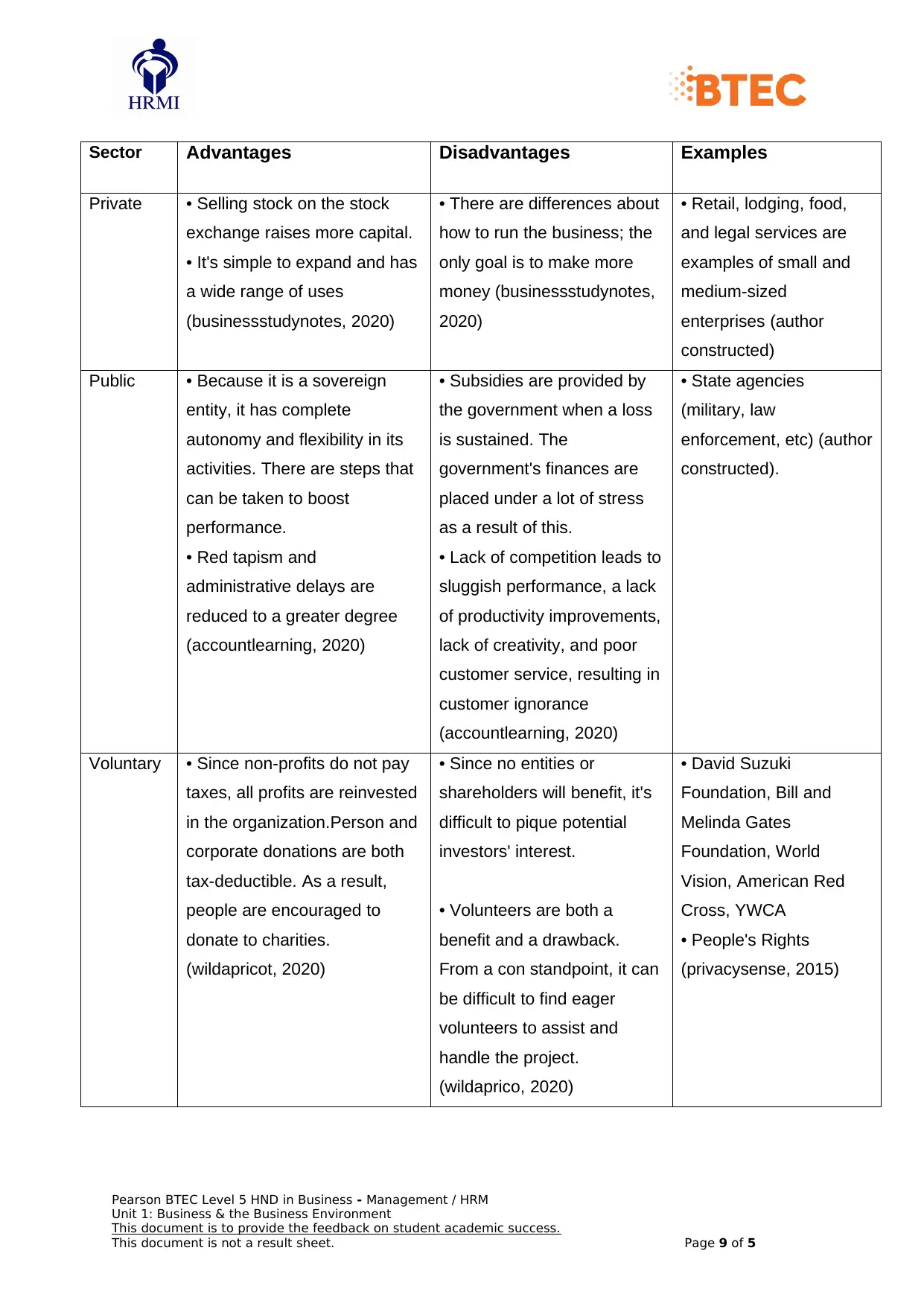
Sector Advantages Disadvantages Examples
Private • Selling stock on the stock
exchange raises more capital.
• It's simple to expand and has
a wide range of uses
(businessstudynotes, 2020)
• There are differences about
how to run the business; the
only goal is to make more
money (businessstudynotes,
2020)
• Retail, lodging, food,
and legal services are
examples of small and
medium-sized
enterprises (author
constructed)
Public • Because it is a sovereign
entity, it has complete
autonomy and flexibility in its
activities. There are steps that
can be taken to boost
performance.
• Red tapism and
administrative delays are
reduced to a greater degree
(accountlearning, 2020)
• Subsidies are provided by
the government when a loss
is sustained. The
government's finances are
placed under a lot of stress
as a result of this.
• Lack of competition leads to
sluggish performance, a lack
of productivity improvements,
lack of creativity, and poor
customer service, resulting in
customer ignorance
(accountlearning, 2020)
• State agencies
(military, law
enforcement, etc) (author
constructed).
Voluntary • Since non-profits do not pay
taxes, all profits are reinvested
in the organization.Person and
corporate donations are both
tax-deductible. As a result,
people are encouraged to
donate to charities.
(wildapricot, 2020)
• Since no entities or
shareholders will benefit, it's
difficult to pique potential
investors' interest.
• Volunteers are both a
benefit and a drawback.
From a con standpoint, it can
be difficult to find eager
volunteers to assist and
handle the project.
(wildaprico, 2020)
• David Suzuki
Foundation, Bill and
Melinda Gates
Foundation, World
Vision, American Red
Cross, YWCA
• People's Rights
(privacysense, 2015)
Pearson BTEC Level 5 HND in Business - Management / HRM
Unit 1: Business & the Business Environment
This document is to provide the feedback on student academic success.
This document is not a result sheet. Page 9 of 5
Private • Selling stock on the stock
exchange raises more capital.
• It's simple to expand and has
a wide range of uses
(businessstudynotes, 2020)
• There are differences about
how to run the business; the
only goal is to make more
money (businessstudynotes,
2020)
• Retail, lodging, food,
and legal services are
examples of small and
medium-sized
enterprises (author
constructed)
Public • Because it is a sovereign
entity, it has complete
autonomy and flexibility in its
activities. There are steps that
can be taken to boost
performance.
• Red tapism and
administrative delays are
reduced to a greater degree
(accountlearning, 2020)
• Subsidies are provided by
the government when a loss
is sustained. The
government's finances are
placed under a lot of stress
as a result of this.
• Lack of competition leads to
sluggish performance, a lack
of productivity improvements,
lack of creativity, and poor
customer service, resulting in
customer ignorance
(accountlearning, 2020)
• State agencies
(military, law
enforcement, etc) (author
constructed).
Voluntary • Since non-profits do not pay
taxes, all profits are reinvested
in the organization.Person and
corporate donations are both
tax-deductible. As a result,
people are encouraged to
donate to charities.
(wildapricot, 2020)
• Since no entities or
shareholders will benefit, it's
difficult to pique potential
investors' interest.
• Volunteers are both a
benefit and a drawback.
From a con standpoint, it can
be difficult to find eager
volunteers to assist and
handle the project.
(wildaprico, 2020)
• David Suzuki
Foundation, Bill and
Melinda Gates
Foundation, World
Vision, American Red
Cross, YWCA
• People's Rights
(privacysense, 2015)
Pearson BTEC Level 5 HND in Business - Management / HRM
Unit 1: Business & the Business Environment
This document is to provide the feedback on student academic success.
This document is not a result sheet. Page 9 of 5
⊘ This is a preview!⊘
Do you want full access?
Subscribe today to unlock all pages.
Trusted by 1+ million students worldwide
Sri Lankan Private, Public, Voluntary Organizations Introduction with
Examples
Private sector: Hemas Holdings PLC
Hemas began in 1948 with a specific goal in mind: to assist families in living a healthy
lifestyle. For more than 72 years, this core belief has driven our growth. We bring healthy
living to life across a portfolio of world-class goods and services in the Consumer,
Healthcare, and Mobility sectors as a leading publicly traded business with over 6,000
employees. Hemas, which is woven into Sri Lanka's socioeconomic structure, has also
spread regionally, with operations in Bangladesh, West Bengal, and Myanmar. We will
continue to invest in diverse and passionate teams, build meaningful offerings, establish
trustworthy alliances, and advocate for a more inclusive environment as we move forward.
(Hemas Holdings PLC, 2021)
Purpose
Make healthful living happen.
Vision
To be the best at enriching life.
HEMAS VALUES
Hemas holds its moral compass,
its ideals, in high regard. Our principles bind us together as we strive for excellence,
providing our customers with the high-quality goods and services they deserve.
Passion for Customer.
Obsession for Performance.
Driven by Innovation.
Concern for People.
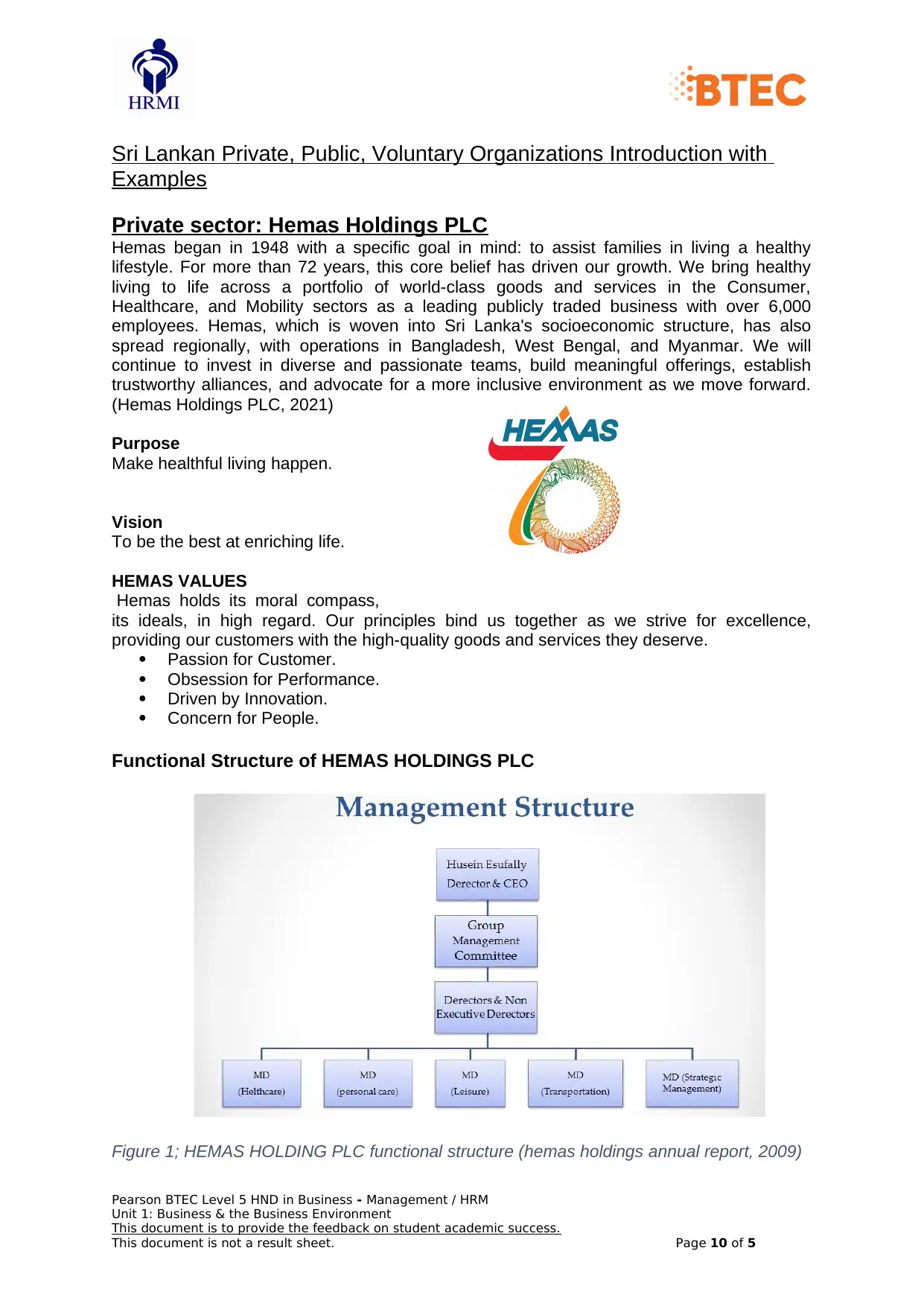
Functional Structure of HEMAS HOLDINGS PLC
Figure 1; HEMAS HOLDING PLC functional structure (hemas holdings annual report, 2009)
Pearson BTEC Level 5 HND in Business - Management / HRM
Unit 1: Business & the Business Environment
This document is to provide the feedback on student academic success.
This document is not a result sheet. Page 10 of 5
Examples
Private sector: Hemas Holdings PLC
Hemas began in 1948 with a specific goal in mind: to assist families in living a healthy
lifestyle. For more than 72 years, this core belief has driven our growth. We bring healthy
living to life across a portfolio of world-class goods and services in the Consumer,
Healthcare, and Mobility sectors as a leading publicly traded business with over 6,000
employees. Hemas, which is woven into Sri Lanka's socioeconomic structure, has also
spread regionally, with operations in Bangladesh, West Bengal, and Myanmar. We will
continue to invest in diverse and passionate teams, build meaningful offerings, establish
trustworthy alliances, and advocate for a more inclusive environment as we move forward.
(Hemas Holdings PLC, 2021)
Purpose
Make healthful living happen.
Vision
To be the best at enriching life.
HEMAS VALUES
Hemas holds its moral compass,
its ideals, in high regard. Our principles bind us together as we strive for excellence,
providing our customers with the high-quality goods and services they deserve.
Passion for Customer.
Obsession for Performance.
Driven by Innovation.
Concern for People.
Functional Structure of HEMAS HOLDINGS PLC
Figure 1; HEMAS HOLDING PLC functional structure (hemas holdings annual report, 2009)
Pearson BTEC Level 5 HND in Business - Management / HRM
Unit 1: Business & the Business Environment
This document is to provide the feedback on student academic success.
This document is not a result sheet. Page 10 of 5
Paraphrase This Document
Need a fresh take? Get an instant paraphrase of this document with our AI Paraphraser
Size and scope
Hemas Home, No. 75, Braybrooke Place, Colombo 02 is the address of the Holding
Company. In capturing its financial results, the Company took into account all 61 of its
subsidiary and affiliate firms. The Group has considered 34 organizations that are legal
entities over which the Group is accountable and has influence when reporting on its
sustainability results. Companies that do not have any activities that have a direct effect on
the environment or society as a whole are exempt from reporting on sustainability results.
Non-operational corporations, investment entities, land-only holding companies, managing
companies, office-based companies, and international activities are among the 27
companies that have been exempt from sustainability reporting this year. These businesses
have been listed in detail below. (hemas annual report,2019-2020)
Pearson BTEC Level 5 HND in Business - Management / HRM
Unit 1: Business & the Business Environment
This document is to provide the feedback on student academic success.
This document is not a result sheet. Page 11 of 5
Hemas Home, No. 75, Braybrooke Place, Colombo 02 is the address of the Holding
Company. In capturing its financial results, the Company took into account all 61 of its
subsidiary and affiliate firms. The Group has considered 34 organizations that are legal
entities over which the Group is accountable and has influence when reporting on its
sustainability results. Companies that do not have any activities that have a direct effect on
the environment or society as a whole are exempt from reporting on sustainability results.
Non-operational corporations, investment entities, land-only holding companies, managing
companies, office-based companies, and international activities are among the 27
companies that have been exempt from sustainability reporting this year. These businesses
have been listed in detail below. (hemas annual report,2019-2020)
Pearson BTEC Level 5 HND in Business - Management / HRM
Unit 1: Business & the Business Environment
This document is to provide the feedback on student academic success.
This document is not a result sheet. Page 11 of 5
Public Sector: Sri Lanka Railway
In 1858, the Sri Lanka Railway (SLR) was created. In 1864, rail was introduced in Sri Lanka
to transport coffee from hill country plantations to Colombo, the port city, on its way to
Europe and the global market.
SLR is a government agency that reports to the Ministry of Transportation. It is the country's
only major transportation company that transports both passengers and freight (Sri Lanka
Railways, 2016).
Vision
‘'To be Sri Lanka's most sought-after land transport provider, offering unrivalled value to our
stakeholders."
Mission
To provide a reliable, dependable, and on-time rail transportation service for both passenger
and freight traffic that is both cost-effective and efficient (Sri Lanka Railways, 2016).
Aims and Goals
• Increasing the contribution of passenger and freight rail transportation.
• To ensure that train operations are safe.
• To improve the passenger train service standard.
• To boost management quality and revenue from the railway (Performance Report
Department of Sri Lanka Railway, 2018).
Services are provided.
• Seat reservations via mobile phones are easy.
• Adding additional services, such as a special train, for religious events.
• At some railway stations, unique lodging facilities are available.
• All cafeterias are well-maintained and provide sufficient facilities to all passengers
(Performance Report Department of Sri Lanka Railway, 2018).
Pearson BTEC Level 5 HND in Business - Management / HRM
Unit 1: Business & the Business Environment
This document is to provide the feedback on student academic success.
This document is not a result sheet. Page 12 of 5
In 1858, the Sri Lanka Railway (SLR) was created. In 1864, rail was introduced in Sri Lanka
to transport coffee from hill country plantations to Colombo, the port city, on its way to
Europe and the global market.
SLR is a government agency that reports to the Ministry of Transportation. It is the country's
only major transportation company that transports both passengers and freight (Sri Lanka
Railways, 2016).
Vision
‘'To be Sri Lanka's most sought-after land transport provider, offering unrivalled value to our
stakeholders."
Mission
To provide a reliable, dependable, and on-time rail transportation service for both passenger
and freight traffic that is both cost-effective and efficient (Sri Lanka Railways, 2016).
Aims and Goals
• Increasing the contribution of passenger and freight rail transportation.
• To ensure that train operations are safe.
• To improve the passenger train service standard.
• To boost management quality and revenue from the railway (Performance Report
Department of Sri Lanka Railway, 2018).
Services are provided.
• Seat reservations via mobile phones are easy.
• Adding additional services, such as a special train, for religious events.
• At some railway stations, unique lodging facilities are available.
• All cafeterias are well-maintained and provide sufficient facilities to all passengers
(Performance Report Department of Sri Lanka Railway, 2018).
Pearson BTEC Level 5 HND in Business - Management / HRM
Unit 1: Business & the Business Environment
This document is to provide the feedback on student academic success.
This document is not a result sheet. Page 12 of 5
⊘ This is a preview!⊘
Do you want full access?
Subscribe today to unlock all pages.
Trusted by 1+ million students worldwide

1 out of 20


Related Documents


Your All-in-One AI-Powered Toolkit for Academic Success.
+13062052269
info@desklib.com
Available 24*7 on WhatsApp / Email
![[object Object]](/_next/static/media/star-bottom.7253800d.svg)
Unlock your academic potential
Copyright © 2020–2026 A2Z Services. All Rights Reserved. Developed and managed by ZUCOL.