Business Environment Analysis: SWOT, Resource Audit, Stakeholders
VerifiedAdded on 2020/05/28
|8
|1987
|57
Report
AI Summary
This report provides an in-depth analysis of the business environment within the travel industry, focusing on the application of strategic tools for travel agents. It begins with an overview of business analysis and the importance of environmental scanning in a competitive market. The report then delves into the use of various tools, including SWOT analysis to identify strengths, weaknesses, opportunities, and threats; resource audits to assess tangible and intangible assets; and stakeholder mapping frameworks to manage relationships with suppliers, customers, and other key players. The report emphasizes the benefits of these tools for travel agents, such as enhancing awareness of the business environment, addressing strategic issues, and identifying opportunities for growth and competitive advantage. It also discusses dynamic capabilities, core competencies, and the importance of skills like customer service and communication. The report concludes with references to relevant academic sources.
Running Head: Business Environment 1
Introduction to the Business Environment
Introduction to the Business Environment

Paraphrase This Document
Need a fresh take? Get an instant paraphrase of this document with our AI Paraphraser
Business Environment 2
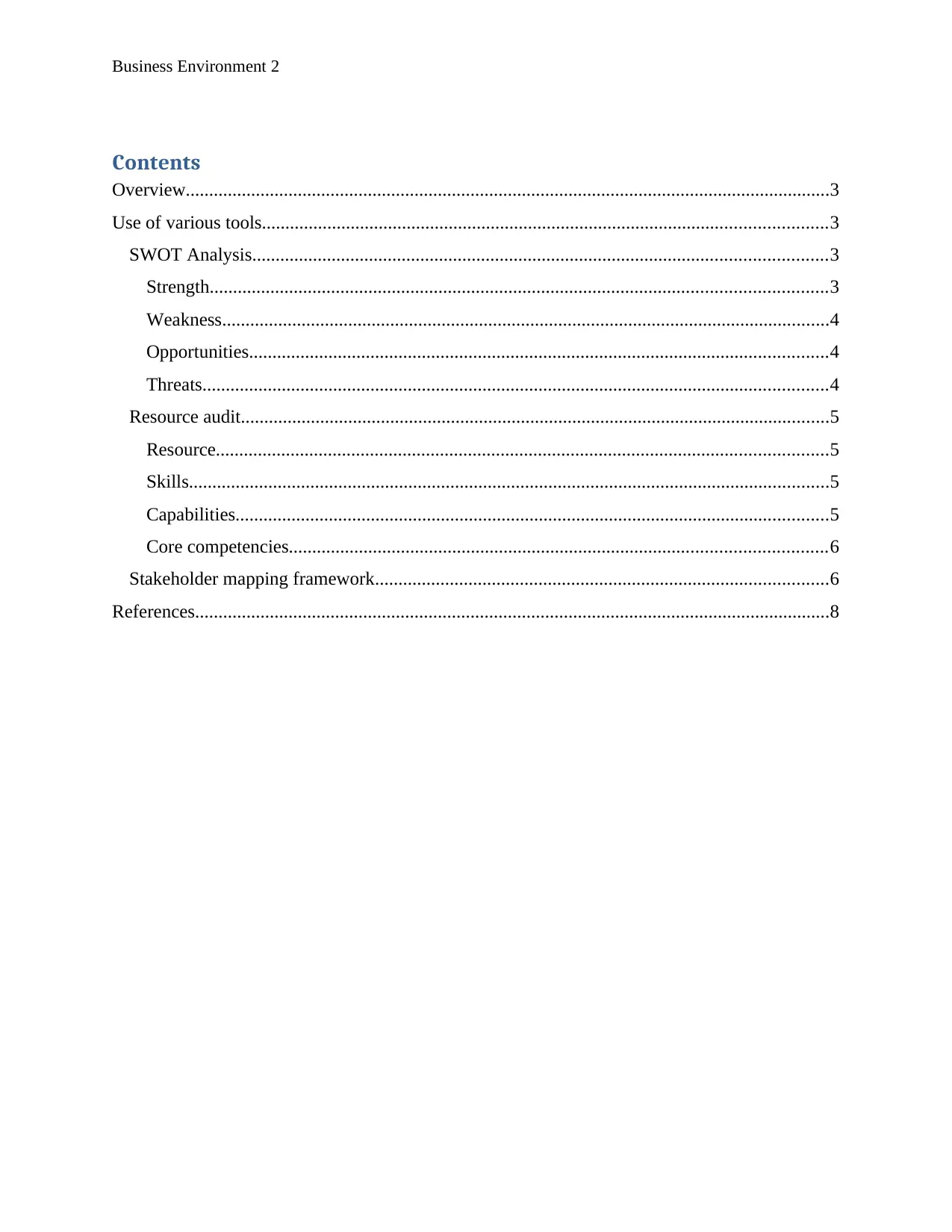
Contents
Overview..........................................................................................................................................3
Use of various tools.........................................................................................................................3
SWOT Analysis...........................................................................................................................3
Strength....................................................................................................................................3
Weakness..................................................................................................................................4
Opportunities............................................................................................................................4
Threats......................................................................................................................................4
Resource audit..............................................................................................................................5
Resource...................................................................................................................................5
Skills.........................................................................................................................................5
Capabilities...............................................................................................................................5
Core competencies...................................................................................................................6
Stakeholder mapping framework.................................................................................................6
References........................................................................................................................................8
Contents
Overview..........................................................................................................................................3
Use of various tools.........................................................................................................................3
SWOT Analysis...........................................................................................................................3
Strength....................................................................................................................................3
Weakness..................................................................................................................................4
Opportunities............................................................................................................................4
Threats......................................................................................................................................4
Resource audit..............................................................................................................................5
Resource...................................................................................................................................5
Skills.........................................................................................................................................5
Capabilities...............................................................................................................................5
Core competencies...................................................................................................................6
Stakeholder mapping framework.................................................................................................6
References........................................................................................................................................8
Business Environment 3
Overview
Business analysis is a process by which a business can identify various opportunities,
problem areas, understanding the roles and responsibilities and business requirements. For every
type of analysis, there are some sets of tools based on the needs and requirements of the
business. This report focuses on the use of some tools i.e. SWOT analysis, resource audit and
stakeholder mapping framework in the specific industry (Kalkan, 2013). For the discussion in the
report, travel industry is selected. The report explains the benefits of these tools on individual as
the travel agent. Today’s unpredictable and highly competitive environment has strong impact on
the travel industry. The travel agents needs to continuously conduct environmental scanning and
analysis on the critical factors that may impact on the business operations. The strategic tools are
helpful in analyzing the business environment in the travel industry.
Use of various tools
Variety of tools and techniques are developed to help the managers and agents in order to
identify and deal with the business decisions. These tools are helpful for me as a travel agent to
capture the information which is suitable for the decision making process. These tools are
beneficial and useful for me as the travel agent in terms of increasing awareness about business
environment, dealing with the strategic issues, identifying opportunities and threats and
providing framework for different business portfolios.
SWOT Analysis
Travel industry is the highly lucrative market for the growth of the economy. Strength of
the industry is considered as the ability of the market to respond on time and provide custom
designed travel excursions to travelers. The SWOT analysis of travel industry is as follows:
Strength
Strength is the current factor that analyzes the outstanding performance of the
organization. Strength in the particular organization is the qualities that enable the organization
to achieve the goals and objectives. Strengths are beneficial factor of the organization which
includes human competencies, process capabilities, products and services, financial resources,
brand loyalty and customer goodwill. As the travel agent, I found that the analyses of strength
Overview
Business analysis is a process by which a business can identify various opportunities,
problem areas, understanding the roles and responsibilities and business requirements. For every
type of analysis, there are some sets of tools based on the needs and requirements of the
business. This report focuses on the use of some tools i.e. SWOT analysis, resource audit and
stakeholder mapping framework in the specific industry (Kalkan, 2013). For the discussion in the
report, travel industry is selected. The report explains the benefits of these tools on individual as
the travel agent. Today’s unpredictable and highly competitive environment has strong impact on
the travel industry. The travel agents needs to continuously conduct environmental scanning and
analysis on the critical factors that may impact on the business operations. The strategic tools are
helpful in analyzing the business environment in the travel industry.
Use of various tools
Variety of tools and techniques are developed to help the managers and agents in order to
identify and deal with the business decisions. These tools are helpful for me as a travel agent to
capture the information which is suitable for the decision making process. These tools are
beneficial and useful for me as the travel agent in terms of increasing awareness about business
environment, dealing with the strategic issues, identifying opportunities and threats and
providing framework for different business portfolios.
SWOT Analysis
Travel industry is the highly lucrative market for the growth of the economy. Strength of
the industry is considered as the ability of the market to respond on time and provide custom
designed travel excursions to travelers. The SWOT analysis of travel industry is as follows:
Strength
Strength is the current factor that analyzes the outstanding performance of the
organization. Strength in the particular organization is the qualities that enable the organization
to achieve the goals and objectives. Strengths are beneficial factor of the organization which
includes human competencies, process capabilities, products and services, financial resources,
brand loyalty and customer goodwill. As the travel agent, I found that the analyses of strength
⊘ This is a preview!⊘
Do you want full access?
Subscribe today to unlock all pages.

Trusted by 1+ million students worldwide
Business Environment 4
aspect are useful for them to understand the traits and qualities of the business which are
important for the organization consistency. For instance, famous travel organization Thomas
Cook has some strength in its business. The organization has strong brand name. It is also listed
on the stock exchange of the country. Along with this, organization has international
collaboration with hotels and various airlines in order to provide various services to the
customers. By the analysis of strengths of the industry, I observed that travel companies are able
to complete the needs of the consumers (Gretzky, 2010).
Weakness
Weakness is the organizational factor that increases the operational costs and reduces the
quality of travel industry. Weakness can be broken down by identifying the causes of the poor
performance. I have observed that there are some common weaknesses in the travel industry i.e.
lack of financial resources, insufficient management training and limited collaborations with the
other travel organizations. For example, I observed that the travel industry has lack of
infrastructure and it impacts on the demands of the customers. Further, the travel industry
sometimes is not aware the presence of some restaurants, hotels and other tourists facilities
which people like to ask from them. As a travel agent, for me it is important for individual to
provide relevant information to the customers. Travel agent need to identify the weakness in
order to help the tourists (Yuan, 2015).
Opportunities
Opportunities are presented by the environment within an organization is operating. By
identifying opportunities, I have realized that an organization can take advantage of various
conditions in the environment to plan and implement the strategies in order to become more
profitable. In case of travel industry, it is observed by me as a travel agent that it can flourish if it
has strong partnership with other travel agencies. The travel industry has proper knowledge
about the leading hotels and public places in the region and provides necessary information to
the tourists (Weaver, 2009).
Threats
There are some uncontrolled factors in the business and they need to be addressed to find
relevant solutions. In case of travel industry, I as a travel agents have faceed great threat for any
travel agency. In UK, there is the economic crisis which has affected the business of travel
industry. Along with this, lack of facilities in tourism areas can discourage the people.
aspect are useful for them to understand the traits and qualities of the business which are
important for the organization consistency. For instance, famous travel organization Thomas
Cook has some strength in its business. The organization has strong brand name. It is also listed
on the stock exchange of the country. Along with this, organization has international
collaboration with hotels and various airlines in order to provide various services to the
customers. By the analysis of strengths of the industry, I observed that travel companies are able
to complete the needs of the consumers (Gretzky, 2010).
Weakness
Weakness is the organizational factor that increases the operational costs and reduces the
quality of travel industry. Weakness can be broken down by identifying the causes of the poor
performance. I have observed that there are some common weaknesses in the travel industry i.e.
lack of financial resources, insufficient management training and limited collaborations with the
other travel organizations. For example, I observed that the travel industry has lack of
infrastructure and it impacts on the demands of the customers. Further, the travel industry
sometimes is not aware the presence of some restaurants, hotels and other tourists facilities
which people like to ask from them. As a travel agent, for me it is important for individual to
provide relevant information to the customers. Travel agent need to identify the weakness in
order to help the tourists (Yuan, 2015).
Opportunities
Opportunities are presented by the environment within an organization is operating. By
identifying opportunities, I have realized that an organization can take advantage of various
conditions in the environment to plan and implement the strategies in order to become more
profitable. In case of travel industry, it is observed by me as a travel agent that it can flourish if it
has strong partnership with other travel agencies. The travel industry has proper knowledge
about the leading hotels and public places in the region and provides necessary information to
the tourists (Weaver, 2009).
Threats
There are some uncontrolled factors in the business and they need to be addressed to find
relevant solutions. In case of travel industry, I as a travel agents have faceed great threat for any
travel agency. In UK, there is the economic crisis which has affected the business of travel
industry. Along with this, lack of facilities in tourism areas can discourage the people.
Paraphrase This Document
Need a fresh take? Get an instant paraphrase of this document with our AI Paraphraser
Business Environment 5
Resource audit
Resource
Resource analysis is the strategy by analyzing the internal competence of the
organization. This analysis believes that the organization has bundle of resources and the
resources are the main sources of the strength and weakness and competitive advantage of the
organization. The resource audit is helpful for me in analyzing the tangible (human capital) or
intangible (innovation) resources of the travel industry. There are some resources which are
helpful for me in analyzing the strengths of a particular industry i.e.
Physical resources- Structures, the equipments or the innovation of the travel organization are
included in the physical resources. The age, condition, limit and areas of every asset decide
usefulness of the resources in the industry.
Financial resources- Financial resources of the travel industry can be included money, capital,
debtor and creditors and suppliers of the cash etc.
Human resources- This type of resource in the travel industry can include the combination like
demographic profiles, learning and aptitudes of representatives and other individuals in the
network of the organization (Kilika & Kabue, 2016).
Skills
In the travel industry, as the travel agent I realized that there should be some skills in
order to fulfill the needs of the customers. The resource audit is helpful for me as the travel agent
in identifying the self skills of the travel agent. As a travel agent, there should be excellent
customer service skills along with strong communication and sales skills in me. Further, by the
resource audit, my ability as the travel agent to cope up with the pressure can be analyzed (Helfat
& Peteraf, 2003).
Capabilities
Dynamic capabilities are helpful for me in the industry to deal in the dynamic and
competitive market environment. The concept of capabilities framework includes identifying,
exploring and integrating the internal and external competences to face dynamic environment.
Strategic capabilities of travel industry can be characterized as the assets and abilities of the
organization required to survive. Capabilities of the travel industry include the changes so that
Resource audit
Resource
Resource analysis is the strategy by analyzing the internal competence of the
organization. This analysis believes that the organization has bundle of resources and the
resources are the main sources of the strength and weakness and competitive advantage of the
organization. The resource audit is helpful for me in analyzing the tangible (human capital) or
intangible (innovation) resources of the travel industry. There are some resources which are
helpful for me in analyzing the strengths of a particular industry i.e.
Physical resources- Structures, the equipments or the innovation of the travel organization are
included in the physical resources. The age, condition, limit and areas of every asset decide
usefulness of the resources in the industry.
Financial resources- Financial resources of the travel industry can be included money, capital,
debtor and creditors and suppliers of the cash etc.
Human resources- This type of resource in the travel industry can include the combination like
demographic profiles, learning and aptitudes of representatives and other individuals in the
network of the organization (Kilika & Kabue, 2016).
Skills
In the travel industry, as the travel agent I realized that there should be some skills in
order to fulfill the needs of the customers. The resource audit is helpful for me as the travel agent
in identifying the self skills of the travel agent. As a travel agent, there should be excellent
customer service skills along with strong communication and sales skills in me. Further, by the
resource audit, my ability as the travel agent to cope up with the pressure can be analyzed (Helfat
& Peteraf, 2003).
Capabilities
Dynamic capabilities are helpful for me in the industry to deal in the dynamic and
competitive market environment. The concept of capabilities framework includes identifying,
exploring and integrating the internal and external competences to face dynamic environment.
Strategic capabilities of travel industry can be characterized as the assets and abilities of the
organization required to survive. Capabilities of the travel industry include the changes so that
Business Environment 6
critical success factors can be identified. As a travel agent, I have realized that travel industry
basically has some strategic capabilities adding and evolving capabilities, extending capabilities,
stretching capabilities, and external capability development. By identifying these capabilities, I
am now able to implement strategic planning in the business organization to satisfy the
customers. There are some capabilities factors which must have the organization i.e. leadership,
collaboration, adaptability, creativity and innovation.
Core competencies
Competencies are the attributes which are useful for me in the travel industry to make the
organization competitive within the industry. The competencies are valuable for me as the travel
agents as it allows me to support my organization for achieving the competitive advantage. I
observed that core competency of the travel industry will basically include capacity to diversify
the services, perceived benefits by the customers and difficult to replace.
Stakeholder mapping framework
Stakeholder mapping is the relevant framework in order to manage various stakeholders
in the industry. Based on the study, I have observed that the concept of the stakeholder mapping
depends upon the mechanism by how the organization in the particular industry understand and
respond of the stakeholders. For the stakeholder mapping, there is the need of management team
to have the understanding of stakeholders and their interest. Various things can be mapped in the
travel industry but most obvious is to map stakeholder against their interest their interest a
program, portfolio or project (Anuar et al, 2012).
Being a travel agent, I observed that stakeholders in the travel industry includes suppliers
and supporting industries, marketing facilitators and intermediaries and the members of the
public and local as well as foreign customers. As the tourism agent, my role is to inform tourists
about the activities, and spaces provided by the suppliers at the travel destination. The
stakeholder mapping framework is helpful for me in promoting the tourism destination and
satisfying the customers (Gunel & Yilmaz, 2008). Along with this, this framework is useful for
me by the positive value in terms of developing traveling packages at the reasonable rates,
hospitality and the distribution of development like accommodation, facilities and transportation.
So, I have realized that stakeholder mapping framework is useful and beneficial for me to
critical success factors can be identified. As a travel agent, I have realized that travel industry
basically has some strategic capabilities adding and evolving capabilities, extending capabilities,
stretching capabilities, and external capability development. By identifying these capabilities, I
am now able to implement strategic planning in the business organization to satisfy the
customers. There are some capabilities factors which must have the organization i.e. leadership,
collaboration, adaptability, creativity and innovation.
Core competencies
Competencies are the attributes which are useful for me in the travel industry to make the
organization competitive within the industry. The competencies are valuable for me as the travel
agents as it allows me to support my organization for achieving the competitive advantage. I
observed that core competency of the travel industry will basically include capacity to diversify
the services, perceived benefits by the customers and difficult to replace.
Stakeholder mapping framework
Stakeholder mapping is the relevant framework in order to manage various stakeholders
in the industry. Based on the study, I have observed that the concept of the stakeholder mapping
depends upon the mechanism by how the organization in the particular industry understand and
respond of the stakeholders. For the stakeholder mapping, there is the need of management team
to have the understanding of stakeholders and their interest. Various things can be mapped in the
travel industry but most obvious is to map stakeholder against their interest their interest a
program, portfolio or project (Anuar et al, 2012).
Being a travel agent, I observed that stakeholders in the travel industry includes suppliers
and supporting industries, marketing facilitators and intermediaries and the members of the
public and local as well as foreign customers. As the tourism agent, my role is to inform tourists
about the activities, and spaces provided by the suppliers at the travel destination. The
stakeholder mapping framework is helpful for me in promoting the tourism destination and
satisfying the customers (Gunel & Yilmaz, 2008). Along with this, this framework is useful for
me by the positive value in terms of developing traveling packages at the reasonable rates,
hospitality and the distribution of development like accommodation, facilities and transportation.
So, I have realized that stakeholder mapping framework is useful and beneficial for me to
⊘ This is a preview!⊘
Do you want full access?
Subscribe today to unlock all pages.
Trusted by 1+ million students worldwide
Business Environment 7
identify the requirements of key stakeholders in the travel industry and satisfy them with their
requirements (Perić, Đurkin & Lamot, 2014).
identify the requirements of key stakeholders in the travel industry and satisfy them with their
requirements (Perić, Đurkin & Lamot, 2014).
Paraphrase This Document
Need a fresh take? Get an instant paraphrase of this document with our AI Paraphraser
Business Environment 8
References
Anuar, A. N. A., Ahmad, H., Jusoh, H., & Hussain, M. Y., (2012), Understanding the factors
influencing formation of tourist friendly destination concept: Journal of Management and
Sustainability, 2(1), 106-114
Gretzky, W., (2010), STRATEGIC PLANNING AND SWOT ANALYSIS, Health Administration
Press
Gunel, O. D., & Yilmaz, B. S., (2008), The Importance of Strategic Stakeholder Management in
Tourism Sector: Research on Probable Applications, accessed on 9th January 2018 from
https://mpra.ub.uni-muenchen.de/25308/1/MPRA_paper_25308.pdf
Helfat, C.E. & Peteraf, M.A., (2003), The Dynamic Resource-Based View: Capability Lifecycles:
Strategic Management Journal, 24, pp. 997-1010
Kalkan, A., (2013), The choice and use of strategic planning tools and techniques in Turkish
SMEs according to attitudes of executives, Procedia - Social and Behavioral Sciences, accessed
on 9th January 2018 from https://ac.els-cdn.com/S1877042813040202/1-s2.0-
S1877042813040202-main.pdf?_tid=b9e159c0-f557-11e7-995f-
00000aab0f01&acdnat=1515514459_7c7680628ed9e4794098b6d549445ca3
Kilika, J. M., & Kabue, L. W., (2016), Firm Resources, Core Competencies and Sustainable
Competitive Advantage: An Integrative Theoretical Framework: Journal of Management and
Strategy, 7
Perić, M., Đurkin, J., & Lamot, I., (2014), IMPORTANCE OF STAKEHOLDER MANAGEMENT
IN TOURISM PROJECT: CASE STUDY OF THE ISTRA INSPIRIT PROJECT, accessed on 9th
January 2018 from
https://www.fthm.uniri.hr/files/Kongresi/THI/Papers/2014/THI_May2014_273to286.pdf
Weaver, D. B., (2009), Travel Agency Threats and Opportunities: The Perspective of Successful
Owners, accessed on 9th January 2018 from
https://www.researchgate.net/publication/29470728_Travel_Agency_Threats_and_Opportunities
_The_Perspective_of_Successful_Owners
Yuan, Z., (2015), STRATEGIC DIAGNOSES OF NEXTRAVEL: A SWOT ANALYSIS, accessed
on 9th January 2018 from
http://broncoscholar.library.cpp.edu/bitstream/handle/10211.3/157294/
YuanZhaotong_Project2015.pdf;sequence=4
References
Anuar, A. N. A., Ahmad, H., Jusoh, H., & Hussain, M. Y., (2012), Understanding the factors
influencing formation of tourist friendly destination concept: Journal of Management and
Sustainability, 2(1), 106-114
Gretzky, W., (2010), STRATEGIC PLANNING AND SWOT ANALYSIS, Health Administration
Press
Gunel, O. D., & Yilmaz, B. S., (2008), The Importance of Strategic Stakeholder Management in
Tourism Sector: Research on Probable Applications, accessed on 9th January 2018 from
https://mpra.ub.uni-muenchen.de/25308/1/MPRA_paper_25308.pdf
Helfat, C.E. & Peteraf, M.A., (2003), The Dynamic Resource-Based View: Capability Lifecycles:
Strategic Management Journal, 24, pp. 997-1010
Kalkan, A., (2013), The choice and use of strategic planning tools and techniques in Turkish
SMEs according to attitudes of executives, Procedia - Social and Behavioral Sciences, accessed
on 9th January 2018 from https://ac.els-cdn.com/S1877042813040202/1-s2.0-
S1877042813040202-main.pdf?_tid=b9e159c0-f557-11e7-995f-
00000aab0f01&acdnat=1515514459_7c7680628ed9e4794098b6d549445ca3
Kilika, J. M., & Kabue, L. W., (2016), Firm Resources, Core Competencies and Sustainable
Competitive Advantage: An Integrative Theoretical Framework: Journal of Management and
Strategy, 7
Perić, M., Đurkin, J., & Lamot, I., (2014), IMPORTANCE OF STAKEHOLDER MANAGEMENT
IN TOURISM PROJECT: CASE STUDY OF THE ISTRA INSPIRIT PROJECT, accessed on 9th
January 2018 from
https://www.fthm.uniri.hr/files/Kongresi/THI/Papers/2014/THI_May2014_273to286.pdf
Weaver, D. B., (2009), Travel Agency Threats and Opportunities: The Perspective of Successful
Owners, accessed on 9th January 2018 from
https://www.researchgate.net/publication/29470728_Travel_Agency_Threats_and_Opportunities
_The_Perspective_of_Successful_Owners
Yuan, Z., (2015), STRATEGIC DIAGNOSES OF NEXTRAVEL: A SWOT ANALYSIS, accessed
on 9th January 2018 from
http://broncoscholar.library.cpp.edu/bitstream/handle/10211.3/157294/
YuanZhaotong_Project2015.pdf;sequence=4

1 out of 8


Related Documents


Your All-in-One AI-Powered Toolkit for Academic Success.
+13062052269
info@desklib.com
Available 24*7 on WhatsApp / Email
![[object Object]](/_next/static/media/star-bottom.7253800d.svg)
Unlock your academic potential
Copyright © 2020–2026 A2Z Services. All Rights Reserved. Developed and managed by ZUCOL.