Business Environment Analysis: Sectors, Structures and Functions
VerifiedAdded on 2020/06/04
|14
|2909
|50
Report
AI Summary
This report provides a detailed analysis of the UK business environment, focusing on the public, private, and voluntary sectors. It examines the purposes, legal structures, size, and scope of organizations within each sector. The report explores the relationship between organizational functions (finance, marketing, production, HR) and their impact on achieving business objectives. It critically evaluates how these functions influence organizational structure and the complexities associated with different business structures. The report also considers the impact of various factors, such as market changes and government policies, on business operations and financial performance, offering insights into strategies for effective management and coordination across departments.

BUSINESS ENVIRONMENT

Paraphrase This Document
Need a fresh take? Get an instant paraphrase of this document with our AI Paraphraser
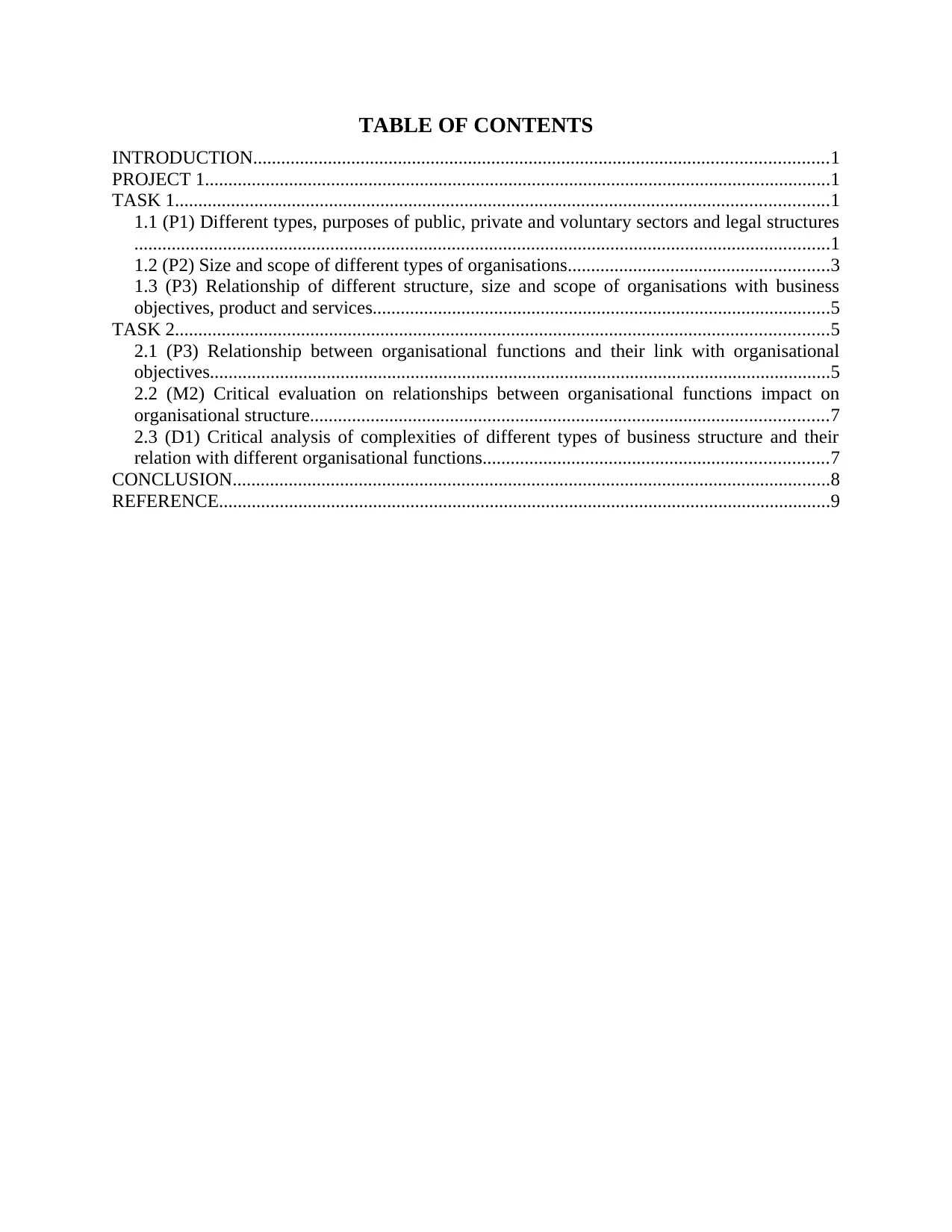
TABLE OF CONTENTS
INTRODUCTION...........................................................................................................................1
PROJECT 1......................................................................................................................................1
TASK 1............................................................................................................................................1
1.1 (P1) Different types, purposes of public, private and voluntary sectors and legal structures
.....................................................................................................................................................1
1.2 (P2) Size and scope of different types of organisations........................................................3
1.3 (P3) Relationship of different structure, size and scope of organisations with business
objectives, product and services..................................................................................................5
TASK 2............................................................................................................................................5
2.1 (P3) Relationship between organisational functions and their link with organisational
objectives.....................................................................................................................................5
2.2 (M2) Critical evaluation on relationships between organisational functions impact on
organisational structure...............................................................................................................7
2.3 (D1) Critical analysis of complexities of different types of business structure and their
relation with different organisational functions..........................................................................7
CONCLUSION................................................................................................................................8
REFERENCE...................................................................................................................................9
INTRODUCTION...........................................................................................................................1
PROJECT 1......................................................................................................................................1
TASK 1............................................................................................................................................1
1.1 (P1) Different types, purposes of public, private and voluntary sectors and legal structures
.....................................................................................................................................................1
1.2 (P2) Size and scope of different types of organisations........................................................3
1.3 (P3) Relationship of different structure, size and scope of organisations with business
objectives, product and services..................................................................................................5
TASK 2............................................................................................................................................5
2.1 (P3) Relationship between organisational functions and their link with organisational
objectives.....................................................................................................................................5
2.2 (M2) Critical evaluation on relationships between organisational functions impact on
organisational structure...............................................................................................................7
2.3 (D1) Critical analysis of complexities of different types of business structure and their
relation with different organisational functions..........................................................................7
CONCLUSION................................................................................................................................8
REFERENCE...................................................................................................................................9

ILLUSTRATION INDEX
Illustration 1: Organisations' sectors................................................................................................4
Illustration 1: Organisations' sectors................................................................................................4
⊘ This is a preview!⊘
Do you want full access?
Subscribe today to unlock all pages.

Trusted by 1+ million students worldwide
INTRODUCTION
Business environmental factors are as micro and macro which impact on business
operations and their management. Including this, changes in business environmental factors
affect financial and non-economic performance of the entity. The project report is based on
understanding different types, purposes and structures of sectors in which business operated in
UK for decision making regarding establishment of new entity. In addition to this, size, scope
and legal structures of the different businesses can be identified. However, relationship of
organisational functions with structures will be introduced in this assignment.
PROJECT 1
TASK 1
1.1 (P1) Different types, purposes of public, private and voluntary sectors and legal structures
According to given case scenario, it is recognised that decision is to made regarding
setting up new entity in UK. Therefore, analysing different sectors, their size, scope and legal
structures is essential for appropriate decisions (Storey, 2016). There are public, private and
voluntary sectors in which businesses are segregated within a country. However, these sectors
and their purposes as well legal structures can be understood as follows:
Public sector organisation:
Under this sector, government interferes in business operations. There are different
public-sector organisations work for different sectors as retail technological and so on
(MitchelmStorey, 2016). For example; Tesco, Morrisons, Sainsbury, NHS etc. In this regard,
their purposes and legal structures can be identified as:
Purposes: Public sector organisations establishes on the basis of following objectives as:
To build up public trust with goods and services provided by entity.
To increase social awareness and public welfare with organisation's services.
To consider government's policy for business operations.
To contribute in nation's effectiveness as economic growth and so.
Legal structures: As public-sector organisations work under government's policies and
follows on all structures, therefore, for expansion of new entity, different legal formalities are to
1
Business environmental factors are as micro and macro which impact on business
operations and their management. Including this, changes in business environmental factors
affect financial and non-economic performance of the entity. The project report is based on
understanding different types, purposes and structures of sectors in which business operated in
UK for decision making regarding establishment of new entity. In addition to this, size, scope
and legal structures of the different businesses can be identified. However, relationship of
organisational functions with structures will be introduced in this assignment.
PROJECT 1
TASK 1
1.1 (P1) Different types, purposes of public, private and voluntary sectors and legal structures
According to given case scenario, it is recognised that decision is to made regarding
setting up new entity in UK. Therefore, analysing different sectors, their size, scope and legal
structures is essential for appropriate decisions (Storey, 2016). There are public, private and
voluntary sectors in which businesses are segregated within a country. However, these sectors
and their purposes as well legal structures can be understood as follows:
Public sector organisation:
Under this sector, government interferes in business operations. There are different
public-sector organisations work for different sectors as retail technological and so on
(MitchelmStorey, 2016). For example; Tesco, Morrisons, Sainsbury, NHS etc. In this regard,
their purposes and legal structures can be identified as:
Purposes: Public sector organisations establishes on the basis of following objectives as:
To build up public trust with goods and services provided by entity.
To increase social awareness and public welfare with organisation's services.
To consider government's policy for business operations.
To contribute in nation's effectiveness as economic growth and so.
Legal structures: As public-sector organisations work under government's policies and
follows on all structures, therefore, for expansion of new entity, different legal formalities are to
1
Paraphrase This Document
Need a fresh take? Get an instant paraphrase of this document with our AI Paraphraser
be required as registration, taking approval of government etc (Mitchelmore and Rowley, 2013).
In this regard, following of rules and regulations amended for business operations is mandatory.
Private sector organisations:
For decision making under private sector, no specific rules and government interference
is determined. However, an individual decision maker makes decisions for business activities
and aims to increase profitability at maximum level (Falkner, 2017). In UK, entities work under
private sector as Marks and Spencer, Johns partnership, Iceland, River Island etc. In this regard,
purposes and legal structure of private sector entities are as:
Purposes: Private sector organisations target to gain profit at maximum level and increasing
number of stores worldwide. Its objectives are as:
To increase productivity and profitability of organisation on large scale.
To adopt new technologies for improving quality services provided by enterprise.
To increase number of stores globally. To achieve entity's effectiveness and enhancing its efficiencies at higher level.
Legal structure: There is no specific legal structure for business operations under private sector.
However, less government interference is recognised in comparison to public sector entity's
business operations (Bouckaert, Peters and Verhoest, 2016). Therefore, no legal structure and
government's policies are considered for this sector's business activities.
Voluntary sector organisations:
This sector organisations are established for social welfare at most (Bebbington and et.al.,
2014). It aims to contribute in country's social development through establishing charitable trust,
foundations, NGO’s etc. Its purposes and legal structure are to be discussed as:
Purpose of voluntary sector organisations: This sector organisations are established for
purposes as:
Top increase social welfare and supporting needy people. To contribute in country’s social development at maximum level.
2
In this regard, following of rules and regulations amended for business operations is mandatory.
Private sector organisations:
For decision making under private sector, no specific rules and government interference
is determined. However, an individual decision maker makes decisions for business activities
and aims to increase profitability at maximum level (Falkner, 2017). In UK, entities work under
private sector as Marks and Spencer, Johns partnership, Iceland, River Island etc. In this regard,
purposes and legal structure of private sector entities are as:
Purposes: Private sector organisations target to gain profit at maximum level and increasing
number of stores worldwide. Its objectives are as:
To increase productivity and profitability of organisation on large scale.
To adopt new technologies for improving quality services provided by enterprise.
To increase number of stores globally. To achieve entity's effectiveness and enhancing its efficiencies at higher level.
Legal structure: There is no specific legal structure for business operations under private sector.
However, less government interference is recognised in comparison to public sector entity's
business operations (Bouckaert, Peters and Verhoest, 2016). Therefore, no legal structure and
government's policies are considered for this sector's business activities.
Voluntary sector organisations:
This sector organisations are established for social welfare at most (Bebbington and et.al.,
2014). It aims to contribute in country's social development through establishing charitable trust,
foundations, NGO’s etc. Its purposes and legal structure are to be discussed as:
Purpose of voluntary sector organisations: This sector organisations are established for
purposes as:
Top increase social welfare and supporting needy people. To contribute in country’s social development at maximum level.
2
Legal structure: There is least government's interference for business operations of voluntary
sector. However, no legal obligations are determined for business operations aimed for social
development at the highest level (Bebbington and et.al., 2014).
Therefore, for decision making regarding expansion of new entity, it is required to
consider above mentioned different sectors' legal structures and purposes.
1.2 (P2) Size and scope of different types of organisations
Public, private and voluntary sector organisations are different in size, scope and
framework can be discussed as follows:
Public sector organisations:
These organisations work under legal obligations and government's policies. It is also
impacted on number of stores, size and its scope :
Size: For expansion of entity and increasing number of stores, entity has to take approval from
government. Therefore, there are some restrictions for business operations for setting up entity
and new stores (Mazzucato, 2015). However, in comparison to private sector organisation,
number of stores of public sector is less.
Scope: Public sector organisation has scope of social welfare and building society's trust with its
goods and services. Including this, projects are accomplished for supporting government and
contribution in country's effectiveness (Valavanis and Vachtsevanos, 2014). Moreover, its scope
is quite effective for providing services in consideration to public welfare and increasing nation's
efficiency.
3
sector. However, no legal obligations are determined for business operations aimed for social
development at the highest level (Bebbington and et.al., 2014).
Therefore, for decision making regarding expansion of new entity, it is required to
consider above mentioned different sectors' legal structures and purposes.
1.2 (P2) Size and scope of different types of organisations
Public, private and voluntary sector organisations are different in size, scope and
framework can be discussed as follows:
Public sector organisations:
These organisations work under legal obligations and government's policies. It is also
impacted on number of stores, size and its scope :
Size: For expansion of entity and increasing number of stores, entity has to take approval from
government. Therefore, there are some restrictions for business operations for setting up entity
and new stores (Mazzucato, 2015). However, in comparison to private sector organisation,
number of stores of public sector is less.
Scope: Public sector organisation has scope of social welfare and building society's trust with its
goods and services. Including this, projects are accomplished for supporting government and
contribution in country's effectiveness (Valavanis and Vachtsevanos, 2014). Moreover, its scope
is quite effective for providing services in consideration to public welfare and increasing nation's
efficiency.
3
⊘ This is a preview!⊘
Do you want full access?
Subscribe today to unlock all pages.
Trusted by 1+ million students worldwide
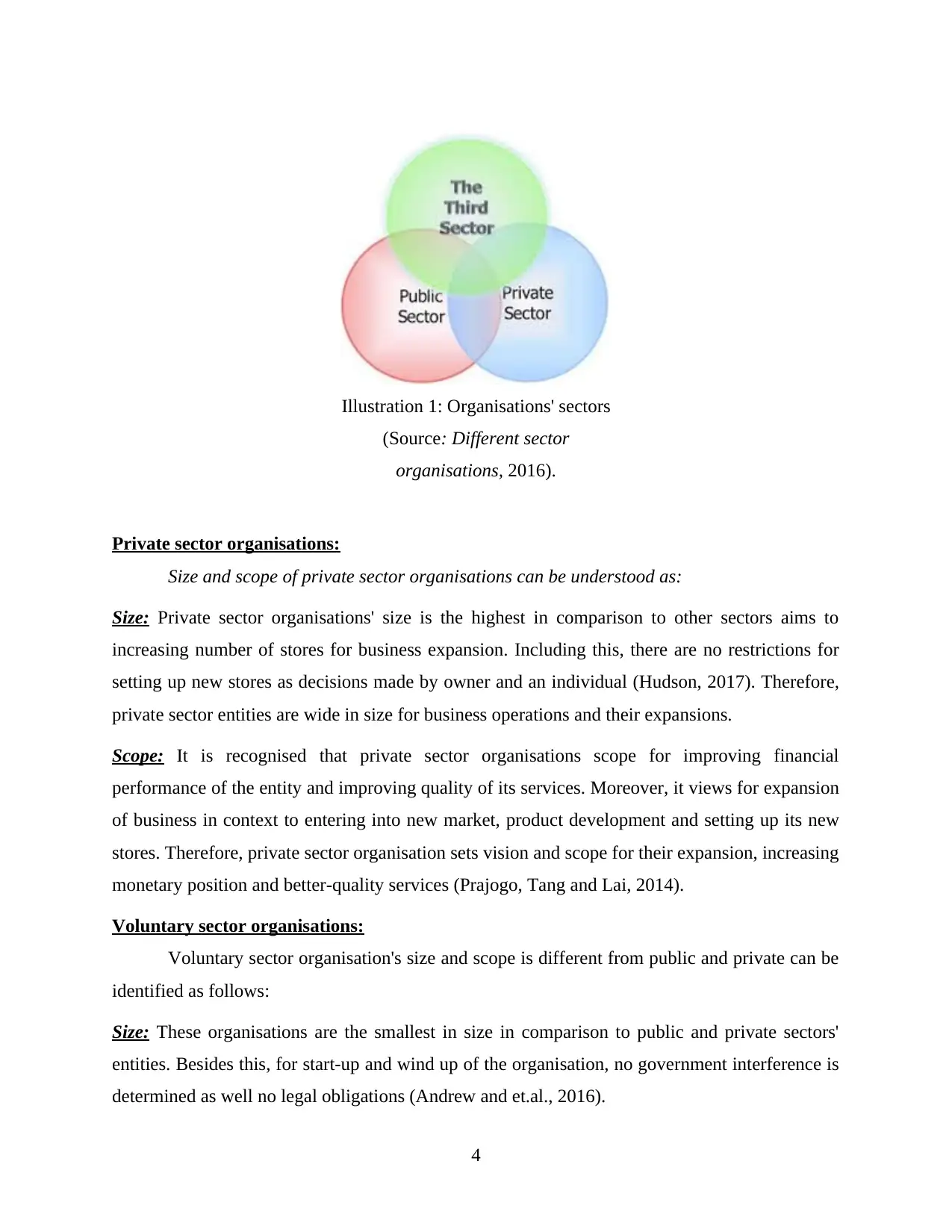
Private sector organisations:
Size and scope of private sector organisations can be understood as:
Size: Private sector organisations' size is the highest in comparison to other sectors aims to
increasing number of stores for business expansion. Including this, there are no restrictions for
setting up new stores as decisions made by owner and an individual (Hudson, 2017). Therefore,
private sector entities are wide in size for business operations and their expansions.
Scope: It is recognised that private sector organisations scope for improving financial
performance of the entity and improving quality of its services. Moreover, it views for expansion
of business in context to entering into new market, product development and setting up its new
stores. Therefore, private sector organisation sets vision and scope for their expansion, increasing
monetary position and better-quality services (Prajogo, Tang and Lai, 2014).
Voluntary sector organisations:
Voluntary sector organisation's size and scope is different from public and private can be
identified as follows:
Size: These organisations are the smallest in size in comparison to public and private sectors'
entities. Besides this, for start-up and wind up of the organisation, no government interference is
determined as well no legal obligations (Andrew and et.al., 2016).
4
Illustration 1: Organisations' sectors
(Source: Different sector
organisations, 2016).
Size and scope of private sector organisations can be understood as:
Size: Private sector organisations' size is the highest in comparison to other sectors aims to
increasing number of stores for business expansion. Including this, there are no restrictions for
setting up new stores as decisions made by owner and an individual (Hudson, 2017). Therefore,
private sector entities are wide in size for business operations and their expansions.
Scope: It is recognised that private sector organisations scope for improving financial
performance of the entity and improving quality of its services. Moreover, it views for expansion
of business in context to entering into new market, product development and setting up its new
stores. Therefore, private sector organisation sets vision and scope for their expansion, increasing
monetary position and better-quality services (Prajogo, Tang and Lai, 2014).
Voluntary sector organisations:
Voluntary sector organisation's size and scope is different from public and private can be
identified as follows:
Size: These organisations are the smallest in size in comparison to public and private sectors'
entities. Besides this, for start-up and wind up of the organisation, no government interference is
determined as well no legal obligations (Andrew and et.al., 2016).
4
Illustration 1: Organisations' sectors
(Source: Different sector
organisations, 2016).
Paraphrase This Document
Need a fresh take? Get an instant paraphrase of this document with our AI Paraphraser
Scope: Voluntary sector organisations aim to increase social welfare and supporting needy
people of the country at maximum level. However, these entities scope for contribution in social
development of the nation effectively.
1.3 (P3) Relationship of different structure, size and scope of organisations with business
objectives, product and services
Different sectors' organisations are linked with their objectives, product and services'
quality as well market position. However, for setting up new entity, it is required to consider
purpose, range and products' quality to attract customers (Storey, 2016). Besides this, structural
framework of business operations generates different ideas for further implementation. Along
with this, operations and services which are required to be improved are analysed for proper
management and creating balance between production and distribution of its goods and services.
Hence, it is recognised that preparing organisational structure is benefited for organisation's
effectiveness and improving its efficiencies.
TASK 2
2.1 (P3) Relationship between organisational functions and their link with organisational
objectives
There are different departments which work for management of entire business
operations with coordination also to achieve its effectiveness. For example; marketing,
production and operation, research and development, sales, finance and HR department. Some
essential departments and their work can be studied as: Finance department: This department is for recording financial transactions, analysing
incurred expenditures and gained income of the organisation (MitchelmStorey, 2016).
However, manager of this department plans and manages fund and focuses upon
increasing profitability. It is linked with business operations as production and
distribution system as well organisation's effectiveness. Marketing department: Manager of this department analyses market position and
competitiveness of the entity. Similarly, he prepares strategies for managing production
and distribution system . Thus, marketing department's function is related with
management of other business activities (Falkner, 2017).
5
people of the country at maximum level. However, these entities scope for contribution in social
development of the nation effectively.
1.3 (P3) Relationship of different structure, size and scope of organisations with business
objectives, product and services
Different sectors' organisations are linked with their objectives, product and services'
quality as well market position. However, for setting up new entity, it is required to consider
purpose, range and products' quality to attract customers (Storey, 2016). Besides this, structural
framework of business operations generates different ideas for further implementation. Along
with this, operations and services which are required to be improved are analysed for proper
management and creating balance between production and distribution of its goods and services.
Hence, it is recognised that preparing organisational structure is benefited for organisation's
effectiveness and improving its efficiencies.
TASK 2
2.1 (P3) Relationship between organisational functions and their link with organisational
objectives
There are different departments which work for management of entire business
operations with coordination also to achieve its effectiveness. For example; marketing,
production and operation, research and development, sales, finance and HR department. Some
essential departments and their work can be studied as: Finance department: This department is for recording financial transactions, analysing
incurred expenditures and gained income of the organisation (MitchelmStorey, 2016).
However, manager of this department plans and manages fund and focuses upon
increasing profitability. It is linked with business operations as production and
distribution system as well organisation's effectiveness. Marketing department: Manager of this department analyses market position and
competitiveness of the entity. Similarly, he prepares strategies for managing production
and distribution system . Thus, marketing department's function is related with
management of other business activities (Falkner, 2017).
5
Production and operation department: This organisational department is for increasing
productivity and profitability affect business operations and their management. In
addition to this, wastage of resources can be reduced also able to improve quality in
services. Thus, production and operations' department manager is for managing entire
business activities and increasing its efficiencies (Bebbington and et.al., 2014).
HR department: This department of the enterprise works for managing performance of
its employees, including this, he organises training and development same as maintain
workers' data. It is linked with organisation's effectiveness and workers' contribution in
achieving its goals (Titi, 2013).
Therefore, above mentioned all organisational functions are interrelated with each other
influences structure and its business operations. However, organisational structures can be
understood as: Functional structure: In this structural framework, all functions of different departments
of the organisation is recognised. Likewise, business performance and its financial
position is identified on which further decisions are made (Valavanis and Vachtsevanos,
2014).
Matrix organisational structure This organisational structure is to present entire business
operations and making decisions for their management effectively.
Thus, different organisational departments work with coordination to increase organisation's
efficiency and managing all operations (MitchelmStorey, 2016). For this purpose, it is essential
to create coordination among all departments to meet objectives more efficiently.
2.2 (M2) Critical evaluation on relationships between organisational functions impact on
organisational structure
It is effective to achieve organisation's effectiveness and managing its entire operations
also impact on quality services. Including this, different ideas are generated for utilization of
fund and resources affect production and distribution system of the entity (Mitchelmore and
Rowley, 2013). Moreover, it is effective for improvement in business performances and qualities
of its services. On critical evaluation, it is determined that creating coordination among
departments' functions remain difficult as well lack of required fund and resources affect
6
productivity and profitability affect business operations and their management. In
addition to this, wastage of resources can be reduced also able to improve quality in
services. Thus, production and operations' department manager is for managing entire
business activities and increasing its efficiencies (Bebbington and et.al., 2014).
HR department: This department of the enterprise works for managing performance of
its employees, including this, he organises training and development same as maintain
workers' data. It is linked with organisation's effectiveness and workers' contribution in
achieving its goals (Titi, 2013).
Therefore, above mentioned all organisational functions are interrelated with each other
influences structure and its business operations. However, organisational structures can be
understood as: Functional structure: In this structural framework, all functions of different departments
of the organisation is recognised. Likewise, business performance and its financial
position is identified on which further decisions are made (Valavanis and Vachtsevanos,
2014).
Matrix organisational structure This organisational structure is to present entire business
operations and making decisions for their management effectively.
Thus, different organisational departments work with coordination to increase organisation's
efficiency and managing all operations (MitchelmStorey, 2016). For this purpose, it is essential
to create coordination among all departments to meet objectives more efficiently.
2.2 (M2) Critical evaluation on relationships between organisational functions impact on
organisational structure
It is effective to achieve organisation's effectiveness and managing its entire operations
also impact on quality services. Including this, different ideas are generated for utilization of
fund and resources affect production and distribution system of the entity (Mitchelmore and
Rowley, 2013). Moreover, it is effective for improvement in business performances and qualities
of its services. On critical evaluation, it is determined that creating coordination among
departments' functions remain difficult as well lack of required fund and resources affect
6
⊘ This is a preview!⊘
Do you want full access?
Subscribe today to unlock all pages.
Trusted by 1+ million students worldwide
productivity and profitability adversely. However, occurrence of uncertain changes in
environmental factors impact on business operations negatively. Therefore, it is required to
prepare strategies for encouraging workers towards working in team with coordination (Hudson,
2017). However, lack of fund and resources required for business operations affect its further
operations adversely. In addition to this, due to changes in market price, government policies,
financial position of the organisation get impacted. Thus, it is required to create structural
framework and strategies to achieve effectiveness of organisation appropriately. In addition to
this, for encouraging workers towards effective contribution for organisation's department, it is
required to segment work according to their abilities and conducting training programs to
increase their working efficiencies. Thus, creating coordination among departments' functions, it
is required to analyse actual performance and decision making regarding further decisions.
2.3 (D1) Critical analysis of complexities of different types of business structure and their
relation with different organisational functions
It is difficult to create coordination among all departments of the organisation affect its
management negatively. However, lack of fund and resources required for business operations
affect its further operations adversely. In addition to this, due to changes in market price,
government policies, financial position of the organisation get impacted (Valavanis and
Vachtsevanos, 2014). Thus, it is required to create structural framework and strategies to achieve
effectiveness of organisation appropriately. In addition to this, for encouraging workers towards
effective contribution for organisation's department, it is required to segment work according to
their abilities and conducting training programs to increase their working efficiencies. Thus,
creating coordination among departments' functions, it is required to analyse actual performance
and decision making regarding further decisions.
CONCLUSION
It is concluded that for expansion of new entity, it is needed to analyse different sectors'
size, scope and purposes as business environmental factors. In this regard, different size and
scope of entities has been understood. Moreover, organisational functions work for achieving
entity's effectiveness is introduced. Along with this, relationship of organisational functions with
organisational structures has been understood which impact on entity's effectiveness. Therefore,
7
environmental factors impact on business operations negatively. Therefore, it is required to
prepare strategies for encouraging workers towards working in team with coordination (Hudson,
2017). However, lack of fund and resources required for business operations affect its further
operations adversely. In addition to this, due to changes in market price, government policies,
financial position of the organisation get impacted. Thus, it is required to create structural
framework and strategies to achieve effectiveness of organisation appropriately. In addition to
this, for encouraging workers towards effective contribution for organisation's department, it is
required to segment work according to their abilities and conducting training programs to
increase their working efficiencies. Thus, creating coordination among departments' functions, it
is required to analyse actual performance and decision making regarding further decisions.
2.3 (D1) Critical analysis of complexities of different types of business structure and their
relation with different organisational functions
It is difficult to create coordination among all departments of the organisation affect its
management negatively. However, lack of fund and resources required for business operations
affect its further operations adversely. In addition to this, due to changes in market price,
government policies, financial position of the organisation get impacted (Valavanis and
Vachtsevanos, 2014). Thus, it is required to create structural framework and strategies to achieve
effectiveness of organisation appropriately. In addition to this, for encouraging workers towards
effective contribution for organisation's department, it is required to segment work according to
their abilities and conducting training programs to increase their working efficiencies. Thus,
creating coordination among departments' functions, it is required to analyse actual performance
and decision making regarding further decisions.
CONCLUSION
It is concluded that for expansion of new entity, it is needed to analyse different sectors'
size, scope and purposes as business environmental factors. In this regard, different size and
scope of entities has been understood. Moreover, organisational functions work for achieving
entity's effectiveness is introduced. Along with this, relationship of organisational functions with
organisational structures has been understood which impact on entity's effectiveness. Therefore,
7
Paraphrase This Document
Need a fresh take? Get an instant paraphrase of this document with our AI Paraphraser

it is signified that different sector organisations' function, size and scope are several impacts on
entity's business performance and its operations.
8
entity's business performance and its operations.
8
REFERENCE
Books and Journal
Andrew, S. and et.al., 2016. Sources of organisational resiliency during the Thailand floods of
2011: a test of the bonding and bridging hypotheses. Disasters. 77(1). pp.65-84.
Bebbington, J. and et.al., 2014. Sustainability accounting and accountability. Routledge.
Bouckaert, G., Peters, B.G. and Verhoest, K., 2016. Coordination of Public Sector
Organizations. Palgrave Macmillan.
Falkner, R., 2017. Business power and conflict in international environmental politics. Springer.
Hudson, M., 2017. MANAGING WITHOUT PROFIT. DIRECTORY OF SOCIAL CHANG.
Mazzucato, M., 2015. The entrepreneurial state: Debunking public vs. private sector myths.
MANAGING WITHOUT PROFIT. DIRECTORY OF SOCIAL CHANG.
Mitchelmore, S. and Rowley, J., 2013. Entrepreneurial competencies of women entrepreneurs
pursuing business growth. Journal of Small Business and Enterprise Development. 78(1).
pp.125-142.
MitchelmStorey, D.J., 2016. Understanding the small business sector. Routledge.
Prajogo, D., KY Tang, A. and Lai, K.H., 2014. The diffusion of environmental management
system and its effect on environmental management practices. International Journal of
Operations & Production Management. 67(5). pp.565-585.
Storey, D.J., 2016. Understanding the small business sector. Routledge.
Titi Amayah, A., 2013. Determinants of knowledge sharing in a public-sector organization.
Journal of Knowledge Management. 788(3). pp.454-471.
Valavanis, K.P. and Vachtsevanos, G.J., 2014. Handbook of unmanned aerial vehicles. Springer
Publishing Company, Incorporated.
Online
Different sectors of organisation. 2016. [Online]. Avaialable through:
<https://www.polemicdigital.com/pestle-strategic-vision-future-seo/>. [Accessed on 29th
October 2017].
9
Books and Journal
Andrew, S. and et.al., 2016. Sources of organisational resiliency during the Thailand floods of
2011: a test of the bonding and bridging hypotheses. Disasters. 77(1). pp.65-84.
Bebbington, J. and et.al., 2014. Sustainability accounting and accountability. Routledge.
Bouckaert, G., Peters, B.G. and Verhoest, K., 2016. Coordination of Public Sector
Organizations. Palgrave Macmillan.
Falkner, R., 2017. Business power and conflict in international environmental politics. Springer.
Hudson, M., 2017. MANAGING WITHOUT PROFIT. DIRECTORY OF SOCIAL CHANG.
Mazzucato, M., 2015. The entrepreneurial state: Debunking public vs. private sector myths.
MANAGING WITHOUT PROFIT. DIRECTORY OF SOCIAL CHANG.
Mitchelmore, S. and Rowley, J., 2013. Entrepreneurial competencies of women entrepreneurs
pursuing business growth. Journal of Small Business and Enterprise Development. 78(1).
pp.125-142.
MitchelmStorey, D.J., 2016. Understanding the small business sector. Routledge.
Prajogo, D., KY Tang, A. and Lai, K.H., 2014. The diffusion of environmental management
system and its effect on environmental management practices. International Journal of
Operations & Production Management. 67(5). pp.565-585.
Storey, D.J., 2016. Understanding the small business sector. Routledge.
Titi Amayah, A., 2013. Determinants of knowledge sharing in a public-sector organization.
Journal of Knowledge Management. 788(3). pp.454-471.
Valavanis, K.P. and Vachtsevanos, G.J., 2014. Handbook of unmanned aerial vehicles. Springer
Publishing Company, Incorporated.
Online
Different sectors of organisation. 2016. [Online]. Avaialable through:
<https://www.polemicdigital.com/pestle-strategic-vision-future-seo/>. [Accessed on 29th
October 2017].
9
⊘ This is a preview!⊘
Do you want full access?
Subscribe today to unlock all pages.
Trusted by 1+ million students worldwide

1 out of 14


Related Documents


Your All-in-One AI-Powered Toolkit for Academic Success.
+13062052269
info@desklib.com
Available 24*7 on WhatsApp / Email
![[object Object]](/_next/static/media/star-bottom.7253800d.svg)
Unlock your academic potential
Copyright © 2020–2026 A2Z Services. All Rights Reserved. Developed and managed by ZUCOL.