Comprehensive Report: Bank of England Business Environment Analysis

Verified

Added on  2022/12/28

|6
|1388
|60
Report
AI Summary
This report provides a comprehensive analysis of the business environment, focusing on the Bank of England. It begins with an introduction to the concept of the business environment, encompassing both internal and external factors. The report then categorizes different types of businesses based on their purposes, including private, public, and voluntary organizations, providing examples for each. A significant portion of the report is dedicated to analyzing the Bank of England, evaluating its strengths, weaknesses, opportunities, and threats. Furthermore, it employs a PESTLE analysis to examine the political, economic, social, technological, legal, and environmental factors impacting the bank. The report also discusses the importance of understanding the needs of stakeholders, particularly the UK government and customers, for the bank's success. The conclusion summarizes the key findings, emphasizing the influence of environmental factors on organizational performance and the necessity of stakeholder satisfaction.
Document Page
The Business Environment
tabler-icon-diamond-filled.svg

Paraphrase This Document

Need a fresh take? Get an instant paraphrase of this document with our AI Paraphraser
Document Page
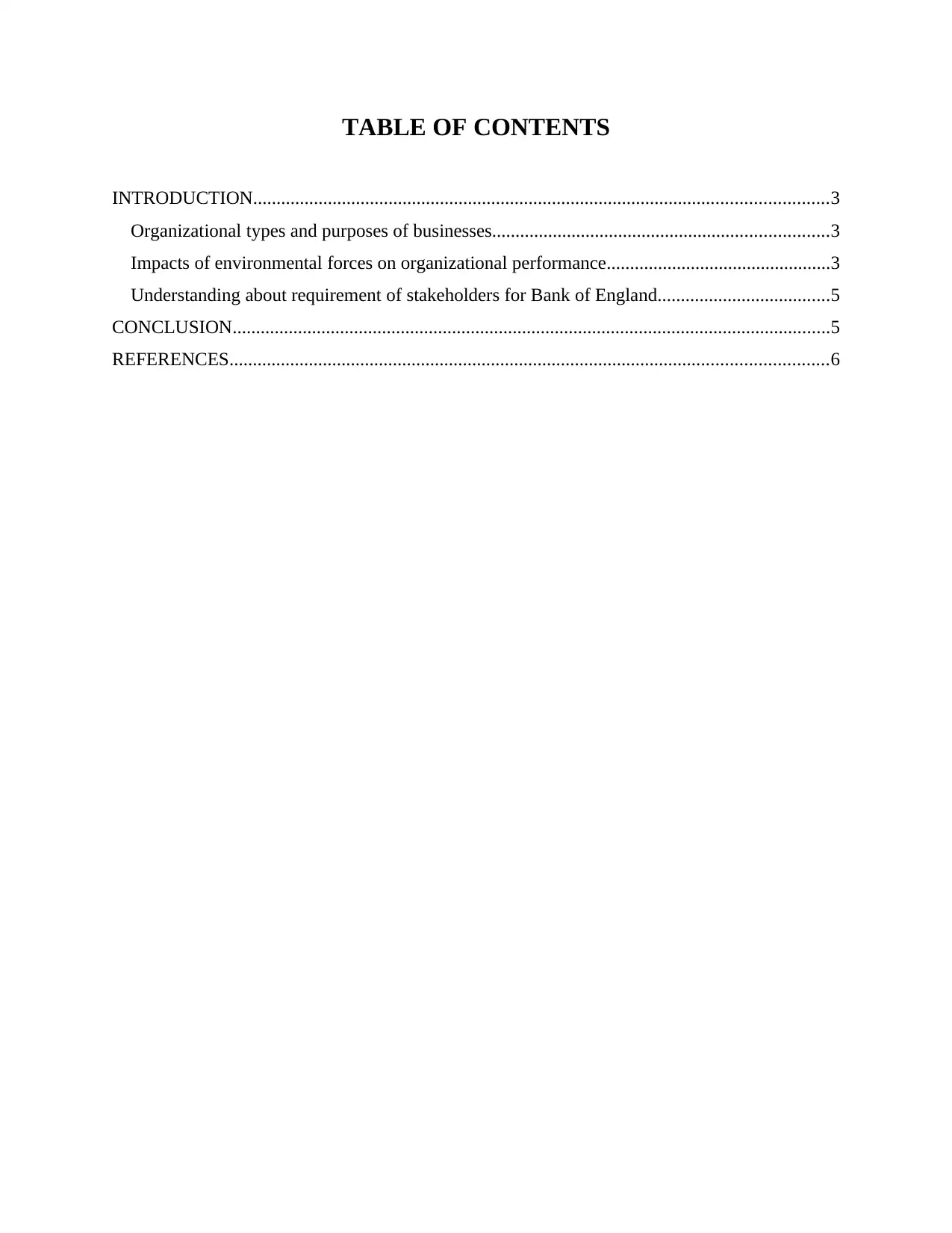
TABLE OF CONTENTS
INTRODUCTION...........................................................................................................................3
Organizational types and purposes of businesses........................................................................3
Impacts of environmental forces on organizational performance................................................3
Understanding about requirement of stakeholders for Bank of England.....................................5
CONCLUSION................................................................................................................................5
REFERENCES................................................................................................................................6
Document Page
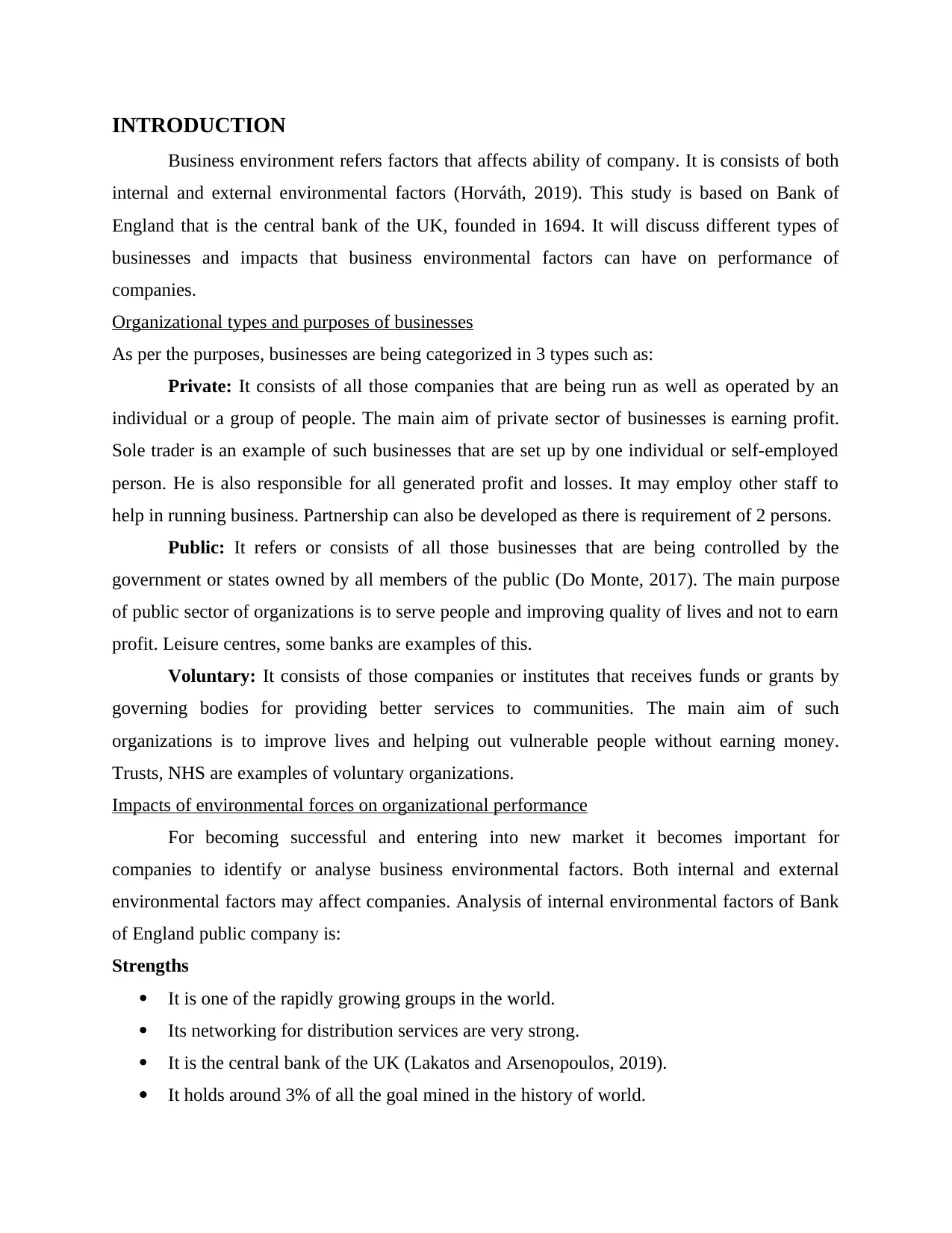
INTRODUCTION
Business environment refers factors that affects ability of company. It is consists of both
internal and external environmental factors (Horváth, 2019). This study is based on Bank of
England that is the central bank of the UK, founded in 1694. It will discuss different types of
businesses and impacts that business environmental factors can have on performance of
companies.
Organizational types and purposes of businesses
As per the purposes, businesses are being categorized in 3 types such as:
Private: It consists of all those companies that are being run as well as operated by an
individual or a group of people. The main aim of private sector of businesses is earning profit.
Sole trader is an example of such businesses that are set up by one individual or self-employed
person. He is also responsible for all generated profit and losses. It may employ other staff to
help in running business. Partnership can also be developed as there is requirement of 2 persons.
Public: It refers or consists of all those businesses that are being controlled by the
government or states owned by all members of the public (Do Monte, 2017). The main purpose
of public sector of organizations is to serve people and improving quality of lives and not to earn
profit. Leisure centres, some banks are examples of this.
Voluntary: It consists of those companies or institutes that receives funds or grants by
governing bodies for providing better services to communities. The main aim of such
organizations is to improve lives and helping out vulnerable people without earning money.
Trusts, NHS are examples of voluntary organizations.
Impacts of environmental forces on organizational performance
For becoming successful and entering into new market it becomes important for
companies to identify or analyse business environmental factors. Both internal and external
environmental factors may affect companies. Analysis of internal environmental factors of Bank
of England public company is:
Strengths
It is one of the rapidly growing groups in the world.
Its networking for distribution services are very strong.
It is the central bank of the UK (Lakatos and Arsenopoulos, 2019).
It holds around 3% of all the goal mined in the history of world.
Document Page
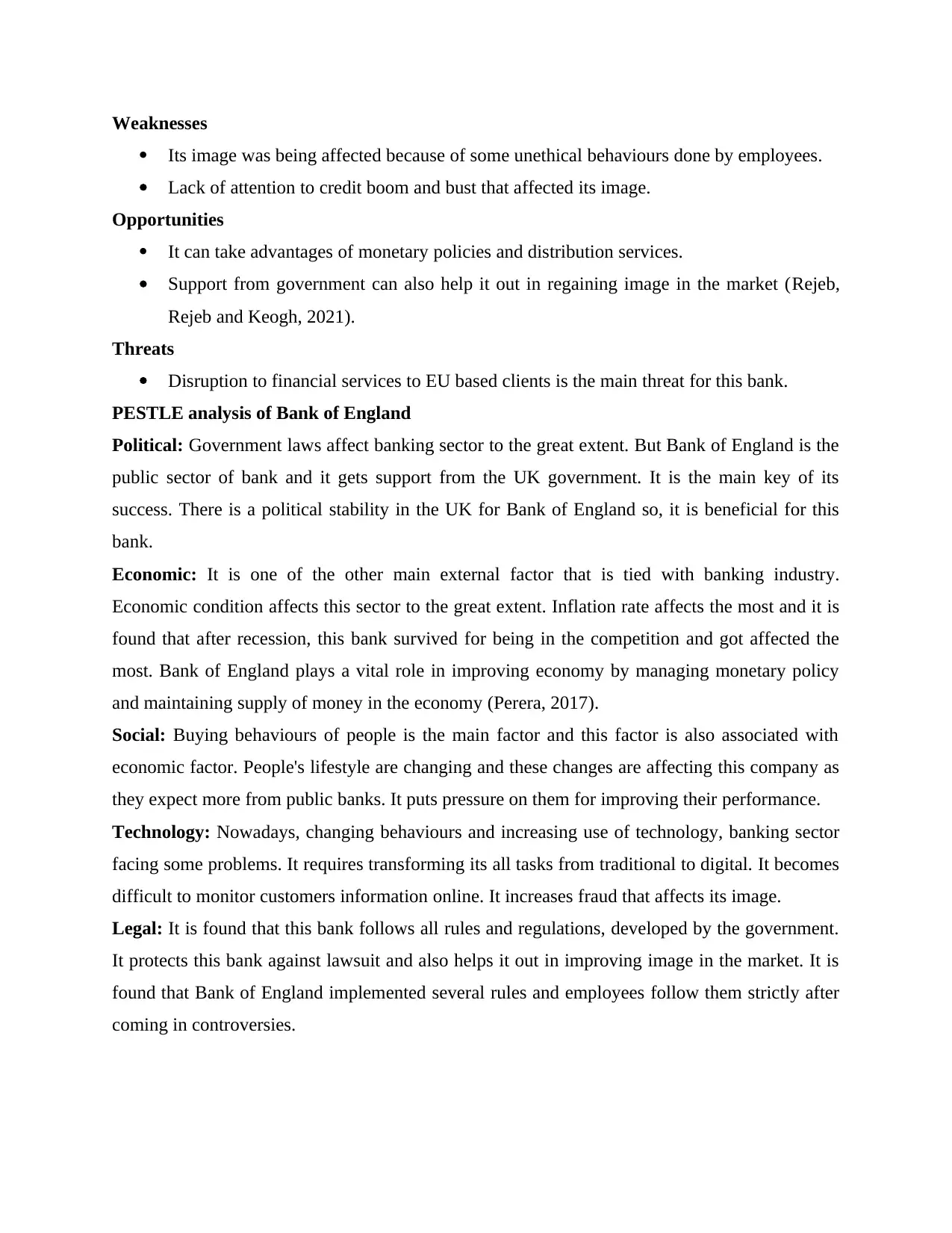
Weaknesses
Its image was being affected because of some unethical behaviours done by employees.
Lack of attention to credit boom and bust that affected its image.
Opportunities
It can take advantages of monetary policies and distribution services.
Support from government can also help it out in regaining image in the market (Rejeb,
Rejeb and Keogh, 2021).
Threats
Disruption to financial services to EU based clients is the main threat for this bank.
PESTLE analysis of Bank of England
Political: Government laws affect banking sector to the great extent. But Bank of England is the
public sector of bank and it gets support from the UK government. It is the main key of its
success. There is a political stability in the UK for Bank of England so, it is beneficial for this
bank.
Economic: It is one of the other main external factor that is tied with banking industry.
Economic condition affects this sector to the great extent. Inflation rate affects the most and it is
found that after recession, this bank survived for being in the competition and got affected the
most. Bank of England plays a vital role in improving economy by managing monetary policy
and maintaining supply of money in the economy (Perera, 2017).
Social: Buying behaviours of people is the main factor and this factor is also associated with
economic factor. People's lifestyle are changing and these changes are affecting this company as
they expect more from public banks. It puts pressure on them for improving their performance.
Technology: Nowadays, changing behaviours and increasing use of technology, banking sector
facing some problems. It requires transforming its all tasks from traditional to digital. It becomes
difficult to monitor customers information online. It increases fraud that affects its image.
Legal: It is found that this bank follows all rules and regulations, developed by the government.
It protects this bank against lawsuit and also helps it out in improving image in the market. It is
found that Bank of England implemented several rules and employees follow them strictly after
coming in controversies.
tabler-icon-diamond-filled.svg

Paraphrase This Document

Need a fresh take? Get an instant paraphrase of this document with our AI Paraphraser
Document Page
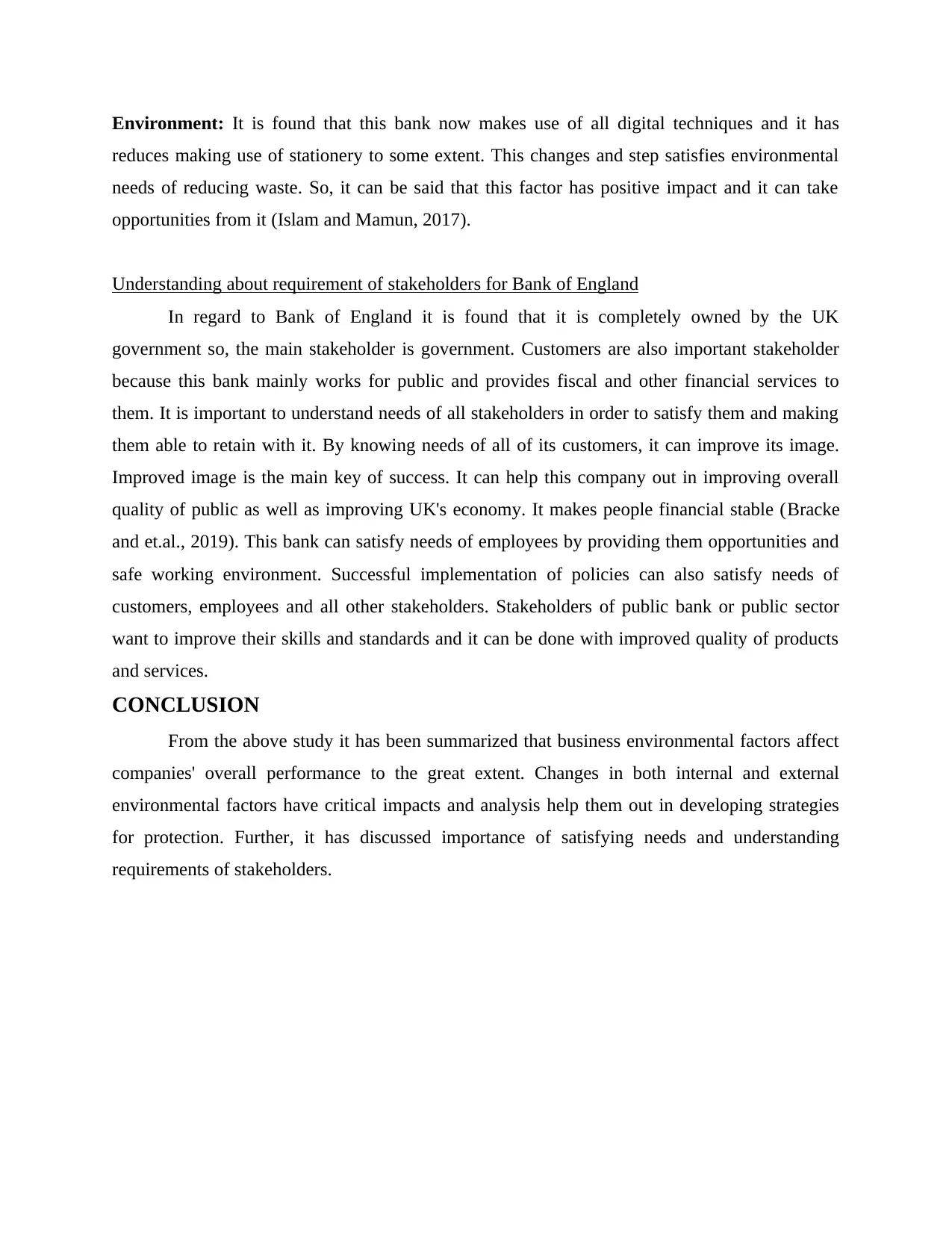
Environment: It is found that this bank now makes use of all digital techniques and it has
reduces making use of stationery to some extent. This changes and step satisfies environmental
needs of reducing waste. So, it can be said that this factor has positive impact and it can take
opportunities from it (Islam and Mamun, 2017).
Understanding about requirement of stakeholders for Bank of England
In regard to Bank of England it is found that it is completely owned by the UK
government so, the main stakeholder is government. Customers are also important stakeholder
because this bank mainly works for public and provides fiscal and other financial services to
them. It is important to understand needs of all stakeholders in order to satisfy them and making
them able to retain with it. By knowing needs of all of its customers, it can improve its image.
Improved image is the main key of success. It can help this company out in improving overall
quality of public as well as improving UK's economy. It makes people financial stable (Bracke
and et.al., 2019). This bank can satisfy needs of employees by providing them opportunities and
safe working environment. Successful implementation of policies can also satisfy needs of
customers, employees and all other stakeholders. Stakeholders of public bank or public sector
want to improve their skills and standards and it can be done with improved quality of products
and services.
CONCLUSION
From the above study it has been summarized that business environmental factors affect
companies' overall performance to the great extent. Changes in both internal and external
environmental factors have critical impacts and analysis help them out in developing strategies
for protection. Further, it has discussed importance of satisfying needs and understanding
requirements of stakeholders.
Document Page
REFERENCES
Books and Journals
Bracke, P. and et.al., 2019. Machine learning explainability in finance: an application to default
risk analysis.
Do Monte, P.A., 2017. Public versus private sector: Do workers’ behave differently?.
EconomiA. 18(2). pp.229-243.
Horváth, V., 2019. Project management competence–definitions, models, standards and practical
implications.Vezetéstudomány-Budapest Management Review. 50(11). pp.2-17.
Islam, F.R. and Mamun, K.A., 2017. Possibilities and challenges of implementing renewable
energy in the light of PESTLE & SWOT analyses for island countries. In Smart Energy
Grid Design for Island Countries (pp. 1-19). Springer, Cham.
Lakatos, E. and Arsenopoulos, A., 2019. Investigating EU financial instruments to tackle energy
poverty in households: A SWOT analysis. Energy Sources, Part B: Economics, Planning,
and Policy. 14(6). pp.235-253.
Perera, R., 2017. The PESTLE analysis. Nerdynaut.
Rejeb, A., Rejeb, K. and Keogh, J.G., 2021. Centralized vs. decentralized ledgers in the money
supply process: a SWOT analysis [J]. Quantitative Finance and Economics. 5(1). pp.40-66.
chevron_up_icon
1 out of 6
circle_padding
hide_on_mobile
zoom_out_icon
[object Object]