Business Environment Analysis Report for HALIFAX Bank, UK
VerifiedAdded on 2020/10/22
|11
|2917
|211
Report
AI Summary
This report provides a comprehensive analysis of HALIFAX Bank's business environment. It begins with an introduction to business environments and the chosen company, HALIFAX Bank. Task 1 explores different organizational types, comparing their advantages, disadvantages, and key differences, including public, private, voluntary, partnership, and sole trader structures. Task 2 delves into HALIFAX Bank's organizational structures, focusing on functional and divisional structures, and examines the relationship between marketing and human resources departments. Task 3 applies a PESTLE analysis to HALIFAX Bank's external environment, evaluating political, economic, social, technological, legal, and environmental factors. Task 4 presents a SWOT analysis, assessing the bank's strengths, weaknesses, opportunities, and threats, and their interrelation with external factors. The report concludes with a summary of the findings and a list of references.

Business Environment

Paraphrase This Document
Need a fresh take? Get an instant paraphrase of this document with our AI Paraphraser
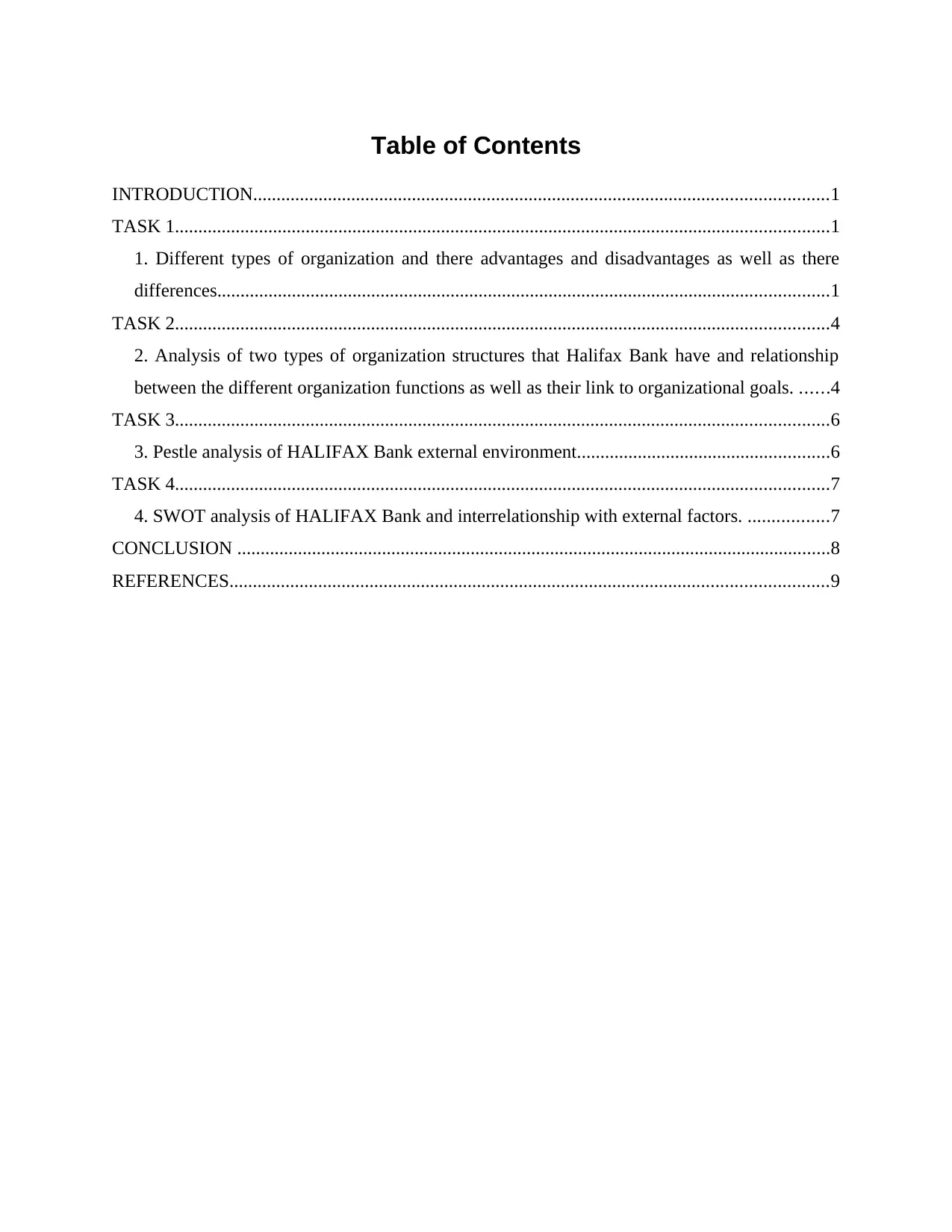
Table of Contents
INTRODUCTION...........................................................................................................................1
TASK 1............................................................................................................................................1
1. Different types of organization and there advantages and disadvantages as well as there
differences...................................................................................................................................1
TASK 2............................................................................................................................................4
2. Analysis of two types of organization structures that Halifax Bank have and relationship
between the different organization functions as well as their link to organizational goals. ......4
TASK 3............................................................................................................................................6
3. Pestle analysis of HALIFAX Bank external environment......................................................6
TASK 4............................................................................................................................................7
4. SWOT analysis of HALIFAX Bank and interrelationship with external factors. .................7
CONCLUSION ...............................................................................................................................8
REFERENCES................................................................................................................................9
INTRODUCTION...........................................................................................................................1
TASK 1............................................................................................................................................1
1. Different types of organization and there advantages and disadvantages as well as there
differences...................................................................................................................................1
TASK 2............................................................................................................................................4
2. Analysis of two types of organization structures that Halifax Bank have and relationship
between the different organization functions as well as their link to organizational goals. ......4
TASK 3............................................................................................................................................6
3. Pestle analysis of HALIFAX Bank external environment......................................................6
TASK 4............................................................................................................................................7
4. SWOT analysis of HALIFAX Bank and interrelationship with external factors. .................7
CONCLUSION ...............................................................................................................................8
REFERENCES................................................................................................................................9
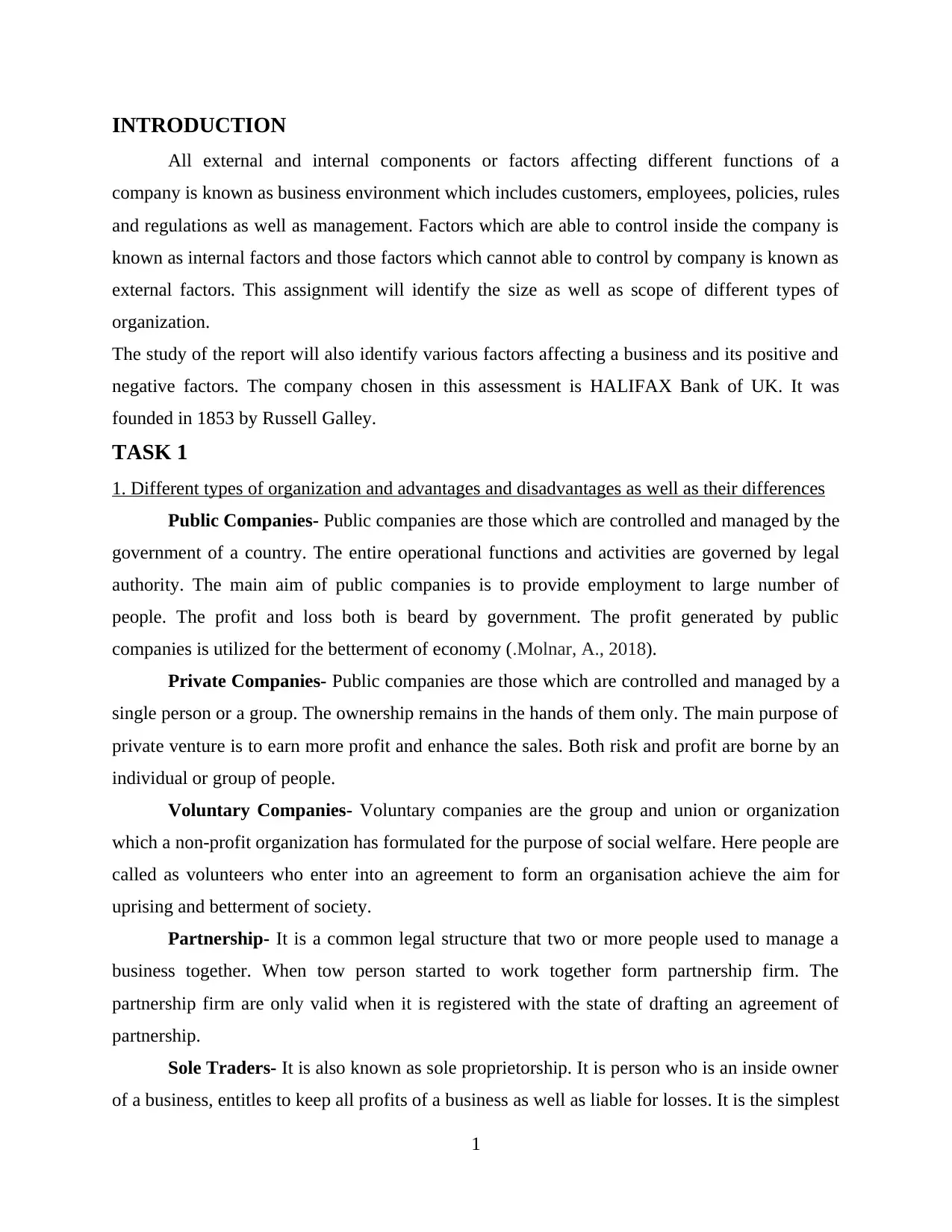
INTRODUCTION
All external and internal components or factors affecting different functions of a
company is known as business environment which includes customers, employees, policies, rules
and regulations as well as management. Factors which are able to control inside the company is
known as internal factors and those factors which cannot able to control by company is known as
external factors. This assignment will identify the size as well as scope of different types of
organization.
The study of the report will also identify various factors affecting a business and its positive and
negative factors. The company chosen in this assessment is HALIFAX Bank of UK. It was
founded in 1853 by Russell Galley.
TASK 1
1. Different types of organization and advantages and disadvantages as well as their differences
Public Companies- Public companies are those which are controlled and managed by the
government of a country. The entire operational functions and activities are governed by legal
authority. The main aim of public companies is to provide employment to large number of
people. The profit and loss both is beard by government. The profit generated by public
companies is utilized for the betterment of economy (.Molnar, A., 2018).
Private Companies- Public companies are those which are controlled and managed by a
single person or a group. The ownership remains in the hands of them only. The main purpose of
private venture is to earn more profit and enhance the sales. Both risk and profit are borne by an
individual or group of people.
Voluntary Companies- Voluntary companies are the group and union or organization
which a non-profit organization has formulated for the purpose of social welfare. Here people are
called as volunteers who enter into an agreement to form an organisation achieve the aim for
uprising and betterment of society.
Partnership- It is a common legal structure that two or more people used to manage a
business together. When tow person started to work together form partnership firm. The
partnership firm are only valid when it is registered with the state of drafting an agreement of
partnership.
Sole Traders- It is also known as sole proprietorship. It is person who is an inside owner
of a business, entitles to keep all profits of a business as well as liable for losses. It is the simplest
1
All external and internal components or factors affecting different functions of a
company is known as business environment which includes customers, employees, policies, rules
and regulations as well as management. Factors which are able to control inside the company is
known as internal factors and those factors which cannot able to control by company is known as
external factors. This assignment will identify the size as well as scope of different types of
organization.
The study of the report will also identify various factors affecting a business and its positive and
negative factors. The company chosen in this assessment is HALIFAX Bank of UK. It was
founded in 1853 by Russell Galley.
TASK 1
1. Different types of organization and advantages and disadvantages as well as their differences
Public Companies- Public companies are those which are controlled and managed by the
government of a country. The entire operational functions and activities are governed by legal
authority. The main aim of public companies is to provide employment to large number of
people. The profit and loss both is beard by government. The profit generated by public
companies is utilized for the betterment of economy (.Molnar, A., 2018).
Private Companies- Public companies are those which are controlled and managed by a
single person or a group. The ownership remains in the hands of them only. The main purpose of
private venture is to earn more profit and enhance the sales. Both risk and profit are borne by an
individual or group of people.
Voluntary Companies- Voluntary companies are the group and union or organization
which a non-profit organization has formulated for the purpose of social welfare. Here people are
called as volunteers who enter into an agreement to form an organisation achieve the aim for
uprising and betterment of society.
Partnership- It is a common legal structure that two or more people used to manage a
business together. When tow person started to work together form partnership firm. The
partnership firm are only valid when it is registered with the state of drafting an agreement of
partnership.
Sole Traders- It is also known as sole proprietorship. It is person who is an inside owner
of a business, entitles to keep all profits of a business as well as liable for losses. It is the simplest
1
⊘ This is a preview!⊘
Do you want full access?
Subscribe today to unlock all pages.

Trusted by 1+ million students worldwide
form of business structure as well as easy and inexpensive to set up. They have a complete
control of assets of business and all decisions of business.
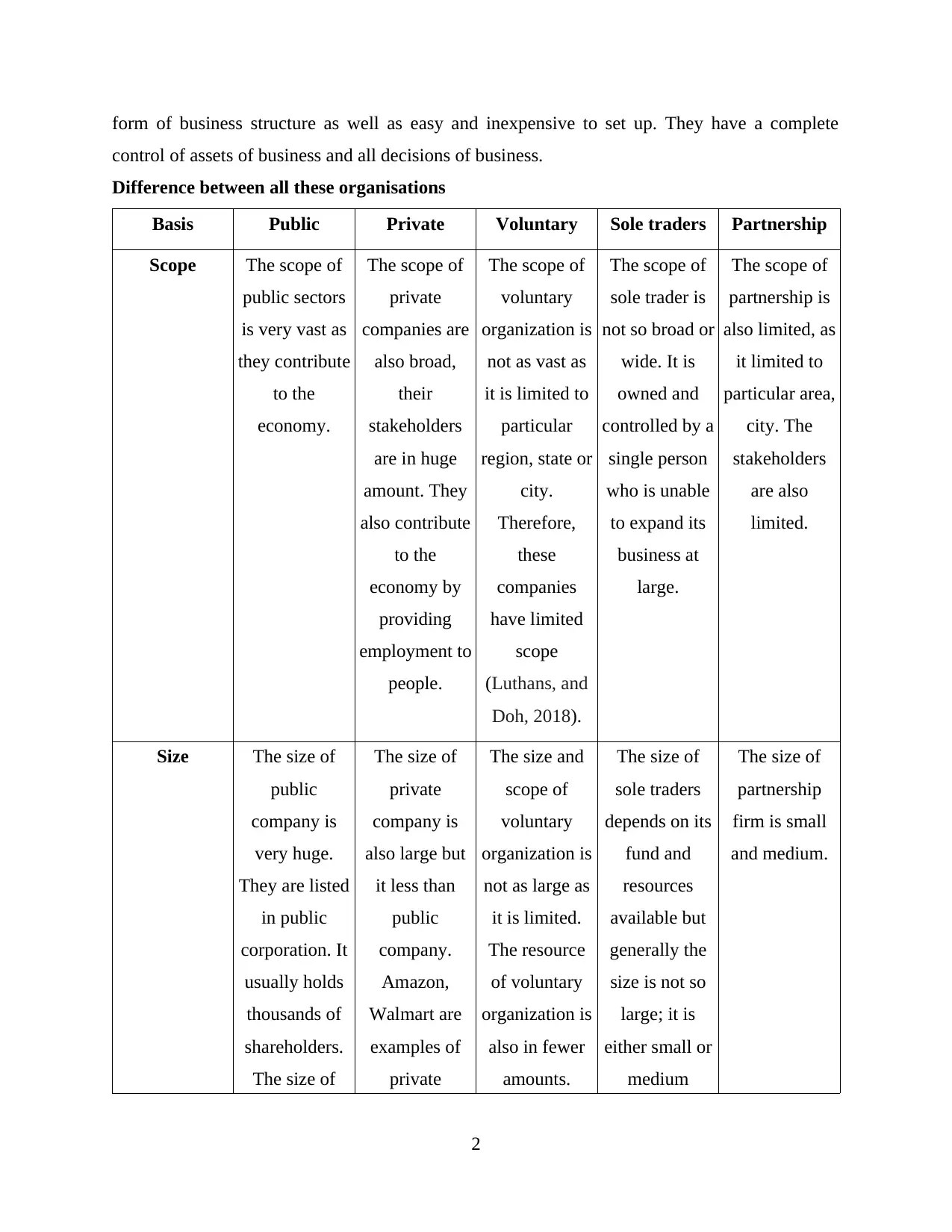
Difference between all these organisations
Basis Public Private Voluntary Sole traders Partnership
Scope The scope of
public sectors
is very vast as
they contribute
to the
economy.
The scope of
private
companies are
also broad,
their
stakeholders
are in huge
amount. They
also contribute
to the
economy by
providing
employment to
people.
The scope of
voluntary
organization is
not as vast as
it is limited to
particular
region, state or
city.
Therefore,
these
companies
have limited
scope
(Luthans, and
Doh, 2018).
The scope of
sole trader is
not so broad or
wide. It is
owned and
controlled by a
single person
who is unable
to expand its
business at
large.
The scope of
partnership is
also limited, as
it limited to
particular area,
city. The
stakeholders
are also
limited.
Size The size of
public
company is
very huge.
They are listed
in public
corporation. It
usually holds
thousands of
shareholders.
The size of
The size of
private
company is
also large but
it less than
public
company.
Amazon,
Walmart are
examples of
private
The size and
scope of
voluntary
organization is
not as large as
it is limited.
The resource
of voluntary
organization is
also in fewer
amounts.
The size of
sole traders
depends on its
fund and
resources
available but
generally the
size is not so
large; it is
either small or
medium
The size of
partnership
firm is small
and medium.
2
control of assets of business and all decisions of business.
Difference between all these organisations
Basis Public Private Voluntary Sole traders Partnership
Scope The scope of
public sectors
is very vast as
they contribute
to the
economy.
The scope of
private
companies are
also broad,
their
stakeholders
are in huge
amount. They
also contribute
to the
economy by
providing
employment to
people.
The scope of
voluntary
organization is
not as vast as
it is limited to
particular
region, state or
city.
Therefore,
these
companies
have limited
scope
(Luthans, and
Doh, 2018).
The scope of
sole trader is
not so broad or
wide. It is
owned and
controlled by a
single person
who is unable
to expand its
business at
large.
The scope of
partnership is
also limited, as
it limited to
particular area,
city. The
stakeholders
are also
limited.
Size The size of
public
company is
very huge.
They are listed
in public
corporation. It
usually holds
thousands of
shareholders.
The size of
The size of
private
company is
also large but
it less than
public
company.
Amazon,
Walmart are
examples of
private
The size and
scope of
voluntary
organization is
not as large as
it is limited.
The resource
of voluntary
organization is
also in fewer
amounts.
The size of
sole traders
depends on its
fund and
resources
available but
generally the
size is not so
large; it is
either small or
medium
The size of
partnership
firm is small
and medium.
2
Paraphrase This Document
Need a fresh take? Get an instant paraphrase of this document with our AI Paraphraser
revenue and
investment is
also in huge
amount.
companies.
The
investment
and profit is
also very
ample.
Majorly, it is
run by the
government
funds,
subsidies,
charity funds
and donations.
(Solodilova,
N.Z., Malikov,
and Grishin,
2018).
Legal
Structure
Public
companies
have to work
according to
the norms
provided by
the
government.
They have to
pay taxes
regularly
(Namvar and
et.al, 2018).
Private
companies
must operate
as per norms,
policies, and
pay taxes.
However, the
legal
restriction is
less than
public
companies.
There are no
legal
formalities
required in
starting or
running the
business. They
are generally
exempted
from taxes.
In sole traders
there is no so
much legal
formalities,
rules and
regulation are
there.
In partnership
there some
legal
formalities
required which
makes easy in
filing the case
in courts and
for rights as
well.
Partnership
agreement
makes the
structure legal.
Objectives The objective
of public
companies is
to provide
employment to
large number
of people.
The objective
of private
companies is
to earn profit
and maximise
the sales.
The objective
of voluntary
organization is
to welfare the
society.
They have
objective to
earn profit and
expand their
business.
Partnership
firm has an
objective to
earn profit and
expand their
business.
Advantages Can easily
raise capital
Limited
liability.
Tax relief.
Trust and
Unlimited
personal
Debts are
divided into
3
investment is
also in huge
amount.
companies.
The
investment
and profit is
also very
ample.
Majorly, it is
run by the
government
funds,
subsidies,
charity funds
and donations.
(Solodilova,
N.Z., Malikov,
and Grishin,
2018).
Legal
Structure
Public
companies
have to work
according to
the norms
provided by
the
government.
They have to
pay taxes
regularly
(Namvar and
et.al, 2018).
Private
companies
must operate
as per norms,
policies, and
pay taxes.
However, the
legal
restriction is
less than
public
companies.
There are no
legal
formalities
required in
starting or
running the
business. They
are generally
exempted
from taxes.
In sole traders
there is no so
much legal
formalities,
rules and
regulation are
there.
In partnership
there some
legal
formalities
required which
makes easy in
filing the case
in courts and
for rights as
well.
Partnership
agreement
makes the
structure legal.
Objectives The objective
of public
companies is
to provide
employment to
large number
of people.
The objective
of private
companies is
to earn profit
and maximise
the sales.
The objective
of voluntary
organization is
to welfare the
society.
They have
objective to
earn profit and
expand their
business.
Partnership
firm has an
objective to
earn profit and
expand their
business.
Advantages Can easily
raise capital
Limited
liability.
Tax relief.
Trust and
Unlimited
personal
Debts are
divided into
3
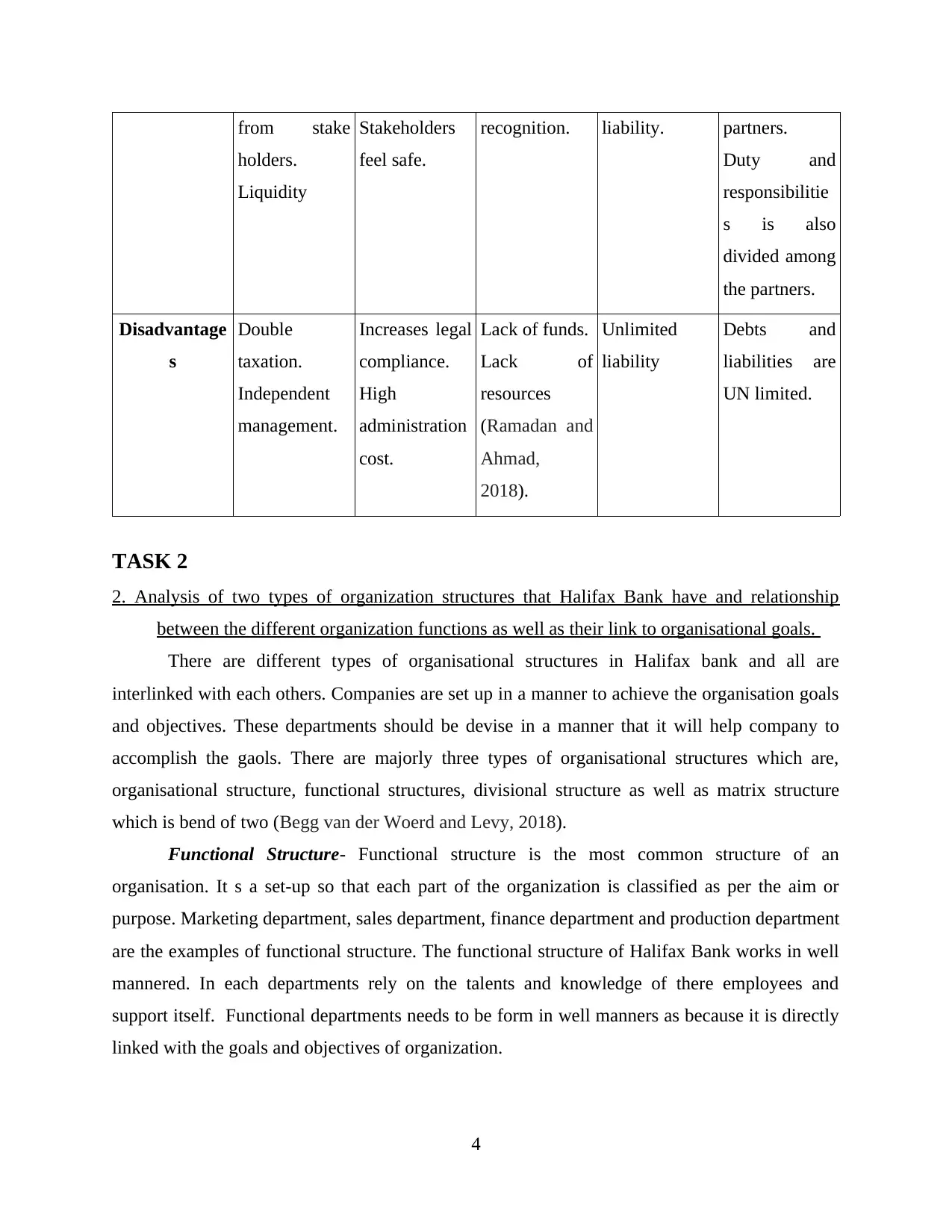
from stake
holders.
Liquidity
Stakeholders
feel safe.
recognition. liability. partners.
Duty and
responsibilitie
s is also
divided among
the partners.
Disadvantage
s
Double
taxation.
Independent
management.
Increases legal
compliance.
High
administration
cost.
Lack of funds.
Lack of
resources
(Ramadan and
Ahmad,
2018).
Unlimited
liability
Debts and
liabilities are
UN limited.
TASK 2
2. Analysis of two types of organization structures that Halifax Bank have and relationship
between the different organization functions as well as their link to organisational goals.
There are different types of organisational structures in Halifax bank and all are
interlinked with each others. Companies are set up in a manner to achieve the organisation goals
and objectives. These departments should be devise in a manner that it will help company to
accomplish the gaols. There are majorly three types of organisational structures which are,
organisational structure, functional structures, divisional structure as well as matrix structure
which is bend of two (Begg van der Woerd and Levy, 2018).
Functional Structure- Functional structure is the most common structure of an
organisation. It s a set-up so that each part of the organization is classified as per the aim or
purpose. Marketing department, sales department, finance department and production department
are the examples of functional structure. The functional structure of Halifax Bank works in well
mannered. In each departments rely on the talents and knowledge of there employees and
support itself. Functional departments needs to be form in well manners as because it is directly
linked with the goals and objectives of organization.
4
holders.
Liquidity
Stakeholders
feel safe.
recognition. liability. partners.
Duty and
responsibilitie
s is also
divided among
the partners.
Disadvantage
s
Double
taxation.
Independent
management.
Increases legal
compliance.
High
administration
cost.
Lack of funds.
Lack of
resources
(Ramadan and
Ahmad,
2018).
Unlimited
liability
Debts and
liabilities are
UN limited.
TASK 2
2. Analysis of two types of organization structures that Halifax Bank have and relationship
between the different organization functions as well as their link to organisational goals.
There are different types of organisational structures in Halifax bank and all are
interlinked with each others. Companies are set up in a manner to achieve the organisation goals
and objectives. These departments should be devise in a manner that it will help company to
accomplish the gaols. There are majorly three types of organisational structures which are,
organisational structure, functional structures, divisional structure as well as matrix structure
which is bend of two (Begg van der Woerd and Levy, 2018).
Functional Structure- Functional structure is the most common structure of an
organisation. It s a set-up so that each part of the organization is classified as per the aim or
purpose. Marketing department, sales department, finance department and production department
are the examples of functional structure. The functional structure of Halifax Bank works in well
mannered. In each departments rely on the talents and knowledge of there employees and
support itself. Functional departments needs to be form in well manners as because it is directly
linked with the goals and objectives of organization.
4
⊘ This is a preview!⊘
Do you want full access?
Subscribe today to unlock all pages.
Trusted by 1+ million students worldwide
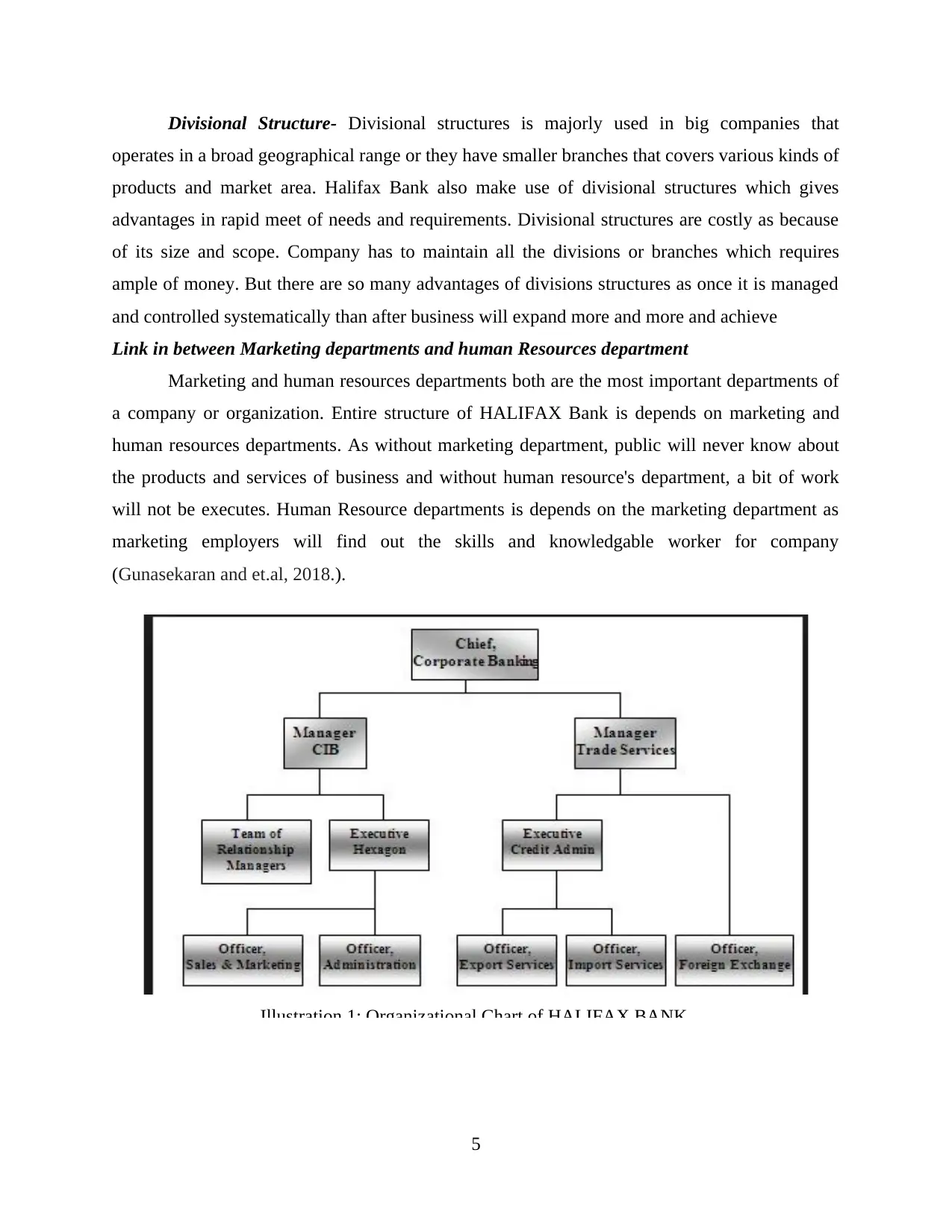
Divisional Structure- Divisional structures is majorly used in big companies that
operates in a broad geographical range or they have smaller branches that covers various kinds of
products and market area. Halifax Bank also make use of divisional structures which gives
advantages in rapid meet of needs and requirements. Divisional structures are costly as because
of its size and scope. Company has to maintain all the divisions or branches which requires
ample of money. But there are so many advantages of divisions structures as once it is managed
and controlled systematically than after business will expand more and more and achieve
Link in between Marketing departments and human Resources department
Marketing and human resources departments both are the most important departments of
a company or organization. Entire structure of HALIFAX Bank is depends on marketing and
human resources departments. As without marketing department, public will never know about
the products and services of business and without human resource's department, a bit of work
will not be executes. Human Resource departments is depends on the marketing department as
marketing employers will find out the skills and knowledgable worker for company
(Gunasekaran and et.al, 2018.).
5
Illustration 1: Organizational Chart of HALIFAX BANK.
operates in a broad geographical range or they have smaller branches that covers various kinds of
products and market area. Halifax Bank also make use of divisional structures which gives
advantages in rapid meet of needs and requirements. Divisional structures are costly as because
of its size and scope. Company has to maintain all the divisions or branches which requires
ample of money. But there are so many advantages of divisions structures as once it is managed
and controlled systematically than after business will expand more and more and achieve
Link in between Marketing departments and human Resources department
Marketing and human resources departments both are the most important departments of
a company or organization. Entire structure of HALIFAX Bank is depends on marketing and
human resources departments. As without marketing department, public will never know about
the products and services of business and without human resource's department, a bit of work
will not be executes. Human Resource departments is depends on the marketing department as
marketing employers will find out the skills and knowledgable worker for company
(Gunasekaran and et.al, 2018.).
5
Illustration 1: Organizational Chart of HALIFAX BANK.
Paraphrase This Document
Need a fresh take? Get an instant paraphrase of this document with our AI Paraphraser
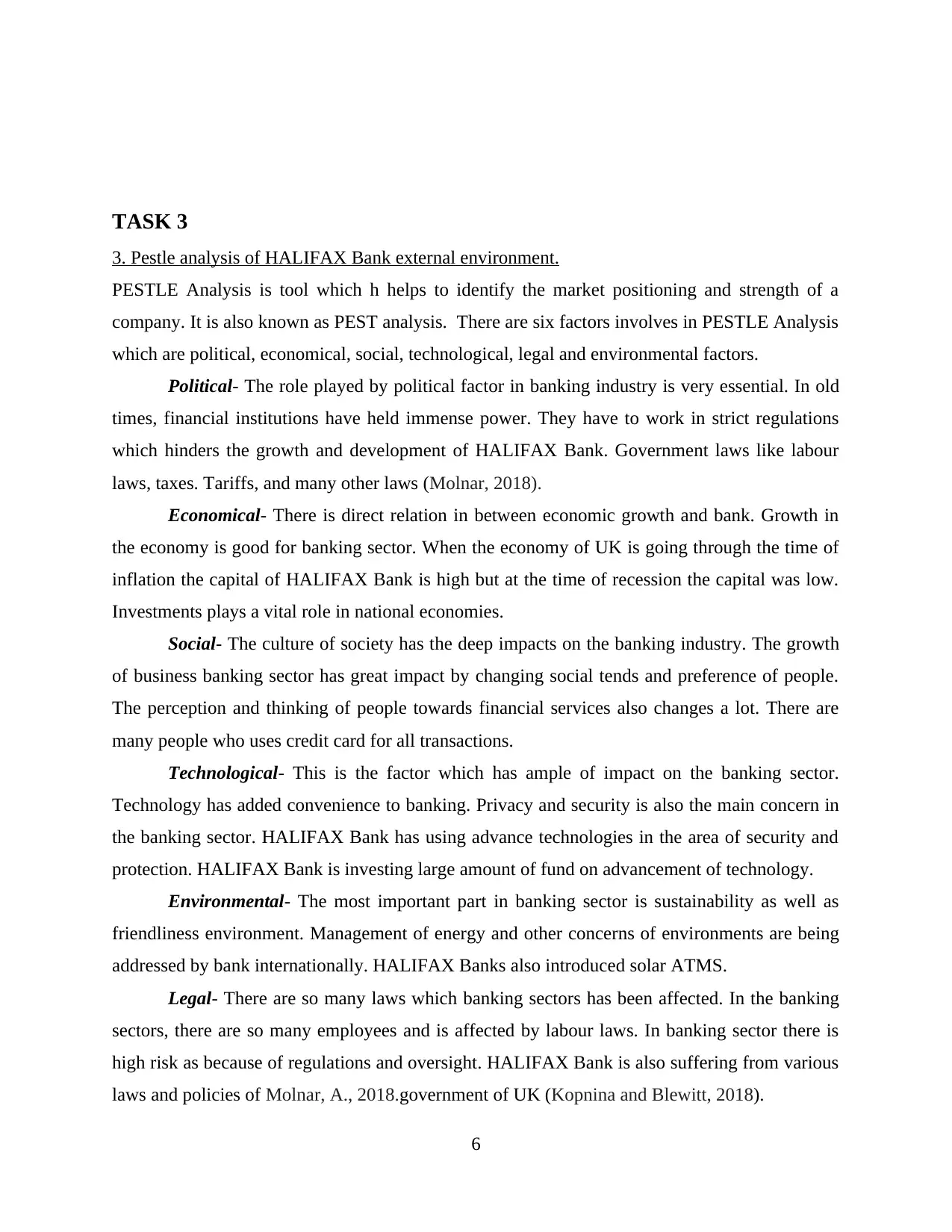
TASK 3
3. Pestle analysis of HALIFAX Bank external environment.
PESTLE Analysis is tool which h helps to identify the market positioning and strength of a
company. It is also known as PEST analysis. There are six factors involves in PESTLE Analysis
which are political, economical, social, technological, legal and environmental factors.
Political- The role played by political factor in banking industry is very essential. In old
times, financial institutions have held immense power. They have to work in strict regulations
which hinders the growth and development of HALIFAX Bank. Government laws like labour
laws, taxes. Tariffs, and many other laws (Molnar, 2018).
Economical- There is direct relation in between economic growth and bank. Growth in
the economy is good for banking sector. When the economy of UK is going through the time of
inflation the capital of HALIFAX Bank is high but at the time of recession the capital was low.
Investments plays a vital role in national economies.
Social- The culture of society has the deep impacts on the banking industry. The growth
of business banking sector has great impact by changing social tends and preference of people.
The perception and thinking of people towards financial services also changes a lot. There are
many people who uses credit card for all transactions.
Technological- This is the factor which has ample of impact on the banking sector.
Technology has added convenience to banking. Privacy and security is also the main concern in
the banking sector. HALIFAX Bank has using advance technologies in the area of security and
protection. HALIFAX Bank is investing large amount of fund on advancement of technology.
Environmental- The most important part in banking sector is sustainability as well as
friendliness environment. Management of energy and other concerns of environments are being
addressed by bank internationally. HALIFAX Banks also introduced solar ATMS.
Legal- There are so many laws which banking sectors has been affected. In the banking
sectors, there are so many employees and is affected by labour laws. In banking sector there is
high risk as because of regulations and oversight. HALIFAX Bank is also suffering from various
laws and policies of Molnar, A., 2018.government of UK (Kopnina and Blewitt, 2018).
6
3. Pestle analysis of HALIFAX Bank external environment.
PESTLE Analysis is tool which h helps to identify the market positioning and strength of a
company. It is also known as PEST analysis. There are six factors involves in PESTLE Analysis
which are political, economical, social, technological, legal and environmental factors.
Political- The role played by political factor in banking industry is very essential. In old
times, financial institutions have held immense power. They have to work in strict regulations
which hinders the growth and development of HALIFAX Bank. Government laws like labour
laws, taxes. Tariffs, and many other laws (Molnar, 2018).
Economical- There is direct relation in between economic growth and bank. Growth in
the economy is good for banking sector. When the economy of UK is going through the time of
inflation the capital of HALIFAX Bank is high but at the time of recession the capital was low.
Investments plays a vital role in national economies.
Social- The culture of society has the deep impacts on the banking industry. The growth
of business banking sector has great impact by changing social tends and preference of people.
The perception and thinking of people towards financial services also changes a lot. There are
many people who uses credit card for all transactions.
Technological- This is the factor which has ample of impact on the banking sector.
Technology has added convenience to banking. Privacy and security is also the main concern in
the banking sector. HALIFAX Bank has using advance technologies in the area of security and
protection. HALIFAX Bank is investing large amount of fund on advancement of technology.
Environmental- The most important part in banking sector is sustainability as well as
friendliness environment. Management of energy and other concerns of environments are being
addressed by bank internationally. HALIFAX Banks also introduced solar ATMS.
Legal- There are so many laws which banking sectors has been affected. In the banking
sectors, there are so many employees and is affected by labour laws. In banking sector there is
high risk as because of regulations and oversight. HALIFAX Bank is also suffering from various
laws and policies of Molnar, A., 2018.government of UK (Kopnina and Blewitt, 2018).
6
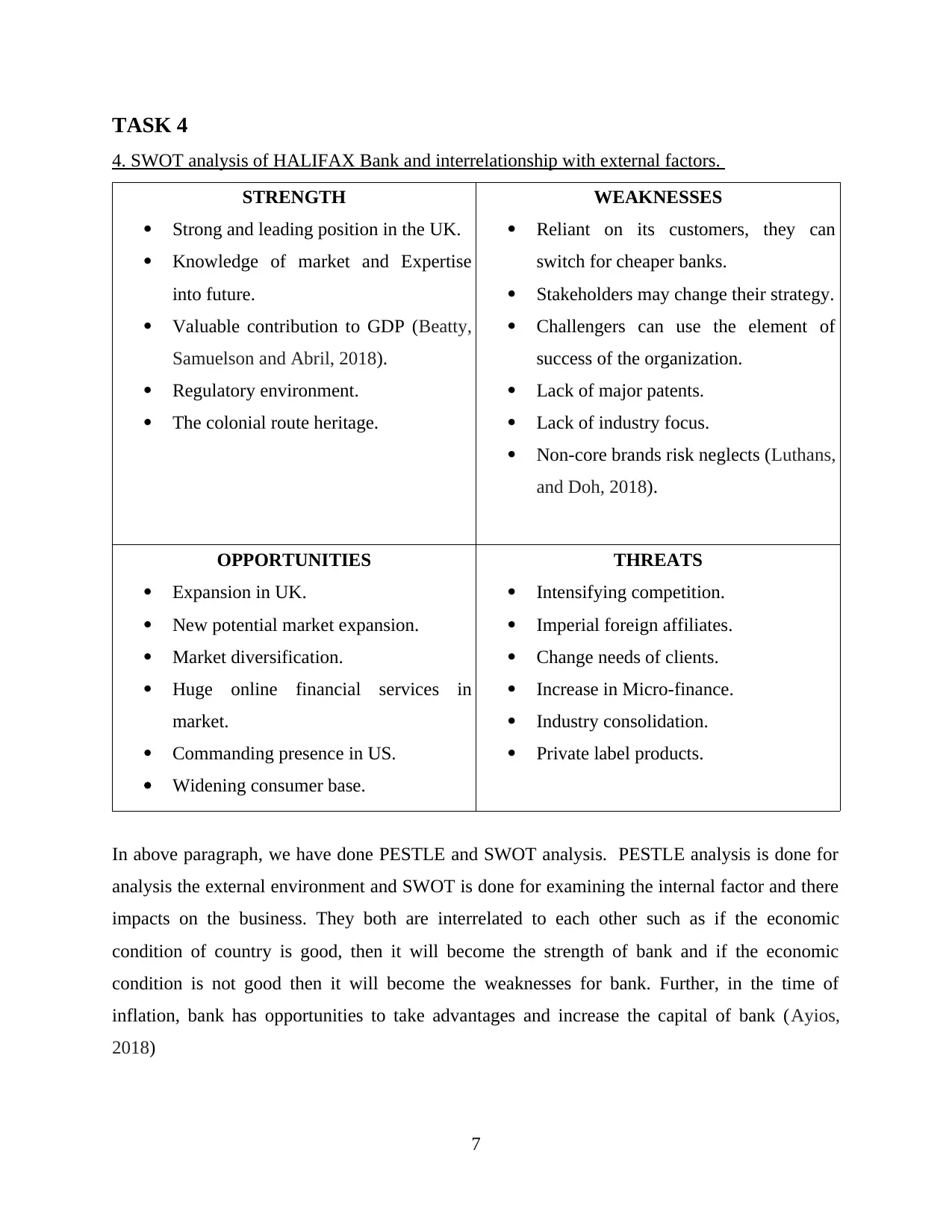
TASK 4
4. SWOT analysis of HALIFAX Bank and interrelationship with external factors.
STRENGTH
Strong and leading position in the UK.
Knowledge of market and Expertise
into future.
Valuable contribution to GDP (Beatty,
Samuelson and Abril, 2018).
Regulatory environment.
The colonial route heritage.
WEAKNESSES
Reliant on its customers, they can
switch for cheaper banks.
Stakeholders may change their strategy.
Challengers can use the element of
success of the organization.
Lack of major patents.
Lack of industry focus.
Non-core brands risk neglects (Luthans,
and Doh, 2018).
OPPORTUNITIES
Expansion in UK.
New potential market expansion.
Market diversification.
Huge online financial services in
market.
Commanding presence in US.
Widening consumer base.
THREATS
Intensifying competition.
Imperial foreign affiliates.
Change needs of clients.
Increase in Micro-finance.
Industry consolidation.
Private label products.
In above paragraph, we have done PESTLE and SWOT analysis. PESTLE analysis is done for
analysis the external environment and SWOT is done for examining the internal factor and there
impacts on the business. They both are interrelated to each other such as if the economic
condition of country is good, then it will become the strength of bank and if the economic
condition is not good then it will become the weaknesses for bank. Further, in the time of
inflation, bank has opportunities to take advantages and increase the capital of bank (Ayios,
2018)
7
4. SWOT analysis of HALIFAX Bank and interrelationship with external factors.
STRENGTH
Strong and leading position in the UK.
Knowledge of market and Expertise
into future.
Valuable contribution to GDP (Beatty,
Samuelson and Abril, 2018).
Regulatory environment.
The colonial route heritage.
WEAKNESSES
Reliant on its customers, they can
switch for cheaper banks.
Stakeholders may change their strategy.
Challengers can use the element of
success of the organization.
Lack of major patents.
Lack of industry focus.
Non-core brands risk neglects (Luthans,
and Doh, 2018).
OPPORTUNITIES
Expansion in UK.
New potential market expansion.
Market diversification.
Huge online financial services in
market.
Commanding presence in US.
Widening consumer base.
THREATS
Intensifying competition.
Imperial foreign affiliates.
Change needs of clients.
Increase in Micro-finance.
Industry consolidation.
Private label products.
In above paragraph, we have done PESTLE and SWOT analysis. PESTLE analysis is done for
analysis the external environment and SWOT is done for examining the internal factor and there
impacts on the business. They both are interrelated to each other such as if the economic
condition of country is good, then it will become the strength of bank and if the economic
condition is not good then it will become the weaknesses for bank. Further, in the time of
inflation, bank has opportunities to take advantages and increase the capital of bank (Ayios,
2018)
7
⊘ This is a preview!⊘
Do you want full access?
Subscribe today to unlock all pages.
Trusted by 1+ million students worldwide
CONCLUSION
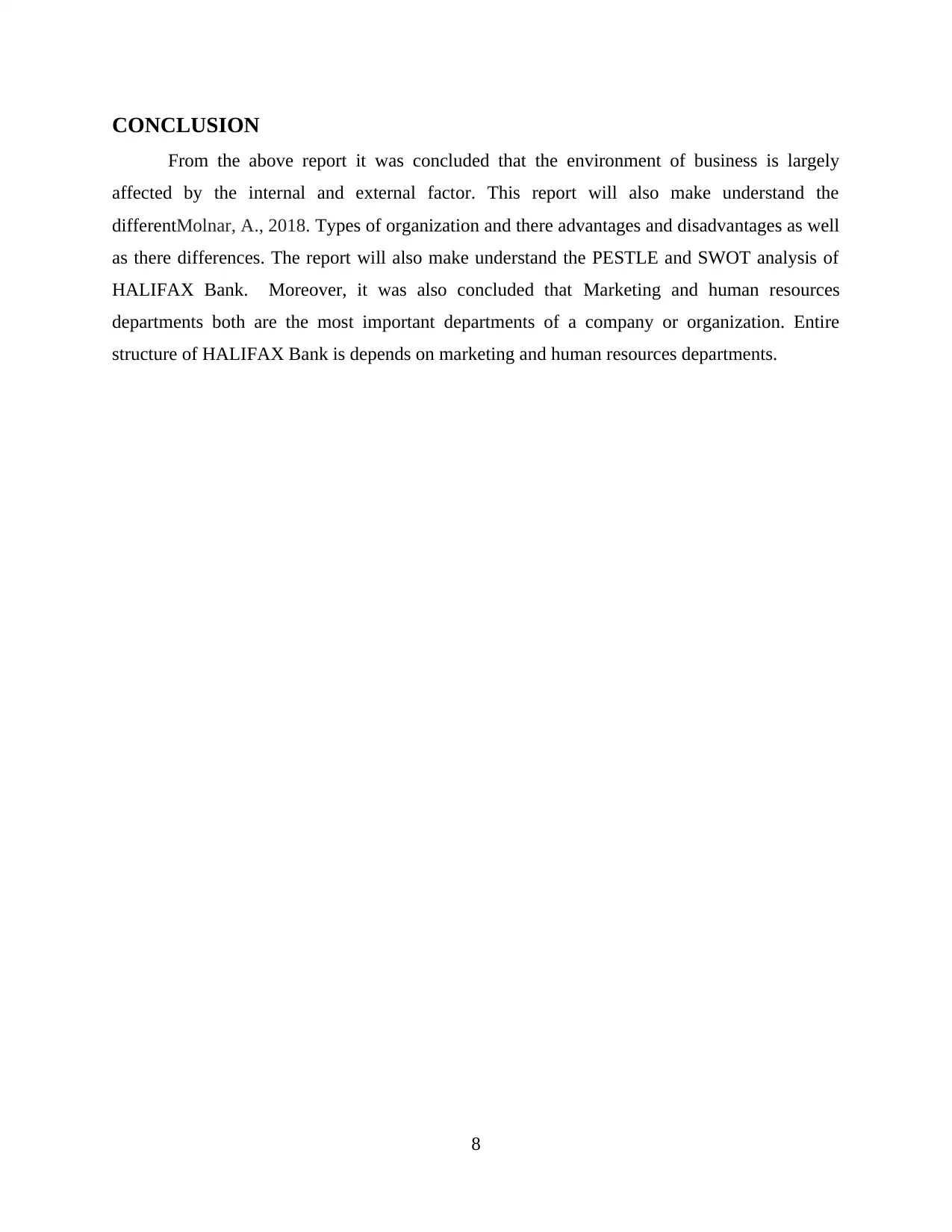
From the above report it was concluded that the environment of business is largely
affected by the internal and external factor. This report will also make understand the
differentMolnar, A., 2018. Types of organization and there advantages and disadvantages as well
as there differences. The report will also make understand the PESTLE and SWOT analysis of
HALIFAX Bank. Moreover, it was also concluded that Marketing and human resources
departments both are the most important departments of a company or organization. Entire
structure of HALIFAX Bank is depends on marketing and human resources departments.
8
From the above report it was concluded that the environment of business is largely
affected by the internal and external factor. This report will also make understand the
differentMolnar, A., 2018. Types of organization and there advantages and disadvantages as well
as there differences. The report will also make understand the PESTLE and SWOT analysis of
HALIFAX Bank. Moreover, it was also concluded that Marketing and human resources
departments both are the most important departments of a company or organization. Entire
structure of HALIFAX Bank is depends on marketing and human resources departments.
8
Paraphrase This Document
Need a fresh take? Get an instant paraphrase of this document with our AI Paraphraser
REFERENCES
Books and Journals
Ayios, A., 2018. Trust and Western-Russian business relationships. Routledge.
Beatty, J.F., Samuelson, S.S. and Abril, P.S., 2018. Business law and the legal environment.
Cengage Learning.
Begg, K., van der Woerd, F. and Levy, D. eds., 2018. The business of climate change:
Corporate responses to Kyoto. Routledge.
Gunasekaran, A. and et.al, 2018. Agile manufacturing practices: the role of big data and
business analytics with multiple case studies. International Journal of Production
Research. 56(1-2). pp.385-397.
Kopnina, H. and Blewitt, J., 2018. Sustainable business: Key issues. Routledge.
Luthans, F. and Doh, J.P., 2018. International management: Culture, strategy, and behavior.
McGraw-Hill.
Molnar, A., 2018. Giving kids the business: The commercialization of America's schools.
Routledge.
Namvar, M. and et.al, 2018. Simplifying sensemaking: concept, process, strengths,
shortcomings, and ways forward for information systems in contemporary business
environments. Australasian journal of information systems. 22.
Ramadan, H.I.M. and Ahmad, S.B., 2018. The impact of business environment on performance
of manufacturing SMEs in Palestine: The empirical evidence. Asian Journal of
Multidisciplinary Studies. 6(2).
Solodilova, N.Z., Malikov, R.I. and Grishin, K.Y., 2018. Potential for development and
limitations of regional business environment. R-Economy. 1(2).
9
Books and Journals
Ayios, A., 2018. Trust and Western-Russian business relationships. Routledge.
Beatty, J.F., Samuelson, S.S. and Abril, P.S., 2018. Business law and the legal environment.
Cengage Learning.
Begg, K., van der Woerd, F. and Levy, D. eds., 2018. The business of climate change:
Corporate responses to Kyoto. Routledge.
Gunasekaran, A. and et.al, 2018. Agile manufacturing practices: the role of big data and
business analytics with multiple case studies. International Journal of Production
Research. 56(1-2). pp.385-397.
Kopnina, H. and Blewitt, J., 2018. Sustainable business: Key issues. Routledge.
Luthans, F. and Doh, J.P., 2018. International management: Culture, strategy, and behavior.
McGraw-Hill.
Molnar, A., 2018. Giving kids the business: The commercialization of America's schools.
Routledge.
Namvar, M. and et.al, 2018. Simplifying sensemaking: concept, process, strengths,
shortcomings, and ways forward for information systems in contemporary business
environments. Australasian journal of information systems. 22.
Ramadan, H.I.M. and Ahmad, S.B., 2018. The impact of business environment on performance
of manufacturing SMEs in Palestine: The empirical evidence. Asian Journal of
Multidisciplinary Studies. 6(2).
Solodilova, N.Z., Malikov, R.I. and Grishin, K.Y., 2018. Potential for development and
limitations of regional business environment. R-Economy. 1(2).
9

1 out of 11


Related Documents


Your All-in-One AI-Powered Toolkit for Academic Success.
+13062052269
info@desklib.com
Available 24*7 on WhatsApp / Email
![[object Object]](/_next/static/media/star-bottom.7253800d.svg)
Unlock your academic potential
Copyright © 2020–2026 A2Z Services. All Rights Reserved. Developed and managed by ZUCOL.