NatWest PLC: Business Environment, SWOT, and Organizational Report
VerifiedAdded on 2020/07/23
|21
|4462
|473
Report
AI Summary
This report delves into the multifaceted realm of the business environment, providing a comprehensive analysis of various organizational structures, including private, public, and charity entities. It meticulously examines the pros and cons associated with each type, considering factors such as scope, size, structure, and objectives. Furthermore, the report dissects the different departments within an organization and their intricate interrelationships. A significant portion is dedicated to analyzing the macro-environment, utilizing tools like SWOT analysis to assess its impact on NatWest PLC, a leading international bank. The report aims to provide a holistic understanding of the factors that influence business operations, decision-making, and overall performance within the dynamic global landscape. The report covers topics such as different types of organizations, their advantages and disadvantages, and an in-depth analysis of NatWest using SWOT analysis.
Business and Business
Environment
Environment

Paraphrase This Document
Need a fresh take? Get an instant paraphrase of this document with our AI Paraphraser
Table of Contents
INTRODUCTION...........................................................................................................................1
TASK 1............................................................................................................................................1
P1 Different type of the organisation.....................................................................................1
P2 Pros and cons of the different types of the organisation with their scope, size, structure and
objective. ...............................................................................................................................2
TASK 2............................................................................................................................................6
2.1 Different departments of the organisation with their inter-relationship and their operation.
................................................................................................................................................6
TASK 3............................................................................................................................................6
3.1 Analysis of macro environment and their impact on the NATWEST..............................6
TASK 4............................................................................................................................................9
4.1 SWOT analysis of the NatWest........................................................................................9
CONCLUSION..............................................................................................................................10
REFERENCES..............................................................................................................................11
INTRODUCTION...........................................................................................................................1
TASK 1............................................................................................................................................1
P1 Different type of the organisation.....................................................................................1
P2 Pros and cons of the different types of the organisation with their scope, size, structure and
objective. ...............................................................................................................................2
TASK 2............................................................................................................................................6
2.1 Different departments of the organisation with their inter-relationship and their operation.
................................................................................................................................................6
TASK 3............................................................................................................................................6
3.1 Analysis of macro environment and their impact on the NATWEST..............................6
TASK 4............................................................................................................................................9
4.1 SWOT analysis of the NatWest........................................................................................9
CONCLUSION..............................................................................................................................10
REFERENCES..............................................................................................................................11
INTRODUCTION
Business environment is the sum total of all the internal and external that can affect the
organisation operations, decision-making, profitability and productivity. There are various external as
well as internal factors where internal includes organisation culture, value system, organisation
structure, human resources, corporate culture etc. and external factors includes political, social,
technological, economical etc. for this report, NatWest PLC have been selected which is more than
44000 office in the world and world's leading international bank. The report includes different types
of organisation such as private, public and charity as well as it includes different department and their
inter-relationship between different organisation. SWOT and Pestle analysis is also made in this
report which help to find internal and external factors that can affect the NatWest.
TASK 1
P1 Different type of the organisation.
In the existing business environment, there are different type of organisations operate for the
different purpose. On the basis of their nature, business operation and objective, these are categorised
into several categories, are as follows:
Private organisation: Private organisation is defined as the business entities which is owned and
managed by the private players or investors. The key purpose of the private organisation is to earn
profit from the different economic and commercial activities. All the shareholders and owners avail
all the profit earned by the company (Aguilar, 2017). There are different type of private owned
organisation exist that are partnership, sole proprietorship and co-operation. There are different
purpose of the organisation and on that purpose, they are categories such as the aim of sole
proprietorship is to serve intense profits to the single person that is owner of the company. Whereas
in the partnership firm, all the profits are earned and distributed to the partners. And in the
corporation organisation, the revenue is earned so that they can able to provide return to their
shareholders. The different private sector organisation in the UK are Prima, Tesco, Marks and
Spencer.
Public organisation: It is also known as the governmental organisation which is directly owned and
managed by the local authorities. The key objective of these firm is to serve well being and benefits
for the society. They generally work so that they can help society in order to sustain in long run not to
earn economic benefits and profits but they. The span and size of the activities of this government
1
Business environment is the sum total of all the internal and external that can affect the
organisation operations, decision-making, profitability and productivity. There are various external as
well as internal factors where internal includes organisation culture, value system, organisation
structure, human resources, corporate culture etc. and external factors includes political, social,
technological, economical etc. for this report, NatWest PLC have been selected which is more than
44000 office in the world and world's leading international bank. The report includes different types
of organisation such as private, public and charity as well as it includes different department and their
inter-relationship between different organisation. SWOT and Pestle analysis is also made in this
report which help to find internal and external factors that can affect the NatWest.
TASK 1
P1 Different type of the organisation.
In the existing business environment, there are different type of organisations operate for the
different purpose. On the basis of their nature, business operation and objective, these are categorised
into several categories, are as follows:
Private organisation: Private organisation is defined as the business entities which is owned and
managed by the private players or investors. The key purpose of the private organisation is to earn
profit from the different economic and commercial activities. All the shareholders and owners avail
all the profit earned by the company (Aguilar, 2017). There are different type of private owned
organisation exist that are partnership, sole proprietorship and co-operation. There are different
purpose of the organisation and on that purpose, they are categories such as the aim of sole
proprietorship is to serve intense profits to the single person that is owner of the company. Whereas
in the partnership firm, all the profits are earned and distributed to the partners. And in the
corporation organisation, the revenue is earned so that they can able to provide return to their
shareholders. The different private sector organisation in the UK are Prima, Tesco, Marks and
Spencer.
Public organisation: It is also known as the governmental organisation which is directly owned and
managed by the local authorities. The key objective of these firm is to serve well being and benefits
for the society. They generally work so that they can help society in order to sustain in long run not to
earn economic benefits and profits but they. The span and size of the activities of this government
1
⊘ This is a preview!⊘
Do you want full access?
Subscribe today to unlock all pages.

Trusted by 1+ million students worldwide
business is so broad and they are directed to the serve non-economic benefits to the society. These
types of the firm are made with the different means such as formed by the direct administration
function which the help of tax paid by the local residents, other example is state owned enterprise
which is run on the basis of expenditure of the national and state government. As well as there is
another form of public organisation that is public outsourcing where public and private venture come
together to that they can able to share liabilities and assets of their related firm (Davis and
Blomstrom, 2016). They key aim of such type of company is to diversify the project and take
maximum benefits of the organisation. Such as National health services, which is the renown public
sector firm which work for the growth of the society and enhancing the community health in the most
effective manner. NHS is formed with the purpose of better availability of the appropriate health
services to every class. The good example of public organisation are London's Olympic Stadium,
World Health Organization (WHO), Sydney Harbour Tunnel, New York's Central Park, Hong Kong
Disneyland.
Charity: It is the specific type of the non-profit organisation, and they do not work to earn any type
of profit from their operation. The sole common objective of this type of company is to ensure
society wellbeing and public interest. The example of the charity firm is Christian Aid which is
introduced with the interest to change the world swiftly (Kennerley and Neely, 2013). The key
objective of this organisation is to make the world fell comfortable that every individual can become
free from the poverty problem. They do not expect any profits and benefits from the firm but they
continue their activities for the moral and social cause. Well known charity's organisation includes
Oxfam, Red Cross and Red Crescent and Medecins Sans Frontiers
P2 Pros and cons of the different types of the organisation with their scope, size, structure and
objective.
Private company
Pros
These type of organisations are more attractive and have large number of the potential
customers.
It the company want to sell their asses or whole company, in that case there are large numbers
of buyers (Buchholz, 2016).
2
types of the firm are made with the different means such as formed by the direct administration
function which the help of tax paid by the local residents, other example is state owned enterprise
which is run on the basis of expenditure of the national and state government. As well as there is
another form of public organisation that is public outsourcing where public and private venture come
together to that they can able to share liabilities and assets of their related firm (Davis and
Blomstrom, 2016). They key aim of such type of company is to diversify the project and take
maximum benefits of the organisation. Such as National health services, which is the renown public
sector firm which work for the growth of the society and enhancing the community health in the most
effective manner. NHS is formed with the purpose of better availability of the appropriate health
services to every class. The good example of public organisation are London's Olympic Stadium,
World Health Organization (WHO), Sydney Harbour Tunnel, New York's Central Park, Hong Kong
Disneyland.
Charity: It is the specific type of the non-profit organisation, and they do not work to earn any type
of profit from their operation. The sole common objective of this type of company is to ensure
society wellbeing and public interest. The example of the charity firm is Christian Aid which is
introduced with the interest to change the world swiftly (Kennerley and Neely, 2013). The key
objective of this organisation is to make the world fell comfortable that every individual can become
free from the poverty problem. They do not expect any profits and benefits from the firm but they
continue their activities for the moral and social cause. Well known charity's organisation includes
Oxfam, Red Cross and Red Crescent and Medecins Sans Frontiers
P2 Pros and cons of the different types of the organisation with their scope, size, structure and
objective.
Private company
Pros
These type of organisations are more attractive and have large number of the potential
customers.
It the company want to sell their asses or whole company, in that case there are large numbers
of buyers (Buchholz, 2016).
2
Paraphrase This Document
Need a fresh take? Get an instant paraphrase of this document with our AI Paraphraser
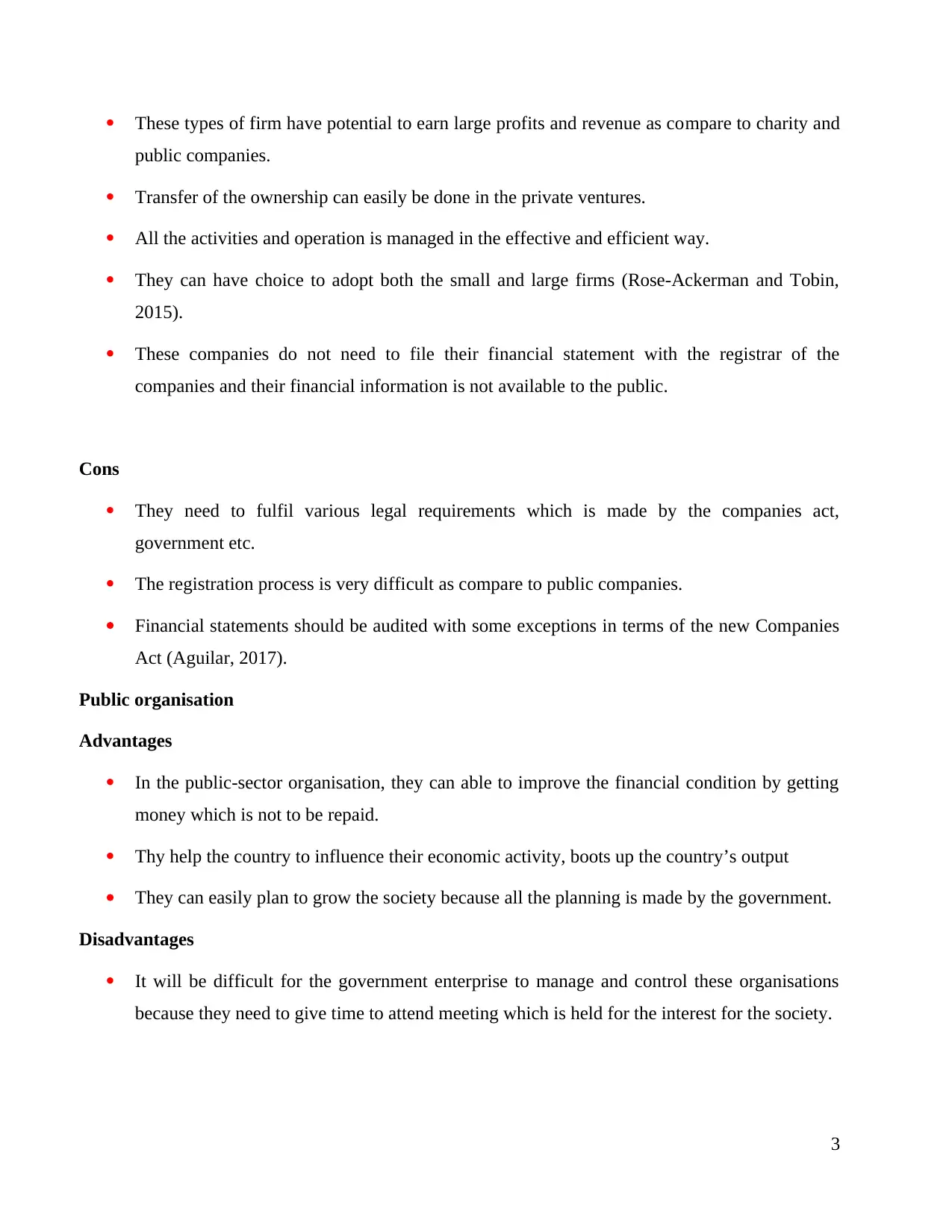
These types of firm have potential to earn large profits and revenue as compare to charity and
public companies.
Transfer of the ownership can easily be done in the private ventures.
All the activities and operation is managed in the effective and efficient way.
They can have choice to adopt both the small and large firms (Rose-Ackerman and Tobin,
2015).
These companies do not need to file their financial statement with the registrar of the
companies and their financial information is not available to the public.
Cons
They need to fulfil various legal requirements which is made by the companies act,
government etc.
The registration process is very difficult as compare to public companies.
Financial statements should be audited with some exceptions in terms of the new Companies
Act (Aguilar, 2017).
Public organisation
Advantages
In the public-sector organisation, they can able to improve the financial condition by getting
money which is not to be repaid.
Thy help the country to influence their economic activity, boots up the country’s output
They can easily plan to grow the society because all the planning is made by the government.
Disadvantages
It will be difficult for the government enterprise to manage and control these organisations
because they need to give time to attend meeting which is held for the interest for the society.
3
public companies.
Transfer of the ownership can easily be done in the private ventures.
All the activities and operation is managed in the effective and efficient way.
They can have choice to adopt both the small and large firms (Rose-Ackerman and Tobin,
2015).
These companies do not need to file their financial statement with the registrar of the
companies and their financial information is not available to the public.
Cons
They need to fulfil various legal requirements which is made by the companies act,
government etc.
The registration process is very difficult as compare to public companies.
Financial statements should be audited with some exceptions in terms of the new Companies
Act (Aguilar, 2017).
Public organisation
Advantages
In the public-sector organisation, they can able to improve the financial condition by getting
money which is not to be repaid.
Thy help the country to influence their economic activity, boots up the country’s output
They can easily plan to grow the society because all the planning is made by the government.
Disadvantages
It will be difficult for the government enterprise to manage and control these organisations
because they need to give time to attend meeting which is held for the interest for the society.
3
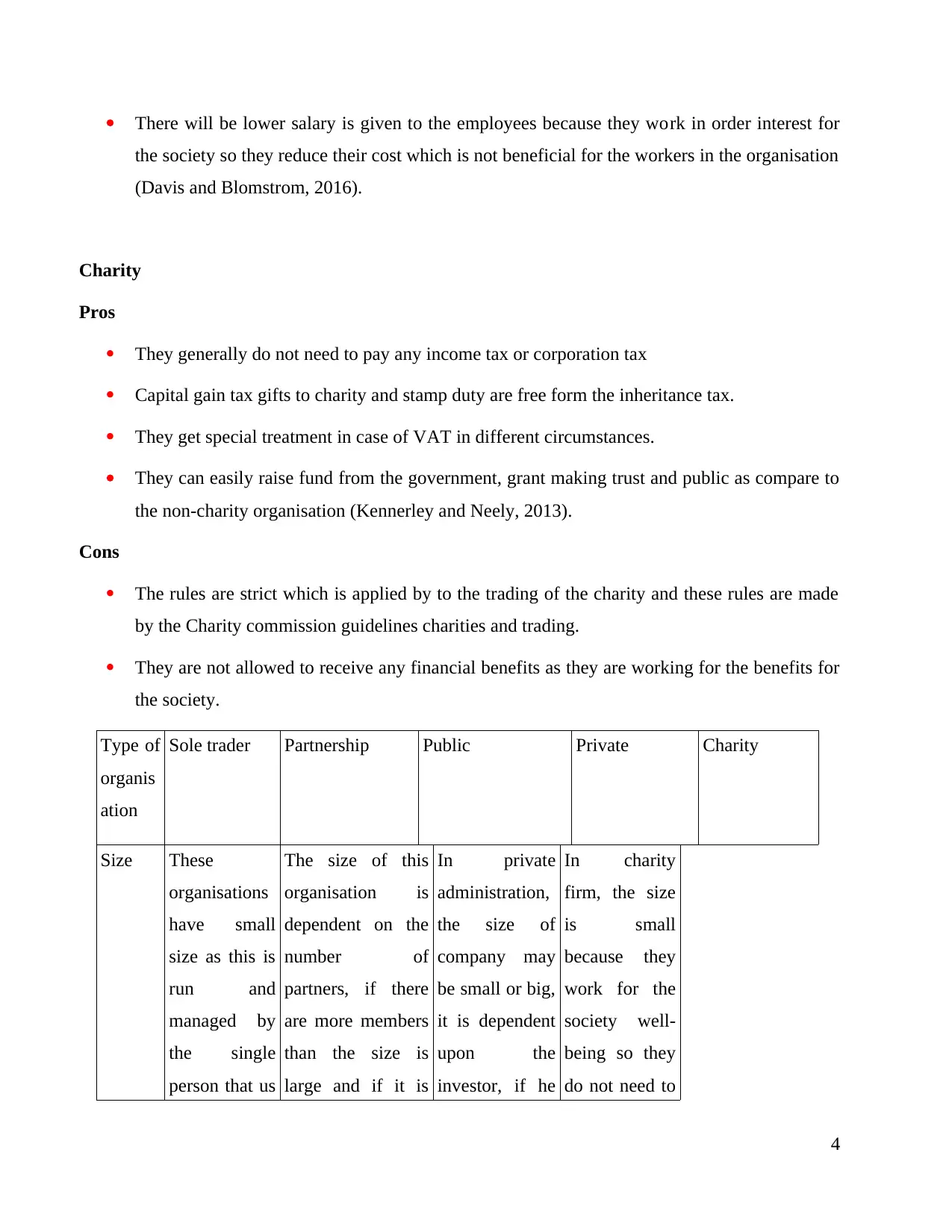
There will be lower salary is given to the employees because they work in order interest for
the society so they reduce their cost which is not beneficial for the workers in the organisation
(Davis and Blomstrom, 2016).
Charity
Pros
They generally do not need to pay any income tax or corporation tax
Capital gain tax gifts to charity and stamp duty are free form the inheritance tax.
They get special treatment in case of VAT in different circumstances.
They can easily raise fund from the government, grant making trust and public as compare to
the non-charity organisation (Kennerley and Neely, 2013).
Cons
The rules are strict which is applied by to the trading of the charity and these rules are made
by the Charity commission guidelines charities and trading.
They are not allowed to receive any financial benefits as they are working for the benefits for
the society.
Type of
organis
ation
Sole trader Partnership Public Private Charity
Size These
organisations
have small
size as this is
run and
managed by
the single
person that us
The size of this
organisation is
dependent on the
number of
partners, if there
are more members
than the size is
large and if it is
In private
administration,
the size of
company may
be small or big,
it is dependent
upon the
investor, if he
In charity
firm, the size
is small
because they
work for the
society well-
being so they
do not need to
4
the society so they reduce their cost which is not beneficial for the workers in the organisation
(Davis and Blomstrom, 2016).
Charity
Pros
They generally do not need to pay any income tax or corporation tax
Capital gain tax gifts to charity and stamp duty are free form the inheritance tax.
They get special treatment in case of VAT in different circumstances.
They can easily raise fund from the government, grant making trust and public as compare to
the non-charity organisation (Kennerley and Neely, 2013).
Cons
The rules are strict which is applied by to the trading of the charity and these rules are made
by the Charity commission guidelines charities and trading.
They are not allowed to receive any financial benefits as they are working for the benefits for
the society.
Type of
organis
ation
Sole trader Partnership Public Private Charity
Size These
organisations
have small
size as this is
run and
managed by
the single
person that us
The size of this
organisation is
dependent on the
number of
partners, if there
are more members
than the size is
large and if it is
In private
administration,
the size of
company may
be small or big,
it is dependent
upon the
investor, if he
In charity
firm, the size
is small
because they
work for the
society well-
being so they
do not need to
4
⊘ This is a preview!⊘
Do you want full access?
Subscribe today to unlock all pages.
Trusted by 1+ million students worldwide
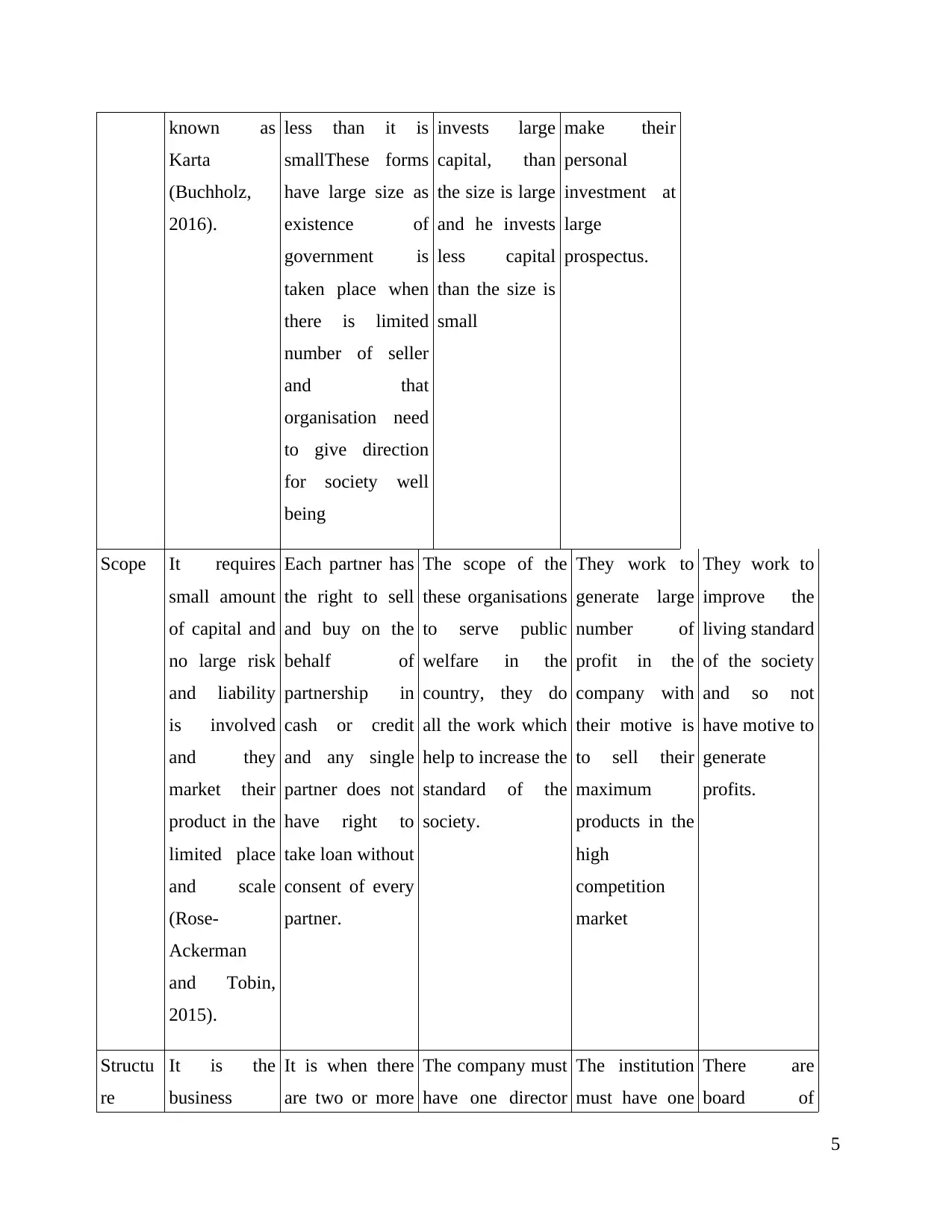
known as
Karta
(Buchholz,
2016).
less than it is
smallThese forms
have large size as
existence of
government is
taken place when
there is limited
number of seller
and that
organisation need
to give direction
for society well
being
invests large
capital, than
the size is large
and he invests
less capital
than the size is
small
make their
personal
investment at
large
prospectus.
Scope It requires
small amount
of capital and
no large risk
and liability
is involved
and they
market their
product in the
limited place
and scale
(Rose-
Ackerman
and Tobin,
2015).
Each partner has
the right to sell
and buy on the
behalf of
partnership in
cash or credit
and any single
partner does not
have right to
take loan without
consent of every
partner.
The scope of the
these organisations
to serve public
welfare in the
country, they do
all the work which
help to increase the
standard of the
society.
They work to
generate large
number of
profit in the
company with
their motive is
to sell their
maximum
products in the
high
competition
market
They work to
improve the
living standard
of the society
and so not
have motive to
generate
profits.
Structu
re
It is the
business
It is when there
are two or more
The company must
have one director
The institution
must have one
There are
board of
5
Karta
(Buchholz,
2016).
less than it is
smallThese forms
have large size as
existence of
government is
taken place when
there is limited
number of seller
and that
organisation need
to give direction
for society well
being
invests large
capital, than
the size is large
and he invests
less capital
than the size is
small
make their
personal
investment at
large
prospectus.
Scope It requires
small amount
of capital and
no large risk
and liability
is involved
and they
market their
product in the
limited place
and scale
(Rose-
Ackerman
and Tobin,
2015).
Each partner has
the right to sell
and buy on the
behalf of
partnership in
cash or credit
and any single
partner does not
have right to
take loan without
consent of every
partner.
The scope of the
these organisations
to serve public
welfare in the
country, they do
all the work which
help to increase the
standard of the
society.
They work to
generate large
number of
profit in the
company with
their motive is
to sell their
maximum
products in the
high
competition
market
They work to
improve the
living standard
of the society
and so not
have motive to
generate
profits.
Structu
re
It is the
business
It is when there
are two or more
The company must
have one director
The institution
must have one
There are
board of
5
Paraphrase This Document
Need a fresh take? Get an instant paraphrase of this document with our AI Paraphraser
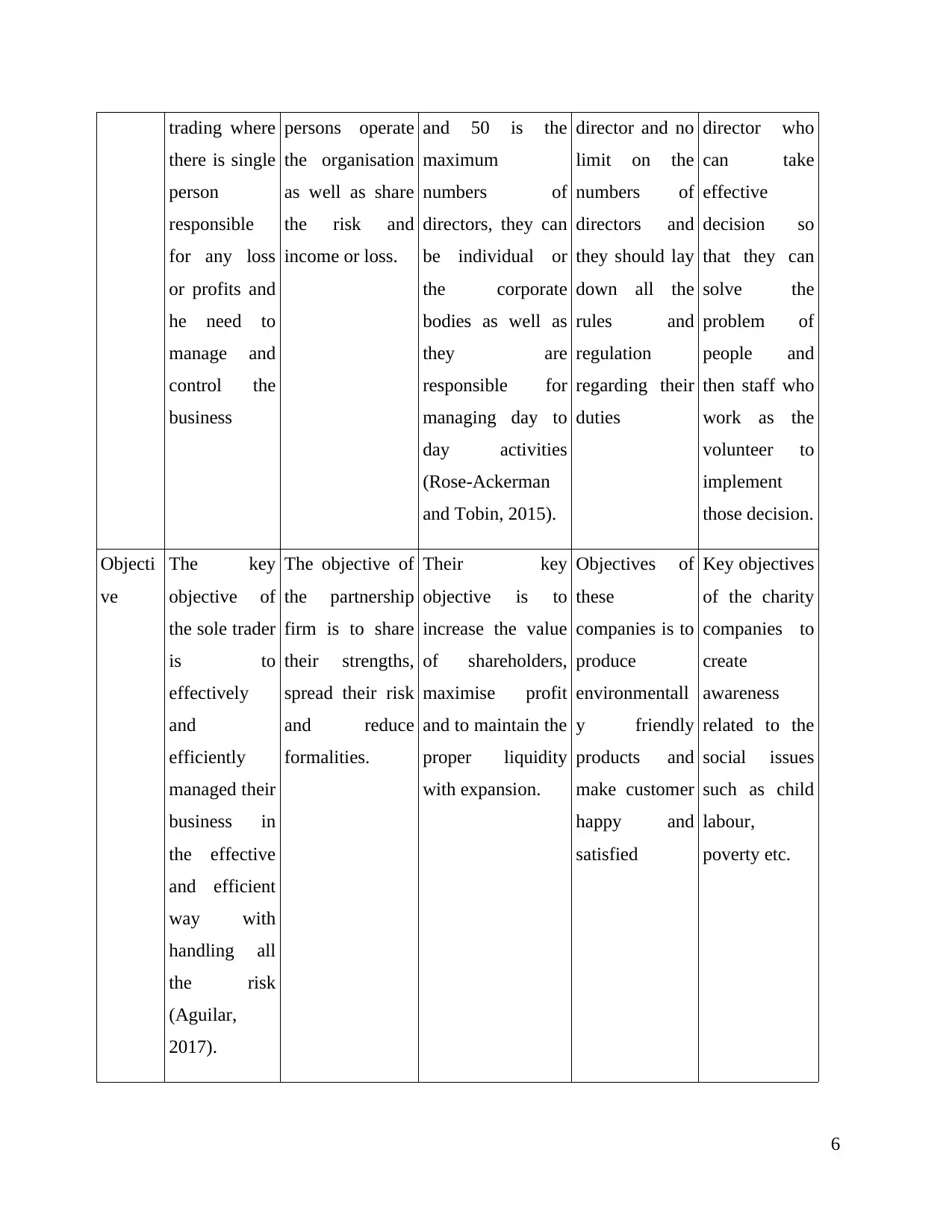
trading where
there is single
person
responsible
for any loss
or profits and
he need to
manage and
control the
business
persons operate
the organisation
as well as share
the risk and
income or loss.
and 50 is the
maximum
numbers of
directors, they can
be individual or
the corporate
bodies as well as
they are
responsible for
managing day to
day activities
(Rose-Ackerman
and Tobin, 2015).
director and no
limit on the
numbers of
directors and
they should lay
down all the
rules and
regulation
regarding their
duties
director who
can take
effective
decision so
that they can
solve the
problem of
people and
then staff who
work as the
volunteer to
implement
those decision.
Objecti
ve
The key
objective of
the sole trader
is to
effectively
and
efficiently
managed their
business in
the effective
and efficient
way with
handling all
the risk
(Aguilar,
2017).
The objective of
the partnership
firm is to share
their strengths,
spread their risk
and reduce
formalities.
Their key
objective is to
increase the value
of shareholders,
maximise profit
and to maintain the
proper liquidity
with expansion.
Objectives of
these
companies is to
produce
environmentall
y friendly
products and
make customer
happy and
satisfied
Key objectives
of the charity
companies to
create
awareness
related to the
social issues
such as child
labour,
poverty etc.
6
there is single
person
responsible
for any loss
or profits and
he need to
manage and
control the
business
persons operate
the organisation
as well as share
the risk and
income or loss.
and 50 is the
maximum
numbers of
directors, they can
be individual or
the corporate
bodies as well as
they are
responsible for
managing day to
day activities
(Rose-Ackerman
and Tobin, 2015).
director and no
limit on the
numbers of
directors and
they should lay
down all the
rules and
regulation
regarding their
duties
director who
can take
effective
decision so
that they can
solve the
problem of
people and
then staff who
work as the
volunteer to
implement
those decision.
Objecti
ve
The key
objective of
the sole trader
is to
effectively
and
efficiently
managed their
business in
the effective
and efficient
way with
handling all
the risk
(Aguilar,
2017).
The objective of
the partnership
firm is to share
their strengths,
spread their risk
and reduce
formalities.
Their key
objective is to
increase the value
of shareholders,
maximise profit
and to maintain the
proper liquidity
with expansion.
Objectives of
these
companies is to
produce
environmentall
y friendly
products and
make customer
happy and
satisfied
Key objectives
of the charity
companies to
create
awareness
related to the
social issues
such as child
labour,
poverty etc.
6
TASK 2
2.1 Different departments of the organisation with their inter-relationship and their operation.
The term organisational structure means deciding the framework of working in order to bring
the effectiveness in the profitability and productivity of the business. The operation of the NatWest is
distributed among the various departments such as human resource, marketing and finance etc. these
all are very essential for the growth survival of bank. The different structure in the organisation are
made in term to attainment of the objectives in the well proper manner. With the help of this all
department organisation find easy way to manage the task and operation of the business enterprise
activities (Kennerley and Neely, 2013). Each department has its own speciality in their particular
unit. The human resource department of the organisation focuses on the recruitment and selection
process. Their main objective is to find out the best suitable candidate for the business enterprise.
They also work as providing the best kind of training and development facility to their employees so
they perform will in order to perform the activities in the best manner.
The well trained employees bring the efficiency in the performance. In addition to this the
marketing department also plays main role growing the business activities. The selling activity of the
firm is overall dependent on the marketing department. The marketing play their role as identifying
the needs of the customer and aware them about the product and services in the market (Davis and
Blomstrom, 2016). They play key role in the success of the department. With the help of this the
financial services are reached to the customer. Moreover, the financial department of the company
helps in allocation the needs of the finance so that organisation activity can run properly without any
intervention. It helps in determining the financial requirement of the company. The well functions of
the organisation depends on the financial resources of the company. The one more department is here
which is also necessary in the terms to identify the need of customer and take various efforts in order
to full-fill them. Being, the bank it is essential to provide good services to customer service. With all
the above department the organisation have one more unit that is IT.
They work in the manner to managing all the computer and technical system. So it can be said
that if all department work in the proper manner than the organisational objective of the firm can
easily achieve. The main objective of the bank is to provide high qualified service to their customer.
The organisation undertake eh financial resources so that each function of the company can perform
well (Aguilar, 2017). All departmental activities are interrelated with each other. For example the
human resource department activities are engaged in the financial services, the main role of the
7
2.1 Different departments of the organisation with their inter-relationship and their operation.
The term organisational structure means deciding the framework of working in order to bring
the effectiveness in the profitability and productivity of the business. The operation of the NatWest is
distributed among the various departments such as human resource, marketing and finance etc. these
all are very essential for the growth survival of bank. The different structure in the organisation are
made in term to attainment of the objectives in the well proper manner. With the help of this all
department organisation find easy way to manage the task and operation of the business enterprise
activities (Kennerley and Neely, 2013). Each department has its own speciality in their particular
unit. The human resource department of the organisation focuses on the recruitment and selection
process. Their main objective is to find out the best suitable candidate for the business enterprise.
They also work as providing the best kind of training and development facility to their employees so
they perform will in order to perform the activities in the best manner.
The well trained employees bring the efficiency in the performance. In addition to this the
marketing department also plays main role growing the business activities. The selling activity of the
firm is overall dependent on the marketing department. The marketing play their role as identifying
the needs of the customer and aware them about the product and services in the market (Davis and
Blomstrom, 2016). They play key role in the success of the department. With the help of this the
financial services are reached to the customer. Moreover, the financial department of the company
helps in allocation the needs of the finance so that organisation activity can run properly without any
intervention. It helps in determining the financial requirement of the company. The well functions of
the organisation depends on the financial resources of the company. The one more department is here
which is also necessary in the terms to identify the need of customer and take various efforts in order
to full-fill them. Being, the bank it is essential to provide good services to customer service. With all
the above department the organisation have one more unit that is IT.
They work in the manner to managing all the computer and technical system. So it can be said
that if all department work in the proper manner than the organisational objective of the firm can
easily achieve. The main objective of the bank is to provide high qualified service to their customer.
The organisation undertake eh financial resources so that each function of the company can perform
well (Aguilar, 2017). All departmental activities are interrelated with each other. For example the
human resource department activities are engaged in the financial services, the main role of the
7
⊘ This is a preview!⊘
Do you want full access?
Subscribe today to unlock all pages.
Trusted by 1+ million students worldwide
marketing department is to make aware customer about their product and services. The HR
department work as recruiting the employees and assigns the suitable work to them. So there should
be division of each department so they can perform their activities in the effective and efficient
manner (Buchholz, 2016). With the help of this company can earn maximum productivity and
profitability.
Production: the production department is responsible for manufacturing the products and services
for the organisation. Production manager is responsible to allot the task to the employees in order to
fulfil the customers order. They are accountable for both quality and quantity of the products.
Products are the only basis by which organisation can satisfy the needs of consumer so production
department need to keep eye on every product they made so that they can achieve maximum standard
of quality
Marketing: They ate responsible to generating awareness in the mind of target market and they have
to generate leads so that they can convert the desire of customer into purchase decision. They need to
identify what customer need and then produce goods accordingly, after that they need to the set the
price while considering three factors cost, competitor and customer perceived value, further they
need to select appropriate distribution channel and marketing strategies to react at target market
Finance: They need to manage all the financial information of the organisation such as income and
expenses, loss or profit, assets and liabilities so that they can draw out conclusion that the
organisation is at loss or profit stage. They also prepare different types of budget so that the cost can
be reduced.
Human resources: They are responsible for managing the work force of organisation which may
include staffing, training, development, compensation, termination etc.
All the department are inter-related with each other and have some relationship such as
production department need to ask to the marketing department that what is the demand of the
customer and then produce the goods. They need finance department to prepare production budget
and human resource for producing goods. Whereas marketing department need production to produce
goods according to needs and wants of customers, finance one to prepare budget for marketing the
products and human resource to sell the products. Therefore, all the department of the company are
interrelated with each other.
8
department work as recruiting the employees and assigns the suitable work to them. So there should
be division of each department so they can perform their activities in the effective and efficient
manner (Buchholz, 2016). With the help of this company can earn maximum productivity and
profitability.
Production: the production department is responsible for manufacturing the products and services
for the organisation. Production manager is responsible to allot the task to the employees in order to
fulfil the customers order. They are accountable for both quality and quantity of the products.
Products are the only basis by which organisation can satisfy the needs of consumer so production
department need to keep eye on every product they made so that they can achieve maximum standard
of quality
Marketing: They ate responsible to generating awareness in the mind of target market and they have
to generate leads so that they can convert the desire of customer into purchase decision. They need to
identify what customer need and then produce goods accordingly, after that they need to the set the
price while considering three factors cost, competitor and customer perceived value, further they
need to select appropriate distribution channel and marketing strategies to react at target market
Finance: They need to manage all the financial information of the organisation such as income and
expenses, loss or profit, assets and liabilities so that they can draw out conclusion that the
organisation is at loss or profit stage. They also prepare different types of budget so that the cost can
be reduced.
Human resources: They are responsible for managing the work force of organisation which may
include staffing, training, development, compensation, termination etc.
All the department are inter-related with each other and have some relationship such as
production department need to ask to the marketing department that what is the demand of the
customer and then produce the goods. They need finance department to prepare production budget
and human resource for producing goods. Whereas marketing department need production to produce
goods according to needs and wants of customers, finance one to prepare budget for marketing the
products and human resource to sell the products. Therefore, all the department of the company are
interrelated with each other.
8
Paraphrase This Document
Need a fresh take? Get an instant paraphrase of this document with our AI Paraphraser
TASK 3
3.1 Analysis of macro environment and their impact on the NATWEST.
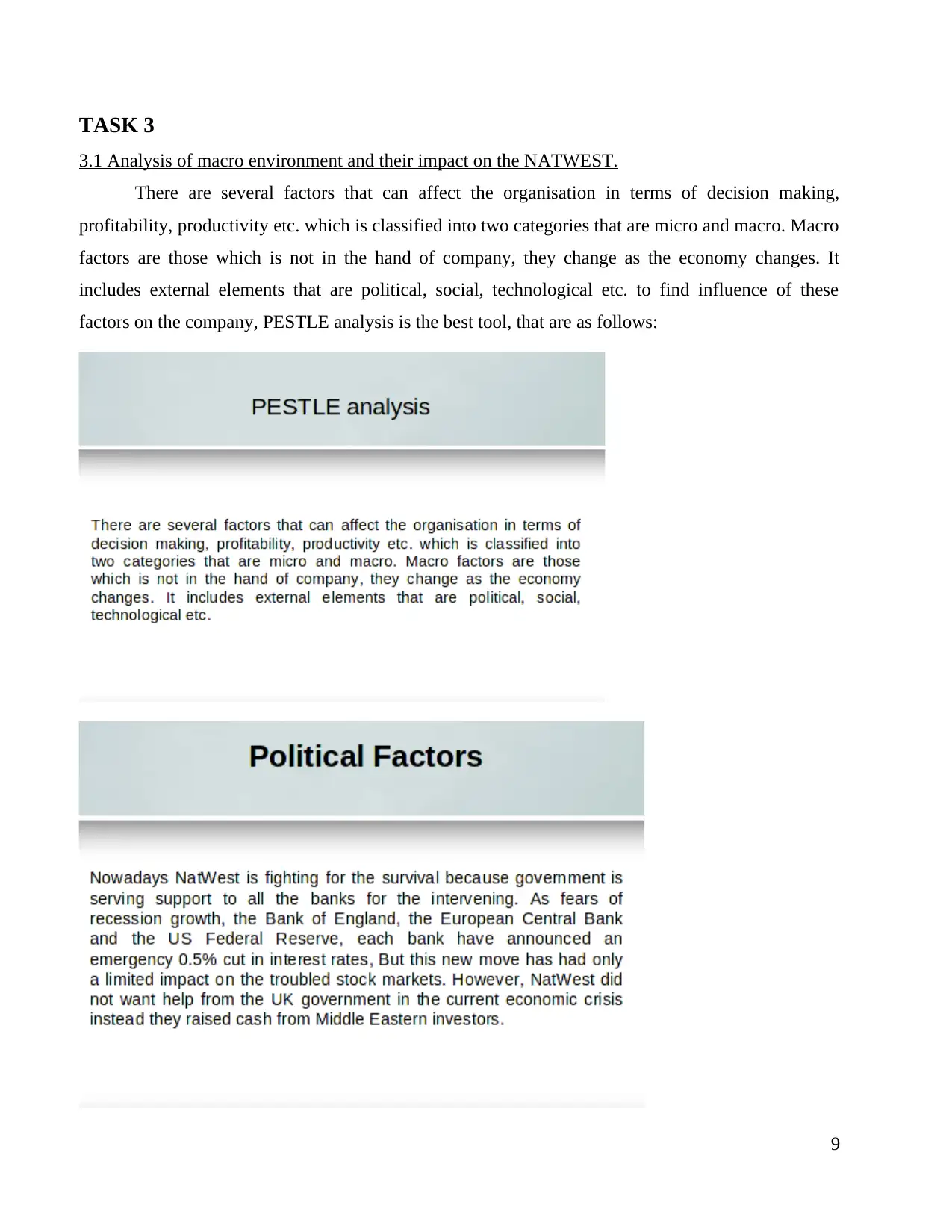
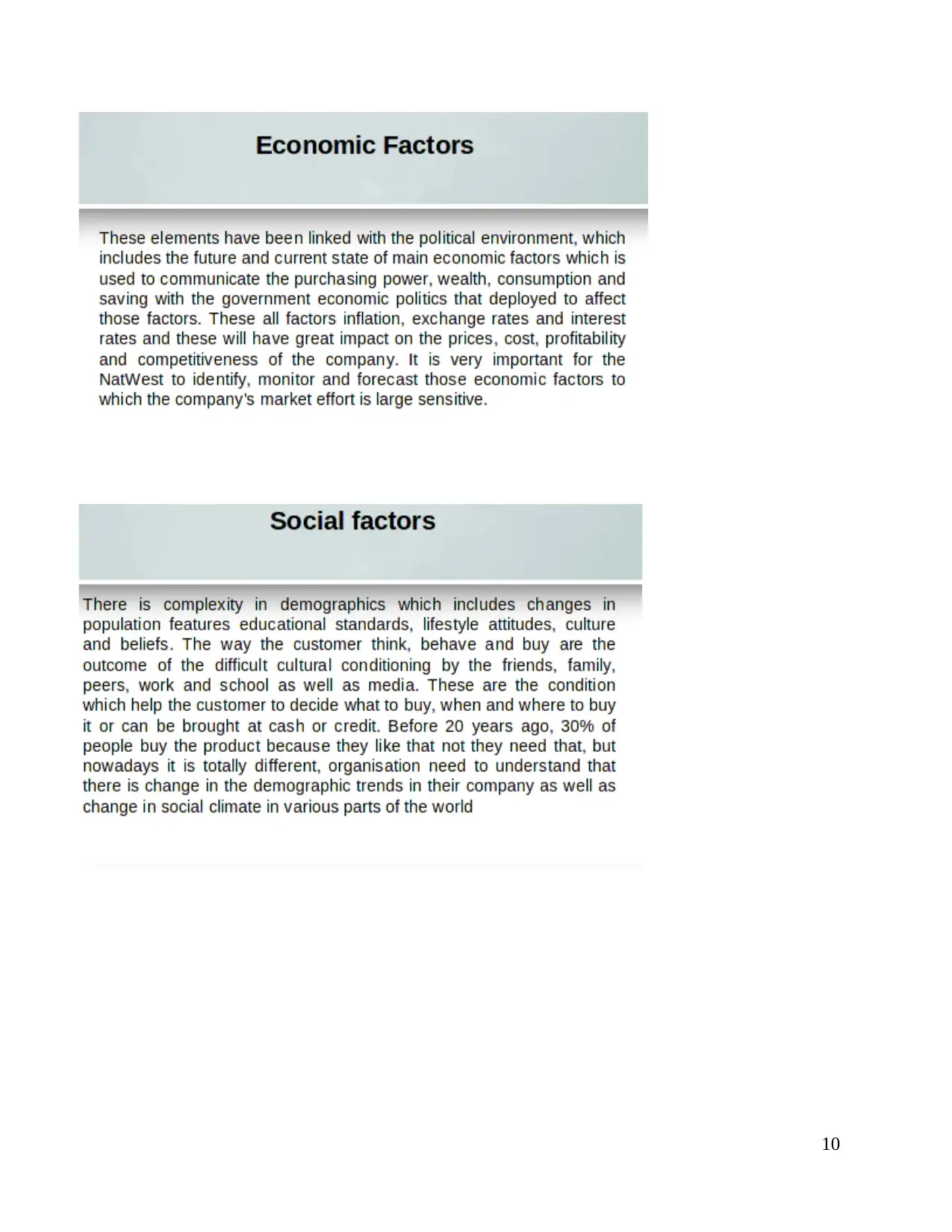
There are several factors that can affect the organisation in terms of decision making,
profitability, productivity etc. which is classified into two categories that are micro and macro. Macro
factors are those which is not in the hand of company, they change as the economy changes. It
includes external elements that are political, social, technological etc. to find influence of these
factors on the company, PESTLE analysis is the best tool, that are as follows:
9
3.1 Analysis of macro environment and their impact on the NATWEST.
There are several factors that can affect the organisation in terms of decision making,
profitability, productivity etc. which is classified into two categories that are micro and macro. Macro
factors are those which is not in the hand of company, they change as the economy changes. It
includes external elements that are political, social, technological etc. to find influence of these
factors on the company, PESTLE analysis is the best tool, that are as follows:
9
10
⊘ This is a preview!⊘
Do you want full access?
Subscribe today to unlock all pages.
Trusted by 1+ million students worldwide

1 out of 21


Related Documents


Your All-in-One AI-Powered Toolkit for Academic Success.
+13062052269
info@desklib.com
Available 24*7 on WhatsApp / Email
![[object Object]](/_next/static/media/star-bottom.7253800d.svg)
Unlock your academic potential
Copyright © 2020–2026 A2Z Services. All Rights Reserved. Developed and managed by ZUCOL.