Business Environment: Organizational Types, Analysis, and Structure
VerifiedAdded on 2020/12/10
|16
|4867
|63
Report
AI Summary
This report provides a comprehensive analysis of the business environment, encompassing various organizational types such as public, private, and volunteer sectors, along with different legal structures. It explores the size and scope of these organizations, differentiating between sole traders, partnerships, corporations, and limited companies. The report delves into the relationships between organizational functions and how they align with objectives and structures, including functional, divisional, hierarchical, and matrix structures. Furthermore, it examines the impact of the macro environment on business operations, offering internal and external analyses to identify strengths, weaknesses, opportunities, and threats. The report concludes by highlighting the interrelation between strengths and weaknesses and external macro factors, providing a holistic view of business operations within its environment.

BUSINESS AND BUSINESS
ENVIRONMENT
ENVIRONMENT

Paraphrase This Document
Need a fresh take? Get an instant paraphrase of this document with our AI Paraphraser
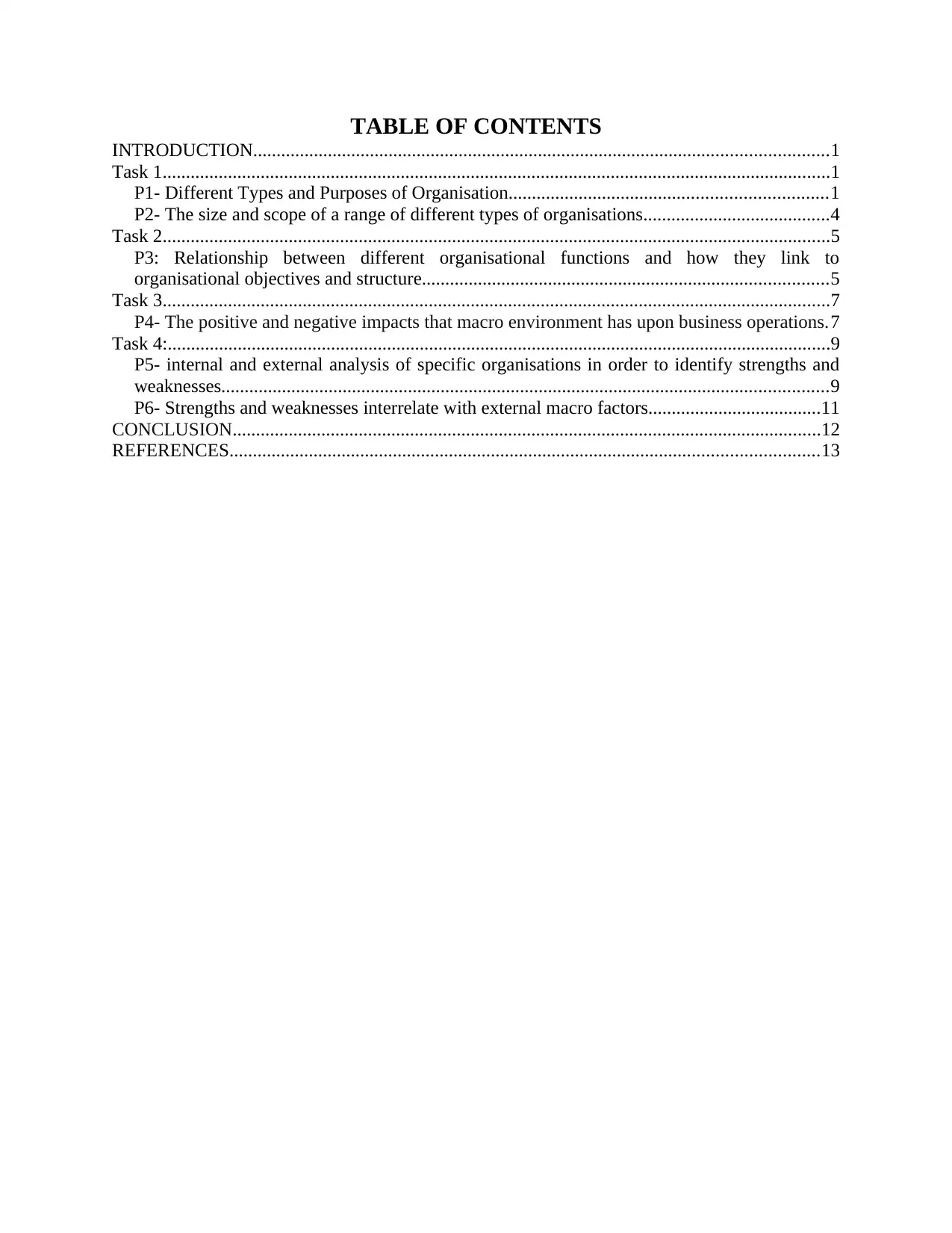
TABLE OF CONTENTS
INTRODUCTION...........................................................................................................................1
Task 1...............................................................................................................................................1
P1- Different Types and Purposes of Organisation....................................................................1
P2- The size and scope of a range of different types of organisations........................................4
Task 2...............................................................................................................................................5
P3: Relationship between different organisational functions and how they link to
organisational objectives and structure.......................................................................................5
Task 3...............................................................................................................................................7
P4- The positive and negative impacts that macro environment has upon business operations.7
Task 4:..............................................................................................................................................9
P5- internal and external analysis of specific organisations in order to identify strengths and
weaknesses..................................................................................................................................9
P6- Strengths and weaknesses interrelate with external macro factors.....................................11
CONCLUSION..............................................................................................................................12
REFERENCES..............................................................................................................................13
INTRODUCTION...........................................................................................................................1
Task 1...............................................................................................................................................1
P1- Different Types and Purposes of Organisation....................................................................1
P2- The size and scope of a range of different types of organisations........................................4
Task 2...............................................................................................................................................5
P3: Relationship between different organisational functions and how they link to
organisational objectives and structure.......................................................................................5
Task 3...............................................................................................................................................7
P4- The positive and negative impacts that macro environment has upon business operations.7
Task 4:..............................................................................................................................................9
P5- internal and external analysis of specific organisations in order to identify strengths and
weaknesses..................................................................................................................................9
P6- Strengths and weaknesses interrelate with external macro factors.....................................11
CONCLUSION..............................................................................................................................12
REFERENCES..............................................................................................................................13
INTRODUCTION
The sub total of internal and external forces that affects firm is known as Business
Environment. These factors which influences the business are government, suppliers, customers,
rivals, political and legal issues, economic conditions of country, market stability or instability,
investors, socio-cultural changes, management, supply, weakness, strength, opportunities, threats
etc. For any business the company environment is most important aspect. Organisation should be
aware ongoing change and also help to adapt them in business environment for future growth
and development of business. Company Environment always presents a problem or
opportunities; it depends on organisation how they cope up with them or what plan would it have
to come up to deal with them for benefits. Business environment differs from area, place, region
and country such as the political conditions of UK differs from China. Company Conditions is
dynamic and complex in nature, survival and growth of business depends on nature of business
environment. The interaction between business and its environment helps the organisation or
firm using its resources more properly. This is very important to business as it helps the firm in
many ways like determining Opportunities and threats, future growth and development
directions, helps in tapping useful resources, meeting competition, know strength and weakness,
and improving performance.
Task 1
P1- Different Types and Purposes of Organisation
Public Organisation
Public organisation is firm that is controlled by government. Public Organisation is
composed of both government and public enterprises which means government is responsible to
entire public. This organisation has a major challenge that government faces throughout the
period is balancing limited resources with huge demand for public services. Public organisations
are funded by government (Bryman and Bell, 2015). Different taxes collected from people are
main source of income for public sectors. Some public organisation are hospitals, Armed forces,
schools and colleges, centrally funded agencies, banks, government departments etc. Public
organisation is divided into different levels: Federal or National, Regional i.e. State, Local,
1
The sub total of internal and external forces that affects firm is known as Business
Environment. These factors which influences the business are government, suppliers, customers,
rivals, political and legal issues, economic conditions of country, market stability or instability,
investors, socio-cultural changes, management, supply, weakness, strength, opportunities, threats
etc. For any business the company environment is most important aspect. Organisation should be
aware ongoing change and also help to adapt them in business environment for future growth
and development of business. Company Environment always presents a problem or
opportunities; it depends on organisation how they cope up with them or what plan would it have
to come up to deal with them for benefits. Business environment differs from area, place, region
and country such as the political conditions of UK differs from China. Company Conditions is
dynamic and complex in nature, survival and growth of business depends on nature of business
environment. The interaction between business and its environment helps the organisation or
firm using its resources more properly. This is very important to business as it helps the firm in
many ways like determining Opportunities and threats, future growth and development
directions, helps in tapping useful resources, meeting competition, know strength and weakness,
and improving performance.
Task 1
P1- Different Types and Purposes of Organisation
Public Organisation
Public organisation is firm that is controlled by government. Public Organisation is
composed of both government and public enterprises which means government is responsible to
entire public. This organisation has a major challenge that government faces throughout the
period is balancing limited resources with huge demand for public services. Public organisations
are funded by government (Bryman and Bell, 2015). Different taxes collected from people are
main source of income for public sectors. Some public organisation are hospitals, Armed forces,
schools and colleges, centrally funded agencies, banks, government departments etc. Public
organisation is divided into different levels: Federal or National, Regional i.e. State, Local,
1
⊘ This is a preview!⊘
Do you want full access?
Subscribe today to unlock all pages.

Trusted by 1+ million students worldwide
Municipal or County. Public organisation influence in shaping human civilization. Public sector
consists of government and all public funded agencies, enterprises and other entities which
deliver the goods and services to public. This sector provides goods and service to private sector
is known as privatization. The public organisation is further classified into two parts i.e.
Government fully owns and finances them by taxes, duties, fees, penalties, etc. or other Govern
holds 51% share of company which comes under various ministries. The main motive of public
sectors is to serve the nation or responsible for development of country not to earn profits.
Private Organisation
Private organisation is basically owned by private individuals, not by the government and
earning profit for its shareholders. This organisation includes sole proprietorship, partnership,
licensing, franchises, private limited companies etc. This sector is created by mainly two ways:
by new enterprises or by the privatization of any public sector enterprises. The goal of private
organisation is to make money from profits and employ more workers. In free enterprises
economies like United States have larger private sectors and government involvement is very
low i.e. there is only few restrictions on businesses (Bughin, Chui and Manyika, 2010). In some
countries' government more controlled, like China have more public sector. The private sectors
are: Finance. IT Services, Education, Mining, Telecommunication, Construction, Banking,
Pharmaceuticals etc. The benefits of working with private sectors is good salary packages,
competitive environment, Incentives etc. In private sector growth of workers only depends on
merits means work performance.
Volunteer Sector
The Voluntary Sector are basically those sectors where serving for public without any
motive of profits. The volunteer sector is also known by non-profit sector, third party sector and
the charity sector. The volunteer sector works for public by providing goods and services to
different sectors but with no profit margins. The non-profit organisations focused on social
services, environment protect services programs, education and other charities. The main
purpose of this sector is to create social wealth than material wealth in country. Some volunteer
2
consists of government and all public funded agencies, enterprises and other entities which
deliver the goods and services to public. This sector provides goods and service to private sector
is known as privatization. The public organisation is further classified into two parts i.e.
Government fully owns and finances them by taxes, duties, fees, penalties, etc. or other Govern
holds 51% share of company which comes under various ministries. The main motive of public
sectors is to serve the nation or responsible for development of country not to earn profits.
Private Organisation
Private organisation is basically owned by private individuals, not by the government and
earning profit for its shareholders. This organisation includes sole proprietorship, partnership,
licensing, franchises, private limited companies etc. This sector is created by mainly two ways:
by new enterprises or by the privatization of any public sector enterprises. The goal of private
organisation is to make money from profits and employ more workers. In free enterprises
economies like United States have larger private sectors and government involvement is very
low i.e. there is only few restrictions on businesses (Bughin, Chui and Manyika, 2010). In some
countries' government more controlled, like China have more public sector. The private sectors
are: Finance. IT Services, Education, Mining, Telecommunication, Construction, Banking,
Pharmaceuticals etc. The benefits of working with private sectors is good salary packages,
competitive environment, Incentives etc. In private sector growth of workers only depends on
merits means work performance.
Volunteer Sector
The Voluntary Sector are basically those sectors where serving for public without any
motive of profits. The volunteer sector is also known by non-profit sector, third party sector and
the charity sector. The volunteer sector works for public by providing goods and services to
different sectors but with no profit margins. The non-profit organisations focused on social
services, environment protect services programs, education and other charities. The main
purpose of this sector is to create social wealth than material wealth in country. Some volunteer
2
Paraphrase This Document
Need a fresh take? Get an instant paraphrase of this document with our AI Paraphraser
sectors are: Social welfare organisation, charity, foundations, clubs, Community groups,
religious groups, etc. The volunteer sector occupied third space and comes between public and
private sector. Globally 195,000 registered charities and plus number of unregistered non-profit
organisation, associations and community groups. The voluntary sector gives a huge contribution
to the economy and society and deliver services like healthcare, youth work, social, cultural
heritage and arts (Cantwell, Dunningand and Lundan, 2010). The voluntary organisation works
in different levels such as: providing services, campaigning, offering information and devices,
giving grants etc. The largest voluntary sector is in UK, which is 27% of the overall workforce.
Legal Structure
Business can be legally structured in many ways, choosing the best legal structure for
business is most important decision need to be taken. Each business structure has different
requirements. Some common issues faced by start-ups are: taxation, liability, risk and control,
continuity of existence, transferability, assets protection and expense & formality. The different
types of business structures are:
Sole Trader: This is the simplest and easy form of business legal structure. A sole trader is the
owner of his/her business. Sole proprietor needs a little expense to start-up.
Partnership: A partnership existing between two or more people who start up the business. Each
partner contribute money, property, labour to run the business. The legal agreement can be
signed between the partners that how profit and loss can be shared, responsibilities, property etc.
Corporation: Among larger companies' corporation is the most common form of business. To
establish corporation, shareholders exchange money, property or both for corporation's capital
stock (Carrolland Buchz, 2014).
Trust: The relationship where trustee carries business for the benefit of other business or people.
A trust is a legal entity; trust may decide how profit will distribute between the beneficiaries or
have fixed interest.
3
religious groups, etc. The volunteer sector occupied third space and comes between public and
private sector. Globally 195,000 registered charities and plus number of unregistered non-profit
organisation, associations and community groups. The voluntary sector gives a huge contribution
to the economy and society and deliver services like healthcare, youth work, social, cultural
heritage and arts (Cantwell, Dunningand and Lundan, 2010). The voluntary organisation works
in different levels such as: providing services, campaigning, offering information and devices,
giving grants etc. The largest voluntary sector is in UK, which is 27% of the overall workforce.
Legal Structure
Business can be legally structured in many ways, choosing the best legal structure for
business is most important decision need to be taken. Each business structure has different
requirements. Some common issues faced by start-ups are: taxation, liability, risk and control,
continuity of existence, transferability, assets protection and expense & formality. The different
types of business structures are:
Sole Trader: This is the simplest and easy form of business legal structure. A sole trader is the
owner of his/her business. Sole proprietor needs a little expense to start-up.
Partnership: A partnership existing between two or more people who start up the business. Each
partner contribute money, property, labour to run the business. The legal agreement can be
signed between the partners that how profit and loss can be shared, responsibilities, property etc.
Corporation: Among larger companies' corporation is the most common form of business. To
establish corporation, shareholders exchange money, property or both for corporation's capital
stock (Carrolland Buchz, 2014).
Trust: The relationship where trustee carries business for the benefit of other business or people.
A trust is a legal entity; trust may decide how profit will distribute between the beneficiaries or
have fixed interest.
3
P2- The size and scope of a range of different types of organisations
Sole trader is first type of organisation that is a small level business in which one person
is responsible for whole business, that is owner. The sole trader has one owner who produces
specific type of goods and services. The owner has limited liability for claim against business
because it could affect him personally due to one person in firm.
These business are small so is restricted to local boundaries. Example: clothing store.
Partnership is the second type of organisation that is larger in size than sole trader. In
partnership two or more owner. They can produce a little more range of goods and services but
still are restricted due to area. They can also have limited liability because of less employees.
Example: A construction company only builds homes but also offers interior designing as
additional speciality (Carroll and Shabana, 2010).
Corporation is the third type of organisation which is much larger than the sole trader or
Partnership. They can produce goods and services in a range and ship internationally. They are
not liable for any claims and legal action against the business due to large number of employees.
The corporation organisation has unlimited owners because of huge business and stock of
ownership and transfer ability. Example: Manufactures of supply goods, who business within
country or across the world.
Limited Companies is the fourth type of organisation which is a vast organisation.
Limited companies can be of two types: private and public. Limited companies are incorporated
hats; they are separated from legal liabilities due to their own legal status. Limited company have
shareholders who own the shares of company. Because of 'legal person' or distinct legal entity on
its own, company have their own name assets, enter into contracts, sue or sued.
Volunteer sector is the fifth type of organisation which are set up with the certain purpose
and objectives. The every start up serves a unique purpose to meet various needs of society. The
volunteer sector or organisation produces goods and services but with no margin of profit. These
type of organisation are set up for not to generate profits for business but rather to work for
society benefits. These organisation includes charities and social enterprises. Volunteer sector
4
Sole trader is first type of organisation that is a small level business in which one person
is responsible for whole business, that is owner. The sole trader has one owner who produces
specific type of goods and services. The owner has limited liability for claim against business
because it could affect him personally due to one person in firm.
These business are small so is restricted to local boundaries. Example: clothing store.
Partnership is the second type of organisation that is larger in size than sole trader. In
partnership two or more owner. They can produce a little more range of goods and services but
still are restricted due to area. They can also have limited liability because of less employees.
Example: A construction company only builds homes but also offers interior designing as
additional speciality (Carroll and Shabana, 2010).
Corporation is the third type of organisation which is much larger than the sole trader or
Partnership. They can produce goods and services in a range and ship internationally. They are
not liable for any claims and legal action against the business due to large number of employees.
The corporation organisation has unlimited owners because of huge business and stock of
ownership and transfer ability. Example: Manufactures of supply goods, who business within
country or across the world.
Limited Companies is the fourth type of organisation which is a vast organisation.
Limited companies can be of two types: private and public. Limited companies are incorporated
hats; they are separated from legal liabilities due to their own legal status. Limited company have
shareholders who own the shares of company. Because of 'legal person' or distinct legal entity on
its own, company have their own name assets, enter into contracts, sue or sued.
Volunteer sector is the fifth type of organisation which are set up with the certain purpose
and objectives. The every start up serves a unique purpose to meet various needs of society. The
volunteer sector or organisation produces goods and services but with no margin of profit. These
type of organisation are set up for not to generate profits for business but rather to work for
society benefits. These organisation includes charities and social enterprises. Volunteer sector
4
⊘ This is a preview!⊘
Do you want full access?
Subscribe today to unlock all pages.
Trusted by 1+ million students worldwide
are generating their funds through donations, sponsorship and investments for the social wealth.
The volunteer organisation usually operates in religious, scientific and educational sectors.
Task 2
P3: Relationship between different organisational functions and how they link to organisational
objectives and structure
As organisational function define the responsibilities and roles are performed in company
that how will be monitored and flow of communication between different departments and
sectors. In Centralized organisation all decision making power hold over to the top management
whereas in decentralized structure these power assign to lower level of departments. The
organizational structure determines relationship between various sectors of business, identifies or
monitors how task is performed through different level (Crane and Matten, 2016). The
organisational structure classified into two categories Vertical and Horizontal. In Vertical,
organization have many authorities with individuals in management whereas Horizontal
structures have wider span i.e. many subordinates have a manager or supervisor. Three ways to
attain the objectives of business: Activities analysis, Decision analysis and relation analysis.
Types of Organisational Structure:
11 Functional Structures: This is the most common and simple organisational structure
which is used by organisations which determines how organisation will operate and
perform. In functional structure organisation is divided into smaller groups or
departments. For example, A company as its IT, finance, Human Resource department,
marketing etc. In functional department groups are classified having similar skill of
people in their respective departments. Every group have a speciality that they are
operated independently with management. In functional organisation the most typical
problem is communication within company rather rigid, this makes industry slow and
inflexible. Lateral communication between functional structure is important not only
vertically but also horizontally so the information is disseminated in organisation.
5
The volunteer organisation usually operates in religious, scientific and educational sectors.
Task 2
P3: Relationship between different organisational functions and how they link to organisational
objectives and structure
As organisational function define the responsibilities and roles are performed in company
that how will be monitored and flow of communication between different departments and
sectors. In Centralized organisation all decision making power hold over to the top management
whereas in decentralized structure these power assign to lower level of departments. The
organizational structure determines relationship between various sectors of business, identifies or
monitors how task is performed through different level (Crane and Matten, 2016). The
organisational structure classified into two categories Vertical and Horizontal. In Vertical,
organization have many authorities with individuals in management whereas Horizontal
structures have wider span i.e. many subordinates have a manager or supervisor. Three ways to
attain the objectives of business: Activities analysis, Decision analysis and relation analysis.
Types of Organisational Structure:
11 Functional Structures: This is the most common and simple organisational structure
which is used by organisations which determines how organisation will operate and
perform. In functional structure organisation is divided into smaller groups or
departments. For example, A company as its IT, finance, Human Resource department,
marketing etc. In functional department groups are classified having similar skill of
people in their respective departments. Every group have a speciality that they are
operated independently with management. In functional organisation the most typical
problem is communication within company rather rigid, this makes industry slow and
inflexible. Lateral communication between functional structure is important not only
vertically but also horizontally so the information is disseminated in organisation.
5
Paraphrase This Document
Need a fresh take? Get an instant paraphrase of this document with our AI Paraphraser
11 Divisional Structures- Divisional structure groups each function into division or
departments. Each division contains all necessary resources and functions that operates
all the demands of an organisation. Each department contains all the complete set of
functions. For example, Retail outlet has branches in many cities then every city will
have their own customer sales department rather than a single sale for the whole country.
This approach is very useful for strong decision making power.
11 Hierarchical Structures: This structure suits for stable environment organisation. The
hierarchy structure consists of a singular or group of power at top with subordinates with
lower power (Elliot, 2011). This form hierarchy is used in large organisation such as
corporation, government and religious with different level of authority and management.
For example: the organisation of Catholic church which consists of The Pope, The
Cardinals the Archbishops and so on. This type of organisational structure provides
security and stability to organisation.
11 Matrix Structures: Matrix structure is a combination of two or more organisational
structure such functional and divisional structures and projected structure. This structure
is not permanent but are project which means team is made up for some specific project
from different sector of organisation who are brought together for project not permanent.
This structure helps the organisation to achieve higher efficiency, readiness and quick
market adaption. However, they increase the productivity of new product in less time in
market to fulfil customer demand. This type of structures is best for dynamic
environment organisation.
To achieve the goals and objectives of an organisation always needs to have a
formal structure for operations and function it is because organisation cannot run without people,
hence create structures or environment for different attitudes, perception, behaviours and traits.
So when group of people work together it is necessary to form a structure for the different work
flow in organisation. In functional organisation, structure can be affected by time it takes for
communication through various levels in different departments. This makes the organisation
slow to new technology, political situations, economic conditions, socio-cultural changes and
6
departments. Each division contains all necessary resources and functions that operates
all the demands of an organisation. Each department contains all the complete set of
functions. For example, Retail outlet has branches in many cities then every city will
have their own customer sales department rather than a single sale for the whole country.
This approach is very useful for strong decision making power.
11 Hierarchical Structures: This structure suits for stable environment organisation. The
hierarchy structure consists of a singular or group of power at top with subordinates with
lower power (Elliot, 2011). This form hierarchy is used in large organisation such as
corporation, government and religious with different level of authority and management.
For example: the organisation of Catholic church which consists of The Pope, The
Cardinals the Archbishops and so on. This type of organisational structure provides
security and stability to organisation.
11 Matrix Structures: Matrix structure is a combination of two or more organisational
structure such functional and divisional structures and projected structure. This structure
is not permanent but are project which means team is made up for some specific project
from different sector of organisation who are brought together for project not permanent.
This structure helps the organisation to achieve higher efficiency, readiness and quick
market adaption. However, they increase the productivity of new product in less time in
market to fulfil customer demand. This type of structures is best for dynamic
environment organisation.
To achieve the goals and objectives of an organisation always needs to have a
formal structure for operations and function it is because organisation cannot run without people,
hence create structures or environment for different attitudes, perception, behaviours and traits.
So when group of people work together it is necessary to form a structure for the different work
flow in organisation. In functional organisation, structure can be affected by time it takes for
communication through various levels in different departments. This makes the organisation
slow to new technology, political situations, economic conditions, socio-cultural changes and
6
legal issues. Employees cannot understand the big scenarios due to specific work skills, whereas
in divisional organisation structure has better flexibility due to low level of management.
This change makes fast communication between the customer and employees deliver the
services as fast as possible. This encourages people for quick and better decision making power
which affects business in a very good way. The hierarchy structure is a pyramid, where height of
ranking decides power status and work ability. This hierarchical follows communication between
employees which can reduce communication overhead by limiting information flow. Matrix
organisational structure is newer which removes the old thinking of one typical boss. In matrix
organisation no clear leader has been found this give rise to high job satisfaction with expertise
and leads to better business performance.
Task 3
P4- The positive and negative impacts that macro environment has upon business operations.
JP Morgan is an international financial service institution which provides financial
services including private, commercial, investment banking, market services and other product.
Political factors can affect company in long term investment across the world. PESTEL analysis
will give a full description of JP Morgan in macro environment. (Griffinand Pustay, 2012).
Political Factor
Different policies, taxes and banking regulations can affect the business operation of JP
Morgan. JP Morgan has to follow rules and regulations set by government for operating
successfully. JP Morgan is a public bank hence changes made by government is directly impact
on organisation. One more concern for asset management, the manager is not able to sell EU
registered fund to UK investors and vice versa. This political issues affect JP Morgan very badly.
JP Morgan is also affected by Midfid (European rules for investment services) for business in
UK or Europe in which they have to follow some rules and regulations.
Positive- Higher taxation leads to increase in the government revenues which gives employee
benefits.
Negative- If government made strict trade regulations and tariffs related to financial sector it will
shattered the fraud financial organisations.
7
in divisional organisation structure has better flexibility due to low level of management.
This change makes fast communication between the customer and employees deliver the
services as fast as possible. This encourages people for quick and better decision making power
which affects business in a very good way. The hierarchy structure is a pyramid, where height of
ranking decides power status and work ability. This hierarchical follows communication between
employees which can reduce communication overhead by limiting information flow. Matrix
organisational structure is newer which removes the old thinking of one typical boss. In matrix
organisation no clear leader has been found this give rise to high job satisfaction with expertise
and leads to better business performance.
Task 3
P4- The positive and negative impacts that macro environment has upon business operations.
JP Morgan is an international financial service institution which provides financial
services including private, commercial, investment banking, market services and other product.
Political factors can affect company in long term investment across the world. PESTEL analysis
will give a full description of JP Morgan in macro environment. (Griffinand Pustay, 2012).
Political Factor
Different policies, taxes and banking regulations can affect the business operation of JP
Morgan. JP Morgan has to follow rules and regulations set by government for operating
successfully. JP Morgan is a public bank hence changes made by government is directly impact
on organisation. One more concern for asset management, the manager is not able to sell EU
registered fund to UK investors and vice versa. This political issues affect JP Morgan very badly.
JP Morgan is also affected by Midfid (European rules for investment services) for business in
UK or Europe in which they have to follow some rules and regulations.
Positive- Higher taxation leads to increase in the government revenues which gives employee
benefits.
Negative- If government made strict trade regulations and tariffs related to financial sector it will
shattered the fraud financial organisations.
7
⊘ This is a preview!⊘
Do you want full access?
Subscribe today to unlock all pages.
Trusted by 1+ million students worldwide
Economic Factor
Economic factors that can affect JP Morgan may be financial crisis, unemployment, and
population growth. The macro environment factor that affects organisation are- inflation rate,
foreign exchange, interest rate etc. (JPMorgan Chase & Co. PESTEL & Environment Analysis.,
2018) The current economic situation such as Brexit, US elections and negative yield forces
customers to shift from equity and go for fixed income assets. Due to this equity decreases
globally including European and Asian market went down.
Positive- Population growth also changes economy of country and this helps JP Morgan, i.e.
increasing in financial services like policies, banking, investments etc.
Negative- Changes in interest rates can affect the JP Morgan financial sectors, that bank also
have to give high interest rates to costumers.
Social Factors
Changing in behaviour of investors can affect financial sectors. The new generation of
investors can view investing from different perspective due to social media and institution
experiences.
Positive- if there is a change in investor’s behaviour in financial sector then it will allow them to
invest in JP Morgan. This will help the bank to acquire more money from people.
Negative- Due to sub-prime crisis and stock market volatility in financial services people more
distrust and socially conscious in investment opportunities which gives a negative impact to JP
Morgan (Teece, 2010).
Technical Factors
Technology is changing continuously for business development. Financial sector also
adapts the changes and enhance its services for customer benefits. JP Morgan adapts changes in
technology and serves with the latest technology to customers for better interaction between the
clients and company such as online banking, Credit card, debit card and so on. JP Morgan gives
customers the best technology and gains customer satisfaction and trust.
Positive- JP Morgan improved its services using advanced technology like credit cards, online
banking which gives the customer a positive satisfaction.
8
Economic factors that can affect JP Morgan may be financial crisis, unemployment, and
population growth. The macro environment factor that affects organisation are- inflation rate,
foreign exchange, interest rate etc. (JPMorgan Chase & Co. PESTEL & Environment Analysis.,
2018) The current economic situation such as Brexit, US elections and negative yield forces
customers to shift from equity and go for fixed income assets. Due to this equity decreases
globally including European and Asian market went down.
Positive- Population growth also changes economy of country and this helps JP Morgan, i.e.
increasing in financial services like policies, banking, investments etc.
Negative- Changes in interest rates can affect the JP Morgan financial sectors, that bank also
have to give high interest rates to costumers.
Social Factors
Changing in behaviour of investors can affect financial sectors. The new generation of
investors can view investing from different perspective due to social media and institution
experiences.
Positive- if there is a change in investor’s behaviour in financial sector then it will allow them to
invest in JP Morgan. This will help the bank to acquire more money from people.
Negative- Due to sub-prime crisis and stock market volatility in financial services people more
distrust and socially conscious in investment opportunities which gives a negative impact to JP
Morgan (Teece, 2010).
Technical Factors
Technology is changing continuously for business development. Financial sector also
adapts the changes and enhance its services for customer benefits. JP Morgan adapts changes in
technology and serves with the latest technology to customers for better interaction between the
clients and company such as online banking, Credit card, debit card and so on. JP Morgan gives
customers the best technology and gains customer satisfaction and trust.
Positive- JP Morgan improved its services using advanced technology like credit cards, online
banking which gives the customer a positive satisfaction.
8
Paraphrase This Document
Need a fresh take? Get an instant paraphrase of this document with our AI Paraphraser
Negative- As advancement in technology in financial sectors increases cybercrime, bank frauds
that can impact JP Morgan.
Environmental Factors
Different sectors have their own environmental standards and clauses that impact image
of company. The environmental factor can influence profitability of an organisation in financial
sector. JP Morgan can have different environmental and liability laws. JP Morgan pays attention
on environmental effects which will help to create good market image and share in financial
sector.
Legal Factor
Every organisation should follow the laws, rules and regulations which are established by
government for financial sectors. There are many laws regarding the financial services, between
company and customers. JP Morgan should follow the rules to survive in the market such as
fixed interest rate, financial charges, loan amounts and the saving interest.
Positive- If government imposes law that the services provide by banks can be charged then JP
Morgan will generate more revenue from the services
Negative- The client information is most securable part for JP Morgan. If firm can fail to protect
this or is leaked then it's a big problem for company and client can file legal action against bank
(Welford,2013).
Task 4:
P5- internal and external analysis of specific organisations in order to identify strengths and
weaknesses.
JP Morgan is the largest US banking institution with leading financial services around the
world. JP Morgan facilitates with commercial banking, assets management, investment and
many other financial services. The JP Morgan is fourth big banks of the United Sates, as
resulting more competitors.
Strengths
JP Morgan is most successful financial service firm in the United States. JP Morgan has
superior reputation in financial sector and a trusted brand name, enjoys good position in the field
9
that can impact JP Morgan.
Environmental Factors
Different sectors have their own environmental standards and clauses that impact image
of company. The environmental factor can influence profitability of an organisation in financial
sector. JP Morgan can have different environmental and liability laws. JP Morgan pays attention
on environmental effects which will help to create good market image and share in financial
sector.
Legal Factor
Every organisation should follow the laws, rules and regulations which are established by
government for financial sectors. There are many laws regarding the financial services, between
company and customers. JP Morgan should follow the rules to survive in the market such as
fixed interest rate, financial charges, loan amounts and the saving interest.
Positive- If government imposes law that the services provide by banks can be charged then JP
Morgan will generate more revenue from the services
Negative- The client information is most securable part for JP Morgan. If firm can fail to protect
this or is leaked then it's a big problem for company and client can file legal action against bank
(Welford,2013).
Task 4:
P5- internal and external analysis of specific organisations in order to identify strengths and
weaknesses.
JP Morgan is the largest US banking institution with leading financial services around the
world. JP Morgan facilitates with commercial banking, assets management, investment and
many other financial services. The JP Morgan is fourth big banks of the United Sates, as
resulting more competitors.
Strengths
JP Morgan is most successful financial service firm in the United States. JP Morgan has
superior reputation in financial sector and a trusted brand name, enjoys good position in the field
9
of finance. In 2016 JP Morgan has $34.6 Billion net revenue and $1.2 trillion assets and about
$106 billion in shareholder’s equity which gives the organisation a strong financial support. JP
Morgan is operated in almost 60 Countries all around the world which is a leading player in
global financial services. Organisation can work for various customers, businesses, institutions
and government client also have leadership in banking, commercial and financial services. JP
Morgan has excellent services for customers through extensive retail network. It has great brand
visibility in Business to Business segment. JP Morgan produce 10% yoy core growth in revenue
and making one of the best performing large bank in USA. With tough loan growth, firm
manages and provide intense competition for loans and increases its loan growth. JP Morgan also
performed great almost across the board by loan type, commercial real estate lending, mortgage
lending and non-mortgage consumer lending.
Weaknesses
In 2013 the company's non-interest expenses are about 72% of total net revenues which
shows that increasing expenses. JP Morgan has weak expenses management. The operational
expenses of JP Morgan are increasing every year. JP Morgan depends on North America over
65% especially US for its revenues. This makes the company at risk to any economic and
business downturn in that market. JP Morgan can be in danger due to fluctuating markets hence
it may be unstable the company in such circumstances.
Opportunities
The company provides services in almost 60 different countries and its continue leading
in market gives the opportunity to expand the business in other countries. As the agreement
between IBM and JP Morgan creates good value in clients, shareholders and employees. The
outsourcing agreements with JP Morgan could make it more capable However the company
resulting in cost reduction and increases quality. The company should provide diversifying
portfolios which can help customers to meet requirements and solve financial problems on time.
JP Morgan should provide best services which are fit for customer needs and requirements so
that they can invest more in company across the world. Commercial Banking with the best
services and JV's can provide by the JP Morgan for their clients (Wheelen and Hunger, J2011).
10
$106 billion in shareholder’s equity which gives the organisation a strong financial support. JP
Morgan is operated in almost 60 Countries all around the world which is a leading player in
global financial services. Organisation can work for various customers, businesses, institutions
and government client also have leadership in banking, commercial and financial services. JP
Morgan has excellent services for customers through extensive retail network. It has great brand
visibility in Business to Business segment. JP Morgan produce 10% yoy core growth in revenue
and making one of the best performing large bank in USA. With tough loan growth, firm
manages and provide intense competition for loans and increases its loan growth. JP Morgan also
performed great almost across the board by loan type, commercial real estate lending, mortgage
lending and non-mortgage consumer lending.
Weaknesses
In 2013 the company's non-interest expenses are about 72% of total net revenues which
shows that increasing expenses. JP Morgan has weak expenses management. The operational
expenses of JP Morgan are increasing every year. JP Morgan depends on North America over
65% especially US for its revenues. This makes the company at risk to any economic and
business downturn in that market. JP Morgan can be in danger due to fluctuating markets hence
it may be unstable the company in such circumstances.
Opportunities
The company provides services in almost 60 different countries and its continue leading
in market gives the opportunity to expand the business in other countries. As the agreement
between IBM and JP Morgan creates good value in clients, shareholders and employees. The
outsourcing agreements with JP Morgan could make it more capable However the company
resulting in cost reduction and increases quality. The company should provide diversifying
portfolios which can help customers to meet requirements and solve financial problems on time.
JP Morgan should provide best services which are fit for customer needs and requirements so
that they can invest more in company across the world. Commercial Banking with the best
services and JV's can provide by the JP Morgan for their clients (Wheelen and Hunger, J2011).
10
⊘ This is a preview!⊘
Do you want full access?
Subscribe today to unlock all pages.
Trusted by 1+ million students worldwide

1 out of 16


Related Documents


Your All-in-One AI-Powered Toolkit for Academic Success.
+13062052269
info@desklib.com
Available 24*7 on WhatsApp / Email
![[object Object]](/_next/static/media/star-bottom.7253800d.svg)
Unlock your academic potential
Copyright © 2020–2026 A2Z Services. All Rights Reserved. Developed and managed by ZUCOL.