Business Environment Analysis: Stakeholders, Policies, and Resources
VerifiedAdded on 2019/12/17
|18
|6244
|347
Report
AI Summary
This report provides a comprehensive analysis of the business environment of Qbic Hotel, examining both internal (micro) and external (macro) factors that impact its operations. It begins by defining organizations and categorizing them based on their objectives, with specific examples like private and public limited companies, voluntary and government organizations. The report then delves into stakeholder responsibilities, explaining how Qbic Hotel meets the objectives of its internal stakeholders (management and employees) and external stakeholders (investors, financial institutions, and the government). It also addresses potential conflicts of interest among stakeholders. The analysis continues by exploring the impact of different economic systems (planned, market, and mixed) on resource allocation, and assesses the influence of fiscal and monetary policies on the firm's operations. The report examines how fiscal policies, including expansionary and tight measures, affect the business. It also investigates the role of monetary policy, such as interest rate adjustments, on the business environment, offering a detailed overview of the complex interplay of these factors.
Business Environment

Paraphrase This Document
Need a fresh take? Get an instant paraphrase of this document with our AI Paraphraser
Table of Contents
INTRODUCTION...........................................................................................................................3
TASK 1............................................................................................................................................3
1.1................................................................................................................................................3
1.2................................................................................................................................................4
1.3 ...............................................................................................................................................5
SECTION 2......................................................................................................................................6
2.1................................................................................................................................................6
2.2 ...............................................................................................................................................7
2.3 ...............................................................................................................................................7
TASK 3 ...........................................................................................................................................8
3.1 ...............................................................................................................................................8
3.2 ...............................................................................................................................................9
3.3................................................................................................................................................9
TASK 4..........................................................................................................................................10
4.1..............................................................................................................................................10
4.2..............................................................................................................................................10
4.3..............................................................................................................................................11
CONCLUSION..............................................................................................................................11
REFERENCES .............................................................................................................................12
INTRODUCTION...........................................................................................................................3
TASK 1............................................................................................................................................3
1.1................................................................................................................................................3
1.2................................................................................................................................................4
1.3 ...............................................................................................................................................5
SECTION 2......................................................................................................................................6
2.1................................................................................................................................................6
2.2 ...............................................................................................................................................7
2.3 ...............................................................................................................................................7
TASK 3 ...........................................................................................................................................8
3.1 ...............................................................................................................................................8
3.2 ...............................................................................................................................................9
3.3................................................................................................................................................9
TASK 4..........................................................................................................................................10
4.1..............................................................................................................................................10
4.2..............................................................................................................................................10
4.3..............................................................................................................................................11
CONCLUSION..............................................................................................................................11
REFERENCES .............................................................................................................................12
INTRODUCTION
A well blended and a combined mixture of internal and external i.e. the micro and macro
environmental factors of a business corporation which effect its functionality and the operational
activities of the organizational structure (Worthington and Britton, 2015). The Internal business
environment relates to the components that can be controlled by the administration and are
refereed as the micro environment, whereas the external factors are the macro environmental
which those which are uncontrollable are and beyond organizational reach. The stakeholders are
considered as an important and influencing factors and which also determines the decision
making process which includes consumers, suppliers, competitors and investors. These are the
significant part of business activities (Kubasek, Brennan and Browne, 2016). The present
analysis is carried out the vacuous types of organizations and also their purposes of carrying out
the businesses. Moreover the responsibilities of the business corporations and also the strategies
employed to meet them.
TASK 1
1.1
An organization is a structural format of relationships, authorities and responsibilities
through which the specific and pre-determined objectives are determined and attained. “A work
organisation is a social arrangement for the controlled performance of collective goals”.
Organizations can be segmented in many ways (Hamilton and Webster, 2015). For instance, the
first way is based on the over-arching purpose or the primary objectives etc.
Private Limited Company: These companies are owned by the individuals or group of
people and purposes at earning, increase sales and expansion, achieving market share while
providing effective customers services. The businesses under this category are registered with
Companies House and have between 1 and 50 shareholders. The shareholders of these companies
may include family or friends and the Limited word in company name is to be added on
mandatory basis (Fernando, 2011). The terminology is defined as the liability of the company is
limited to the capital (shares) invested. The shares however cannot be traded on the stock
exchange. If the Qbic hotel goes bankrupt however, the owner would not be personally liable for
debts incurred.
A well blended and a combined mixture of internal and external i.e. the micro and macro
environmental factors of a business corporation which effect its functionality and the operational
activities of the organizational structure (Worthington and Britton, 2015). The Internal business
environment relates to the components that can be controlled by the administration and are
refereed as the micro environment, whereas the external factors are the macro environmental
which those which are uncontrollable are and beyond organizational reach. The stakeholders are
considered as an important and influencing factors and which also determines the decision
making process which includes consumers, suppliers, competitors and investors. These are the
significant part of business activities (Kubasek, Brennan and Browne, 2016). The present
analysis is carried out the vacuous types of organizations and also their purposes of carrying out
the businesses. Moreover the responsibilities of the business corporations and also the strategies
employed to meet them.
TASK 1
1.1
An organization is a structural format of relationships, authorities and responsibilities
through which the specific and pre-determined objectives are determined and attained. “A work
organisation is a social arrangement for the controlled performance of collective goals”.
Organizations can be segmented in many ways (Hamilton and Webster, 2015). For instance, the
first way is based on the over-arching purpose or the primary objectives etc.
Private Limited Company: These companies are owned by the individuals or group of
people and purposes at earning, increase sales and expansion, achieving market share while
providing effective customers services. The businesses under this category are registered with
Companies House and have between 1 and 50 shareholders. The shareholders of these companies
may include family or friends and the Limited word in company name is to be added on
mandatory basis (Fernando, 2011). The terminology is defined as the liability of the company is
limited to the capital (shares) invested. The shares however cannot be traded on the stock
exchange. If the Qbic hotel goes bankrupt however, the owner would not be personally liable for
debts incurred.
⊘ This is a preview!⊘
Do you want full access?
Subscribe today to unlock all pages.

Trusted by 1+ million students worldwide
Public Limited Company: These business entities controlled by the government and the
governing bodies. Tax amount collected from the public is used to fund such corporations. The
major purpose of public sector companies is to help and support the social communities. These
are the business corporations where shares must be available to the general public through the
Stock Exchange, and this therefore means that the PLC needs a Stock Exchange Listing. This is a
costly process which may also take a long time which involves the process for obtaining one of
these (Wijaya, Spruit, Scheper and Versendaal, 2011). There are certain requirements for having
a PLC too; there must be:
At least £50,000-worth (Republic of Ireland: €38,092.14) of share capital of which at
least 25% must have been paid for.
Two shareholders
Two directors, one of whom may also be the company secretary
A certificate of entitlement (the trading certificate) to do business and borrow capital.
Voluntary Organizations: These organizations are also denoted as charitable trusts they
support the vulnerable groups which are said to be as non-profit organisation.
Government Organizations: Government service means, employees are under
government directly in state and central. Their salaries are determined by government and differs
from private sector and partially privatized public sector. defence (Front line soldiers and
ordnance factories to produce weapons), Indian post, Railway, shipping, utilities . These
employees have benefits like PF, Medical reimbursement, bonus and pension after retirement.
Government organizations are also known as departmental organizations. The are fully owned
controlled and managed by the government departments or ministries like Railways and Post and
Telegraph department.
Charitable: These types of organizations are a kind of business that fits within the non-
profit organization (NPO) category and is also referred as as a charity or foundation, which can
be run publicly or privately. Many of these organizations may be centred around religious,
educational or other public interest activities that are philanthropic in nature. charitable
organizations operate as private foundations that obtain their principal funding through a
corporation, family, individual or other single financial source.
1.2
Describing the extent to which organization meets the objectives of stakeholders
governing bodies. Tax amount collected from the public is used to fund such corporations. The
major purpose of public sector companies is to help and support the social communities. These
are the business corporations where shares must be available to the general public through the
Stock Exchange, and this therefore means that the PLC needs a Stock Exchange Listing. This is a
costly process which may also take a long time which involves the process for obtaining one of
these (Wijaya, Spruit, Scheper and Versendaal, 2011). There are certain requirements for having
a PLC too; there must be:
At least £50,000-worth (Republic of Ireland: €38,092.14) of share capital of which at
least 25% must have been paid for.
Two shareholders
Two directors, one of whom may also be the company secretary
A certificate of entitlement (the trading certificate) to do business and borrow capital.
Voluntary Organizations: These organizations are also denoted as charitable trusts they
support the vulnerable groups which are said to be as non-profit organisation.
Government Organizations: Government service means, employees are under
government directly in state and central. Their salaries are determined by government and differs
from private sector and partially privatized public sector. defence (Front line soldiers and
ordnance factories to produce weapons), Indian post, Railway, shipping, utilities . These
employees have benefits like PF, Medical reimbursement, bonus and pension after retirement.
Government organizations are also known as departmental organizations. The are fully owned
controlled and managed by the government departments or ministries like Railways and Post and
Telegraph department.
Charitable: These types of organizations are a kind of business that fits within the non-
profit organization (NPO) category and is also referred as as a charity or foundation, which can
be run publicly or privately. Many of these organizations may be centred around religious,
educational or other public interest activities that are philanthropic in nature. charitable
organizations operate as private foundations that obtain their principal funding through a
corporation, family, individual or other single financial source.
1.2
Describing the extent to which organization meets the objectives of stakeholders
Paraphrase This Document
Need a fresh take? Get an instant paraphrase of this document with our AI Paraphraser
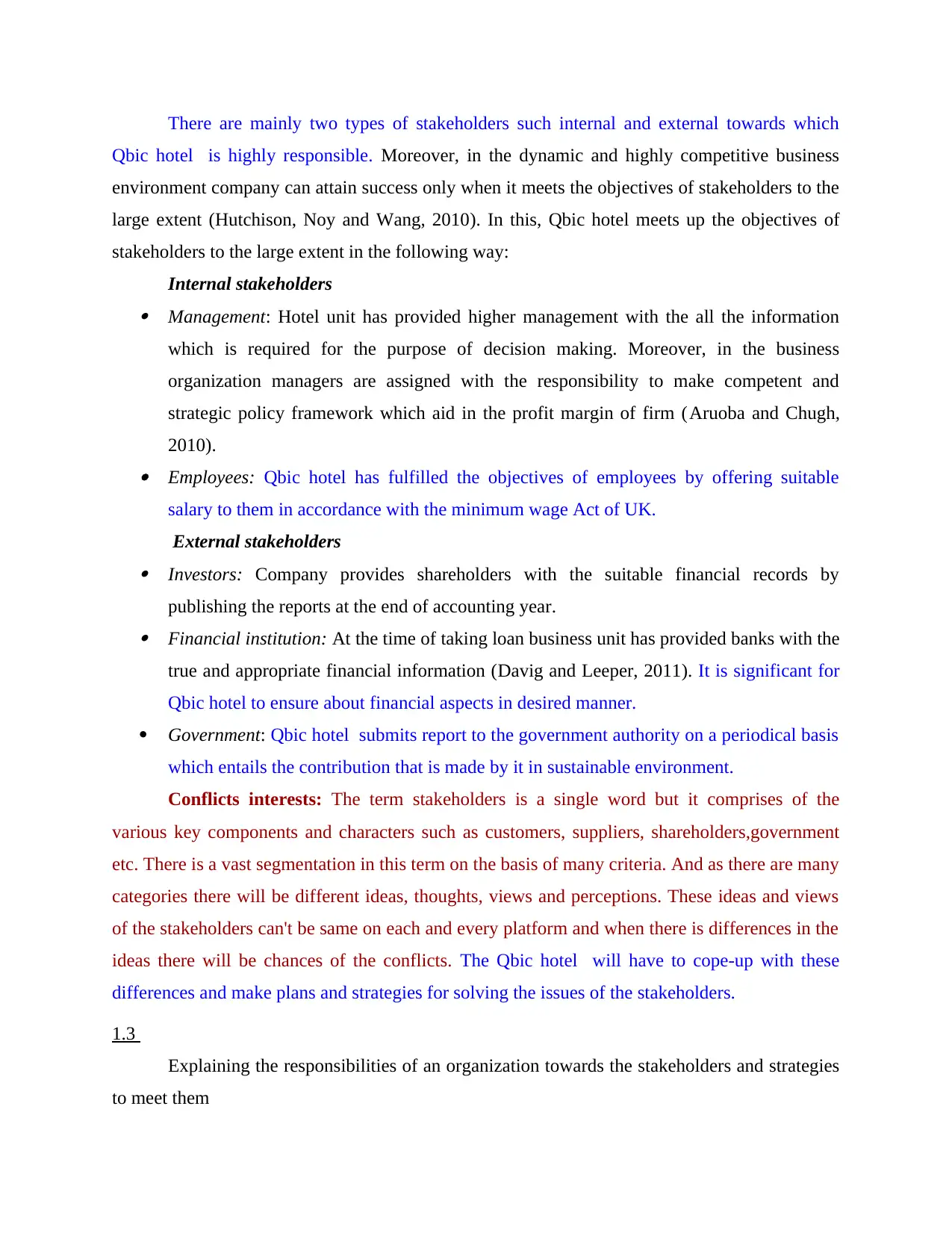
There are mainly two types of stakeholders such internal and external towards which
Qbic hotel is highly responsible. Moreover, in the dynamic and highly competitive business
environment company can attain success only when it meets the objectives of stakeholders to the
large extent (Hutchison, Noy and Wang, 2010). In this, Qbic hotel meets up the objectives of
stakeholders to the large extent in the following way:
Internal stakeholders Management: Hotel unit has provided higher management with the all the information
which is required for the purpose of decision making. Moreover, in the business
organization managers are assigned with the responsibility to make competent and
strategic policy framework which aid in the profit margin of firm (Aruoba and Chugh,
2010). Employees: Qbic hotel has fulfilled the objectives of employees by offering suitable
salary to them in accordance with the minimum wage Act of UK.
External stakeholders Investors: Company provides shareholders with the suitable financial records by
publishing the reports at the end of accounting year. Financial institution: At the time of taking loan business unit has provided banks with the
true and appropriate financial information (Davig and Leeper, 2011). It is significant for
Qbic hotel to ensure about financial aspects in desired manner.
Government: Qbic hotel submits report to the government authority on a periodical basis
which entails the contribution that is made by it in sustainable environment.
Conflicts interests: The term stakeholders is a single word but it comprises of the
various key components and characters such as customers, suppliers, shareholders,government
etc. There is a vast segmentation in this term on the basis of many criteria. And as there are many
categories there will be different ideas, thoughts, views and perceptions. These ideas and views
of the stakeholders can't be same on each and every platform and when there is differences in the
ideas there will be chances of the conflicts. The Qbic hotel will have to cope-up with these
differences and make plans and strategies for solving the issues of the stakeholders.
1.3
Explaining the responsibilities of an organization towards the stakeholders and strategies
to meet them
Qbic hotel is highly responsible. Moreover, in the dynamic and highly competitive business
environment company can attain success only when it meets the objectives of stakeholders to the
large extent (Hutchison, Noy and Wang, 2010). In this, Qbic hotel meets up the objectives of
stakeholders to the large extent in the following way:
Internal stakeholders Management: Hotel unit has provided higher management with the all the information
which is required for the purpose of decision making. Moreover, in the business
organization managers are assigned with the responsibility to make competent and
strategic policy framework which aid in the profit margin of firm (Aruoba and Chugh,
2010). Employees: Qbic hotel has fulfilled the objectives of employees by offering suitable
salary to them in accordance with the minimum wage Act of UK.
External stakeholders Investors: Company provides shareholders with the suitable financial records by
publishing the reports at the end of accounting year. Financial institution: At the time of taking loan business unit has provided banks with the
true and appropriate financial information (Davig and Leeper, 2011). It is significant for
Qbic hotel to ensure about financial aspects in desired manner.
Government: Qbic hotel submits report to the government authority on a periodical basis
which entails the contribution that is made by it in sustainable environment.
Conflicts interests: The term stakeholders is a single word but it comprises of the
various key components and characters such as customers, suppliers, shareholders,government
etc. There is a vast segmentation in this term on the basis of many criteria. And as there are many
categories there will be different ideas, thoughts, views and perceptions. These ideas and views
of the stakeholders can't be same on each and every platform and when there is differences in the
ideas there will be chances of the conflicts. The Qbic hotel will have to cope-up with these
differences and make plans and strategies for solving the issues of the stakeholders.
1.3
Explaining the responsibilities of an organization towards the stakeholders and strategies
to meet them
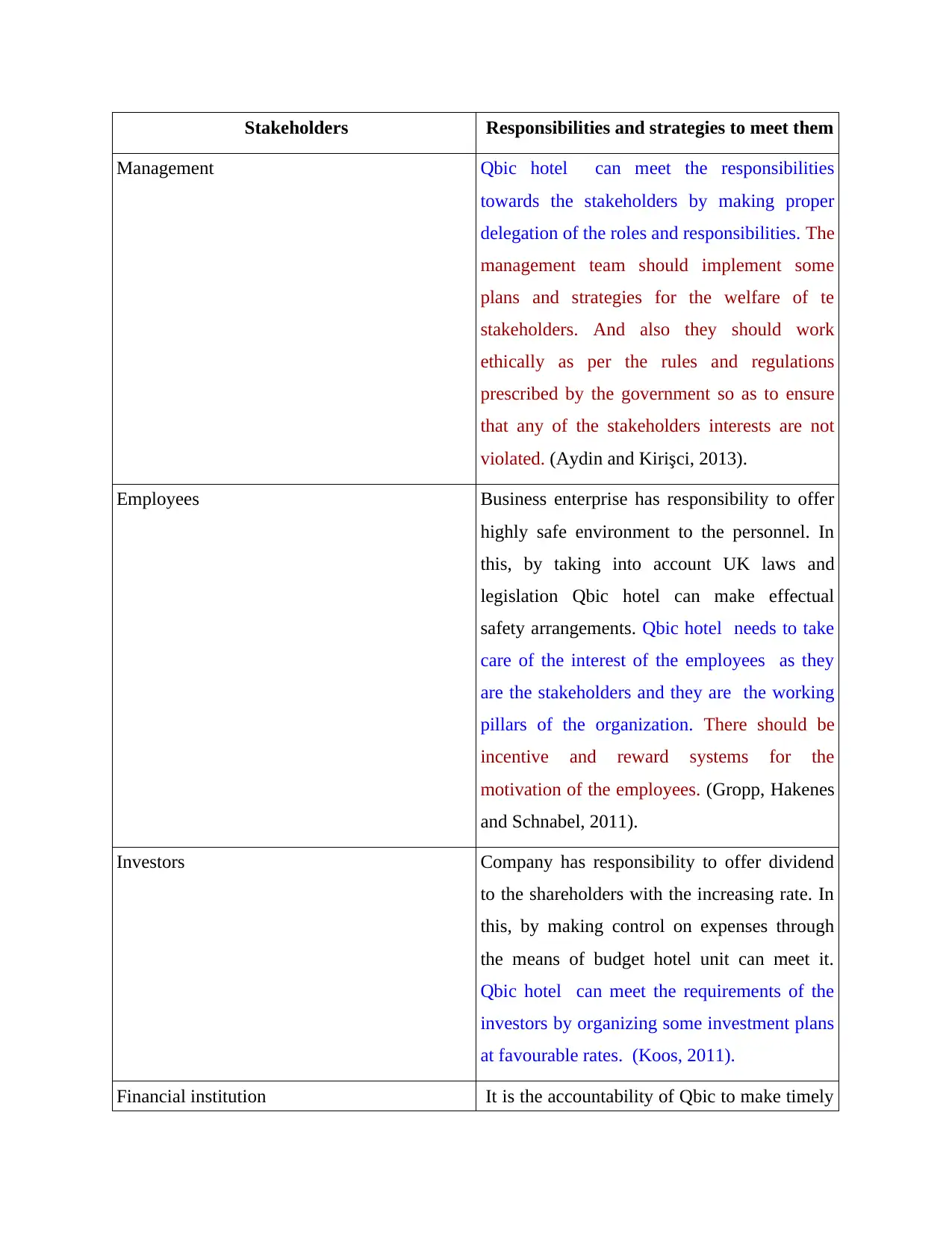
Stakeholders Responsibilities and strategies to meet them
Management Qbic hotel can meet the responsibilities
towards the stakeholders by making proper
delegation of the roles and responsibilities. The
management team should implement some
plans and strategies for the welfare of te
stakeholders. And also they should work
ethically as per the rules and regulations
prescribed by the government so as to ensure
that any of the stakeholders interests are not
violated. (Aydin and Kirişci, 2013).
Employees Business enterprise has responsibility to offer
highly safe environment to the personnel. In
this, by taking into account UK laws and
legislation Qbic hotel can make effectual
safety arrangements. Qbic hotel needs to take
care of the interest of the employees as they
are the stakeholders and they are the working
pillars of the organization. There should be
incentive and reward systems for the
motivation of the employees. (Gropp, Hakenes
and Schnabel, 2011).
Investors Company has responsibility to offer dividend
to the shareholders with the increasing rate. In
this, by making control on expenses through
the means of budget hotel unit can meet it.
Qbic hotel can meet the requirements of the
investors by organizing some investment plans
at favourable rates. (Koos, 2011).
Financial institution It is the accountability of Qbic to make timely
Management Qbic hotel can meet the responsibilities
towards the stakeholders by making proper
delegation of the roles and responsibilities. The
management team should implement some
plans and strategies for the welfare of te
stakeholders. And also they should work
ethically as per the rules and regulations
prescribed by the government so as to ensure
that any of the stakeholders interests are not
violated. (Aydin and Kirişci, 2013).
Employees Business enterprise has responsibility to offer
highly safe environment to the personnel. In
this, by taking into account UK laws and
legislation Qbic hotel can make effectual
safety arrangements. Qbic hotel needs to take
care of the interest of the employees as they
are the stakeholders and they are the working
pillars of the organization. There should be
incentive and reward systems for the
motivation of the employees. (Gropp, Hakenes
and Schnabel, 2011).
Investors Company has responsibility to offer dividend
to the shareholders with the increasing rate. In
this, by making control on expenses through
the means of budget hotel unit can meet it.
Qbic hotel can meet the requirements of the
investors by organizing some investment plans
at favourable rates. (Koos, 2011).
Financial institution It is the accountability of Qbic to make timely
⊘ This is a preview!⊘
Do you want full access?
Subscribe today to unlock all pages.
Trusted by 1+ million students worldwide
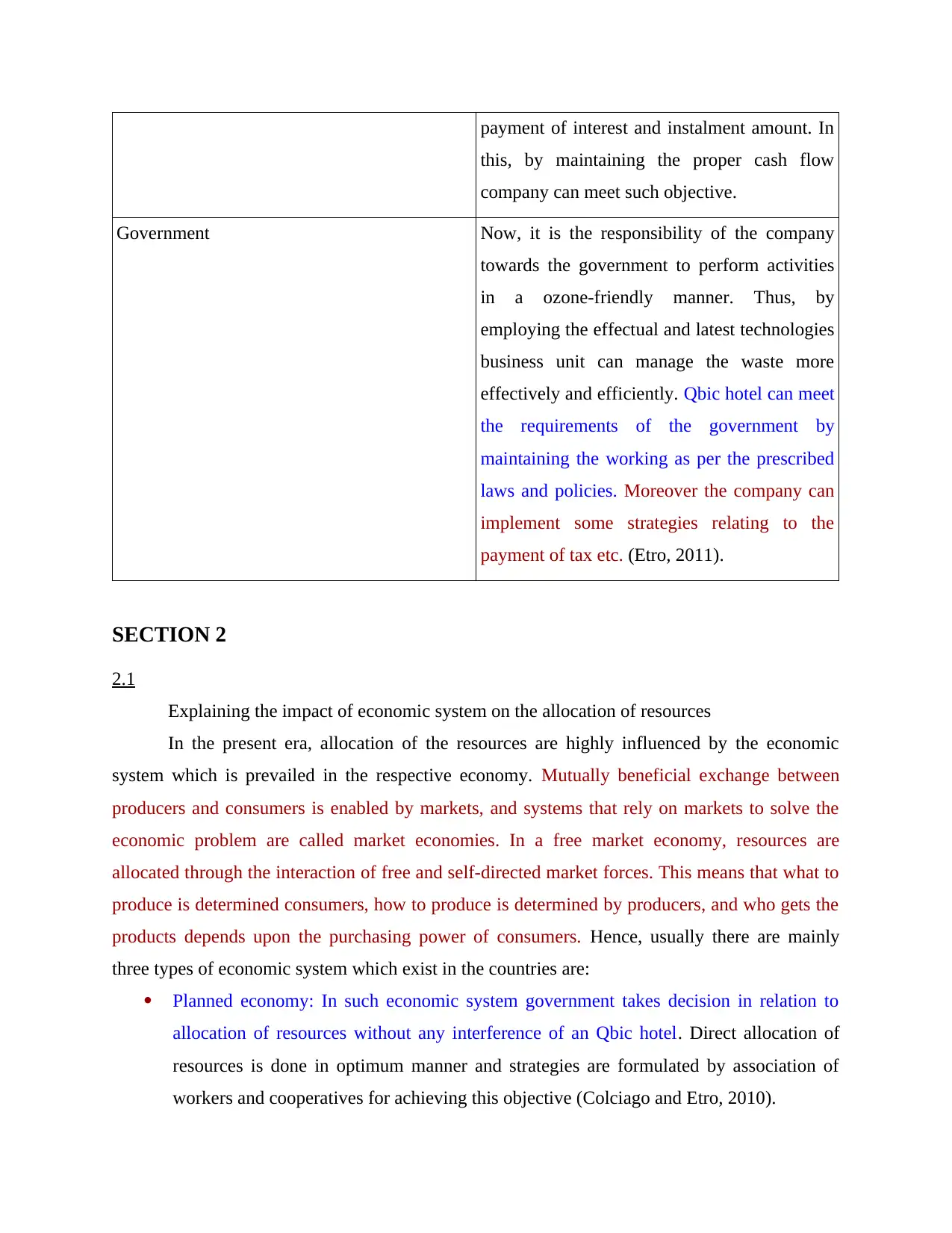
payment of interest and instalment amount. In
this, by maintaining the proper cash flow
company can meet such objective.
Government Now, it is the responsibility of the company
towards the government to perform activities
in a ozone-friendly manner. Thus, by
employing the effectual and latest technologies
business unit can manage the waste more
effectively and efficiently. Qbic hotel can meet
the requirements of the government by
maintaining the working as per the prescribed
laws and policies. Moreover the company can
implement some strategies relating to the
payment of tax etc. (Etro, 2011).
SECTION 2
2.1
Explaining the impact of economic system on the allocation of resources
In the present era, allocation of the resources are highly influenced by the economic
system which is prevailed in the respective economy. Mutually beneficial exchange between
producers and consumers is enabled by markets, and systems that rely on markets to solve the
economic problem are called market economies. In a free market economy, resources are
allocated through the interaction of free and self-directed market forces. This means that what to
produce is determined consumers, how to produce is determined by producers, and who gets the
products depends upon the purchasing power of consumers. Hence, usually there are mainly
three types of economic system which exist in the countries are:
Planned economy: In such economic system government takes decision in relation to
allocation of resources without any interference of an Qbic hotel. Direct allocation of
resources is done in optimum manner and strategies are formulated by association of
workers and cooperatives for achieving this objective (Colciago and Etro, 2010).
this, by maintaining the proper cash flow
company can meet such objective.
Government Now, it is the responsibility of the company
towards the government to perform activities
in a ozone-friendly manner. Thus, by
employing the effectual and latest technologies
business unit can manage the waste more
effectively and efficiently. Qbic hotel can meet
the requirements of the government by
maintaining the working as per the prescribed
laws and policies. Moreover the company can
implement some strategies relating to the
payment of tax etc. (Etro, 2011).
SECTION 2
2.1
Explaining the impact of economic system on the allocation of resources
In the present era, allocation of the resources are highly influenced by the economic
system which is prevailed in the respective economy. Mutually beneficial exchange between
producers and consumers is enabled by markets, and systems that rely on markets to solve the
economic problem are called market economies. In a free market economy, resources are
allocated through the interaction of free and self-directed market forces. This means that what to
produce is determined consumers, how to produce is determined by producers, and who gets the
products depends upon the purchasing power of consumers. Hence, usually there are mainly
three types of economic system which exist in the countries are:
Planned economy: In such economic system government takes decision in relation to
allocation of resources without any interference of an Qbic hotel. Direct allocation of
resources is done in optimum manner and strategies are formulated by association of
workers and cooperatives for achieving this objective (Colciago and Etro, 2010).
Paraphrase This Document
Need a fresh take? Get an instant paraphrase of this document with our AI Paraphraser
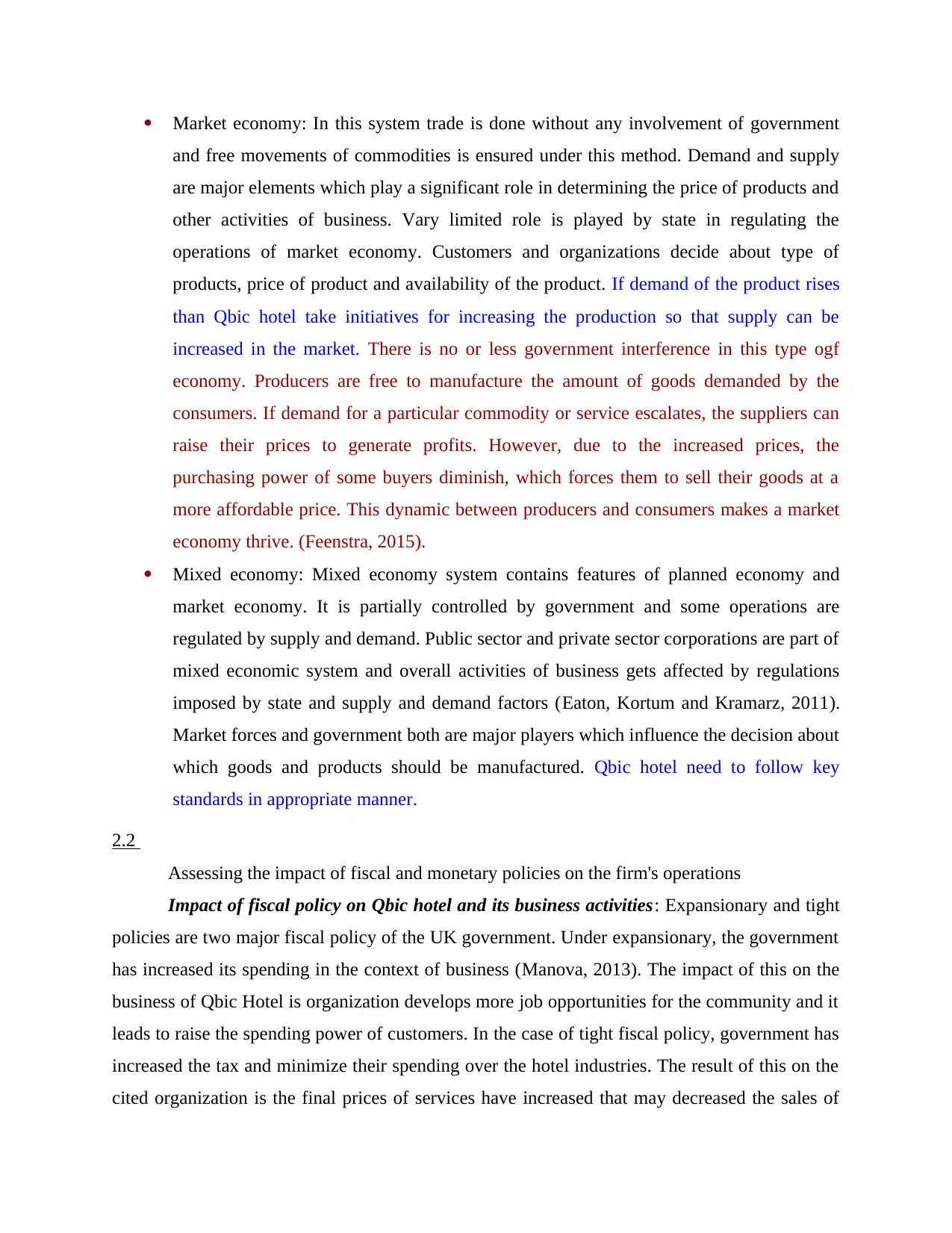
Market economy: In this system trade is done without any involvement of government
and free movements of commodities is ensured under this method. Demand and supply
are major elements which play a significant role in determining the price of products and
other activities of business. Vary limited role is played by state in regulating the
operations of market economy. Customers and organizations decide about type of
products, price of product and availability of the product. If demand of the product rises
than Qbic hotel take initiatives for increasing the production so that supply can be
increased in the market. There is no or less government interference in this type ogf
economy. Producers are free to manufacture the amount of goods demanded by the
consumers. If demand for a particular commodity or service escalates, the suppliers can
raise their prices to generate profits. However, due to the increased prices, the
purchasing power of some buyers diminish, which forces them to sell their goods at a
more affordable price. This dynamic between producers and consumers makes a market
economy thrive. (Feenstra, 2015).
Mixed economy: Mixed economy system contains features of planned economy and
market economy. It is partially controlled by government and some operations are
regulated by supply and demand. Public sector and private sector corporations are part of
mixed economic system and overall activities of business gets affected by regulations
imposed by state and supply and demand factors (Eaton, Kortum and Kramarz, 2011).
Market forces and government both are major players which influence the decision about
which goods and products should be manufactured. Qbic hotel need to follow key
standards in appropriate manner.
2.2
Assessing the impact of fiscal and monetary policies on the firm's operations
Impact of fiscal policy on Qbic hotel and its business activities: Expansionary and tight
policies are two major fiscal policy of the UK government. Under expansionary, the government
has increased its spending in the context of business (Manova, 2013). The impact of this on the
business of Qbic Hotel is organization develops more job opportunities for the community and it
leads to raise the spending power of customers. In the case of tight fiscal policy, government has
increased the tax and minimize their spending over the hotel industries. The result of this on the
cited organization is the final prices of services have increased that may decreased the sales of
and free movements of commodities is ensured under this method. Demand and supply
are major elements which play a significant role in determining the price of products and
other activities of business. Vary limited role is played by state in regulating the
operations of market economy. Customers and organizations decide about type of
products, price of product and availability of the product. If demand of the product rises
than Qbic hotel take initiatives for increasing the production so that supply can be
increased in the market. There is no or less government interference in this type ogf
economy. Producers are free to manufacture the amount of goods demanded by the
consumers. If demand for a particular commodity or service escalates, the suppliers can
raise their prices to generate profits. However, due to the increased prices, the
purchasing power of some buyers diminish, which forces them to sell their goods at a
more affordable price. This dynamic between producers and consumers makes a market
economy thrive. (Feenstra, 2015).
Mixed economy: Mixed economy system contains features of planned economy and
market economy. It is partially controlled by government and some operations are
regulated by supply and demand. Public sector and private sector corporations are part of
mixed economic system and overall activities of business gets affected by regulations
imposed by state and supply and demand factors (Eaton, Kortum and Kramarz, 2011).
Market forces and government both are major players which influence the decision about
which goods and products should be manufactured. Qbic hotel need to follow key
standards in appropriate manner.
2.2
Assessing the impact of fiscal and monetary policies on the firm's operations
Impact of fiscal policy on Qbic hotel and its business activities: Expansionary and tight
policies are two major fiscal policy of the UK government. Under expansionary, the government
has increased its spending in the context of business (Manova, 2013). The impact of this on the
business of Qbic Hotel is organization develops more job opportunities for the community and it
leads to raise the spending power of customers. In the case of tight fiscal policy, government has
increased the tax and minimize their spending over the hotel industries. The result of this on the
cited organization is the final prices of services have increased that may decreased the sales of
hotel services which can bring the lower down the profit level of the Qbic hotel . The fiscal
policies which are Tax-related affects the business activities by changing the amount of
disposable income the consumers have to spend. Fiscal policy that involves government
spending and adds to the federal deficit can lead to higher interest rates. This can increase the
cost of credit and mortgages that may make consumers think twice about purchases. (Chor and
Manova, 2012).
Impact of monetary policy on Qbic Hotel and its business activities: When the
government increase the supply of money in the market then it becomes easy for Qbic and other
hotels to borrow money either from market or bank. This thing reduces the interest rates over the
credit funds. This gives benefit to the hotel to easily take loan for long term perspectives. But in
case of less supply of money in the market will be create difficulties for the company to borrow
money for raise investment level. There is an inter-relationship between interest rates and the
value of money. When the Federal Reserve makes the cost of borrowing cheaper, more money
starts flowing in the economy. The more money that are out there, the less each one is worth
(Levchenko, Lewis and Tesar, 2010). It means Qbic hotel need to ensure about it in appropriate
manner.
2.3
Evaluating the competition and other laws on the business organization
As per the Competition act, abuse of an organization dominant position employee either
at local or international level, development and operation of cartels, avoiding concerted practice
affects the business operations of an organization in the negative manner. The impact of this on
Qbic Hotel is to fix the prices of the hotel services (Gross and Juncos, 2010). In addition to this,
the management of the Qbic hotel has stick on the business objectives and other promises
related to deliver the good quality services and achieve greater customer satisfaction level. This
thing has helped the cited firm to maintain transparency during the payment with the business
clients and service users. On the other hand, regulatory mechanism such as Enterprise Act 2002,
Enterprise and Regulatory Reform Act 2013 etc also makes impact on the business operations of
Qbic Hotel. According to Enterprise Act 2002, this has minimized market dominance behaviour
of the hotel companies in the marketplace. It results to the cited firm has tried to reduce the
influencing power of politicians parties in business activities (Falkner, 2011). Beside this, effect
of Enterprise and Regulatory Reform Act 2013 on Qbic Hotel is management imposing various
policies which are Tax-related affects the business activities by changing the amount of
disposable income the consumers have to spend. Fiscal policy that involves government
spending and adds to the federal deficit can lead to higher interest rates. This can increase the
cost of credit and mortgages that may make consumers think twice about purchases. (Chor and
Manova, 2012).
Impact of monetary policy on Qbic Hotel and its business activities: When the
government increase the supply of money in the market then it becomes easy for Qbic and other
hotels to borrow money either from market or bank. This thing reduces the interest rates over the
credit funds. This gives benefit to the hotel to easily take loan for long term perspectives. But in
case of less supply of money in the market will be create difficulties for the company to borrow
money for raise investment level. There is an inter-relationship between interest rates and the
value of money. When the Federal Reserve makes the cost of borrowing cheaper, more money
starts flowing in the economy. The more money that are out there, the less each one is worth
(Levchenko, Lewis and Tesar, 2010). It means Qbic hotel need to ensure about it in appropriate
manner.
2.3
Evaluating the competition and other laws on the business organization
As per the Competition act, abuse of an organization dominant position employee either
at local or international level, development and operation of cartels, avoiding concerted practice
affects the business operations of an organization in the negative manner. The impact of this on
Qbic Hotel is to fix the prices of the hotel services (Gross and Juncos, 2010). In addition to this,
the management of the Qbic hotel has stick on the business objectives and other promises
related to deliver the good quality services and achieve greater customer satisfaction level. This
thing has helped the cited firm to maintain transparency during the payment with the business
clients and service users. On the other hand, regulatory mechanism such as Enterprise Act 2002,
Enterprise and Regulatory Reform Act 2013 etc also makes impact on the business operations of
Qbic Hotel. According to Enterprise Act 2002, this has minimized market dominance behaviour
of the hotel companies in the marketplace. It results to the cited firm has tried to reduce the
influencing power of politicians parties in business activities (Falkner, 2011). Beside this, effect
of Enterprise and Regulatory Reform Act 2013 on Qbic Hotel is management imposing various
⊘ This is a preview!⊘
Do you want full access?
Subscribe today to unlock all pages.
Trusted by 1+ million students worldwide
policies and regulations to protect the rights of the customers and employees from the unethical
practices of the business. So, from the above some competition and other mechanism laws
evaluation, it has found that these have made positive impacts on business activities of Qbic
Hotel. The below are the four pillars of competition policy:-
Monopolistic competition: The concept comprises of several number of firms. While
comparing with the Perfect Competition there is not a restriction for entering but, however, in
this one the types of the products can be completely different to each other. For instance
Builders, restaurants, hotels and bars are some examples for this market structure. In this case
The demand curve is downward sloping but relatively elastic in this case.
TASK 3
3.1
Market structure which determine the pricing and output decision of businesses including
Qbic Hotel:
Market structure assists the organizations to take decisions regarding prices and volume
of production of goods as per the demand in the market. There are four type of market structures
perfect competition, oligopoly, monopoly and monopolistic (Thomas, 2011). When more than
one company provide homogeneous services and products to the customers than it is called
perfect market structure. The profit margin in such kind of competition is low. On the other
hand, in monopoly market structure, there are few organizations who are dominating in a
particular market which sometimes create a perfect competition situation for the firms. The level
of profit margin is at moderate level and it has created barriers for new companies to enter into
this marketplace (Worthington and Britton, 2015). While under monopolistic market structure,
organizations are offering differentiated goods and services to the customers that help them to
generate high profit level.
Oligopoly:- There are large number of suppliers present which further impacts the
decision making power of the enterprise. In these type of strategy, Qbic hotel is not able to make
the changes in pricing strategy whenever they desire to. Firms under oligopoly are strategically
interdependent to other firms, to understand the effect of this interdependence on firms'
behaviour understanding of game theory is helpful.
practices of the business. So, from the above some competition and other mechanism laws
evaluation, it has found that these have made positive impacts on business activities of Qbic
Hotel. The below are the four pillars of competition policy:-
Monopolistic competition: The concept comprises of several number of firms. While
comparing with the Perfect Competition there is not a restriction for entering but, however, in
this one the types of the products can be completely different to each other. For instance
Builders, restaurants, hotels and bars are some examples for this market structure. In this case
The demand curve is downward sloping but relatively elastic in this case.
TASK 3
3.1
Market structure which determine the pricing and output decision of businesses including
Qbic Hotel:
Market structure assists the organizations to take decisions regarding prices and volume
of production of goods as per the demand in the market. There are four type of market structures
perfect competition, oligopoly, monopoly and monopolistic (Thomas, 2011). When more than
one company provide homogeneous services and products to the customers than it is called
perfect market structure. The profit margin in such kind of competition is low. On the other
hand, in monopoly market structure, there are few organizations who are dominating in a
particular market which sometimes create a perfect competition situation for the firms. The level
of profit margin is at moderate level and it has created barriers for new companies to enter into
this marketplace (Worthington and Britton, 2015). While under monopolistic market structure,
organizations are offering differentiated goods and services to the customers that help them to
generate high profit level.
Oligopoly:- There are large number of suppliers present which further impacts the
decision making power of the enterprise. In these type of strategy, Qbic hotel is not able to make
the changes in pricing strategy whenever they desire to. Firms under oligopoly are strategically
interdependent to other firms, to understand the effect of this interdependence on firms'
behaviour understanding of game theory is helpful.
Paraphrase This Document
Need a fresh take? Get an instant paraphrase of this document with our AI Paraphraser
Competitive advantage:- The concept of the competitive advantage is what makes the company
better than the competition in the customers' minds. temporary price cut to gain market
share might work in the short-term. But that lead will disappear when it restores those prices to a
profitable level. The Qbic hotel must create clear goals, strategies, and operations to sustain its
competitive advantage. The corporate culture and values of the employees must be in alignment
with those goals, as well. It's difficult to do all those things well. That's why few companies can
create a sustainable competitive advantage.
In the case of Qbic Hotel, organization has operated its business in UK hospitality
industry where market structure is perfect competition. The reason is different competitors are
providing similar hotel services to the customers to selected target marker. On the basis of the
current demand in the market and level of competition has helped Qbic Hotel to take decision
regarding price and production volume (Kubasek, Brennan and Browne, 2016). There are
different types of pricing strategies such as premium, penetration, economy and price skimming
strategies use by the cited organization.
3.2
Market forces shape Qbic Hotel responses
There are some market forces which affect the business operations of Qbic Hotel either in
positive or negative manner and these are as follows:
Demand and supply: Demand is a market force which affects the success of any business
entity around the world. UK is large market and have a huge population who always look
forward for new items in food products. Because there are good disposable income of the
consumer. The demand for car are increase day by day. The current level supply of goods
including their demand affects the action of the organization. From the study, it has found that
demand of hotel services in the UK is increasing with the alarming rate which creates new
opportunities for the growth of the businesses. The consumptions related to these services have
also increased with time. In this situation, Qbic Hotel gives response in terms of by raising the
number of different existing and new services along with this setting of unique distribution
channels in the UK market. (Hamilton and Webster, 2015).
Elasticity of demand and supply: Demand and supply of the goods change as per the
consumption rate of the consumers. Qbic Hotel adopts the different strategies to maintain the
better than the competition in the customers' minds. temporary price cut to gain market
share might work in the short-term. But that lead will disappear when it restores those prices to a
profitable level. The Qbic hotel must create clear goals, strategies, and operations to sustain its
competitive advantage. The corporate culture and values of the employees must be in alignment
with those goals, as well. It's difficult to do all those things well. That's why few companies can
create a sustainable competitive advantage.
In the case of Qbic Hotel, organization has operated its business in UK hospitality
industry where market structure is perfect competition. The reason is different competitors are
providing similar hotel services to the customers to selected target marker. On the basis of the
current demand in the market and level of competition has helped Qbic Hotel to take decision
regarding price and production volume (Kubasek, Brennan and Browne, 2016). There are
different types of pricing strategies such as premium, penetration, economy and price skimming
strategies use by the cited organization.
3.2
Market forces shape Qbic Hotel responses
There are some market forces which affect the business operations of Qbic Hotel either in
positive or negative manner and these are as follows:
Demand and supply: Demand is a market force which affects the success of any business
entity around the world. UK is large market and have a huge population who always look
forward for new items in food products. Because there are good disposable income of the
consumer. The demand for car are increase day by day. The current level supply of goods
including their demand affects the action of the organization. From the study, it has found that
demand of hotel services in the UK is increasing with the alarming rate which creates new
opportunities for the growth of the businesses. The consumptions related to these services have
also increased with time. In this situation, Qbic Hotel gives response in terms of by raising the
number of different existing and new services along with this setting of unique distribution
channels in the UK market. (Hamilton and Webster, 2015).
Elasticity of demand and supply: Demand and supply of the goods change as per the
consumption rate of the consumers. Qbic Hotel adopts the different strategies to maintain the
sales of the services in different seasonal conditions. The result of this is company has always
made balance between the demand and supply of the goods. (Fernando, 2011).
Economic of sales: This is a type of cost benefits which attain by an organization via
volume of production, lot size, sales strategies etc over cost per unit product. To accomplish this,
Qbic Hotel has given the response in the form of bring the reduction in the wastage of the
resources and unnecessary business activities from the different process which bring the
increment in the cost of the hotel services (Wijaya, Spruit, Scheper and Versendaal, 2011).
Governments
Governments hold much sway over the free markets. Fiscal and monetary policy have a
profound effect on the financial marketplace. By increasing and decreasing interest rates the
government and Federal Reserve can effectively slow or attempt to speed up growth within the
country. This is called monetary policy. If government spending increases or contracts, this is
known as fiscal policy, and can be used to help ease unemployment and or stabilize prices. By
altering interest rates and the amount of dollars available on the open market, governments can
change how much investment flows into and out of the country. If Qbic hotel does not follow
such standards effectively then it will impact the overall outcome in diverse manner.
All market forces must be addressed concurrently according to standards defined by the
market. While a business may trade a response to one force for another, such as compromising
quality to boost profits, they may only do so temporarily. At some point, the market will punish
any entity failing to fully respond effectively to any and all of the four market pressures.
Market forces will always produce pressure on organizations to perform. The business
corporations are some times unable to respond quickly to rapidly changing technology that
affects their markets, and to highly informed, fickle customers who constantly demand new
customized responses while continuing to insist on high quality, rapid delivery, and low prices,
are finding it to be increasingly difficult to compete. This need to respond quickly to rapidly
changing market demands drives many organizations to consider changes in Qbic hotel
structures, cultures, and management practices that create quick and flexible market responses.
3.3
Business environment is the mixture of all the factors that is internal and external which
affects the operations and the productions of the entity. Internal environment includes the
employees and shareholders. External environment includes the government and the consumers .
made balance between the demand and supply of the goods. (Fernando, 2011).
Economic of sales: This is a type of cost benefits which attain by an organization via
volume of production, lot size, sales strategies etc over cost per unit product. To accomplish this,
Qbic Hotel has given the response in the form of bring the reduction in the wastage of the
resources and unnecessary business activities from the different process which bring the
increment in the cost of the hotel services (Wijaya, Spruit, Scheper and Versendaal, 2011).
Governments
Governments hold much sway over the free markets. Fiscal and monetary policy have a
profound effect on the financial marketplace. By increasing and decreasing interest rates the
government and Federal Reserve can effectively slow or attempt to speed up growth within the
country. This is called monetary policy. If government spending increases or contracts, this is
known as fiscal policy, and can be used to help ease unemployment and or stabilize prices. By
altering interest rates and the amount of dollars available on the open market, governments can
change how much investment flows into and out of the country. If Qbic hotel does not follow
such standards effectively then it will impact the overall outcome in diverse manner.
All market forces must be addressed concurrently according to standards defined by the
market. While a business may trade a response to one force for another, such as compromising
quality to boost profits, they may only do so temporarily. At some point, the market will punish
any entity failing to fully respond effectively to any and all of the four market pressures.
Market forces will always produce pressure on organizations to perform. The business
corporations are some times unable to respond quickly to rapidly changing technology that
affects their markets, and to highly informed, fickle customers who constantly demand new
customized responses while continuing to insist on high quality, rapid delivery, and low prices,
are finding it to be increasingly difficult to compete. This need to respond quickly to rapidly
changing market demands drives many organizations to consider changes in Qbic hotel
structures, cultures, and management practices that create quick and flexible market responses.
3.3
Business environment is the mixture of all the factors that is internal and external which
affects the operations and the productions of the entity. Internal environment includes the
employees and shareholders. External environment includes the government and the consumers .
⊘ This is a preview!⊘
Do you want full access?
Subscribe today to unlock all pages.
Trusted by 1+ million students worldwide

1 out of 18


Related Documents


Your All-in-One AI-Powered Toolkit for Academic Success.
+13062052269
info@desklib.com
Available 24*7 on WhatsApp / Email
![[object Object]](/_next/static/media/star-bottom.7253800d.svg)
Unlock your academic potential
Copyright © 2020–2026 A2Z Services. All Rights Reserved. Developed and managed by ZUCOL.