Business Environment Report: Organizations, Stakeholders, and Factors
VerifiedAdded on 2020/06/04
|10
|2756
|30
Report
AI Summary
This report provides an in-depth analysis of the business environment, focusing on various organizational types like private, public, and voluntary sectors. It explores the purposes of organizations such as John Lewis and Red Cross, examining their mission statements and objectives. The report delves into stakeholder relationships, including internal and external stakeholders like employees, customers, and government agencies, and their impact on organizational goals. Furthermore, it investigates the influence of the economic environment, including market and mixed economic systems, on business activities. The report also assesses the impact of political, social, cultural, and environmental factors on businesses, highlighting how companies adapt to changing conditions and regulations. The analysis underscores the importance of understanding these factors for strategic decision-making and sustainable development.
Business
Environment
Environment

Paraphrase This Document
Need a fresh take? Get an instant paraphrase of this document with our AI Paraphraser
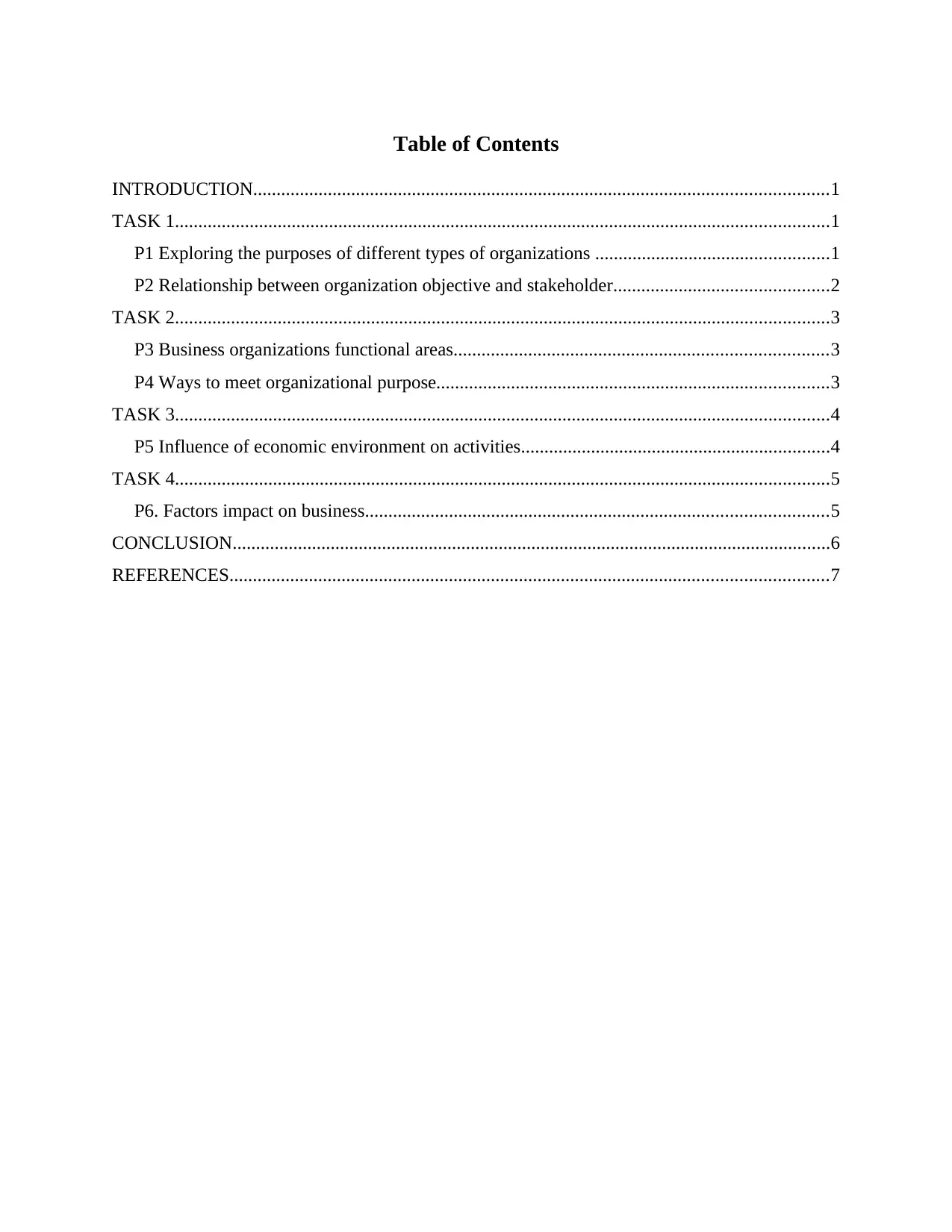
Table of Contents
INTRODUCTION...........................................................................................................................1
TASK 1............................................................................................................................................1
P1 Exploring the purposes of different types of organizations ..................................................1
P2 Relationship between organization objective and stakeholder..............................................2
TASK 2............................................................................................................................................3
P3 Business organizations functional areas................................................................................3
P4 Ways to meet organizational purpose....................................................................................3
TASK 3............................................................................................................................................4
P5 Influence of economic environment on activities..................................................................4
TASK 4............................................................................................................................................5
P6. Factors impact on business...................................................................................................5
CONCLUSION................................................................................................................................6
REFERENCES................................................................................................................................7
INTRODUCTION...........................................................................................................................1
TASK 1............................................................................................................................................1
P1 Exploring the purposes of different types of organizations ..................................................1
P2 Relationship between organization objective and stakeholder..............................................2
TASK 2............................................................................................................................................3
P3 Business organizations functional areas................................................................................3
P4 Ways to meet organizational purpose....................................................................................3
TASK 3............................................................................................................................................4
P5 Influence of economic environment on activities..................................................................4
TASK 4............................................................................................................................................5
P6. Factors impact on business...................................................................................................5
CONCLUSION................................................................................................................................6
REFERENCES................................................................................................................................7
INTRODUCTION
Every organization has to work in a particular environment that is called as Business
environment. There are two types of environment such as internal and external which affects the
operations of company (Stacey, 2016). It is very important for business entities to analyze all
these factors in order to make effective strategies. The present report aims to understand the
business environment under different corporate scenarios. The different types of organization
have been discussed while explaining the purpose. The business purpose of private, public and
voluntary organizations has been discussed. Further importance of stakeholders, internal and
externals factors as well as competition policies of the government that affects the business will
also be analysed. The aim behind promoting competitive policies such as Anti-trust and free
trade will also be discussed.
TASK 1
P1 Exploring the purposes of different types of organizations
It is very significant for every type of organization to map its strategy before it
undertakes its operations. It is advised to find out where to go and what direction to take as it is
necessary in an industry to work toward making profits to achieve the objectives of an
organization. The mission statement of a company provides information regarding its purposes
of business. It clearly identifies the purpose of the business and who are involved in the company
and what the company will be serving and satisfying through its daily activities. In the current
world economy there may be various type of organization such as private company, public
company, government business, cooperatives, charitable etc. and purposes of these organizations
may be different according to their nature. Following are different types of organizations and
their purposes (Schaltegger, Lüdeke-Freund and Hansen, 2016).
The purpose of John Lewis is to offer best products and services that can attract and satisfy the
customers and generates profits for the company. John Lewis is a profit organization which aims
to deliver products and services, sold for the purpose of income generation of the owners,
investors and employees of the company and pay for expenses it incurred to develop goods.
Red Cross is a non-profit organization which aims to deliver services that can generate
common good for the public. Red Cross was established in 1870 as a charitable organization
with more than 25000 volunteers. The aim is to help people in crisis both at national and
1
Every organization has to work in a particular environment that is called as Business
environment. There are two types of environment such as internal and external which affects the
operations of company (Stacey, 2016). It is very important for business entities to analyze all
these factors in order to make effective strategies. The present report aims to understand the
business environment under different corporate scenarios. The different types of organization
have been discussed while explaining the purpose. The business purpose of private, public and
voluntary organizations has been discussed. Further importance of stakeholders, internal and
externals factors as well as competition policies of the government that affects the business will
also be analysed. The aim behind promoting competitive policies such as Anti-trust and free
trade will also be discussed.
TASK 1
P1 Exploring the purposes of different types of organizations
It is very significant for every type of organization to map its strategy before it
undertakes its operations. It is advised to find out where to go and what direction to take as it is
necessary in an industry to work toward making profits to achieve the objectives of an
organization. The mission statement of a company provides information regarding its purposes
of business. It clearly identifies the purpose of the business and who are involved in the company
and what the company will be serving and satisfying through its daily activities. In the current
world economy there may be various type of organization such as private company, public
company, government business, cooperatives, charitable etc. and purposes of these organizations
may be different according to their nature. Following are different types of organizations and
their purposes (Schaltegger, Lüdeke-Freund and Hansen, 2016).
The purpose of John Lewis is to offer best products and services that can attract and satisfy the
customers and generates profits for the company. John Lewis is a profit organization which aims
to deliver products and services, sold for the purpose of income generation of the owners,
investors and employees of the company and pay for expenses it incurred to develop goods.
Red Cross is a non-profit organization which aims to deliver services that can generate
common good for the public. Red Cross was established in 1870 as a charitable organization
with more than 25000 volunteers. The aim is to help people in crisis both at national and
1
⊘ This is a preview!⊘
Do you want full access?
Subscribe today to unlock all pages.

Trusted by 1+ million students worldwide
international level. The organization is committed to serve public regardless of the religion,
nationality, ethnicity, political beliefs. It depends on funds contributed by public and
organizations to pay for its expenses.
P2 Relationship between organization objective and stakeholder
The stakeholders of John Lewis are individuals and institutions who are interested in
business performance. The internal stakeholders include board of directors, employees, investors
and external includes suppliers, customers, government agencies, trade unions and communities.
Board Of Directors - The company directors are interested in the successful operation of
the business and they are provided with exceptional remuneration for their decision
making. Hence, Board of director have full right to know all the details and information
of a business (Sanz and Jones, 2013).
Employees - John Lewis follows competitive compensation and benefits policy for its
human capital to ensure they are motivated and productive. Employees helps in effective
application of strategies which allows to ensure that long term goals and objectives can
also be achieved. By giving motivation and providing increment help the staff to work
more efficiently.
Customers - John Lewis is committed to provide goods and services of the best quality
that satisfies the needs of its customers. By having a feedback from customer’s side the
business firm tries to accomplish key goals and objectives.
Communities - The society is interested in employment opportunities and that the
activities of the company do not affect surroundings. For this purpose John Lewis has
adopted sustainable energy measures and invested in renewable energy to reduce carbon
emissions.
Government - The organization duly follows rules and regulations of the nation in which
it operates and fulfills financial requirements at the year end (Rothaermel, 2015).
For sustainable development the businesses are more attracted towards effective
application of standards through which they can focus on stakeholders needs. Involvement of
stakeholders is significant because it allows to have sustainable development. With an assistance
of stakeholders the overall work process can be advanced which might help in gaining diverse
2
nationality, ethnicity, political beliefs. It depends on funds contributed by public and
organizations to pay for its expenses.
P2 Relationship between organization objective and stakeholder
The stakeholders of John Lewis are individuals and institutions who are interested in
business performance. The internal stakeholders include board of directors, employees, investors
and external includes suppliers, customers, government agencies, trade unions and communities.
Board Of Directors - The company directors are interested in the successful operation of
the business and they are provided with exceptional remuneration for their decision
making. Hence, Board of director have full right to know all the details and information
of a business (Sanz and Jones, 2013).
Employees - John Lewis follows competitive compensation and benefits policy for its
human capital to ensure they are motivated and productive. Employees helps in effective
application of strategies which allows to ensure that long term goals and objectives can
also be achieved. By giving motivation and providing increment help the staff to work
more efficiently.
Customers - John Lewis is committed to provide goods and services of the best quality
that satisfies the needs of its customers. By having a feedback from customer’s side the
business firm tries to accomplish key goals and objectives.
Communities - The society is interested in employment opportunities and that the
activities of the company do not affect surroundings. For this purpose John Lewis has
adopted sustainable energy measures and invested in renewable energy to reduce carbon
emissions.
Government - The organization duly follows rules and regulations of the nation in which
it operates and fulfills financial requirements at the year end (Rothaermel, 2015).
For sustainable development the businesses are more attracted towards effective
application of standards through which they can focus on stakeholders needs. Involvement of
stakeholders is significant because it allows to have sustainable development. With an assistance
of stakeholders the overall work process can be advanced which might help in gaining diverse
2
Paraphrase This Document
Need a fresh take? Get an instant paraphrase of this document with our AI Paraphraser
benefits. It means the consideration of stakeholders is necessary while dealing with activities for
accomplishment of objectives.
TASK 2
P3 Business organizations functional areas
All workers in John Lewis are partners, the company has a different type of structure.
They have an independent structure which allows staff to pass their own view in order to help
with management and other things. The structure of the company is classified as follows:
• Departmentalization- John Lewis Partnership is departmentalized according to the
products and functions as well as commercial activities.
• Chain of command and Span of Control- When making decisions, permanent staff
also get to have a say as they also own a part of the company. But they are not the ones that can
get to make important decisions as there is a management top level who takes charge of that.
• Centralization and Decentralization- They have a decentralization structure as the
employees have a stake in the company which makes them closer to the company(Reddick and
Roy, 2013).
Red Cross has a hierarchical structure because it has a lot of layers and a lot of people
reporting into more than one person before that information gets to the boss. A hierarchical
structure has many levels. Each level is controlled by one person. A hierarchical company tends
to be a very big company just like Red Cross. In a hierarchy instructions are generally passed
down from one person to another until it gets to the bottom of the hierarchical structure. If there
was a problem in a hierarchical structure it would move up through the structure again from one
person to another until it gets to where it is supported to be. Strengths of a Hierarchical structure
is that there is a close control of workers. Workers in Red Cross will know exactly what they
have to do so they don't wait around until they are told (Page, 2017).
P4 Ways to meet organizational purpose
John Lewis’ aim is to make sure that their customers and employees are satisfied by
achieving the businesses high standards, they also want the company to grow and earn as much
profit as possible; beating their competition. On other side, Red Cross aim is to provide quality
of public service, improve the lifestyle of individuals. Its also motive is to present a concern
about public issues so that corrective measures can be taken into account. In John Lewis span of
3
accomplishment of objectives.
TASK 2
P3 Business organizations functional areas
All workers in John Lewis are partners, the company has a different type of structure.
They have an independent structure which allows staff to pass their own view in order to help
with management and other things. The structure of the company is classified as follows:
• Departmentalization- John Lewis Partnership is departmentalized according to the
products and functions as well as commercial activities.
• Chain of command and Span of Control- When making decisions, permanent staff
also get to have a say as they also own a part of the company. But they are not the ones that can
get to make important decisions as there is a management top level who takes charge of that.
• Centralization and Decentralization- They have a decentralization structure as the
employees have a stake in the company which makes them closer to the company(Reddick and
Roy, 2013).
Red Cross has a hierarchical structure because it has a lot of layers and a lot of people
reporting into more than one person before that information gets to the boss. A hierarchical
structure has many levels. Each level is controlled by one person. A hierarchical company tends
to be a very big company just like Red Cross. In a hierarchy instructions are generally passed
down from one person to another until it gets to the bottom of the hierarchical structure. If there
was a problem in a hierarchical structure it would move up through the structure again from one
person to another until it gets to where it is supported to be. Strengths of a Hierarchical structure
is that there is a close control of workers. Workers in Red Cross will know exactly what they
have to do so they don't wait around until they are told (Page, 2017).
P4 Ways to meet organizational purpose
John Lewis’ aim is to make sure that their customers and employees are satisfied by
achieving the businesses high standards, they also want the company to grow and earn as much
profit as possible; beating their competition. On other side, Red Cross aim is to provide quality
of public service, improve the lifestyle of individuals. Its also motive is to present a concern
about public issues so that corrective measures can be taken into account. In John Lewis span of
3
control is managed by number of people responsibility allocation. Hierarchy holds the control
over final decisions which assist in improving performance. A hierarchical structure is a
pyramid-shaped structure that only has one person at the top and very few individuals that can
directly report to him/her. By having an appropriate consideration of key measures the issues are
being resolved within Red Cross. It helps business firm to meet the organizational purpose
(Mutuku, 2014).
TASK 3
P5 Influence of economic environment on activities
Motivating labour and setup an infrastructure to producing and distributing goods are
characteristics of the UK economic system. There are four types of the economic system
including traditional, Market, mixed and command economic system.
In the traditional economic system, organizations considered historical success of social customs
and norms. Market system or capitalist economic system is dominant by private businesses and
role of the government is almost negligible. It is based on the consumers and their buying
behaviour. They decide the type of the products they want and how much amount are paying for
purchase it. In the command economic system, the ownership and management of the business
activities related to power lies with the government and private sector business is almost
restricted. But this system is very slow to adapt changes and less flexible due to increase
complexity. While the market economic system and command economic system makes mixed
economic system (Kor and Mesko, 2013).
John Lewis is the best example of privatization because the roles and responsibility in the
hand of the owners. Mixed economy system of the UK provides equal opportunity to both
private and government sectors. It helps firm in incremental growth in aviation sectors. The
airline company is free from government restriction and management control and they can
change their products and policies according to their needs as well as to fulfil the demands of the
customers. By having an improved focus on mixed economic system the business firm can attain
diverse benefits in terms of both public and private sector. It is because the involvement of
private bodies and government is equally shared which allows to improve aspects (Glavas and
Mathews, 2014).
4
over final decisions which assist in improving performance. A hierarchical structure is a
pyramid-shaped structure that only has one person at the top and very few individuals that can
directly report to him/her. By having an appropriate consideration of key measures the issues are
being resolved within Red Cross. It helps business firm to meet the organizational purpose
(Mutuku, 2014).
TASK 3
P5 Influence of economic environment on activities
Motivating labour and setup an infrastructure to producing and distributing goods are
characteristics of the UK economic system. There are four types of the economic system
including traditional, Market, mixed and command economic system.
In the traditional economic system, organizations considered historical success of social customs
and norms. Market system or capitalist economic system is dominant by private businesses and
role of the government is almost negligible. It is based on the consumers and their buying
behaviour. They decide the type of the products they want and how much amount are paying for
purchase it. In the command economic system, the ownership and management of the business
activities related to power lies with the government and private sector business is almost
restricted. But this system is very slow to adapt changes and less flexible due to increase
complexity. While the market economic system and command economic system makes mixed
economic system (Kor and Mesko, 2013).
John Lewis is the best example of privatization because the roles and responsibility in the
hand of the owners. Mixed economy system of the UK provides equal opportunity to both
private and government sectors. It helps firm in incremental growth in aviation sectors. The
airline company is free from government restriction and management control and they can
change their products and policies according to their needs as well as to fulfil the demands of the
customers. By having an improved focus on mixed economic system the business firm can attain
diverse benefits in terms of both public and private sector. It is because the involvement of
private bodies and government is equally shared which allows to improve aspects (Glavas and
Mathews, 2014).
4
⊘ This is a preview!⊘
Do you want full access?
Subscribe today to unlock all pages.
Trusted by 1+ million students worldwide
TASK 4
P6. Factors impact on business
Politics can impact John Lewis in both negatively and positively through changes made
to tax, labour and national security laws. For example, politicians can raise taxes directly on
businesses or on individuals, which ends up costing the company in the long run as people spend
less money on goods and services. John Lewis would respond accordingly to the politics. From
increasing interest rates to adjusting their demographic models. Moreover, Businesses can be
affected by many aspects of government policy. In particular, all businesses must comply with
the law. They must also consider the impact of any forthcoming legislation on their operations.
This may require taking action before the legislation comes into effect. One issue that affects
manufacturers and retailers of John Lewis goods is the disposal of these products at the end of
their life. Recycling is high on the public agenda. There are government initiatives to promote
more recycling. These initiatives are sometimes backed by legislation (Fitó-Bertran, Hernández-
Lara and Serradell-López, 2014).
Society is continually changing. For example, tastes and fashions constantly change. As an
example, consider the growing popularity of social media such as Facebook, especially among
younger people. Unlike their parents, young consumers have been brought up in an age where
mobile phones and computers are used every day. Young customers are more likely to use digital
technology, to shop online and to prefer online methods to print images. Older generations are
more likely to stick to traditional methods. For example, they are more likely to want to have
their photos developed and printed in-store. Businesses will adapt to this norm and start to cater
to the needs of the new generations. In addition to this, it can be said that by having an
understanding of social norms the John Lewis management can have effective development of
products and services. It allows to have sustainable development so that long term opportunities
can be advanced. It also helps in improving the satisfaction level among customers in order to
lead business firm to impressive level of success.
Cultural factors also make great impact in the business. Every organization need to develop plan
as per the social need and preferences. It necessary for them to coup with the society effectively.
Economical factors include inflation rate, financial condition and income structure of the people.
Hence, company need to set their product price their per above all these situations.
5
P6. Factors impact on business
Politics can impact John Lewis in both negatively and positively through changes made
to tax, labour and national security laws. For example, politicians can raise taxes directly on
businesses or on individuals, which ends up costing the company in the long run as people spend
less money on goods and services. John Lewis would respond accordingly to the politics. From
increasing interest rates to adjusting their demographic models. Moreover, Businesses can be
affected by many aspects of government policy. In particular, all businesses must comply with
the law. They must also consider the impact of any forthcoming legislation on their operations.
This may require taking action before the legislation comes into effect. One issue that affects
manufacturers and retailers of John Lewis goods is the disposal of these products at the end of
their life. Recycling is high on the public agenda. There are government initiatives to promote
more recycling. These initiatives are sometimes backed by legislation (Fitó-Bertran, Hernández-
Lara and Serradell-López, 2014).
Society is continually changing. For example, tastes and fashions constantly change. As an
example, consider the growing popularity of social media such as Facebook, especially among
younger people. Unlike their parents, young consumers have been brought up in an age where
mobile phones and computers are used every day. Young customers are more likely to use digital
technology, to shop online and to prefer online methods to print images. Older generations are
more likely to stick to traditional methods. For example, they are more likely to want to have
their photos developed and printed in-store. Businesses will adapt to this norm and start to cater
to the needs of the new generations. In addition to this, it can be said that by having an
understanding of social norms the John Lewis management can have effective development of
products and services. It allows to have sustainable development so that long term opportunities
can be advanced. It also helps in improving the satisfaction level among customers in order to
lead business firm to impressive level of success.
Cultural factors also make great impact in the business. Every organization need to develop plan
as per the social need and preferences. It necessary for them to coup with the society effectively.
Economical factors include inflation rate, financial condition and income structure of the people.
Hence, company need to set their product price their per above all these situations.
5
Paraphrase This Document
Need a fresh take? Get an instant paraphrase of this document with our AI Paraphraser
Environmental factors include, weather, climate, nature etc. which make great impact in business
activity. In this company need to develop all such products which are suitable as per the nature of
country (Doyle, McEachern and MacGregor, 2015).
CONCLUSION
As per above study, it can be concluded that organizational structure and culture influence brand
reputation and growth of the company. It figures out that management has to make changes in
leadership style and process of managing workers according to behaviour of workers and
business conditions. Research identifies positive impact of motivation theories on productivity of
workers and organization. By having an improved focus on diverse tactics the environmental
values can be well maintained. It also explain the economic environment which make great
impact in business operations. By analysing the various factors like political, social, economical,
social and environmental factor it shows the company's efficiency (Barnes and Hunt, 2013).
6
activity. In this company need to develop all such products which are suitable as per the nature of
country (Doyle, McEachern and MacGregor, 2015).
CONCLUSION
As per above study, it can be concluded that organizational structure and culture influence brand
reputation and growth of the company. It figures out that management has to make changes in
leadership style and process of managing workers according to behaviour of workers and
business conditions. Research identifies positive impact of motivation theories on productivity of
workers and organization. By having an improved focus on diverse tactics the environmental
values can be well maintained. It also explain the economic environment which make great
impact in business operations. By analysing the various factors like political, social, economical,
social and environmental factor it shows the company's efficiency (Barnes and Hunt, 2013).
6
REFERENCES
Books and Journals
Barnes, S. and Hunt, B., 2013. E-commerce and v-business. Routledge.
Doyle, T., McEachern, D. and MacGregor, S., 2015. Environment and politics. Routledge.
Fitó-Bertran, À., Hernández-Lara, A. B. and Serradell-López, E., 2014. Comparing student
competences in a face-to-face and online business game. Computers in Human
Behavior. 30. pp.452-459.
Glavas, C. and Mathews, S., 2014. How international entrepreneurship characteristics influence
Internet capabilities for the international business processes of the firm. International
Business Review. 23(1). pp.228-245.
Kor, Y. Y. and Mesko, A., 2013. Dynamic managerial capabilities: Configuration and
orchestration of top executives' capabilities and the firm's dominant logic. Strategic
Management Journal. 34(2). pp.233-244.
Mutuku, J. M., 2014. Strategic responses to the dynamic business environment in Kenya by old
mutual Kenya limited (Doctoral dissertation, University of Nairobi).
Page, S. J. and et.al., 2017. Case study: Wellness, tourism and small business development in a
UK coastal resort: Public engagement in practice. Tourism Management. 60. pp.466-477.
Picoto, W. N., Bélanger, F. and Palma-dos-Reis, A., 2014. A technology–organisation–
environment (TOE)-based m-business value instrument.International Journal of Mobile
Communications. 12(1). pp.78-101.
Reddick, C. G. and Roy, J., 2013. Business perceptions and satisfaction with e-government:
Findings from a Canadian survey. Government Information Quarterly. 30(1). pp.1-9.
Rothaermel, F. T., 2015. Strategic management. New York, NY: McGraw-Hill.
Sanz, L. and Jones, V., 2013. Advances in business research in Latin American studies. Journal
of Business Research. 66(3). pp.397-400.
Schaltegger, S., Lüdeke-Freund, F. and Hansen, E. G., 2016. Business models for sustainability:
a co-evolutionary analysis of sustainable entrepreneurship, innovation, and
transformation. Organization & Environment. 29(3). pp.264-289.
Stacey, R. D., 2016. The chaos frontier: creative strategic control for business. Butterworth-
Heinemann.
7
Books and Journals
Barnes, S. and Hunt, B., 2013. E-commerce and v-business. Routledge.
Doyle, T., McEachern, D. and MacGregor, S., 2015. Environment and politics. Routledge.
Fitó-Bertran, À., Hernández-Lara, A. B. and Serradell-López, E., 2014. Comparing student
competences in a face-to-face and online business game. Computers in Human
Behavior. 30. pp.452-459.
Glavas, C. and Mathews, S., 2014. How international entrepreneurship characteristics influence
Internet capabilities for the international business processes of the firm. International
Business Review. 23(1). pp.228-245.
Kor, Y. Y. and Mesko, A., 2013. Dynamic managerial capabilities: Configuration and
orchestration of top executives' capabilities and the firm's dominant logic. Strategic
Management Journal. 34(2). pp.233-244.
Mutuku, J. M., 2014. Strategic responses to the dynamic business environment in Kenya by old
mutual Kenya limited (Doctoral dissertation, University of Nairobi).
Page, S. J. and et.al., 2017. Case study: Wellness, tourism and small business development in a
UK coastal resort: Public engagement in practice. Tourism Management. 60. pp.466-477.
Picoto, W. N., Bélanger, F. and Palma-dos-Reis, A., 2014. A technology–organisation–
environment (TOE)-based m-business value instrument.International Journal of Mobile
Communications. 12(1). pp.78-101.
Reddick, C. G. and Roy, J., 2013. Business perceptions and satisfaction with e-government:
Findings from a Canadian survey. Government Information Quarterly. 30(1). pp.1-9.
Rothaermel, F. T., 2015. Strategic management. New York, NY: McGraw-Hill.
Sanz, L. and Jones, V., 2013. Advances in business research in Latin American studies. Journal
of Business Research. 66(3). pp.397-400.
Schaltegger, S., Lüdeke-Freund, F. and Hansen, E. G., 2016. Business models for sustainability:
a co-evolutionary analysis of sustainable entrepreneurship, innovation, and
transformation. Organization & Environment. 29(3). pp.264-289.
Stacey, R. D., 2016. The chaos frontier: creative strategic control for business. Butterworth-
Heinemann.
7
⊘ This is a preview!⊘
Do you want full access?
Subscribe today to unlock all pages.
Trusted by 1+ million students worldwide
Online
Negative and positive effects of globalization for developing country business, 2015. [Online].
Available through: <https://www.boundless.com/users/235420/textbooks/business-
fundamentals/international-business-for-the-entrepreneur-14/globalization-opportunities-
and-threats-to-developing-country-business-55/negative-and-positive-effects-of-
globalization-for-developing-country-business-253-15556/>. [Accessed on 8 July 2017].
8
Negative and positive effects of globalization for developing country business, 2015. [Online].
Available through: <https://www.boundless.com/users/235420/textbooks/business-
fundamentals/international-business-for-the-entrepreneur-14/globalization-opportunities-
and-threats-to-developing-country-business-55/negative-and-positive-effects-of-
globalization-for-developing-country-business-253-15556/>. [Accessed on 8 July 2017].
8

1 out of 10


Related Documents
![Business and Business Environment Analysis Report - [Course Name]](/_next/image/?url=https%3A%2F%2Fdesklib.com%2Fmedia%2Fimages%2Fsh%2F1f2b172c364e48c8beb7aaca2d402a17.jpg&w=256&q=75)


Your All-in-One AI-Powered Toolkit for Academic Success.
+13062052269
info@desklib.com
Available 24*7 on WhatsApp / Email
![[object Object]](/_next/static/media/star-bottom.7253800d.svg)
Unlock your academic potential
Copyright © 2020–2026 A2Z Services. All Rights Reserved. Developed and managed by ZUCOL.