Business Environment Report: Sainsbury and Organizational Analysis
VerifiedAdded on 2020/10/04
|18
|5649
|308
Report
AI Summary
This report provides a comprehensive analysis of Sainsbury's business environment. It begins by defining different organizational types (public, private, and voluntary) and their legal structures, using examples like NHS, Sainsbury, and Oxfam. The report then explores the size and scope of these organizations, linking them to their respective business objectives, products, and services. It further examines the interrelationship between various organizational functions, such as finance, marketing, and human resources, and how they contribute to achieving business goals. The report also discusses the impact of macro-environmental factors, applying PESTLE and SWOT analyses to assess the external and internal environments. Finally, it critically analyzes the micro and macro factors influencing decision-making within the organization. The report concludes with a critical analysis of different types of business structure and interrelation.
Business and Business
Environment
Environment

Paraphrase This Document
Need a fresh take? Get an instant paraphrase of this document with our AI Paraphraser
Table of Contents
INTRODUCTION...........................................................................................................................1
P1 Explain different types of organisation and it's purpose & legal structure.............................1
P2 Explain size and scope of the organisation with their business objective, product & services
......................................................................................................................................................2
M1 Analyse how Size & scope of the organisation link with business objective and product &
services.........................................................................................................................................3
P3 Explain the relationship between different organisational functions and how they linked
with business objective................................................................................................................4
M2 Analyse the advantage & disadvantage of interrelationship among the various
organisational functions...............................................................................................................5
D1 Critical analysis of different types of business structure and interrelation ...........................5
P4 Explain the positive or negative impact of macro environmental factors..............................6
M3 Application of PESTLE that supports macro environment...................................................7
P5 Evaluate internal or external analysis of the organisation in order to identify strength &
weakness......................................................................................................................................7
P6 Explain how Strength & Weakness interrelated with external macro factors........................9
M4 Application of SWOT in decision making .........................................................................11
D2 Critical Analysis of micro and macro factors on decision making......................................11
CONCLUSION..............................................................................................................................12
REFERENCES..............................................................................................................................13
INTRODUCTION...........................................................................................................................1
P1 Explain different types of organisation and it's purpose & legal structure.............................1
P2 Explain size and scope of the organisation with their business objective, product & services
......................................................................................................................................................2
M1 Analyse how Size & scope of the organisation link with business objective and product &
services.........................................................................................................................................3
P3 Explain the relationship between different organisational functions and how they linked
with business objective................................................................................................................4
M2 Analyse the advantage & disadvantage of interrelationship among the various
organisational functions...............................................................................................................5
D1 Critical analysis of different types of business structure and interrelation ...........................5
P4 Explain the positive or negative impact of macro environmental factors..............................6
M3 Application of PESTLE that supports macro environment...................................................7
P5 Evaluate internal or external analysis of the organisation in order to identify strength &
weakness......................................................................................................................................7
P6 Explain how Strength & Weakness interrelated with external macro factors........................9
M4 Application of SWOT in decision making .........................................................................11
D2 Critical Analysis of micro and macro factors on decision making......................................11
CONCLUSION..............................................................................................................................12
REFERENCES..............................................................................................................................13

⊘ This is a preview!⊘
Do you want full access?
Subscribe today to unlock all pages.

Trusted by 1+ million students worldwide
INTRODUCTION
Business environment is the essential part of any organisation which includes collection
of micro and macro factor like as customers need and expectation, employees, demand and
supply, shareholders, clients, government legislation, retailers, new invention and social markets.
In additional, it is marketing term that influence the business ability and capacity to maintain the
customer relation by solving customer's problems (Avramenko, 2012). To understand the impact
of business environment in an organisation Sainsbury has been chosen that is UK based largest
company. It deals in grocery, clothing to home wears, electrical and more products. This report
will contain various topics such as size and scope of different types of business enterprises,
interrelationship of different function and its organisational structure and positive and negative
impact of external factors on business operations. Moreover, this report will also state strength
and weakness of businesses and relations with external factors
P1 Explain different types of organisation and its purpose & legal structure
Organisation is a collection of people who engages in business activity in order to make
profits. An association or entity which provides products and services to its customers and
focuses on growth of business is known as organisation. It can be classified into public, private
and voluntary company.
Public company: It is the company where ownership is distributed among the people and
shares are traded in the security markets. Public company can launch their shares through IPO to
the general public. Shares of the company can easily trade in the security exchange market. For
example: - NHS (National Health Service) it is public funded UK based company and
established in the year1948.
Purpose: To provide effective services to the general public for their welfare not for
maximise their profit marginal. Public company also focus on generating employment
opportunities for the people.
Legal structure:
Central government: Under this legal structure, central government hold the
independent supremacy all over the state. They are responsible for the economic development or
welfare of people.
1
Business environment is the essential part of any organisation which includes collection
of micro and macro factor like as customers need and expectation, employees, demand and
supply, shareholders, clients, government legislation, retailers, new invention and social markets.
In additional, it is marketing term that influence the business ability and capacity to maintain the
customer relation by solving customer's problems (Avramenko, 2012). To understand the impact
of business environment in an organisation Sainsbury has been chosen that is UK based largest
company. It deals in grocery, clothing to home wears, electrical and more products. This report
will contain various topics such as size and scope of different types of business enterprises,
interrelationship of different function and its organisational structure and positive and negative
impact of external factors on business operations. Moreover, this report will also state strength
and weakness of businesses and relations with external factors
P1 Explain different types of organisation and its purpose & legal structure
Organisation is a collection of people who engages in business activity in order to make
profits. An association or entity which provides products and services to its customers and
focuses on growth of business is known as organisation. It can be classified into public, private
and voluntary company.
Public company: It is the company where ownership is distributed among the people and
shares are traded in the security markets. Public company can launch their shares through IPO to
the general public. Shares of the company can easily trade in the security exchange market. For
example: - NHS (National Health Service) it is public funded UK based company and
established in the year1948.
Purpose: To provide effective services to the general public for their welfare not for
maximise their profit marginal. Public company also focus on generating employment
opportunities for the people.
Legal structure:
Central government: Under this legal structure, central government hold the
independent supremacy all over the state. They are responsible for the economic development or
welfare of people.
1
Paraphrase This Document
Need a fresh take? Get an instant paraphrase of this document with our AI Paraphraser
State government: It is considered under federal government and contain three branches
such as judicial, legislative or executive.
NHS company deals in territory sector because it provide services to their patients or
clients. To make them heather with various services such as emergency, dental services etc.
Private company: Those company which have private ownership and have unlimited
liability. Private company can issue shares and have shareholders but not through Initial Public
Offer (IPO). For example: Sainsbury, it is UK based supermarket company which provide
various wide range of products from groceries and Clothing to electronics etc.
Purpose: Purpose of the organisation is to generate value for their consumers through
offering wide range of products. Main objective of private company is to maximise their profit.
Legal structure:
Sole trader: - Sole traders are those who run the business individually and there is no
separation among the owner or business entity. There is no legal restriction for the sole traders
and owner have unlimited liability (Bovee, Thill and Raina, 2016).
Limited liability: In this structure, members of the company have limited liabilities to
bear any risk. Individual person not liable to pay company's debt and these companies are hybrid
because it include some characteristics of partnership or sole trader.
Partnership: It is a formal arrangement where two or more people mutually decide to
run business on specific legal terms.
Sainsbury company currently deals in secondary or tertiary sector because it is retail
sector company. It also comes under primary sector because they company have their own farm
to produce vegetables and all. Manufacture products to sell and supply to their consumers. So
basically Sainsbury deals in all sectors.
Voluntary company: It is also called non-profit organisation who work for the welfare
of society and this company is built by some of the people who have common interest regarding
any social issues. For example: Oxfam is UK based company established in the year 1942 and it
was founded by Winnie Byanyima.
Purpose: To enrich society through their effort or without any aim to generate profit.
Purpose of Oxfam is to remove poverty in the nation and provide health & education facilities to
those people who are financially not strong to afford these expenses.
Legal structure:
2
such as judicial, legislative or executive.
NHS company deals in territory sector because it provide services to their patients or
clients. To make them heather with various services such as emergency, dental services etc.
Private company: Those company which have private ownership and have unlimited
liability. Private company can issue shares and have shareholders but not through Initial Public
Offer (IPO). For example: Sainsbury, it is UK based supermarket company which provide
various wide range of products from groceries and Clothing to electronics etc.
Purpose: Purpose of the organisation is to generate value for their consumers through
offering wide range of products. Main objective of private company is to maximise their profit.
Legal structure:
Sole trader: - Sole traders are those who run the business individually and there is no
separation among the owner or business entity. There is no legal restriction for the sole traders
and owner have unlimited liability (Bovee, Thill and Raina, 2016).
Limited liability: In this structure, members of the company have limited liabilities to
bear any risk. Individual person not liable to pay company's debt and these companies are hybrid
because it include some characteristics of partnership or sole trader.
Partnership: It is a formal arrangement where two or more people mutually decide to
run business on specific legal terms.
Sainsbury company currently deals in secondary or tertiary sector because it is retail
sector company. It also comes under primary sector because they company have their own farm
to produce vegetables and all. Manufacture products to sell and supply to their consumers. So
basically Sainsbury deals in all sectors.
Voluntary company: It is also called non-profit organisation who work for the welfare
of society and this company is built by some of the people who have common interest regarding
any social issues. For example: Oxfam is UK based company established in the year 1942 and it
was founded by Winnie Byanyima.
Purpose: To enrich society through their effort or without any aim to generate profit.
Purpose of Oxfam is to remove poverty in the nation and provide health & education facilities to
those people who are financially not strong to afford these expenses.
Legal structure:
2
Trust: It include the group of people who handle the whole work regarding their
activities and trustees responsible for the company's operational functions.
Association: Where people work for the society and welfare of public without making any
profit.
Oxfam company also comes under tertiary sector because it provide the services to the
lower class people and make their life better through eliminating poverty.
P2 Explain size and scope of the organisation with their business objective, product & services
Public Company: National Health Services (NHS)
Size & Scope: - NHS is large size organisation which provide health care services and
scope of the company is to provide more facilities in regarding health by using new technology.
Objectives: - Objective of the company is to enhance their service and expand all over
the world. Also provide health care education to their staff as well as their patient.
Product & Service: - Company provide health services such as urgent and emergency
services, sexual health services, dentist services.
Private Company: Sainsbury
Size & Scope: - Company have 1423 grocery shops in the UK market and 186900
employees currently. Scope of the company is to provide variety in food & beverage items to
their consumers (Cavalcante, Kesting and Ulhøi, 2011).
Objectives: - To provide high level customer services through satisfy their each and
every consumers with the help of quality product.
Product & Service: - Company offer wide range of products such as fruit & vegetables,
dairy, egg, juice etc.
Voluntary Company: Oxfam
Size & Scope: - It is large size non-profit organisation which provide variety of services
and scope includes union of 20 independent charitable industry that focuses on removal of
poverty in the nation.
Objectives: - To tackle with problem from their root cause and then identify the solution
for the social welfare.
Product & Service: - It provides trade justice, debt and aid services, increase living
standard of general public, eliminate inequality and reduce poverty (Hair, 2015).
3
activities and trustees responsible for the company's operational functions.
Association: Where people work for the society and welfare of public without making any
profit.
Oxfam company also comes under tertiary sector because it provide the services to the
lower class people and make their life better through eliminating poverty.
P2 Explain size and scope of the organisation with their business objective, product & services
Public Company: National Health Services (NHS)
Size & Scope: - NHS is large size organisation which provide health care services and
scope of the company is to provide more facilities in regarding health by using new technology.
Objectives: - Objective of the company is to enhance their service and expand all over
the world. Also provide health care education to their staff as well as their patient.
Product & Service: - Company provide health services such as urgent and emergency
services, sexual health services, dentist services.
Private Company: Sainsbury
Size & Scope: - Company have 1423 grocery shops in the UK market and 186900
employees currently. Scope of the company is to provide variety in food & beverage items to
their consumers (Cavalcante, Kesting and Ulhøi, 2011).
Objectives: - To provide high level customer services through satisfy their each and
every consumers with the help of quality product.
Product & Service: - Company offer wide range of products such as fruit & vegetables,
dairy, egg, juice etc.
Voluntary Company: Oxfam
Size & Scope: - It is large size non-profit organisation which provide variety of services
and scope includes union of 20 independent charitable industry that focuses on removal of
poverty in the nation.
Objectives: - To tackle with problem from their root cause and then identify the solution
for the social welfare.
Product & Service: - It provides trade justice, debt and aid services, increase living
standard of general public, eliminate inequality and reduce poverty (Hair, 2015).
3
⊘ This is a preview!⊘
Do you want full access?
Subscribe today to unlock all pages.
Trusted by 1+ million students worldwide
M1 Analyse How Size & scope of the organisation link with business objective and product &
services
Size and scope of the organisation link with business goals because large company set
huge targets which required effective structure to fulfil this. Because, to achieve big targets or
objectives company required huge human resource, capital or proper management which help
them to achieve their goals. On the other side, company set their objectives according to their
size & scope of their organisation. Because if business have enough man power or capital to
invest then they can build objectives or target. Give their efforts to achieve their goals with the
help of customer satisfaction and provide them various products range. Scope of the company is
to provide their services in the whole nation. Organisation set their goals & objectives according
to their consumers’ needs and demand. They try to develop strategies in respect of customers &
set their future objectives to achieve and generate profit. Marketing of their products required lot
of investment & human power and these requirements fulfil by the finance or HR department.
P3 Explain the relationship between different organisational functions and how they linked with
business objective
Finance: - Accounting and financial function of the organisation include the various
activities such as maintain the record of each transactions and prepare financial statements.
These statement help the company to analyse whether they earn profit or not. If not then,
manager of the Sainsbury company need to take effective decision by developing various
strategies which helps in to increase productivity as well as profitability. Financial function of
the Sainsbury company also provides funds for the each activity happen for the production. This
organisational functions also include the administration or management of accounting that is
required for the internal analysis and further decision making process. Every department of the
Sainsbury required money to perform their work effectively and make them capable to achieve
their business goals & objectives (Hamilton and Webster, 2015).
Finance department linked with the other department such human resources, marketing or
operational department. Company required people for managing their accounts so approach
Human resources team to hire skilled people. For this whole process HR team required money to
start their recruitment process. Marketing department also required funding from finance
department to build their promotional strategies and execute in the market to increase their sale
and profitability.
4
services
Size and scope of the organisation link with business goals because large company set
huge targets which required effective structure to fulfil this. Because, to achieve big targets or
objectives company required huge human resource, capital or proper management which help
them to achieve their goals. On the other side, company set their objectives according to their
size & scope of their organisation. Because if business have enough man power or capital to
invest then they can build objectives or target. Give their efforts to achieve their goals with the
help of customer satisfaction and provide them various products range. Scope of the company is
to provide their services in the whole nation. Organisation set their goals & objectives according
to their consumers’ needs and demand. They try to develop strategies in respect of customers &
set their future objectives to achieve and generate profit. Marketing of their products required lot
of investment & human power and these requirements fulfil by the finance or HR department.
P3 Explain the relationship between different organisational functions and how they linked with
business objective
Finance: - Accounting and financial function of the organisation include the various
activities such as maintain the record of each transactions and prepare financial statements.
These statement help the company to analyse whether they earn profit or not. If not then,
manager of the Sainsbury company need to take effective decision by developing various
strategies which helps in to increase productivity as well as profitability. Financial function of
the Sainsbury company also provides funds for the each activity happen for the production. This
organisational functions also include the administration or management of accounting that is
required for the internal analysis and further decision making process. Every department of the
Sainsbury required money to perform their work effectively and make them capable to achieve
their business goals & objectives (Hamilton and Webster, 2015).
Finance department linked with the other department such human resources, marketing or
operational department. Company required people for managing their accounts so approach
Human resources team to hire skilled people. For this whole process HR team required money to
start their recruitment process. Marketing department also required funding from finance
department to build their promotional strategies and execute in the market to increase their sale
and profitability.
4
Paraphrase This Document
Need a fresh take? Get an instant paraphrase of this document with our AI Paraphraser
Marketing: - Marketing functions focus on identification or satisfaction of the
consumers with a suitable price range of products. It required intense research regarding
marketing demand and customer’s preference in respect of products. Marketing strategies
include the various activities such as target the right market for the product development, set the
price, promotional strategies etc. Marketing functions help the Sainsbury company to develop
effective promotional strategies which further increase the product sale or profitability. To fulfil
their marketing functions organisation required other organisational functions helps such as
financial, operational or human resources.
To perform their duty marketing department also required man force and it will be
fulfilled by the HR department to hire new candidates. Finance department help through
providing money because these process required enough money. So basically all departments are
interlinked with each other. If they wanted to perform well in their area so they have to required
other departments help to perform their operational functions.
Human resources: - HR functions include the various activities which help the
Sainsbury company to achieve their business goals & objectives. It includes the recruitment &
selection process of new candidate which required to perform business operational activities and
it will be done through human resources. This function also includes the training & development
of the employees which enhance the skills of workers or help to achieve business goals &
objectives. Other than these activities, HR function include the employee relation, grievance
process etc. Other department functions also required help from human resource such training of
employees requires fund which will pass from the finance department.
To perform their task effectively HR Team required money so they approach finance
department to approve their funds. Human resource also need help from marketing department
to prepare and post the job application on different areas where people can see and apply for the
vacancy. Such as job posting on social media sites, news paper, company's web sites etc. Below
organisational structure chart show that how different departments are interlinked with each
other.
5
consumers with a suitable price range of products. It required intense research regarding
marketing demand and customer’s preference in respect of products. Marketing strategies
include the various activities such as target the right market for the product development, set the
price, promotional strategies etc. Marketing functions help the Sainsbury company to develop
effective promotional strategies which further increase the product sale or profitability. To fulfil
their marketing functions organisation required other organisational functions helps such as
financial, operational or human resources.
To perform their duty marketing department also required man force and it will be
fulfilled by the HR department to hire new candidates. Finance department help through
providing money because these process required enough money. So basically all departments are
interlinked with each other. If they wanted to perform well in their area so they have to required
other departments help to perform their operational functions.
Human resources: - HR functions include the various activities which help the
Sainsbury company to achieve their business goals & objectives. It includes the recruitment &
selection process of new candidate which required to perform business operational activities and
it will be done through human resources. This function also includes the training & development
of the employees which enhance the skills of workers or help to achieve business goals &
objectives. Other than these activities, HR function include the employee relation, grievance
process etc. Other department functions also required help from human resource such training of
employees requires fund which will pass from the finance department.
To perform their task effectively HR Team required money so they approach finance
department to approve their funds. Human resource also need help from marketing department
to prepare and post the job application on different areas where people can see and apply for the
vacancy. Such as job posting on social media sites, news paper, company's web sites etc. Below
organisational structure chart show that how different departments are interlinked with each
other.
5
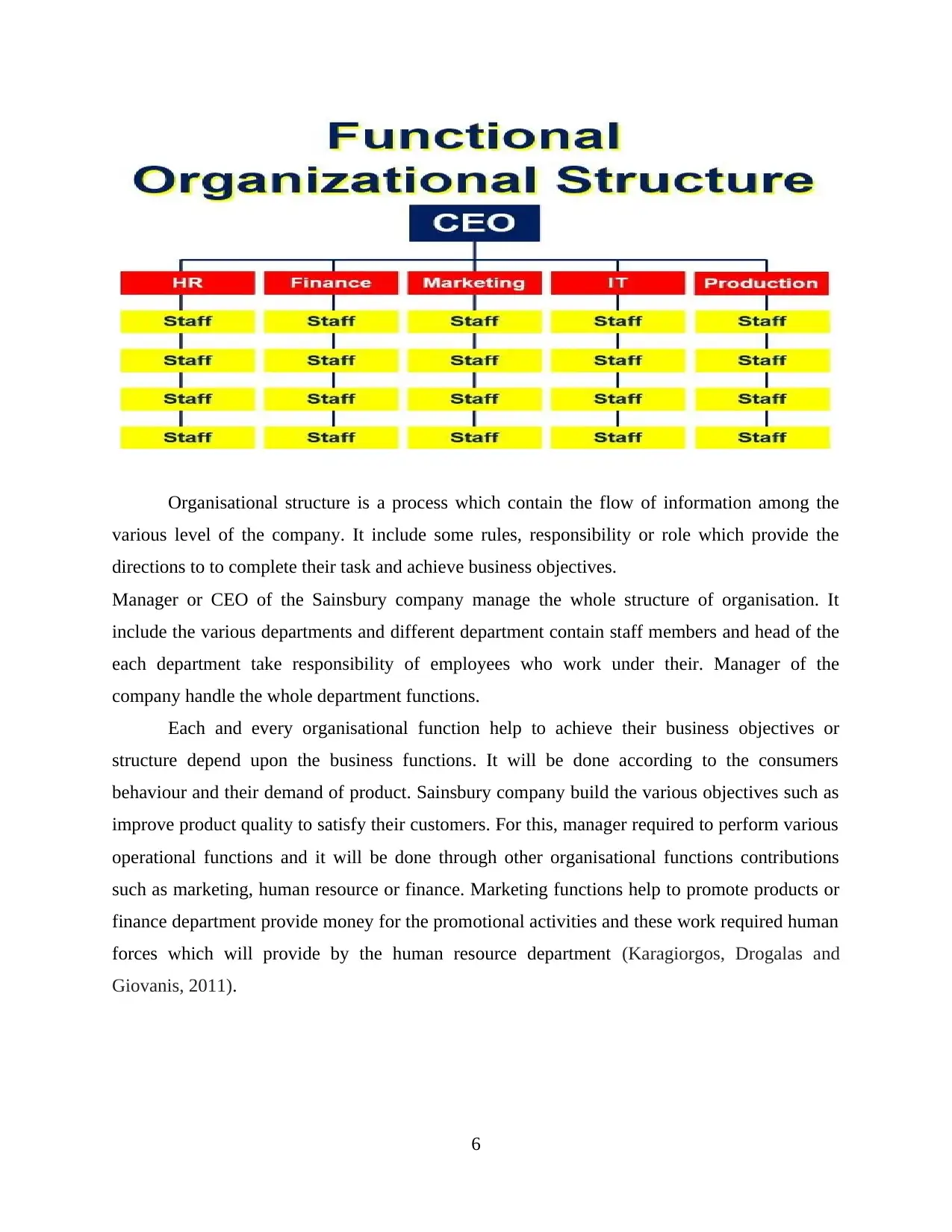
Organisational structure is a process which contain the flow of information among the
various level of the company. It include some rules, responsibility or role which provide the
directions to to complete their task and achieve business objectives.
Manager or CEO of the Sainsbury company manage the whole structure of organisation. It
include the various departments and different department contain staff members and head of the
each department take responsibility of employees who work under their. Manager of the
company handle the whole department functions.
Each and every organisational function help to achieve their business objectives or
structure depend upon the business functions. It will be done according to the consumers
behaviour and their demand of product. Sainsbury company build the various objectives such as
improve product quality to satisfy their customers. For this, manager required to perform various
operational functions and it will be done through other organisational functions contributions
such as marketing, human resource or finance. Marketing functions help to promote products or
finance department provide money for the promotional activities and these work required human
forces which will provide by the human resource department (Karagiorgos, Drogalas and
Giovanis, 2011).
6
various level of the company. It include some rules, responsibility or role which provide the
directions to to complete their task and achieve business objectives.
Manager or CEO of the Sainsbury company manage the whole structure of organisation. It
include the various departments and different department contain staff members and head of the
each department take responsibility of employees who work under their. Manager of the
company handle the whole department functions.
Each and every organisational function help to achieve their business objectives or
structure depend upon the business functions. It will be done according to the consumers
behaviour and their demand of product. Sainsbury company build the various objectives such as
improve product quality to satisfy their customers. For this, manager required to perform various
operational functions and it will be done through other organisational functions contributions
such as marketing, human resource or finance. Marketing functions help to promote products or
finance department provide money for the promotional activities and these work required human
forces which will provide by the human resource department (Karagiorgos, Drogalas and
Giovanis, 2011).
6
⊘ This is a preview!⊘
Do you want full access?
Subscribe today to unlock all pages.
Trusted by 1+ million students worldwide
M2 Analyse the advantage & disadvantage of interrelationship among the various organisational
functions
It has been analysed that organisational functions help to arrange all the function of any
organisation such as marketing, human resource, finance and operating function. It affects the
organisation culture that has some advantages and disadvantages-
Advantages: Interrelationship of employees between different organisational function
helps to maintain cooperation. It also helps to increase employee’s effectiveness in business
activity. Marketing manager finds the needs and wants of customer and provide that kind of
products with the help of finance and operation department. Interrelation of different
departments positively impact the organisational structure and the flow of information timely
deliver among the employees. So company can achieve their business goals and objective with
the effective organisational structure.
Disadvantages: It increases the competition level between various functional branches. It
can be manipulated by the managers that may be harmful for organisations. It increases the job
responsibility by adopting new technology that increases risk between different department. If
manager of the company able to circulate the information so it is negatively impact the company.
Lack of information among the workers will create confusion or disputes which is not good and
company not able to achieve their business goals & objectives.
D1 Critical analysis of different types of business structure and interrelation
It has been evaluated that different organisation such as public, private and voluntary
company has different department like as marketing, finance, operation and human resource
which are interrelated with each other and helps to increase the productivity in any organisation.
Sainsbury faces many problems during its business activities which create a confusion among the
people because of that workers not able to achieve their goals.. All department and it's activities
are interlinked with each other. If any department not fulfl their duty then it will affect the other
departments operational functions too. (Kolk, 2016). Effective organisational structure convey
the information in every level which is helpful for the business to perform well with the help of
department to achieve business goals & objectives.
7
functions
It has been analysed that organisational functions help to arrange all the function of any
organisation such as marketing, human resource, finance and operating function. It affects the
organisation culture that has some advantages and disadvantages-
Advantages: Interrelationship of employees between different organisational function
helps to maintain cooperation. It also helps to increase employee’s effectiveness in business
activity. Marketing manager finds the needs and wants of customer and provide that kind of
products with the help of finance and operation department. Interrelation of different
departments positively impact the organisational structure and the flow of information timely
deliver among the employees. So company can achieve their business goals and objective with
the effective organisational structure.
Disadvantages: It increases the competition level between various functional branches. It
can be manipulated by the managers that may be harmful for organisations. It increases the job
responsibility by adopting new technology that increases risk between different department. If
manager of the company able to circulate the information so it is negatively impact the company.
Lack of information among the workers will create confusion or disputes which is not good and
company not able to achieve their business goals & objectives.
D1 Critical analysis of different types of business structure and interrelation
It has been evaluated that different organisation such as public, private and voluntary
company has different department like as marketing, finance, operation and human resource
which are interrelated with each other and helps to increase the productivity in any organisation.
Sainsbury faces many problems during its business activities which create a confusion among the
people because of that workers not able to achieve their goals.. All department and it's activities
are interlinked with each other. If any department not fulfl their duty then it will affect the other
departments operational functions too. (Kolk, 2016). Effective organisational structure convey
the information in every level which is helpful for the business to perform well with the help of
department to achieve business goals & objectives.
7
Paraphrase This Document
Need a fresh take? Get an instant paraphrase of this document with our AI Paraphraser
P4 Explain the positive or negative impact of macro environmental factors
PESTEL analysis help the organisation to identify their positive as well as negative
impact which affect the business profitability or productivity. There are various factors which
affect the Sainsbury company that are discussed below:
Political factor: Government policies and political stability affect the Sainsbury
company and their operational functions. Which further affect the company's profitability or
productivity and its growth in global market.
Positive: Government policies of different countries such as tax policy, interest rates,
trade restriction etc. influence the Sainsbury company or help them to increase their production.
UK government recently decrease the tax rate which increase the net profit of the company. .
Negative: Some of the service tax rates increase which negatively affect the organisation
because it will reduce the net income of the company. (Nishitani and et. al., 2012).
Economic factor: This factor refers to purchasing power, disposable income or inflation
rate which affected on profitability of production of Sainsbury company.
Positive: Company major focus on their consumers and their disposable income for any
product. So they develop products according to their consumers and price range on the basis of
their disposable income.
Negative: Continuous increment in the wages of labours will increase the labour cost of
the company which decrease the profit of Sainsbury company.
Social factor: These social factors include population, social culture, lifestyle and age
distribution. It will affect the company as well as their profit margin because these factors
important for the business to achieve their goals & objectives.
Positive: Develop their product according to customer's demand and satisfy them through
providing wide range of product which will increase the market share of profitability.
Negative: There are various competitors available in the markets so if consumers are not
satisfy then they will shift on another company's product and biggest competitor is Tesco.
Technological factor: It will include the new technology or innovation in the product or
production process that will lead the organisation to survive in the market for long period.
Positive: Sainsbury use the latest technology in their production process which will
increase the efficiency that will save the time as well as money of the company. Also help the
8
PESTEL analysis help the organisation to identify their positive as well as negative
impact which affect the business profitability or productivity. There are various factors which
affect the Sainsbury company that are discussed below:
Political factor: Government policies and political stability affect the Sainsbury
company and their operational functions. Which further affect the company's profitability or
productivity and its growth in global market.
Positive: Government policies of different countries such as tax policy, interest rates,
trade restriction etc. influence the Sainsbury company or help them to increase their production.
UK government recently decrease the tax rate which increase the net profit of the company. .
Negative: Some of the service tax rates increase which negatively affect the organisation
because it will reduce the net income of the company. (Nishitani and et. al., 2012).
Economic factor: This factor refers to purchasing power, disposable income or inflation
rate which affected on profitability of production of Sainsbury company.
Positive: Company major focus on their consumers and their disposable income for any
product. So they develop products according to their consumers and price range on the basis of
their disposable income.
Negative: Continuous increment in the wages of labours will increase the labour cost of
the company which decrease the profit of Sainsbury company.
Social factor: These social factors include population, social culture, lifestyle and age
distribution. It will affect the company as well as their profit margin because these factors
important for the business to achieve their goals & objectives.
Positive: Develop their product according to customer's demand and satisfy them through
providing wide range of product which will increase the market share of profitability.
Negative: There are various competitors available in the markets so if consumers are not
satisfy then they will shift on another company's product and biggest competitor is Tesco.
Technological factor: It will include the new technology or innovation in the product or
production process that will lead the organisation to survive in the market for long period.
Positive: Sainsbury use the latest technology in their production process which will
increase the efficiency that will save the time as well as money of the company. Also help the
8
organisation run their business according to market or consumer's requirement and it help the
business to grow in the global market.
Negative: New technology required huge investment which is very expensive for the
organisation and company also have to provide training too their works regarding use of this
technology.
Environmental factor: Environmental factors also affect the business such as
environmental law, climate change etc.
Positive: Organisation done various CSR activities which increase the brand value of the
company. Also build a good image among the consumers.
Negative: there are various ethical issues create because of the selling organic foods and
treatment of animals etc.
Legal factor: It include the various legal laws which affect the business and it include
employment law, labour law, discrimination law, etc. These laws will take care external affairs
for the smooth operational functions (Osterwalder and Pigneur, 2010).
Positive: Company follow the all legal laws related to their operations or regarding their
employees such as minimum wages act, employment law.
Negative: Health and safety law become an issue for the Sainsbury company because
some the product quality is not up to the mark.
M3 Application of PESTLE that supports macro environment
PESTEL analysis help the organisation to identify which factor affect the production in
positive or negative way. Because political stability or government rules which is beneficial for
the company can improve the production as well as profitability of Sainsbury company. Other
factors too such as legal or environmental factors can create issues for the business because of
product quality or ethical issues. These factors help the manager oif the company to take
effective decision which increase the productivity as well as profitability of the organisations.
P5 Evaluate internal or external analysis of the organisation in order to identify strength &
weakness
SWOT analysis is a kind of strategic technique which is helpful for the organisations in
analysing their strength, weaknesses, opportunities and threats. This tool is helpful in analysing
internal and external aspect of a business. It helps companies in making future plans and
strategies because it provides a framework to take future decisions. With the use of this, a
9
business to grow in the global market.
Negative: New technology required huge investment which is very expensive for the
organisation and company also have to provide training too their works regarding use of this
technology.
Environmental factor: Environmental factors also affect the business such as
environmental law, climate change etc.
Positive: Organisation done various CSR activities which increase the brand value of the
company. Also build a good image among the consumers.
Negative: there are various ethical issues create because of the selling organic foods and
treatment of animals etc.
Legal factor: It include the various legal laws which affect the business and it include
employment law, labour law, discrimination law, etc. These laws will take care external affairs
for the smooth operational functions (Osterwalder and Pigneur, 2010).
Positive: Company follow the all legal laws related to their operations or regarding their
employees such as minimum wages act, employment law.
Negative: Health and safety law become an issue for the Sainsbury company because
some the product quality is not up to the mark.
M3 Application of PESTLE that supports macro environment
PESTEL analysis help the organisation to identify which factor affect the production in
positive or negative way. Because political stability or government rules which is beneficial for
the company can improve the production as well as profitability of Sainsbury company. Other
factors too such as legal or environmental factors can create issues for the business because of
product quality or ethical issues. These factors help the manager oif the company to take
effective decision which increase the productivity as well as profitability of the organisations.
P5 Evaluate internal or external analysis of the organisation in order to identify strength &
weakness
SWOT analysis is a kind of strategic technique which is helpful for the organisations in
analysing their strength, weaknesses, opportunities and threats. This tool is helpful in analysing
internal and external aspect of a business. It helps companies in making future plans and
strategies because it provides a framework to take future decisions. With the use of this, a
9
⊘ This is a preview!⊘
Do you want full access?
Subscribe today to unlock all pages.
Trusted by 1+ million students worldwide

1 out of 18


Related Documents


Your All-in-One AI-Powered Toolkit for Academic Success.
+13062052269
info@desklib.com
Available 24*7 on WhatsApp / Email
![[object Object]](/_next/static/media/star-bottom.7253800d.svg)
Unlock your academic potential
Copyright © 2020–2026 A2Z Services. All Rights Reserved. Developed and managed by ZUCOL.