Introduction to Business Environment Analysis: Sainsbury's Report
VerifiedAdded on 2020/12/09
|13
|3456
|214
Report
AI Summary
This report provides a comprehensive analysis of Sainsbury's business environment. It begins by differentiating between public, private, and voluntary organizations, then focuses on Sainsbury's operations as a private entity. The report examines stakeholder mapping, detailing how Sainsbury fulfills stakeholder objectives. It proceeds to conduct a macro and micro industry analysis, utilizing PESTLE analysis to assess external factors, SWOT analysis to evaluate internal strengths and weaknesses along with external opportunities and threats, and Porter's Five Forces to determine competitive forces within the market. The report concludes with an overview of the findings, emphasizing the importance of these analytical tools for Sainsbury's strategic decision-making and competitive advantage. The report is a student submission to Desklib, a platform offering study resources.
INTRODUCTION TO
BUSINESS
ENVIRONMENT
BUSINESS
ENVIRONMENT

Paraphrase This Document
Need a fresh take? Get an instant paraphrase of this document with our AI Paraphraser
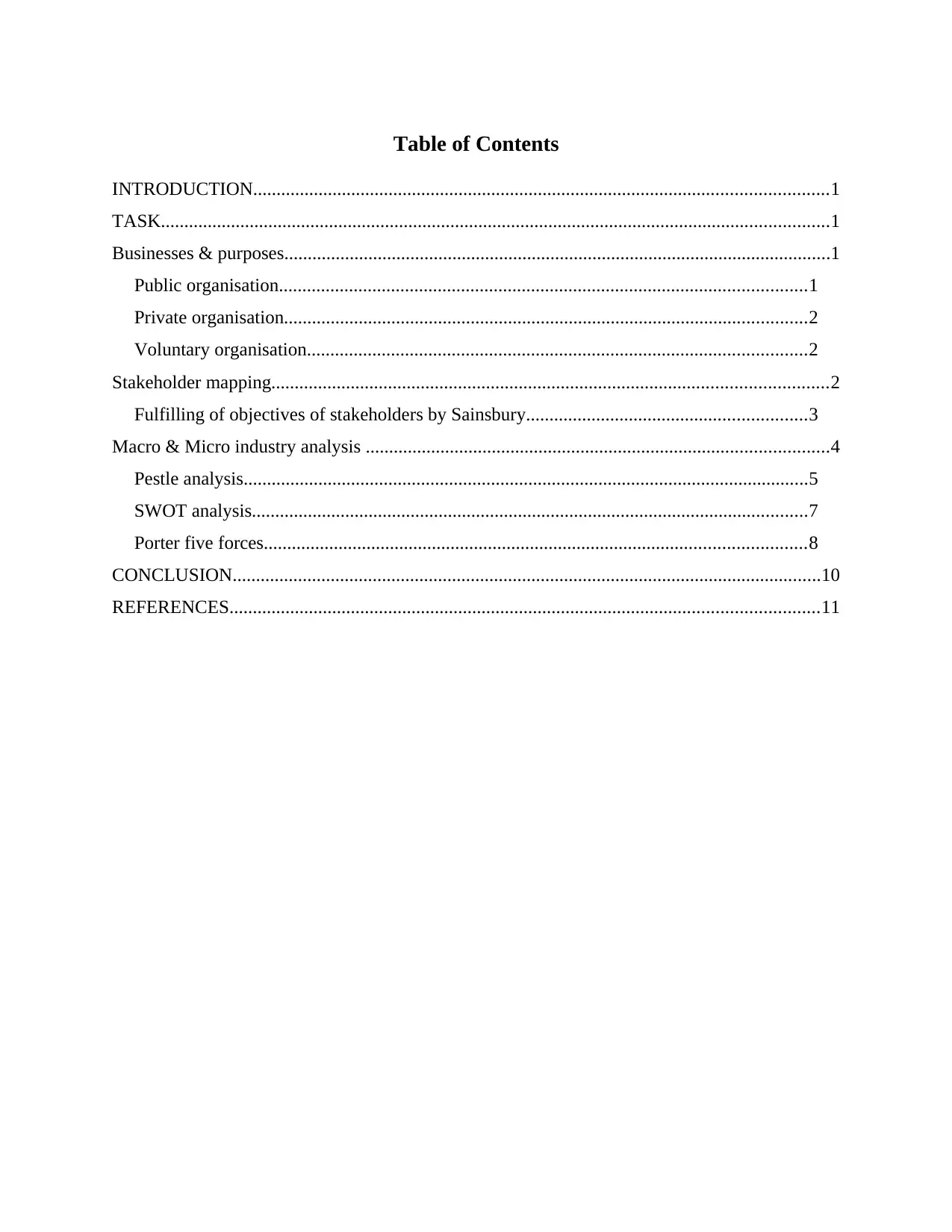
Table of Contents
INTRODUCTION...........................................................................................................................1
TASK...............................................................................................................................................1
Businesses & purposes.....................................................................................................................1
Public organisation.................................................................................................................1
Private organisation................................................................................................................2
Voluntary organisation...........................................................................................................2
Stakeholder mapping.......................................................................................................................2
Fulfilling of objectives of stakeholders by Sainsbury............................................................3
Macro & Micro industry analysis ...................................................................................................4
Pestle analysis.........................................................................................................................5
SWOT analysis.......................................................................................................................7
Porter five forces....................................................................................................................8
CONCLUSION..............................................................................................................................10
REFERENCES..............................................................................................................................11
INTRODUCTION...........................................................................................................................1
TASK...............................................................................................................................................1
Businesses & purposes.....................................................................................................................1
Public organisation.................................................................................................................1
Private organisation................................................................................................................2
Voluntary organisation...........................................................................................................2
Stakeholder mapping.......................................................................................................................2
Fulfilling of objectives of stakeholders by Sainsbury............................................................3
Macro & Micro industry analysis ...................................................................................................4
Pestle analysis.........................................................................................................................5
SWOT analysis.......................................................................................................................7
Porter five forces....................................................................................................................8
CONCLUSION..............................................................................................................................10
REFERENCES..............................................................................................................................11
INTRODUCTION
Business consist of various elements such as employees, resources, products etc. which
are important for an organisation for performing their business operations. These businesses also
need to consider the various factors in decision making or strategy making which can impact the
business operations such as macro and micro environmental factors. These factors must be
overcome by the business firms in order to achieve their predetermined aims and targets. The
taken firm in this assessment is Sainsbury which is a UK based retail firm having operations
through out the UK. The company is employing more than 186,900 employees throughout their
1415 shops in UK. This report will cover the differences between various types of businesses and
their purposes along with the extent up-to which an organisation meets the objectives of different
stakeholders. Further this report will conduct the Pestle analysis, SWOT analysis, Porter five
forces for determining the external and internal macro and micro environmental factors.
TASK
Businesses & purposes
Main aim of any organisation is to satisfy the needs and demand of their customers so
that the firm can achieve their business goals effectively. These organisations are segmented into
three types which are Public, Private and Voluntary. The purpose of all three types of
organisations varies with each other. The purpose and type of organisations are discussed as
follows:
Public organisation
Public organisations refer to the companies in which more than 50% of shares are owned
by the government. These organisations are formed for the welfare of people or to serve the
people and are not focused on earning money or profit (Adeoye and Elegunde, 2012). The
government bears the loss of such organisations and also the money for running the firm is
collected through tax from peoples, different duties etc. National health services (NHS) is a
public organisations of UK which is regulated and owned by the central government of the UK
country. The purpose of NHS is as follows:
To offer quality based treatment and care to the local people of UK in the lowest possible
prices.
To improve the health of the citizens of UK in order to improve the society.
1
Business consist of various elements such as employees, resources, products etc. which
are important for an organisation for performing their business operations. These businesses also
need to consider the various factors in decision making or strategy making which can impact the
business operations such as macro and micro environmental factors. These factors must be
overcome by the business firms in order to achieve their predetermined aims and targets. The
taken firm in this assessment is Sainsbury which is a UK based retail firm having operations
through out the UK. The company is employing more than 186,900 employees throughout their
1415 shops in UK. This report will cover the differences between various types of businesses and
their purposes along with the extent up-to which an organisation meets the objectives of different
stakeholders. Further this report will conduct the Pestle analysis, SWOT analysis, Porter five
forces for determining the external and internal macro and micro environmental factors.
TASK
Businesses & purposes
Main aim of any organisation is to satisfy the needs and demand of their customers so
that the firm can achieve their business goals effectively. These organisations are segmented into
three types which are Public, Private and Voluntary. The purpose of all three types of
organisations varies with each other. The purpose and type of organisations are discussed as
follows:
Public organisation
Public organisations refer to the companies in which more than 50% of shares are owned
by the government. These organisations are formed for the welfare of people or to serve the
people and are not focused on earning money or profit (Adeoye and Elegunde, 2012). The
government bears the loss of such organisations and also the money for running the firm is
collected through tax from peoples, different duties etc. National health services (NHS) is a
public organisations of UK which is regulated and owned by the central government of the UK
country. The purpose of NHS is as follows:
To offer quality based treatment and care to the local people of UK in the lowest possible
prices.
To improve the health of the citizens of UK in order to improve the society.
1
⊘ This is a preview!⊘
Do you want full access?
Subscribe today to unlock all pages.

Trusted by 1+ million students worldwide
Private organisation
These types of organisations are formed by individual or group of individuals in order to
gain maximum profit by offering the products and services to the customers. These are owned by
individuals and government does not play any part in such organisation however the firms need
to follow the rules and regulations set by the government (Boons and Lüdeke-Freund, 2013).
Sainsbury is a UK based firm of private sector which is providing their products and services to
customers in UK for enhancing their profit and revenue. The purpose of the Sainsbury are as
follows:
To fulfil the increasing demand and needs of customers through their products and
services.
To enhance the supermarket chain in order to enhance the market share in retail sector of
UK.
Voluntary organisation
These types of organisations are formed by single or multiple individuals who come
together for improving the society as well as for the welfare of the society. The people in such
organisations act as volunteer. The founder of organisations needs to consider the different laws
of government before starting the firm (Erasmus, Strydom and Rudansky-Kloppers, 2016).
Oxfam is a UK based voluntary organisation who is providing their support to the needy people
suffered from natural, man-made disasters etc. the purpose of Oxfam are as follows:
To enhance the living standard and quality of people suffered from natural or man-made
calamities.
To develop a poverty free environment for the welfare of society and economy.
Stakeholder mapping
Stakeholders are the essential elements of an organisation who provides their support for
the development of the organisation in the marketplace (Hamilton and Webster, 2018). These
stakeholders should be determined by the business firms such as Sainsbury in order to meet their
expectations and objectives. These stakeholders can be identified by the management of
Sainsbury by using the stakeholder mapping. Stakeholder mapping include 3 steps which are
discussed below:
2
These types of organisations are formed by individual or group of individuals in order to
gain maximum profit by offering the products and services to the customers. These are owned by
individuals and government does not play any part in such organisation however the firms need
to follow the rules and regulations set by the government (Boons and Lüdeke-Freund, 2013).
Sainsbury is a UK based firm of private sector which is providing their products and services to
customers in UK for enhancing their profit and revenue. The purpose of the Sainsbury are as
follows:
To fulfil the increasing demand and needs of customers through their products and
services.
To enhance the supermarket chain in order to enhance the market share in retail sector of
UK.
Voluntary organisation
These types of organisations are formed by single or multiple individuals who come
together for improving the society as well as for the welfare of the society. The people in such
organisations act as volunteer. The founder of organisations needs to consider the different laws
of government before starting the firm (Erasmus, Strydom and Rudansky-Kloppers, 2016).
Oxfam is a UK based voluntary organisation who is providing their support to the needy people
suffered from natural, man-made disasters etc. the purpose of Oxfam are as follows:
To enhance the living standard and quality of people suffered from natural or man-made
calamities.
To develop a poverty free environment for the welfare of society and economy.
Stakeholder mapping
Stakeholders are the essential elements of an organisation who provides their support for
the development of the organisation in the marketplace (Hamilton and Webster, 2018). These
stakeholders should be determined by the business firms such as Sainsbury in order to meet their
expectations and objectives. These stakeholders can be identified by the management of
Sainsbury by using the stakeholder mapping. Stakeholder mapping include 3 steps which are
discussed below:
2
Paraphrase This Document
Need a fresh take? Get an instant paraphrase of this document with our AI Paraphraser
Identify the Stakeholders: In this step, management of the Sainsbury should use the
brainstorming technique for determining the stakeholders which are effected by the operations of
the company. These stakeholders includes shareholders, customers, suppliers, investors, etc. who
are providing their support and efforts for the success of the business.
Prioritize the Stakeholders: In this step, management of the Sainsbury needs to analyse
the stakeholders in order to prioritise the stakeholders based on their interest and power. These
stakeholders can be prioritised by determining their influential power on the business and their
interest in the work of company. This step is further divided into four parts as given below: Satisfy: These stakeholders do not have any interest in engaging in the projects of
business however they are highly influential. Such stakeholder for Sainsbury are
Employees, Board of Directors etc. Manage: These are the key stakeholders which are interested in the results of business
operations and also they have a lot of influence. Sainsbury should manage these
stakeholders for building better relationships (Hansen, 2018). Example in context of
Sainsbury includes investors, government etc. Monitor: These stakeholders does not have any influence or interest in the business
however these sits on the periphery of the project. Sainsbury should monitor their
activities for determining their involvement in the organisation. These stakeholder of
Sainsbury are Leaders, managers etc. Inform: These stakeholders have little power for influencing the business operations
however have strong interest in the business operations of Sainsbury. Sainsbury should
determine their needs for ensuring their support. Example of such stakeholder in context
of Sainsbury includes Customers, suppliers etc.
Understand the Key Stakeholders: This is the last step in which the organisation i.e.
Sainsbury needs to determine the expectations of the key stakeholder for which they are
providing their support and effort to organisation (Hilton and Platt, 2013).
Fulfilling of objectives of stakeholders by Sainsbury
The company should fulfil the objectives of their stakeholder in order to ensure their
continuous support to the organisation. For example: for meeting the objectives of customers,
company is providing good quality based products at low prices. For investors, company is
providing good return to them according to their invested amount which is collected through the
3
brainstorming technique for determining the stakeholders which are effected by the operations of
the company. These stakeholders includes shareholders, customers, suppliers, investors, etc. who
are providing their support and efforts for the success of the business.
Prioritize the Stakeholders: In this step, management of the Sainsbury needs to analyse
the stakeholders in order to prioritise the stakeholders based on their interest and power. These
stakeholders can be prioritised by determining their influential power on the business and their
interest in the work of company. This step is further divided into four parts as given below: Satisfy: These stakeholders do not have any interest in engaging in the projects of
business however they are highly influential. Such stakeholder for Sainsbury are
Employees, Board of Directors etc. Manage: These are the key stakeholders which are interested in the results of business
operations and also they have a lot of influence. Sainsbury should manage these
stakeholders for building better relationships (Hansen, 2018). Example in context of
Sainsbury includes investors, government etc. Monitor: These stakeholders does not have any influence or interest in the business
however these sits on the periphery of the project. Sainsbury should monitor their
activities for determining their involvement in the organisation. These stakeholder of
Sainsbury are Leaders, managers etc. Inform: These stakeholders have little power for influencing the business operations
however have strong interest in the business operations of Sainsbury. Sainsbury should
determine their needs for ensuring their support. Example of such stakeholder in context
of Sainsbury includes Customers, suppliers etc.
Understand the Key Stakeholders: This is the last step in which the organisation i.e.
Sainsbury needs to determine the expectations of the key stakeholder for which they are
providing their support and effort to organisation (Hilton and Platt, 2013).
Fulfilling of objectives of stakeholders by Sainsbury
The company should fulfil the objectives of their stakeholder in order to ensure their
continuous support to the organisation. For example: for meeting the objectives of customers,
company is providing good quality based products at low prices. For investors, company is
providing good return to them according to their invested amount which is collected through the
3
selling of products and services. For government, company is ensuring that the laws and
regulations are compiled accordingly so that penalties can be avoided and support can be gained.
For the employees, company is providing them good salary and incentives for ensuring that their
needs are fulfilled. For suppliers, company is purchasing the raw materials at proper cost in order
to ensure their satisfaction (Morrison, 2011). Sainsbury is meeting the objectives of their
stakeholder by meeting their expectations and needs which is essential for their satisfaction too.
When the stakeholders are feeling satisfied and happy with the company then they will provide
their maximum and continuous efforts to the organisation in order to accomplish the
organisational goals.
Macro & Micro industry analysis
A large number of factor exists in the market which can impact the business environment
of Sainsbury. These factors consist of internal and external macro as well as micro environment
factors which should be determined by the company in order to achieve higher growth and
sustainability. The company can use the Pestle analysis for determining the external environment
factors, SWOT analysis for determining the internal and external capabilities and Porter five
forces for determining the market forces (Noe and et. al., 2017). These tools are useful for the
Sainsbury in achieving higher competitive edge over the competitors as they know the factors
which can influence their market position and productivity. These tools are discussed below:
4
regulations are compiled accordingly so that penalties can be avoided and support can be gained.
For the employees, company is providing them good salary and incentives for ensuring that their
needs are fulfilled. For suppliers, company is purchasing the raw materials at proper cost in order
to ensure their satisfaction (Morrison, 2011). Sainsbury is meeting the objectives of their
stakeholder by meeting their expectations and needs which is essential for their satisfaction too.
When the stakeholders are feeling satisfied and happy with the company then they will provide
their maximum and continuous efforts to the organisation in order to accomplish the
organisational goals.
Macro & Micro industry analysis
A large number of factor exists in the market which can impact the business environment
of Sainsbury. These factors consist of internal and external macro as well as micro environment
factors which should be determined by the company in order to achieve higher growth and
sustainability. The company can use the Pestle analysis for determining the external environment
factors, SWOT analysis for determining the internal and external capabilities and Porter five
forces for determining the market forces (Noe and et. al., 2017). These tools are useful for the
Sainsbury in achieving higher competitive edge over the competitors as they know the factors
which can influence their market position and productivity. These tools are discussed below:
4
⊘ This is a preview!⊘
Do you want full access?
Subscribe today to unlock all pages.
Trusted by 1+ million students worldwide
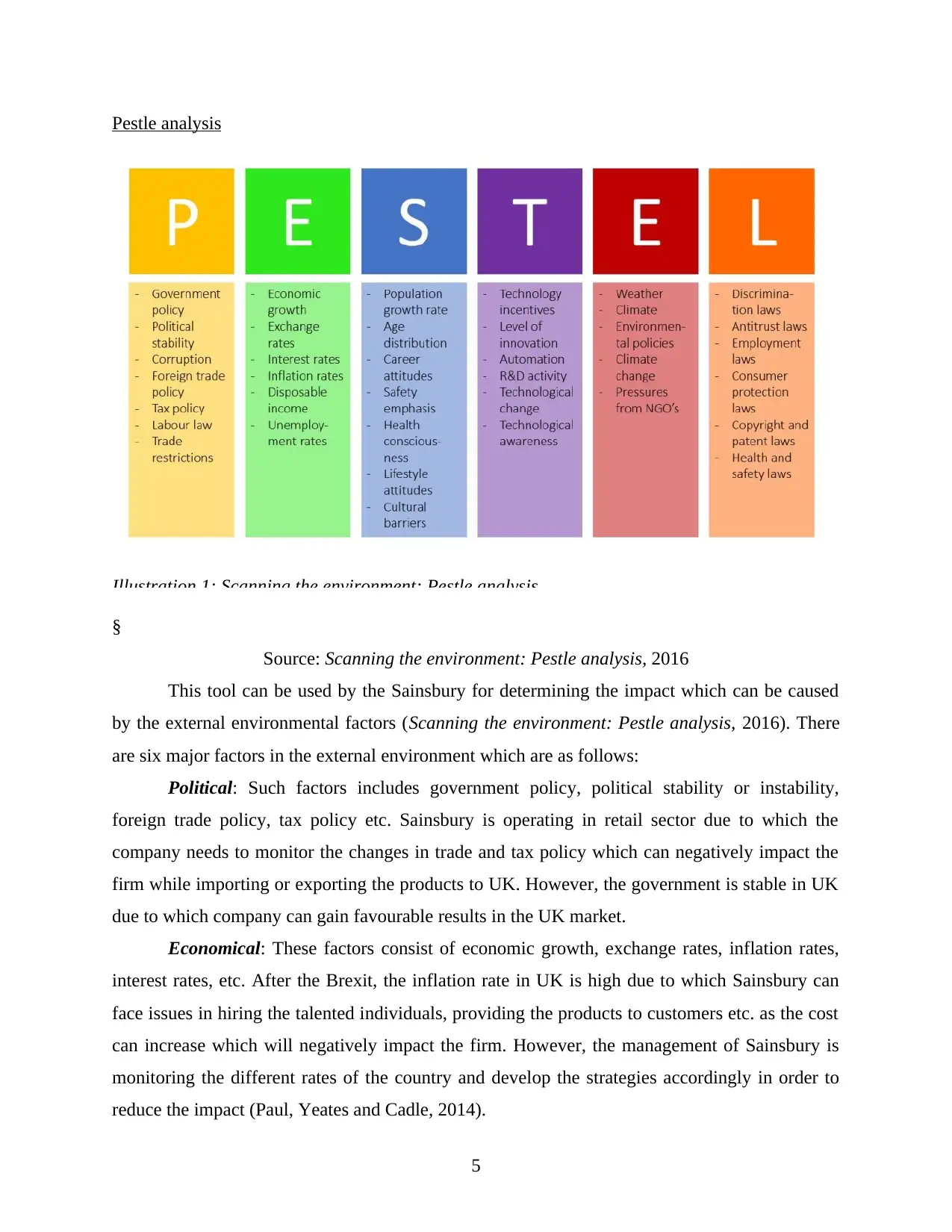
Pestle analysis
Illustration 1: Scanning the environment: Pestle analysis
§
Source: Scanning the environment: Pestle analysis, 2016
This tool can be used by the Sainsbury for determining the impact which can be caused
by the external environmental factors (Scanning the environment: Pestle analysis, 2016). There
are six major factors in the external environment which are as follows:
Political: Such factors includes government policy, political stability or instability,
foreign trade policy, tax policy etc. Sainsbury is operating in retail sector due to which the
company needs to monitor the changes in trade and tax policy which can negatively impact the
firm while importing or exporting the products to UK. However, the government is stable in UK
due to which company can gain favourable results in the UK market.
Economical: These factors consist of economic growth, exchange rates, inflation rates,
interest rates, etc. After the Brexit, the inflation rate in UK is high due to which Sainsbury can
face issues in hiring the talented individuals, providing the products to customers etc. as the cost
can increase which will negatively impact the firm. However, the management of Sainsbury is
monitoring the different rates of the country and develop the strategies accordingly in order to
reduce the impact (Paul, Yeates and Cadle, 2014).
5
Illustration 1: Scanning the environment: Pestle analysis
§
Source: Scanning the environment: Pestle analysis, 2016
This tool can be used by the Sainsbury for determining the impact which can be caused
by the external environmental factors (Scanning the environment: Pestle analysis, 2016). There
are six major factors in the external environment which are as follows:
Political: Such factors includes government policy, political stability or instability,
foreign trade policy, tax policy etc. Sainsbury is operating in retail sector due to which the
company needs to monitor the changes in trade and tax policy which can negatively impact the
firm while importing or exporting the products to UK. However, the government is stable in UK
due to which company can gain favourable results in the UK market.
Economical: These factors consist of economic growth, exchange rates, inflation rates,
interest rates, etc. After the Brexit, the inflation rate in UK is high due to which Sainsbury can
face issues in hiring the talented individuals, providing the products to customers etc. as the cost
can increase which will negatively impact the firm. However, the management of Sainsbury is
monitoring the different rates of the country and develop the strategies accordingly in order to
reduce the impact (Paul, Yeates and Cadle, 2014).
5
Paraphrase This Document
Need a fresh take? Get an instant paraphrase of this document with our AI Paraphraser
Social: These include population growth rate, age distribution, income distribution,
career attitudes, etc. Sainsbury is providing the products to customers according to their needs
and demand which are determined by using the market research and it is positively impacting the
firm. However, the needs and demand of the customers are dynamic in nature due to which the
firm need to conduct the research in particular interval of time which is cost and time consuming
process.
Technological: These factors includes level of innovation, automation, research and
development (R&D) activity, technological change etc. Sainsbury is using the data driven
analytics for determining the customer insights as well as checkout system and the inventory
management which is positively impacting the company (Quinlan and et. al., 2019).
Environmental: These are associated with the scarcity of raw materials, pollution targets
and carbon footprint targets, etc. Sainsbury is using the approach of ‘Reduce, Reuse, Recycle’
for managing the waste, packaging and recycling for their operations so that the carbon
footprints from operations can be reduced.
Legal: Such factors includes the laws and regulations set by the government which
should be followed by business firm. Sainsbury is operating in retail sector due to which the
company is following the laws such as national minimum wage policy, alcohol selling age
legislations, discrimination and fair treatment legislations etc. This is positively impacting the
company as the government interference is avoided by the company (Cadle, Paul and Turner,
2014).
6
career attitudes, etc. Sainsbury is providing the products to customers according to their needs
and demand which are determined by using the market research and it is positively impacting the
firm. However, the needs and demand of the customers are dynamic in nature due to which the
firm need to conduct the research in particular interval of time which is cost and time consuming
process.
Technological: These factors includes level of innovation, automation, research and
development (R&D) activity, technological change etc. Sainsbury is using the data driven
analytics for determining the customer insights as well as checkout system and the inventory
management which is positively impacting the company (Quinlan and et. al., 2019).
Environmental: These are associated with the scarcity of raw materials, pollution targets
and carbon footprint targets, etc. Sainsbury is using the approach of ‘Reduce, Reuse, Recycle’
for managing the waste, packaging and recycling for their operations so that the carbon
footprints from operations can be reduced.
Legal: Such factors includes the laws and regulations set by the government which
should be followed by business firm. Sainsbury is operating in retail sector due to which the
company is following the laws such as national minimum wage policy, alcohol selling age
legislations, discrimination and fair treatment legislations etc. This is positively impacting the
company as the government interference is avoided by the company (Cadle, Paul and Turner,
2014).
6
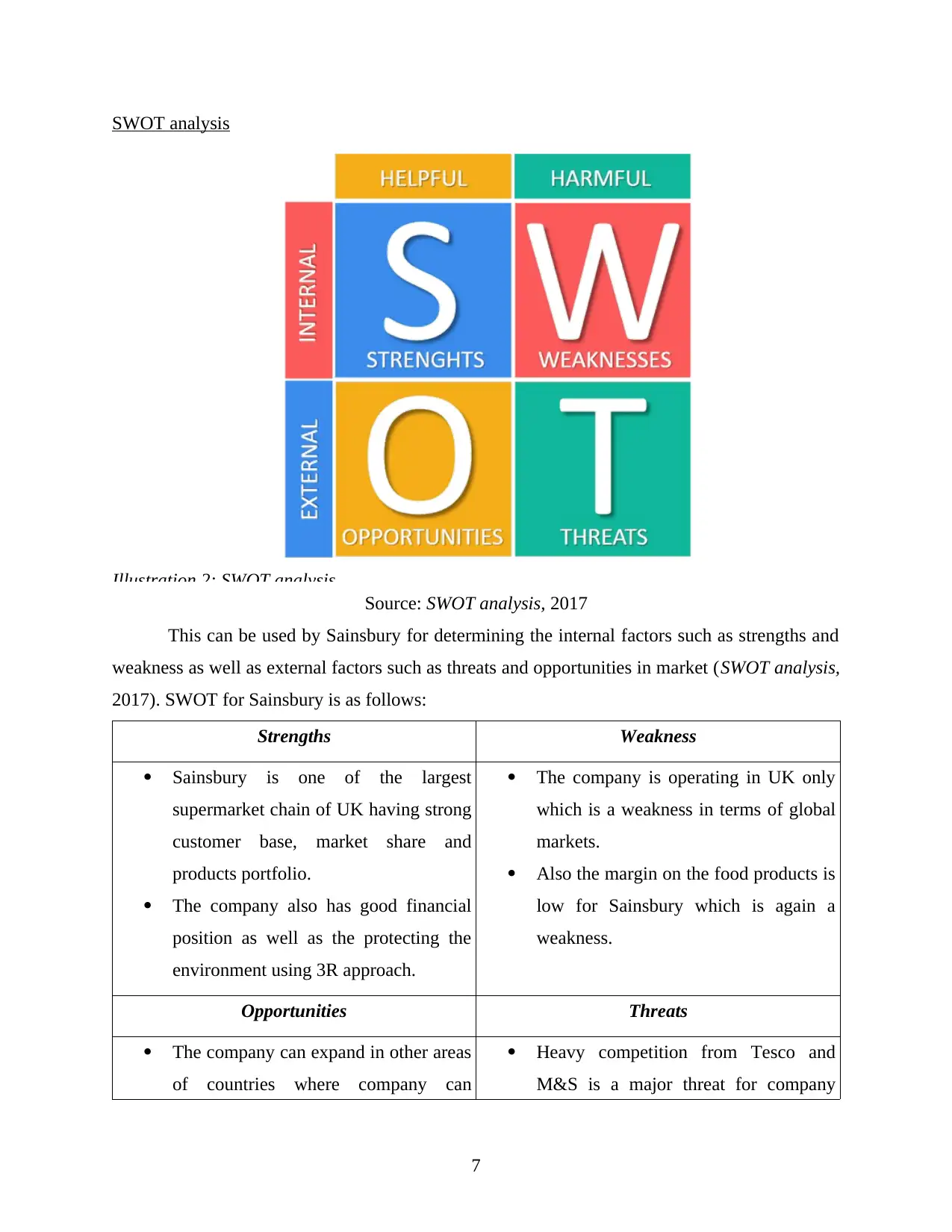
SWOT analysis
Illustration 2: SWOT analysis
Source: SWOT analysis, 2017
This can be used by Sainsbury for determining the internal factors such as strengths and
weakness as well as external factors such as threats and opportunities in market (SWOT analysis,
2017). SWOT for Sainsbury is as follows:
Strengths Weakness
Sainsbury is one of the largest
supermarket chain of UK having strong
customer base, market share and
products portfolio.
The company also has good financial
position as well as the protecting the
environment using 3R approach.
The company is operating in UK only
which is a weakness in terms of global
markets.
Also the margin on the food products is
low for Sainsbury which is again a
weakness.
Opportunities Threats
The company can expand in other areas
of countries where company can
Heavy competition from Tesco and
M&S is a major threat for company
7
Illustration 2: SWOT analysis
Source: SWOT analysis, 2017
This can be used by Sainsbury for determining the internal factors such as strengths and
weakness as well as external factors such as threats and opportunities in market (SWOT analysis,
2017). SWOT for Sainsbury is as follows:
Strengths Weakness
Sainsbury is one of the largest
supermarket chain of UK having strong
customer base, market share and
products portfolio.
The company also has good financial
position as well as the protecting the
environment using 3R approach.
The company is operating in UK only
which is a weakness in terms of global
markets.
Also the margin on the food products is
low for Sainsbury which is again a
weakness.
Opportunities Threats
The company can expand in other areas
of countries where company can
Heavy competition from Tesco and
M&S is a major threat for company
7
⊘ This is a preview!⊘
Do you want full access?
Subscribe today to unlock all pages.
Trusted by 1+ million students worldwide
collaborate with local firms.
Also the use of online platforms and
convenience stores will create
opportunities for company in future as
these can enhance the sales of
company.
which can impact the profitability.
The company need to increase the
prices of their products due to the
Brexit which can also negatively
impact the firm.
Porter five forces
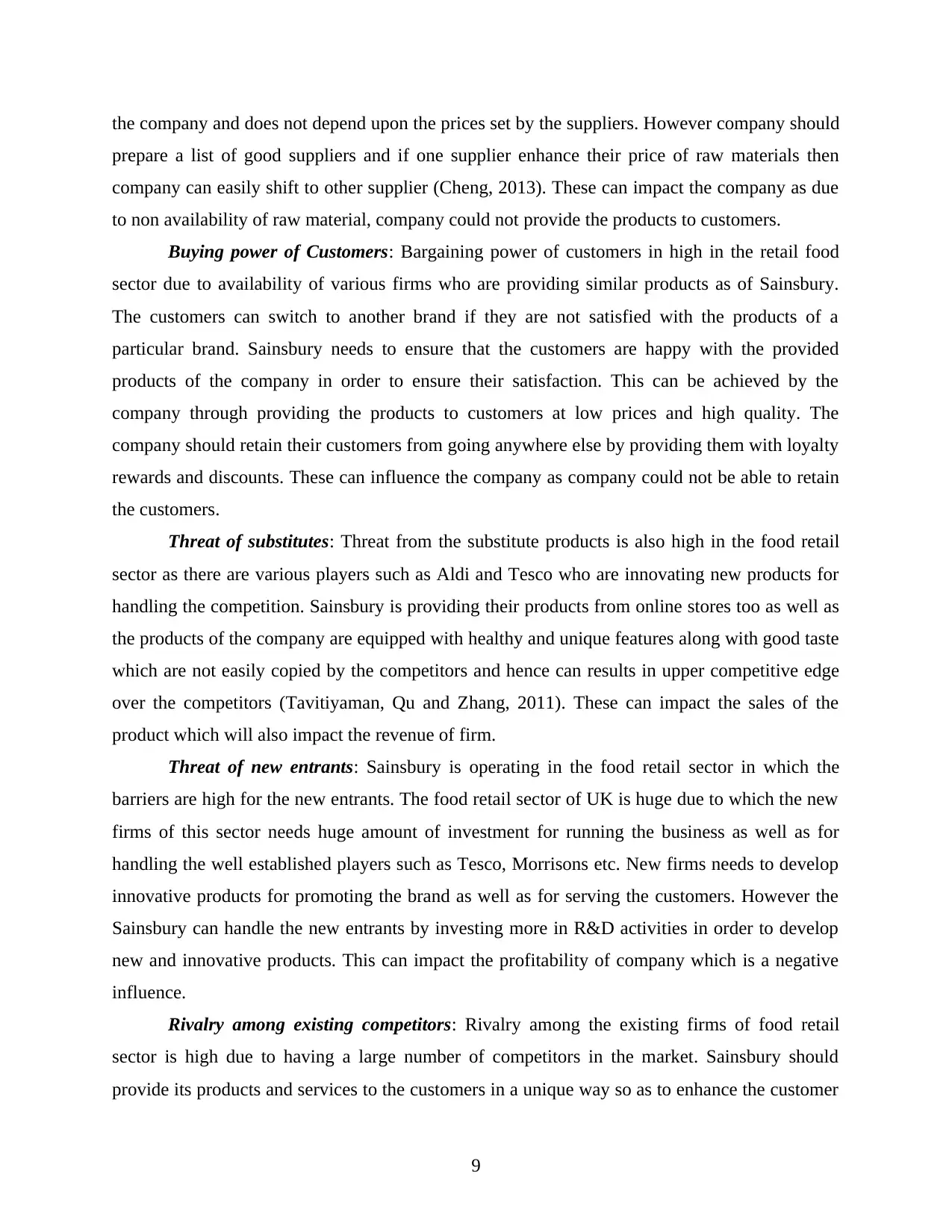
This model can be used by Sainsbury for determining the various forces through which
the company can gain higher position over the rivals of same sector (Porter five forces, 2013).
The forces of this model are as follows:
Illustration 3: Porter five forces
Source: Porter five forces, 2013
Buying power of Suppliers: The bargaining power of suppliers is low in food retail sector
of UK due to having high number of suppliers than the buyers. The products of the suppliers are
fairly standardised, less differentiated and have low switching costs due to which Sainsbury can
switch to another supplier in any difficult situation. Also the prices of products are decided by
8
Also the use of online platforms and
convenience stores will create
opportunities for company in future as
these can enhance the sales of
company.
which can impact the profitability.
The company need to increase the
prices of their products due to the
Brexit which can also negatively
impact the firm.
Porter five forces
This model can be used by Sainsbury for determining the various forces through which
the company can gain higher position over the rivals of same sector (Porter five forces, 2013).
The forces of this model are as follows:
Illustration 3: Porter five forces
Source: Porter five forces, 2013
Buying power of Suppliers: The bargaining power of suppliers is low in food retail sector
of UK due to having high number of suppliers than the buyers. The products of the suppliers are
fairly standardised, less differentiated and have low switching costs due to which Sainsbury can
switch to another supplier in any difficult situation. Also the prices of products are decided by
8
Paraphrase This Document
Need a fresh take? Get an instant paraphrase of this document with our AI Paraphraser
the company and does not depend upon the prices set by the suppliers. However company should
prepare a list of good suppliers and if one supplier enhance their price of raw materials then
company can easily shift to other supplier (Cheng, 2013). These can impact the company as due
to non availability of raw material, company could not provide the products to customers.
Buying power of Customers: Bargaining power of customers in high in the retail food
sector due to availability of various firms who are providing similar products as of Sainsbury.
The customers can switch to another brand if they are not satisfied with the products of a
particular brand. Sainsbury needs to ensure that the customers are happy with the provided
products of the company in order to ensure their satisfaction. This can be achieved by the
company through providing the products to customers at low prices and high quality. The
company should retain their customers from going anywhere else by providing them with loyalty
rewards and discounts. These can influence the company as company could not be able to retain
the customers.
Threat of substitutes: Threat from the substitute products is also high in the food retail
sector as there are various players such as Aldi and Tesco who are innovating new products for
handling the competition. Sainsbury is providing their products from online stores too as well as
the products of the company are equipped with healthy and unique features along with good taste
which are not easily copied by the competitors and hence can results in upper competitive edge
over the competitors (Tavitiyaman, Qu and Zhang, 2011). These can impact the sales of the
product which will also impact the revenue of firm.
Threat of new entrants: Sainsbury is operating in the food retail sector in which the
barriers are high for the new entrants. The food retail sector of UK is huge due to which the new
firms of this sector needs huge amount of investment for running the business as well as for
handling the well established players such as Tesco, Morrisons etc. New firms needs to develop
innovative products for promoting the brand as well as for serving the customers. However the
Sainsbury can handle the new entrants by investing more in R&D activities in order to develop
new and innovative products. This can impact the profitability of company which is a negative
influence.
Rivalry among existing competitors: Rivalry among the existing firms of food retail
sector is high due to having a large number of competitors in the market. Sainsbury should
provide its products and services to the customers in a unique way so as to enhance the customer
9
prepare a list of good suppliers and if one supplier enhance their price of raw materials then
company can easily shift to other supplier (Cheng, 2013). These can impact the company as due
to non availability of raw material, company could not provide the products to customers.
Buying power of Customers: Bargaining power of customers in high in the retail food
sector due to availability of various firms who are providing similar products as of Sainsbury.
The customers can switch to another brand if they are not satisfied with the products of a
particular brand. Sainsbury needs to ensure that the customers are happy with the provided
products of the company in order to ensure their satisfaction. This can be achieved by the
company through providing the products to customers at low prices and high quality. The
company should retain their customers from going anywhere else by providing them with loyalty
rewards and discounts. These can influence the company as company could not be able to retain
the customers.
Threat of substitutes: Threat from the substitute products is also high in the food retail
sector as there are various players such as Aldi and Tesco who are innovating new products for
handling the competition. Sainsbury is providing their products from online stores too as well as
the products of the company are equipped with healthy and unique features along with good taste
which are not easily copied by the competitors and hence can results in upper competitive edge
over the competitors (Tavitiyaman, Qu and Zhang, 2011). These can impact the sales of the
product which will also impact the revenue of firm.
Threat of new entrants: Sainsbury is operating in the food retail sector in which the
barriers are high for the new entrants. The food retail sector of UK is huge due to which the new
firms of this sector needs huge amount of investment for running the business as well as for
handling the well established players such as Tesco, Morrisons etc. New firms needs to develop
innovative products for promoting the brand as well as for serving the customers. However the
Sainsbury can handle the new entrants by investing more in R&D activities in order to develop
new and innovative products. This can impact the profitability of company which is a negative
influence.
Rivalry among existing competitors: Rivalry among the existing firms of food retail
sector is high due to having a large number of competitors in the market. Sainsbury should
provide its products and services to the customers in a unique way so as to enhance the customer
9
satisfaction and loyalty. The firm needs to develop new products which can satisfy the needs of
customers effectively so that the company can gain high competitive advantage over the
competitors. This can influence the company in terms of achieving sustainability and in
enhancing the market share and higher competitive edge.
CONCLUSION
It has been concluded from the above report that there are different types of organisations
having different purpose for which they are formed. These organisations are essential for any
country as they provides support in the development and growth of the country in which the
business operations are running. The companies must fulfil the objectives of their different
stakeholders in order to ensure their satisfaction from the products and services of the
organisation. Also the companies can use the Pestle analysis for determining the external
environment factors, SWOT analysis for determining the internal and external capabilities and
Porter five forces for determining the market forces. Through these tools, companies can
determine their capabilities and weakness which can be overcome through these determinations.
10
customers effectively so that the company can gain high competitive advantage over the
competitors. This can influence the company in terms of achieving sustainability and in
enhancing the market share and higher competitive edge.
CONCLUSION
It has been concluded from the above report that there are different types of organisations
having different purpose for which they are formed. These organisations are essential for any
country as they provides support in the development and growth of the country in which the
business operations are running. The companies must fulfil the objectives of their different
stakeholders in order to ensure their satisfaction from the products and services of the
organisation. Also the companies can use the Pestle analysis for determining the external
environment factors, SWOT analysis for determining the internal and external capabilities and
Porter five forces for determining the market forces. Through these tools, companies can
determine their capabilities and weakness which can be overcome through these determinations.
10
⊘ This is a preview!⊘
Do you want full access?
Subscribe today to unlock all pages.
Trusted by 1+ million students worldwide

1 out of 13


Related Documents


Your All-in-One AI-Powered Toolkit for Academic Success.
+13062052269
info@desklib.com
Available 24*7 on WhatsApp / Email
![[object Object]](/_next/static/media/star-bottom.7253800d.svg)
Unlock your academic potential
Copyright © 2020–2026 A2Z Services. All Rights Reserved. Developed and managed by ZUCOL.