Strategic Analysis: Sainsbury's, Business Environment, & Merger
VerifiedAdded on 2023/04/21
|19
|4791
|249
Report
AI Summary
This report provides an in-depth analysis of Sainsbury's strategic management within the dynamic UK retail industry, focusing on the proposed merger with Asda and its potential implications. It examines the reasons behind the merger, including intense competition from rivals like Tesco, Aldi, Lidl, and Amazon, as well as the perceived opportunity to establish a stronger market position. The report assesses the impact on various stakeholders, such as employees, customers, shareholders, and supply chain partners, considering potential job losses, changes in consumer savings, and ethical concerns. Furthermore, it employs Porter’s Five Forces model and SWOT analysis to evaluate the external environment and Sainsbury's competitive position. The analysis highlights the concerns raised by the Competition Markets Authority (CMA) regarding reduced consumer choice and potential anti-competitive effects. The report concludes with recommendations for mitigating potential negative impacts and ensuring a more favorable outcome for all stakeholders, emphasizing the need for careful consideration of market dynamics and ethical implications. Desklib offers a wealth of similar solved assignments and past papers for students.
Running head: BUSINESS ENVIRONMENT AND STRATEGIC MANAGEMENT
Business Environment and Strategic Management
Name of the Student
Name of the University
Author notes
Business Environment and Strategic Management
Name of the Student
Name of the University
Author notes

Paraphrase This Document
Need a fresh take? Get an instant paraphrase of this document with our AI Paraphraser
1BUSINESS ENVIRONMENT AND STRATEGIC MANAGEMENT
Executive Summary
The retail industry of the United Kingdom can be considered dynamic. Sainsbury’s, who have
been established back in 1860, find themselves in a stable position till date which was backed by
their consistent performance. The company expressed interest in merging with Asda, their long
term rivals whose parent company is Walmart. Both the companies showed leeway on the
proposal which has led to a huge amount of speculation in the market. It has been opined by the
highest regulatory bodies in the territory as unfavourable and that it will lead to deterioration of
end user experience. Sainsbury’s lost its share value and there are subject to much more
devastating consequences. The aim of the paper is to enlarge and elaborate on the case scenario,
its implication, the possible rationale and the effects that the event could have on the
stakeholders. Finally recommendations have been provided regarding how the companies can
mitigate the issue that could possibly exist if the event becomes a reality.
Executive Summary
The retail industry of the United Kingdom can be considered dynamic. Sainsbury’s, who have
been established back in 1860, find themselves in a stable position till date which was backed by
their consistent performance. The company expressed interest in merging with Asda, their long
term rivals whose parent company is Walmart. Both the companies showed leeway on the
proposal which has led to a huge amount of speculation in the market. It has been opined by the
highest regulatory bodies in the territory as unfavourable and that it will lead to deterioration of
end user experience. Sainsbury’s lost its share value and there are subject to much more
devastating consequences. The aim of the paper is to enlarge and elaborate on the case scenario,
its implication, the possible rationale and the effects that the event could have on the
stakeholders. Finally recommendations have been provided regarding how the companies can
mitigate the issue that could possibly exist if the event becomes a reality.
2BUSINESS ENVIRONMENT AND STRATEGIC MANAGEMENT
Table of Contents
Introduction......................................................................................................................................4
Case overview..................................................................................................................................4
Findings and Analysis......................................................................................................................5
Implications.................................................................................................................................5
Reasons behind opting for the merger.........................................................................................6
Intense competition..................................................................................................................6
New market opportunity..........................................................................................................7
The Stakeholders.........................................................................................................................8
The employees.........................................................................................................................8
The customers..........................................................................................................................8
Shareholder..............................................................................................................................9
Supply Chain Relations.........................................................................................................10
The external environment..............................................................................................................10
Porter’s five forces model..........................................................................................................10
SWOT analysis..........................................................................................................................11
The ethical issue............................................................................................................................12
The current scenario..................................................................................................................13
Conclusion and recommendations.................................................................................................13
REFERENCES..............................................................................................................................16
Table of Contents
Introduction......................................................................................................................................4
Case overview..................................................................................................................................4
Findings and Analysis......................................................................................................................5
Implications.................................................................................................................................5
Reasons behind opting for the merger.........................................................................................6
Intense competition..................................................................................................................6
New market opportunity..........................................................................................................7
The Stakeholders.........................................................................................................................8
The employees.........................................................................................................................8
The customers..........................................................................................................................8
Shareholder..............................................................................................................................9
Supply Chain Relations.........................................................................................................10
The external environment..............................................................................................................10
Porter’s five forces model..........................................................................................................10
SWOT analysis..........................................................................................................................11
The ethical issue............................................................................................................................12
The current scenario..................................................................................................................13
Conclusion and recommendations.................................................................................................13
REFERENCES..............................................................................................................................16
⊘ This is a preview!⊘
Do you want full access?
Subscribe today to unlock all pages.

Trusted by 1+ million students worldwide
3BUSINESS ENVIRONMENT AND STRATEGIC MANAGEMENT
Paraphrase This Document
Need a fresh take? Get an instant paraphrase of this document with our AI Paraphraser
4BUSINESS ENVIRONMENT AND STRATEGIC MANAGEMENT
Introduction
Sainsbury’s is a chain of super markets in the United Kingdom. The company was
founded in 1869, and have been responsible for the outbreak of Super market across the United
Kingdom (Alexander 2015). The company has been recognised as one of the first super markets
in the UK and was founded by John James Sainsbury (Alexander 2015). It was the name of the
latter after whom the company was named. The company is based in London, United Kingdom,
with approximately 1400 retail outlets across the United Kingdom (Varley 2014). The company
have also established subsidiaries such as their very own bank. There has been recent discussion
about a merger between Sainsbury’s and another supermarket called Asda. There has been a
great deal of speculation in the topic regarding the causes and implications that this potential
merger can have. The aim of the paper is to develop a proper under understanding of the scenario
that prevails within the company. The following section of the paper will enumerate the key
issue that have been formulated as a result of the same. Furthermore, it will enumerate on the
basic causal effect of mergers in general along with the effects that the merger could have on the
company and its stakeholders.
Case overview
The market of the UK is considered one of the most competitive grocery and
supermarkets in the world (Ochieng et al 2014). This fact was realised by Walmart and they
wanted to offer their subsidiary to Sainsbury. Asda has been also recognised as one of the
leading supermarket specialising in groceries in the market of the United Kingdom (Grundvåg,
Larsen and Young 2014). This proposal was considered by Sainsbury as they saw it as an
opportunity to provide improved services to the consumer community. The former viewed it as
Introduction
Sainsbury’s is a chain of super markets in the United Kingdom. The company was
founded in 1869, and have been responsible for the outbreak of Super market across the United
Kingdom (Alexander 2015). The company has been recognised as one of the first super markets
in the UK and was founded by John James Sainsbury (Alexander 2015). It was the name of the
latter after whom the company was named. The company is based in London, United Kingdom,
with approximately 1400 retail outlets across the United Kingdom (Varley 2014). The company
have also established subsidiaries such as their very own bank. There has been recent discussion
about a merger between Sainsbury’s and another supermarket called Asda. There has been a
great deal of speculation in the topic regarding the causes and implications that this potential
merger can have. The aim of the paper is to develop a proper under understanding of the scenario
that prevails within the company. The following section of the paper will enumerate the key
issue that have been formulated as a result of the same. Furthermore, it will enumerate on the
basic causal effect of mergers in general along with the effects that the merger could have on the
company and its stakeholders.
Case overview
The market of the UK is considered one of the most competitive grocery and
supermarkets in the world (Ochieng et al 2014). This fact was realised by Walmart and they
wanted to offer their subsidiary to Sainsbury. Asda has been also recognised as one of the
leading supermarket specialising in groceries in the market of the United Kingdom (Grundvåg,
Larsen and Young 2014). This proposal was considered by Sainsbury as they saw it as an
opportunity to provide improved services to the consumer community. The former viewed it as
5BUSINESS ENVIRONMENT AND STRATEGIC MANAGEMENT
an opportunity to create a collaborative partnership with a Fortune 500 company while also
trying to capitalise on the expertise offered by Asda. The proposal was deemed to be favourable
by the company and they realised that this would give them access to the supply chain of the
company which could ultimately bolster the performance of the company in providing services
to the community through which the consumers can derive utility. However, the merger could
lead to serious implications such as rise of the cost of service of the products that the final
merger would sell. Thus it has been argued that the proposed merger would have negative
implication such as disapproval of the customer community and loss of the latter’s support.
Findings and Analysis
Implications
The share prices of Sainsbury grew unfavourably by 15% after the information regarding
the merger was announced in public (Sainsburys.co.uk 2019). The Competition Markets
Authority opined that the merger would prove to become unfavourable as the formation of a
merged company will lead to lesser choices that are presented before the consumers in the
market. It can be said the condition of a company in the market is sustained by the response and
nature of behaviour of the consumer community. Thus the response of the consumers and their
behaviour is of key concern of the super markets industry and every other industry that can be
thought of. The Competition Markets Authority is department of the government of the United
Kingdom that deals with activities relating to the competitive scenario within the territory
(Whish, R. and Bailey 2015). The main job of the CMA is to reduce the anti-competitive
activities within the United Kingdom (Davies 2016). Thus their opinion has to be considered as
they are one of the highest non-ministerial regulative bodies of the country. Sainsbury have had
considerably favourable past as per the regulatory body. However the fact that they have not
an opportunity to create a collaborative partnership with a Fortune 500 company while also
trying to capitalise on the expertise offered by Asda. The proposal was deemed to be favourable
by the company and they realised that this would give them access to the supply chain of the
company which could ultimately bolster the performance of the company in providing services
to the community through which the consumers can derive utility. However, the merger could
lead to serious implications such as rise of the cost of service of the products that the final
merger would sell. Thus it has been argued that the proposed merger would have negative
implication such as disapproval of the customer community and loss of the latter’s support.
Findings and Analysis
Implications
The share prices of Sainsbury grew unfavourably by 15% after the information regarding
the merger was announced in public (Sainsburys.co.uk 2019). The Competition Markets
Authority opined that the merger would prove to become unfavourable as the formation of a
merged company will lead to lesser choices that are presented before the consumers in the
market. It can be said the condition of a company in the market is sustained by the response and
nature of behaviour of the consumer community. Thus the response of the consumers and their
behaviour is of key concern of the super markets industry and every other industry that can be
thought of. The Competition Markets Authority is department of the government of the United
Kingdom that deals with activities relating to the competitive scenario within the territory
(Whish, R. and Bailey 2015). The main job of the CMA is to reduce the anti-competitive
activities within the United Kingdom (Davies 2016). Thus their opinion has to be considered as
they are one of the highest non-ministerial regulative bodies of the country. Sainsbury have had
considerably favourable past as per the regulatory body. However the fact that they have not
⊘ This is a preview!⊘
Do you want full access?
Subscribe today to unlock all pages.
Trusted by 1+ million students worldwide
6BUSINESS ENVIRONMENT AND STRATEGIC MANAGEMENT
been able to cater to the changing markets is evident. The latter is the main reason why the
initiative of the Sainsbury’s and Asda merger is deemed to fail as per the opinion of the CMA.
Reasons behind opting for the merger
Intense competition
Sainsbury’s is one of the oldest supermarket of the country (Azeez 2014). They have
been showcasing decent performance that sustained the existence of the company over the years.
The company have been able to satisfy the consumer community adjacent to the M25 and
customer of the chain mainly consisted of white collar buyers (Fuller 2015). They have been
very clear in justifying the price that the super markets offers to its customers. The rationale
behind selection of such a final price is due to the fact that they have been providing the
customers with superior quality goods. Asda have been a rival to the former company (Ritson,
Byrne and Cohen 2018). They have been competing in the industry form when the two started
co-existing in the same market. Asda supermarkets have been able to secure a considerable
portion of the United Kingdom and posed threats to the existence of Sainsbury. Asda’s were the
company, who were considered as one of the most dominant super markets in the northern region
of the province of the United Kingdom (Monios 2015).
Big American names such as Amazon enter the supermarket industry making life difficult
for the aforementioned super market (Keen and Williams 2013). Moreover, new players such as
Lidi, Aldi and Tesco implied that the companies in contention would be facing considerable
amount of competition in the market (Tse et al. 2016). It can be said that Tesco have been a
company who did not have favourable performance in the past (Page 2014). However, the fact
has been realised that the company have been revamped and they are back in contention. Not
only did Tesco’s new and revamped business policy attract loads of customers from the
been able to cater to the changing markets is evident. The latter is the main reason why the
initiative of the Sainsbury’s and Asda merger is deemed to fail as per the opinion of the CMA.
Reasons behind opting for the merger
Intense competition
Sainsbury’s is one of the oldest supermarket of the country (Azeez 2014). They have
been showcasing decent performance that sustained the existence of the company over the years.
The company have been able to satisfy the consumer community adjacent to the M25 and
customer of the chain mainly consisted of white collar buyers (Fuller 2015). They have been
very clear in justifying the price that the super markets offers to its customers. The rationale
behind selection of such a final price is due to the fact that they have been providing the
customers with superior quality goods. Asda have been a rival to the former company (Ritson,
Byrne and Cohen 2018). They have been competing in the industry form when the two started
co-existing in the same market. Asda supermarkets have been able to secure a considerable
portion of the United Kingdom and posed threats to the existence of Sainsbury. Asda’s were the
company, who were considered as one of the most dominant super markets in the northern region
of the province of the United Kingdom (Monios 2015).
Big American names such as Amazon enter the supermarket industry making life difficult
for the aforementioned super market (Keen and Williams 2013). Moreover, new players such as
Lidi, Aldi and Tesco implied that the companies in contention would be facing considerable
amount of competition in the market (Tse et al. 2016). It can be said that Tesco have been a
company who did not have favourable performance in the past (Page 2014). However, the fact
has been realised that the company have been revamped and they are back in contention. Not
only did Tesco’s new and revamped business policy attract loads of customers from the
Paraphrase This Document
Need a fresh take? Get an instant paraphrase of this document with our AI Paraphraser
7BUSINESS ENVIRONMENT AND STRATEGIC MANAGEMENT
companies in contention, it posed a threat of loss of market share for both the parties associated
in the merger. Along with the emergence of Tesco, Lidi, Aldi and Amazon where also posing
serious threats to the existence of the company. One of the biggest challenges came from the part
of Amazon. The latter where already a world renowned company and they were investing in the
retail industry (Newcombe et al. 2015). Furthermore, they had the advantage in terms of
technicality and ability to use the internet. The company’s internet base was already strong and
they entered the market to expand into the same. It is said that customers have a favourable
response to big brand names. There is no point in justifying the brand image of Amazon.
Emergence of foreign competitor including big name such as Amazon was responsible for the
two companies deciding to merge. It is assumed that the rivals decided to collaborate their efforts
as they saw the emergence of new companies to be threatening their own existence. It can be said
that the delusional thinking of the owners and policy makers of the company were responsible
for going for such an unrealistic decision.
New market opportunity
Sainsbury’s were performing favourably in the market and Asda were not very far behind
(Caritte, Acha and Shah 2015). They companies though that they would be establishing a better
position in the market as a result of the merger. They rationale behind the formulation of the idea
was to establish themselves as a monopoly in the market of the United Kingdom. This fact could
be considered if there were very few or no competition in the market. The companies failed to
realise that the idea of monopoly was a paradoxical idea in a market that is as dynamic the
markets that they operated in. The decision to go for a merger was as a result of lack of research
and market awareness form the part of both the companies. They were unaware of the fact that
their aim of achieving a monopolistic nature could not possibly be realised.
companies in contention, it posed a threat of loss of market share for both the parties associated
in the merger. Along with the emergence of Tesco, Lidi, Aldi and Amazon where also posing
serious threats to the existence of the company. One of the biggest challenges came from the part
of Amazon. The latter where already a world renowned company and they were investing in the
retail industry (Newcombe et al. 2015). Furthermore, they had the advantage in terms of
technicality and ability to use the internet. The company’s internet base was already strong and
they entered the market to expand into the same. It is said that customers have a favourable
response to big brand names. There is no point in justifying the brand image of Amazon.
Emergence of foreign competitor including big name such as Amazon was responsible for the
two companies deciding to merge. It is assumed that the rivals decided to collaborate their efforts
as they saw the emergence of new companies to be threatening their own existence. It can be said
that the delusional thinking of the owners and policy makers of the company were responsible
for going for such an unrealistic decision.
New market opportunity
Sainsbury’s were performing favourably in the market and Asda were not very far behind
(Caritte, Acha and Shah 2015). They companies though that they would be establishing a better
position in the market as a result of the merger. They rationale behind the formulation of the idea
was to establish themselves as a monopoly in the market of the United Kingdom. This fact could
be considered if there were very few or no competition in the market. The companies failed to
realise that the idea of monopoly was a paradoxical idea in a market that is as dynamic the
markets that they operated in. The decision to go for a merger was as a result of lack of research
and market awareness form the part of both the companies. They were unaware of the fact that
their aim of achieving a monopolistic nature could not possibly be realised.
8BUSINESS ENVIRONMENT AND STRATEGIC MANAGEMENT
The Stakeholders
The stakeholders of a company can be identified as the customers, the employees of both
the organisations, their shareholders, the supply chains, partners and the community as a whole
(Lawrence and Weber 2014). All major and minor activities of a company have implications on
the stakeholders associated with any company (Rodríguez et al. 2015). It can be said that
favourable information have positive effects on the stakeholders and the reverse happens in
conditions that are deemed to be unfavourable, ceteris paribus.
The employees
It has been inferred by experts that the merger will result in employee dissatisfaction. As
of 2018, there were approximately 186,000 and 165,000 people employed in Sainsbury’s and
Asda respectively. The merger will lead to a combined workforce and it is assumed that this will
lead to losses of Jobs form the part of the employees. The territory of United Kingdom boasts
one of the highest number of people who are employable (Crisp and Powell 2017). However
there are lack of sufficient employment opportunities. Inevitability of loss of jobs will result in
loss of jobs. Furthermore, it has been found that the pay rates of employees at Sainsbury’s are
considerably higher than the employees of Asda. Thus there might be conflict among the
employees if they have to work in under the same roof. Employees of Asda will demand higher
pay and the ones of Sainsbury’s will be dissatisfied and might even consider to leave if there is a
pay cut.
The customers
Both the companies employ a considerable amount of sales promotional activities
(Adams 2015). They offer a fair and generous amounts of discounts to the consumers. The
merger can result in the combined effect of the discount policies of both the companies. The
The Stakeholders
The stakeholders of a company can be identified as the customers, the employees of both
the organisations, their shareholders, the supply chains, partners and the community as a whole
(Lawrence and Weber 2014). All major and minor activities of a company have implications on
the stakeholders associated with any company (Rodríguez et al. 2015). It can be said that
favourable information have positive effects on the stakeholders and the reverse happens in
conditions that are deemed to be unfavourable, ceteris paribus.
The employees
It has been inferred by experts that the merger will result in employee dissatisfaction. As
of 2018, there were approximately 186,000 and 165,000 people employed in Sainsbury’s and
Asda respectively. The merger will lead to a combined workforce and it is assumed that this will
lead to losses of Jobs form the part of the employees. The territory of United Kingdom boasts
one of the highest number of people who are employable (Crisp and Powell 2017). However
there are lack of sufficient employment opportunities. Inevitability of loss of jobs will result in
loss of jobs. Furthermore, it has been found that the pay rates of employees at Sainsbury’s are
considerably higher than the employees of Asda. Thus there might be conflict among the
employees if they have to work in under the same roof. Employees of Asda will demand higher
pay and the ones of Sainsbury’s will be dissatisfied and might even consider to leave if there is a
pay cut.
The customers
Both the companies employ a considerable amount of sales promotional activities
(Adams 2015). They offer a fair and generous amounts of discounts to the consumers. The
merger can result in the combined effect of the discount policies of both the companies. The
⊘ This is a preview!⊘
Do you want full access?
Subscribe today to unlock all pages.
Trusted by 1+ million students worldwide
9BUSINESS ENVIRONMENT AND STRATEGIC MANAGEMENT
newly merged company could offer the consumers of the companies with increased amounts of
discount and offer additional saving. According to the Environment Food and Rural Affairs
Select committee, the company can aim to offer the consumers with offers that they would not be
able to reject. The companies have declared that there would be savings offerings to the
consumer community. However, one should not be too optimistic about the possibility of savings
as the retail markets are subject to serious competition. One of the senior executives of the
Sainsbury’s declared that the merger will incorporate a considerable amount of savings, however
the customers might have to wait for more than one and a half years before the savings policies
are incorporated. Some can also opine that the efforts the company might not even be able to
sustain itself till then considering the unfavourable facts.
Shareholder
It can be said that the information affects the share markets (Cho, Lee and Pfeiffer 2013).
Favourable information makes people invest in a said share and information of unfavourable
nature leads to reduction of investment form the part of the shareholders. The merger can be
perceived by different shareholders in different manners. The shareholders who might support
the company’s vision of merger decision might offer investment to the shares of the company.
The shareholder who would view the merger as unfavourable would refrain from purchasing the
shares of the company. Effects can be catastrophic if the latter takes place. It has been seen that
the consumers and regulatory bodies have not taken the idea of the merger favourably. The share
prices of Sainsbury’s has already dropped by approximately 15% and that can be mainly
accredited to the opinions passed on by the regulatory bodies such as the CMA. Speculation has
been revolving around the merger and the media has played a vital role in the same, thus this
resulted in reduction of share prices of the company.
newly merged company could offer the consumers of the companies with increased amounts of
discount and offer additional saving. According to the Environment Food and Rural Affairs
Select committee, the company can aim to offer the consumers with offers that they would not be
able to reject. The companies have declared that there would be savings offerings to the
consumer community. However, one should not be too optimistic about the possibility of savings
as the retail markets are subject to serious competition. One of the senior executives of the
Sainsbury’s declared that the merger will incorporate a considerable amount of savings, however
the customers might have to wait for more than one and a half years before the savings policies
are incorporated. Some can also opine that the efforts the company might not even be able to
sustain itself till then considering the unfavourable facts.
Shareholder
It can be said that the information affects the share markets (Cho, Lee and Pfeiffer 2013).
Favourable information makes people invest in a said share and information of unfavourable
nature leads to reduction of investment form the part of the shareholders. The merger can be
perceived by different shareholders in different manners. The shareholders who might support
the company’s vision of merger decision might offer investment to the shares of the company.
The shareholder who would view the merger as unfavourable would refrain from purchasing the
shares of the company. Effects can be catastrophic if the latter takes place. It has been seen that
the consumers and regulatory bodies have not taken the idea of the merger favourably. The share
prices of Sainsbury’s has already dropped by approximately 15% and that can be mainly
accredited to the opinions passed on by the regulatory bodies such as the CMA. Speculation has
been revolving around the merger and the media has played a vital role in the same, thus this
resulted in reduction of share prices of the company.
Paraphrase This Document
Need a fresh take? Get an instant paraphrase of this document with our AI Paraphraser
10BUSINESS ENVIRONMENT AND STRATEGIC MANAGEMENT
Supply Chain Relations
The nature of the relation that a company has with the members of the supply chain
determine the nature of productivity of the operations that are conducted between the said
business and the supply partner. Asda is a retailer who specialise in groceries, therefore majority
of their suppliers are farms and vendors. They offer other products as well although it can be said
that majority of their revenue is earned form selling groceries and raw fruits and vegetables. On
the other hand Sainsbury are a company who are dealing in products much more diverse than just
groceries or raw vegetables and fruits. Both the companies have different supply chains and
merging can result in clash between the supply partners of both the companies. The companies
are not only subject to loss of relationship with suppliers, however they are also subject to loss of
overall productivity.
The external environment
The external environment for the operations of the company and the merger will be evaluated
using Porter’s five forces model and SWOT analysis.
Porter’s five forces model
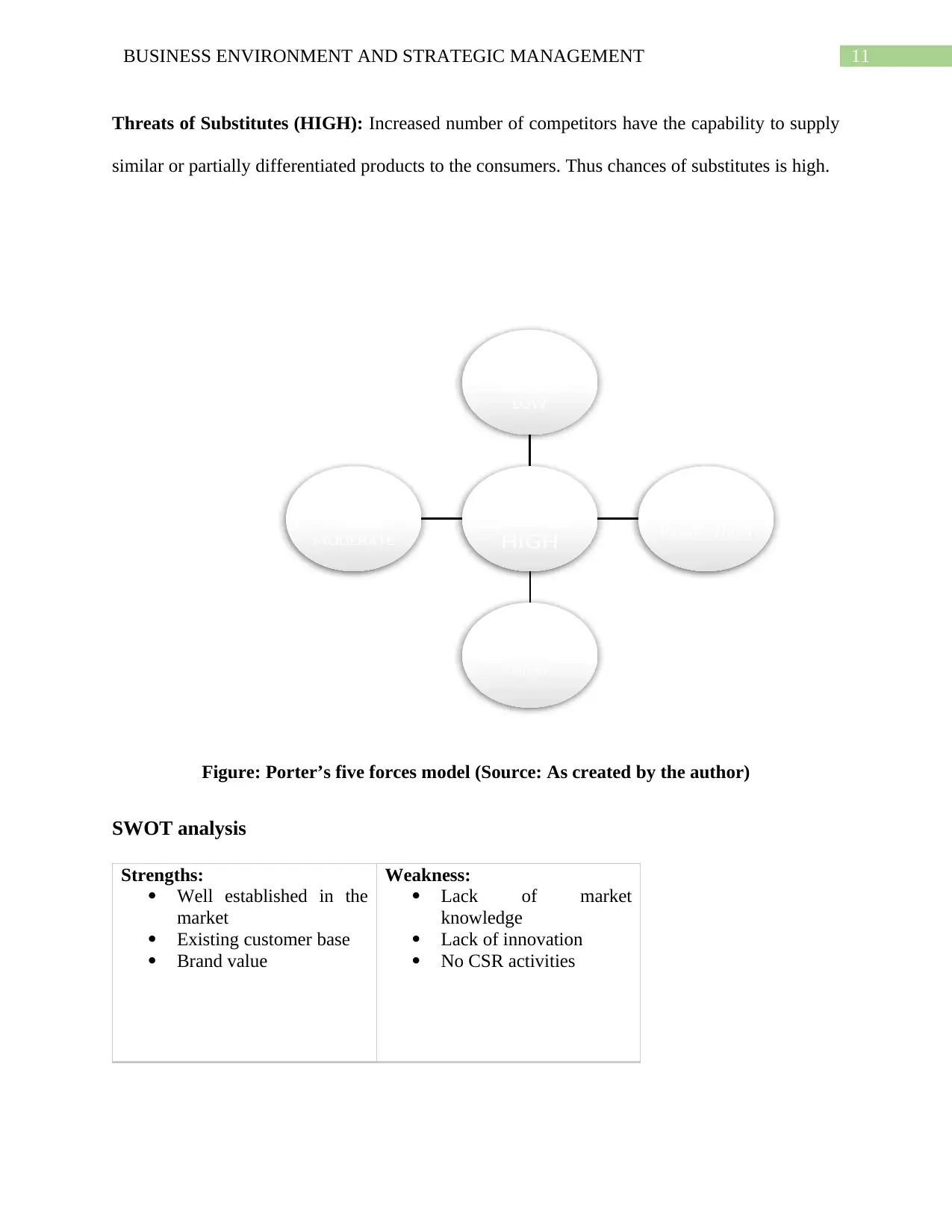
Industry Rivalry (HIGH): There exist high amount of rivalry within the industry.
Bargaining power of the buyers (HIGH): Many players within the industry exist within the
market, thus there is varied range that the customers can choose from.
Bargaining power of the sellers (Moderate): Moderate bargaining power since the nature of
the market is similar to perfect competition.
Threat of new entrant (LOW): There is a chance of entrance of competitors. However, existing
players can make existence difficult for the new entrants.
Supply Chain Relations
The nature of the relation that a company has with the members of the supply chain
determine the nature of productivity of the operations that are conducted between the said
business and the supply partner. Asda is a retailer who specialise in groceries, therefore majority
of their suppliers are farms and vendors. They offer other products as well although it can be said
that majority of their revenue is earned form selling groceries and raw fruits and vegetables. On
the other hand Sainsbury are a company who are dealing in products much more diverse than just
groceries or raw vegetables and fruits. Both the companies have different supply chains and
merging can result in clash between the supply partners of both the companies. The companies
are not only subject to loss of relationship with suppliers, however they are also subject to loss of
overall productivity.
The external environment
The external environment for the operations of the company and the merger will be evaluated
using Porter’s five forces model and SWOT analysis.
Porter’s five forces model
Industry Rivalry (HIGH): There exist high amount of rivalry within the industry.
Bargaining power of the buyers (HIGH): Many players within the industry exist within the
market, thus there is varied range that the customers can choose from.
Bargaining power of the sellers (Moderate): Moderate bargaining power since the nature of
the market is similar to perfect competition.
Threat of new entrant (LOW): There is a chance of entrance of competitors. However, existing
players can make existence difficult for the new entrants.
11BUSINESS ENVIRONMENT AND STRATEGIC MANAGEMENT
Threats of Substitutes (HIGH): Increased number of competitors have the capability to supply
similar or partially differentiated products to the consumers. Thus chances of substitutes is high.
Figure: Porter’s five forces model (Source: As created by the author)
SWOT analysis
Strengths:
Well established in the
market
Existing customer base
Brand value
Weakness:
Lack of market
knowledge
Lack of innovation
No CSR activities
Industry
rivalry:
HIGH
Threat of
new
entrants:
LOW
Bargaining
power of the
buyers: HIGH
Threat of
subsititutes:
HIGH
Bargaining
power of the
sellers:
MODERATE
Threats of Substitutes (HIGH): Increased number of competitors have the capability to supply
similar or partially differentiated products to the consumers. Thus chances of substitutes is high.
Figure: Porter’s five forces model (Source: As created by the author)
SWOT analysis
Strengths:
Well established in the
market
Existing customer base
Brand value
Weakness:
Lack of market
knowledge
Lack of innovation
No CSR activities
Industry
rivalry:
HIGH
Threat of
new
entrants:
LOW
Bargaining
power of the
buyers: HIGH
Threat of
subsititutes:
HIGH
Bargaining
power of the
sellers:
MODERATE
⊘ This is a preview!⊘
Do you want full access?
Subscribe today to unlock all pages.
Trusted by 1+ million students worldwide

1 out of 19


Related Documents


Your All-in-One AI-Powered Toolkit for Academic Success.
+13062052269
info@desklib.com
Available 24*7 on WhatsApp / Email
![[object Object]](/_next/static/media/star-bottom.7253800d.svg)
Unlock your academic potential
Copyright © 2020–2026 A2Z Services. All Rights Reserved. Developed and managed by ZUCOL.