Business Environment: Organizational Functions, Impacts & Analysis
VerifiedAdded on 2024/05/16
|16
|3261
|268
Report
AI Summary
This report provides a comprehensive analysis of the business environment, focusing on different types of organizations, their functions, and the impact of the macro environment. It examines public, private, and voluntary sectors, detailing their legal structures, sizes, and scopes. The report elucidates the relationship between various organizational functions, such as human resources, finance, marketing, and production, and how these functions link to organizational objectives and structure. Furthermore, it identifies the positive and negative impacts of the macro environment on business operations using PESTLE analysis, with specific examples. The report includes an internal and external analysis of Samsung, identifying its strengths and weaknesses through SWOT analysis and explaining how these factors interrelate with external macro factors. The overall goal is to provide a detailed understanding of the business environment and its influence on organizational performance, all while providing students with valuable insights and resources through Desklib.
BUSINESS AND BUSINESS ENVIRONMENT
admin
admin

Paraphrase This Document
Need a fresh take? Get an instant paraphrase of this document with our AI Paraphraser
Table of Contents
INTRODUCTION................................................................................................................................2
TASK 1..............................................................................................................................................3
P1- EXPLAIN DIFFERENT TYPES AND PURPOSES OF ORGANISATIONS; PUBLIC, PRIVATE AND
VOLUNTARY SECTORS AND LEGAL STRUCTURES........................................................................3
P2- EXPLAIN THE SIZE AND SCOPE OF A RANGE OF DIFFERENT TYPES OF ORGANISATIONS.....4
TASK 2..............................................................................................................................................5
P3- EXPLAIN THE RELATIONSHIP BETWEEN DIFFERENT ORGANISATIONAL FUNCTIONS AND
HOW THEY LINK TO ORGANISATIONAL OBJECTIVES AND STRUCTURE.......................................5
TASK 3..............................................................................................................................................7
P4- IDENTIFY THE POSITIVE AND NEGATIVE IMPACTS THE MACRO ENVIRONMENT HAS UPON
BUSINESS OPERATIONS, SUPPORTED BY SPECIFIC EXAMPLES....................................................7
TASK 4..............................................................................................................................................9
P5- CONDUCT INTERNAL AND EXTERNAL ANALYSIS OF SPECIFIC ORGANISATIONS IN ORDER
TO IDENTIFY STRENGTHS AND WEAKNESSES..............................................................................9
P6- EXPLAIN HOW STRENGTHS AND WEAKNESSES INTERRELATE WITH EXTERNAL MACRO
FACTORS....................................................................................................................................11
CONCLUSION.................................................................................................................................12
REFERENCES...................................................................................................................................13
1
INTRODUCTION................................................................................................................................2
TASK 1..............................................................................................................................................3
P1- EXPLAIN DIFFERENT TYPES AND PURPOSES OF ORGANISATIONS; PUBLIC, PRIVATE AND
VOLUNTARY SECTORS AND LEGAL STRUCTURES........................................................................3
P2- EXPLAIN THE SIZE AND SCOPE OF A RANGE OF DIFFERENT TYPES OF ORGANISATIONS.....4
TASK 2..............................................................................................................................................5
P3- EXPLAIN THE RELATIONSHIP BETWEEN DIFFERENT ORGANISATIONAL FUNCTIONS AND
HOW THEY LINK TO ORGANISATIONAL OBJECTIVES AND STRUCTURE.......................................5
TASK 3..............................................................................................................................................7
P4- IDENTIFY THE POSITIVE AND NEGATIVE IMPACTS THE MACRO ENVIRONMENT HAS UPON
BUSINESS OPERATIONS, SUPPORTED BY SPECIFIC EXAMPLES....................................................7
TASK 4..............................................................................................................................................9
P5- CONDUCT INTERNAL AND EXTERNAL ANALYSIS OF SPECIFIC ORGANISATIONS IN ORDER
TO IDENTIFY STRENGTHS AND WEAKNESSES..............................................................................9
P6- EXPLAIN HOW STRENGTHS AND WEAKNESSES INTERRELATE WITH EXTERNAL MACRO
FACTORS....................................................................................................................................11
CONCLUSION.................................................................................................................................12
REFERENCES...................................................................................................................................13
1
INTRODUCTION
Business environment can be defined as the overall factors such as internal and external that
can influence the entire business administration and the operations of working criteria. It
comprises of many factors and important aspects; who are responsible for the success of the
business such as customers, suppliers, government, employees, policies, regulations and
societal activities etc. internal factors or environment of the business is known as the
microenvironment while external environment is called macro factor. In this assignment, the
different types of organization and their size or scope will describe that also demonstrates the
several functions or business operations accordingly. Some of the contemporary approaches
will describe that impacted the overall macro environment will also describe with the specific
terms in accordance with the SWOT analysis of the business by which the negative and positive
both the factors can be analyzed easily. The chosen organization for this assignment is the
Samsung mobile company that is a South Korean multinational brand, which provides
electronic, software and hardware products and services accordingly.
2
Business environment can be defined as the overall factors such as internal and external that
can influence the entire business administration and the operations of working criteria. It
comprises of many factors and important aspects; who are responsible for the success of the
business such as customers, suppliers, government, employees, policies, regulations and
societal activities etc. internal factors or environment of the business is known as the
microenvironment while external environment is called macro factor. In this assignment, the
different types of organization and their size or scope will describe that also demonstrates the
several functions or business operations accordingly. Some of the contemporary approaches
will describe that impacted the overall macro environment will also describe with the specific
terms in accordance with the SWOT analysis of the business by which the negative and positive
both the factors can be analyzed easily. The chosen organization for this assignment is the
Samsung mobile company that is a South Korean multinational brand, which provides
electronic, software and hardware products and services accordingly.
2
⊘ This is a preview!⊘
Do you want full access?
Subscribe today to unlock all pages.

Trusted by 1+ million students worldwide
TASK 1
P1- EXPLAIN DIFFERENT TYPES AND PURPOSES OF ORGANISATIONS; PUBLIC,
PRIVATE AND VOLUNTARY SECTORS AND LEGAL STRUCTURES
The business administration can be referred as the convertible processes that set some of the
specific standards in order to provide services and the goods to the people as per the demands
and requirements of them. The business environment comprises of two major factors such as
micro and macro that can influence the entire business operations and functions. The major key
factors of any business organization are the stakeholders, who are responsible to accomplish
the goals and objectives and make the organization profitable as well (Drucker, 2017). It has
been determined that the resources like human resource, financial resources and some of the
several significant aspects are the major components of the company by which they can easily
gain the advantage and generate revenue as well. It is important for any kind of business to
analyses the needs of their customers and then provides them with such required things in
order to enhance the profitability and the effectiveness. In context to Samsung, which is a
multinational brand that always seeks to gain competitive advantages works according to it and
makes strategies time to time respectively.
Different types of organization-
Public sector
Private organization
Voluntary sector
Public sector: it can be defined as when it is owned by the person itself or even we can say that
it is the self-financing commercial business operation that provides goods and services to the
people. it also refers to a governmental-owned sector. It includes services like the
infrastructure of roads, buildings, etc. military, police, education, healthcare and many more.
These services benefitted the entire society and it emphasized on the values and advantage of
the societal norms accordingly.
3
P1- EXPLAIN DIFFERENT TYPES AND PURPOSES OF ORGANISATIONS; PUBLIC,
PRIVATE AND VOLUNTARY SECTORS AND LEGAL STRUCTURES
The business administration can be referred as the convertible processes that set some of the
specific standards in order to provide services and the goods to the people as per the demands
and requirements of them. The business environment comprises of two major factors such as
micro and macro that can influence the entire business operations and functions. The major key
factors of any business organization are the stakeholders, who are responsible to accomplish
the goals and objectives and make the organization profitable as well (Drucker, 2017). It has
been determined that the resources like human resource, financial resources and some of the
several significant aspects are the major components of the company by which they can easily
gain the advantage and generate revenue as well. It is important for any kind of business to
analyses the needs of their customers and then provides them with such required things in
order to enhance the profitability and the effectiveness. In context to Samsung, which is a
multinational brand that always seeks to gain competitive advantages works according to it and
makes strategies time to time respectively.
Different types of organization-
Public sector
Private organization
Voluntary sector
Public sector: it can be defined as when it is owned by the person itself or even we can say that
it is the self-financing commercial business operation that provides goods and services to the
people. it also refers to a governmental-owned sector. It includes services like the
infrastructure of roads, buildings, etc. military, police, education, healthcare and many more.
These services benefitted the entire society and it emphasized on the values and advantage of
the societal norms accordingly.
3
Paraphrase This Document
Need a fresh take? Get an instant paraphrase of this document with our AI Paraphraser
Private organization: it encompasses for the profit and it is not owned by the government and
any other regulatory bodies and it provides services and goods to the customers outside of the
governments. It is managed and owned by a private enterprise that always works in order to
generate more revenue and making the organization more profitable as well. It can also be
defined as the part of country’s economy (Hillary, 2017).
Voluntary sector: it is called as the non-profit organization, which major aims to provide
services and goods to the customers without any demand for profit or making money. The
major purpose of this kind of organization is to enrich the community and creates social welfare
within the society.
P2- EXPLAIN THE SIZE AND SCOPE OF A RANGE OF DIFFERENT TYPES OF
ORGANISATIONS
Size of the different organization-
As mentioned above that there is majorly three type of organization such as private, public and
the voluntary, which governs services and goods to the customers according to their demands
and needs (Botha, et al. 2014). Private sector company runs their business operations on the
small, Medium and large scale. Whereas the public sector is based on the large business
operations and in another hand, the voluntary sector, the business operation can be comprised
of small and medium basis.
The scope of the business organization-
It can be defined as the various forms that are as follows-
Sole proprietorship: in this kind of business, the owner and the entrepreneur of the business
administration is responsible for all the business norms and he/she can be able to control or
monitor the performances accordingly.
Partnership: when the two or more than two company or owners of the organization
collaborated the functions and set the standards with the help of each other in order to gain
profit and advantages, then it is called partnership business criteria. It can be run on the small
or medium structure basis.
4
any other regulatory bodies and it provides services and goods to the customers outside of the
governments. It is managed and owned by a private enterprise that always works in order to
generate more revenue and making the organization more profitable as well. It can also be
defined as the part of country’s economy (Hillary, 2017).
Voluntary sector: it is called as the non-profit organization, which major aims to provide
services and goods to the customers without any demand for profit or making money. The
major purpose of this kind of organization is to enrich the community and creates social welfare
within the society.
P2- EXPLAIN THE SIZE AND SCOPE OF A RANGE OF DIFFERENT TYPES OF
ORGANISATIONS
Size of the different organization-
As mentioned above that there is majorly three type of organization such as private, public and
the voluntary, which governs services and goods to the customers according to their demands
and needs (Botha, et al. 2014). Private sector company runs their business operations on the
small, Medium and large scale. Whereas the public sector is based on the large business
operations and in another hand, the voluntary sector, the business operation can be comprised
of small and medium basis.
The scope of the business organization-
It can be defined as the various forms that are as follows-
Sole proprietorship: in this kind of business, the owner and the entrepreneur of the business
administration is responsible for all the business norms and he/she can be able to control or
monitor the performances accordingly.
Partnership: when the two or more than two company or owners of the organization
collaborated the functions and set the standards with the help of each other in order to gain
profit and advantages, then it is called partnership business criteria. It can be run on the small
or medium structure basis.
4
Joint stock company: this work of the company can be referred by the amalgamation and in
which the duties and responsibilities of the people are also defined in a manner (Pinto, 2015).
The scope of this kind of business operation is quite complicated.
TASK 2
P3- EXPLAIN THE RELATIONSHIP BETWEEN DIFFERENT ORGANISATIONAL
FUNCTIONS AND HOW THEY LINK TO ORGANISATIONAL OBJECTIVES AND
STRUCTURE
As mentioned above that there are various kinds of organization, which major aims to provide
services and goods to the people as per their requirements and demands. There are various
functional departments are present in the organization, which is based on the business
processes and the quality services. Human resource, finance, management, operational,
production, marketing and many of the functional department is responsible to set the
different standards and works according to the attainment of the organizational goals and
objectives as per their level accordingly (Crane and Matten, 2016). These functions are the
bridge of any organization y which they can easily make the decision and make their plans to
attain it effectively. The human resource department of the company is responsible to recruit
and hire new employees for the organization who can be able to do their work effectively and
helps in the enhancement of the profitability as well. They also conduct training and
development program by which the employees and entire staff can easily develop their skill set
and improves their learning skills too. The effective training program is helpful in the
enhancement of interpersonal growth and also gives the potential strength to the people, so
that they can easily provide the effective or satisfactory services to the customer.
Apart from that, the marketing department is responsible to make the plans for promoting the
services and goods in the marketplace in order to increase awareness and accomplishment of
the organizational goals as well. The production department manufactures the goods with the
help of finance department. So it can be easily analyzed that these all the department of the
organization are interrelated with each other and all they have their own different roles and
5
which the duties and responsibilities of the people are also defined in a manner (Pinto, 2015).
The scope of this kind of business operation is quite complicated.
TASK 2
P3- EXPLAIN THE RELATIONSHIP BETWEEN DIFFERENT ORGANISATIONAL
FUNCTIONS AND HOW THEY LINK TO ORGANISATIONAL OBJECTIVES AND
STRUCTURE
As mentioned above that there are various kinds of organization, which major aims to provide
services and goods to the people as per their requirements and demands. There are various
functional departments are present in the organization, which is based on the business
processes and the quality services. Human resource, finance, management, operational,
production, marketing and many of the functional department is responsible to set the
different standards and works according to the attainment of the organizational goals and
objectives as per their level accordingly (Crane and Matten, 2016). These functions are the
bridge of any organization y which they can easily make the decision and make their plans to
attain it effectively. The human resource department of the company is responsible to recruit
and hire new employees for the organization who can be able to do their work effectively and
helps in the enhancement of the profitability as well. They also conduct training and
development program by which the employees and entire staff can easily develop their skill set
and improves their learning skills too. The effective training program is helpful in the
enhancement of interpersonal growth and also gives the potential strength to the people, so
that they can easily provide the effective or satisfactory services to the customer.
Apart from that, the marketing department is responsible to make the plans for promoting the
services and goods in the marketplace in order to increase awareness and accomplishment of
the organizational goals as well. The production department manufactures the goods with the
help of finance department. So it can be easily analyzed that these all the department of the
organization are interrelated with each other and all they have their own different roles and
5
⊘ This is a preview!⊘
Do you want full access?
Subscribe today to unlock all pages.
Trusted by 1+ million students worldwide
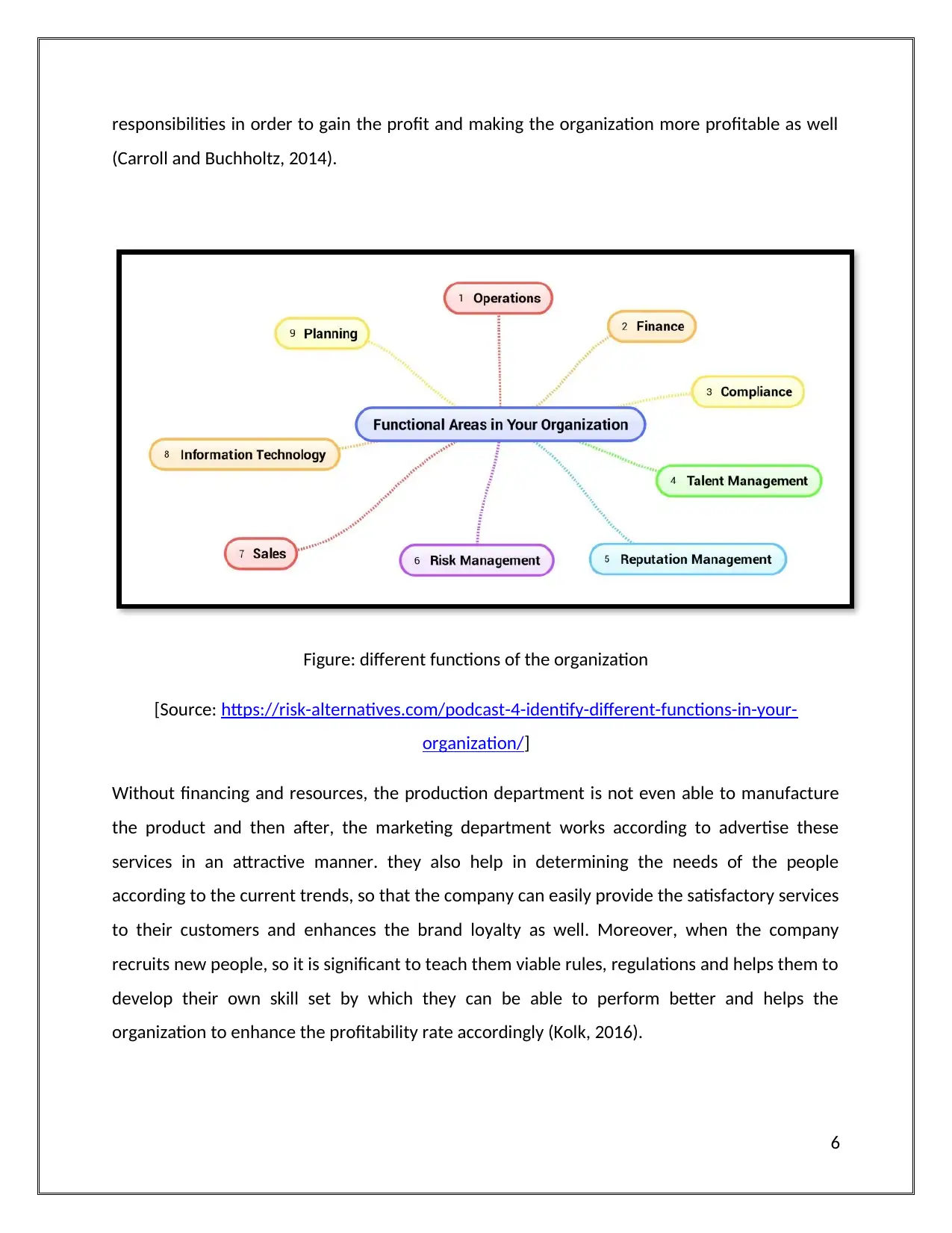
responsibilities in order to gain the profit and making the organization more profitable as well
(Carroll and Buchholtz, 2014).
Figure: different functions of the organization
[Source: https://risk-alternatives.com/podcast-4-identify-different-functions-in-your-
organization/]
Without financing and resources, the production department is not even able to manufacture
the product and then after, the marketing department works according to advertise these
services in an attractive manner. they also help in determining the needs of the people
according to the current trends, so that the company can easily provide the satisfactory services
to their customers and enhances the brand loyalty as well. Moreover, when the company
recruits new people, so it is significant to teach them viable rules, regulations and helps them to
develop their own skill set by which they can be able to perform better and helps the
organization to enhance the profitability rate accordingly (Kolk, 2016).
6
(Carroll and Buchholtz, 2014).
Figure: different functions of the organization
[Source: https://risk-alternatives.com/podcast-4-identify-different-functions-in-your-
organization/]
Without financing and resources, the production department is not even able to manufacture
the product and then after, the marketing department works according to advertise these
services in an attractive manner. they also help in determining the needs of the people
according to the current trends, so that the company can easily provide the satisfactory services
to their customers and enhances the brand loyalty as well. Moreover, when the company
recruits new people, so it is significant to teach them viable rules, regulations and helps them to
develop their own skill set by which they can be able to perform better and helps the
organization to enhance the profitability rate accordingly (Kolk, 2016).
6
Paraphrase This Document
Need a fresh take? Get an instant paraphrase of this document with our AI Paraphraser
The effective business plan has been made by the management department of the company,
which communicated to the entire staff in a good manner and they also allocated the duties of
the different role to the staff members as per their experience and knowledge, which helps in
gaining competitive advantages and also improves the efficiency respectively.
TASK 3
P4- IDENTIFY THE POSITIVE AND NEGATIVE IMPACTS THE MACRO
ENVIRONMENT HAS UPON BUSINESS OPERATIONS, SUPPORTED BY SPECIFIC
EXAMPLES
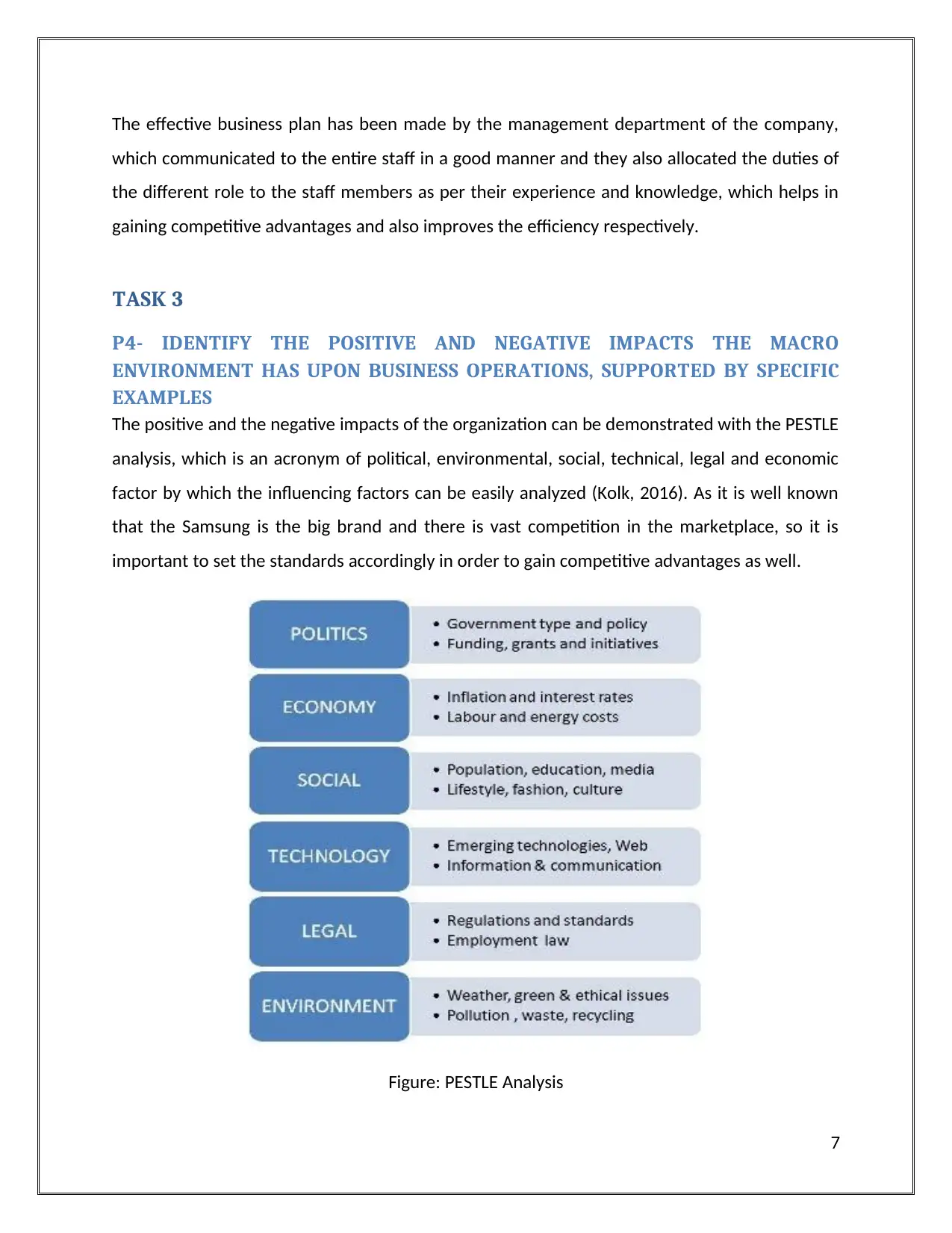
The positive and the negative impacts of the organization can be demonstrated with the PESTLE
analysis, which is an acronym of political, environmental, social, technical, legal and economic
factor by which the influencing factors can be easily analyzed (Kolk, 2016). As it is well known
that the Samsung is the big brand and there is vast competition in the marketplace, so it is
important to set the standards accordingly in order to gain competitive advantages as well.
Figure: PESTLE Analysis
7
which communicated to the entire staff in a good manner and they also allocated the duties of
the different role to the staff members as per their experience and knowledge, which helps in
gaining competitive advantages and also improves the efficiency respectively.
TASK 3
P4- IDENTIFY THE POSITIVE AND NEGATIVE IMPACTS THE MACRO
ENVIRONMENT HAS UPON BUSINESS OPERATIONS, SUPPORTED BY SPECIFIC
EXAMPLES
The positive and the negative impacts of the organization can be demonstrated with the PESTLE
analysis, which is an acronym of political, environmental, social, technical, legal and economic
factor by which the influencing factors can be easily analyzed (Kolk, 2016). As it is well known
that the Samsung is the big brand and there is vast competition in the marketplace, so it is
important to set the standards accordingly in order to gain competitive advantages as well.
Figure: PESTLE Analysis
7
[Source: http://abbasaify.blogspot.in/2013/11/27th-october-2013-4th-november-2013.html]
PESTLE analysis of Samsung-
Political factor: the Samsung operates their business operation in the whole world and
sometimes it faces challenging situations in some countries that create instability or also
threaten the entire business functions. Moreover, in the American or some other countries, the
Samsung has been faced political pressure that changes their governing structure and also
creates issues and problems accordingly.
Economic factor: as Samsung always expand their business functions and in the global market,
they also set different strategies and regulations towards the accomplishment of success but
the economic factor is the major crisis of Samsung Company (Schaltegger, et al. 2016).
Recession, exchange rates and many other economic factors of the company affect the entire
business performances.
Social factor: as it produces smartphones and the electronics, which are the best feature of the
company and the customer loyalty of the company is more likely to be influenced that helps in
improving efficiency.
Technological factor: technical advancement is the most prior factor and it can fasten the
procedures of the business. Innovative ideas and the different developed strategies help the
company to gain competitive advantage and also improve customer loyalty as well.
Legal factor: as it is mentioned that the governmental norms, societal rules and other legal
factors is created problematic situations and affects the entire strategy of the marketplace.
Environmental factor: the major aim of the Samsung is to satisfying the needs of customers
and providing them with such required things according to the trends so that the customer
loyalty can be acquired easily (Wheelen, et al. 2017). By identifying the needs and demands of
the people and then providing such services and goods to them can be helpful in enhancing the
profitability rate and effectiveness accordingly.
8
PESTLE analysis of Samsung-
Political factor: the Samsung operates their business operation in the whole world and
sometimes it faces challenging situations in some countries that create instability or also
threaten the entire business functions. Moreover, in the American or some other countries, the
Samsung has been faced political pressure that changes their governing structure and also
creates issues and problems accordingly.
Economic factor: as Samsung always expand their business functions and in the global market,
they also set different strategies and regulations towards the accomplishment of success but
the economic factor is the major crisis of Samsung Company (Schaltegger, et al. 2016).
Recession, exchange rates and many other economic factors of the company affect the entire
business performances.
Social factor: as it produces smartphones and the electronics, which are the best feature of the
company and the customer loyalty of the company is more likely to be influenced that helps in
improving efficiency.
Technological factor: technical advancement is the most prior factor and it can fasten the
procedures of the business. Innovative ideas and the different developed strategies help the
company to gain competitive advantage and also improve customer loyalty as well.
Legal factor: as it is mentioned that the governmental norms, societal rules and other legal
factors is created problematic situations and affects the entire strategy of the marketplace.
Environmental factor: the major aim of the Samsung is to satisfying the needs of customers
and providing them with such required things according to the trends so that the customer
loyalty can be acquired easily (Wheelen, et al. 2017). By identifying the needs and demands of
the people and then providing such services and goods to them can be helpful in enhancing the
profitability rate and effectiveness accordingly.
8
⊘ This is a preview!⊘
Do you want full access?
Subscribe today to unlock all pages.
Trusted by 1+ million students worldwide
TASK 4
P5- CONDUCT INTERNAL AND EXTERNAL ANALYSIS OF SPECIFIC
ORGANISATIONS IN ORDER TO IDENTIFY STRENGTHS AND WEAKNESSES
Internal and external analysis of the business operations can be determined by the SWOT
analysis of the company that is an acronym of strength, weaknesses, opportunities and the
threats. These are the factors by which the Samsung can easily analyse the internal or external
aspects and then make their plans according to it in order to make strategies for reducing
negative effects as well as strengthen the power accordingly (Schaltegger and Wagner, 2017).
Strengths and weaknesses are the internal analysis while for analyzing the external factor,
opportunities and the threats of the organization can be determined.
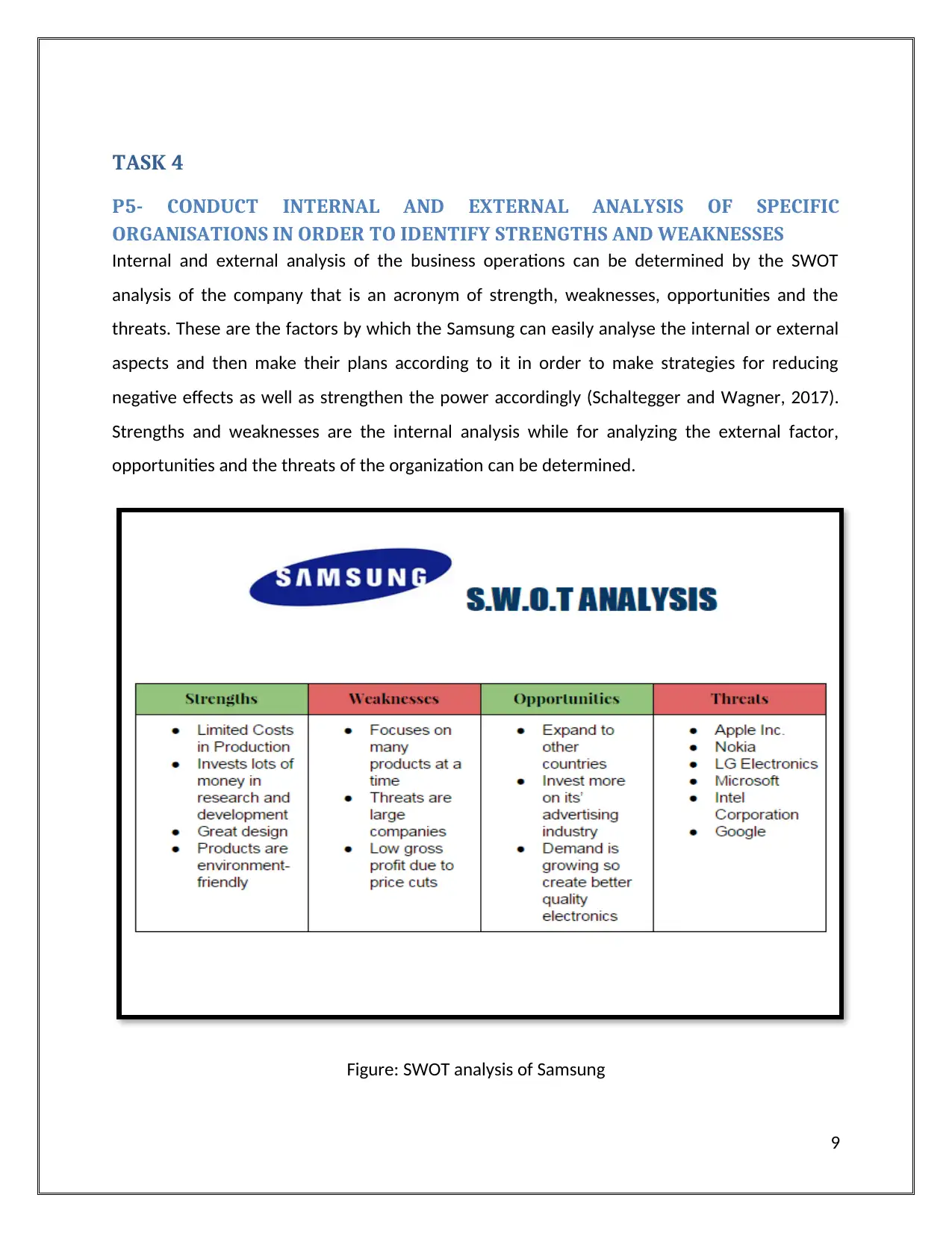
Figure: SWOT analysis of Samsung
9
P5- CONDUCT INTERNAL AND EXTERNAL ANALYSIS OF SPECIFIC
ORGANISATIONS IN ORDER TO IDENTIFY STRENGTHS AND WEAKNESSES
Internal and external analysis of the business operations can be determined by the SWOT
analysis of the company that is an acronym of strength, weaknesses, opportunities and the
threats. These are the factors by which the Samsung can easily analyse the internal or external
aspects and then make their plans according to it in order to make strategies for reducing
negative effects as well as strengthen the power accordingly (Schaltegger and Wagner, 2017).
Strengths and weaknesses are the internal analysis while for analyzing the external factor,
opportunities and the threats of the organization can be determined.
Figure: SWOT analysis of Samsung
9
Paraphrase This Document
Need a fresh take? Get an instant paraphrase of this document with our AI Paraphraser
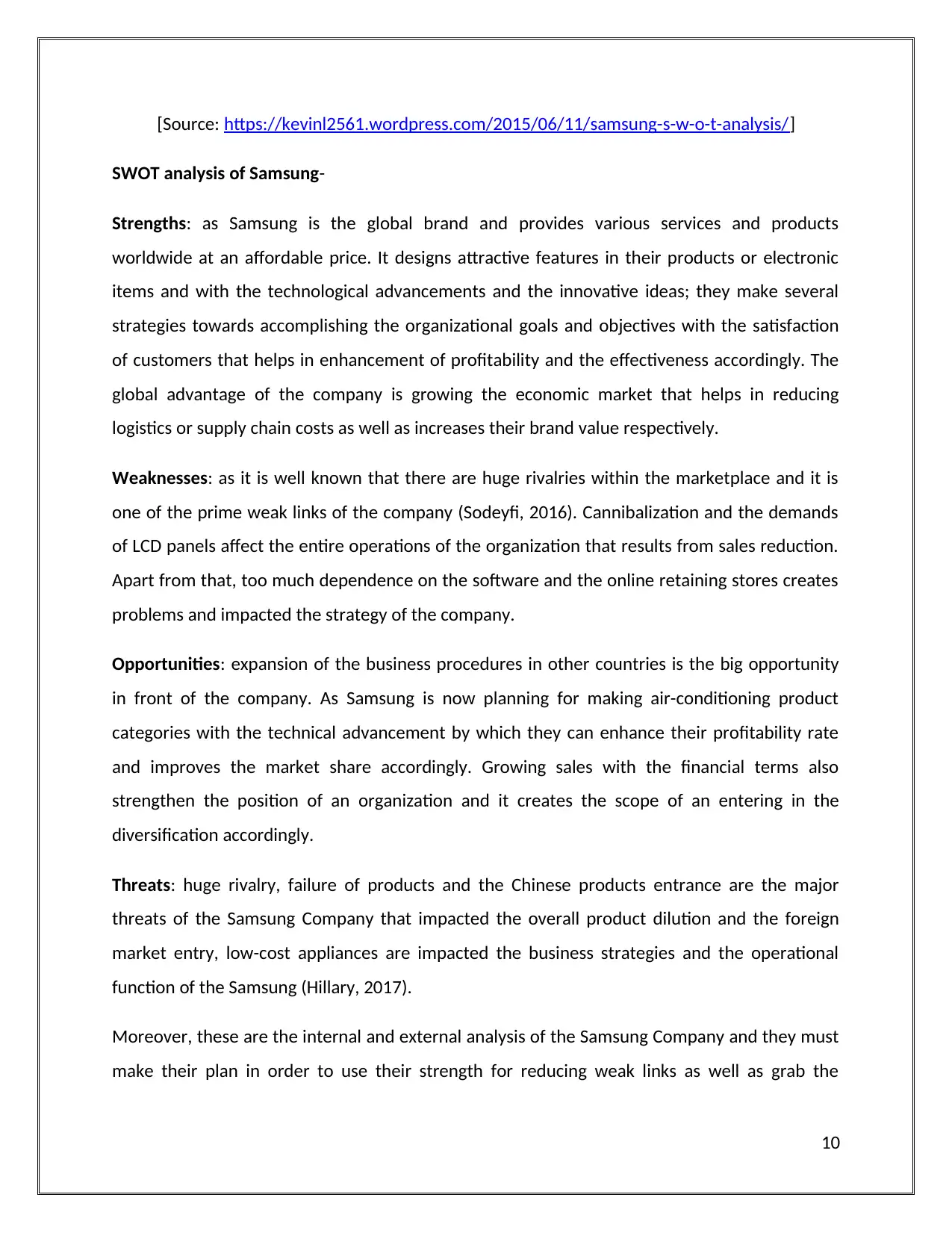
[Source: https://kevinl2561.wordpress.com/2015/06/11/samsung-s-w-o-t-analysis/]
SWOT analysis of Samsung-
Strengths: as Samsung is the global brand and provides various services and products
worldwide at an affordable price. It designs attractive features in their products or electronic
items and with the technological advancements and the innovative ideas; they make several
strategies towards accomplishing the organizational goals and objectives with the satisfaction
of customers that helps in enhancement of profitability and the effectiveness accordingly. The
global advantage of the company is growing the economic market that helps in reducing
logistics or supply chain costs as well as increases their brand value respectively.
Weaknesses: as it is well known that there are huge rivalries within the marketplace and it is
one of the prime weak links of the company (Sodeyfi, 2016). Cannibalization and the demands
of LCD panels affect the entire operations of the organization that results from sales reduction.
Apart from that, too much dependence on the software and the online retaining stores creates
problems and impacted the strategy of the company.
Opportunities: expansion of the business procedures in other countries is the big opportunity
in front of the company. As Samsung is now planning for making air-conditioning product
categories with the technical advancement by which they can enhance their profitability rate
and improves the market share accordingly. Growing sales with the financial terms also
strengthen the position of an organization and it creates the scope of an entering in the
diversification accordingly.
Threats: huge rivalry, failure of products and the Chinese products entrance are the major
threats of the Samsung Company that impacted the overall product dilution and the foreign
market entry, low-cost appliances are impacted the business strategies and the operational
function of the Samsung (Hillary, 2017).
Moreover, these are the internal and external analysis of the Samsung Company and they must
make their plan in order to use their strength for reducing weak links as well as grab the
10
SWOT analysis of Samsung-
Strengths: as Samsung is the global brand and provides various services and products
worldwide at an affordable price. It designs attractive features in their products or electronic
items and with the technological advancements and the innovative ideas; they make several
strategies towards accomplishing the organizational goals and objectives with the satisfaction
of customers that helps in enhancement of profitability and the effectiveness accordingly. The
global advantage of the company is growing the economic market that helps in reducing
logistics or supply chain costs as well as increases their brand value respectively.
Weaknesses: as it is well known that there are huge rivalries within the marketplace and it is
one of the prime weak links of the company (Sodeyfi, 2016). Cannibalization and the demands
of LCD panels affect the entire operations of the organization that results from sales reduction.
Apart from that, too much dependence on the software and the online retaining stores creates
problems and impacted the strategy of the company.
Opportunities: expansion of the business procedures in other countries is the big opportunity
in front of the company. As Samsung is now planning for making air-conditioning product
categories with the technical advancement by which they can enhance their profitability rate
and improves the market share accordingly. Growing sales with the financial terms also
strengthen the position of an organization and it creates the scope of an entering in the
diversification accordingly.
Threats: huge rivalry, failure of products and the Chinese products entrance are the major
threats of the Samsung Company that impacted the overall product dilution and the foreign
market entry, low-cost appliances are impacted the business strategies and the operational
function of the Samsung (Hillary, 2017).
Moreover, these are the internal and external analysis of the Samsung Company and they must
make their plan in order to use their strength for reducing weak links as well as grab the
10
opportunities and mitigating the threating factors as well towards accomplishing the
organizational goals and objectives and gaining the competitive advantages respectively.
P6- EXPLAIN HOW STRENGTHS AND WEAKNESSES INTERRELATE WITH
EXTERNAL MACRO FACTORS
As mentioned above that the internal and external factors of the Samsung company determines
the overall aspects and with the help of this analysis, they can easily make their plans and
strategies for gaining competitive advantages and attaining the organizational goals and
objectives as well (Kolk, 2016). The strengths and the opportunities of the company may give
the potential power to the employees and the entire staff workers so that they can do their
work easily and in an effective manner towards the attainment of the organizational goals and
objectives. The analyzed weak links and the threats are helpful to make the better strategies or
plans by which they can easily reduce these problems and the issues and helps the organization
to make a better plan for the development and the growth accordingly.
Innovation is the crucial part of any organization that also creates a positive environment within
the organization towards generating more revenues and for the profit margin of the
organization. Samsung is capable of designing the products in the more innovative manner that
also increases their customer loyalty and the brand value.
On the other hand, competition, foreign exchange rates, Chinese products and the sales
reduction are the major weak links of the company that must be reduced by the effective
planning strategies with the proper use of company’s strength, so that the people can easily
make their plans gain the competitive advantages respectively (Schaltegger, et al. 2016).
11
organizational goals and objectives and gaining the competitive advantages respectively.
P6- EXPLAIN HOW STRENGTHS AND WEAKNESSES INTERRELATE WITH
EXTERNAL MACRO FACTORS
As mentioned above that the internal and external factors of the Samsung company determines
the overall aspects and with the help of this analysis, they can easily make their plans and
strategies for gaining competitive advantages and attaining the organizational goals and
objectives as well (Kolk, 2016). The strengths and the opportunities of the company may give
the potential power to the employees and the entire staff workers so that they can do their
work easily and in an effective manner towards the attainment of the organizational goals and
objectives. The analyzed weak links and the threats are helpful to make the better strategies or
plans by which they can easily reduce these problems and the issues and helps the organization
to make a better plan for the development and the growth accordingly.
Innovation is the crucial part of any organization that also creates a positive environment within
the organization towards generating more revenues and for the profit margin of the
organization. Samsung is capable of designing the products in the more innovative manner that
also increases their customer loyalty and the brand value.
On the other hand, competition, foreign exchange rates, Chinese products and the sales
reduction are the major weak links of the company that must be reduced by the effective
planning strategies with the proper use of company’s strength, so that the people can easily
make their plans gain the competitive advantages respectively (Schaltegger, et al. 2016).
11
⊘ This is a preview!⊘
Do you want full access?
Subscribe today to unlock all pages.
Trusted by 1+ million students worldwide

1 out of 16


Related Documents


Your All-in-One AI-Powered Toolkit for Academic Success.
+13062052269
info@desklib.com
Available 24*7 on WhatsApp / Email
![[object Object]](/_next/static/media/star-bottom.7253800d.svg)
Unlock your academic potential
Copyright © 2020–2026 A2Z Services. All Rights Reserved. Developed and managed by ZUCOL.