Business Environment Report: Impact of External and Internal Factors
VerifiedAdded on 2020/02/03
|10
|2685
|220
Report
AI Summary
This report provides a comprehensive analysis of the business environment, encompassing various aspects such as types of businesses (sole trader, limited company), their purposes, and ownership structures. It delves into different types of stakeholders and their significance, the organization of businesses in terms of structure and functioning (matrix, functional, product), and how organizational styles contribute to fulfilling business objectives. The report further examines the influence of contrasting economic environments (recession, stability) on business activities, including the impact of credit availability and cost. Additionally, it explores the influence of political, legal, and social factors on businesses like Asda, highlighting the importance of adapting to changing market trends, government regulations, and social dynamics. The analysis emphasizes the need for businesses to identify and address weaknesses and threats within their environment to ensure success.
The Business Environment

Paraphrase This Document
Need a fresh take? Get an instant paraphrase of this document with our AI Paraphraser
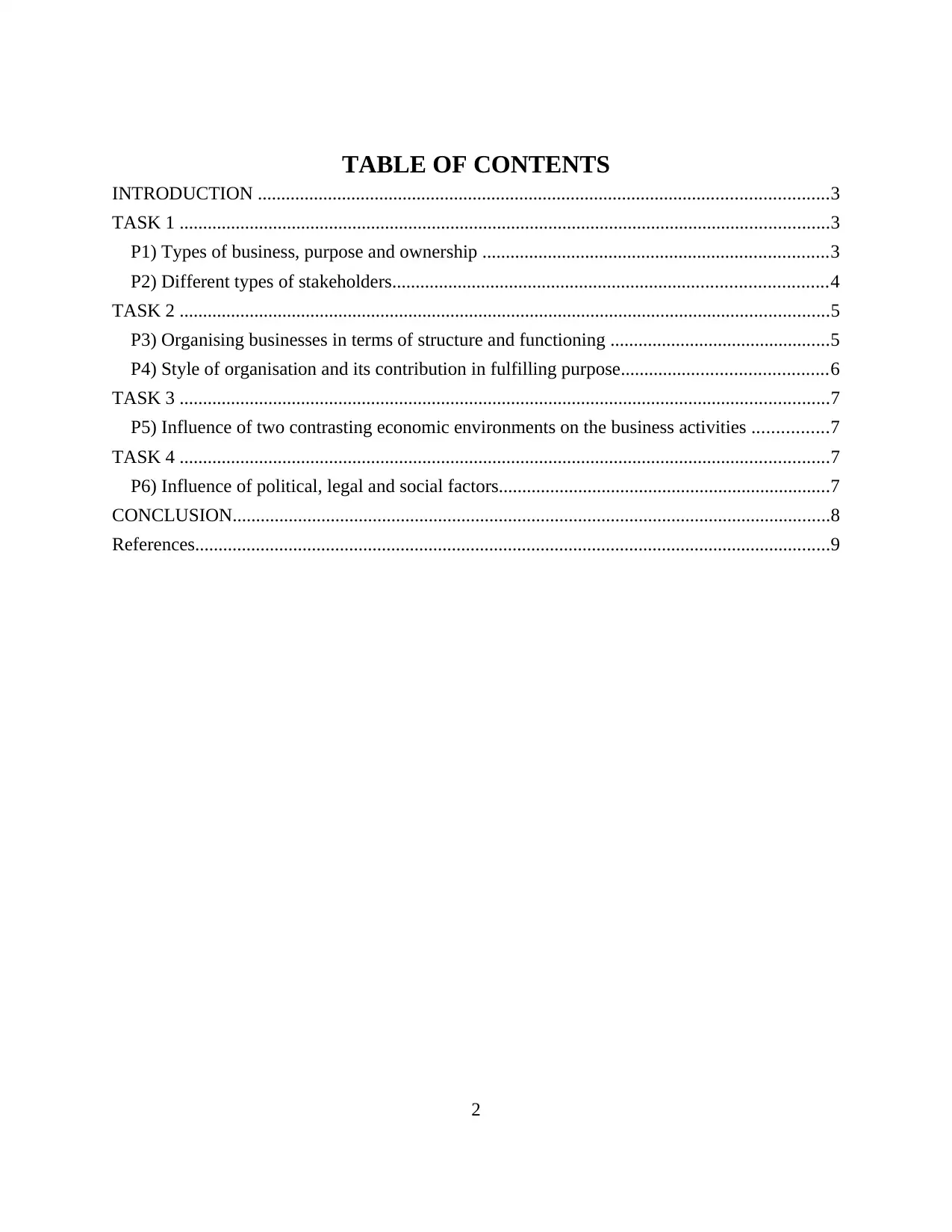
TABLE OF CONTENTS
INTRODUCTION ..........................................................................................................................3
TASK 1 ...........................................................................................................................................3
P1) Types of business, purpose and ownership ..........................................................................3
P2) Different types of stakeholders.............................................................................................4
TASK 2 ...........................................................................................................................................5
P3) Organising businesses in terms of structure and functioning ...............................................5
P4) Style of organisation and its contribution in fulfilling purpose............................................6
TASK 3 ...........................................................................................................................................7
P5) Influence of two contrasting economic environments on the business activities ................7
TASK 4 ...........................................................................................................................................7
P6) Influence of political, legal and social factors.......................................................................7
CONCLUSION................................................................................................................................8
References........................................................................................................................................9
2
INTRODUCTION ..........................................................................................................................3
TASK 1 ...........................................................................................................................................3
P1) Types of business, purpose and ownership ..........................................................................3
P2) Different types of stakeholders.............................................................................................4
TASK 2 ...........................................................................................................................................5
P3) Organising businesses in terms of structure and functioning ...............................................5
P4) Style of organisation and its contribution in fulfilling purpose............................................6
TASK 3 ...........................................................................................................................................7
P5) Influence of two contrasting economic environments on the business activities ................7
TASK 4 ...........................................................................................................................................7
P6) Influence of political, legal and social factors.......................................................................7
CONCLUSION................................................................................................................................8
References........................................................................................................................................9
2
INTRODUCTION
The definition of business environment means all of the internal and external factors that
affect how the company functions including employees, customers, management, supply and
demand and business regulations. In this report, types of business, purpose and ownership ,
different types of stakeholders, Organising businesses in terms of structure and functioning, Style
of organisation and its contribution in fulfilling purpose have been discussed. Furthermore,
Influence of two economic environments on the business activities and Influence of political,
legal and social factors on the two given businesses has been elaborated.
TASK 1
P1) Types of business, purpose and ownership
A sole trader describes any business that is owned and controlled by one person, although
they may employ workers, eg a newsagent's shop. Individuals who provide a specialist service
like hairdressers, plumbers or photographers, are also sole traders. Sole traders do not have a
separate legal existence from their owner (Johnson and Scholes, 2003). As a result, the owners
are personally liable for the firm's debts, and may have to pay them out of their own pocket.
Advantages
The firms are usually small, and easy to set up.
Generally, only a small amount of capital needs to be invested, which reduces the initial
start-up cost.
The wage bill will usually be low, because there a few or no employees. It is easier to keep overall control, because the owner has a hands-on approach to running
the business and can make decisions without consulting anyone else (Hall,2012).
Disadvantages
The sole trader has no one to share the responsibility of running the business with. A
good hairdresser, for example, may not be very good at handling the accounts.
Sole traders often work long hours and find it difficult to take holidays, or time off if they
are ill.
Developing the business is also limited by the amount of capital personally available
(Williamson, et al, 2004).
3
The definition of business environment means all of the internal and external factors that
affect how the company functions including employees, customers, management, supply and
demand and business regulations. In this report, types of business, purpose and ownership ,
different types of stakeholders, Organising businesses in terms of structure and functioning, Style
of organisation and its contribution in fulfilling purpose have been discussed. Furthermore,
Influence of two economic environments on the business activities and Influence of political,
legal and social factors on the two given businesses has been elaborated.
TASK 1
P1) Types of business, purpose and ownership
A sole trader describes any business that is owned and controlled by one person, although
they may employ workers, eg a newsagent's shop. Individuals who provide a specialist service
like hairdressers, plumbers or photographers, are also sole traders. Sole traders do not have a
separate legal existence from their owner (Johnson and Scholes, 2003). As a result, the owners
are personally liable for the firm's debts, and may have to pay them out of their own pocket.
Advantages
The firms are usually small, and easy to set up.
Generally, only a small amount of capital needs to be invested, which reduces the initial
start-up cost.
The wage bill will usually be low, because there a few or no employees. It is easier to keep overall control, because the owner has a hands-on approach to running
the business and can make decisions without consulting anyone else (Hall,2012).
Disadvantages
The sole trader has no one to share the responsibility of running the business with. A
good hairdresser, for example, may not be very good at handling the accounts.
Sole traders often work long hours and find it difficult to take holidays, or time off if they
are ill.
Developing the business is also limited by the amount of capital personally available
(Williamson, et al, 2004).
3
⊘ This is a preview!⊘
Do you want full access?
Subscribe today to unlock all pages.

Trusted by 1+ million students worldwide
There is also the risk of unlimited liability, where the sole trader can be forced to sell
personal assets to cover any business debts.
A limited company has special status in the eyes of the law. These types of company are
incorporated, which means they have their own legal identity and can sue or own assets in their
own right. The ownership of a limited company is divided up into equal parts called shares.
Whoever owns one or more of these is called a shareholder (Palmer and Hartley, 2006).
Because limited companies have their own legal identity, their owners are not personally
liable for the firm's debts. The shareholders have limited liability, which is the major advantage
of this type of business legal structure (Botha, Kourie and Snyman, 2014).
Unlike a sole trader or a partnership, the owners of a limited company are not necessarily
involved in running the business, unless they have been elected to the Board of Directors.
There are two main types of limited company:
A private limited company (ltd) is often a small business such as an independent retailer
in a market town. Shares do not trade on the stock exchange.
A public limited company (plc) is usually a large, well-known business. This could be a
manufacturer or a chain of retailers with branches in most city centres. Shares trade on
the stock exchange.
P2) Different types of stakeholders
Stakeholder refers to anyone with an interest in a given business or organization.
Although all stakeholders can affect or be affected by the organization's actions, objectives, and
policies, not all stakeholders are equal (Lasanthaw 2012). Primary stakeholders are usually
internal stakeholders who engage in economic transactions with the business, such as
shareholders, customers, suppliers, creditors, and employees. In contrast, secondary stakeholders
are usually external stakeholders who may not necessarily engage in direct economic exchange
with the organization.
Funders and Donors
Funders and donors are yet another powerful stakeholder. Funding is the lifeblood of any venture
and is especially important for smaller organizations and non-profits (Riley, 2012).
Employees and customers
4
personal assets to cover any business debts.
A limited company has special status in the eyes of the law. These types of company are
incorporated, which means they have their own legal identity and can sue or own assets in their
own right. The ownership of a limited company is divided up into equal parts called shares.
Whoever owns one or more of these is called a shareholder (Palmer and Hartley, 2006).
Because limited companies have their own legal identity, their owners are not personally
liable for the firm's debts. The shareholders have limited liability, which is the major advantage
of this type of business legal structure (Botha, Kourie and Snyman, 2014).
Unlike a sole trader or a partnership, the owners of a limited company are not necessarily
involved in running the business, unless they have been elected to the Board of Directors.
There are two main types of limited company:
A private limited company (ltd) is often a small business such as an independent retailer
in a market town. Shares do not trade on the stock exchange.
A public limited company (plc) is usually a large, well-known business. This could be a
manufacturer or a chain of retailers with branches in most city centres. Shares trade on
the stock exchange.
P2) Different types of stakeholders
Stakeholder refers to anyone with an interest in a given business or organization.
Although all stakeholders can affect or be affected by the organization's actions, objectives, and
policies, not all stakeholders are equal (Lasanthaw 2012). Primary stakeholders are usually
internal stakeholders who engage in economic transactions with the business, such as
shareholders, customers, suppliers, creditors, and employees. In contrast, secondary stakeholders
are usually external stakeholders who may not necessarily engage in direct economic exchange
with the organization.
Funders and Donors
Funders and donors are yet another powerful stakeholder. Funding is the lifeblood of any venture
and is especially important for smaller organizations and non-profits (Riley, 2012).
Employees and customers
4
Paraphrase This Document
Need a fresh take? Get an instant paraphrase of this document with our AI Paraphraser
Employees one of the most important primary stakeholders in an organization. An employee
contributes labor and/or expertise to an organization, and in many cases they are the connecting
tissue between the products or services being provided and the customer (Peh, 2009).
Board of Directors
The board of directors are considered primary stakeholders with substantial power in the life of
an organization. The board is a body of elected or appointed members who jointly oversee the
activities of a company or organization.
Stockholders
Some of the most powerful primary stakeholders are stockholders. A stockholder, or shareholder,
is an individual or institution that legally owns a share of stock in a public or private corporation.
Suppliers who want the business to continue to buy their products (Bryman, and Bell, 2015).
Lenders who want to be repaid on time and in full.
The community which has a stake in the business as employers of local people. Business activity
also affects the local environment. For example, noisy night-time deliveries or a smelly factory
would be unpopular with local residents.
Direct and Indirect Stakeholders
Direct stakeholders are concerned with the day to day activities of a project. Team members are
direct stakeholders as their workloads are scheduled around the project each workday. Indirect
stakeholders are not impacted by the project. Those not affected are your customers and end
users, because their concern is with the finished project. This would be the quality of
merchandise, price, packaging, and availability (Johnson and Scholes, 2003).
The management of stakeholder responsibility is very important to the success of a project. It's
important to define the various types of stakeholders, their needs or interests, and communicate
with them effectively.
TASK 2
P3) Organising businesses in terms of structure and functioning
Large or small, every organization should operate with a defined organizational structure.
Following are the types of organisational structures:
Matrix Organizational Structure: A matrix structure provides for reporting levels both
horizontally as well as vertically. Employees may be part of a functional group (i.e.
5
contributes labor and/or expertise to an organization, and in many cases they are the connecting
tissue between the products or services being provided and the customer (Peh, 2009).
Board of Directors
The board of directors are considered primary stakeholders with substantial power in the life of
an organization. The board is a body of elected or appointed members who jointly oversee the
activities of a company or organization.
Stockholders
Some of the most powerful primary stakeholders are stockholders. A stockholder, or shareholder,
is an individual or institution that legally owns a share of stock in a public or private corporation.
Suppliers who want the business to continue to buy their products (Bryman, and Bell, 2015).
Lenders who want to be repaid on time and in full.
The community which has a stake in the business as employers of local people. Business activity
also affects the local environment. For example, noisy night-time deliveries or a smelly factory
would be unpopular with local residents.
Direct and Indirect Stakeholders
Direct stakeholders are concerned with the day to day activities of a project. Team members are
direct stakeholders as their workloads are scheduled around the project each workday. Indirect
stakeholders are not impacted by the project. Those not affected are your customers and end
users, because their concern is with the finished project. This would be the quality of
merchandise, price, packaging, and availability (Johnson and Scholes, 2003).
The management of stakeholder responsibility is very important to the success of a project. It's
important to define the various types of stakeholders, their needs or interests, and communicate
with them effectively.
TASK 2
P3) Organising businesses in terms of structure and functioning
Large or small, every organization should operate with a defined organizational structure.
Following are the types of organisational structures:
Matrix Organizational Structure: A matrix structure provides for reporting levels both
horizontally as well as vertically. Employees may be part of a functional group (i.e.
5
engineer) but may serve on a team that supports new product development (i.e. new
album). This kind of structure may have members of different groups working together to
develop a new product line (Belás, Habánik,and Novák, 2014).
Functional Organizational Structure: Functional organizational structures are the most
common. A structure of this type groups individuals by specific functions performed.
Common departments such as human resources, accounting and purchasing are organized
by separating each of these areas and managing them independently of the others.
Product Organizational Structure: Another common structure is to be organized by a
specific product type. Each product group falls within the reporting structure of an
executive and that person oversees everything related to that particular product line.
Following is the organisation of businesses according to functions:
Design and Production
Finance
Human Resources
Sales and Marketing
Administration
Research and Development.
P4) Style of organisation and its contribution in fulfilling purpose
Asda is a company that wants to sell all of the best products to customers and be one of
the best selling supermarkets in the UK. Asda has a hierarchical style which means there are
fewer people at the top of the organisation managing the people below. This style means that the
managing directors of the company at the top of the chart can make all of the key decisions in
which way the businesses performance should go. Each director is accountable for a different
division of the business. For example customer service is very important for the company
because it is the one place that customers will go to ask for help or any problems that they may
have. The company will have one person that manages a large team in head office, at all call
centres and in stores where every colleague is responsible for taking care of each customer.
The IT department also work with all of the departments because they are always looking
for new ways of doing things to help the business progress further. The HR Department work
with all of the department because they are offer training needs and help them recruit key people
6
album). This kind of structure may have members of different groups working together to
develop a new product line (Belás, Habánik,and Novák, 2014).
Functional Organizational Structure: Functional organizational structures are the most
common. A structure of this type groups individuals by specific functions performed.
Common departments such as human resources, accounting and purchasing are organized
by separating each of these areas and managing them independently of the others.
Product Organizational Structure: Another common structure is to be organized by a
specific product type. Each product group falls within the reporting structure of an
executive and that person oversees everything related to that particular product line.
Following is the organisation of businesses according to functions:
Design and Production
Finance
Human Resources
Sales and Marketing
Administration
Research and Development.
P4) Style of organisation and its contribution in fulfilling purpose
Asda is a company that wants to sell all of the best products to customers and be one of
the best selling supermarkets in the UK. Asda has a hierarchical style which means there are
fewer people at the top of the organisation managing the people below. This style means that the
managing directors of the company at the top of the chart can make all of the key decisions in
which way the businesses performance should go. Each director is accountable for a different
division of the business. For example customer service is very important for the company
because it is the one place that customers will go to ask for help or any problems that they may
have. The company will have one person that manages a large team in head office, at all call
centres and in stores where every colleague is responsible for taking care of each customer.
The IT department also work with all of the departments because they are always looking
for new ways of doing things to help the business progress further. The HR Department work
with all of the department because they are offer training needs and help them recruit key people
6
⊘ This is a preview!⊘
Do you want full access?
Subscribe today to unlock all pages.
Trusted by 1+ million students worldwide
for the different functional areas that the business have. The PR Department work closely with
the press which means that if there are any stories to report about Asda then these are the people
that will give this information to them. The Finance Department manages things like employees /
payroll / invoice payments / P&L / balance sheets and business performance.
TASK 3
P5) Influence of two contrasting economic environments on the business activities
The economic environment is the totality of economic factors, such as employment,
income, inflation, interest rates, productivity, and wealth, that influence the buying behavior of
consumers and institutions.
Recession is when there is a decrease in growth and this can be because of two reasons, the first
is that the consumer is cutting back on the amount on which they are spending (they may be
saving more instead of spending) and this will lead to the manufactures to cut back on how much
they order from suppliers and then this will result in cut backs and this will then lead to business
making people redundant because they cannot afford to hire them.
Stability in the economy is forever changing again for good and bad and it all depends on if we
have changed are buying habits, if we spend more we will have a strong and stable economy and
it’s the opposite for a bad and unstable economy, if people spend less and save more the
economy will begin to full because the money is not being spent.
Availability and cost of credit (borrowing money) is the rate of interest, when the interest rate
rises this can affect the business badly because this means that the business will have to pay
additional costs and if the business is not good financially then this may put them in the breaking
point and they will go bankrupt.
TASK 4
P6) Influence of political, legal and social factors
Political: Asda will continue to face many trends that will change the market for better or worse.
The government may have a major effect on Asda when it comes to changes in government laws
such as taxation, price restrictions, and how money is managed. Asda will try to meet all
government regulations while pursuing the retail market.
7
the press which means that if there are any stories to report about Asda then these are the people
that will give this information to them. The Finance Department manages things like employees /
payroll / invoice payments / P&L / balance sheets and business performance.
TASK 3
P5) Influence of two contrasting economic environments on the business activities
The economic environment is the totality of economic factors, such as employment,
income, inflation, interest rates, productivity, and wealth, that influence the buying behavior of
consumers and institutions.
Recession is when there is a decrease in growth and this can be because of two reasons, the first
is that the consumer is cutting back on the amount on which they are spending (they may be
saving more instead of spending) and this will lead to the manufactures to cut back on how much
they order from suppliers and then this will result in cut backs and this will then lead to business
making people redundant because they cannot afford to hire them.
Stability in the economy is forever changing again for good and bad and it all depends on if we
have changed are buying habits, if we spend more we will have a strong and stable economy and
it’s the opposite for a bad and unstable economy, if people spend less and save more the
economy will begin to full because the money is not being spent.
Availability and cost of credit (borrowing money) is the rate of interest, when the interest rate
rises this can affect the business badly because this means that the business will have to pay
additional costs and if the business is not good financially then this may put them in the breaking
point and they will go bankrupt.
TASK 4
P6) Influence of political, legal and social factors
Political: Asda will continue to face many trends that will change the market for better or worse.
The government may have a major effect on Asda when it comes to changes in government laws
such as taxation, price restrictions, and how money is managed. Asda will try to meet all
government regulations while pursuing the retail market.
7
Paraphrase This Document
Need a fresh take? Get an instant paraphrase of this document with our AI Paraphraser
Social: Changes in social trends can affect the demand for Asda's food and non-food products
and the availability and willingness of individuals to work for it. In the UK, for example, there is
a growing pool of retired workers willing to work to supplement their pensions. Asda have
started to recruit older employees to tap into this growing labour pool.
Legal:Asda need to be aware of planning permission regulations and make sure that continued
store expansions complies with planning regulations. Planning permission is heavily regulated
in the UK. A PESTLE analysis would help Asda to identify relevant planning laws and comply
with them to reduce any disruption to his store expansion programme by local people's dissent or
the local authority refusal. The analysis would assess the potential success of opening a new
store in an area.
CONCLUSION
As a conclusion, business environment involve internal and external environment. A
firm maybe strong in certain areas and it may be weak in some other areas. The firm should
identify weaknesses and threats so as to correct it as early as possible. The higher the likelihood
of it occurring, the greater the impact of any change and the more significant this factor will be
to the firm's planning. Through this report one can understand the the type of business if it is a
sole trader, partnership or private limited organisation and their purpose and ownership.
Furthermore, the different stakeholders (such as customers, employees, owners, suppliers, trade
unions, employer associations; local and national communities and governments) who influence
the purpose of two contrasting businesses has been discussed.
8
and the availability and willingness of individuals to work for it. In the UK, for example, there is
a growing pool of retired workers willing to work to supplement their pensions. Asda have
started to recruit older employees to tap into this growing labour pool.
Legal:Asda need to be aware of planning permission regulations and make sure that continued
store expansions complies with planning regulations. Planning permission is heavily regulated
in the UK. A PESTLE analysis would help Asda to identify relevant planning laws and comply
with them to reduce any disruption to his store expansion programme by local people's dissent or
the local authority refusal. The analysis would assess the potential success of opening a new
store in an area.
CONCLUSION
As a conclusion, business environment involve internal and external environment. A
firm maybe strong in certain areas and it may be weak in some other areas. The firm should
identify weaknesses and threats so as to correct it as early as possible. The higher the likelihood
of it occurring, the greater the impact of any change and the more significant this factor will be
to the firm's planning. Through this report one can understand the the type of business if it is a
sole trader, partnership or private limited organisation and their purpose and ownership.
Furthermore, the different stakeholders (such as customers, employees, owners, suppliers, trade
unions, employer associations; local and national communities and governments) who influence
the purpose of two contrasting businesses has been discussed.
8
REFERENCES
Books and Journals
Johnson, G. and Scholes, K., 2003, Exploring Corporate Strategy, Prentice- Hall of India Private
Limited, New Delhi.
Williamson, et al, 2004, Strategic Management and Business Analysis, Butterworth-Heinemann,
Oxford.
Palmer, A. and Hartley, B., 2006, The Business Environment (5th edi.), McGraw-Hill Education,
Berkshire, UK.
Worthington, I. and Britton, C., 2006, The Business Environment (5th ed.), De Monfort
University, Leicester.
Botha, A., Kourie, D. and Snyman, R., 2014. Coping with continuous change in the business
environment: Knowledge management and knowledge management technology. Elsevier.
Bryman, A. and Bell, E., 2015. Business research methods. Oxford University Press, USA.
Wetherly, P. and Otter, D., 2014. The business environment: themes and issues in a globalizing
world. Oxford University Press.
Storey, D.J., 2016. Understanding the small business sector. Routledge.
Belás, J., Bartos, P., Habánik, J. and Novák, P., 2014. Significant attributes of the business
environment in small and meduim-sized enterprises. Economics & Sociology, 7(3), p.22.
Online
Peh, E., (2009), Economic system [online], June 20, 2009, Available from:
http://btechnd.blogspot.com/2009/06/explain-how-economic-systems-attempt-to.html [Accessed:
04/05/2017].
Riley, G., (2012), Government intervention-competition policy [online], Available from:
http://www.tutor2u.net/economics/revision-notes/a2-micro-competition-policy.html [Accessed:
04/05/2017].
Lasanthaw (2012), Objectives of Public and Private sector organizations – A comparison
[Online], August 3, 2012, Available from: http://lasanthaw.hubpages.com/hub/Objectives-of-
Public-and-Private-organizations-comparison [Accessed: 04/05/2017].
9
Books and Journals
Johnson, G. and Scholes, K., 2003, Exploring Corporate Strategy, Prentice- Hall of India Private
Limited, New Delhi.
Williamson, et al, 2004, Strategic Management and Business Analysis, Butterworth-Heinemann,
Oxford.
Palmer, A. and Hartley, B., 2006, The Business Environment (5th edi.), McGraw-Hill Education,
Berkshire, UK.
Worthington, I. and Britton, C., 2006, The Business Environment (5th ed.), De Monfort
University, Leicester.
Botha, A., Kourie, D. and Snyman, R., 2014. Coping with continuous change in the business
environment: Knowledge management and knowledge management technology. Elsevier.
Bryman, A. and Bell, E., 2015. Business research methods. Oxford University Press, USA.
Wetherly, P. and Otter, D., 2014. The business environment: themes and issues in a globalizing
world. Oxford University Press.
Storey, D.J., 2016. Understanding the small business sector. Routledge.
Belás, J., Bartos, P., Habánik, J. and Novák, P., 2014. Significant attributes of the business
environment in small and meduim-sized enterprises. Economics & Sociology, 7(3), p.22.
Online
Peh, E., (2009), Economic system [online], June 20, 2009, Available from:
http://btechnd.blogspot.com/2009/06/explain-how-economic-systems-attempt-to.html [Accessed:
04/05/2017].
Riley, G., (2012), Government intervention-competition policy [online], Available from:
http://www.tutor2u.net/economics/revision-notes/a2-micro-competition-policy.html [Accessed:
04/05/2017].
Lasanthaw (2012), Objectives of Public and Private sector organizations – A comparison
[Online], August 3, 2012, Available from: http://lasanthaw.hubpages.com/hub/Objectives-of-
Public-and-Private-organizations-comparison [Accessed: 04/05/2017].
9
⊘ This is a preview!⊘
Do you want full access?
Subscribe today to unlock all pages.
Trusted by 1+ million students worldwide
Hall, S., (2012), The Implications of Fiscal Policy and Monetary Policy to Business [online],
Available from: http://www.ehow.com/facts_6899691_implications-policy-monetary-policy-
business.html [Accessed: 04/05/2017].
10
Available from: http://www.ehow.com/facts_6899691_implications-policy-monetary-policy-
business.html [Accessed: 04/05/2017].
10

1 out of 10


Related Documents


Your All-in-One AI-Powered Toolkit for Academic Success.
+13062052269
info@desklib.com
Available 24*7 on WhatsApp / Email
![[object Object]](/_next/static/media/star-bottom.7253800d.svg)
Unlock your academic potential
Copyright © 2020–2026 A2Z Services. All Rights Reserved. Developed and managed by ZUCOL.