Introduction to Business Environment: A TESCO Case Study Report
VerifiedAdded on 2020/10/22
|13
|3216
|122
Report
AI Summary
This report provides a comprehensive analysis of TESCO's business environment. It begins with an introduction to different types of businesses, including private, public, and voluntary sectors, and their respective purposes. The report then explores how TESCO meets the objectives of various stakeholders using stakeholder mapping. The core of the report focuses on a detailed PESTLE analysis, examining the political, economic, social, technological, environmental, and legal factors affecting TESCO. Furthermore, it applies Porter's Five Forces model to assess the competitive landscape and concludes with a SWOT analysis, evaluating TESCO's strengths, weaknesses, opportunities, and threats. The report uses diagrams, and examples to support its analysis and findings.
Introduction to Business
Environment
Environment

Paraphrase This Document
Need a fresh take? Get an instant paraphrase of this document with our AI Paraphraser
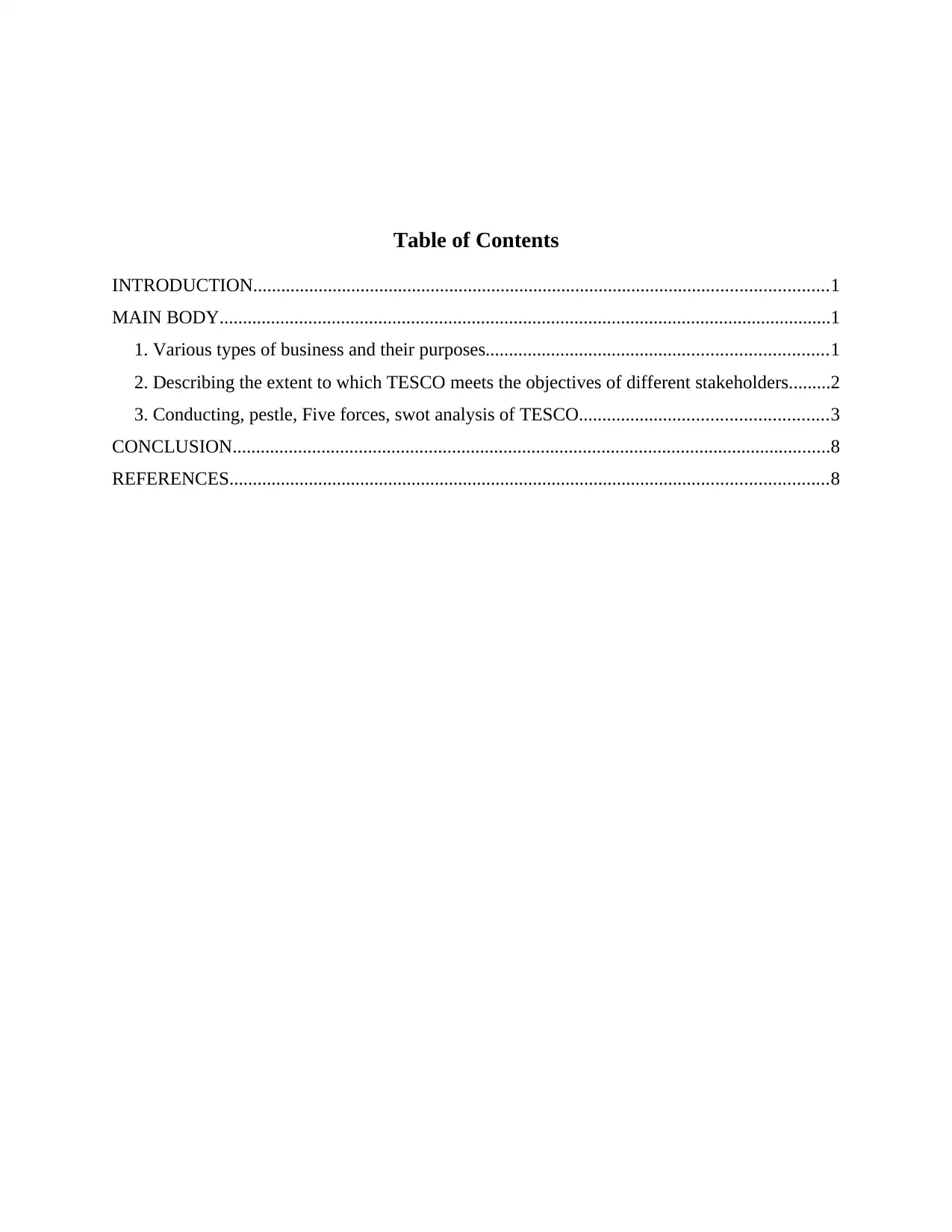
Table of Contents
INTRODUCTION...........................................................................................................................1
MAIN BODY...................................................................................................................................1
1. Various types of business and their purposes.........................................................................1
2. Describing the extent to which TESCO meets the objectives of different stakeholders.........2
3. Conducting, pestle, Five forces, swot analysis of TESCO.....................................................3
CONCLUSION................................................................................................................................8
REFERENCES................................................................................................................................8
INTRODUCTION...........................................................................................................................1
MAIN BODY...................................................................................................................................1
1. Various types of business and their purposes.........................................................................1
2. Describing the extent to which TESCO meets the objectives of different stakeholders.........2
3. Conducting, pestle, Five forces, swot analysis of TESCO.....................................................3
CONCLUSION................................................................................................................................8
REFERENCES................................................................................................................................8
INTRODUCTION
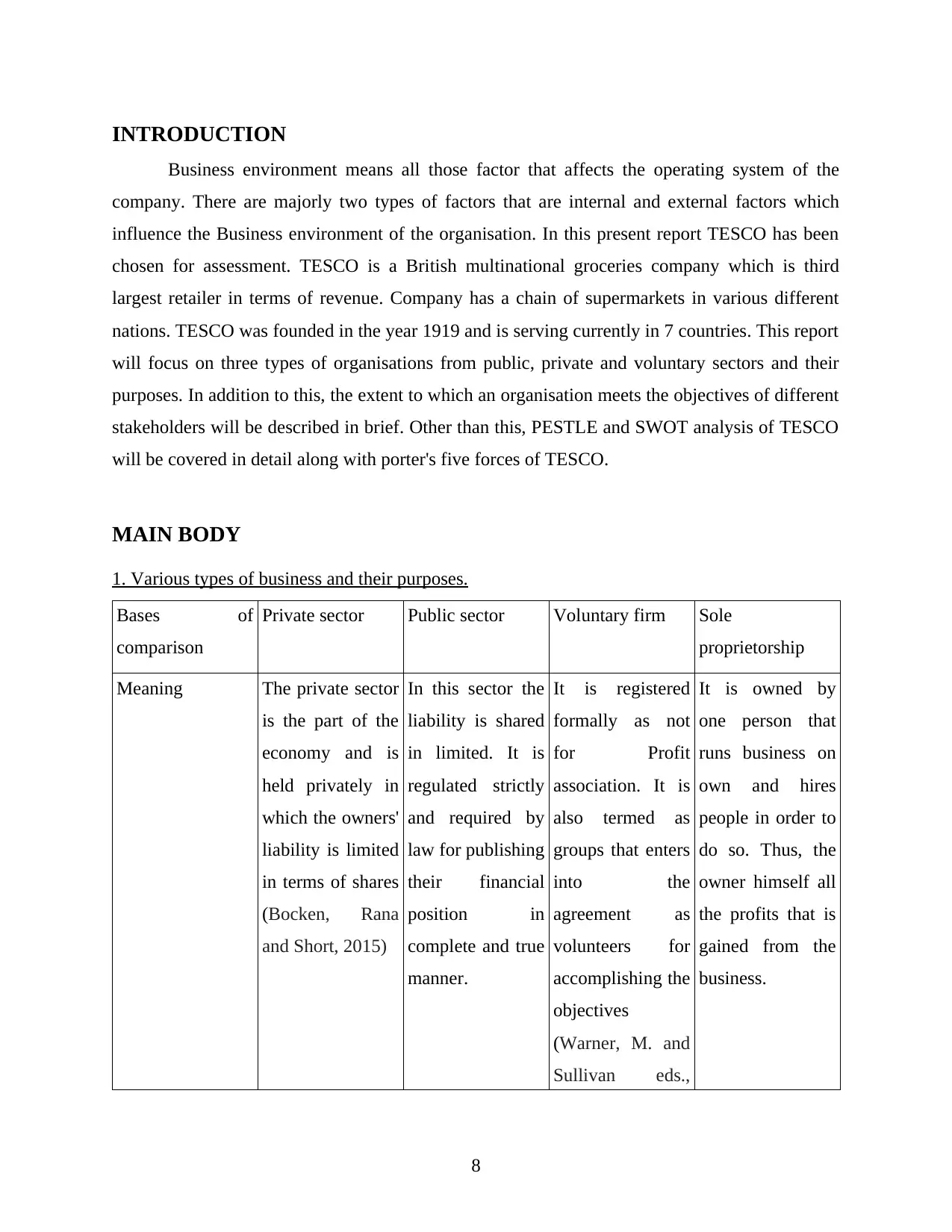
Business environment means all those factor that affects the operating system of the
company. There are majorly two types of factors that are internal and external factors which
influence the Business environment of the organisation. In this present report TESCO has been
chosen for assessment. TESCO is a British multinational groceries company which is third
largest retailer in terms of revenue. Company has a chain of supermarkets in various different
nations. TESCO was founded in the year 1919 and is serving currently in 7 countries. This report
will focus on three types of organisations from public, private and voluntary sectors and their
purposes. In addition to this, the extent to which an organisation meets the objectives of different
stakeholders will be described in brief. Other than this, PESTLE and SWOT analysis of TESCO
will be covered in detail along with porter's five forces of TESCO.
MAIN BODY
1. Various types of business and their purposes.
Bases of
comparison
Private sector Public sector Voluntary firm Sole
proprietorship
Meaning The private sector
is the part of the
economy and is
held privately in
which the owners'
liability is limited
in terms of shares
(Bocken, Rana
and Short, 2015)
In this sector the
liability is shared
in limited. It is
regulated strictly
and required by
law for publishing
their financial
position in
complete and true
manner.
It is registered
formally as not
for Profit
association. It is
also termed as
groups that enters
into the
agreement as
volunteers for
accomplishing the
objectives
(Warner, M. and
Sullivan eds.,
It is owned by
one person that
runs business on
own and hires
people in order to
do so. Thus, the
owner himself all
the profits that is
gained from the
business.
8
Business environment means all those factor that affects the operating system of the
company. There are majorly two types of factors that are internal and external factors which
influence the Business environment of the organisation. In this present report TESCO has been
chosen for assessment. TESCO is a British multinational groceries company which is third
largest retailer in terms of revenue. Company has a chain of supermarkets in various different
nations. TESCO was founded in the year 1919 and is serving currently in 7 countries. This report
will focus on three types of organisations from public, private and voluntary sectors and their
purposes. In addition to this, the extent to which an organisation meets the objectives of different
stakeholders will be described in brief. Other than this, PESTLE and SWOT analysis of TESCO
will be covered in detail along with porter's five forces of TESCO.
MAIN BODY
1. Various types of business and their purposes.
Bases of
comparison
Private sector Public sector Voluntary firm Sole
proprietorship
Meaning The private sector
is the part of the
economy and is
held privately in
which the owners'
liability is limited
in terms of shares
(Bocken, Rana
and Short, 2015)
In this sector the
liability is shared
in limited. It is
regulated strictly
and required by
law for publishing
their financial
position in
complete and true
manner.
It is registered
formally as not
for Profit
association. It is
also termed as
groups that enters
into the
agreement as
volunteers for
accomplishing the
objectives
(Warner, M. and
Sullivan eds.,
It is owned by
one person that
runs business on
own and hires
people in order to
do so. Thus, the
owner himself all
the profits that is
gained from the
business.
8
⊘ This is a preview!⊘
Do you want full access?
Subscribe today to unlock all pages.

Trusted by 1+ million students worldwide
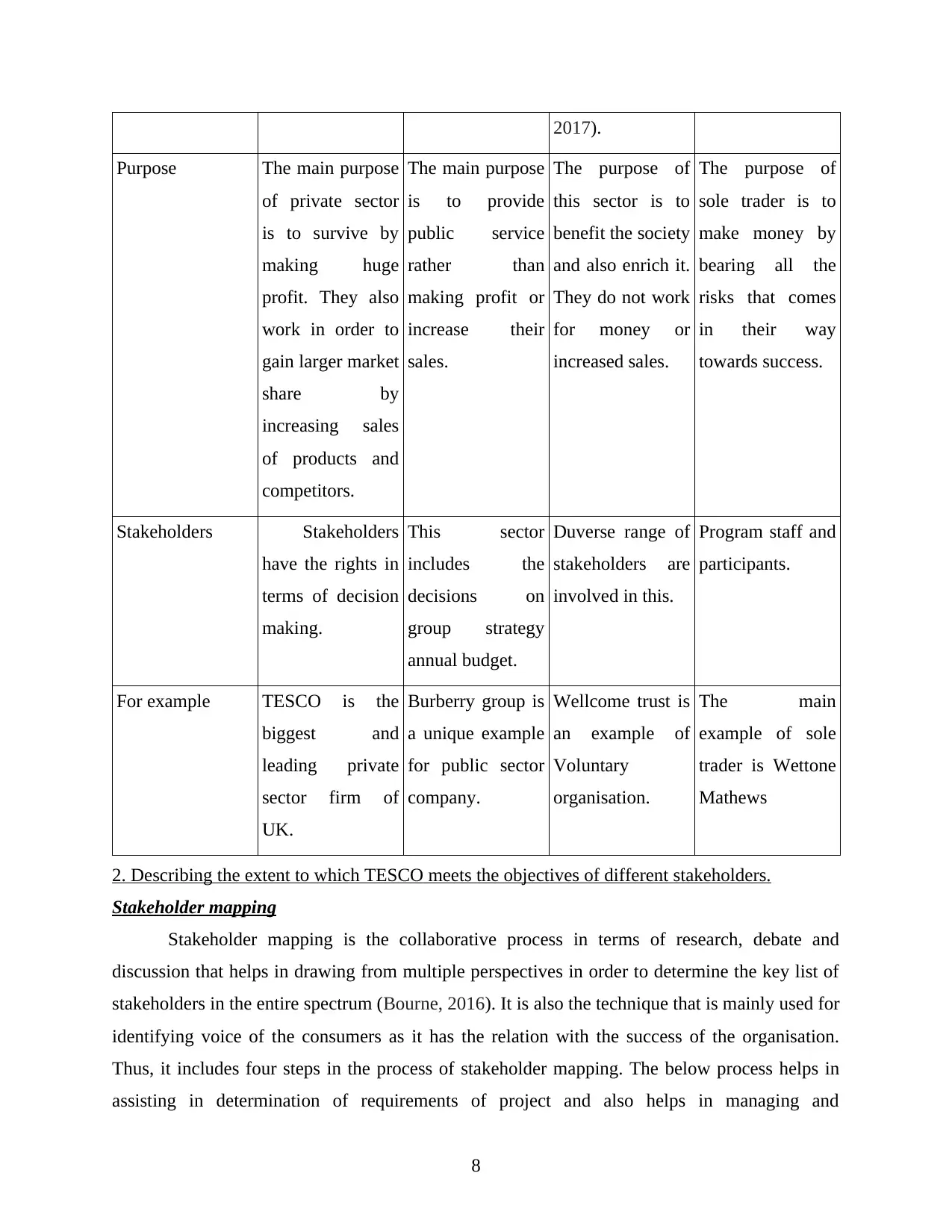
2017).
Purpose The main purpose
of private sector
is to survive by
making huge
profit. They also
work in order to
gain larger market
share by
increasing sales
of products and
competitors.
The main purpose
is to provide
public service
rather than
making profit or
increase their
sales.
The purpose of
this sector is to
benefit the society
and also enrich it.
They do not work
for money or
increased sales.
The purpose of
sole trader is to
make money by
bearing all the
risks that comes
in their way
towards success.
Stakeholders Stakeholders
have the rights in
terms of decision
making.
This sector
includes the
decisions on
group strategy
annual budget.
Duverse range of
stakeholders are
involved in this.
Program staff and
participants.
For example TESCO is the
biggest and
leading private
sector firm of
UK.
Burberry group is
a unique example
for public sector
company.
Wellcome trust is
an example of
Voluntary
organisation.
The main
example of sole
trader is Wettone
Mathews
2. Describing the extent to which TESCO meets the objectives of different stakeholders.
Stakeholder mapping
Stakeholder mapping is the collaborative process in terms of research, debate and
discussion that helps in drawing from multiple perspectives in order to determine the key list of
stakeholders in the entire spectrum (Bourne, 2016). It is also the technique that is mainly used for
identifying voice of the consumers as it has the relation with the success of the organisation.
Thus, it includes four steps in the process of stakeholder mapping. The below process helps in
assisting in determination of requirements of project and also helps in managing and
8
Purpose The main purpose
of private sector
is to survive by
making huge
profit. They also
work in order to
gain larger market
share by
increasing sales
of products and
competitors.
The main purpose
is to provide
public service
rather than
making profit or
increase their
sales.
The purpose of
this sector is to
benefit the society
and also enrich it.
They do not work
for money or
increased sales.
The purpose of
sole trader is to
make money by
bearing all the
risks that comes
in their way
towards success.
Stakeholders Stakeholders
have the rights in
terms of decision
making.
This sector
includes the
decisions on
group strategy
annual budget.
Duverse range of
stakeholders are
involved in this.
Program staff and
participants.
For example TESCO is the
biggest and
leading private
sector firm of
UK.
Burberry group is
a unique example
for public sector
company.
Wellcome trust is
an example of
Voluntary
organisation.
The main
example of sole
trader is Wettone
Mathews
2. Describing the extent to which TESCO meets the objectives of different stakeholders.
Stakeholder mapping
Stakeholder mapping is the collaborative process in terms of research, debate and
discussion that helps in drawing from multiple perspectives in order to determine the key list of
stakeholders in the entire spectrum (Bourne, 2016). It is also the technique that is mainly used for
identifying voice of the consumers as it has the relation with the success of the organisation.
Thus, it includes four steps in the process of stakeholder mapping. The below process helps in
assisting in determination of requirements of project and also helps in managing and
8
Paraphrase This Document
Need a fresh take? Get an instant paraphrase of this document with our AI Paraphraser
communicating with the stakeholders in effective manner (Forrester and et.al., 2015). The
process includes following steps-
Identifying- the first step in the stakeholder mapping is identification (Power, 2016).
Thus, identification of stakeholders can be done through various process that includes
brainstorming, mind mapping, creating a list of stakeholders in TESCO, analysing the
documentation from the previous project that were accomplished, using the
organisational chart or directories and later categorisation of stakeholders. Furthermore, it
becomes very important in order to identify individuals as stakeholders.
Analysing- After identification process, they must analyse their stakeholders of TESCO.
For this, they have to conduct process regarding impact and influence of the stakeholders
that are related in terms of objectives of the projects. Thus, it is done after providing
value that is measured through several categories of stakeholders. This includes power,
urgency, legitimacy, influence and interest in organisation.
Prioritise- the third step in the process of stakeholder mapping includes developing a
strategy that will help in gaining involvement of more stakeholder. The key of this step is
to manage all the stakeholders that are involved in TESCO company without giving any
negative impact to project or organisation. For this, TESCO may conduct an interview so
that the stakeholders become interested and can also easily focus on discussion between
the groups that motivates them as they feel that they are involved. This also gives them
opportunities for supporting good cause rather than spending lot of money.
Engagement- it is the last step in stakeholder mapping process. This step helps in figuring
out about the engagement of stakeholders so that they can support messages and
objectives. This step is started by developing the communication and report. This forms
basis of communication plan.
Continuous professional development offers the analysis of stakeholders the training
courses online in order to help in terms of carrying out systematic process for mapping the
stakeholder.
3. Conducting, pestle, Five forces, swot analysis of TESCO.
Pestle
Pestle analysis is that tool that is used by marketers for analysing the external factors affecting
internal business environment (Grundy, 2017). Thus, it is discussed as per below context-
8
process includes following steps-
Identifying- the first step in the stakeholder mapping is identification (Power, 2016).
Thus, identification of stakeholders can be done through various process that includes
brainstorming, mind mapping, creating a list of stakeholders in TESCO, analysing the
documentation from the previous project that were accomplished, using the
organisational chart or directories and later categorisation of stakeholders. Furthermore, it
becomes very important in order to identify individuals as stakeholders.
Analysing- After identification process, they must analyse their stakeholders of TESCO.
For this, they have to conduct process regarding impact and influence of the stakeholders
that are related in terms of objectives of the projects. Thus, it is done after providing
value that is measured through several categories of stakeholders. This includes power,
urgency, legitimacy, influence and interest in organisation.
Prioritise- the third step in the process of stakeholder mapping includes developing a
strategy that will help in gaining involvement of more stakeholder. The key of this step is
to manage all the stakeholders that are involved in TESCO company without giving any
negative impact to project or organisation. For this, TESCO may conduct an interview so
that the stakeholders become interested and can also easily focus on discussion between
the groups that motivates them as they feel that they are involved. This also gives them
opportunities for supporting good cause rather than spending lot of money.
Engagement- it is the last step in stakeholder mapping process. This step helps in figuring
out about the engagement of stakeholders so that they can support messages and
objectives. This step is started by developing the communication and report. This forms
basis of communication plan.
Continuous professional development offers the analysis of stakeholders the training
courses online in order to help in terms of carrying out systematic process for mapping the
stakeholder.
3. Conducting, pestle, Five forces, swot analysis of TESCO.
Pestle
Pestle analysis is that tool that is used by marketers for analysing the external factors affecting
internal business environment (Grundy, 2017). Thus, it is discussed as per below context-
8
Political- TESCO is a multinational company that operates in 12 countries. Therefore, it
is exposed with number of political factors that may affect the operation of TESCO to a
large extent (Oh, bin Pg Hamir and bin Mohd Shah, 2018). This factors include tax rates,
current and implementing legislation, political instability, rate of unemployment and also
the economic conditions of a company. In addition to this, import duty that has been paid
on the goods that is been exported by TESCO affects it because it imports inventory from
outside.
Economic- the main economic factor that affect TESCO is labour cost. Wage rate has
been increased by 4.4% for individual of 25 years or more. The cited company is also
been affected by cost, prices and profits. Therefore, they must focus on increasing cost of
borrowing in UK. In addition to this, TESCO should check the economic condition of
nation before establishing any new supermarket. As economic condition only allow to
know about the purchasing power of the nation.
Social- The trends of consumers shopping are changing constantly over the time.
Individuals mainly demand for fast delivery of goods with return policy having
flexibility. The demand is mainly related towards beliefs and attitudes of customers that
becomes the main issue. Therefore, TESCO must understand all these requirements of
customers and accordingly provide them with services that will help them in meeting this
issues.
8
is exposed with number of political factors that may affect the operation of TESCO to a
large extent (Oh, bin Pg Hamir and bin Mohd Shah, 2018). This factors include tax rates,
current and implementing legislation, political instability, rate of unemployment and also
the economic conditions of a company. In addition to this, import duty that has been paid
on the goods that is been exported by TESCO affects it because it imports inventory from
outside.
Economic- the main economic factor that affect TESCO is labour cost. Wage rate has
been increased by 4.4% for individual of 25 years or more. The cited company is also
been affected by cost, prices and profits. Therefore, they must focus on increasing cost of
borrowing in UK. In addition to this, TESCO should check the economic condition of
nation before establishing any new supermarket. As economic condition only allow to
know about the purchasing power of the nation.
Social- The trends of consumers shopping are changing constantly over the time.
Individuals mainly demand for fast delivery of goods with return policy having
flexibility. The demand is mainly related towards beliefs and attitudes of customers that
becomes the main issue. Therefore, TESCO must understand all these requirements of
customers and accordingly provide them with services that will help them in meeting this
issues.
8
⊘ This is a preview!⊘
Do you want full access?
Subscribe today to unlock all pages.
Trusted by 1+ million students worldwide
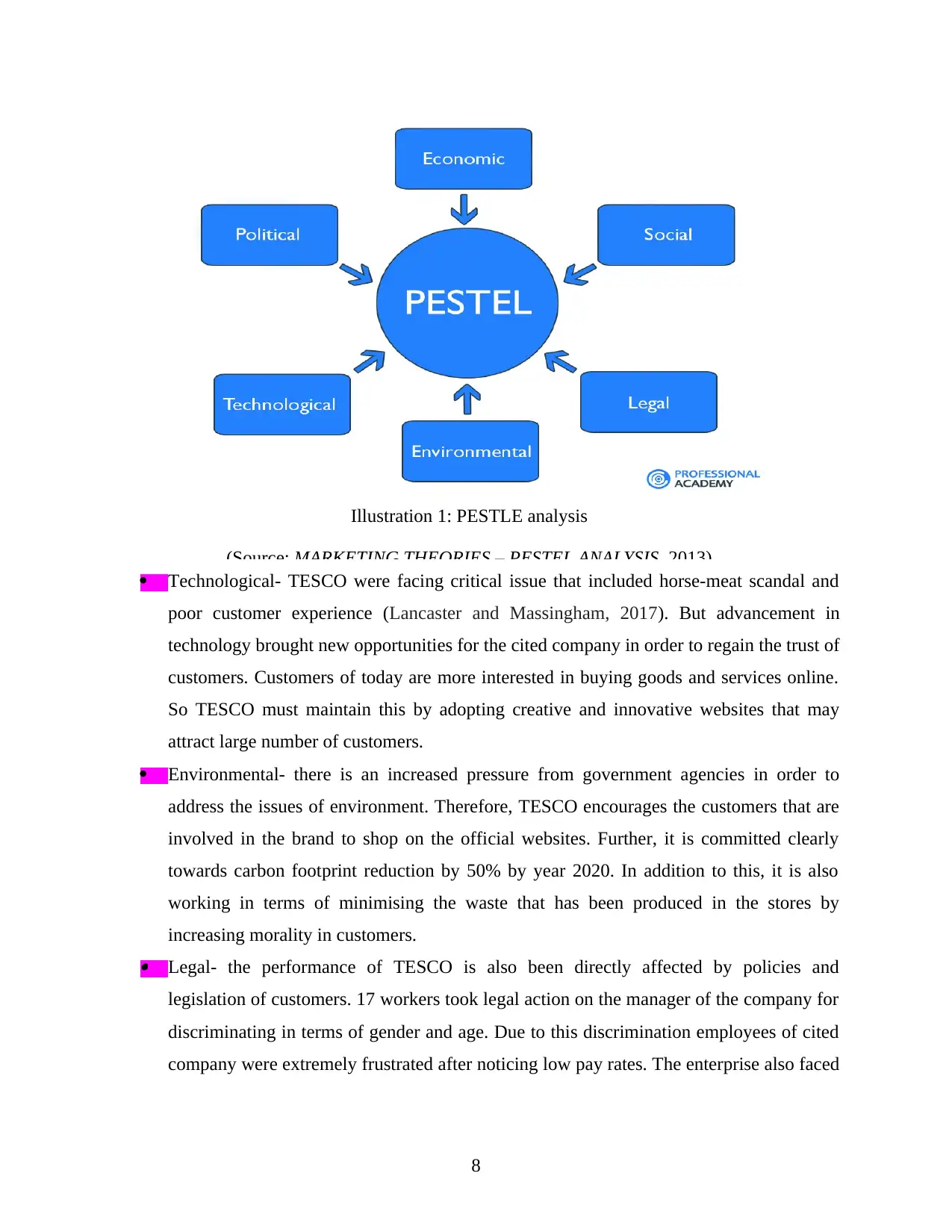
Illustration 1: PESTLE analysis
(Source: MARKETING THEORIES – PESTEL ANALYSIS, 2013)
Technological- TESCO were facing critical issue that included horse-meat scandal and
poor customer experience (Lancaster and Massingham, 2017). But advancement in
technology brought new opportunities for the cited company in order to regain the trust of
customers. Customers of today are more interested in buying goods and services online.
So TESCO must maintain this by adopting creative and innovative websites that may
attract large number of customers.
Environmental- there is an increased pressure from government agencies in order to
address the issues of environment. Therefore, TESCO encourages the customers that are
involved in the brand to shop on the official websites. Further, it is committed clearly
towards carbon footprint reduction by 50% by year 2020. In addition to this, it is also
working in terms of minimising the waste that has been produced in the stores by
increasing morality in customers. Legal- the performance of TESCO is also been directly affected by policies and
legislation of customers. 17 workers took legal action on the manager of the company for
discriminating in terms of gender and age. Due to this discrimination employees of cited
company were extremely frustrated after noticing low pay rates. The enterprise also faced
8
(Source: MARKETING THEORIES – PESTEL ANALYSIS, 2013)
Technological- TESCO were facing critical issue that included horse-meat scandal and
poor customer experience (Lancaster and Massingham, 2017). But advancement in
technology brought new opportunities for the cited company in order to regain the trust of
customers. Customers of today are more interested in buying goods and services online.
So TESCO must maintain this by adopting creative and innovative websites that may
attract large number of customers.
Environmental- there is an increased pressure from government agencies in order to
address the issues of environment. Therefore, TESCO encourages the customers that are
involved in the brand to shop on the official websites. Further, it is committed clearly
towards carbon footprint reduction by 50% by year 2020. In addition to this, it is also
working in terms of minimising the waste that has been produced in the stores by
increasing morality in customers. Legal- the performance of TESCO is also been directly affected by policies and
legislation of customers. 17 workers took legal action on the manager of the company for
discriminating in terms of gender and age. Due to this discrimination employees of cited
company were extremely frustrated after noticing low pay rates. The enterprise also faced
8
Paraphrase This Document
Need a fresh take? Get an instant paraphrase of this document with our AI Paraphraser
legal action for misleading and frauding with investors and had to pay 12 million for
settling this case.
Five Forces model
This model of Porter helps in understanding forces that shapes competition within the company.
It helps in adjusting the strategy that suit the competitive environment and improve profit that is
potential (Hamilton and Webster, 2015). It includes five forces as are-
1. Threat of new entrants- this is the major threat for TESCO because profitable industries
that consume high profits will attract new firms. And this new entrants decreases profit of
other enterprises that are involved in an industry. Thus, there is also variation in terms of
attractiveness of segments that depends upon entry and exit barriers. Thus, segment with
high entry and low exit barriers are more attractive as compared to other. Due to this the
power of TESCO gets affected. The treat is high when
The capital requirements for starting a new business is less.
If customers can easily switch to other brands.
The product that has been produced by TESCO is not differentiated.
2. Bargaining power of suppliers- bargaining power if strong allows supplier in order to
sell high priced or low quality raw materials to the buyers. This affects directly to profit
of the firm that buys as they have to spend more on buying raw materials. Suppliers have
strong power of bargaining when,
The number of suppliers are high as compared to buyer.
Existence of few substitute raw materials.
Cost is high in terms of switching raw materials.
3. Bargaining power of customers- If bargaining power is strong then buyers can demand
for lowering price for high quality products from the producers (Kull, 2016). Hence,
lower price in turn means lack of revenue for producers. While if producer produces high
quality product at low cost, then this will increase the cost of production. In both way
producers are affected. Thus, bargaining power is strong for buyers when,
They are buying in large quantities.
Limited number of buyers in market.
Cost of switching is low.
If buyers are sensitive towards the price.
8
settling this case.
Five Forces model
This model of Porter helps in understanding forces that shapes competition within the company.
It helps in adjusting the strategy that suit the competitive environment and improve profit that is
potential (Hamilton and Webster, 2015). It includes five forces as are-
1. Threat of new entrants- this is the major threat for TESCO because profitable industries
that consume high profits will attract new firms. And this new entrants decreases profit of
other enterprises that are involved in an industry. Thus, there is also variation in terms of
attractiveness of segments that depends upon entry and exit barriers. Thus, segment with
high entry and low exit barriers are more attractive as compared to other. Due to this the
power of TESCO gets affected. The treat is high when
The capital requirements for starting a new business is less.
If customers can easily switch to other brands.
The product that has been produced by TESCO is not differentiated.
2. Bargaining power of suppliers- bargaining power if strong allows supplier in order to
sell high priced or low quality raw materials to the buyers. This affects directly to profit
of the firm that buys as they have to spend more on buying raw materials. Suppliers have
strong power of bargaining when,
The number of suppliers are high as compared to buyer.
Existence of few substitute raw materials.
Cost is high in terms of switching raw materials.
3. Bargaining power of customers- If bargaining power is strong then buyers can demand
for lowering price for high quality products from the producers (Kull, 2016). Hence,
lower price in turn means lack of revenue for producers. While if producer produces high
quality product at low cost, then this will increase the cost of production. In both way
producers are affected. Thus, bargaining power is strong for buyers when,
They are buying in large quantities.
Limited number of buyers in market.
Cost of switching is low.
If buyers are sensitive towards the price.
8
4. Threat of substitutes- out of five forces, this one is extremely threatening as buyers can
easily find substitutes for products that have attractive prices and good quality. Thus, the
easy and cheap way makes the position of a company weaken and also threatens
profitability of TESCO.
5. Industry rivalry- TESCO have to compete in aggressive manner for achieving good
market share. Thus, this in turn results in low profits. Hence, rivalry among competitors
may occur when,
The number of competitors are high in market.
Barriers of exit are high
Growth of industry is slow or in negative way. Lack of customer loyalty.
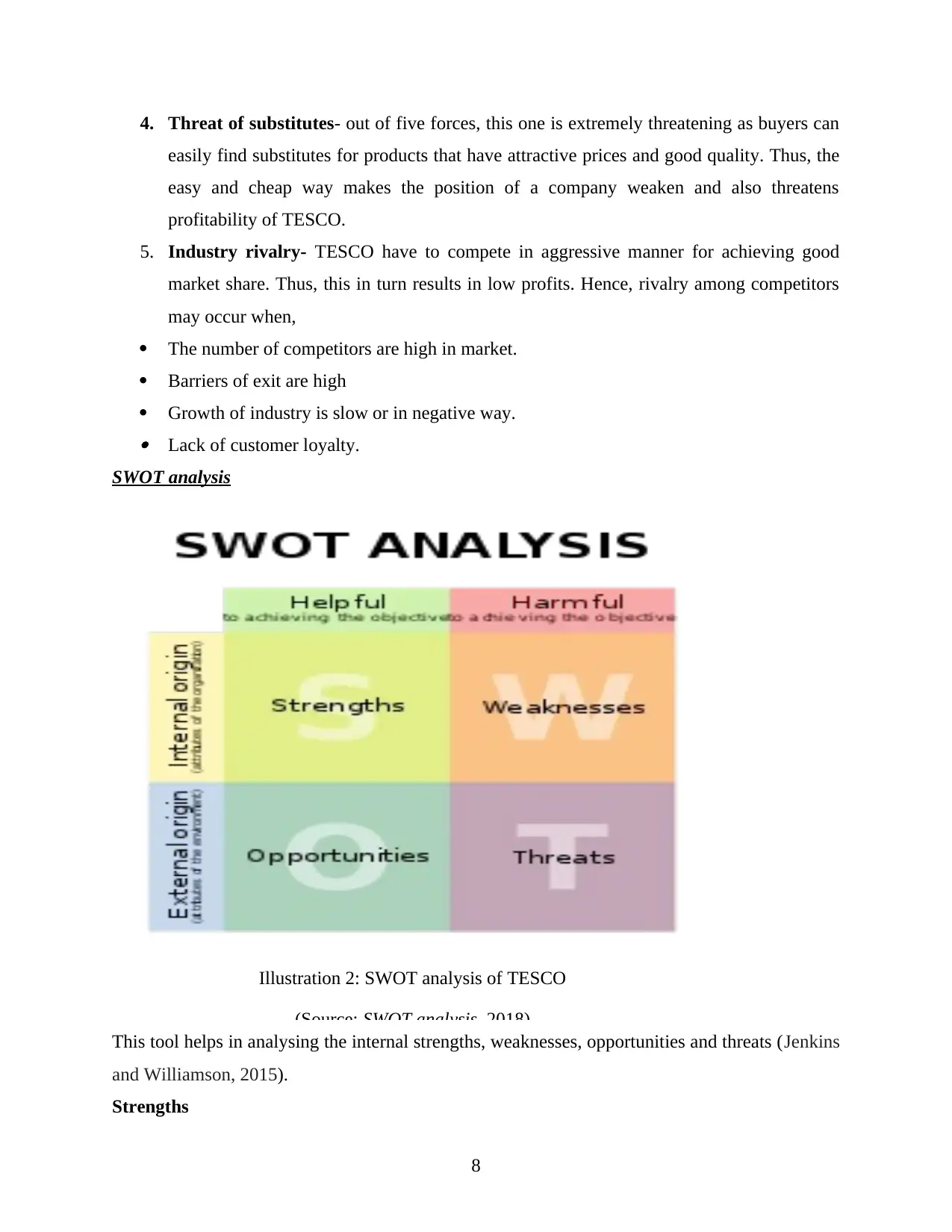
SWOT analysis
Illustration 2: SWOT analysis of TESCO
(Source: SWOT analysis, 2018)
This tool helps in analysing the internal strengths, weaknesses, opportunities and threats (Jenkins
and Williamson, 2015).
Strengths
8
easily find substitutes for products that have attractive prices and good quality. Thus, the
easy and cheap way makes the position of a company weaken and also threatens
profitability of TESCO.
5. Industry rivalry- TESCO have to compete in aggressive manner for achieving good
market share. Thus, this in turn results in low profits. Hence, rivalry among competitors
may occur when,
The number of competitors are high in market.
Barriers of exit are high
Growth of industry is slow or in negative way. Lack of customer loyalty.
SWOT analysis
Illustration 2: SWOT analysis of TESCO
(Source: SWOT analysis, 2018)
This tool helps in analysing the internal strengths, weaknesses, opportunities and threats (Jenkins
and Williamson, 2015).
Strengths
8
⊘ This is a preview!⊘
Do you want full access?
Subscribe today to unlock all pages.
Trusted by 1+ million students worldwide
TESCO has won number of awards for its excellence in retailer and service towards
customers.
It has reserves of cash in significant manner that has wider range of property which helps
in providing strong financial position.
The use of technology in TESCO has been improved throughout its operations that
creates great cost efficiencies and also services experiences in enhanced manner.
Weaknesses
Some subsidiaries of TESCO are not operating and also are more vulnerable to certain
external factors.
There is a high pressure of competitive that led to price wars that have also eroded the
profit margins.
It is wholly depended on UK and Europe in terms of sales and is not spending time and
resources on the development of any other markets where operation of TESCO takes
place.
Opportunities
There is a significant opportunity in the market that has private label.
Markets that are emerging has number of opportunities for retail format and can also
easily provide better access towards western goods.
It also has an opportunity in growing trend of online shopping and also for offering
service of home delivery to many more areas.
They also have an opportunity in terms of joint venture where local company helps in
researching about requirements of market and offer services accordingly.
They also have opportunity in terms of strategic alliance with other brands that are
available in order to offer more products and also attract huge volume of customers.
Threats
The cited company has major threat of stakeholder pressure that is related to environment
and social responsibility that impact the cost basis.
The cost of raw materials are also rising that threatens profitability of TESCO in greater
extent.
Prices of food are also rising that leads in reducing the buying ability of consumers due to
the disposal income they are available.
8
customers.
It has reserves of cash in significant manner that has wider range of property which helps
in providing strong financial position.
The use of technology in TESCO has been improved throughout its operations that
creates great cost efficiencies and also services experiences in enhanced manner.
Weaknesses
Some subsidiaries of TESCO are not operating and also are more vulnerable to certain
external factors.
There is a high pressure of competitive that led to price wars that have also eroded the
profit margins.
It is wholly depended on UK and Europe in terms of sales and is not spending time and
resources on the development of any other markets where operation of TESCO takes
place.
Opportunities
There is a significant opportunity in the market that has private label.
Markets that are emerging has number of opportunities for retail format and can also
easily provide better access towards western goods.
It also has an opportunity in growing trend of online shopping and also for offering
service of home delivery to many more areas.
They also have an opportunity in terms of joint venture where local company helps in
researching about requirements of market and offer services accordingly.
They also have opportunity in terms of strategic alliance with other brands that are
available in order to offer more products and also attract huge volume of customers.
Threats
The cited company has major threat of stakeholder pressure that is related to environment
and social responsibility that impact the cost basis.
The cost of raw materials are also rising that threatens profitability of TESCO in greater
extent.
Prices of food are also rising that leads in reducing the buying ability of consumers due to
the disposal income they are available.
8
Paraphrase This Document
Need a fresh take? Get an instant paraphrase of this document with our AI Paraphraser
Threat of competition are also increasing in world that leads TESCO to offer high quality
goods at low price as compared to competitors that attract large number of customers
(Johnson, Leenders and McCue, 2017).
Labour threats are also increasing in terms of high wages and benefits all over the world.
This puts pressure on pricing strategy of TESCO.
Recommendation
TESCO should focus on its subsidiaries and all markets other than Europe. As it has low
business profits from different markets.
TESCO should focus more on non food items as it gives more business and it carries low
cost of inventory. As many a time, die to high cost of handling inventory TESCO overall
profits are suffered.
Different opportunities should be grabbed by TESCO so that it can expand its business
for future and earn higher growth in the industry.
TESCO should check the economic condition of nation before establishing any new
supermarket. As economic condition only allow to know about the purchasing power of
the nation. It will help in growing its business and suffering fewer losses in the future.
CONCLUSION
From the above report it has been concluded that there are various forms of business
organisation in which most common are public and private sector. Public sector is where capital
is raised by public through shares and various other ways. Whereas in private sector shares are
not issue by organisation to raise capital. In addition to this, there are different factors of
environment that influence the operations and management of the company. To determine the
same SWOT analysis has been done. This tool helps in analysing the internal strengths,
weaknesses, opportunities and threats of organisation. Furthermore, TESCO is facing that The
trends of consumers shopping are changing constantly over the time. Individuals mainly demand
for fast delivery of goods with return policy having flexibility.
8
goods at low price as compared to competitors that attract large number of customers
(Johnson, Leenders and McCue, 2017).
Labour threats are also increasing in terms of high wages and benefits all over the world.
This puts pressure on pricing strategy of TESCO.
Recommendation
TESCO should focus on its subsidiaries and all markets other than Europe. As it has low
business profits from different markets.
TESCO should focus more on non food items as it gives more business and it carries low
cost of inventory. As many a time, die to high cost of handling inventory TESCO overall
profits are suffered.
Different opportunities should be grabbed by TESCO so that it can expand its business
for future and earn higher growth in the industry.
TESCO should check the economic condition of nation before establishing any new
supermarket. As economic condition only allow to know about the purchasing power of
the nation. It will help in growing its business and suffering fewer losses in the future.
CONCLUSION
From the above report it has been concluded that there are various forms of business
organisation in which most common are public and private sector. Public sector is where capital
is raised by public through shares and various other ways. Whereas in private sector shares are
not issue by organisation to raise capital. In addition to this, there are different factors of
environment that influence the operations and management of the company. To determine the
same SWOT analysis has been done. This tool helps in analysing the internal strengths,
weaknesses, opportunities and threats of organisation. Furthermore, TESCO is facing that The
trends of consumers shopping are changing constantly over the time. Individuals mainly demand
for fast delivery of goods with return policy having flexibility.
8
REFERENCES
Books and Journal
Bocken, N.M.P., Rana, P. and Short, S.W., 2015. Value mapping for sustainable business
thinking. Journal of Industrial and Production Engineering. 32(1). pp.67-81.
Bourne, L., 2016. Stakeholder relationship management: a maturity model for organisational
implementation. Routledge.
Forrester, J. and et.al., 2015. Combining participatory mapping with Q-methodology to map
stakeholder perceptions of complex environmental problems. Applied Geography. 56.
pp.199-208.
Grundy, T.D., 2017. Dynamic Competitive Strategy: Turning Strategy Upside Down. Routledge.
Hamilton, L. and Webster, P., 2015. The international business environment. Oxford University
Press, USA.
Jenkins, W. and Williamson, D., 2015. Strategic management and business analysis. Routledge.
Johnson, P.F., Leenders, M.R. and McCue, C., 2017. A comparison of purchasing’s
organizational roles and responsibilities in the public and private sector. Journal of Public
Procurement. 3(1). pp.57-74.
Kull, M., 2016. Introduction. In European Integration and Rural Development (pp. 15-22).
Routledge.
Lancaster, G. and Massingham, L., 2017. Customer care and relationship marketing.
In Essentials of Marketing Management (pp. 270-288). Routledge.
Oh, Y., bin Pg Hamir, A.M.H. and bin Mohd Shah, M.A.S., 2018. THE VIABILITY OF
HALAL FOOD INDUSTRY FOR BRUNEI ECONOMIC DIVERSIFICATION: SWOT
ANALYSIS. PEOPLE: International Journal of Social Sciences. 3(3).
Power, H.I.H., 2016. Stakeholder Analysis.
Warner, M. and Sullivan, R. eds., 2017. Putting partnerships to work: Strategic alliances for
development between government, the private sector and civil society. Routledge.
Online
SWOT analysis. 2018. [Online] Available through:
<https://en.wikipedia.org/wiki/SWOT_analysis>
8
Books and Journal
Bocken, N.M.P., Rana, P. and Short, S.W., 2015. Value mapping for sustainable business
thinking. Journal of Industrial and Production Engineering. 32(1). pp.67-81.
Bourne, L., 2016. Stakeholder relationship management: a maturity model for organisational
implementation. Routledge.
Forrester, J. and et.al., 2015. Combining participatory mapping with Q-methodology to map
stakeholder perceptions of complex environmental problems. Applied Geography. 56.
pp.199-208.
Grundy, T.D., 2017. Dynamic Competitive Strategy: Turning Strategy Upside Down. Routledge.
Hamilton, L. and Webster, P., 2015. The international business environment. Oxford University
Press, USA.
Jenkins, W. and Williamson, D., 2015. Strategic management and business analysis. Routledge.
Johnson, P.F., Leenders, M.R. and McCue, C., 2017. A comparison of purchasing’s
organizational roles and responsibilities in the public and private sector. Journal of Public
Procurement. 3(1). pp.57-74.
Kull, M., 2016. Introduction. In European Integration and Rural Development (pp. 15-22).
Routledge.
Lancaster, G. and Massingham, L., 2017. Customer care and relationship marketing.
In Essentials of Marketing Management (pp. 270-288). Routledge.
Oh, Y., bin Pg Hamir, A.M.H. and bin Mohd Shah, M.A.S., 2018. THE VIABILITY OF
HALAL FOOD INDUSTRY FOR BRUNEI ECONOMIC DIVERSIFICATION: SWOT
ANALYSIS. PEOPLE: International Journal of Social Sciences. 3(3).
Power, H.I.H., 2016. Stakeholder Analysis.
Warner, M. and Sullivan, R. eds., 2017. Putting partnerships to work: Strategic alliances for
development between government, the private sector and civil society. Routledge.
Online
SWOT analysis. 2018. [Online] Available through:
<https://en.wikipedia.org/wiki/SWOT_analysis>
8
⊘ This is a preview!⊘
Do you want full access?
Subscribe today to unlock all pages.
Trusted by 1+ million students worldwide

1 out of 13


Related Documents


Your All-in-One AI-Powered Toolkit for Academic Success.
+13062052269
info@desklib.com
Available 24*7 on WhatsApp / Email
![[object Object]](/_next/static/media/star-bottom.7253800d.svg)
Unlock your academic potential
Copyright © 2020–2026 A2Z Services. All Rights Reserved. Developed and managed by ZUCOL.