Business and Business Environment Project: Tesco's Strategic Analysis
VerifiedAdded on 2020/06/03
|9
|2733
|29
Project
AI Summary
This project analyzes the business environment of Tesco, a major UK-based retailer. It begins by defining the business environment and its impact on organizational performance. The project explores different types of organizations (public, private, and voluntary sectors), detailing their characteristics and purposes, with Tesco as a case study. It examines the size and scope of these organizations and how organizational size relates to objectives. The project then delves into the interrelationship between organizational functions (finance, HR, marketing) and structure, outlining the advantages and disadvantages of this interrelationship. Finally, it discusses the complexities of business structures, specifically focusing on the matrix structure adopted by Tesco, and concludes with a summary of the key findings. The project aims to provide a comprehensive understanding of Tesco's operations within its business environment.
BUSINESS AND
BUSINESS
ENVIRONMENT
(Project - 1)
BUSINESS
ENVIRONMENT
(Project - 1)

Paraphrase This Document
Need a fresh take? Get an instant paraphrase of this document with our AI Paraphraser
Table of Contents
INTRODUCTION...........................................................................................................................1
TASK 1............................................................................................................................................1
INTRODUCTION...........................................................................................................................1
TASK 1............................................................................................................................................1
1.1 Different types and purpose of organisations........................................................................1
1.2 Size and scope of different types of organisations................................................................3
1.3 (M1) How to inter-linked organisational size with its objectives.........................................4
TASK 2............................................................................................................................................5
2.1 Interrelationship between organisational functions and its structure....................................5
2.2 (M2) Advantages and disadvantages of interrelationships between organisational functions
.....................................................................................................................................................6
2.3 (D1) Complexities of business structure...............................................................................6
CONCLUSION................................................................................................................................6
REFERENCES................................................................................................................................7
INTRODUCTION...........................................................................................................................1
TASK 1............................................................................................................................................1
INTRODUCTION...........................................................................................................................1
TASK 1............................................................................................................................................1
1.1 Different types and purpose of organisations........................................................................1
1.2 Size and scope of different types of organisations................................................................3
1.3 (M1) How to inter-linked organisational size with its objectives.........................................4
TASK 2............................................................................................................................................5
2.1 Interrelationship between organisational functions and its structure....................................5
2.2 (M2) Advantages and disadvantages of interrelationships between organisational functions
.....................................................................................................................................................6
2.3 (D1) Complexities of business structure...............................................................................6
CONCLUSION................................................................................................................................6
REFERENCES................................................................................................................................7
INTRODUCTION
Business environment is an intermixture of all entities, individuals and further factors
which may affect organisational performance in a positive and negative manner. In addition, it
can also influence profitability, productivity, even growth and survival of the firm. Every
commercial entity operates in a distinct environment and therefore, it cannot exist in isolation. In
a business environment, there are two types of factors, i.e. internal and external. (Reinhardt and
Stavins, 2010) Along with this, the notion of business environment is relative since it varies from
one to another location. Tesco is the chosen organisation in this present assignment which is one
of the largest retailing companies in UK with having a total revenue of £55,917 million. The
main objectives of company is to gain higher customer satisfaction by providing them qualitative
products and services. Apart from this, the report will describe various types and purposes of
organisations. The document will also state the way different organisational functions are
interlinked with each other in order to achieve firm's goals and objectives. Further, a basic
marketing plan for the chosen firm will be prepared here as well.
TASK 1
1.1 Different types and purpose of organisations
In this competitive era, operated several entities are running their business in order to
gain higher profitability and market share. On the basis of their work, business organisations are
classified into three sectors such as public, private and legal. Below mentioned is the brief
description of these organisations: -
1
Business environment is an intermixture of all entities, individuals and further factors
which may affect organisational performance in a positive and negative manner. In addition, it
can also influence profitability, productivity, even growth and survival of the firm. Every
commercial entity operates in a distinct environment and therefore, it cannot exist in isolation. In
a business environment, there are two types of factors, i.e. internal and external. (Reinhardt and
Stavins, 2010) Along with this, the notion of business environment is relative since it varies from
one to another location. Tesco is the chosen organisation in this present assignment which is one
of the largest retailing companies in UK with having a total revenue of £55,917 million. The
main objectives of company is to gain higher customer satisfaction by providing them qualitative
products and services. Apart from this, the report will describe various types and purposes of
organisations. The document will also state the way different organisational functions are
interlinked with each other in order to achieve firm's goals and objectives. Further, a basic
marketing plan for the chosen firm will be prepared here as well.
TASK 1
1.1 Different types and purpose of organisations
In this competitive era, operated several entities are running their business in order to
gain higher profitability and market share. On the basis of their work, business organisations are
classified into three sectors such as public, private and legal. Below mentioned is the brief
description of these organisations: -
1
⊘ This is a preview!⊘
Do you want full access?
Subscribe today to unlock all pages.

Trusted by 1+ million students worldwide
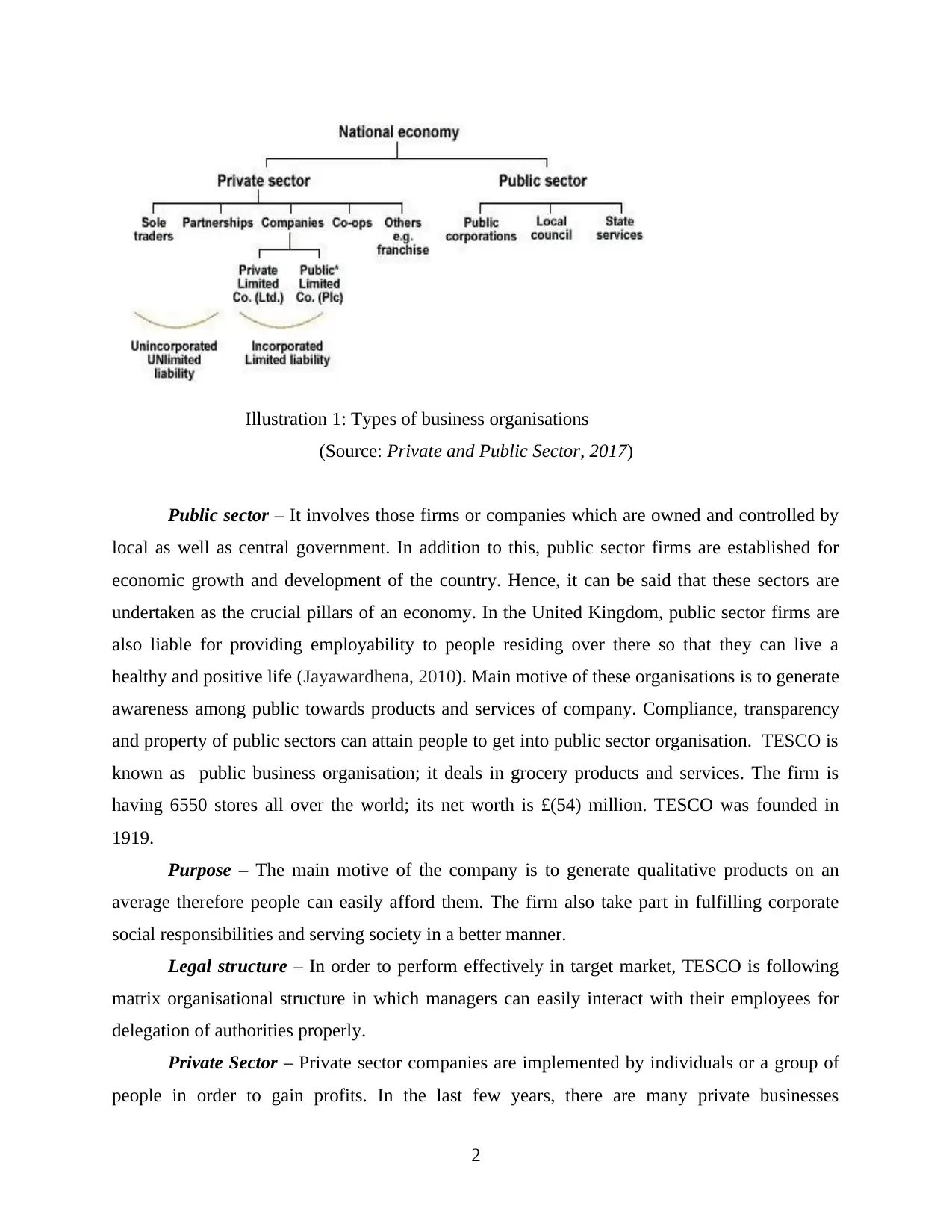
Illustration 1: Types of business organisations
(Source: Private and Public Sector, 2017)
Public sector – It involves those firms or companies which are owned and controlled by
local as well as central government. In addition to this, public sector firms are established for
economic growth and development of the country. Hence, it can be said that these sectors are
undertaken as the crucial pillars of an economy. In the United Kingdom, public sector firms are
also liable for providing employability to people residing over there so that they can live a
healthy and positive life (Jayawardhena, 2010). Main motive of these organisations is to generate
awareness among public towards products and services of company. Compliance, transparency
and property of public sectors can attain people to get into public sector organisation. TESCO is
known as public business organisation; it deals in grocery products and services. The firm is
having 6550 stores all over the world; its net worth is £(54) million. TESCO was founded in
1919.
Purpose – The main motive of the company is to generate qualitative products on an
average therefore people can easily afford them. The firm also take part in fulfilling corporate
social responsibilities and serving society in a better manner.
Legal structure – In order to perform effectively in target market, TESCO is following
matrix organisational structure in which managers can easily interact with their employees for
delegation of authorities properly.
Private Sector – Private sector companies are implemented by individuals or a group of
people in order to gain profits. In the last few years, there are many private businesses
2
(Source: Private and Public Sector, 2017)
Public sector – It involves those firms or companies which are owned and controlled by
local as well as central government. In addition to this, public sector firms are established for
economic growth and development of the country. Hence, it can be said that these sectors are
undertaken as the crucial pillars of an economy. In the United Kingdom, public sector firms are
also liable for providing employability to people residing over there so that they can live a
healthy and positive life (Jayawardhena, 2010). Main motive of these organisations is to generate
awareness among public towards products and services of company. Compliance, transparency
and property of public sectors can attain people to get into public sector organisation. TESCO is
known as public business organisation; it deals in grocery products and services. The firm is
having 6550 stores all over the world; its net worth is £(54) million. TESCO was founded in
1919.
Purpose – The main motive of the company is to generate qualitative products on an
average therefore people can easily afford them. The firm also take part in fulfilling corporate
social responsibilities and serving society in a better manner.
Legal structure – In order to perform effectively in target market, TESCO is following
matrix organisational structure in which managers can easily interact with their employees for
delegation of authorities properly.
Private Sector – Private sector companies are implemented by individuals or a group of
people in order to gain profits. In the last few years, there are many private businesses
2
Paraphrase This Document
Need a fresh take? Get an instant paraphrase of this document with our AI Paraphraser
developed. Along with this, these multinational companies also play a vital role in the economic
growth and development by rendering job opportunities to people. This helps in maximising
GDP rate as well as per capita income of the country (Doz and Kosonen, 2010). Best way group
is selected as private business entity; it is a multinational conglomerate operating company in
UK. The firm is known as second largest wholesaler by having 125000 retail stores all over the
nation. The group also runs UK's third largest Pharmacy company, i.e. Well pharmacy. Along
with this, legal structure of the company is, owners and firm has separate legal entities.
Shareholders have limited liability as they are not responsible for any kind of debts of the firm.
Purpose – The main purpose of the firm is to become world's largest retailing company
by providing qualitative and value added products and services to customers. In order to gain
high competitive advantage, the firm is now expanding itself other fields as well, such as-
banking, cement, pharmacy, wholesale etc.
Voluntary sector – It involves non-profit organisations and charities. Voluntary firms are
regulated for social development and welfare of people. In the UK, there are various voluntary
sectors who are established by government and other legal authorities. NHS is one of the public
non – departmental charitable body which is implemented in order to provide better health care
services to people. NHS has almost 50 sites over England.
Purpose – Main purpose of this firm is to deliver the best and healthy treatment as they
can live happily (Lee, Olson and Trimi, 2012).
1.2 Size and scope of different types of organisations
In this modern era, the number of private, public and voluntary business organisations is
rapidly increasing. Due to dynamic and flexible nature of environment is very easier to perform
in global market. In order to analyse business environment, managers are used different tools and
techniques so as to serve better to society. Below mentioned size and scope of public, private and
voluntary business organisations: -
Public sector – TESCO is one of greatest player in retail market; it serve its products and
services at global level. It is third largest supermarket chain of grocery products in terms of
revenues and profits. TESCO has 14 stores in all over the world, i.e. Europe, Asia, North
America, Malaysia etc. The firm is having 30% market share of overall retailing market. Apart
from this, the operating income of the firm is £1,280 million are there are over 480000
employees are currently working with it.
3
growth and development by rendering job opportunities to people. This helps in maximising
GDP rate as well as per capita income of the country (Doz and Kosonen, 2010). Best way group
is selected as private business entity; it is a multinational conglomerate operating company in
UK. The firm is known as second largest wholesaler by having 125000 retail stores all over the
nation. The group also runs UK's third largest Pharmacy company, i.e. Well pharmacy. Along
with this, legal structure of the company is, owners and firm has separate legal entities.
Shareholders have limited liability as they are not responsible for any kind of debts of the firm.
Purpose – The main purpose of the firm is to become world's largest retailing company
by providing qualitative and value added products and services to customers. In order to gain
high competitive advantage, the firm is now expanding itself other fields as well, such as-
banking, cement, pharmacy, wholesale etc.
Voluntary sector – It involves non-profit organisations and charities. Voluntary firms are
regulated for social development and welfare of people. In the UK, there are various voluntary
sectors who are established by government and other legal authorities. NHS is one of the public
non – departmental charitable body which is implemented in order to provide better health care
services to people. NHS has almost 50 sites over England.
Purpose – Main purpose of this firm is to deliver the best and healthy treatment as they
can live happily (Lee, Olson and Trimi, 2012).
1.2 Size and scope of different types of organisations
In this modern era, the number of private, public and voluntary business organisations is
rapidly increasing. Due to dynamic and flexible nature of environment is very easier to perform
in global market. In order to analyse business environment, managers are used different tools and
techniques so as to serve better to society. Below mentioned size and scope of public, private and
voluntary business organisations: -
Public sector – TESCO is one of greatest player in retail market; it serve its products and
services at global level. It is third largest supermarket chain of grocery products in terms of
revenues and profits. TESCO has 14 stores in all over the world, i.e. Europe, Asia, North
America, Malaysia etc. The firm is having 30% market share of overall retailing market. Apart
from this, the operating income of the firm is £1,280 million are there are over 480000
employees are currently working with it.
3
Goal and objective : - The main goal and objective of the firm is to create value for their
customers so as to earn lifetime loyalty. In order to achieve its aims and targets the firm is
always engaged with CSR activities; it also tries to serve better to societies in order to get long
term growth and success (Eckerson, 2010).
Private sector – Best way is the private business which deals in wholesale, cement,
banking etc. sectors. The firm was founded in 1976; the overall revenue of the firm is 3.4 billion
pound. There are over 34000 employees are currently working with it. In addition, in cement
industry, Best way group has enhnaced its overall sales revenue with 1.8 million dollar in last
years.
Goals and objectives – The main goal and objective of the company is to achieve high
competitive advantage by providing qualitative and value added products and services to
customers in an effective manner.
Voluntary sector – NHS is a public health care services which is located in Scotland,
England and Wales. It is manipulated by Labour party and certain public funds. Apart from this,
it provides comprehensive range of health and social services for growth and development of
British people. In 201516 it was employed 1.6 million people and the overall revenue of the
organisation is 6.7 million pound per year.
Goals and objectives – The main aim of NHS is work for social welfare and
development. For this purpose, these organisations promote educational facilities, increase public
conscience towards social problems and prevent public from dangerous health diseases.
1.3 (M1) How to inter-linked organisational size with its objectives
Business organisations are classified into three parts, as per their working activities and
operations. Under this, BBC is public sector organisation, TESCO is seem as private business
entity, whereas NHS is one of the major voluntary sector. Apart from this, the size and scope of
business organisations aids them to achieve their goals and objectives in an effective manner.
Because, if a firm has wide range of scope and products, then it can easily attracts numerous
customers (Kuckertz and Wagner, 2010). Higher number of customers are liable for improving
sales and profitability in a certain time period. For example- BBC, TESCO and NHS, these
organisations are deal at global level, as all of them has higher sales revenue and net income.
Now TESCO is operating in 14 countries, whereas it has covered almost 33% market share. But
4
customers so as to earn lifetime loyalty. In order to achieve its aims and targets the firm is
always engaged with CSR activities; it also tries to serve better to societies in order to get long
term growth and success (Eckerson, 2010).
Private sector – Best way is the private business which deals in wholesale, cement,
banking etc. sectors. The firm was founded in 1976; the overall revenue of the firm is 3.4 billion
pound. There are over 34000 employees are currently working with it. In addition, in cement
industry, Best way group has enhnaced its overall sales revenue with 1.8 million dollar in last
years.
Goals and objectives – The main goal and objective of the company is to achieve high
competitive advantage by providing qualitative and value added products and services to
customers in an effective manner.
Voluntary sector – NHS is a public health care services which is located in Scotland,
England and Wales. It is manipulated by Labour party and certain public funds. Apart from this,
it provides comprehensive range of health and social services for growth and development of
British people. In 201516 it was employed 1.6 million people and the overall revenue of the
organisation is 6.7 million pound per year.
Goals and objectives – The main aim of NHS is work for social welfare and
development. For this purpose, these organisations promote educational facilities, increase public
conscience towards social problems and prevent public from dangerous health diseases.
1.3 (M1) How to inter-linked organisational size with its objectives
Business organisations are classified into three parts, as per their working activities and
operations. Under this, BBC is public sector organisation, TESCO is seem as private business
entity, whereas NHS is one of the major voluntary sector. Apart from this, the size and scope of
business organisations aids them to achieve their goals and objectives in an effective manner.
Because, if a firm has wide range of scope and products, then it can easily attracts numerous
customers (Kuckertz and Wagner, 2010). Higher number of customers are liable for improving
sales and profitability in a certain time period. For example- BBC, TESCO and NHS, these
organisations are deal at global level, as all of them has higher sales revenue and net income.
Now TESCO is operating in 14 countries, whereas it has covered almost 33% market share. But
4
⊘ This is a preview!⊘
Do you want full access?
Subscribe today to unlock all pages.
Trusted by 1+ million students worldwide
for this achievement, firms need to provide qualitative and value added products to their
customers so as to gain long term growth.
TASK 2
2.1 Interrelationship between organisational functions and its structure
Every business organisation follows an adequate organisational structure so as to perform
effectively in target market. An organisational structure is a combination of different
departments and sections which are worked together for achieving company's goals and
objectives. Along with this, organisational structure of TESCO is created various departments,
i.e. human resource, finance, marketing, research, production etc. Senior managers of these
organisations are needed to examine business strategies and then give a suitable
recommendations that makes better to end results (Scherer and Palazzo, 2011). These
departments plays a very role in growth and development of TESCO, as firm can gain high
competitive advantage from target market. Finance department – The primary work of this unit is to keep analyse financial
resources therefore, working activities can be done in proper manner. Finance department
is liable for preparing account statements and balance sheet of the company in order to
establish a balance between asset and liabilities. Human resources department – HR department of the company is liable to encourage
and motivate staff members towards work as the firm can easily sustain higher
competitive advantage.
Marketing department – The unit states and develop various policies and strategies so as
to meet customers desires in an effective manner. Marketing department is responsible to
promote protects and services of the company in global environment.
All these above described functions helps is creating healthy working environment at
workplace. Hence, TESCO is following matrix organisational structure in which staff members
can easily communicate with their managers towards any queries in production. Apart from this,
as per the diagram, board of directors are responsible for taking all decisions and developing
policies. Whereas chief executive of TESCO directors all activities whether or they are
completing in proper manner. Managers of marketing, human resource and finance department,
reported to the CEO.
5
customers so as to gain long term growth.
TASK 2
2.1 Interrelationship between organisational functions and its structure
Every business organisation follows an adequate organisational structure so as to perform
effectively in target market. An organisational structure is a combination of different
departments and sections which are worked together for achieving company's goals and
objectives. Along with this, organisational structure of TESCO is created various departments,
i.e. human resource, finance, marketing, research, production etc. Senior managers of these
organisations are needed to examine business strategies and then give a suitable
recommendations that makes better to end results (Scherer and Palazzo, 2011). These
departments plays a very role in growth and development of TESCO, as firm can gain high
competitive advantage from target market. Finance department – The primary work of this unit is to keep analyse financial
resources therefore, working activities can be done in proper manner. Finance department
is liable for preparing account statements and balance sheet of the company in order to
establish a balance between asset and liabilities. Human resources department – HR department of the company is liable to encourage
and motivate staff members towards work as the firm can easily sustain higher
competitive advantage.
Marketing department – The unit states and develop various policies and strategies so as
to meet customers desires in an effective manner. Marketing department is responsible to
promote protects and services of the company in global environment.
All these above described functions helps is creating healthy working environment at
workplace. Hence, TESCO is following matrix organisational structure in which staff members
can easily communicate with their managers towards any queries in production. Apart from this,
as per the diagram, board of directors are responsible for taking all decisions and developing
policies. Whereas chief executive of TESCO directors all activities whether or they are
completing in proper manner. Managers of marketing, human resource and finance department,
reported to the CEO.
5
Paraphrase This Document
Need a fresh take? Get an instant paraphrase of this document with our AI Paraphraser
2.2 (M2) Advantages and disadvantages of interrelationships between organisational functions
Effective monitoring of organisational structure helps a firm to achieve its goals and
objectives in certain time of span. In addition, it is essential for managers of different
departments, i.e. finance, human resource and marketing, to work with proper coordination and
cooperation for getting better results (Zortea-Johnston, Darroch and Matear, 2012). But if these
departments will not be worked together then they this will affect business activities or tasks.
Organisational functions are required to be linked with organisational structures. Below
mentioned advantages and disadvantages of this interrelationship: -
Advantages Disadvantages
High productivity Lack of control
Learning better with time Poor intra-department coordination
Quick decision making and better efficiency. Lack team orientation.
2.3 (D1) Complexities of business structure
There are three types of organisational structure, i.e. functional, divisional and matrix.
But TESCO is following matrix organisational structure; in which there is no chain of command.
Employees can easily work in team and interact with each other. However, there are some
complexities of this organisational structure, as it leads poor communication and higher
involvement of senior authorities which can generate frustration and confusions among staff
members (Añón Higón and Driffield, 2011). In this context, staff members cannot work
properly.
CONCLUSION
From the above mentioned report, it has been concluded that business environment plays
a very vital role in growth and success of a commercial entity. On the basis of working activities,
business organisations are classified into three categories, i.e. public, private and voluntary. In
addition, all these entities have their own goals and objectives for their accomplishment they
develop strategies and policies. Along with this, organisational functions are interlinked with its
6
Effective monitoring of organisational structure helps a firm to achieve its goals and
objectives in certain time of span. In addition, it is essential for managers of different
departments, i.e. finance, human resource and marketing, to work with proper coordination and
cooperation for getting better results (Zortea-Johnston, Darroch and Matear, 2012). But if these
departments will not be worked together then they this will affect business activities or tasks.
Organisational functions are required to be linked with organisational structures. Below
mentioned advantages and disadvantages of this interrelationship: -
Advantages Disadvantages
High productivity Lack of control
Learning better with time Poor intra-department coordination
Quick decision making and better efficiency. Lack team orientation.
2.3 (D1) Complexities of business structure
There are three types of organisational structure, i.e. functional, divisional and matrix.
But TESCO is following matrix organisational structure; in which there is no chain of command.
Employees can easily work in team and interact with each other. However, there are some
complexities of this organisational structure, as it leads poor communication and higher
involvement of senior authorities which can generate frustration and confusions among staff
members (Añón Higón and Driffield, 2011). In this context, staff members cannot work
properly.
CONCLUSION
From the above mentioned report, it has been concluded that business environment plays
a very vital role in growth and success of a commercial entity. On the basis of working activities,
business organisations are classified into three categories, i.e. public, private and voluntary. In
addition, all these entities have their own goals and objectives for their accomplishment they
develop strategies and policies. Along with this, organisational functions are interlinked with its
6
structure so as to perform potency in target market. In organisational structure of TESCO, there
is involved three types of department, i.e. finance, human resource and marketing.
REFERENCES
Books and Journal
Añón Higón, D. and Driffield, N., 2011. Exporting and innovation performance: Analysis of the
annual Small Business Survey in the UK. International Small Business Journal. 29(1).
pp.4-24.
Doz, Y. L. and Kosonen, M., 2010. Embedding strategic agility: A leadership agenda for
accelerating business model renewal. Long range planning. 43(2). pp.370-382.
Eckerson, W. W., 2010. Performance dashboards: measuring, monitoring, and managing your
business. John Wiley & Sons.
Jayawardhena, C., 2010. The impact of service encounter quality in service evaluation: evidence
from a business-to-business context. Journal of Business & Industrial Marketing. 25(5).
pp.338-348.
Kuckertz, A. and Wagner, M., 2010. The influence of sustainability orientation on
entrepreneurial intentions—Investigating the role of business experience. Journal of
Business Venturing. 25(5). pp.524-539.
Lee, S. M., Olson, D. L. and Trimi, S., 2012. Co-innovation: convergenomics, collaboration, and
co-creation for organizational values. Management Decision. 50(5). pp.817-831.
Reinhardt, F. L. and Stavins, R. N., 2010. Corporate social responsibility, business strategy, and
the environment. Oxford Review of Economic Policy. 26(2). pp.164-181.
Scherer, A. G. and Palazzo, G., 2011. The new political role of business in a globalized world: A
review of a new perspective on CSR and its implications for the firm, governance, and
democracy. Journal of management studies. 48(4). pp.899-931.
Zortea-Johnston, E., Darroch, J. and Matear, S., 2012. Business orientations and innovation in
small and medium sized enterprises. International Entrepreneurship and Management
Journal. 8(2). pp.145-164.
Online
Private and Public Sector. 2017. [Online]. Available through:
<http://textbook.stpauls.br/business_organization/page_19.htm>. [Accessed on 30th
October 2017].
7
is involved three types of department, i.e. finance, human resource and marketing.
REFERENCES
Books and Journal
Añón Higón, D. and Driffield, N., 2011. Exporting and innovation performance: Analysis of the
annual Small Business Survey in the UK. International Small Business Journal. 29(1).
pp.4-24.
Doz, Y. L. and Kosonen, M., 2010. Embedding strategic agility: A leadership agenda for
accelerating business model renewal. Long range planning. 43(2). pp.370-382.
Eckerson, W. W., 2010. Performance dashboards: measuring, monitoring, and managing your
business. John Wiley & Sons.
Jayawardhena, C., 2010. The impact of service encounter quality in service evaluation: evidence
from a business-to-business context. Journal of Business & Industrial Marketing. 25(5).
pp.338-348.
Kuckertz, A. and Wagner, M., 2010. The influence of sustainability orientation on
entrepreneurial intentions—Investigating the role of business experience. Journal of
Business Venturing. 25(5). pp.524-539.
Lee, S. M., Olson, D. L. and Trimi, S., 2012. Co-innovation: convergenomics, collaboration, and
co-creation for organizational values. Management Decision. 50(5). pp.817-831.
Reinhardt, F. L. and Stavins, R. N., 2010. Corporate social responsibility, business strategy, and
the environment. Oxford Review of Economic Policy. 26(2). pp.164-181.
Scherer, A. G. and Palazzo, G., 2011. The new political role of business in a globalized world: A
review of a new perspective on CSR and its implications for the firm, governance, and
democracy. Journal of management studies. 48(4). pp.899-931.
Zortea-Johnston, E., Darroch, J. and Matear, S., 2012. Business orientations and innovation in
small and medium sized enterprises. International Entrepreneurship and Management
Journal. 8(2). pp.145-164.
Online
Private and Public Sector. 2017. [Online]. Available through:
<http://textbook.stpauls.br/business_organization/page_19.htm>. [Accessed on 30th
October 2017].
7
⊘ This is a preview!⊘
Do you want full access?
Subscribe today to unlock all pages.
Trusted by 1+ million students worldwide

1 out of 9


Related Documents


Your All-in-One AI-Powered Toolkit for Academic Success.
+13062052269
info@desklib.com
Available 24*7 on WhatsApp / Email
![[object Object]](/_next/static/media/star-bottom.7253800d.svg)
Unlock your academic potential
Copyright © 2020–2025 A2Z Services. All Rights Reserved. Developed and managed by ZUCOL.