Business Environment Analysis of TESCO: Organizations and Structures
VerifiedAdded on 2021/02/21
|15
|4685
|73
Report
AI Summary
This report provides a comprehensive analysis of TESCO, a multinational retail organization operating in the UK and internationally. It begins by defining the business environment and its impact on organizations, followed by an examination of different organizational types including private (TESCO), public (BBC), and non-profit organizations (Action for M.E.), detailing their purposes and legal structures. The report then explores the size and scope of organizations, differentiating between micro, small, medium, and large enterprises based on various metrics such as employee count, revenue, and market share, and discusses the future scope of each type. Furthermore, the report examines the interrelationships between different organizational functions, such as finance and marketing, and their impact on achieving business objectives. Finally, the report applies strategic analysis tools like PESTLE, SWOT, and Porter's Five Forces to assess the macro factors influencing the UK retail sector, providing a holistic view of TESCO's operating environment and strategic positioning.
BUSINESS AND
BUSINESS
ENVIRONMENT
BUSINESS
ENVIRONMENT

Paraphrase This Document
Need a fresh take? Get an instant paraphrase of this document with our AI Paraphraser
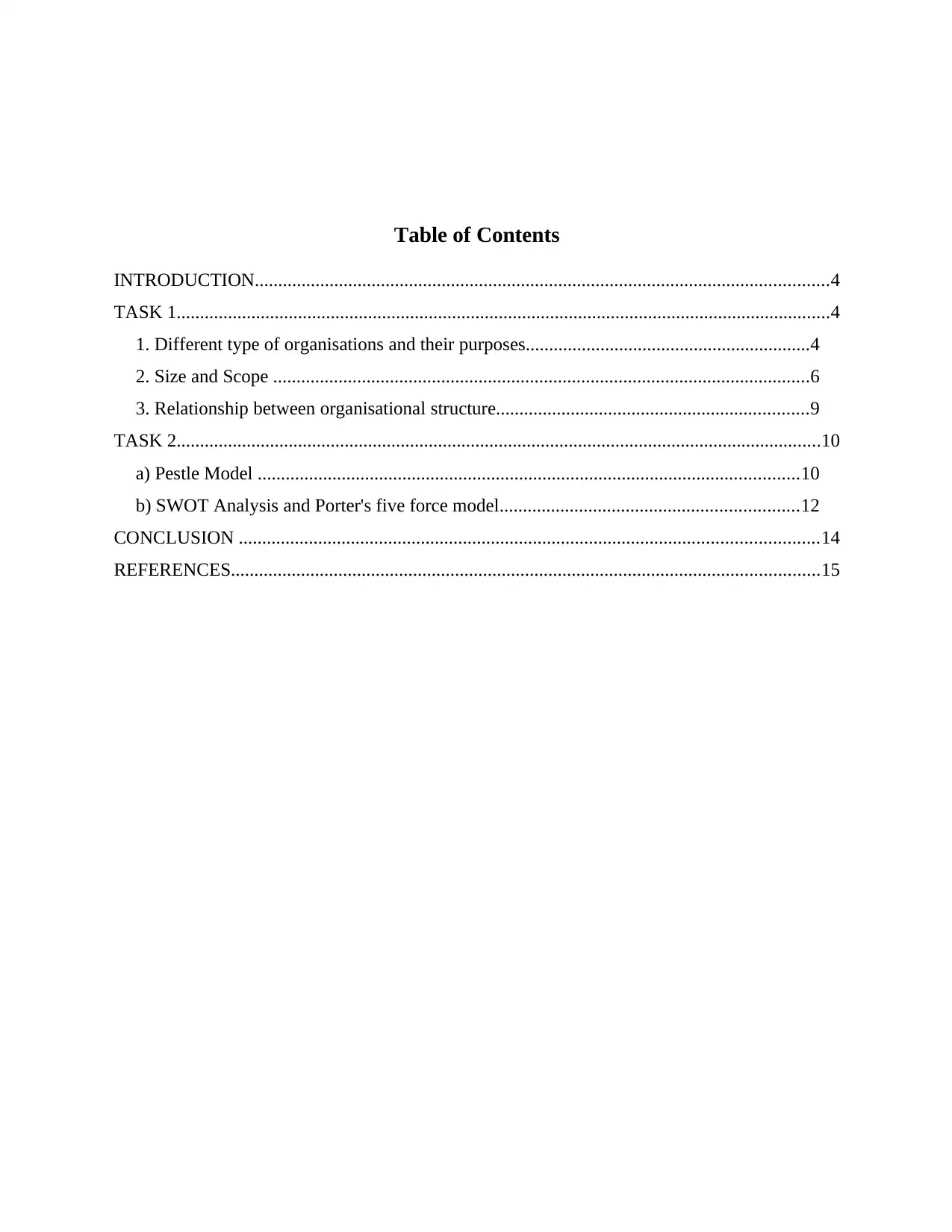
Table of Contents
INTRODUCTION...........................................................................................................................4
TASK 1............................................................................................................................................4
1. Different type of organisations and their purposes.............................................................4
2. Size and Scope ...................................................................................................................6
3. Relationship between organisational structure...................................................................9
TASK 2..........................................................................................................................................10
a) Pestle Model ....................................................................................................................10
b) SWOT Analysis and Porter's five force model................................................................12
CONCLUSION ............................................................................................................................14
REFERENCES..............................................................................................................................15
INTRODUCTION...........................................................................................................................4
TASK 1............................................................................................................................................4
1. Different type of organisations and their purposes.............................................................4
2. Size and Scope ...................................................................................................................6
3. Relationship between organisational structure...................................................................9
TASK 2..........................................................................................................................................10
a) Pestle Model ....................................................................................................................10
b) SWOT Analysis and Porter's five force model................................................................12
CONCLUSION ............................................................................................................................14
REFERENCES..............................................................................................................................15
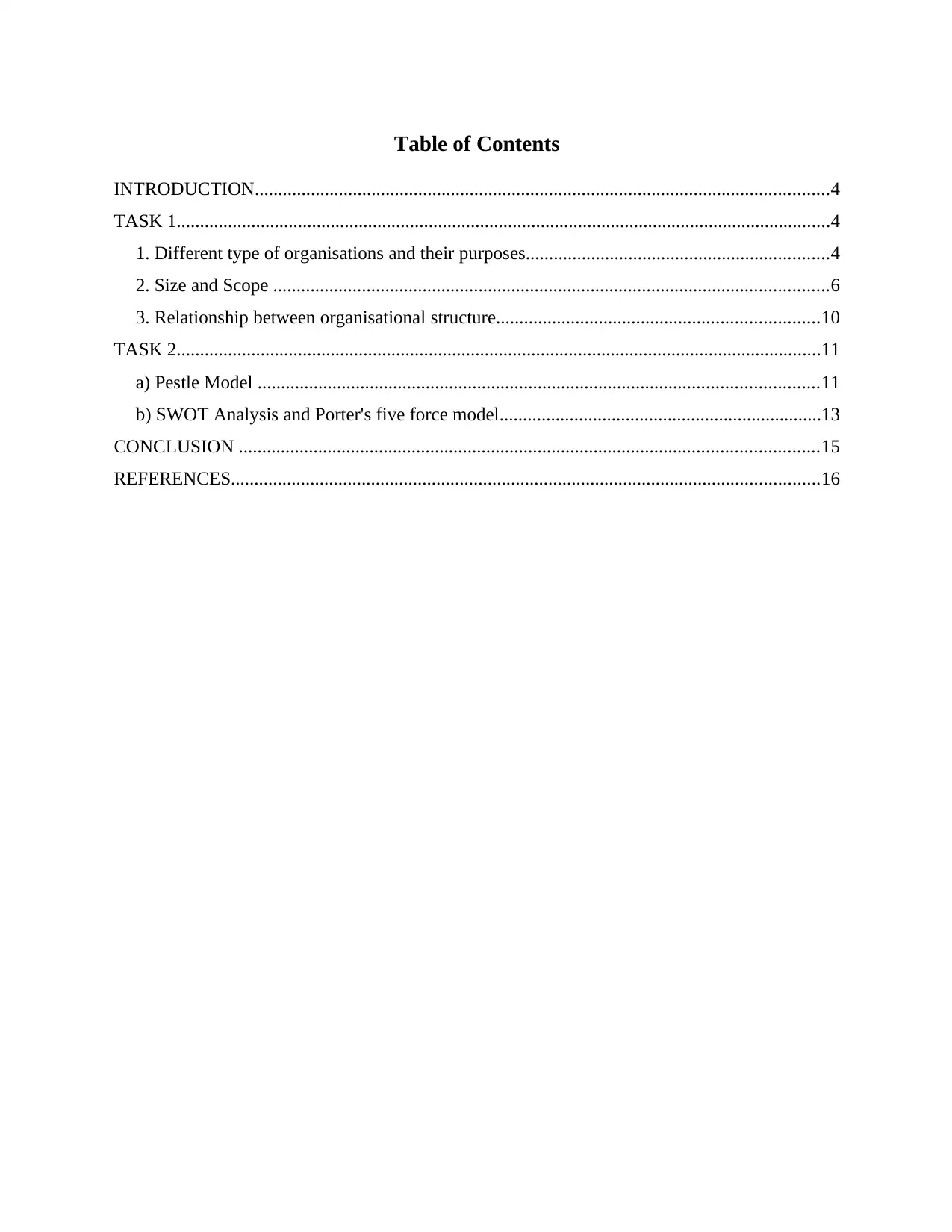
Table of Contents
INTRODUCTION...........................................................................................................................4
TASK 1............................................................................................................................................4
1. Different type of organisations and their purposes.................................................................4
2. Size and Scope .......................................................................................................................6
3. Relationship between organisational structure.....................................................................10
TASK 2..........................................................................................................................................11
a) Pestle Model ........................................................................................................................11
b) SWOT Analysis and Porter's five force model.....................................................................13
CONCLUSION ............................................................................................................................15
REFERENCES..............................................................................................................................16
INTRODUCTION...........................................................................................................................4
TASK 1............................................................................................................................................4
1. Different type of organisations and their purposes.................................................................4
2. Size and Scope .......................................................................................................................6
3. Relationship between organisational structure.....................................................................10
TASK 2..........................................................................................................................................11
a) Pestle Model ........................................................................................................................11
b) SWOT Analysis and Porter's five force model.....................................................................13
CONCLUSION ............................................................................................................................15
REFERENCES..............................................................................................................................16
⊘ This is a preview!⊘
Do you want full access?
Subscribe today to unlock all pages.

Trusted by 1+ million students worldwide
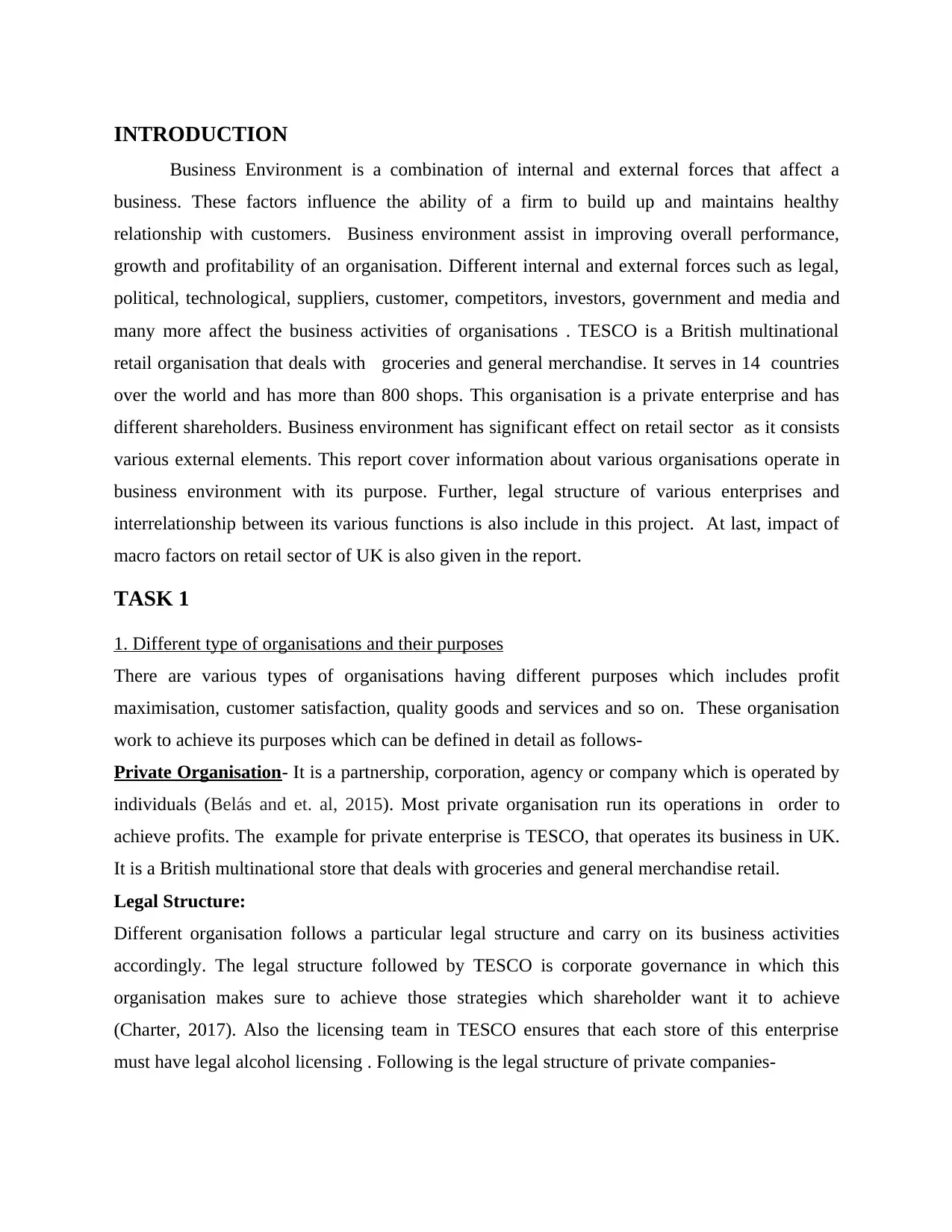
INTRODUCTION
Business Environment is a combination of internal and external forces that affect a
business. These factors influence the ability of a firm to build up and maintains healthy
relationship with customers. Business environment assist in improving overall performance,
growth and profitability of an organisation. Different internal and external forces such as legal,
political, technological, suppliers, customer, competitors, investors, government and media and
many more affect the business activities of organisations . TESCO is a British multinational
retail organisation that deals with groceries and general merchandise. It serves in 14 countries
over the world and has more than 800 shops. This organisation is a private enterprise and has
different shareholders. Business environment has significant effect on retail sector as it consists
various external elements. This report cover information about various organisations operate in
business environment with its purpose. Further, legal structure of various enterprises and
interrelationship between its various functions is also include in this project. At last, impact of
macro factors on retail sector of UK is also given in the report.
TASK 1
1. Different type of organisations and their purposes
There are various types of organisations having different purposes which includes profit
maximisation, customer satisfaction, quality goods and services and so on. These organisation
work to achieve its purposes which can be defined in detail as follows-
Private Organisation- It is a partnership, corporation, agency or company which is operated by
individuals (Belás and et. al, 2015). Most private organisation run its operations in order to
achieve profits. The example for private enterprise is TESCO, that operates its business in UK.
It is a British multinational store that deals with groceries and general merchandise retail.
Legal Structure:
Different organisation follows a particular legal structure and carry on its business activities
accordingly. The legal structure followed by TESCO is corporate governance in which this
organisation makes sure to achieve those strategies which shareholder want it to achieve
(Charter, 2017). Also the licensing team in TESCO ensures that each store of this enterprise
must have legal alcohol licensing . Following is the legal structure of private companies-
Business Environment is a combination of internal and external forces that affect a
business. These factors influence the ability of a firm to build up and maintains healthy
relationship with customers. Business environment assist in improving overall performance,
growth and profitability of an organisation. Different internal and external forces such as legal,
political, technological, suppliers, customer, competitors, investors, government and media and
many more affect the business activities of organisations . TESCO is a British multinational
retail organisation that deals with groceries and general merchandise. It serves in 14 countries
over the world and has more than 800 shops. This organisation is a private enterprise and has
different shareholders. Business environment has significant effect on retail sector as it consists
various external elements. This report cover information about various organisations operate in
business environment with its purpose. Further, legal structure of various enterprises and
interrelationship between its various functions is also include in this project. At last, impact of
macro factors on retail sector of UK is also given in the report.
TASK 1
1. Different type of organisations and their purposes
There are various types of organisations having different purposes which includes profit
maximisation, customer satisfaction, quality goods and services and so on. These organisation
work to achieve its purposes which can be defined in detail as follows-
Private Organisation- It is a partnership, corporation, agency or company which is operated by
individuals (Belás and et. al, 2015). Most private organisation run its operations in order to
achieve profits. The example for private enterprise is TESCO, that operates its business in UK.
It is a British multinational store that deals with groceries and general merchandise retail.
Legal Structure:
Different organisation follows a particular legal structure and carry on its business activities
accordingly. The legal structure followed by TESCO is corporate governance in which this
organisation makes sure to achieve those strategies which shareholder want it to achieve
(Charter, 2017). Also the licensing team in TESCO ensures that each store of this enterprise
must have legal alcohol licensing . Following is the legal structure of private companies-
Paraphrase This Document
Need a fresh take? Get an instant paraphrase of this document with our AI Paraphraser
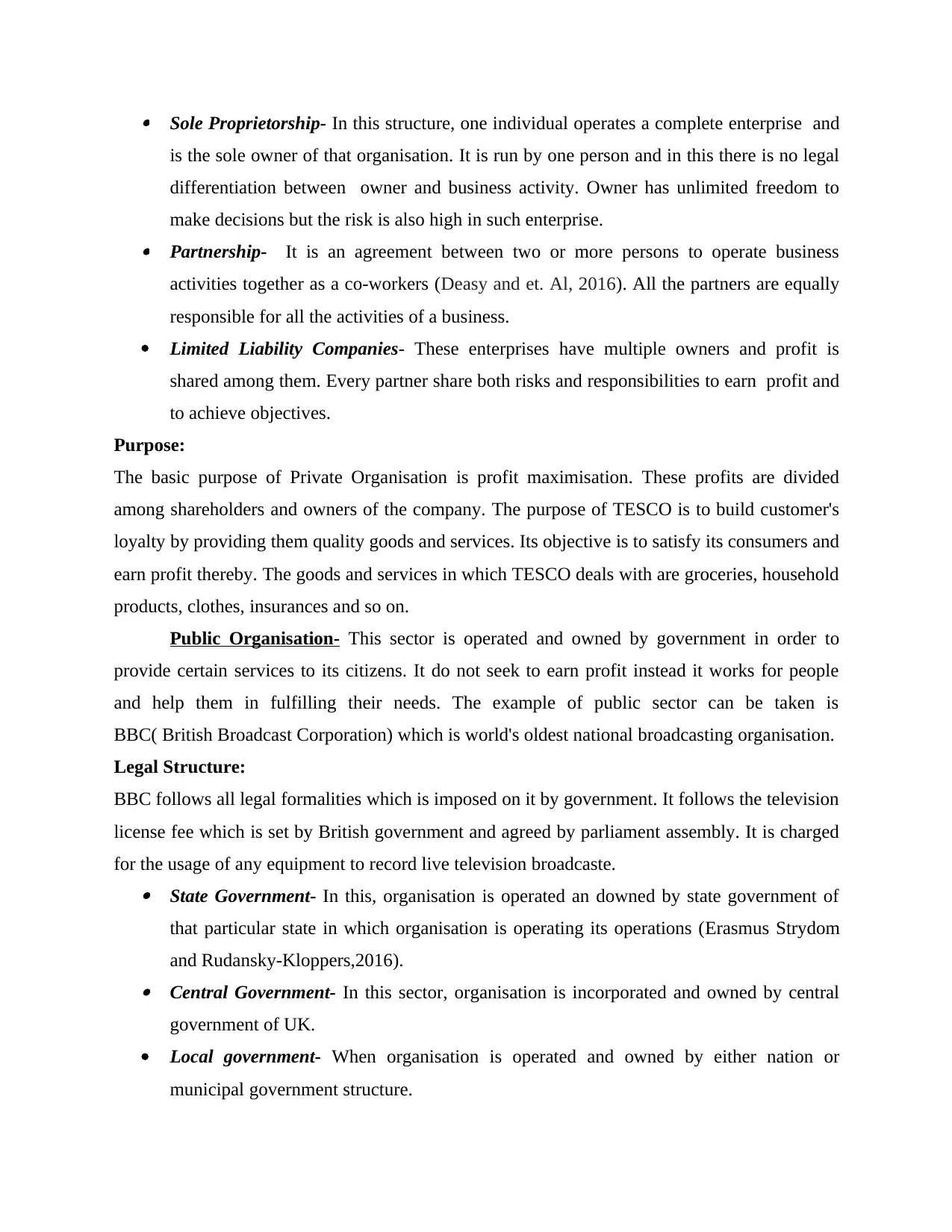
Sole Proprietorship- In this structure, one individual operates a complete enterprise and
is the sole owner of that organisation. It is run by one person and in this there is no legal
differentiation between owner and business activity. Owner has unlimited freedom to
make decisions but the risk is also high in such enterprise. Partnership- It is an agreement between two or more persons to operate business
activities together as a co-workers (Deasy and et. Al, 2016). All the partners are equally
responsible for all the activities of a business.
Limited Liability Companies- These enterprises have multiple owners and profit is
shared among them. Every partner share both risks and responsibilities to earn profit and
to achieve objectives.
Purpose:
The basic purpose of Private Organisation is profit maximisation. These profits are divided
among shareholders and owners of the company. The purpose of TESCO is to build customer's
loyalty by providing them quality goods and services. Its objective is to satisfy its consumers and
earn profit thereby. The goods and services in which TESCO deals with are groceries, household
products, clothes, insurances and so on.
Public Organisation- This sector is operated and owned by government in order to
provide certain services to its citizens. It do not seek to earn profit instead it works for people
and help them in fulfilling their needs. The example of public sector can be taken is
BBC( British Broadcast Corporation) which is world's oldest national broadcasting organisation.
Legal Structure:
BBC follows all legal formalities which is imposed on it by government. It follows the television
license fee which is set by British government and agreed by parliament assembly. It is charged
for the usage of any equipment to record live television broadcaste. State Government- In this, organisation is operated an downed by state government of
that particular state in which organisation is operating its operations (Erasmus Strydom
and Rudansky-Kloppers,2016). Central Government- In this sector, organisation is incorporated and owned by central
government of UK.
Local government- When organisation is operated and owned by either nation or
municipal government structure.
is the sole owner of that organisation. It is run by one person and in this there is no legal
differentiation between owner and business activity. Owner has unlimited freedom to
make decisions but the risk is also high in such enterprise. Partnership- It is an agreement between two or more persons to operate business
activities together as a co-workers (Deasy and et. Al, 2016). All the partners are equally
responsible for all the activities of a business.
Limited Liability Companies- These enterprises have multiple owners and profit is
shared among them. Every partner share both risks and responsibilities to earn profit and
to achieve objectives.
Purpose:
The basic purpose of Private Organisation is profit maximisation. These profits are divided
among shareholders and owners of the company. The purpose of TESCO is to build customer's
loyalty by providing them quality goods and services. Its objective is to satisfy its consumers and
earn profit thereby. The goods and services in which TESCO deals with are groceries, household
products, clothes, insurances and so on.
Public Organisation- This sector is operated and owned by government in order to
provide certain services to its citizens. It do not seek to earn profit instead it works for people
and help them in fulfilling their needs. The example of public sector can be taken is
BBC( British Broadcast Corporation) which is world's oldest national broadcasting organisation.
Legal Structure:
BBC follows all legal formalities which is imposed on it by government. It follows the television
license fee which is set by British government and agreed by parliament assembly. It is charged
for the usage of any equipment to record live television broadcaste. State Government- In this, organisation is operated an downed by state government of
that particular state in which organisation is operating its operations (Erasmus Strydom
and Rudansky-Kloppers,2016). Central Government- In this sector, organisation is incorporated and owned by central
government of UK.
Local government- When organisation is operated and owned by either nation or
municipal government structure.
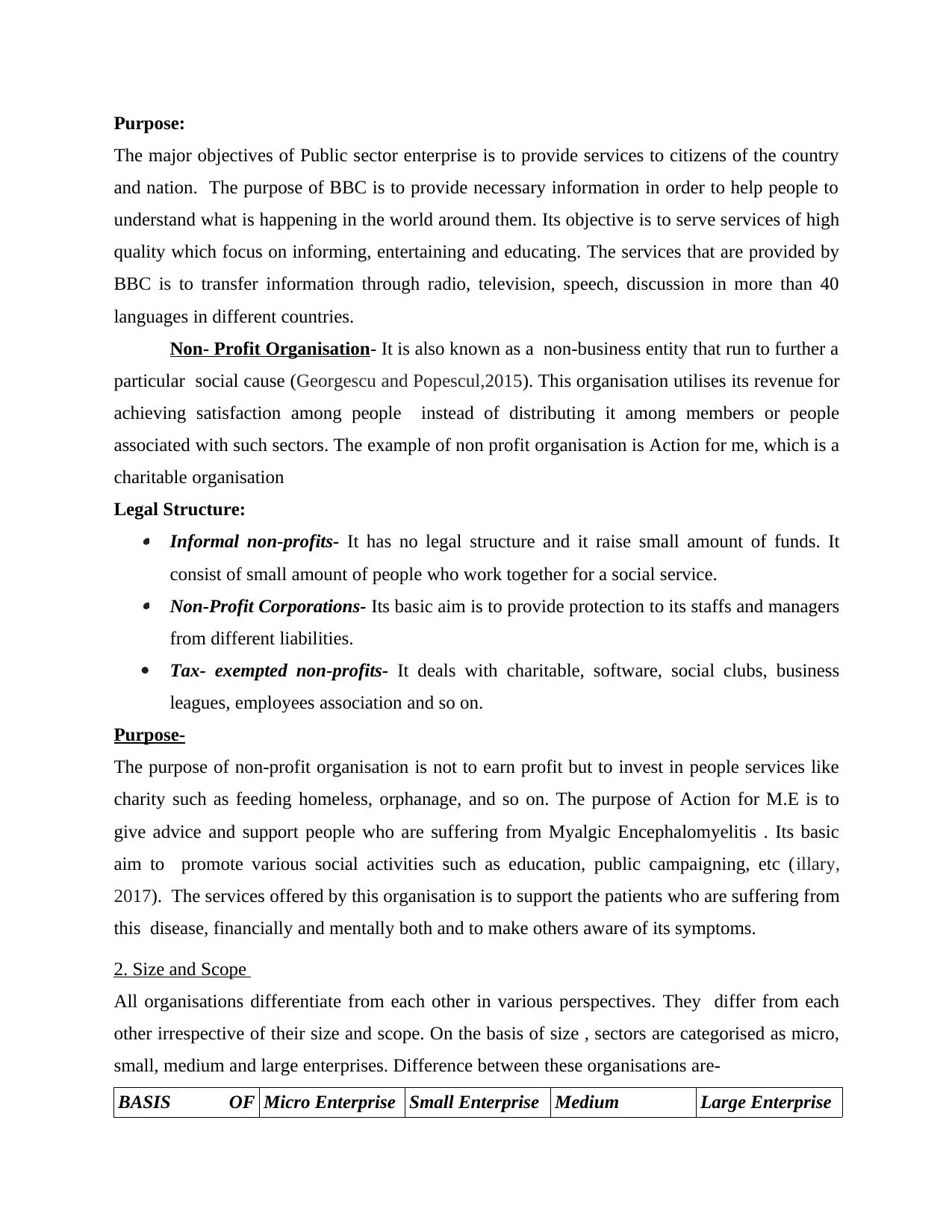
Purpose:
The major objectives of Public sector enterprise is to provide services to citizens of the country
and nation. The purpose of BBC is to provide necessary information in order to help people to
understand what is happening in the world around them. Its objective is to serve services of high
quality which focus on informing, entertaining and educating. The services that are provided by
BBC is to transfer information through radio, television, speech, discussion in more than 40
languages in different countries.
Non- Profit Organisation- It is also known as a non-business entity that run to further a
particular social cause (Georgescu and Popescul,2015). This organisation utilises its revenue for
achieving satisfaction among people instead of distributing it among members or people
associated with such sectors. The example of non profit organisation is Action for me, which is a
charitable organisation
Legal Structure: Informal non-profits- It has no legal structure and it raise small amount of funds. It
consist of small amount of people who work together for a social service. Non-Profit Corporations- Its basic aim is to provide protection to its staffs and managers
from different liabilities.
Tax- exempted non-profits- It deals with charitable, software, social clubs, business
leagues, employees association and so on.
Purpose-
The purpose of non-profit organisation is not to earn profit but to invest in people services like
charity such as feeding homeless, orphanage, and so on. The purpose of Action for M.E is to
give advice and support people who are suffering from Myalgic Encephalomyelitis . Its basic
aim to promote various social activities such as education, public campaigning, etc (illary,
2017). The services offered by this organisation is to support the patients who are suffering from
this disease, financially and mentally both and to make others aware of its symptoms.
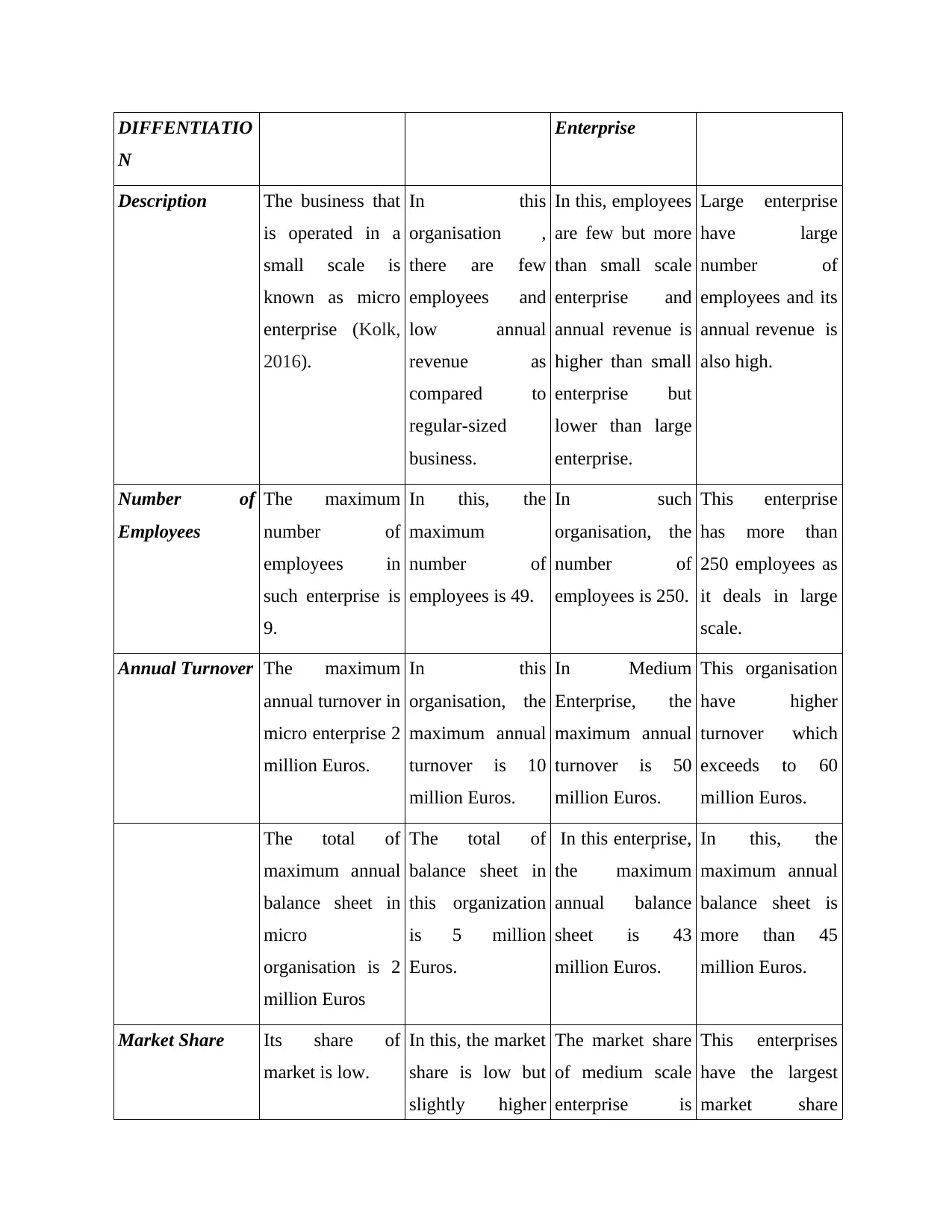
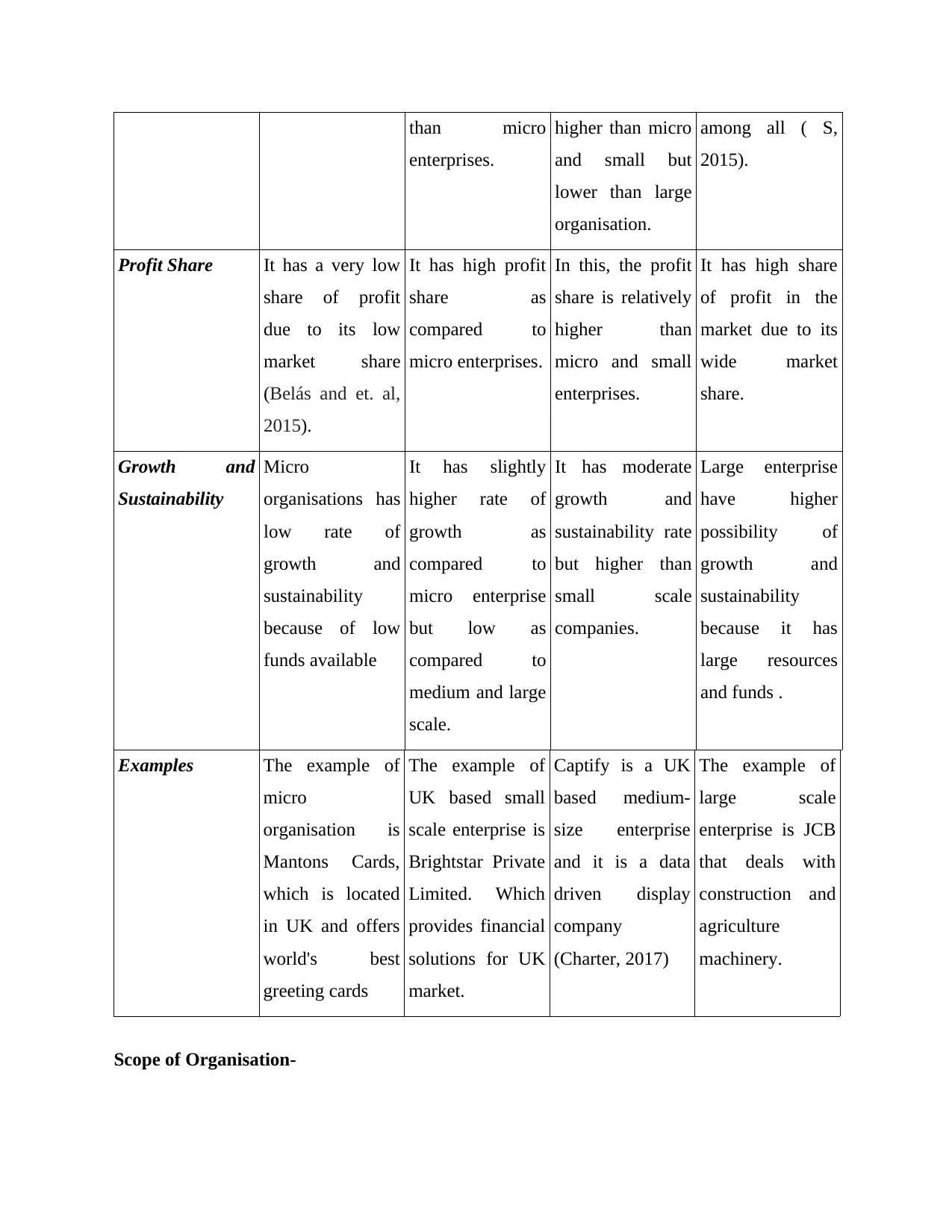
2. Size and Scope
All organisations differentiate from each other in various perspectives. They differ from each
other irrespective of their size and scope. On the basis of size , sectors are categorised as micro,
small, medium and large enterprises. Difference between these organisations are-
BASIS OF Micro Enterprise Small Enterprise Medium Large Enterprise
The major objectives of Public sector enterprise is to provide services to citizens of the country
and nation. The purpose of BBC is to provide necessary information in order to help people to
understand what is happening in the world around them. Its objective is to serve services of high
quality which focus on informing, entertaining and educating. The services that are provided by
BBC is to transfer information through radio, television, speech, discussion in more than 40
languages in different countries.
Non- Profit Organisation- It is also known as a non-business entity that run to further a
particular social cause (Georgescu and Popescul,2015). This organisation utilises its revenue for
achieving satisfaction among people instead of distributing it among members or people
associated with such sectors. The example of non profit organisation is Action for me, which is a
charitable organisation
Legal Structure: Informal non-profits- It has no legal structure and it raise small amount of funds. It
consist of small amount of people who work together for a social service. Non-Profit Corporations- Its basic aim is to provide protection to its staffs and managers
from different liabilities.
Tax- exempted non-profits- It deals with charitable, software, social clubs, business
leagues, employees association and so on.
Purpose-
The purpose of non-profit organisation is not to earn profit but to invest in people services like
charity such as feeding homeless, orphanage, and so on. The purpose of Action for M.E is to
give advice and support people who are suffering from Myalgic Encephalomyelitis . Its basic
aim to promote various social activities such as education, public campaigning, etc (illary,
2017). The services offered by this organisation is to support the patients who are suffering from
this disease, financially and mentally both and to make others aware of its symptoms.
2. Size and Scope
All organisations differentiate from each other in various perspectives. They differ from each
other irrespective of their size and scope. On the basis of size , sectors are categorised as micro,
small, medium and large enterprises. Difference between these organisations are-
BASIS OF Micro Enterprise Small Enterprise Medium Large Enterprise
⊘ This is a preview!⊘
Do you want full access?
Subscribe today to unlock all pages.
Trusted by 1+ million students worldwide
DIFFENTIATIO
N
Enterprise
Description The business that
is operated in a
small scale is
known as micro
enterprise (Kolk,
2016).
In this
organisation ,
there are few
employees and
low annual
revenue as
compared to
regular-sized
business.
In this, employees
are few but more
than small scale
enterprise and
annual revenue is
higher than small
enterprise but
lower than large
enterprise.
Large enterprise
have large
number of
employees and its
annual revenue is
also high.
Number of
Employees
The maximum
number of
employees in
such enterprise is
9.
In this, the
maximum
number of
employees is 49.
In such
organisation, the
number of
employees is 250.
This enterprise
has more than
250 employees as
it deals in large
scale.
Annual Turnover The maximum
annual turnover in
micro enterprise 2
million Euros.
In this
organisation, the
maximum annual
turnover is 10
million Euros.
In Medium
Enterprise, the
maximum annual
turnover is 50
million Euros.
This organisation
have higher
turnover which
exceeds to 60
million Euros.
The total of
maximum annual
balance sheet in
micro
organisation is 2
million Euros
The total of
balance sheet in
this organization
is 5 million
Euros.
In this enterprise,
the maximum
annual balance
sheet is 43
million Euros.
In this, the
maximum annual
balance sheet is
more than 45
million Euros.
Market Share Its share of
market is low.
In this, the market
share is low but
slightly higher
The market share
of medium scale
enterprise is
This enterprises
have the largest
market share
N
Enterprise
Description The business that
is operated in a
small scale is
known as micro
enterprise (Kolk,
2016).
In this
organisation ,
there are few
employees and
low annual
revenue as
compared to
regular-sized
business.
In this, employees
are few but more
than small scale
enterprise and
annual revenue is
higher than small
enterprise but
lower than large
enterprise.
Large enterprise
have large
number of
employees and its
annual revenue is
also high.
Number of
Employees
The maximum
number of
employees in
such enterprise is
9.
In this, the
maximum
number of
employees is 49.
In such
organisation, the
number of
employees is 250.
This enterprise
has more than
250 employees as
it deals in large
scale.
Annual Turnover The maximum
annual turnover in
micro enterprise 2
million Euros.
In this
organisation, the
maximum annual
turnover is 10
million Euros.
In Medium
Enterprise, the
maximum annual
turnover is 50
million Euros.
This organisation
have higher
turnover which
exceeds to 60
million Euros.
The total of
maximum annual
balance sheet in
micro
organisation is 2
million Euros
The total of
balance sheet in
this organization
is 5 million
Euros.
In this enterprise,
the maximum
annual balance
sheet is 43
million Euros.
In this, the
maximum annual
balance sheet is
more than 45
million Euros.
Market Share Its share of
market is low.
In this, the market
share is low but
slightly higher
The market share
of medium scale
enterprise is
This enterprises
have the largest
market share
Paraphrase This Document
Need a fresh take? Get an instant paraphrase of this document with our AI Paraphraser
than micro
enterprises.
higher than micro
and small but
lower than large
organisation.
among all ( S,
2015).
Profit Share It has a very low
share of profit
due to its low
market share
(Belás and et. al,
2015).
It has high profit
share as
compared to
micro enterprises.
In this, the profit
share is relatively
higher than
micro and small
enterprises.
It has high share
of profit in the
market due to its
wide market
share.
Growth and
Sustainability
Micro
organisations has
low rate of
growth and
sustainability
because of low
funds available
It has slightly
higher rate of
growth as
compared to
micro enterprise
but low as
compared to
medium and large
scale.
It has moderate
growth and
sustainability rate
but higher than
small scale
companies.
Large enterprise
have higher
possibility of
growth and
sustainability
because it has
large resources
and funds .
Examples The example of
micro
organisation is
Mantons Cards,
which is located
in UK and offers
world's best
greeting cards
The example of
UK based small
scale enterprise is
Brightstar Private
Limited. Which
provides financial
solutions for UK
market.
Captify is a UK
based medium-
size enterprise
and it is a data
driven display
company
(Charter, 2017)
The example of
large scale
enterprise is JCB
that deals with
construction and
agriculture
machinery.
Scope of Organisation-
enterprises.
higher than micro
and small but
lower than large
organisation.
among all ( S,
2015).
Profit Share It has a very low
share of profit
due to its low
market share
(Belás and et. al,
2015).
It has high profit
share as
compared to
micro enterprises.
In this, the profit
share is relatively
higher than
micro and small
enterprises.
It has high share
of profit in the
market due to its
wide market
share.
Growth and
Sustainability
Micro
organisations has
low rate of
growth and
sustainability
because of low
funds available
It has slightly
higher rate of
growth as
compared to
micro enterprise
but low as
compared to
medium and large
scale.
It has moderate
growth and
sustainability rate
but higher than
small scale
companies.
Large enterprise
have higher
possibility of
growth and
sustainability
because it has
large resources
and funds .
Examples The example of
micro
organisation is
Mantons Cards,
which is located
in UK and offers
world's best
greeting cards
The example of
UK based small
scale enterprise is
Brightstar Private
Limited. Which
provides financial
solutions for UK
market.
Captify is a UK
based medium-
size enterprise
and it is a data
driven display
company
(Charter, 2017)
The example of
large scale
enterprise is JCB
that deals with
construction and
agriculture
machinery.
Scope of Organisation-
Each kind of organisation has its scope of growth in future which can be seen in detail
below-
Private Organisation- The scope of private organisation in future is wide as the number of
private companies in the world is increasing day by day. Also, it is giving opportunities to many
people who are seeking job by giving them employment.
Public Organisation- It has wider scope because the government plays an vital role in growth
of an economy of a country. It achieves the overall objectives of a country by contributing in
developing economy (Deasy and et. al, 2016).
Non-profit Organisation- This sector is growing day by day. Although it does not focus on
profits but it is providing job to various communities by which this sector can grow in future.
3. Relationship between organisational structure
Different organisation department serves various functions which helps the business in
achieving its objectives. All the departments of an organisation are closely interrelated and
dependent upon each other. The inter relationship between these functions helps the enterprise in
its smooth functioning. Some of the relationship between organisation function are described
below- Finance and Marketing Department- Both of these departments are closely interrelated
with each other. When competition increases in market, they need to carry their work
together in order to increase share in market and improvement in bottom line. The role
of marketing department is to create awareness among customers for a particular product
or service by investing in promotional techniques (Erasmus Strydom and Rudansky-
Kloppers, 2016,). On the other hand, finance department makes ensure that money
should be appropriately invested and there is no misappropriation of financial resources.
Both of these departments work together in order to achieve organisational goals by
generating product need in the market while investing appropriate financial resources. Production and Finance Department- These departments are linked with each other and
aims to achieve objectives of an enterprise. Production department involves in producing
appropriate goods and services for meeting the needs of customers. On the other hand,
finance department provides monetary funds to organisation for producing adequate
goods. In order to produce a product, production department will need some cost that will
below-
Private Organisation- The scope of private organisation in future is wide as the number of
private companies in the world is increasing day by day. Also, it is giving opportunities to many
people who are seeking job by giving them employment.
Public Organisation- It has wider scope because the government plays an vital role in growth
of an economy of a country. It achieves the overall objectives of a country by contributing in
developing economy (Deasy and et. al, 2016).
Non-profit Organisation- This sector is growing day by day. Although it does not focus on
profits but it is providing job to various communities by which this sector can grow in future.
3. Relationship between organisational structure
Different organisation department serves various functions which helps the business in
achieving its objectives. All the departments of an organisation are closely interrelated and
dependent upon each other. The inter relationship between these functions helps the enterprise in
its smooth functioning. Some of the relationship between organisation function are described
below- Finance and Marketing Department- Both of these departments are closely interrelated
with each other. When competition increases in market, they need to carry their work
together in order to increase share in market and improvement in bottom line. The role
of marketing department is to create awareness among customers for a particular product
or service by investing in promotional techniques (Erasmus Strydom and Rudansky-
Kloppers, 2016,). On the other hand, finance department makes ensure that money
should be appropriately invested and there is no misappropriation of financial resources.
Both of these departments work together in order to achieve organisational goals by
generating product need in the market while investing appropriate financial resources. Production and Finance Department- These departments are linked with each other and
aims to achieve objectives of an enterprise. Production department involves in producing
appropriate goods and services for meeting the needs of customers. On the other hand,
finance department provides monetary funds to organisation for producing adequate
goods. In order to produce a product, production department will need some cost that will
⊘ This is a preview!⊘
Do you want full access?
Subscribe today to unlock all pages.
Trusted by 1+ million students worldwide
incurred while producing that product and for this finance department will come into
action. By producing product that will meet customers need will result in increase in
profits of organisation and by investing appropriate cost will able to achieve
organisational objectives. HR Department and IT department- Human resource department can help technical
department to provide them well trained employees which can function properly in order
to achieve organisational goals. On the other hand, IT department can help human
resource to provide them best tools available which will help it to organise training by
using latest HR software. A strong relationship and bond between these departments will
help the organisation to grow and achieve its objectives (Belás and et. al, 2015).
Marketing and R&D Department- Both of these departments provide a link with each
other and without proper functioning of one, the other will not able to function properly.
If the R&D department will not provide a low of innovation and technology than
marketing sector will not be effective any longer. On the other hand, if market
department will not generate new ideas and translate these innovations into action, than
research and development department will not able to pay its bills. Both of them are
dependent on each other and they work together effectively for attaining goals of an
organisation.
TASK 2
a) Pestle Model
It determines the impact of external environment on growth and sustainability of an
organisation. It consists of six major macro level forces which are political, economical, social,
technological, legal and environmental, that affects the decisions which is taken by organisations
(Deasy and et. al, 2016). Pestle model has affected the UK retail market as follows- Political: These are the forces which is not only affecting company at present but also
affects it in future. It includes all those factors that government has on an enterprise such
as policies of government, foreign trade policy, etc. In UK retail sector, Political factors
has affect over its revenue and profitability. One of the key political factor which will
affect the retail industry is rate of tax imposed by UK government. In present scenario,
action. By producing product that will meet customers need will result in increase in
profits of organisation and by investing appropriate cost will able to achieve
organisational objectives. HR Department and IT department- Human resource department can help technical
department to provide them well trained employees which can function properly in order
to achieve organisational goals. On the other hand, IT department can help human
resource to provide them best tools available which will help it to organise training by
using latest HR software. A strong relationship and bond between these departments will
help the organisation to grow and achieve its objectives (Belás and et. al, 2015).
Marketing and R&D Department- Both of these departments provide a link with each
other and without proper functioning of one, the other will not able to function properly.
If the R&D department will not provide a low of innovation and technology than
marketing sector will not be effective any longer. On the other hand, if market
department will not generate new ideas and translate these innovations into action, than
research and development department will not able to pay its bills. Both of them are
dependent on each other and they work together effectively for attaining goals of an
organisation.
TASK 2
a) Pestle Model
It determines the impact of external environment on growth and sustainability of an
organisation. It consists of six major macro level forces which are political, economical, social,
technological, legal and environmental, that affects the decisions which is taken by organisations
(Deasy and et. al, 2016). Pestle model has affected the UK retail market as follows- Political: These are the forces which is not only affecting company at present but also
affects it in future. It includes all those factors that government has on an enterprise such
as policies of government, foreign trade policy, etc. In UK retail sector, Political factors
has affect over its revenue and profitability. One of the key political factor which will
affect the retail industry is rate of tax imposed by UK government. In present scenario,
Paraphrase This Document
Need a fresh take? Get an instant paraphrase of this document with our AI Paraphraser
the interest rates of UK is 0.5% which is low. This is an opportunity for retailers to
borrow large sum of money in order to expand capital at lower rates. Taken the example
of TESCO, a tax known as TESCO Tax is imposed by local council on this organisation
which is neglected by UK government. In future if such initiatives exists, than it can
affect TESCO negatively. Economical: These factors consists of economic growth, inflation and interest rates,
exchange and unemployment rates, etc (Charter, 2017). There is low economic growth in
UK since 2010. This have negatively affect retail industry as its major source of
generating revenue is dependent upon economy. . Social: These factors also have significant impact on an organisation and its
profitability. It includes changes in tastes and preferences of customers and demographic
changes. The most important issue in this prospect of UK is increasing ageing
population. Companies like Mark & Spencer that deals with latest fashion of clothes is
negatively affected by this factor because ageing population prefer simple clothes than
trending clothes. UK is an culturally diverse nation which act as an opportunity for retail
market. Technological: The change in technology and innovation also affects the retail sector of
UK. Nowadays due to increase in technology and innovation, competition in retail sector
had increased to wide range. In UK, social media application have become major mode
of communication between customers and sellers. This can be seen as an opportunity to
retail sector as this enterprises can update its collection on social media. It can also check
reviews posted by audience which will help it to know the tastes and preferences of
customers, Environmental: These factors came into forces because of increase in scarcity of raw
materials, pollution, reductions in natural resources and so on. They are imposed by
government in order to prevent environment from harm. . Retail companies like Tesco
and Marks and Spencer need to produce such products that provide reduction in carbon
footprint and renewable power (Erasmus Strydom and Rudansky-Kloppers, 2016). In
UK, the environmental issues are floods that take place on frequent basis and snow
storms in which sales become low. This has negatively impact retail sector
borrow large sum of money in order to expand capital at lower rates. Taken the example
of TESCO, a tax known as TESCO Tax is imposed by local council on this organisation
which is neglected by UK government. In future if such initiatives exists, than it can
affect TESCO negatively. Economical: These factors consists of economic growth, inflation and interest rates,
exchange and unemployment rates, etc (Charter, 2017). There is low economic growth in
UK since 2010. This have negatively affect retail industry as its major source of
generating revenue is dependent upon economy. . Social: These factors also have significant impact on an organisation and its
profitability. It includes changes in tastes and preferences of customers and demographic
changes. The most important issue in this prospect of UK is increasing ageing
population. Companies like Mark & Spencer that deals with latest fashion of clothes is
negatively affected by this factor because ageing population prefer simple clothes than
trending clothes. UK is an culturally diverse nation which act as an opportunity for retail
market. Technological: The change in technology and innovation also affects the retail sector of
UK. Nowadays due to increase in technology and innovation, competition in retail sector
had increased to wide range. In UK, social media application have become major mode
of communication between customers and sellers. This can be seen as an opportunity to
retail sector as this enterprises can update its collection on social media. It can also check
reviews posted by audience which will help it to know the tastes and preferences of
customers, Environmental: These factors came into forces because of increase in scarcity of raw
materials, pollution, reductions in natural resources and so on. They are imposed by
government in order to prevent environment from harm. . Retail companies like Tesco
and Marks and Spencer need to produce such products that provide reduction in carbon
footprint and renewable power (Erasmus Strydom and Rudansky-Kloppers, 2016). In
UK, the environmental issues are floods that take place on frequent basis and snow
storms in which sales become low. This has negatively impact retail sector
Legal: These factors include specific legal laws and regulations like discrimination laws,
employment laws, consumer protection laws and so . These laws bound the organisation
to work keeping in mind the legal restrictions imposed on them. One of the law imposed
on retail sector by UK government is minimum wage legislation in which employers
need to pay employees a minimum 6.19 Euro per hour. This can act as a threat to retailers
as organisation like TESCO have large number of low wage workers which makes it
tough of it to maintain minimum wage legislation (Georgescu and Popescul, 2015).
b) SWOT Analysis and Porter's five force model
Porter' five force model
This model aids in determining scope of growth and finding opportunities by identifying
competitive trends and competitors. It has five forces which will affect the retail industry in
following ways-
Threat from Competitors- The competition prevailing in retail industry is intense
by which new competitors can arrive in market with advance technology and give
threat to existing market players. Retail industry need to keep an eye to its
competitors and produce product accordingly.
Threats from substitutes- The substitutes available in market will lower the
profitability of retail sector by influencing the cost of a product. The substitutes in
retail industry are online shopping, home delivery service, low price available in
market and so on.
Bargaining power of buyers- In retail sector UK, the bargaining power of
customers are high because of large number of availability of substitutes and
lower price available in market. This industry need to overcome from this for
increasing profitability of business (Hillary, 2017).
Bargaining power of suppliers- They provide raw materials for an industry and
their bargaining power will depend upon quality of raw materials. If it is unique
the suppliers will have high bargaining power specially in retail sector.
The intensity of competition rivalry- In retail industry, the factors which
determine the level of competitive rivalry are price and quality of product and
service. It is increased by same size and power of retailers who are dominant
whoa are pushing in order to increase market share.
employment laws, consumer protection laws and so . These laws bound the organisation
to work keeping in mind the legal restrictions imposed on them. One of the law imposed
on retail sector by UK government is minimum wage legislation in which employers
need to pay employees a minimum 6.19 Euro per hour. This can act as a threat to retailers
as organisation like TESCO have large number of low wage workers which makes it
tough of it to maintain minimum wage legislation (Georgescu and Popescul, 2015).
b) SWOT Analysis and Porter's five force model
Porter' five force model
This model aids in determining scope of growth and finding opportunities by identifying
competitive trends and competitors. It has five forces which will affect the retail industry in
following ways-
Threat from Competitors- The competition prevailing in retail industry is intense
by which new competitors can arrive in market with advance technology and give
threat to existing market players. Retail industry need to keep an eye to its
competitors and produce product accordingly.
Threats from substitutes- The substitutes available in market will lower the
profitability of retail sector by influencing the cost of a product. The substitutes in
retail industry are online shopping, home delivery service, low price available in
market and so on.
Bargaining power of buyers- In retail sector UK, the bargaining power of
customers are high because of large number of availability of substitutes and
lower price available in market. This industry need to overcome from this for
increasing profitability of business (Hillary, 2017).
Bargaining power of suppliers- They provide raw materials for an industry and
their bargaining power will depend upon quality of raw materials. If it is unique
the suppliers will have high bargaining power specially in retail sector.
The intensity of competition rivalry- In retail industry, the factors which
determine the level of competitive rivalry are price and quality of product and
service. It is increased by same size and power of retailers who are dominant
whoa are pushing in order to increase market share.
⊘ This is a preview!⊘
Do you want full access?
Subscribe today to unlock all pages.
Trusted by 1+ million students worldwide

1 out of 15


Related Documents


Your All-in-One AI-Powered Toolkit for Academic Success.
+13062052269
info@desklib.com
Available 24*7 on WhatsApp / Email
![[object Object]](/_next/static/media/star-bottom.7253800d.svg)
Unlock your academic potential
Copyright © 2020–2026 A2Z Services. All Rights Reserved. Developed and managed by ZUCOL.