BUS101: Business Environment Report Analyzing Unilever Company
VerifiedAdded on 2023/03/17
|12
|795
|91
Report
AI Summary
This report provides an analysis of the business environment, focusing on Unilever. It begins with an introduction to the factors influencing businesses, followed by an examination of different organizational structures, including private, public, and voluntary sectors, and their respective purposes. The report then delves into the scope and size of various organizations, such as SMEs and NGOs, and their impact on the UK economy. It also explores the differences between private and public limited companies and their operational characteristics. The conclusion emphasizes the importance of both internal and external factors in shaping the business environment, and the need for a positive environment to ensure business success. The report references key business research methods and supply chain management principles.
BUSINES
ENVIRONMENT
ENVIRONMENT
Paraphrase This Document
Need a fresh take? Get an instant paraphrase of this document with our AI Paraphraser

2
TABLE OF CONTENT
Introduction
Different structure and purpose of business organization
Scope and size of different organization
Conclusion
References
TABLE OF CONTENT
Introduction
Different structure and purpose of business organization
Scope and size of different organization
Conclusion
References

3
Introduction
The business environment consists of various factors which affect
business. The business environment is actually a combination of
complex, dynamic and uncontrollable external factors from which
business operating factors are affected. There is no direct relation
to any business with its environment. They affect the business
indirectly. The present report is on Unilever Company which offers
products such as personal care, food and refreshment to people.
Introduction
The business environment consists of various factors which affect
business. The business environment is actually a combination of
complex, dynamic and uncontrollable external factors from which
business operating factors are affected. There is no direct relation
to any business with its environment. They affect the business
indirectly. The present report is on Unilever Company which offers
products such as personal care, food and refreshment to people.
⊘ This is a preview!⊘
Do you want full access?
Subscribe today to unlock all pages.

Trusted by 1+ million students worldwide

4
Different structure and purpose of business
organization
Each business is different and every organization is direct and
every one of them is affected by the changing environment
differently.
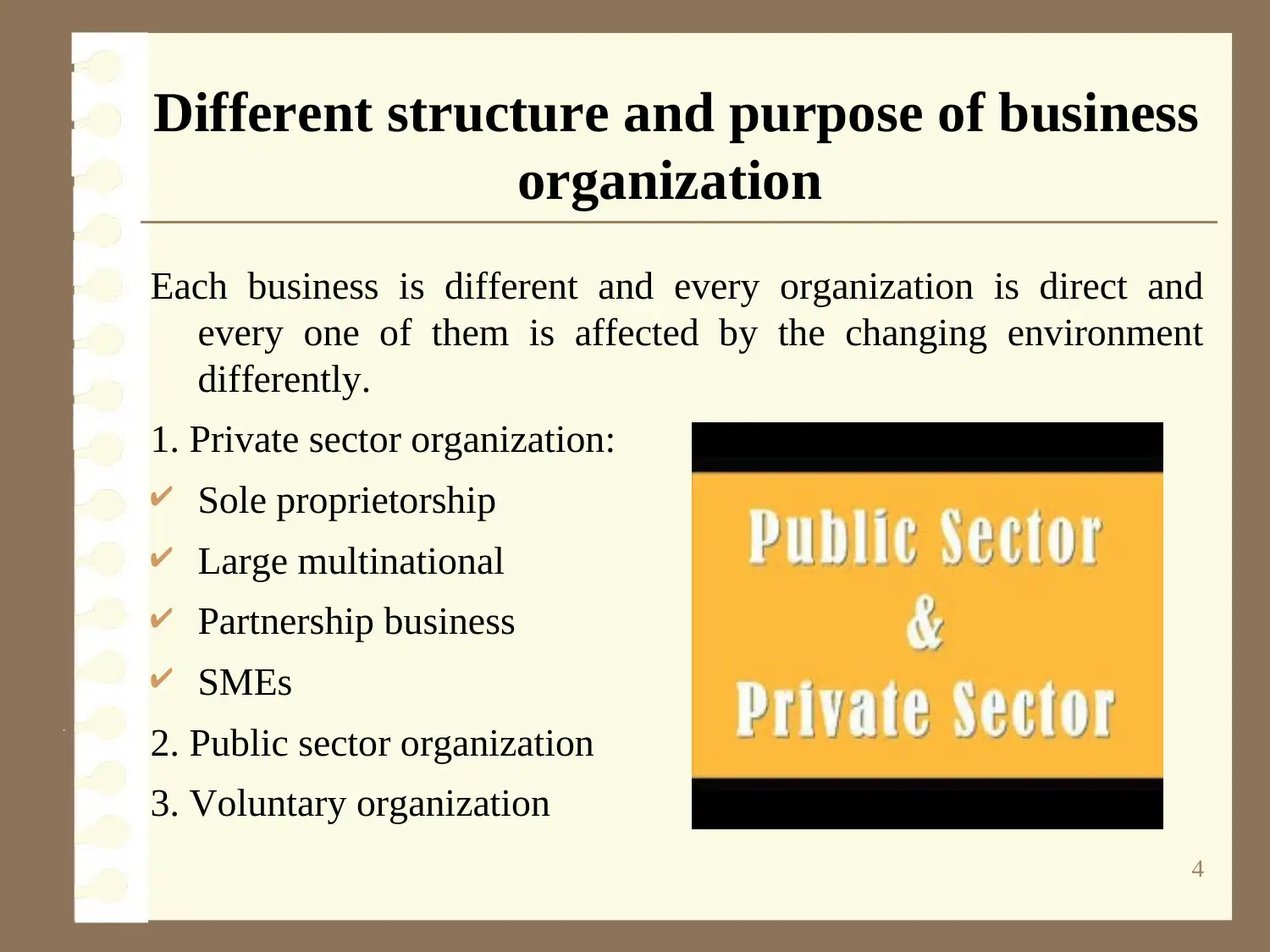
1. Private sector organization:
Sole proprietorship
Large multinational
Partnership business
SMEs
2. Public sector organization
3. Voluntary organization
Different structure and purpose of business
organization
Each business is different and every organization is direct and
every one of them is affected by the changing environment
differently.
1. Private sector organization:
Sole proprietorship
Large multinational
Partnership business
SMEs
2. Public sector organization
3. Voluntary organization
Paraphrase This Document
Need a fresh take? Get an instant paraphrase of this document with our AI Paraphraser

5
Scope and size of different organization
Scope refers to extent an organization could go for to make its
production most efficient. It also includes the study of organization
structure. Organizations structure the aim and outputs of the
organization full fill them. We will study three different types of
organization and their effects
Scope and size of different organization
Scope refers to extent an organization could go for to make its
production most efficient. It also includes the study of organization
structure. Organizations structure the aim and outputs of the
organization full fill them. We will study three different types of
organization and their effects

Management - Chapter 11 6
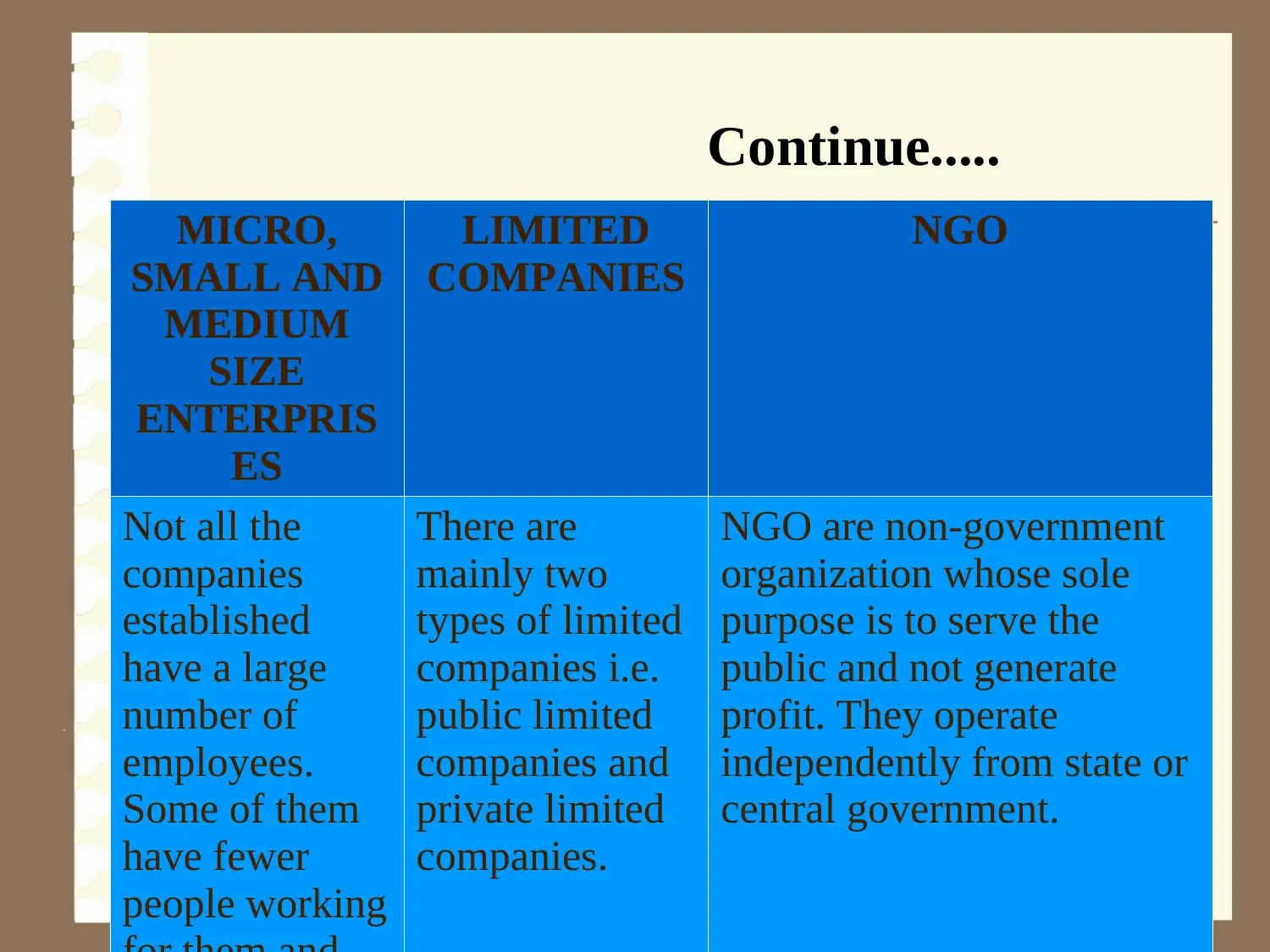
Continue.....
MICRO,
SMALL AND
MEDIUM
SIZE
ENTERPRIS
ES
LIMITED
COMPANIES
NGO
Not all the
companies
established
have a large
number of
employees.
Some of them
have fewer
people working
There are
mainly two
types of limited
companies i.e.
public limited
companies and
private limited
companies.
NGO are non-government
organization whose sole
purpose is to serve the
public and not generate
profit. They operate
independently from state or
central government.
Continue.....
MICRO,
SMALL AND
MEDIUM
SIZE
ENTERPRIS
ES
LIMITED
COMPANIES
NGO
Not all the
companies
established
have a large
number of
employees.
Some of them
have fewer
people working
There are
mainly two
types of limited
companies i.e.
public limited
companies and
private limited
companies.
NGO are non-government
organization whose sole
purpose is to serve the
public and not generate
profit. They operate
independently from state or
central government.
⊘ This is a preview!⊘
Do you want full access?
Subscribe today to unlock all pages.

Trusted by 1+ million students worldwide

Management - Chapter 11 7
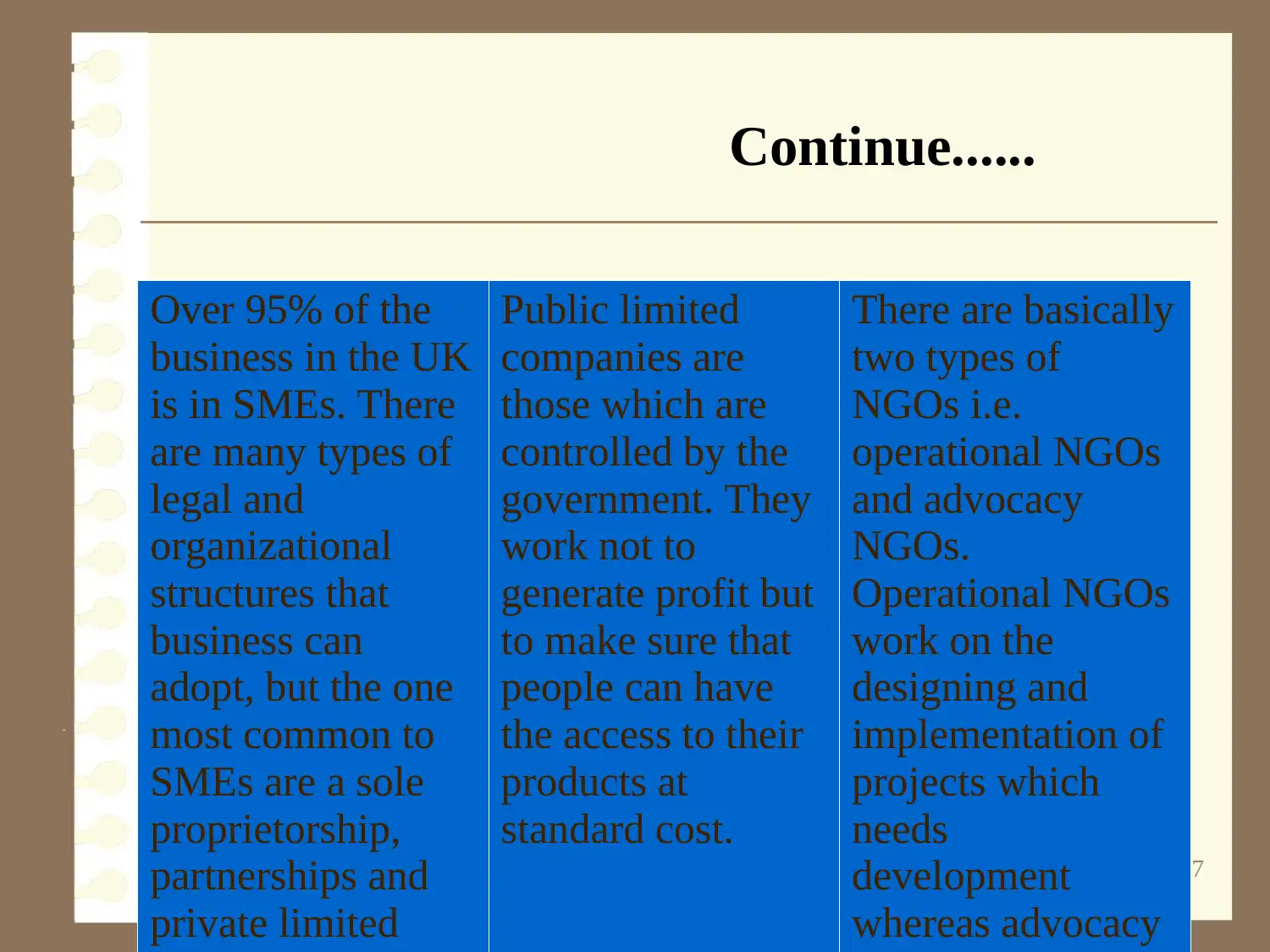
Continue......
Over 95% of the
business in the UK
is in SMEs. There
are many types of
legal and
organizational
structures that
business can
adopt, but the one
most common to
SMEs are a sole
proprietorship,
partnerships and
private limited
Public limited
companies are
those which are
controlled by the
government. They
work not to
generate profit but
to make sure that
people can have
the access to their
products at
standard cost.
There are basically
two types of
NGOs i.e.
operational NGOs
and advocacy
NGOs.
Operational NGOs
work on the
designing and
implementation of
projects which
needs
development
whereas advocacy
Continue......
Over 95% of the
business in the UK
is in SMEs. There
are many types of
legal and
organizational
structures that
business can
adopt, but the one
most common to
SMEs are a sole
proprietorship,
partnerships and
private limited
Public limited
companies are
those which are
controlled by the
government. They
work not to
generate profit but
to make sure that
people can have
the access to their
products at
standard cost.
There are basically
two types of
NGOs i.e.
operational NGOs
and advocacy
NGOs.
Operational NGOs
work on the
designing and
implementation of
projects which
needs
development
whereas advocacy
Paraphrase This Document
Need a fresh take? Get an instant paraphrase of this document with our AI Paraphraser

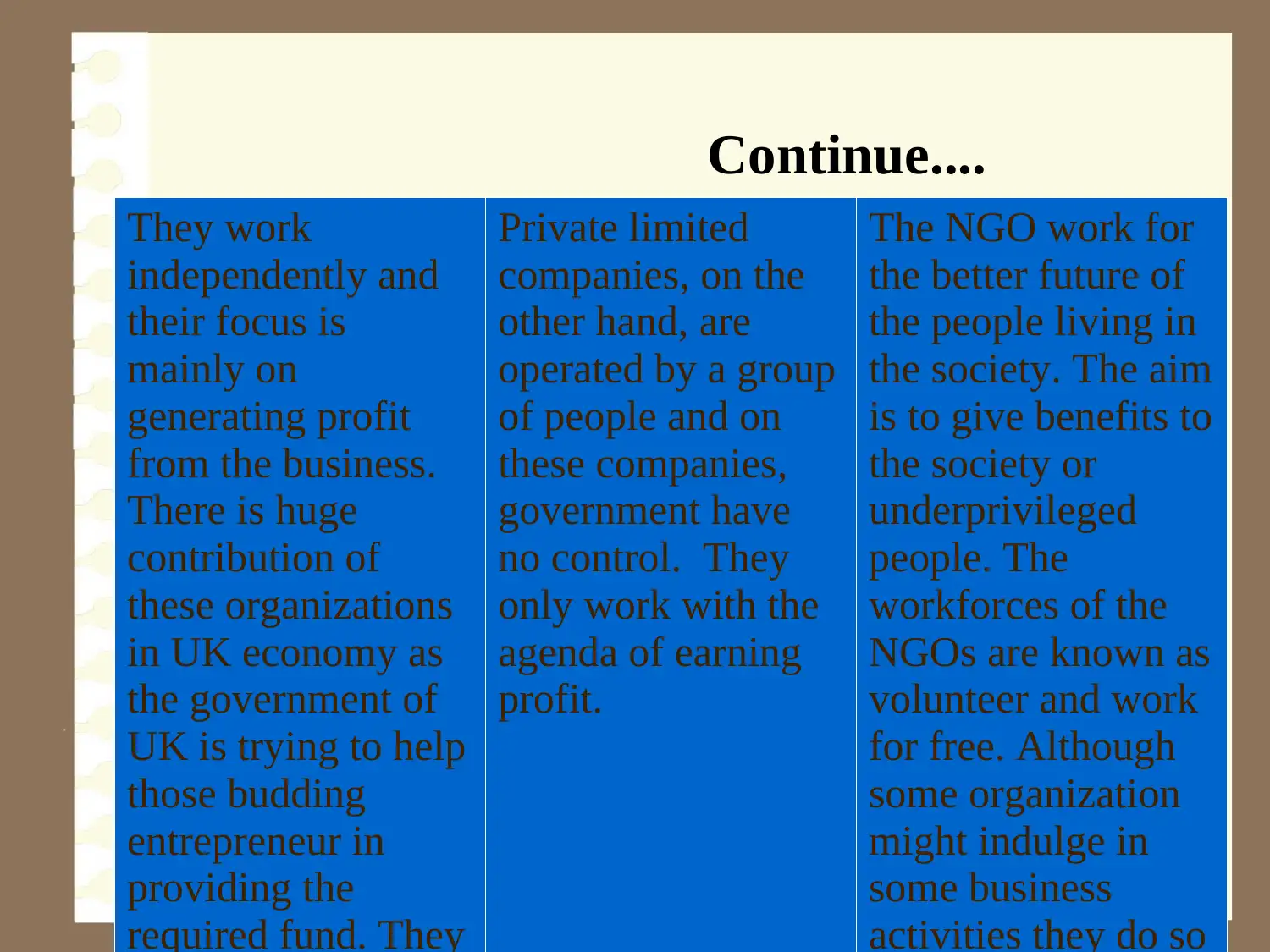
Continue....
They work
independently and
their focus is
mainly on
generating profit
from the business.
There is huge
contribution of
these organizations
in UK economy as
the government of
UK is trying to help
those budding
entrepreneur in
providing the
required fund. They
Private limited
companies, on the
other hand, are
operated by a group
of people and on
these companies,
government have
no control. They
only work with the
agenda of earning
profit.
The NGO work for
the better future of
the people living in
the society. The aim
is to give benefits to
the society or
underprivileged
people. The
workforces of the
NGOs are known as
volunteer and work
for free. Although
some organization
might indulge in
some business
activities they do so
They work
independently and
their focus is
mainly on
generating profit
from the business.
There is huge
contribution of
these organizations
in UK economy as
the government of
UK is trying to help
those budding
entrepreneur in
providing the
required fund. They
Private limited
companies, on the
other hand, are
operated by a group
of people and on
these companies,
government have
no control. They
only work with the
agenda of earning
profit.
The NGO work for
the better future of
the people living in
the society. The aim
is to give benefits to
the society or
underprivileged
people. The
workforces of the
NGOs are known as
volunteer and work
for free. Although
some organization
might indulge in
some business
activities they do so

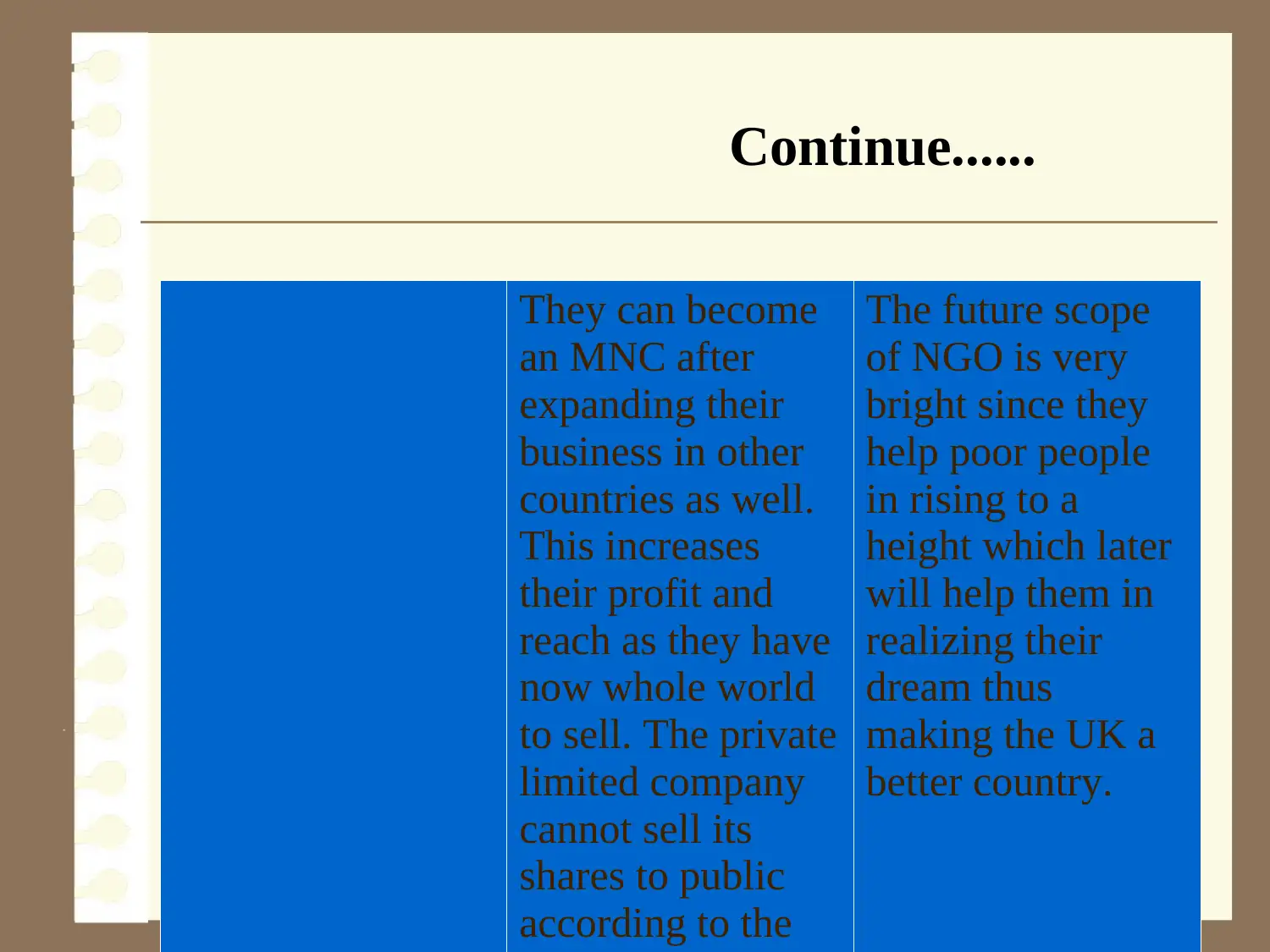
Continue......
They can become
an MNC after
expanding their
business in other
countries as well.
This increases
their profit and
reach as they have
now whole world
to sell. The private
limited company
cannot sell its
shares to public
according to the
The future scope
of NGO is very
bright since they
help poor people
in rising to a
height which later
will help them in
realizing their
dream thus
making the UK a
better country.
They can become
an MNC after
expanding their
business in other
countries as well.
This increases
their profit and
reach as they have
now whole world
to sell. The private
limited company
cannot sell its
shares to public
according to the
The future scope
of NGO is very
bright since they
help poor people
in rising to a
height which later
will help them in
realizing their
dream thus
making the UK a
better country.
⊘ This is a preview!⊘
Do you want full access?
Subscribe today to unlock all pages.

Trusted by 1+ million students worldwide

10
Conclusion
From the above report it is concluded that there can be two types of
business influencing factors i. e. internal and external. Internal
include items such as company’s product, employee and assets
whereas external factors include stockholders, economic
conditions, government policies etc. It is very important to
maintain good business environment so that your worker know
what to expect.
Conclusion
From the above report it is concluded that there can be two types of
business influencing factors i. e. internal and external. Internal
include items such as company’s product, employee and assets
whereas external factors include stockholders, economic
conditions, government policies etc. It is very important to
maintain good business environment so that your worker know
what to expect.
Paraphrase This Document
Need a fresh take? Get an instant paraphrase of this document with our AI Paraphraser

11
References
Bryman, A. and Bell, E., 2015. Business research methods. Oxford
University Press, USA.
Christopher, M. and Holweg, M., 2011. “Supply Chain 2.0”:
managing supply chains in the era of turbulence. International
Journal of Physical Distribution & Logistics Management.
41(1). pp.63-82.
Cross, F. B. and Miller, R. L., 2011. The Legal Environment of
Business: Text and Cases: Ethical, Regulatory, Global, and
Corporate Issues. Cengage Learning.
References
Bryman, A. and Bell, E., 2015. Business research methods. Oxford
University Press, USA.
Christopher, M. and Holweg, M., 2011. “Supply Chain 2.0”:
managing supply chains in the era of turbulence. International
Journal of Physical Distribution & Logistics Management.
41(1). pp.63-82.
Cross, F. B. and Miller, R. L., 2011. The Legal Environment of
Business: Text and Cases: Ethical, Regulatory, Global, and
Corporate Issues. Cengage Learning.

THANK YOU
⊘ This is a preview!⊘
Do you want full access?
Subscribe today to unlock all pages.

Trusted by 1+ million students worldwide
1 out of 12
Related Documents
Your All-in-One AI-Powered Toolkit for Academic Success.
+13062052269
info@desklib.com
Available 24*7 on WhatsApp / Email
Unlock your academic potential
Copyright © 2020–2025 A2Z Services. All Rights Reserved. Developed and managed by ZUCOL.