Business Ethics: Goodpaster, Stakeholders, and Supermarkets

Verified

Added on  2022/09/01

|8
|1441
|20
Essay
AI Summary
This essay delves into the realm of business ethics, focusing on Kenneth E. Goodpaster's theories on stakeholder analysis and its implications for ethical decision-making. It begins by defining Goodpaster's concept of 'strategic stakeholder synthesis' and critiques its potential shortcomings in integrating ethical values into business operations. The essay then contrasts Goodpaster's nonfiduciary approach with the multi-fiduciary stakeholder approach and the strategic stakeholder approach, evaluating its effectiveness in protecting stakeholder interests beyond shareholders. Furthermore, the essay examines ethical practices of major supermarket chains in Australia, specifically Coles and Woolworths, in light of Goodpaster's moral duties. The analysis includes an assessment of the 'Mind the Gap' scheme implemented by Woolworths, exploring its consistency with both narrow and stakeholder-based views of business ethics, supported by evidence from a radio program. The essay concludes by offering insights into the ethical responsibilities of large supermarkets towards their suppliers.
Document Page
Running head: BUSINESS AND PROFESSIONAL ETHICS
BUSINESS AND PROFESSIONAL ETHICS
Name of the Student
Name of the University
Author Note
tabler-icon-diamond-filled.svg

Paraphrase This Document

Need a fresh take? Get an instant paraphrase of this document with our AI Paraphraser
Document Page
1BUSINESS AND PROFESSIONAL ETHICS
Question 1
a) What does Goodpaster mean by ‘strategic stakeholder synthesis’? Why does
he think that businesses that operate according to the principles of strategic
stakeholder synthesis do not really introduce ethical values into business
decision making?
Strategic stakeholder synthesis according to Goodpaster is said to be when organisations
assess who are the stakeholders who have the highest influence on the operations and the
business of the company and organisation and include them in the decision making of the
organisation based on that fact (Goodpaster 1991).
Goodpaster states that introduction of values and ethics is not mandatory and can skip
doing this as the company will only prioritize stakeholders and shareholders having huge effect
on the business and thus it is important just to function properly to keep the stakeholders satisfied
who do not have much influence on the organisation (Goodpaster 1991).
b) Goodpaster argues that we need an approach to business ethics that avoids
business without ethics (strategic stakeholder synthesis) and ethics without
business (a multi-fiduciary stakeholder approach). Explain Goodpaster’s
nonfiduciary approach to business obligations, making sure you distinguish it
from both the multifiduciary stakeholder approach and the strategic
stakeholder approach.
According to Goodpaster, Nemo Dat Principle is an effective nonfiduciary approach
which states that it is important for the businesses to generally satisfy and meet the demands of
Document Page
2BUSINESS AND PROFESSIONAL ETHICS
the consumers by providing quality services and products and thus do not need to act ethically
additionally (Goodpaster 1991).
The approach is considered to be beneficial and more effective than the multi-fiduciary
stakeholder approach and strategic stakeholder analysis. The multi-fiduciary stakeholder
approach tells that companies and organisation do not have non-fiduciary obligations to any third
parties that mainly revolve around relationships that are fiduciary. The strategic stakeholder
approach on the other hand which states that organisations emphasize on stakeholders having
high influence and include them in the decision making process of an organisation however not
the stakeholders who have very little effect on the organisation. Thus, making the approach
suggested by Goodpaster feasible.
c) Does Goodpaster’s nonfiduciary account of business obligations provide
sufficient protection for the interests of stakeholders other than
shareholders? Does it avoid the problem of treating stakeholders as mere
means to corporate ends? Give reasons for your answer.
The non-fiduciary approach suggested by Goodpaster will help in safeguarding the stakeholder’s
interest as it focuses on providing the customers on consumers with the products and services of
high quality and helps in meeting the demands of the stakeholders automatically making it
ethical without following any ethical rules.
This approach is seen to be favouring the stakeholders and treating them more than means to
their corporate goals. This approach considers moral values and also helps in making positive
relationship with the customers and also boosts their reputation in the market. This later helps in
building a positive relationship between both the stakeholders and the organisations.
Document Page
3BUSINESS AND PROFESSIONAL ETHICS
Question 2
a) Do you believe, based on the accounts given in the radio program, that the
major supermarket chains in Australia violate any of the fundamental moral
duties which Goodpaster argues for? Provide details to support your answer.
Major supermarket chains like Coles and Woolworths generally do not follow or practice any
moral duties, the ones which was argued by Goodpaster. One can get to know about this from the
confessions of the suppliers who had anonymously voiced out their opinions in the radio
program which was known as Background Briefing (ABC Radio National 2020).
Goodpaster had stated that there are some moral duties one should follow while doing a business
which is to avoid cheating, harming and making false claims to the stakeholders. However,
confessions made by suppliers state that majority of the renowned supermarkets like Coles
threaten the suppliers to stop doing any business with them in order to reduce the amount paid to
them or to skip providing them with any profits which is highly unethical and harms the
suppliers who are an important stakeholder to the supermarkets. This has been proved when the
Managing Director of Coles, Ian McLeod himself has agreed to the fact that they had asked the
suppliers to bear their costs of discounts (ABC Radio National 2020).
b) What moral duties, if any, do you believe the large supermarkets owe to their
suppliers? Answer this question using your own moral reasoning and
examples from the program to illustrate your points.
The major and big supermarkets like Woolworths and Coles violate moral duties as their
practices tend to harm or cheat their own suppliers. The supermarkets blackmail the suppliers
and threaten them by stating they will not continue their business with them. The large
tabler-icon-diamond-filled.svg

Paraphrase This Document

Need a fresh take? Get an instant paraphrase of this document with our AI Paraphraser
Document Page
4BUSINESS AND PROFESSIONAL ETHICS
supermarkets need to provide their suppliers with some share of the profit as it is the supplies
that help in the operations of the supermarkets.
The suppliers have huge power in the supermarkets and helps in making sure the
organisations operate smoothly. The moral duties suggest the fact that the organisation should
not harm, lie or cheat any of their stakeholders and thus the supermarkets need to follow this.
Question 3
a) Is Woolworths’ request for ‘Mind the Gap’ payments from suppliers consistent
with the narrow view of business ethics? Provide reasons to support your
conclusion.
According to ethical business functioning, the request for the scheme named Mind the
Gap by Woolworths is not justified and uncalled for.
It has been seen that the federal court has supported Woolworths stating that the reason
provided them was justified as they had stated that this scheme helps the business grow and as a
part of the business the suppliers are just helping the business cope up through crisis (Low
2016). However, from the ethical business point of view, it is highly unethical as Woolworths is
not going to take any responsibility if the suppliers are suffering from any kind of loss and the
supermarket does not provide the suppliers with any share in their profits thus asking them for
paying for their loss is unethical (Locke 2016).
Document Page
5BUSINESS AND PROFESSIONAL ETHICS
b) Is Woolworths’ request for ‘Mind the Gap’ payments from suppliers consistent
with a stakeholder approach to business ethics? Provide reasons to support your
conclusion.
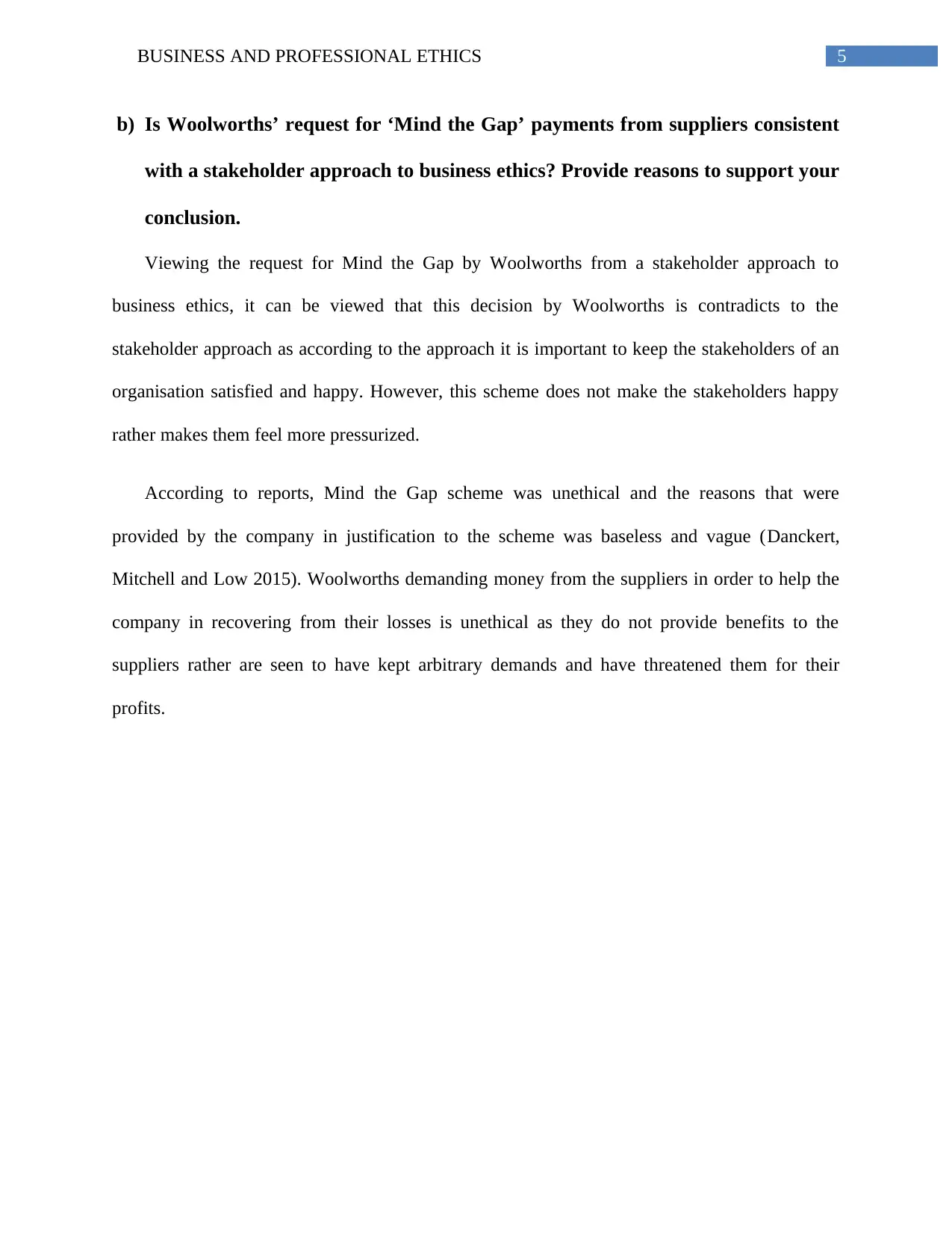
Viewing the request for Mind the Gap by Woolworths from a stakeholder approach to
business ethics, it can be viewed that this decision by Woolworths is contradicts to the
stakeholder approach as according to the approach it is important to keep the stakeholders of an
organisation satisfied and happy. However, this scheme does not make the stakeholders happy
rather makes them feel more pressurized.
According to reports, Mind the Gap scheme was unethical and the reasons that were
provided by the company in justification to the scheme was baseless and vague (Danckert,
Mitchell and Low 2015). Woolworths demanding money from the suppliers in order to help the
company in recovering from their losses is unethical as they do not provide benefits to the
suppliers rather are seen to have kept arbitrary demands and have threatened them for their
profits.
Document Page
6BUSINESS AND PROFESSIONAL ETHICS
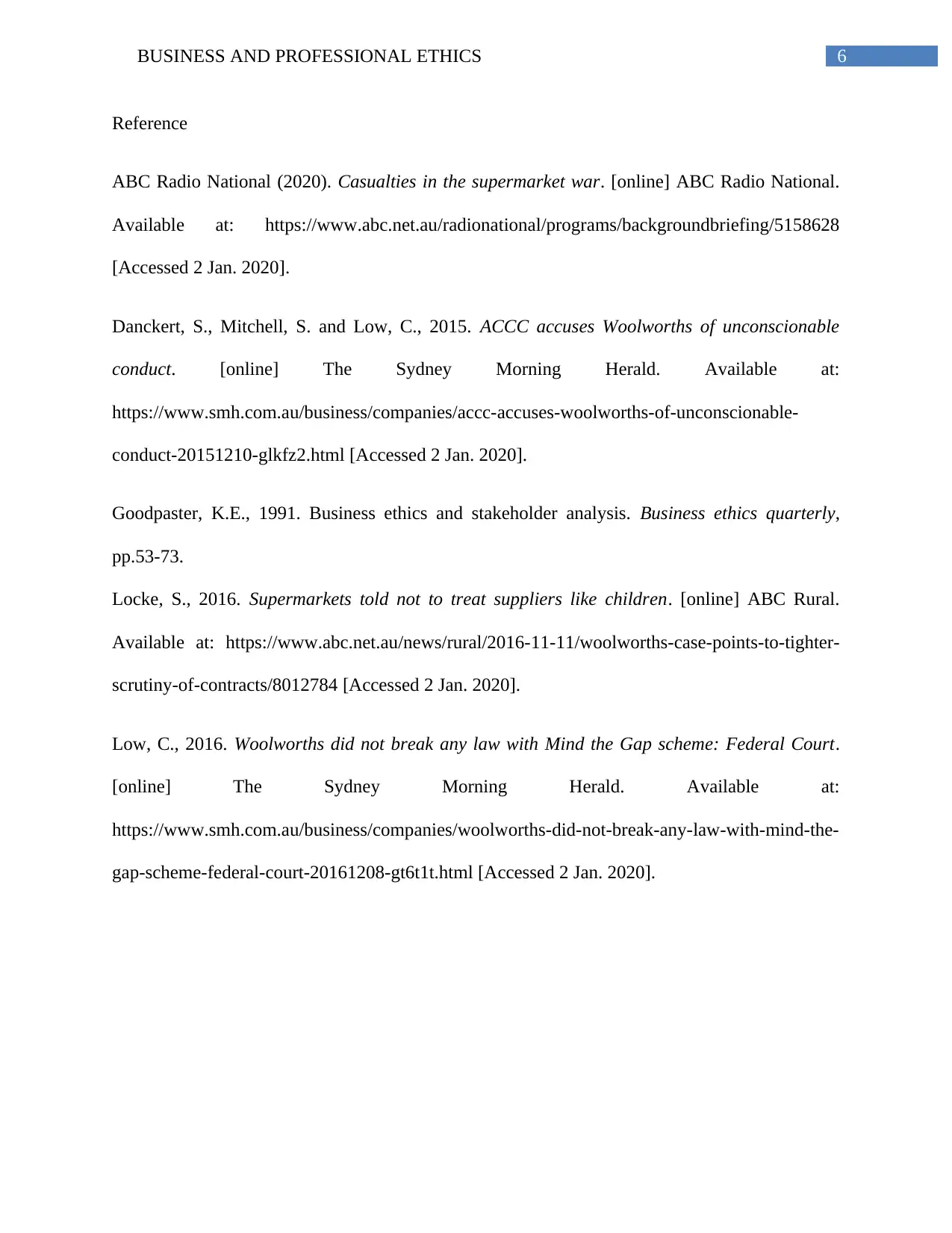
Reference
ABC Radio National (2020). Casualties in the supermarket war. [online] ABC Radio National.
Available at: https://www.abc.net.au/radionational/programs/backgroundbriefing/5158628
[Accessed 2 Jan. 2020].
Danckert, S., Mitchell, S. and Low, C., 2015. ACCC accuses Woolworths of unconscionable
conduct. [online] The Sydney Morning Herald. Available at:
https://www.smh.com.au/business/companies/accc-accuses-woolworths-of-unconscionable-
conduct-20151210-glkfz2.html [Accessed 2 Jan. 2020].
Goodpaster, K.E., 1991. Business ethics and stakeholder analysis. Business ethics quarterly,
pp.53-73.
Locke, S., 2016. Supermarkets told not to treat suppliers like children. [online] ABC Rural.
Available at: https://www.abc.net.au/news/rural/2016-11-11/woolworths-case-points-to-tighter-
scrutiny-of-contracts/8012784 [Accessed 2 Jan. 2020].
Low, C., 2016. Woolworths did not break any law with Mind the Gap scheme: Federal Court.
[online] The Sydney Morning Herald. Available at:
https://www.smh.com.au/business/companies/woolworths-did-not-break-any-law-with-mind-the-
gap-scheme-federal-court-20161208-gt6t1t.html [Accessed 2 Jan. 2020].
tabler-icon-diamond-filled.svg

Paraphrase This Document

Need a fresh take? Get an instant paraphrase of this document with our AI Paraphraser
Document Page
7BUSINESS AND PROFESSIONAL ETHICS
chevron_up_icon
1 out of 8
circle_padding
hide_on_mobile
zoom_out_icon
[object Object]