A Comprehensive Analysis of Business Ethics: Concepts and Evolution

Verified

Added on  2021/10/01

|26
|1952
|98
Report
AI Summary
This report provides a comprehensive overview of business ethics, beginning with fundamental concepts such as morals, principles, and values, and extending to ethical culture and corporate social responsibility. It explores the historical development of business ethics in the U.S., from the pre-1960s era through the twenty-first century, highlighting key events, legislation, and societal shifts that have shaped ethical considerations in business. The report examines the benefits of business ethics, including increased employee commitment, investor loyalty, customer satisfaction, and ultimately, enhanced profitability. It also touches upon the extent of ethical misconduct in the workplace, the pressures for unethical behavior, and the process by which business practices transition from legal to unethical and potentially illegal. The report uses tables and timelines to illustrate key points and provides a solid foundation for understanding the importance and implications of business ethics in the modern business environment.
Document Page
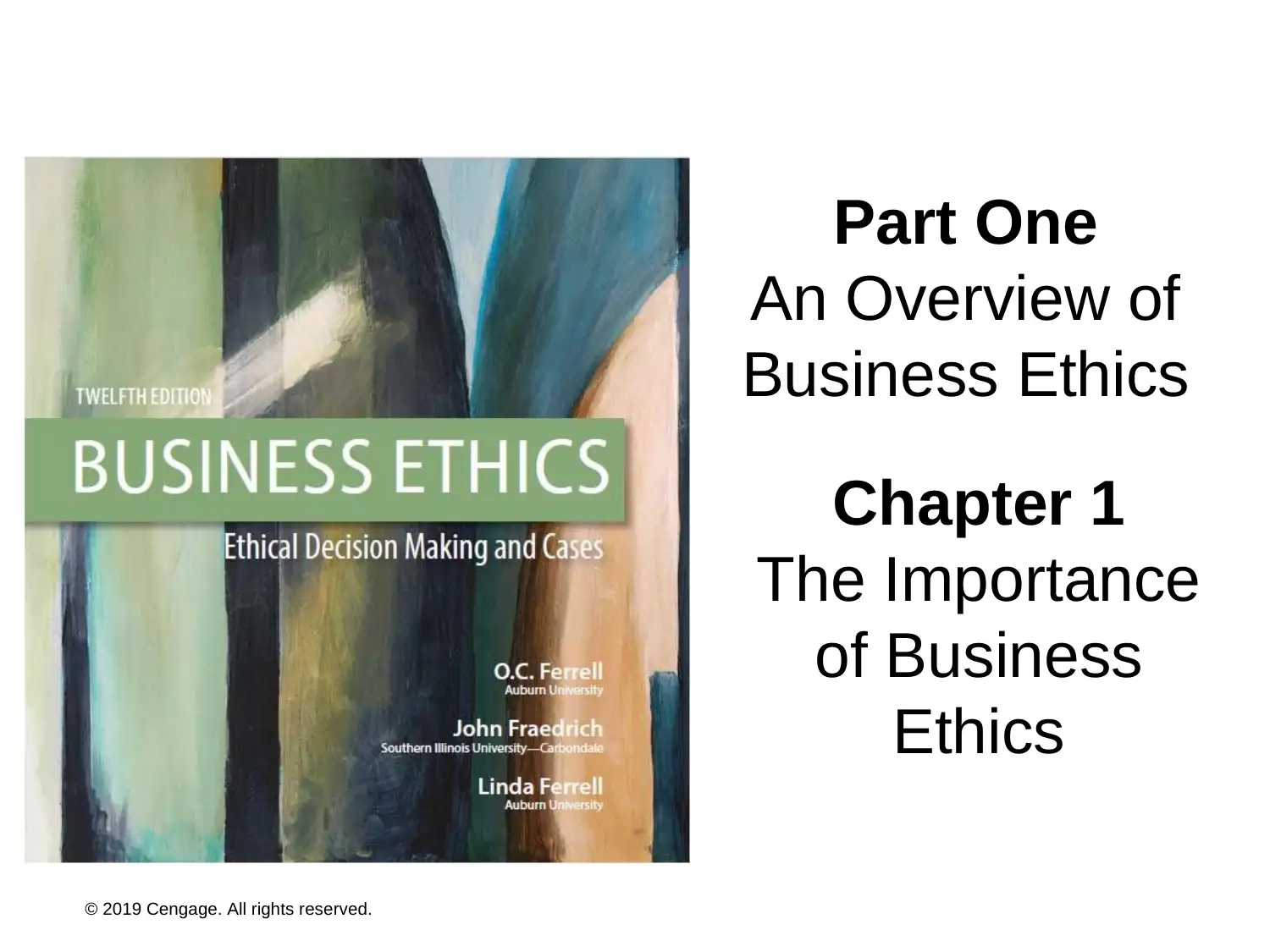
Part One
An Overview of
Business Ethics
Chapter 1
The Importance
of Business
Ethics
© 2019 Cengage. All rights reserved.
tabler-icon-diamond-filled.svg

Paraphrase This Document

Need a fresh take? Get an instant paraphrase of this document with our AI Paraphraser
Document Page
© 2019 Cengage. All rights reserved.
2
Learning Objectives
Explore conceptualizations of business ethics
from an organizational perspective
Examine the historical foundations and evolution
of business ethics
Provide evidence that ethical value systems
support business performance
Gain insight into the extent of ethical misconduct
in the workplace and the pressures for unethical
behavior
Document Page
© 2019 Cengage. All rights reserved.
3
The Basic Concepts in
Business Ethics (1 of 4)
Morals: Personal philosophies that define right
and wrong.
Business ethics: Organizational principles,
values, and norms that may originate from
individuals, organizational statements, or from
the legal system that primarily guide individual
and group behavior in business.
Document Page
© 2019 Cengage. All rights reserved.
4
The Basic Concepts in
Business Ethics (2 of 4)
Principles: Specific boundaries for behavior that
often become the basis for rules (human rights,
freedom of speech).
Values: Enduring beliefs and ideals that are
socially enforced (trust and integrity).
tabler-icon-diamond-filled.svg

Paraphrase This Document

Need a fresh take? Get an instant paraphrase of this document with our AI Paraphraser
Document Page
© 2019 Cengage. All rights reserved.
5
The Basic Concepts in
Business Ethics (3 of 4)
Moral dilemma: Two or more morals in conflict
with one another.
Value dilemma: Two or more beliefs/ideals in
conflict with one another.
Document Page
© 2019 Cengage. All rights reserved.
6
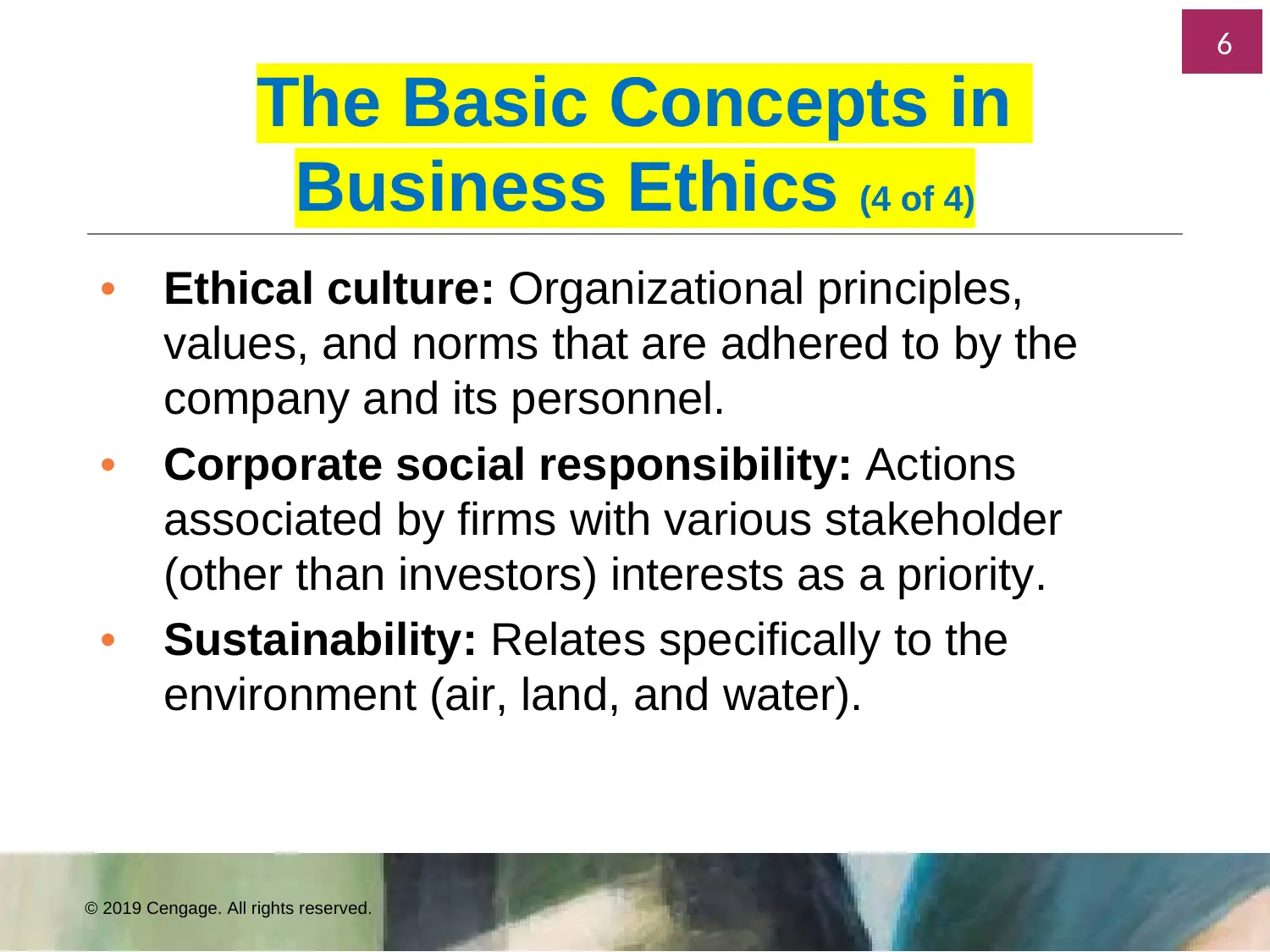
The Basic Concepts in
Business Ethics (4 of 4)
Ethical culture: Organizational principles,
values, and norms that are adhered to by the
company and its personnel.
Corporate social responsibility: Actions
associated by firms with various stakeholder
(other than investors) interests as a priority.
Sustainability: Relates specifically to the
environment (air, land, and water).
Document Page
© 2019 Cengage. All rights reserved.
7
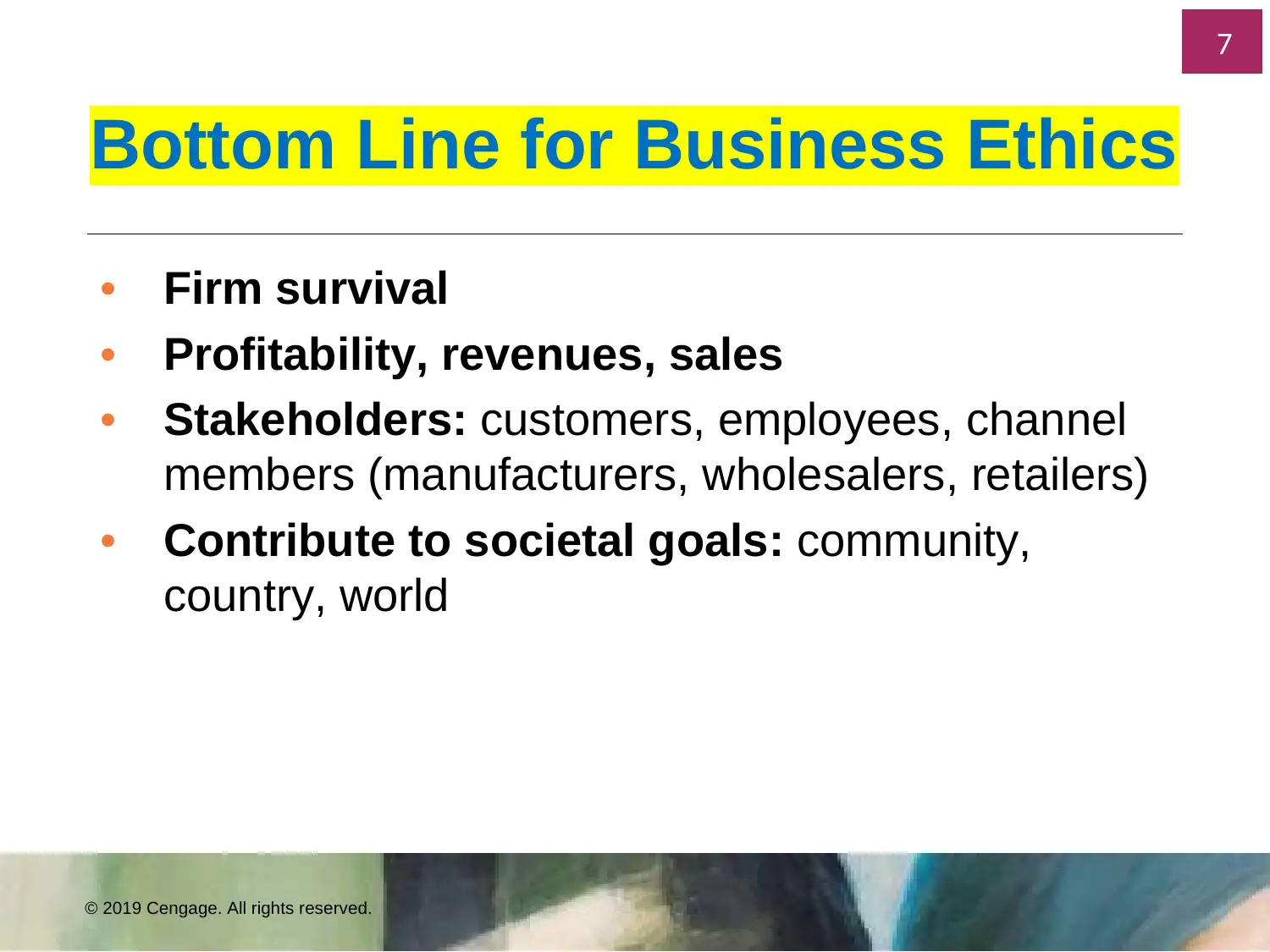
Bottom Line for Business Ethics
Firm survival
Profitability, revenues, sales
Stakeholders: customers, employees, channel
members (manufacturers, wholesalers, retailers)
Contribute to societal goals: community,
country, world
tabler-icon-diamond-filled.svg

Paraphrase This Document

Need a fresh take? Get an instant paraphrase of this document with our AI Paraphraser
Document Page
© 2019 Cengage. All rights reserved.
8
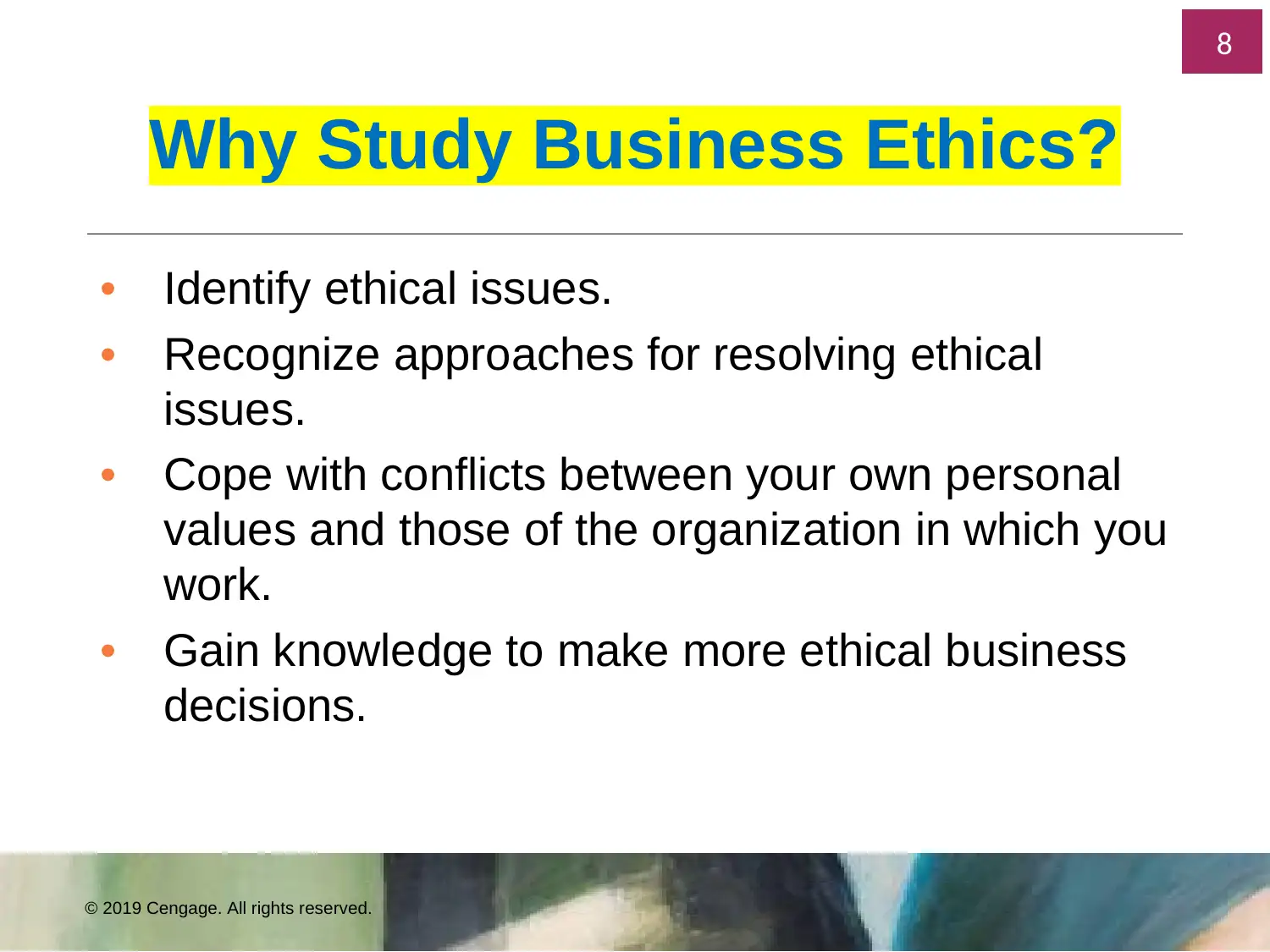
Why Study Business Ethics?
Identify ethical issues.
Recognize approaches for resolving ethical
issues.
Cope with conflicts between your own personal
values and those of the organization in which you
work.
Gain knowledge to make more ethical business
decisions.
Document Page
© 2019 Cengage. All rights reserved.
9
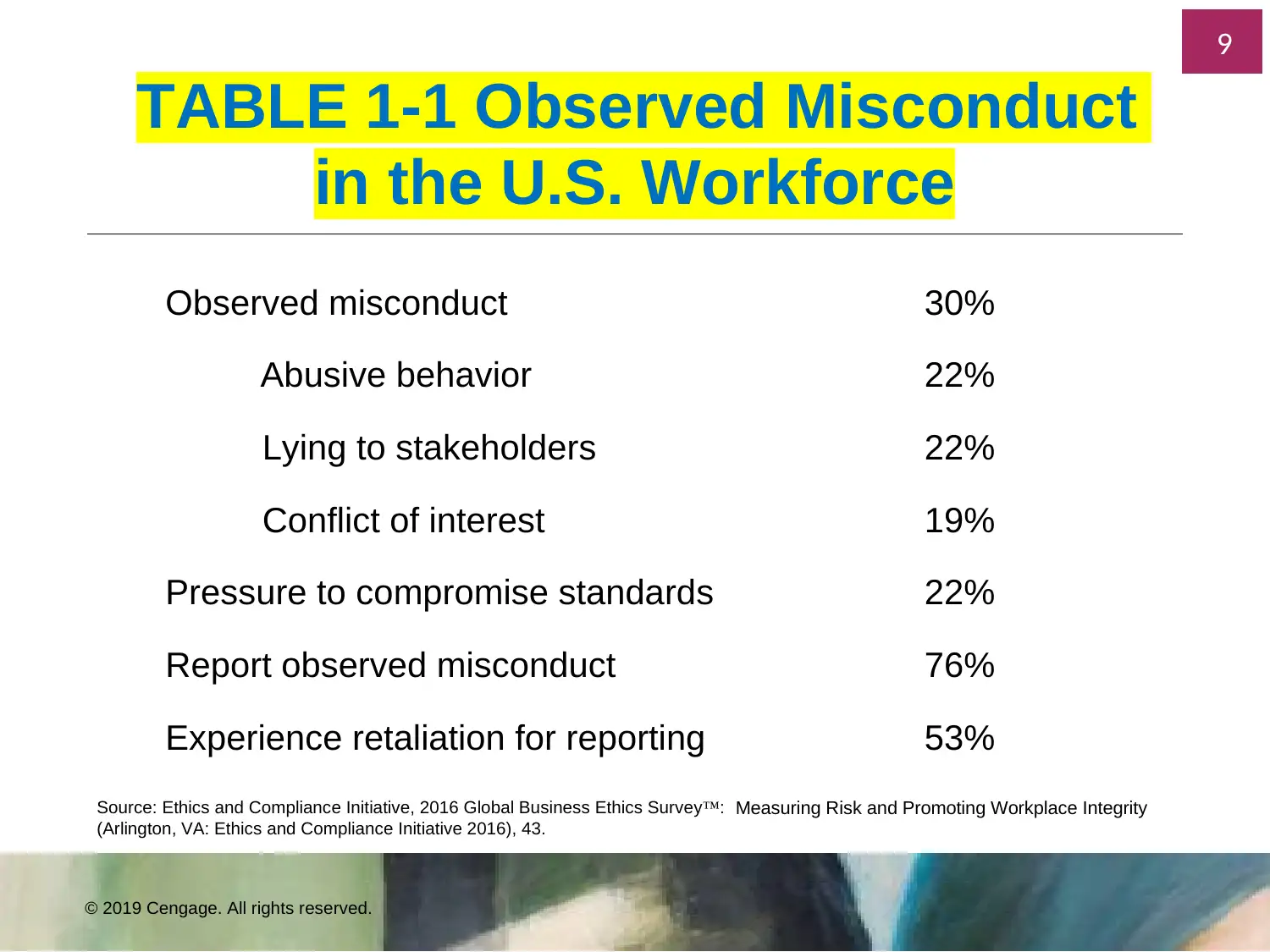
TABLE 1-1 Observed Misconduct
in the U.S. Workforce
Observed misconduct 30%
Abusive behavior 22%
Lying to stakeholders 22%
Conflict of interest 19%
Pressure to compromise standards 22%
Report observed misconduct 76%
Experience retaliation for reporting 53%
Source: Ethics and Compliance Initiative, 2016 Global Business Ethics Survey: Measuring Risk and Promoting Workplace Integrity
(Arlington, VA: Ethics and Compliance Initiative 2016), 43.
Document Page
© 2019 Cengage. All rights reserved.
10
The Process of Legal to Unethical
to Illegal Business Practice
Steps in the process:
1. A major event occurs that negatively sensitizes the
public to a business practice.
2. The public uses social media to increase
awareness.
3. Legislators (local, state, and federal) become
sensitized to the negative business practices.
4. Bills, laws, and local, state or federal agencies are
introduced to make specific items illegal or
regulated.
tabler-icon-diamond-filled.svg

Paraphrase This Document

Need a fresh take? Get an instant paraphrase of this document with our AI Paraphraser
Document Page
© 2019 Cengage. All rights reserved.
11
The Development of Business
Ethics in the U.S.—Before 1960
Capitalism dictated business practices.
1920s: Provide a living wage—income sufficient
for education, recreation, health, and retirement.
1930s: The New Deal (President Franklin D.
Roosevelt)—blamed business as the cause for
U.S. problems.
1950s: The Fair Deal (President Harry S.
Truman)—defined such matters as environmental
responsibility as ethical issues that businesses
had to address.
Document Page
© 2019 Cengage. All rights reserved.
12
The Development of Business Ethics in
the U.S.—The 1960s: The Rise of Social
Issues in Business (1 of 2)
Development of anti-business trend.
Decay of inner cities; growth of ecological
problems.
President John F. Kennedy: The Consumers’ Bill
of Rights
Right to safety.
Right to be informed.
Right to choose.
Right to be heard.
chevron_up_icon
1 out of 26
circle_padding
hide_on_mobile
zoom_out_icon
[object Object]