Business Ethics Report: CSR, Stakeholders, and Ethical Frameworks
VerifiedAdded on 2020/10/22
|15
|3828
|211
Report
AI Summary
This report provides a comprehensive analysis of business ethics, focusing on the application of ethical theories and corporate social responsibility (CSR) within the context of the retail giant Tesco. It begins by defining normative ethical theory, differentiating between consequentialist and non-consequentialist approaches, with specific examples of egoism and the ethics of duties. The report then delves into the concept of CSR, outlining its definition, the frameworks that govern it (including Carroll's pyramid), and the distinction between traditional and contemporary CSR practices. Furthermore, it examines the concept of corporate citizenship, including its five stages of development. The final section defines stakeholders and evaluates the impact of organizational actions on employees and customers. Throughout, the report emphasizes the importance of ethical considerations and the role of stakeholders in shaping business practices, using Tesco as a case study to illustrate these concepts.
Business Ethics

Paraphrase This Document
Need a fresh take? Get an instant paraphrase of this document with our AI Paraphraser
TABLE OF CONTENTS
INTRODUCTION:..........................................................................................................................1
PART 1............................................................................................................................................1
a) What is normative ethical theory?..........................................................................................1
b) Outline one non-consequentialist and one consequentialist approach....................................2
PART 2............................................................................................................................................3
a) Carefully define corporate social responsibility.....................................................................3
PART 3............................................................................................................................................6
a) Carefully define the concept of stakeholders..........................................................................6
b) Impact of organisation actions on these employees and customers .......................................8
CONCLUSION:...............................................................................................................................9
REFERENCES:.............................................................................................................................10
INTRODUCTION:..........................................................................................................................1
PART 1............................................................................................................................................1
a) What is normative ethical theory?..........................................................................................1
b) Outline one non-consequentialist and one consequentialist approach....................................2
PART 2............................................................................................................................................3
a) Carefully define corporate social responsibility.....................................................................3
PART 3............................................................................................................................................6
a) Carefully define the concept of stakeholders..........................................................................6
b) Impact of organisation actions on these employees and customers .......................................8
CONCLUSION:...............................................................................................................................9
REFERENCES:.............................................................................................................................10
INTRODUCTION:
Business ethics is related to how organisation performs their roles and responsibilities.
Generally, it consists of four elements that are commitment, responsibility, quality and
reliability. Ethics describe the way in which business solves problems. Ethical considerations
describe the organisational culture (Crane and Matten, 2016). It shows the way in which
employee’s values and beliefs are respected in business. Besides this, it is important to follow the
specific ethics that will help in creating a better environment. Moreover, there are various ethical
theories that are followed by business while developing the ethical policy. This report will
describe a normative ethical theory and its strengths and weaknesses as well. Along with this, the
role of corporate governance in business is studied here. At last, the impact of stakeholders on
organisation is discussed (Trevino and Nelson, 2016). For this report, organisation selected is
Tesco. It operates globally in the retail sector.
PART 1
a) What is normative ethical theory?
It is a part of ethical action that investigates how employee should act or speaks in the
organisation. It creates outlines for setting moral principles and taking decisions. The purpose of
normative ethical theory is to articulate an ethical code that determines what behaviour is moral
and what is not (Armstrong, Harker and Brennan, 2015). It describes ethical and moral
phenomena. It helps in generating moral standards, principles and judgements. Moral standards
differs from moral principles, it provides the criteria to show what moral actions should consists.
Moral principles focus on actions that describes what is moral and immoral. In this theory moral
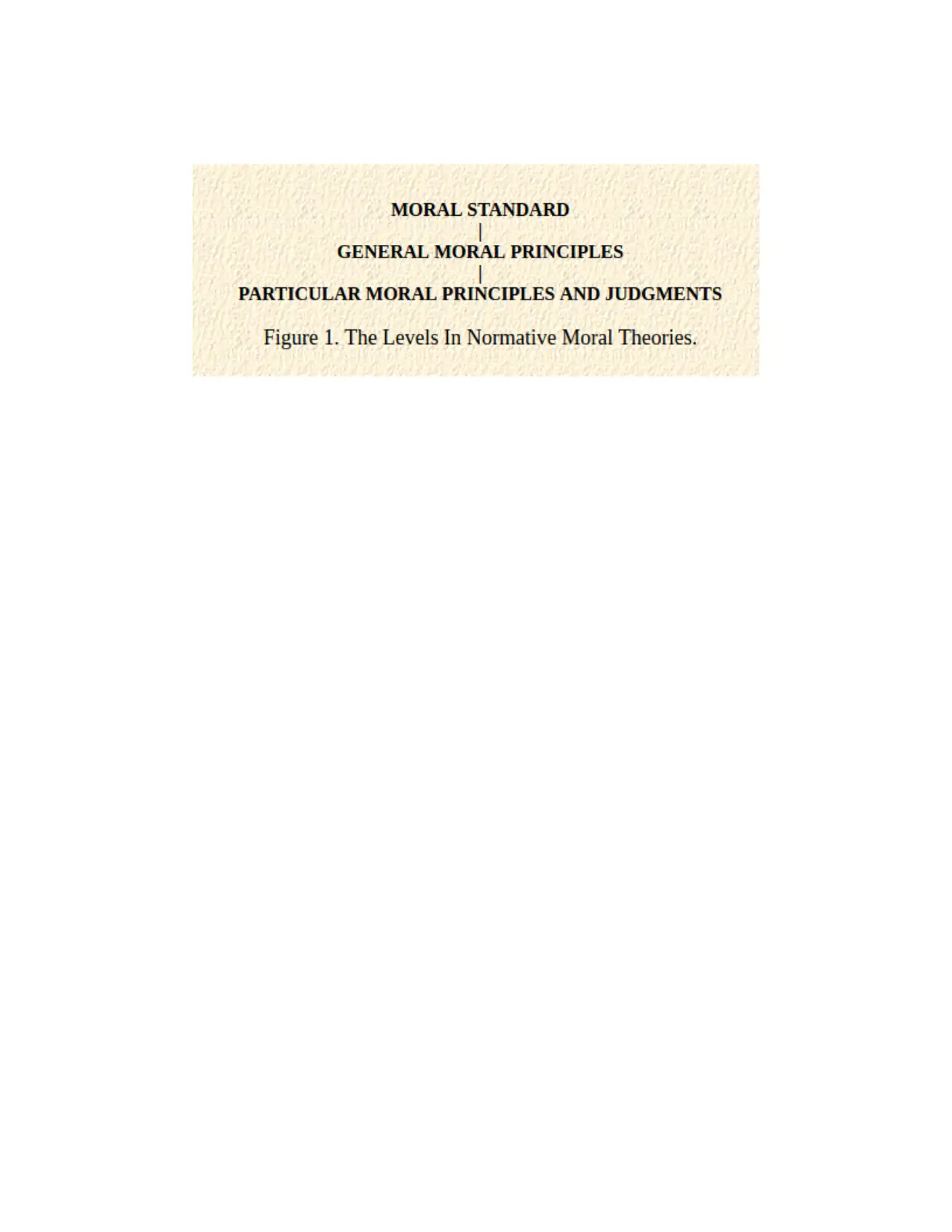
principles is the final level. There are three levels in this theory.
Business ethics is related to how organisation performs their roles and responsibilities.
Generally, it consists of four elements that are commitment, responsibility, quality and
reliability. Ethics describe the way in which business solves problems. Ethical considerations
describe the organisational culture (Crane and Matten, 2016). It shows the way in which
employee’s values and beliefs are respected in business. Besides this, it is important to follow the
specific ethics that will help in creating a better environment. Moreover, there are various ethical
theories that are followed by business while developing the ethical policy. This report will
describe a normative ethical theory and its strengths and weaknesses as well. Along with this, the
role of corporate governance in business is studied here. At last, the impact of stakeholders on
organisation is discussed (Trevino and Nelson, 2016). For this report, organisation selected is
Tesco. It operates globally in the retail sector.
PART 1
a) What is normative ethical theory?
It is a part of ethical action that investigates how employee should act or speaks in the
organisation. It creates outlines for setting moral principles and taking decisions. The purpose of
normative ethical theory is to articulate an ethical code that determines what behaviour is moral
and what is not (Armstrong, Harker and Brennan, 2015). It describes ethical and moral
phenomena. It helps in generating moral standards, principles and judgements. Moral standards
differs from moral principles, it provides the criteria to show what moral actions should consists.
Moral principles focus on actions that describes what is moral and immoral. In this theory moral
principles is the final level. There are three levels in this theory.
⊘ This is a preview!⊘
Do you want full access?
Subscribe today to unlock all pages.

Trusted by 1+ million students worldwide
Paraphrase This Document
Need a fresh take? Get an instant paraphrase of this document with our AI Paraphraser
Moral standards- It consists of moral standards on the basis of which principles are
developed.
General moral principles- It contains principles by which judgements are taken.
Particular principles and judgements- These judgements are applied for developing
ethics.
b) Outline one non-consequentialist and one consequentialist approach
Consequential- egoism
It is a normative theory in is applicable to one own actions. It consists of two elements
that are descriptive and normative. In descriptive, egoism is considered as the factual description
of human affairs while normative states that people should be motivated apart from their present
behaviour. Normative egoism is related with promoting the self-behaviour. In this, the person
acts require for self-preservation that includes enjoying benefits that is gained from universal
welfare (Wallace and Sheldon, 2015). When a person cares for himself, his care for others dies.
Then there will be no one to care for. This theory is not directly related to human nature but
shows how people behaviour with others. It is different from psychological egoism. It describes
basic fact about human nature. Ethical egoism is not having any solution when a problem arises
of conflicts. Other than this the theory goes against the principle of impartiality.
Strengths – It is very simple and easy to understand. This can be followed as employee will
know about ethics that exist in organisation (Strobel, Tumasjan and Welpe, 2015).It helps in
establishing a greater personal identity in society. An individual understands his identity in
profound manner. This makes it easy to identify differences in other people and self interests.
Moreover, this theory promotes sustainable working. Furthermore, it ensures that personal needs
will be fulfilled.
Weakness- egoism does not work in case of conflicts. This means that it does not provide any
solution when a problem arises of conflicts (Hartman, DesJardins and MacDonald, 2014). This
restricts organisation to use it. Also, it destroys relationship with others. It eliminates objectives
of personal interests.
developed.
General moral principles- It contains principles by which judgements are taken.
Particular principles and judgements- These judgements are applied for developing
ethics.
b) Outline one non-consequentialist and one consequentialist approach
Consequential- egoism
It is a normative theory in is applicable to one own actions. It consists of two elements
that are descriptive and normative. In descriptive, egoism is considered as the factual description
of human affairs while normative states that people should be motivated apart from their present
behaviour. Normative egoism is related with promoting the self-behaviour. In this, the person
acts require for self-preservation that includes enjoying benefits that is gained from universal
welfare (Wallace and Sheldon, 2015). When a person cares for himself, his care for others dies.
Then there will be no one to care for. This theory is not directly related to human nature but
shows how people behaviour with others. It is different from psychological egoism. It describes
basic fact about human nature. Ethical egoism is not having any solution when a problem arises
of conflicts. Other than this the theory goes against the principle of impartiality.
Strengths – It is very simple and easy to understand. This can be followed as employee will
know about ethics that exist in organisation (Strobel, Tumasjan and Welpe, 2015).It helps in
establishing a greater personal identity in society. An individual understands his identity in
profound manner. This makes it easy to identify differences in other people and self interests.
Moreover, this theory promotes sustainable working. Furthermore, it ensures that personal needs
will be fulfilled.
Weakness- egoism does not work in case of conflicts. This means that it does not provide any
solution when a problem arises of conflicts (Hartman, DesJardins and MacDonald, 2014). This
restricts organisation to use it. Also, it destroys relationship with others. It eliminates objectives
of personal interests.
Non consequential- ethics of duties
` this theory differs from utilitarianism approach in several ways. While utilitarianism is
based on goal of happiness ethics of duty focus on action of outcome of an act. This act can be
morally bad but it may lead to favourable outcome. It states that a person who performs action
have to act morally (Hoffman, Frederick and Schwartz, 2014) According to Kent moral of
action is determined by human will. There are three formulations in this which is given below :-
In this kent states that moral should not be based on another person identity of taking
decisions. It is a golden rule in which do not take any action that can hit you afterwards.
Action can be formulated in hypothetical way.
In second it states that every action must not be considered only a principle but an end.
Every end is hypothetical in nature. A person must not use other moral for own
advantage.
The laws developed should be universal. If it will not be universal they will not be
considered as code of conduct (Chell, Spence and Harris, 2016) For example – lying
will negatively affect other trust.
Strengths – It provides a basis of human rights. Moreover, it is an international law that is
followed all around the world. It contains moral laws regardless of culture. This theory is very
reliable. Besides this theory is based on rational rather than emotion.
Weakness- Its weakness is sometimes it can break relations with other person as well. It lacks
motivation as theory is based on rational. Universal laws are changing thus every situation is
unique, hence morality should be based on reality basis (May, Luth and Schwoerer, 2014)
PART 2
a) Carefully define corporate social responsibility
Corporate Social Responsibility (CSR): It is related to organisation’s contribution
towards society. It helps the business to sustain for long time. The efforts that are made by
business for protecting the environment and well-being of society are included in this. For this,
business develops several rules and regulations so that it would not operate beyond that. This
` this theory differs from utilitarianism approach in several ways. While utilitarianism is
based on goal of happiness ethics of duty focus on action of outcome of an act. This act can be
morally bad but it may lead to favourable outcome. It states that a person who performs action
have to act morally (Hoffman, Frederick and Schwartz, 2014) According to Kent moral of
action is determined by human will. There are three formulations in this which is given below :-
In this kent states that moral should not be based on another person identity of taking
decisions. It is a golden rule in which do not take any action that can hit you afterwards.
Action can be formulated in hypothetical way.
In second it states that every action must not be considered only a principle but an end.
Every end is hypothetical in nature. A person must not use other moral for own
advantage.
The laws developed should be universal. If it will not be universal they will not be
considered as code of conduct (Chell, Spence and Harris, 2016) For example – lying
will negatively affect other trust.
Strengths – It provides a basis of human rights. Moreover, it is an international law that is
followed all around the world. It contains moral laws regardless of culture. This theory is very
reliable. Besides this theory is based on rational rather than emotion.
Weakness- Its weakness is sometimes it can break relations with other person as well. It lacks
motivation as theory is based on rational. Universal laws are changing thus every situation is
unique, hence morality should be based on reality basis (May, Luth and Schwoerer, 2014)
PART 2
a) Carefully define corporate social responsibility
Corporate Social Responsibility (CSR): It is related to organisation’s contribution
towards society. It helps the business to sustain for long time. The efforts that are made by
business for protecting the environment and well-being of society are included in this. For this,
business develops several rules and regulations so that it would not operate beyond that. This
⊘ This is a preview!⊘
Do you want full access?
Subscribe today to unlock all pages.
Trusted by 1+ million students worldwide
ensures that business operations are performed in a proper way. Also, business has to follow the
environmental laws (Michaelson and Dunn, 2014). Stakeholders play main role in corporate
social responsibility activities. They monitor them and ensuring that business follows concept
and practices. Tesco is highly involved in CSR activities. They have increased their contribution
towards the social activities. It has helped organisation to improve their brand image in the
market. Also, this has resulted in increasing the sales and profits. CSR activities are described on
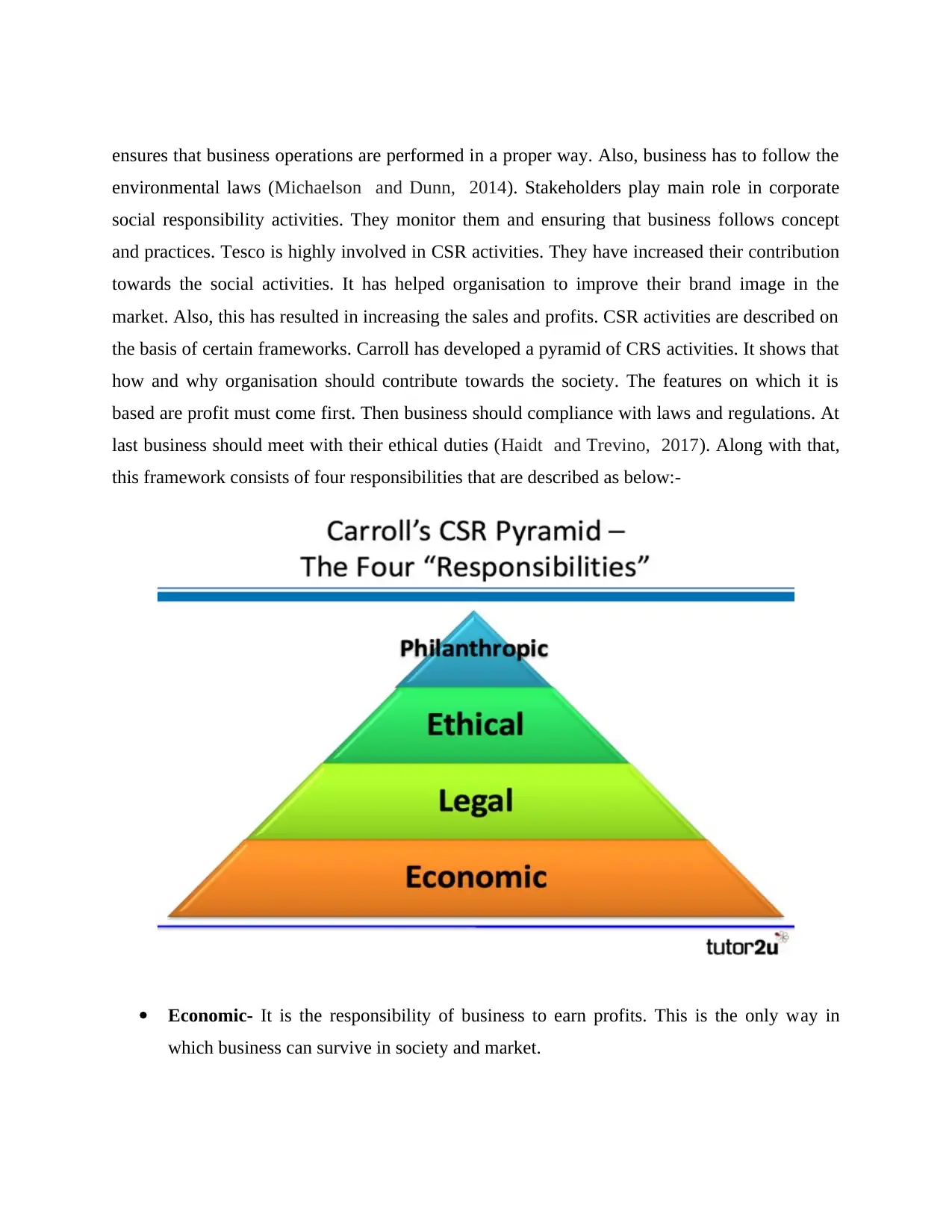
the basis of certain frameworks. Carroll has developed a pyramid of CRS activities. It shows that
how and why organisation should contribute towards the society. The features on which it is
based are profit must come first. Then business should compliance with laws and regulations. At
last business should meet with their ethical duties (Haidt and Trevino, 2017). Along with that,
this framework consists of four responsibilities that are described as below:-
Economic- It is the responsibility of business to earn profits. This is the only way in
which business can survive in society and market.
environmental laws (Michaelson and Dunn, 2014). Stakeholders play main role in corporate
social responsibility activities. They monitor them and ensuring that business follows concept
and practices. Tesco is highly involved in CSR activities. They have increased their contribution
towards the social activities. It has helped organisation to improve their brand image in the
market. Also, this has resulted in increasing the sales and profits. CSR activities are described on
the basis of certain frameworks. Carroll has developed a pyramid of CRS activities. It shows that
how and why organisation should contribute towards the society. The features on which it is
based are profit must come first. Then business should compliance with laws and regulations. At
last business should meet with their ethical duties (Haidt and Trevino, 2017). Along with that,
this framework consists of four responsibilities that are described as below:-
Economic- It is the responsibility of business to earn profits. This is the only way in
which business can survive in society and market.
Paraphrase This Document
Need a fresh take? Get an instant paraphrase of this document with our AI Paraphraser
Legal – Business responsibility is to follow rules and regulations such as employment,
competition, health and safety, etc. It will help in creating a distinct image in the market.
Ethical- In this, business should act ethically and morally with employees and
stakeholders. They must follow the law. For example- treatment of suppliers and
employees (Wang and Calvano, 2015).
Philanthropic – Business must make some contribution towards the society. It is not
necessary to follow this. Example – charity, donations, etc.
This model is easy to understand and emphasises on the profits. But, on the other hand,
ethics are kept at last.
CSR is further divided in two types. They are traditional and contemporary. It allows
companies to follow them in their own way. In recent times CSR activities has grown. It has
changed the actions that are acceptable to companies. Now, companies are taking decisions that
are acceptable in both social and economic way ( Swanson and Frederick, 2016). It has created
some responsibilities on the global scale. There has been shift in methods in doing business
operations. Now, emphasis is that stakeholders must receive high profits.
In contemporary companies are reaching target areas by promoting their ethics. It has
emerged as a new way of earning profit and increasing customer base. It means that companies
are ensuring that their products should satisfy the needs of people. This will automatically lead to
attract a large number of people. For example- many companies are working closely with
suppliers to meet the social parameters for responsibility.
Corporate citizenship is a concept in which business has to meet their legal, social and
economic responsibilities as established by stakeholders (Crane and Matten, 2016). It is
followed to improve the living standard of society. It is done by maintaining balance between the
needs of stakeholders and society. This will help in sustaining for long term. There are five
stages in the corporate citizenship. It allows companies to follow a systematic process. Corporate
citizenship depends on company’s ability and capability to support the society. By understanding
their needs, business can combine corporate citizenship in their culture and structure. The five
stages are as follows:-
competition, health and safety, etc. It will help in creating a distinct image in the market.
Ethical- In this, business should act ethically and morally with employees and
stakeholders. They must follow the law. For example- treatment of suppliers and
employees (Wang and Calvano, 2015).
Philanthropic – Business must make some contribution towards the society. It is not
necessary to follow this. Example – charity, donations, etc.
This model is easy to understand and emphasises on the profits. But, on the other hand,
ethics are kept at last.
CSR is further divided in two types. They are traditional and contemporary. It allows
companies to follow them in their own way. In recent times CSR activities has grown. It has
changed the actions that are acceptable to companies. Now, companies are taking decisions that
are acceptable in both social and economic way ( Swanson and Frederick, 2016). It has created
some responsibilities on the global scale. There has been shift in methods in doing business
operations. Now, emphasis is that stakeholders must receive high profits.
In contemporary companies are reaching target areas by promoting their ethics. It has
emerged as a new way of earning profit and increasing customer base. It means that companies
are ensuring that their products should satisfy the needs of people. This will automatically lead to
attract a large number of people. For example- many companies are working closely with
suppliers to meet the social parameters for responsibility.
Corporate citizenship is a concept in which business has to meet their legal, social and
economic responsibilities as established by stakeholders (Crane and Matten, 2016). It is
followed to improve the living standard of society. It is done by maintaining balance between the
needs of stakeholders and society. This will help in sustaining for long term. There are five
stages in the corporate citizenship. It allows companies to follow a systematic process. Corporate
citizenship depends on company’s ability and capability to support the society. By understanding
their needs, business can combine corporate citizenship in their culture and structure. The five
stages are as follows:-
Elementary – It is an initial stage in which there is no involvement of corporate
citizenship by company. Also, there are not enough resources available to get involved in
community activities.
Engaged – It is the first step taken by company towards corporate citizenship. In this,
they develop strategies and policies to promote the involvement of employees and
managers in social activities (Trevino and Nelson, 2016). This is then applied at all the
levels of management.
Innovative- Through policies, companies get more involved in the corporate citizenship.
Meetings are organised with the shareholders. In this, funds are allocated to the policies
with support of top level management. Along with this, corporate citizenship is
monitored by analysing the public reports.
Integrated- Corporate citizenship is integrated with daily business operations.
Performance is monitored and even training is provided to employees to get more
involved in corporate citizenship.
Transforming – Now companies understand that corporate citizenship play a vital role in
growth and development. It helps in promoting business products and increasing sales
and profits (Armstrong, Harker and Brennan, 2015).
TESCO is involved in CSR activities through contemporary approach. It is targetting
customers by promoting their ethics. This has allowed TESCO to increase sales and gain more
market share. It is protecting the environmental by launching various campaigns. TESCO has
reduced its energy consumption to 36 % between 1997 and 2005. Company gives 1% of its profit
to charity. Their total contribution in 2004 05 was around 21,762,931 Euros. TESCO has also
created a trust named as TESCO charity trust that helps in improving living standards of people
in UK. Besides this, company has contributed in all around the world (Wallace and Sheldon,
2015). It is providing employment to people and supplying goods in other countries to fulfil
needs of people. In last six years TESCO has provided employment to 2000 people. Moreover, in
2005 TESCO provided jobs to 1000 people in Coventry city. They have planted trees around
their stores. According to Friends of the Earth (FOE) TESCO distributed 1.4 billion plastic bags
in 2004. It resulted in ending up landfill. In only UK 7% of these bags were recycled by TESCO.
citizenship by company. Also, there are not enough resources available to get involved in
community activities.
Engaged – It is the first step taken by company towards corporate citizenship. In this,
they develop strategies and policies to promote the involvement of employees and
managers in social activities (Trevino and Nelson, 2016). This is then applied at all the
levels of management.
Innovative- Through policies, companies get more involved in the corporate citizenship.
Meetings are organised with the shareholders. In this, funds are allocated to the policies
with support of top level management. Along with this, corporate citizenship is
monitored by analysing the public reports.
Integrated- Corporate citizenship is integrated with daily business operations.
Performance is monitored and even training is provided to employees to get more
involved in corporate citizenship.
Transforming – Now companies understand that corporate citizenship play a vital role in
growth and development. It helps in promoting business products and increasing sales
and profits (Armstrong, Harker and Brennan, 2015).
TESCO is involved in CSR activities through contemporary approach. It is targetting
customers by promoting their ethics. This has allowed TESCO to increase sales and gain more
market share. It is protecting the environmental by launching various campaigns. TESCO has
reduced its energy consumption to 36 % between 1997 and 2005. Company gives 1% of its profit
to charity. Their total contribution in 2004 05 was around 21,762,931 Euros. TESCO has also
created a trust named as TESCO charity trust that helps in improving living standards of people
in UK. Besides this, company has contributed in all around the world (Wallace and Sheldon,
2015). It is providing employment to people and supplying goods in other countries to fulfil
needs of people. In last six years TESCO has provided employment to 2000 people. Moreover, in
2005 TESCO provided jobs to 1000 people in Coventry city. They have planted trees around
their stores. According to Friends of the Earth (FOE) TESCO distributed 1.4 billion plastic bags
in 2004. It resulted in ending up landfill. In only UK 7% of these bags were recycled by TESCO.
⊘ This is a preview!⊘
Do you want full access?
Subscribe today to unlock all pages.
Trusted by 1+ million students worldwide
PART 3
a) Carefully define the concept of stakeholders
Stakeholder is a social group who possesses an interest and moral right. Stake holders
either affected by the achievement of an organization. Stack holder has a dual instrumental
normative quality other hand enhance the organization management capabilities and increasing
socio economic interconnectivity (Strobel, Tumasjan and Welpe, 2015). Stakeholder describes
the connection between legitimate interest and management practices. The stack holder analysis
consists of systematic identification and characterization. Stakeholder classified into two ways:
Primary group - primary stack holder are the firm operation such as owner, investor,
suppliers, customers.
Secondary group - Secondary stakeholder are the firm operation but not directly
connected in transaction with the firm.
2. SHARE HOLDER:- Shareholder is important to business operation and directly or indirectly
understanding expectation of shareholder that helps a corporate world reduce potential impact on
operations create new opportunity (Hartman, DesJardins and MacDonald, 2014) According to
stakeholder analysis, the most important group to SCG's operation are customer, employee,
supplier, community and government agency.
3 CUSTOMER:- we will provide the quality products and services while customer
sanctification is very important survey. There are channels for customer complaints or
recommendations. It receives complain feedback on product and services to develop new product
and services to meet customers need.
4. EMPLOYEE: It is welfare and remuneration and knowledge of development at work and
Employee sanctification is important lead to improvement of employee caring and welfare
(Hoffman, Frederick and Schwartz, 2014). It is such as thing welfare on father on maternity
leaves.
5. SUPPLIER: Supplier ethics and transparency on business transaction and they have the
knowledge and competency development. Supplies has to be classified and support to understand
a) Carefully define the concept of stakeholders
Stakeholder is a social group who possesses an interest and moral right. Stake holders
either affected by the achievement of an organization. Stack holder has a dual instrumental
normative quality other hand enhance the organization management capabilities and increasing
socio economic interconnectivity (Strobel, Tumasjan and Welpe, 2015). Stakeholder describes
the connection between legitimate interest and management practices. The stack holder analysis
consists of systematic identification and characterization. Stakeholder classified into two ways:
Primary group - primary stack holder are the firm operation such as owner, investor,
suppliers, customers.
Secondary group - Secondary stakeholder are the firm operation but not directly
connected in transaction with the firm.
2. SHARE HOLDER:- Shareholder is important to business operation and directly or indirectly
understanding expectation of shareholder that helps a corporate world reduce potential impact on
operations create new opportunity (Hartman, DesJardins and MacDonald, 2014) According to
stakeholder analysis, the most important group to SCG's operation are customer, employee,
supplier, community and government agency.
3 CUSTOMER:- we will provide the quality products and services while customer
sanctification is very important survey. There are channels for customer complaints or
recommendations. It receives complain feedback on product and services to develop new product
and services to meet customers need.
4. EMPLOYEE: It is welfare and remuneration and knowledge of development at work and
Employee sanctification is important lead to improvement of employee caring and welfare
(Hoffman, Frederick and Schwartz, 2014). It is such as thing welfare on father on maternity
leaves.
5. SUPPLIER: Supplier ethics and transparency on business transaction and they have the
knowledge and competency development. Supplies has to be classified and support to understand
Paraphrase This Document
Need a fresh take? Get an instant paraphrase of this document with our AI Paraphraser
the need of supplier. Supplier visit to listen the problems and give their own suggestions.
Supplier development understand the sustainability and to improve the performance in several
areas such as loss and reduction.
6. COMMUNITY: Community sanctification is important to survey annually in every 3 year
and the development of life quality and generation of community. The protection and care of
environment surrounding to all the community (Chell, Spence and Harris, 2016) Stake holder
engagement understand the problem and need of communities and then development program
proceeds. The stake holder are government sector and collaborates to the SCG.
7. GOVERMENT: The government agency has role model is other organization in management
with transparency and excellence. The have communication between articles and media, projects
to create collaborative actions.
8. CIVIL SOCIETY: Society defines a path towards human progress and the political transition
in many countries. Most of the people build their name and reputation. Civil society and
government taking a funding from similar sources (May, Luth and Schwoerer, 2014).
b) Impact of organisation actions on these employees and customers
Stakeholders are the pillars of every organisation. All stakeholders are related to
company so they will be affected if any action is taken by company. There are different
stakeholders of company like suppliers, competitors, society, etc. Similarly, actions taken by
company create impact on other stakeholders. Besides this, every company have its own
strategies to attract stakeholders (Michaelson and Dunn, 2014). This depends on how size and
nature. Moreover, any action taken by organisation will affect one stakeholder. It can also affect
two or more than two. Stakeholders are interconnected to each other. So any action taken by
organisation has to critically evaluated. This will help in taking correct decision to perform right
action.
Employees – Employees are work force that works for organisation to achieve goals and
objectives. They work internally to creates organisational culture. Thus, any action taken by
tesco will directly affect their culture. They perform activities that helps in producing goods and
delivering services to customers (Haidt and Trevino, 2017). Tesco is having policies and
Supplier development understand the sustainability and to improve the performance in several
areas such as loss and reduction.
6. COMMUNITY: Community sanctification is important to survey annually in every 3 year
and the development of life quality and generation of community. The protection and care of
environment surrounding to all the community (Chell, Spence and Harris, 2016) Stake holder
engagement understand the problem and need of communities and then development program
proceeds. The stake holder are government sector and collaborates to the SCG.
7. GOVERMENT: The government agency has role model is other organization in management
with transparency and excellence. The have communication between articles and media, projects
to create collaborative actions.
8. CIVIL SOCIETY: Society defines a path towards human progress and the political transition
in many countries. Most of the people build their name and reputation. Civil society and
government taking a funding from similar sources (May, Luth and Schwoerer, 2014).
b) Impact of organisation actions on these employees and customers
Stakeholders are the pillars of every organisation. All stakeholders are related to
company so they will be affected if any action is taken by company. There are different
stakeholders of company like suppliers, competitors, society, etc. Similarly, actions taken by
company create impact on other stakeholders. Besides this, every company have its own
strategies to attract stakeholders (Michaelson and Dunn, 2014). This depends on how size and
nature. Moreover, any action taken by organisation will affect one stakeholder. It can also affect
two or more than two. Stakeholders are interconnected to each other. So any action taken by
organisation has to critically evaluated. This will help in taking correct decision to perform right
action.
Employees – Employees are work force that works for organisation to achieve goals and
objectives. They work internally to creates organisational culture. Thus, any action taken by
tesco will directly affect their culture. They perform activities that helps in producing goods and
delivering services to customers (Haidt and Trevino, 2017). Tesco is having policies and
produces that is followed by employees. If tesco makes any changes in policies and increased
working hours, it will create negative impact on employees. This will reduce their efficiency and
productivity. But on the hand if tesco takes actions to involve in social activities it allows
employee to contribute too. It will create a positive working condition. Also, it helps in
promoting effective organisational culture (Wang and Calvano, 2015).
Customers- Without customers companies can not exist. Customers are closely linked with
tesco actions. Any action taken by company will directly affect its customers. It is because
companies always works for the benefit of customers. For example- if tesco took decision of
changing their production process then it will affect quality of product. This will result in
decrease in customer satisfaction. Thus, company have to identify customer needs and then
produce products (Swanson and Frederick, 2016). Furthermore, if tesco decides to get involved
more in social activities by organising campaigns and workshops then will create a positive
impact on customer mind. They will be attracted to get engaged with tesco. It will help in
increasing brand awareness in the market and providing competitive advantage. But on the other
hand if tesco is involved in any illegal activities than it will create a negative image. This will
restrict customer to buy products from them. It will create a bad impact in customer relations.
Therefore, any action taken by tesco will directly affect customers.
CONCLUSION:
This report summarises that business ethics must be effectively followed and
implemented by organisation. The purpose of normative ethical theory is to articulate an ethical
code that determines what behaviour is moral and what is not. Corporate social responsibility is
related to organisation contribution towards society. It helps business to sustain for long time.
TESCO is involved in CSR activities through contemporary approach. It is targetting customers
by promoting their ethics. Stakeholders are the pillars of every organisation. All stakeholders are
related to company so they will be affected if any action is taken by company. Therefore,
companies must take actions by analysing situation so that it does not affect stakeholders.
working hours, it will create negative impact on employees. This will reduce their efficiency and
productivity. But on the hand if tesco takes actions to involve in social activities it allows
employee to contribute too. It will create a positive working condition. Also, it helps in
promoting effective organisational culture (Wang and Calvano, 2015).
Customers- Without customers companies can not exist. Customers are closely linked with
tesco actions. Any action taken by company will directly affect its customers. It is because
companies always works for the benefit of customers. For example- if tesco took decision of
changing their production process then it will affect quality of product. This will result in
decrease in customer satisfaction. Thus, company have to identify customer needs and then
produce products (Swanson and Frederick, 2016). Furthermore, if tesco decides to get involved
more in social activities by organising campaigns and workshops then will create a positive
impact on customer mind. They will be attracted to get engaged with tesco. It will help in
increasing brand awareness in the market and providing competitive advantage. But on the other
hand if tesco is involved in any illegal activities than it will create a negative image. This will
restrict customer to buy products from them. It will create a bad impact in customer relations.
Therefore, any action taken by tesco will directly affect customers.
CONCLUSION:
This report summarises that business ethics must be effectively followed and
implemented by organisation. The purpose of normative ethical theory is to articulate an ethical
code that determines what behaviour is moral and what is not. Corporate social responsibility is
related to organisation contribution towards society. It helps business to sustain for long time.
TESCO is involved in CSR activities through contemporary approach. It is targetting customers
by promoting their ethics. Stakeholders are the pillars of every organisation. All stakeholders are
related to company so they will be affected if any action is taken by company. Therefore,
companies must take actions by analysing situation so that it does not affect stakeholders.
⊘ This is a preview!⊘
Do you want full access?
Subscribe today to unlock all pages.
Trusted by 1+ million students worldwide

1 out of 15


Related Documents


Your All-in-One AI-Powered Toolkit for Academic Success.
+13062052269
info@desklib.com
Available 24*7 on WhatsApp / Email
![[object Object]](/_next/static/media/star-bottom.7253800d.svg)
Unlock your academic potential
Copyright © 2020–2026 A2Z Services. All Rights Reserved. Developed and managed by ZUCOL.