Business Ethics and Document Falsification
VerifiedAdded on 2020/03/01
|12
|2951
|21
Essay
AI Summary
This essay discusses the issue of document falsification in both academic and business contexts, exploring its ethical implications through MacDonald's four levels of business ethics. It highlights the consequences of such practices on individuals and society, emphasizing the need for accountability and integrity in both educational and professional settings.
Running head: BUSINESS ETHICS AND SUSTAINABILITY 1
Business Ethics and Sustainability
Student Name
Institution
Business Ethics and Sustainability
Student Name
Institution

Paraphrase This Document
Need a fresh take? Get an instant paraphrase of this document with our AI Paraphraser
BUSINESS ETHICS AND SUSTAINABILITY 2
Introduction
Document falsification refers to the presentation of false document or theory.
Falsification of documents is an ethical crime that contradicts society and business norms. Fake
documents are some of the trending issues that currently characterize most organizations. Ethical
standards dictate that individuals should be fully accountable for their own actions. The situation
is similar in the academic industry with most students currently present documents that are
written on behalf. Presenting or submitting documents that are not their own document
falsification and does not only touches students but also business sector. In the business sector,
there are many companies that currently are run with intention of writing other students’
assignment. These assignments are presented in school or university for unmerited degree or
diplomas. Document falsification is also part of companies where fake documents are also
presented as though genuine. Theories have been put forward to explain various perspectives of
ethics. There are consequences of document falsification that cut across the sphere of life from
personal level to society level. To understand document falsification, it is important to
understand MacDonald’s four levels of business ethics.
Student document falsification
Document falsification is an ethical destructive crime that has also infiltrated into
academic systems thereby corrupting the entire system with an immoral presentation of
unmerited grades (Blackburn, 2001). Ethical standards require professionals to act in morally
accepted principles of that constitute honesty and merited. Students should be accountable for
their own action and practice. Document falsification is a fraud that goes in a cycle starting with
Introduction
Document falsification refers to the presentation of false document or theory.
Falsification of documents is an ethical crime that contradicts society and business norms. Fake
documents are some of the trending issues that currently characterize most organizations. Ethical
standards dictate that individuals should be fully accountable for their own actions. The situation
is similar in the academic industry with most students currently present documents that are
written on behalf. Presenting or submitting documents that are not their own document
falsification and does not only touches students but also business sector. In the business sector,
there are many companies that currently are run with intention of writing other students’
assignment. These assignments are presented in school or university for unmerited degree or
diplomas. Document falsification is also part of companies where fake documents are also
presented as though genuine. Theories have been put forward to explain various perspectives of
ethics. There are consequences of document falsification that cut across the sphere of life from
personal level to society level. To understand document falsification, it is important to
understand MacDonald’s four levels of business ethics.
Student document falsification
Document falsification is an ethical destructive crime that has also infiltrated into
academic systems thereby corrupting the entire system with an immoral presentation of
unmerited grades (Blackburn, 2001). Ethical standards require professionals to act in morally
accepted principles of that constitute honesty and merited. Students should be accountable for
their own action and practice. Document falsification is a fraud that goes in a cycle starting with
BUSINESS ETHICS AND SUSTAINABILITY 3
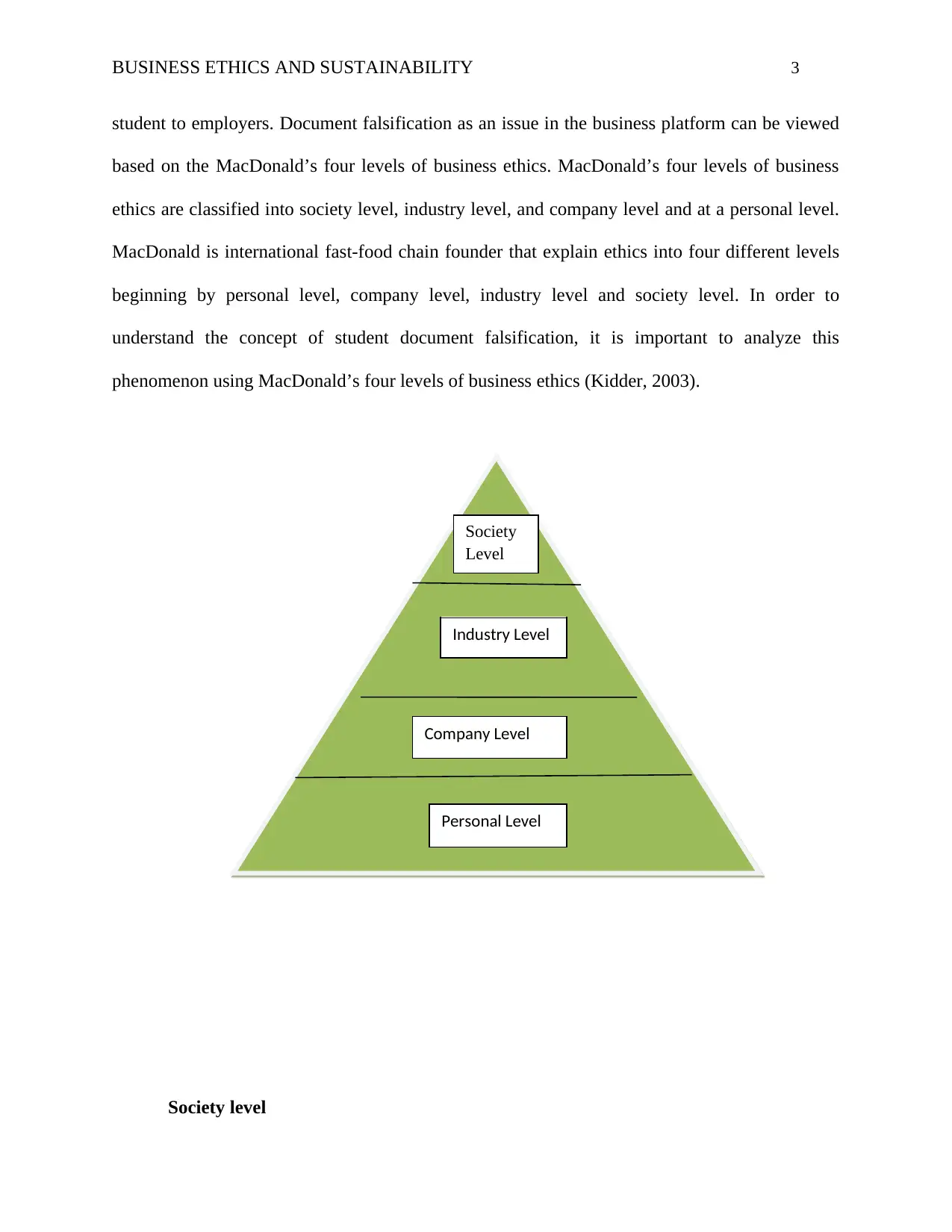
student to employers. Document falsification as an issue in the business platform can be viewed
based on the MacDonald’s four levels of business ethics. MacDonald’s four levels of business
ethics are classified into society level, industry level, and company level and at a personal level.
MacDonald is international fast-food chain founder that explain ethics into four different levels
beginning by personal level, company level, industry level and society level. In order to
understand the concept of student document falsification, it is important to analyze this
phenomenon using MacDonald’s four levels of business ethics (Kidder, 2003).
Society level
Society
Level
Company Level
Personal Level
Industry Level
student to employers. Document falsification as an issue in the business platform can be viewed
based on the MacDonald’s four levels of business ethics. MacDonald’s four levels of business
ethics are classified into society level, industry level, and company level and at a personal level.
MacDonald is international fast-food chain founder that explain ethics into four different levels
beginning by personal level, company level, industry level and society level. In order to
understand the concept of student document falsification, it is important to analyze this
phenomenon using MacDonald’s four levels of business ethics (Kidder, 2003).
Society level
Society
Level
Company Level
Personal Level
Industry Level
⊘ This is a preview!⊘
Do you want full access?
Subscribe today to unlock all pages.

Trusted by 1+ million students worldwide
BUSINESS ETHICS AND SUSTAINABILITY 4
Society is the apex of the triangle that forms the basis of the MacDonald’s four levels of
business ethics. The society is currently affected by the document falsification as a nearly most
institution in general tries to detect or identify false document presented by students claiming
ownership. Firstly, currently, document falsification touches nearly all industries meaning all
sectors of the economy are most likely to be affected by this fraud (Roger, 2011). This means
that the fraud has infiltrated the entire society as grandaunts present papers that falsely attained
in the university. Secondly, many offices both in public and private sectors are battling out fake
papers that are presented as genuine certificates supposing obtained from universities. Thirdly,
ethical standards at the society level will be jeopardized since companies will crop up that assist
students to attain grades. The society is founded on the moral principles that are accepted all
people in the society including companies that employ students after school (O'Connor, 2015).
Industry level
MacDonald’s four levels of business ethics classification indicate that ethics in the
industry is where the entire sector and related sectors or production has an application of the
ethics. Firstly, document falsification at the industry level is the act of ethical concern
surrounding false documents that are presented without ethical standards. Secondly, university
and related industries can be doomed affected with the document falsification as many students
currently submit assignment or papers that are not their own. Industry level of MacDonald’s four
levels of business ethics represents academic and related industries. For instance, the academic
platform is an example of the industry affected by this unethical practice that also touch on other
industries related to universities. Moreover, in the industry, there are many elements of
document falsification as published assignments and reports are submitted not only in an
Society is the apex of the triangle that forms the basis of the MacDonald’s four levels of
business ethics. The society is currently affected by the document falsification as a nearly most
institution in general tries to detect or identify false document presented by students claiming
ownership. Firstly, currently, document falsification touches nearly all industries meaning all
sectors of the economy are most likely to be affected by this fraud (Roger, 2011). This means
that the fraud has infiltrated the entire society as grandaunts present papers that falsely attained
in the university. Secondly, many offices both in public and private sectors are battling out fake
papers that are presented as genuine certificates supposing obtained from universities. Thirdly,
ethical standards at the society level will be jeopardized since companies will crop up that assist
students to attain grades. The society is founded on the moral principles that are accepted all
people in the society including companies that employ students after school (O'Connor, 2015).
Industry level
MacDonald’s four levels of business ethics classification indicate that ethics in the
industry is where the entire sector and related sectors or production has an application of the
ethics. Firstly, document falsification at the industry level is the act of ethical concern
surrounding false documents that are presented without ethical standards. Secondly, university
and related industries can be doomed affected with the document falsification as many students
currently submit assignment or papers that are not their own. Industry level of MacDonald’s four
levels of business ethics represents academic and related industries. For instance, the academic
platform is an example of the industry affected by this unethical practice that also touch on other
industries related to universities. Moreover, in the industry, there are many elements of
document falsification as published assignments and reports are submitted not only in an
Paraphrase This Document
Need a fresh take? Get an instant paraphrase of this document with our AI Paraphraser
BUSINESS ETHICS AND SUSTAINABILITY 5
academic institution but also other organizations that require such papers. A similar concern has
also been raised by business sector where business papers and reports or research papers are also
written on behalf of people who employees who are supposed to write.
Company level
Company level of the ethics is the level at which ethics touches as a single organization,
for example, a university or an institution. At the university, for example, document falsification
is evident in many ways. Firstly, students submitting the assignment that has been done by other
people as though their own assignment (Perle, 2004). Sometimes the student pays other
professional or freelance academic writers to write on their behalf. The assignment is therefore
written in a way that can bypass all the plagiarism checks without detection. The university is
forced to develop systems that can detect plagiarism though this does not detect indicate the
connection between student submitting a paper and the paper itself (Russell, 2013). Secondly,
this fraud is connected to two industries, one for the writer and another for the university. The
company therefore falsely gives out a certificate to the student for the unmerited grade. This
document is further presented in another institution where the grandaunt seeks employment. In
another instance, other students use or own up another person’s theory as though their own idea.
Despite this being plagiarism, the student also present the idea documented as a false document.
To bypass plagiarism theories are rewritten in own word as own idea (Cully, 2014). This
document falsification and contradict the ethical or moral standards of professionalism.
Personal Level
academic institution but also other organizations that require such papers. A similar concern has
also been raised by business sector where business papers and reports or research papers are also
written on behalf of people who employees who are supposed to write.
Company level
Company level of the ethics is the level at which ethics touches as a single organization,
for example, a university or an institution. At the university, for example, document falsification
is evident in many ways. Firstly, students submitting the assignment that has been done by other
people as though their own assignment (Perle, 2004). Sometimes the student pays other
professional or freelance academic writers to write on their behalf. The assignment is therefore
written in a way that can bypass all the plagiarism checks without detection. The university is
forced to develop systems that can detect plagiarism though this does not detect indicate the
connection between student submitting a paper and the paper itself (Russell, 2013). Secondly,
this fraud is connected to two industries, one for the writer and another for the university. The
company therefore falsely gives out a certificate to the student for the unmerited grade. This
document is further presented in another institution where the grandaunt seeks employment. In
another instance, other students use or own up another person’s theory as though their own idea.
Despite this being plagiarism, the student also present the idea documented as a false document.
To bypass plagiarism theories are rewritten in own word as own idea (Cully, 2014). This
document falsification and contradict the ethical or moral standards of professionalism.
Personal Level
BUSINESS ETHICS AND SUSTAINABILITY 6
At the personal level, an individual, manager or office take full responsibility of own
action. Personhood can be termed as individual accountability that gives the full responsibility of
own action and is directly reflected in use and submission of papers. Firstly, the individual
student should take full responsibility and accountability for papers they may falsely give as
though personal. It is unethical to submit documents that a student did not write as though they
have written and can also be termed as immoral. According to Lynch, (2002), morality dictates
that one need to do something that does not contradict what is morally accepted. In case of such
immoral act, the student should take full moral accountability. Honesty begins at a personal level
and this means that once a student becomes disobedient the whole system becomes corrupt. One
theory for ethics is Kantianism that emphasis on individual action rather than the result. This
based on the student's action that is not morally accepted as opposing the result that the student
obtains from the false assignment (Miller, 2009).
Theories of ethics
There are different theories that been advanced to explain ethics especially document
falsification. Some of these theories are consequentialism, deontology and virtue ethics and
relativist perspectives. These theories look at the different perspective of ethics and each has a
different view on morality, accountability, and standards.
Consequentialism theory looks at the ethics from consequences of an action rather than
the action itself. Unlike MacDonald’s four levels of business ethics that just focus on the outward
level of business ethics. The theory explains that students, for instance, are judged base on the
result not considering the document submitted in the university. Though document falsification
by the student may not be morally accepted, it is only judged from the consequent of action
At the personal level, an individual, manager or office take full responsibility of own
action. Personhood can be termed as individual accountability that gives the full responsibility of
own action and is directly reflected in use and submission of papers. Firstly, the individual
student should take full responsibility and accountability for papers they may falsely give as
though personal. It is unethical to submit documents that a student did not write as though they
have written and can also be termed as immoral. According to Lynch, (2002), morality dictates
that one need to do something that does not contradict what is morally accepted. In case of such
immoral act, the student should take full moral accountability. Honesty begins at a personal level
and this means that once a student becomes disobedient the whole system becomes corrupt. One
theory for ethics is Kantianism that emphasis on individual action rather than the result. This
based on the student's action that is not morally accepted as opposing the result that the student
obtains from the false assignment (Miller, 2009).
Theories of ethics
There are different theories that been advanced to explain ethics especially document
falsification. Some of these theories are consequentialism, deontology and virtue ethics and
relativist perspectives. These theories look at the different perspective of ethics and each has a
different view on morality, accountability, and standards.
Consequentialism theory looks at the ethics from consequences of an action rather than
the action itself. Unlike MacDonald’s four levels of business ethics that just focus on the outward
level of business ethics. The theory explains that students, for instance, are judged base on the
result not considering the document submitted in the university. Though document falsification
by the student may not be morally accepted, it is only judged from the consequent of action
⊘ This is a preview!⊘
Do you want full access?
Subscribe today to unlock all pages.
Trusted by 1+ million students worldwide
BUSINESS ETHICS AND SUSTAINABILITY 7
rather than intention or action. At the end of every action that one does there are consequences
that follow. This is particularly connected to the accountability of an individual for their own
action. Whether the result is positive or negative, the student is solemnly accountable for own
behavior as this will be reflected on their work performance once employed or working (Russell,
2013).
Deontology, on the other hand, is a perspective that looks at the nature of duty and
obligation, unlike consequentialism theory. It is the duty of the student to study and do the
assignment. It is also the obligation of students to study and write an assignment and this dictates
that only qualified person is awarded certificate (Portmore & Douglas, 2011). The whole
perspective does not consider any action but just the nature of duty and obligation that is required
of an individual. This implies that student that has a duty to study attend lectures and are
assessed as the nature of their duty need not involve in other practice that is not their obligation.
According to Salzman (1995), Deontology is partly in agreement with the virtue theory since all
point to an obligation that is expected of an individual (Sutton et al, 2010).
Another theory is virtue ethics that considers character above all another aspect of
personhood. This is different from other theories that solemnly look at action, result or
consequences. Virtue ethics rely on the personal accountability practice and one needs to be
responsible for own action and act in the morally accepted manner (Hoy, 2005). As in the case of
the university, the morality of student should be based on a personal character that is closely
related to deontology even though deontology explains ethics from the duty perspective (Pojman
& Fieser, 2009). This is similar to virtue ethics that also consider personal accountability hence
as student nature of duty and obligation should bring strong personal character based on what is
rather than intention or action. At the end of every action that one does there are consequences
that follow. This is particularly connected to the accountability of an individual for their own
action. Whether the result is positive or negative, the student is solemnly accountable for own
behavior as this will be reflected on their work performance once employed or working (Russell,
2013).
Deontology, on the other hand, is a perspective that looks at the nature of duty and
obligation, unlike consequentialism theory. It is the duty of the student to study and do the
assignment. It is also the obligation of students to study and write an assignment and this dictates
that only qualified person is awarded certificate (Portmore & Douglas, 2011). The whole
perspective does not consider any action but just the nature of duty and obligation that is required
of an individual. This implies that student that has a duty to study attend lectures and are
assessed as the nature of their duty need not involve in other practice that is not their obligation.
According to Salzman (1995), Deontology is partly in agreement with the virtue theory since all
point to an obligation that is expected of an individual (Sutton et al, 2010).
Another theory is virtue ethics that considers character above all another aspect of
personhood. This is different from other theories that solemnly look at action, result or
consequences. Virtue ethics rely on the personal accountability practice and one needs to be
responsible for own action and act in the morally accepted manner (Hoy, 2005). As in the case of
the university, the morality of student should be based on a personal character that is closely
related to deontology even though deontology explains ethics from the duty perspective (Pojman
& Fieser, 2009). This is similar to virtue ethics that also consider personal accountability hence
as student nature of duty and obligation should bring strong personal character based on what is
Paraphrase This Document
Need a fresh take? Get an instant paraphrase of this document with our AI Paraphraser
BUSINESS ETHICS AND SUSTAINABILITY 8
morally right. Virtue ethics also contradict consequentialism theory that fully judge according to
the result and this means there is no need for accountability or character (Devettere, 2002).
Theory of relativism explains that there is no absolute truth even though ethics is based
on what is true and morally accepted. The theory contradicts other theories that focus on a
certain aspect of ethics or standards of practice that are accepted in business practice. As students
get their assignment written for them, relativism theory requires or indicates that there is no truth
and anything is just accepted (Michael, 2010). Whether the action contradicts what is morally
accepted, the theory of relativism just comments that practice can be accepted so long as the
owner remains realistic about owning the work. This implies that if the student owns up the
assignment regardless of the source of the assignment the student remains the owner of work.
The relativist theory Furthermore, explains ethics in a manner that does not also agree with
deontology theory that relies on duty and obligation of a student in school (Lafollette, 2014).
Consequences of document falsification
Document falsification is not morally accepted the practice does not confer to standards
of practice. Document falsification has consequences both to the student and their profession.
Firstly, presenting false documents is a crime since it contradicts the ethical requirement and
duty or obligation of students. It is the duty of students to study and write an assignment, having
the assignment done for a student at a fee is contradicting duty and obligation of students.
Secondly, document falsification leads to unmerited grades that are awarded to students despite
not doing the assignments (Cavalier, 2013). Thirdly, presenting documents falsely as though
personal kills the professionalism as grades are awarded to students they are not qualified.
Qualification for grades should be based on the ability of the student to study, write and are
morally right. Virtue ethics also contradict consequentialism theory that fully judge according to
the result and this means there is no need for accountability or character (Devettere, 2002).
Theory of relativism explains that there is no absolute truth even though ethics is based
on what is true and morally accepted. The theory contradicts other theories that focus on a
certain aspect of ethics or standards of practice that are accepted in business practice. As students
get their assignment written for them, relativism theory requires or indicates that there is no truth
and anything is just accepted (Michael, 2010). Whether the action contradicts what is morally
accepted, the theory of relativism just comments that practice can be accepted so long as the
owner remains realistic about owning the work. This implies that if the student owns up the
assignment regardless of the source of the assignment the student remains the owner of work.
The relativist theory Furthermore, explains ethics in a manner that does not also agree with
deontology theory that relies on duty and obligation of a student in school (Lafollette, 2014).
Consequences of document falsification
Document falsification is not morally accepted the practice does not confer to standards
of practice. Document falsification has consequences both to the student and their profession.
Firstly, presenting false documents is a crime since it contradicts the ethical requirement and
duty or obligation of students. It is the duty of students to study and write an assignment, having
the assignment done for a student at a fee is contradicting duty and obligation of students.
Secondly, document falsification leads to unmerited grades that are awarded to students despite
not doing the assignments (Cavalier, 2013). Thirdly, presenting documents falsely as though
personal kills the professionalism as grades are awarded to students they are not qualified.
Qualification for grades should be based on the ability of the student to study, write and are
BUSINESS ETHICS AND SUSTAINABILITY 9
assessed. Fourthly, employment may face problems since students who graduate with false
documents will present fake papers to the employer (Kamm, 2006). Finally, the whole society is
infiltrated with the immoral behaviors as many companies also engage in assignment writing
practice. The situation will worsen the academic industry as many people will have unmerited
degrees, diplomas or certificates. The society expects the students to exhibit professionalism,
accountability and ethical standards that are acceptable to the society (Doris & Stich, 2008;
Wallace, 2007). Therefore, individuals who commit the crime of document falsification should
be burned from learning for a specific period of time as punishment for their action.
Conclusion
In conclusion, document falsification is a crime that involves student presenting
assignment, report or essay written by a paid writer as though students own written work.
MacDonald's four levels of business ethics explain the four levels of business ethics ranging
from personal ethic at the lowest level followed by company, industry, and society at the apex.
There are also other theories that have been advanced to explain ethics from a different
perspective. Some of these theories are consequentialism, deontology and virtue ethics and
relativist perspectives. Document falsification is linked to consequences that are not only felt at a
personal level but also at the society level.
assessed. Fourthly, employment may face problems since students who graduate with false
documents will present fake papers to the employer (Kamm, 2006). Finally, the whole society is
infiltrated with the immoral behaviors as many companies also engage in assignment writing
practice. The situation will worsen the academic industry as many people will have unmerited
degrees, diplomas or certificates. The society expects the students to exhibit professionalism,
accountability and ethical standards that are acceptable to the society (Doris & Stich, 2008;
Wallace, 2007). Therefore, individuals who commit the crime of document falsification should
be burned from learning for a specific period of time as punishment for their action.
Conclusion
In conclusion, document falsification is a crime that involves student presenting
assignment, report or essay written by a paid writer as though students own written work.
MacDonald's four levels of business ethics explain the four levels of business ethics ranging
from personal ethic at the lowest level followed by company, industry, and society at the apex.
There are also other theories that have been advanced to explain ethics from a different
perspective. Some of these theories are consequentialism, deontology and virtue ethics and
relativist perspectives. Document falsification is linked to consequences that are not only felt at a
personal level but also at the society level.
⊘ This is a preview!⊘
Do you want full access?
Subscribe today to unlock all pages.
Trusted by 1+ million students worldwide
BUSINESS ETHICS AND SUSTAINABILITY 10
Reference
Blackburn, S. (2001), Being good: A short introduction to ethics. Oxford: Oxford University
Press.
Cully, P. (2014), Plagiarism avoidance in academic submissions. Dublin Institute of Technology,
2013. Full PDF available for download at: http://arrow.dit.ie/bescharcoth/4/
Cavalier, R. (2013), Meta-ethics, Normative Ethics, and Applied Ethics. Online Guide to Ethics
and Moral Philosophy. Archived from the original on November 12, 2013.
Devettere, R. J. (2002), Introduction to Virtue Ethics. Washington, D.C.: Georgetown University
Press.
Doris & Stich (2008), & Wallace (2007), Wallace writes: "Moral psychology is the study of
morality in its psychological dimensions" (p. 86).
Kamm F. M. Professor of Philosophy Harvard University (2006), Intricate Ethics Rights,
Responsibilities, and Permissible Harm Rights, Responsibilities, and Permissible Harm.
Oxford University Press.
Hoy, D. (2005), Critical Resistance from Poststructuralism to Postcritique. Massachusetts
Institute of Technology, Cambridge, Massachusetts.
Kidder, R. (2003), How Good People Make Tough Choices: Resolving the Dilemmas of Ethical
Living. New York: Harper Collins. p. 63.
Reference
Blackburn, S. (2001), Being good: A short introduction to ethics. Oxford: Oxford University
Press.
Cully, P. (2014), Plagiarism avoidance in academic submissions. Dublin Institute of Technology,
2013. Full PDF available for download at: http://arrow.dit.ie/bescharcoth/4/
Cavalier, R. (2013), Meta-ethics, Normative Ethics, and Applied Ethics. Online Guide to Ethics
and Moral Philosophy. Archived from the original on November 12, 2013.
Devettere, R. J. (2002), Introduction to Virtue Ethics. Washington, D.C.: Georgetown University
Press.
Doris & Stich (2008), & Wallace (2007), Wallace writes: "Moral psychology is the study of
morality in its psychological dimensions" (p. 86).
Kamm F. M. Professor of Philosophy Harvard University (2006), Intricate Ethics Rights,
Responsibilities, and Permissible Harm Rights, Responsibilities, and Permissible Harm.
Oxford University Press.
Hoy, D. (2005), Critical Resistance from Poststructuralism to Postcritique. Massachusetts
Institute of Technology, Cambridge, Massachusetts.
Kidder, R. (2003), How Good People Make Tough Choices: Resolving the Dilemmas of Ethical
Living. New York: Harper Collins. p. 63.
Paraphrase This Document
Need a fresh take? Get an instant paraphrase of this document with our AI Paraphraser
BUSINESS ETHICS AND SUSTAINABILITY 11
Lafollette, H. (2014), Ethics in Practice: An Anthology[ed.]. Wiley Blackwell, 4th edition,
Oxford.
Lynch, J. (2002), The Perfectly Acceptable Practice of Literary Theft: Plagiarism, Copyright,
and the Eighteenth Century, in Colonial Williamsburg: The Journal of the Colonial
Williamsburg Foundation 24, no. 4 (Winter 2002–3), pp. 51–54. Also available online
since 2006 at Writing World.
Miller, C. (2009), The Conditions of Moral Realism. The Journal of Philosophical Research, 34,
123-155
Michael, K. (2010), Relativism: A Contemporary Anthology, New York: Columbia University
Press,
O'Connor, Z. (2015), Extreme plagiarism: The rise of the e-Idiot? International Journal of
Learning in Higher Education, 20 (1), pp1-11.
Pojman, L.P. & Fieser, J. (2009), Virtue Theory. In Ethics: Discovering Right and Wrong (pp.
146-169). (6th ed.) Belmont, CA: Wadsworth.
Portmore, & Douglas, W. (2011), Commonsense Consequentialism: Wherein Morality Meets
Rationality. New York: Oxford University Press.
Perle, S. (March 11, 2004), Morality and Ethics: An Introduction. Retrieved February 13, 2007.,
Butchvarov, Panayot. Skepticism in Ethics (1989).
Roger, T. A. (April 30, 2011), Confucian Role Ethics: A Vocabulary. University of Hawaiʻi
Press.
Lafollette, H. (2014), Ethics in Practice: An Anthology[ed.]. Wiley Blackwell, 4th edition,
Oxford.
Lynch, J. (2002), The Perfectly Acceptable Practice of Literary Theft: Plagiarism, Copyright,
and the Eighteenth Century, in Colonial Williamsburg: The Journal of the Colonial
Williamsburg Foundation 24, no. 4 (Winter 2002–3), pp. 51–54. Also available online
since 2006 at Writing World.
Miller, C. (2009), The Conditions of Moral Realism. The Journal of Philosophical Research, 34,
123-155
Michael, K. (2010), Relativism: A Contemporary Anthology, New York: Columbia University
Press,
O'Connor, Z. (2015), Extreme plagiarism: The rise of the e-Idiot? International Journal of
Learning in Higher Education, 20 (1), pp1-11.
Pojman, L.P. & Fieser, J. (2009), Virtue Theory. In Ethics: Discovering Right and Wrong (pp.
146-169). (6th ed.) Belmont, CA: Wadsworth.
Portmore, & Douglas, W. (2011), Commonsense Consequentialism: Wherein Morality Meets
Rationality. New York: Oxford University Press.
Perle, S. (March 11, 2004), Morality and Ethics: An Introduction. Retrieved February 13, 2007.,
Butchvarov, Panayot. Skepticism in Ethics (1989).
Roger, T. A. (April 30, 2011), Confucian Role Ethics: A Vocabulary. University of Hawaiʻi
Press.
BUSINESS ETHICS AND SUSTAINABILITY 12
Russell, D. C. (2013), The Cambridge Companion to Virtue Ethics. New York: Cambridge
University Press.
Salzman, T. A. (1995), Deontology and Teleology: An Investigation of the Normative Debate in
Roman Catholic Moral Theology. University Press.
Sutton, A. J. et al, (July 2010), Assessing publication bias in meta-analysis in the presence of
between-study heterogeneity. Journal of the Royal Statistical Society: Series A (Statistics
in Society), 173 (3): 575–591.
Russell, D. C. (2013), The Cambridge Companion to Virtue Ethics. New York: Cambridge
University Press.
Salzman, T. A. (1995), Deontology and Teleology: An Investigation of the Normative Debate in
Roman Catholic Moral Theology. University Press.
Sutton, A. J. et al, (July 2010), Assessing publication bias in meta-analysis in the presence of
between-study heterogeneity. Journal of the Royal Statistical Society: Series A (Statistics
in Society), 173 (3): 575–591.
⊘ This is a preview!⊘
Do you want full access?
Subscribe today to unlock all pages.
Trusted by 1+ million students worldwide

1 out of 12


Related Documents


Your All-in-One AI-Powered Toolkit for Academic Success.
+13062052269
info@desklib.com
Available 24*7 on WhatsApp / Email
![[object Object]](/_next/static/media/star-bottom.7253800d.svg)
Unlock your academic potential
Copyright © 2020–2026 A2Z Services. All Rights Reserved. Developed and managed by ZUCOL.