The Role of Business Ethics in Enhancing Hospitality Productivity
VerifiedAdded on 2021/04/17
|17
|3789
|216
Report
AI Summary
This report, titled 'Research and Design,' investigates the influence of business ethics on employee efficiency and productivity within the hospitality industry. The study explores the relationship between ethical practices, employee performance, and profitability, addressing research questions about the impact of business ethics on profitability and employee efficiency. The report includes a literature review examining existing research on ethics in hospitality, a conceptual model outlining the relationships between business ethics and various factors, and a detailed methodology section describing the research philosophy, approach, and methods employed. The findings aim to provide insights into how ethical business practices can enhance the performance of hospitality businesses, particularly in terms of employee productivity and overall profitability. The report also provides recommendations for businesses in the hospitality sector.

Running head: RESEARCH AND DESIGN
Research and Design
Name of the Student
Name of the University
Author note
Research and Design
Name of the Student
Name of the University
Author note

Paraphrase This Document
Need a fresh take? Get an instant paraphrase of this document with our AI Paraphraser
1RESEARCH AND DESIGN
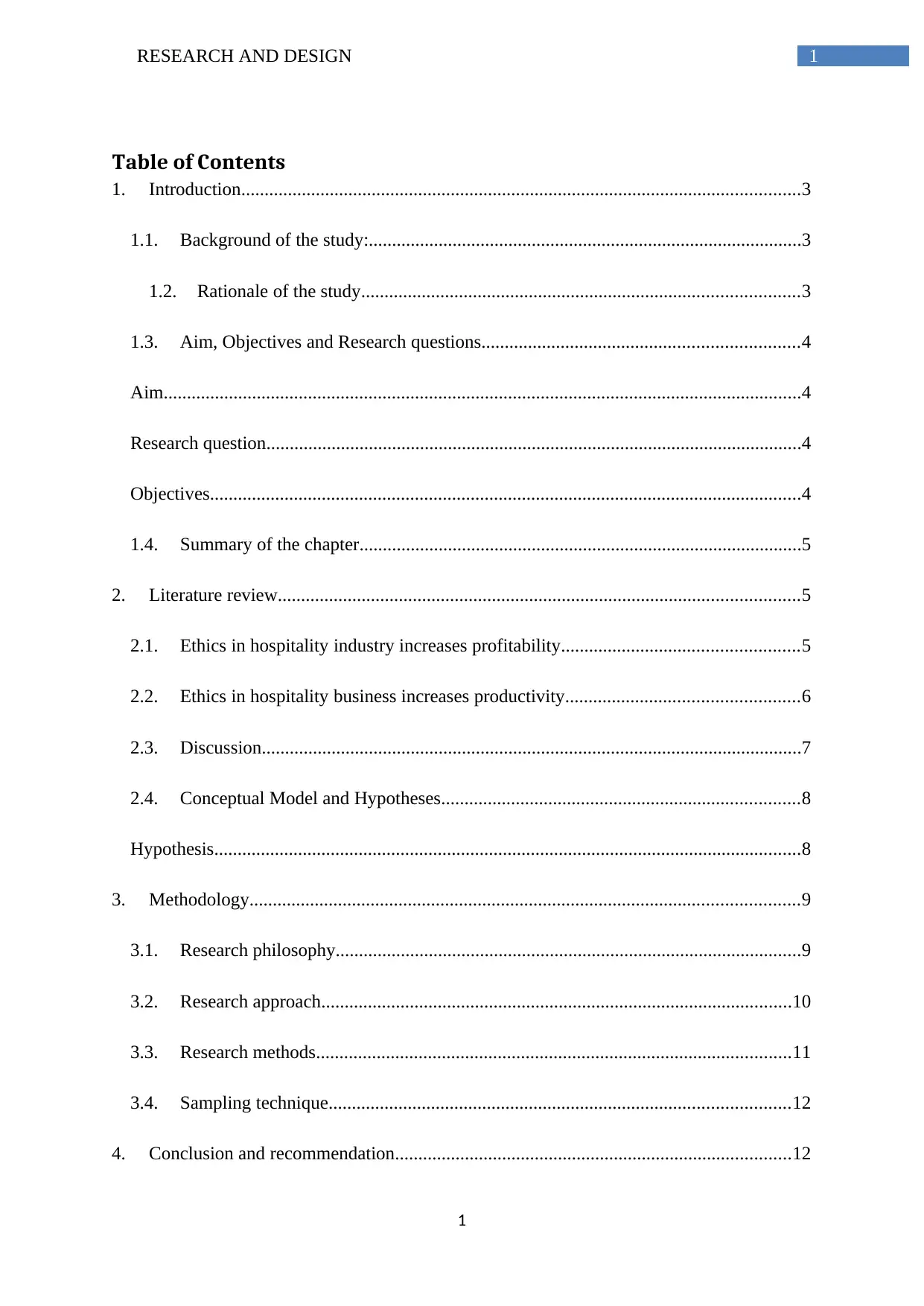
Table of Contents
1. Introduction........................................................................................................................3
1.1. Background of the study:.............................................................................................3
1.2. Rationale of the study..............................................................................................3
1.3. Aim, Objectives and Research questions....................................................................4
Aim.........................................................................................................................................4
Research question...................................................................................................................4
Objectives...............................................................................................................................4
1.4. Summary of the chapter...............................................................................................5
2. Literature review................................................................................................................5
2.1. Ethics in hospitality industry increases profitability...................................................5
2.2. Ethics in hospitality business increases productivity..................................................6
2.3. Discussion....................................................................................................................7
2.4. Conceptual Model and Hypotheses.............................................................................8
Hypothesis..............................................................................................................................8
3. Methodology......................................................................................................................9
3.1. Research philosophy....................................................................................................9
3.2. Research approach.....................................................................................................10
3.3. Research methods......................................................................................................11
3.4. Sampling technique...................................................................................................12
4. Conclusion and recommendation.....................................................................................12
1
Table of Contents
1. Introduction........................................................................................................................3
1.1. Background of the study:.............................................................................................3
1.2. Rationale of the study..............................................................................................3
1.3. Aim, Objectives and Research questions....................................................................4
Aim.........................................................................................................................................4
Research question...................................................................................................................4
Objectives...............................................................................................................................4
1.4. Summary of the chapter...............................................................................................5
2. Literature review................................................................................................................5
2.1. Ethics in hospitality industry increases profitability...................................................5
2.2. Ethics in hospitality business increases productivity..................................................6
2.3. Discussion....................................................................................................................7
2.4. Conceptual Model and Hypotheses.............................................................................8
Hypothesis..............................................................................................................................8
3. Methodology......................................................................................................................9
3.1. Research philosophy....................................................................................................9
3.2. Research approach.....................................................................................................10
3.3. Research methods......................................................................................................11
3.4. Sampling technique...................................................................................................12
4. Conclusion and recommendation.....................................................................................12
1

2RESEARCH AND DESIGN
4.1 Recommendation............................................................................................................12
4.2 Conclusion......................................................................................................................13
References................................................................................................................................14
2
4.1 Recommendation............................................................................................................12
4.2 Conclusion......................................................................................................................13
References................................................................................................................................14
2
⊘ This is a preview!⊘
Do you want full access?
Subscribe today to unlock all pages.

Trusted by 1+ million students worldwide
3RESEARCH AND DESIGN
1. Introduction
1.1. Background of the study:
It is a widely accepted fact that the system of employment relations in any business
corporation and the ethical behavior is immensely important for increase in productivity,
general development of the employees along with the organization and the services provided
by the organization (Knani 2014). It can also be said that the extent to which the business
organizations adhere to the standards of ethics would determine the happiness or security of
all the stakeholders, profitability and most definitely the productivity of the organization
along with the economic growth and development of the whole country where the
organization operates (Jayaweera 2015).
The notion of efficiency can be applied to the area of employment relationship can be
considered as a function of appropriate management of the workforce at the workplace and
along with that an adherence to the ethical standards of the workplace (López-Gamero et al.
2016). Surely it can be said that work is a dominant factor of the lives of the employees that
can be looked at as collectively as well as individually is a central feature of a business
organization. It can be said that the totality of the fundamental nature of the work within the
society is that it is the fundamental determinism around which the lives of the human beings
are ordered (Knani 2014). The countries get developed and subsequently the organizations
get improved.
1.2. Rationale of the study
There are various types of managements in business organizations with numerous
perceptions regarding the business ethics (Pereira-Moliner et al. 2015). Some of them look at
it as a constraint on the profitability of their business; as they think that maintaining business
ethics is totally inversely proportional with the profitability of the business. In today’s world
it can be said that if an organization managed to sustain their business ethics the management
3
1. Introduction
1.1. Background of the study:
It is a widely accepted fact that the system of employment relations in any business
corporation and the ethical behavior is immensely important for increase in productivity,
general development of the employees along with the organization and the services provided
by the organization (Knani 2014). It can also be said that the extent to which the business
organizations adhere to the standards of ethics would determine the happiness or security of
all the stakeholders, profitability and most definitely the productivity of the organization
along with the economic growth and development of the whole country where the
organization operates (Jayaweera 2015).
The notion of efficiency can be applied to the area of employment relationship can be
considered as a function of appropriate management of the workforce at the workplace and
along with that an adherence to the ethical standards of the workplace (López-Gamero et al.
2016). Surely it can be said that work is a dominant factor of the lives of the employees that
can be looked at as collectively as well as individually is a central feature of a business
organization. It can be said that the totality of the fundamental nature of the work within the
society is that it is the fundamental determinism around which the lives of the human beings
are ordered (Knani 2014). The countries get developed and subsequently the organizations
get improved.
1.2. Rationale of the study
There are various types of managements in business organizations with numerous
perceptions regarding the business ethics (Pereira-Moliner et al. 2015). Some of them look at
it as a constraint on the profitability of their business; as they think that maintaining business
ethics is totally inversely proportional with the profitability of the business. In today’s world
it can be said that if an organization managed to sustain their business ethics the management
3
Paraphrase This Document
Need a fresh take? Get an instant paraphrase of this document with our AI Paraphraser
4RESEARCH AND DESIGN
will surely have a competitive edge. However, in reality it can be found out that maintaining
business ethics and gaining desired profitability at the same time can be difficult for the
business organization. It is also noteworthy to mention that without efficient employees, the
organization would not be able to meet their target. However, in order to have a trustworthy
relationship between the employees and organization, ethical applications can also play a
great role. Therefore if a business organization has a reputation of maintaining good business
ethics, then the management will surely experience boost in productivity as it would decrease
the business transaction costs and would establish a trust among the customers and suppliers
making them more loyal towards the business organization (López-Gamero et al. 2016).
It is important to organizations in the tourism sector follow the business ethics while
providing service to the customers. The tourism sector is a service industry where the role of
the employees is impeccable. It is important for the business organization to abide by the
ethics in order to take care of the moral judgments of the individuals within the organization.
Thus, abiding by the business ethics helps in improving the productivity of the employees, as
the employees are able to relate with the organizational aims, objectives and the core values
of the organizations. Thus, following the business ethics ensures that fair decisions are made
by the individuals and the groups.
1.3. Aim, Objectives and Research questions
Aim
The aim of this research is to find out that whether maintaining business ethics in the
operations of the business would help to increase the productivity by increasing the efficiency
level of the employees of business organizations operating in hospitality industry.
4
will surely have a competitive edge. However, in reality it can be found out that maintaining
business ethics and gaining desired profitability at the same time can be difficult for the
business organization. It is also noteworthy to mention that without efficient employees, the
organization would not be able to meet their target. However, in order to have a trustworthy
relationship between the employees and organization, ethical applications can also play a
great role. Therefore if a business organization has a reputation of maintaining good business
ethics, then the management will surely experience boost in productivity as it would decrease
the business transaction costs and would establish a trust among the customers and suppliers
making them more loyal towards the business organization (López-Gamero et al. 2016).
It is important to organizations in the tourism sector follow the business ethics while
providing service to the customers. The tourism sector is a service industry where the role of
the employees is impeccable. It is important for the business organization to abide by the
ethics in order to take care of the moral judgments of the individuals within the organization.
Thus, abiding by the business ethics helps in improving the productivity of the employees, as
the employees are able to relate with the organizational aims, objectives and the core values
of the organizations. Thus, following the business ethics ensures that fair decisions are made
by the individuals and the groups.
1.3. Aim, Objectives and Research questions
Aim
The aim of this research is to find out that whether maintaining business ethics in the
operations of the business would help to increase the productivity by increasing the efficiency
level of the employees of business organizations operating in hospitality industry.
4
5RESEARCH AND DESIGN
Research question
RQ1. Do maintaining business ethics improve profitability?
RQ2. Do maintaining business ethics help to sustain and develop efficiency of the
employees?
Objectives
1. To find out whether maintaining business ethics would increase the professional skills of
the employees.
2. To find out how sustaining business ethics in hospitality business improve profitability.
Research hypothesis
H0: Business ethics has does not increase employee efficiency and productivity
H1: Business ethics does increase employee efficiency and productivity
1.4. Summary of the chapter
Hotel industry nowadays is facing various threats as the competition in the market has
become intense and the world wide recession in economy is making it difficult to sustain the
profitability of the hospitality businesses (Molina-Azorín et al. 2015). Thus it would be wiser
to determine whether the sustenance of excellent business ethics would help the
managements of the business organizations to improve the efficiencies of the workforce to
improve the level of service and to increase the local customer base as well. Another aim of
this research is to find out how maintaining good business ethics would help the hospitality
businesses to increase the level of profitability in today’s market.
2. Literature review
5
Research question
RQ1. Do maintaining business ethics improve profitability?
RQ2. Do maintaining business ethics help to sustain and develop efficiency of the
employees?
Objectives
1. To find out whether maintaining business ethics would increase the professional skills of
the employees.
2. To find out how sustaining business ethics in hospitality business improve profitability.
Research hypothesis
H0: Business ethics has does not increase employee efficiency and productivity
H1: Business ethics does increase employee efficiency and productivity
1.4. Summary of the chapter
Hotel industry nowadays is facing various threats as the competition in the market has
become intense and the world wide recession in economy is making it difficult to sustain the
profitability of the hospitality businesses (Molina-Azorín et al. 2015). Thus it would be wiser
to determine whether the sustenance of excellent business ethics would help the
managements of the business organizations to improve the efficiencies of the workforce to
improve the level of service and to increase the local customer base as well. Another aim of
this research is to find out how maintaining good business ethics would help the hospitality
businesses to increase the level of profitability in today’s market.
2. Literature review
5
⊘ This is a preview!⊘
Do you want full access?
Subscribe today to unlock all pages.
Trusted by 1+ million students worldwide
6RESEARCH AND DESIGN
2.1. Ethics in hospitality industry increases profitability
In today’s world, the term ethics has a huge significance in business world. The term
came from a Greek word ethos that meant significance, honesty. It is a matter of fact that
there are no definitions of business ethics that is widely accepted and can be implemented at
different times (Pereira-Moliner et al. 2015). From the perspective of economical
management it can be said that if a business organization operating in hospitality industry
take initiative regarding their corporate social responsibility in a significant manner, it would
help them achieve a good reputation and that may increase the loyalty of their customers. It
may increase the customer base of the organization too (Heizer 2016). These types of activity
would help the organization to gain huge popularity and that would eventually become a huge
publicity. In this way the businesses in hospitality industry may improve the profitability by
improving and maintaining business ethics.
2.2. Ethics in hospitality business increases productivity
It can be said that maintaining proper business ethics in the workplace would definitely
influence the productivity of the business also. Numerous managers of hotel businesses have
accepted the fact that in daily operations they face various problems where the business ethics
get challenged on a regular basis (Knani 2014). In many occasions these managers handle
issues related to theft, below standard food quality, lack of enthusiasm of the employees to
serve the guests and many more. These issues are against the policies of the service industry.
In service industry the chief goal should be to please the guests and to build the reputation of
the organization (Molina-Azorín et al. 2015). This is important as in hotel businesses the
reputation of the organization have a significant contribution to the profitability of the
6
2.1. Ethics in hospitality industry increases profitability
In today’s world, the term ethics has a huge significance in business world. The term
came from a Greek word ethos that meant significance, honesty. It is a matter of fact that
there are no definitions of business ethics that is widely accepted and can be implemented at
different times (Pereira-Moliner et al. 2015). From the perspective of economical
management it can be said that if a business organization operating in hospitality industry
take initiative regarding their corporate social responsibility in a significant manner, it would
help them achieve a good reputation and that may increase the loyalty of their customers. It
may increase the customer base of the organization too (Heizer 2016). These types of activity
would help the organization to gain huge popularity and that would eventually become a huge
publicity. In this way the businesses in hospitality industry may improve the profitability by
improving and maintaining business ethics.
2.2. Ethics in hospitality business increases productivity
It can be said that maintaining proper business ethics in the workplace would definitely
influence the productivity of the business also. Numerous managers of hotel businesses have
accepted the fact that in daily operations they face various problems where the business ethics
get challenged on a regular basis (Knani 2014). In many occasions these managers handle
issues related to theft, below standard food quality, lack of enthusiasm of the employees to
serve the guests and many more. These issues are against the policies of the service industry.
In service industry the chief goal should be to please the guests and to build the reputation of
the organization (Molina-Azorín et al. 2015). This is important as in hotel businesses the
reputation of the organization have a significant contribution to the profitability of the
6
Paraphrase This Document
Need a fresh take? Get an instant paraphrase of this document with our AI Paraphraser
7RESEARCH AND DESIGN
company. It is a matter of fact that the satisfaction level of the customers would make them
loyal towards the organization and in hotel business the customers who come back generate
the most of the profit (López-Gamero et al. 2016). Thus satisfying the requirements of the
customers is very important and that falls under the business ethics of the hotel business. As
the aim of the research is to find out how maintaining business ethics would increase the
efficiency of the employees, it would be worthwhile to mention that if the management of the
organization needs to maintain certain business ethics they would surely deploy a team that
would be dedicated to control the quality of the service (Pereira-Moliner et al. 2015). It
would be their duty to find out the employees who are struggling with their tasks. Then it
would be the duty of the management of the business organization to train those individuals
to improve their professional skills. In this way maintaining certain business ethics would
help the workforce to improve their efficiencies.
2.3. Discussion
The decision making in workplace has to be ethical as otherwise it would disrupt the
positive ambience of the workplace. It is a matter of fact that the managers of the hotel
businesses are compelled to provide the customers with highest level of service, good return
of the money they are investing and also to ensure the satisfaction of the guests. Therefore
these services of these managers fall under maintaining the business ethics of the
organization (Knani 2014). Thus it can be said that if a manager fails to do so, it would not
make the guests happy and that would harm the reputation of the organization. It is a
generally accepted fact that in hospitality business if the reputation of an organization gets
lowered, it would be very difficult for the management of the organization to regain their spot
as in today’s market the competition in hotel business has got intense in every part of the
world. It is a a matter of fact that a part of maintaining business ethics in hotel business is to
ensure that the guests receive the service of the highest quality as that would please the
7
company. It is a matter of fact that the satisfaction level of the customers would make them
loyal towards the organization and in hotel business the customers who come back generate
the most of the profit (López-Gamero et al. 2016). Thus satisfying the requirements of the
customers is very important and that falls under the business ethics of the hotel business. As
the aim of the research is to find out how maintaining business ethics would increase the
efficiency of the employees, it would be worthwhile to mention that if the management of the
organization needs to maintain certain business ethics they would surely deploy a team that
would be dedicated to control the quality of the service (Pereira-Moliner et al. 2015). It
would be their duty to find out the employees who are struggling with their tasks. Then it
would be the duty of the management of the business organization to train those individuals
to improve their professional skills. In this way maintaining certain business ethics would
help the workforce to improve their efficiencies.
2.3. Discussion
The decision making in workplace has to be ethical as otherwise it would disrupt the
positive ambience of the workplace. It is a matter of fact that the managers of the hotel
businesses are compelled to provide the customers with highest level of service, good return
of the money they are investing and also to ensure the satisfaction of the guests. Therefore
these services of these managers fall under maintaining the business ethics of the
organization (Knani 2014). Thus it can be said that if a manager fails to do so, it would not
make the guests happy and that would harm the reputation of the organization. It is a
generally accepted fact that in hospitality business if the reputation of an organization gets
lowered, it would be very difficult for the management of the organization to regain their spot
as in today’s market the competition in hotel business has got intense in every part of the
world. It is a a matter of fact that a part of maintaining business ethics in hotel business is to
ensure that the guests receive the service of the highest quality as that would please the
7
8RESEARCH AND DESIGN
Business ethics
Improved employee efficiency and productivity
Individual factors
Social factors
Government rules and regulations
Ethics of the industry
customers and would increase the customer base of the organization which is very important
in today’s market full of competition (López-Gamero et al. 2016).
The managements of the hotel businesses have to be conscience of a fact that
employee satisfaction is another issue that is at times becomes very difficult to deal with
(Pereira-Moliner et al. 2015). The managers often experience certain situations where while
maintaining the business ethics in order to satisfy a customer, the employees’ interest gets
hurt and that can potentially reduce the loyalty of the employee and that can directly affect
the effectiveness of that employee (Molina-Azorín et al. 2015). Thus it can be said that it
would also fall under the duties of the managers to keep the workforce satisfied and to keep
the attrition level on the lower side.
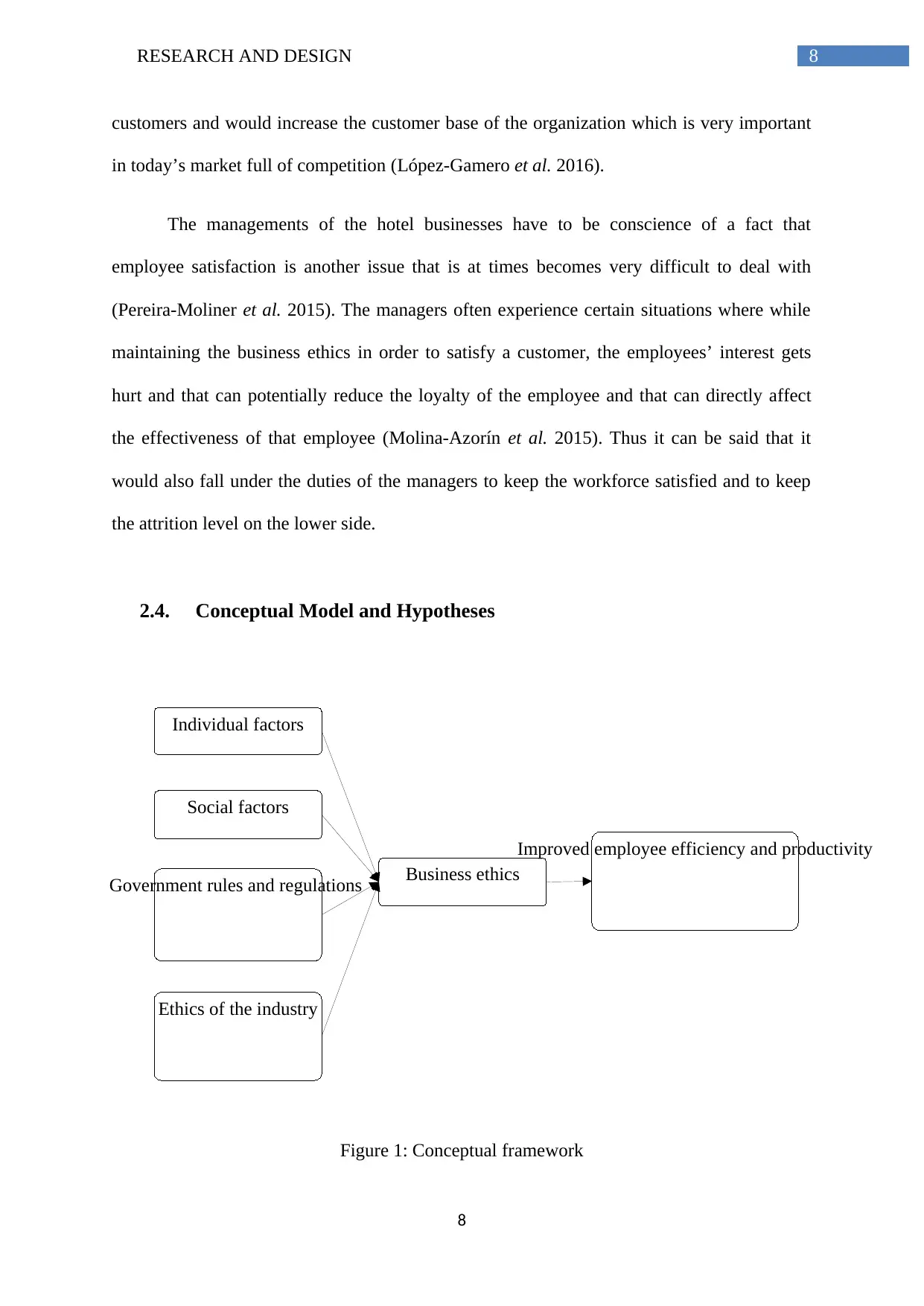
2.4. Conceptual Model and Hypotheses
Figure 1: Conceptual framework
8
Business ethics
Improved employee efficiency and productivity
Individual factors
Social factors
Government rules and regulations
Ethics of the industry
customers and would increase the customer base of the organization which is very important
in today’s market full of competition (López-Gamero et al. 2016).
The managements of the hotel businesses have to be conscience of a fact that
employee satisfaction is another issue that is at times becomes very difficult to deal with
(Pereira-Moliner et al. 2015). The managers often experience certain situations where while
maintaining the business ethics in order to satisfy a customer, the employees’ interest gets
hurt and that can potentially reduce the loyalty of the employee and that can directly affect
the effectiveness of that employee (Molina-Azorín et al. 2015). Thus it can be said that it
would also fall under the duties of the managers to keep the workforce satisfied and to keep
the attrition level on the lower side.
2.4. Conceptual Model and Hypotheses
Figure 1: Conceptual framework
8
⊘ This is a preview!⊘
Do you want full access?
Subscribe today to unlock all pages.
Trusted by 1+ million students worldwide
9RESEARCH AND DESIGN
Source: Created by author
3. Methodology
The research methodology is the systematic practice for collecting the required
information from diverse sources. The fundamental principle of the research methodology
is to evaluate the collected information and data with the practical tools for carrying out
the research work (Silverman 2016). For this research study, some methodological tools
have been utilized such as research philosophy, research approach, research methods,
sampling etc.
3.1. Research philosophy
Before performing any specific research study, the entire research problem needs to be
observed with the help of gathered information and data in a methodical way. The research
philosophy is a suitable tool that can help identifying the primary research issue with the help
of different methods (Lewis 2015). The research philosophy is generally of three kinds:
realism research philosophy, positivism research philosophy and interpretivism research
philosophy. The positivism research philosophy refers to the factual knowledge that can be
gained through sense observation and measurement. On the other hand, the interpretivism
research philosophy refers to the proper interpretation of various elements of the research by
integrating human interest within the study (Mackey and Gass 2015). Realism research
philosophy depends on the concept of autonomy of reality from human mind, therefore it can
be said that this particular philosophy is based on the hypothesis of scientific approaches for
developing more knowledge.
Justification of the chosen research philosophy
9
Source: Created by author
3. Methodology
The research methodology is the systematic practice for collecting the required
information from diverse sources. The fundamental principle of the research methodology
is to evaluate the collected information and data with the practical tools for carrying out
the research work (Silverman 2016). For this research study, some methodological tools
have been utilized such as research philosophy, research approach, research methods,
sampling etc.
3.1. Research philosophy
Before performing any specific research study, the entire research problem needs to be
observed with the help of gathered information and data in a methodical way. The research
philosophy is a suitable tool that can help identifying the primary research issue with the help
of different methods (Lewis 2015). The research philosophy is generally of three kinds:
realism research philosophy, positivism research philosophy and interpretivism research
philosophy. The positivism research philosophy refers to the factual knowledge that can be
gained through sense observation and measurement. On the other hand, the interpretivism
research philosophy refers to the proper interpretation of various elements of the research by
integrating human interest within the study (Mackey and Gass 2015). Realism research
philosophy depends on the concept of autonomy of reality from human mind, therefore it can
be said that this particular philosophy is based on the hypothesis of scientific approaches for
developing more knowledge.
Justification of the chosen research philosophy
9
Paraphrase This Document
Need a fresh take? Get an instant paraphrase of this document with our AI Paraphraser
10RESEARCH AND DESIGN
This particular research study will work on the role of the business ethics in increasing
efficiency and productivity in the backdrop of a small scale hotel in UK. For this purpose, the
positivism research philosophy will be chosen. This philosophy is entirely based on the keen
and in-depth observation. Therefore, before gathering all the information, a detailed
observation will be made in order to complete the whole study in a successful way. It should
also be noted that this particular research philosophy is low cost effective. However,
following this research philosophy, one does not need to spend a lot of time for analyzing the
issue of research, but if the interpretivism research philosophy is followed, adequate amount
of time should be invested as it is entirely based on interpretation of the collection
information (Silverman 2016). Therefore, this research study will be completed following the
positivism research philosophy.
3.2. Research approach
The primary purpose of research approach is to analyze the collected information and
data by assessing the issue of research from various perspectives. The research approach
includes two primary kinds: inductive research approach and deductive research approach.
The deductive research approach aims to examine the collected information and data on the
basis of the accessible theories (Lewis 2015). Deductive approach also aims at hypothesis
testing for measuring the information properly. On the other hand the inductive research
approach is mostly focused on the evaluation of the collected information and data with the
help of a completely new theory. Therefore, if this research approach is followed, an
effectual risk analysis should be done to ensure that the new theory is advantageous for the
specific research issue.
Justification of chosen research approach
10
This particular research study will work on the role of the business ethics in increasing
efficiency and productivity in the backdrop of a small scale hotel in UK. For this purpose, the
positivism research philosophy will be chosen. This philosophy is entirely based on the keen
and in-depth observation. Therefore, before gathering all the information, a detailed
observation will be made in order to complete the whole study in a successful way. It should
also be noted that this particular research philosophy is low cost effective. However,
following this research philosophy, one does not need to spend a lot of time for analyzing the
issue of research, but if the interpretivism research philosophy is followed, adequate amount
of time should be invested as it is entirely based on interpretation of the collection
information (Silverman 2016). Therefore, this research study will be completed following the
positivism research philosophy.
3.2. Research approach
The primary purpose of research approach is to analyze the collected information and
data by assessing the issue of research from various perspectives. The research approach
includes two primary kinds: inductive research approach and deductive research approach.
The deductive research approach aims to examine the collected information and data on the
basis of the accessible theories (Lewis 2015). Deductive approach also aims at hypothesis
testing for measuring the information properly. On the other hand the inductive research
approach is mostly focused on the evaluation of the collected information and data with the
help of a completely new theory. Therefore, if this research approach is followed, an
effectual risk analysis should be done to ensure that the new theory is advantageous for the
specific research issue.
Justification of chosen research approach
10
11RESEARCH AND DESIGN
This study will focus using the deductive research approach. The deductive research
approach is suitable for completing the study with help of the accessible theories along with
hypothesis testing. This study will use several case studies in the small scale hotels in UK for
analyzing the role of business ethics in increasing efficiency and productivity. Following the
inductive research approach will be difficult as there will be risk factors. If the new theory is
not relevant for the particular research study, the entire research may lose its flow Therefore,
for this research study, the deductive research approach will be followed.
3.3. Research methods
Data Collection Method
The data collection and data analysis is the most vital parts of the research study. It is also
considered to be one of the most effectual tools (Silverman 2016). The two types of data
collection techniques, that is, primary and secondary. In the case of primary data collection
technique, both qualitative and quantitative data collection technique can be used. Qualitative
data collection technique focuses more on the quality of the data, that is, interview whereas
quantitative data collection technique emphasizes on the numbers of the respondents that is
survey. In the case of interview, the sample size is less as it is time consuming whereas in the
case of survey data is collected from large population and categorized with the number of the
respondents (Lewis 2015). For this study, primary data will be collected through survey-
questionnaire procedure.
Sample Size
This study will involve fifty employees and ten managers for collecting the primary
data from a small scale hospitality organization in UK.
11
This study will focus using the deductive research approach. The deductive research
approach is suitable for completing the study with help of the accessible theories along with
hypothesis testing. This study will use several case studies in the small scale hotels in UK for
analyzing the role of business ethics in increasing efficiency and productivity. Following the
inductive research approach will be difficult as there will be risk factors. If the new theory is
not relevant for the particular research study, the entire research may lose its flow Therefore,
for this research study, the deductive research approach will be followed.
3.3. Research methods
Data Collection Method
The data collection and data analysis is the most vital parts of the research study. It is also
considered to be one of the most effectual tools (Silverman 2016). The two types of data
collection techniques, that is, primary and secondary. In the case of primary data collection
technique, both qualitative and quantitative data collection technique can be used. Qualitative
data collection technique focuses more on the quality of the data, that is, interview whereas
quantitative data collection technique emphasizes on the numbers of the respondents that is
survey. In the case of interview, the sample size is less as it is time consuming whereas in the
case of survey data is collected from large population and categorized with the number of the
respondents (Lewis 2015). For this study, primary data will be collected through survey-
questionnaire procedure.
Sample Size
This study will involve fifty employees and ten managers for collecting the primary
data from a small scale hospitality organization in UK.
11
⊘ This is a preview!⊘
Do you want full access?
Subscribe today to unlock all pages.
Trusted by 1+ million students worldwide

1 out of 17


Related Documents


Your All-in-One AI-Powered Toolkit for Academic Success.
+13062052269
info@desklib.com
Available 24*7 on WhatsApp / Email
![[object Object]](/_next/static/media/star-bottom.7253800d.svg)
Unlock your academic potential
Copyright © 2020–2026 A2Z Services. All Rights Reserved. Developed and managed by ZUCOL.