Business Ethics: Reflective Journal on Professionalism and Ethics
VerifiedAdded on 2022/08/18
|8
|1895
|18
Homework Assignment
AI Summary
This assignment is a reflective journal exploring key concepts in business ethics. It addresses the purpose of ethics and its relevance to business, using Colgate-Palmolive as an example of ethical practices. The assignment then delves into informed consent, defining its importance and application within a software development career, emphasizing ethical responsibilities. Finally, it examines the key components of professionalism, such as effective communication, ethics, integrity, and self-improvement, and how these contribute to ethical conduct within the software engineering field. The student utilizes the provided textbook and includes in-text citations and a reference list in APA format to support the analysis and arguments presented. The assignment highlights the interrelation between ethical considerations and professional practice, particularly within the context of software development.
Running head: BUSINESS ETHICS
BUSINESS ETHICS
Name of the Student
Name of the University
Author Note
BUSINESS ETHICS
Name of the Student
Name of the University
Author Note
Paraphrase This Document
Need a fresh take? Get an instant paraphrase of this document with our AI Paraphraser

1BUSINESS ETHICS
Response to question 1: Purpose of ethics and influence on business
Ethics can also be termed as the moral philosophy, which focuses on the defending,
systematizing and recommending the concepts of wrong and right conduct. Ethics can be
defined as moral principles, which governs the behaviour of people in conducting various
activities. The practice of implementing suitable business policies in regards to the arguably
controversial areas of business is known as business ethics. Business ethics can be considered
as the form of professional ethics, which helps in examining the moral and ethical principles,
which arise in the form of a challenge in the business environment (Shaw et al., 2016). The
main purpose of ethics is to offer a moral map for the population involved in a controversial
or operating practice. Ethics acts as a base for leading a decision-making process in the
business. The purpose of the ethics extends to the responsibility of determining good and bad
in society and in individual (Trevino & Nelson, 2016). The purpose of ethics is vast as ethics
aims at satisfying the human needs of the organization. The functionality of ethics also drives
the business by managing credibility and also aims at improving the overall decision-making
process by planning for long-term gains in the organization. Business functions and practices
are based upon ethical principles. Ethics in business can be witnessed under a single entity,
legal issues, business relationship and turnover (Abend, 2016). The close relation of business
ethics with business functionalities can be understood by assessing the significant role of
ethics in lowering the risks related to business decisions (McMurrian & Matulich, 2016).
Ethics also helps businesses in maintaining their reputation and competitive position in the
market. One of the instances of an organization that practices ethics or involved with ethical
practices is Colgate-Palmolive. Colgate-Palmolive is engaged in promoting ethical behaviour
throughout the organizational practices and reflects the base of ethical guidelines by adopting
ethical leadership. The company seek pride in their ethical practices and also encourages the
customers to ask questions regarding any doubt or suspicion in the code of conduct by
utilizing in the EthicsLine. The purpose of the Colgate-Palmolive EthicsLine is providing
Response to question 1: Purpose of ethics and influence on business
Ethics can also be termed as the moral philosophy, which focuses on the defending,
systematizing and recommending the concepts of wrong and right conduct. Ethics can be
defined as moral principles, which governs the behaviour of people in conducting various
activities. The practice of implementing suitable business policies in regards to the arguably
controversial areas of business is known as business ethics. Business ethics can be considered
as the form of professional ethics, which helps in examining the moral and ethical principles,
which arise in the form of a challenge in the business environment (Shaw et al., 2016). The
main purpose of ethics is to offer a moral map for the population involved in a controversial
or operating practice. Ethics acts as a base for leading a decision-making process in the
business. The purpose of the ethics extends to the responsibility of determining good and bad
in society and in individual (Trevino & Nelson, 2016). The purpose of ethics is vast as ethics
aims at satisfying the human needs of the organization. The functionality of ethics also drives
the business by managing credibility and also aims at improving the overall decision-making
process by planning for long-term gains in the organization. Business functions and practices
are based upon ethical principles. Ethics in business can be witnessed under a single entity,
legal issues, business relationship and turnover (Abend, 2016). The close relation of business
ethics with business functionalities can be understood by assessing the significant role of
ethics in lowering the risks related to business decisions (McMurrian & Matulich, 2016).
Ethics also helps businesses in maintaining their reputation and competitive position in the
market. One of the instances of an organization that practices ethics or involved with ethical
practices is Colgate-Palmolive. Colgate-Palmolive is engaged in promoting ethical behaviour
throughout the organizational practices and reflects the base of ethical guidelines by adopting
ethical leadership. The company seek pride in their ethical practices and also encourages the
customers to ask questions regarding any doubt or suspicion in the code of conduct by
utilizing in the EthicsLine. The purpose of the Colgate-Palmolive EthicsLine is providing

2BUSINESS ETHICS
advice on the issues aroused by the people of Colgate in specific controversial situations. The
suggestions derived from the EthicsLine supports the stakeholders to known and understand
the guidelines, which they can apply in specific doubtful cases (Colgatepalmolive.com,
2020). Ethics collaborated with business is compulsory for operating respectably by
considering the best interest of everyone. Colgate’s Code of Conduct acts as a base for the
purpose of daily business interactions and in reflecting the standard behaviour with corporate
values.
Response to Question 2: Informed consent and relation to a professional career
Informed consent can be defined as the permission granted with full knowledge
regarding the potential consequences. The knowing consent amongst individuals with the
legally authorized agreement and without the presence of duress, fraud and force for the
decision is known as informed consent. Informed consent involves sufficient information for
a person to derive an informed and independent decision. Informed consent should begin with
a focussed and concise presentation on the key information which will assist the prospective
subject in authorizing the representative with the understanding of the reasons with respect to
participation (Fryer, 2016). Researchers believe that informed consent should not be regarded
as a form but should be a process. Informed consent can also be described as the deliberate
action for free choice. A valid informed consent involves major elements such as
competency, disclosure of data and volunteer decision (Keene et al., 2018). The main purpose
of the informed consent is to construct trust and positive understanding amongst the two
parties by reducing the risk and to engraving effective communication with a lesser chance of
risk and legal action. The process of conducting an activity with the well-informed
permission from the subject depicts the concept of informed consent (Kusi-Yeboah et al.,
2019). The practice of undergoing or witnessing an informed consent will involve the factors
like implications, consequences and facts. Informed consent is an ethical approach, which can
be experienced in various areas of business and career opportunities (Werhane, 2019). My
advice on the issues aroused by the people of Colgate in specific controversial situations. The
suggestions derived from the EthicsLine supports the stakeholders to known and understand
the guidelines, which they can apply in specific doubtful cases (Colgatepalmolive.com,
2020). Ethics collaborated with business is compulsory for operating respectably by
considering the best interest of everyone. Colgate’s Code of Conduct acts as a base for the
purpose of daily business interactions and in reflecting the standard behaviour with corporate
values.
Response to Question 2: Informed consent and relation to a professional career
Informed consent can be defined as the permission granted with full knowledge
regarding the potential consequences. The knowing consent amongst individuals with the
legally authorized agreement and without the presence of duress, fraud and force for the
decision is known as informed consent. Informed consent involves sufficient information for
a person to derive an informed and independent decision. Informed consent should begin with
a focussed and concise presentation on the key information which will assist the prospective
subject in authorizing the representative with the understanding of the reasons with respect to
participation (Fryer, 2016). Researchers believe that informed consent should not be regarded
as a form but should be a process. Informed consent can also be described as the deliberate
action for free choice. A valid informed consent involves major elements such as
competency, disclosure of data and volunteer decision (Keene et al., 2018). The main purpose
of the informed consent is to construct trust and positive understanding amongst the two
parties by reducing the risk and to engraving effective communication with a lesser chance of
risk and legal action. The process of conducting an activity with the well-informed
permission from the subject depicts the concept of informed consent (Kusi-Yeboah et al.,
2019). The practice of undergoing or witnessing an informed consent will involve the factors
like implications, consequences and facts. Informed consent is an ethical approach, which can
be experienced in various areas of business and career opportunities (Werhane, 2019). My
⊘ This is a preview!⊘
Do you want full access?
Subscribe today to unlock all pages.

Trusted by 1+ million students worldwide

3BUSINESS ETHICS
professional career will be based on software development. In this professional career,
informed consent plays a major role in reflecting the ethical boundaries of the responsibility.
Informed consent acts as a review or co-creation approach for incorporating various features,
implementations, specifications and designs in order to respond to the client needs. The
relation of the principle of informed consent with my professional career of informed consent
is very significant as it ensures three steps, which ultimately help in the responsibility of
ethical behaviour. Three steps involved with the principle of informed consent includes
giving sufficient data regarding costs, benefits and costs for the associated parties, ensuring
the comprehension of the information and related importance by all parties and devising
solution where parties can reflect the agreement. These steps demonstrate the connection
between informed consent and my professional career as a software developer. Informed
consent helps in deriving the base for the acting under certain Code of Conduct and ensures
the involvement of ethical practice with respect to the amalgamation of features,
functionalities and programs. Informed consent acts as a base, guideline as well as a shield
for lowering the complexities facing the career of a software developer.
Response to Question 3: Key components for professionalism
There are various components of becoming professional for availing or contributing
efficiently in the workplace, including:
Effective communication: Communicating effectively in the professional environment
helps in building a strong relationship with both internal and external stakeholders.
Ethics: Ethics should be the base for conducting organizational responsibilities with
respect to Ethical guidelines.
Organized and structured: Professionalism is directly linked with being organized
with the demand of the clients and presenting the features of services or products
based upon the strategized structure.
professional career will be based on software development. In this professional career,
informed consent plays a major role in reflecting the ethical boundaries of the responsibility.
Informed consent acts as a review or co-creation approach for incorporating various features,
implementations, specifications and designs in order to respond to the client needs. The
relation of the principle of informed consent with my professional career of informed consent
is very significant as it ensures three steps, which ultimately help in the responsibility of
ethical behaviour. Three steps involved with the principle of informed consent includes
giving sufficient data regarding costs, benefits and costs for the associated parties, ensuring
the comprehension of the information and related importance by all parties and devising
solution where parties can reflect the agreement. These steps demonstrate the connection
between informed consent and my professional career as a software developer. Informed
consent helps in deriving the base for the acting under certain Code of Conduct and ensures
the involvement of ethical practice with respect to the amalgamation of features,
functionalities and programs. Informed consent acts as a base, guideline as well as a shield
for lowering the complexities facing the career of a software developer.
Response to Question 3: Key components for professionalism
There are various components of becoming professional for availing or contributing
efficiently in the workplace, including:
Effective communication: Communicating effectively in the professional environment
helps in building a strong relationship with both internal and external stakeholders.
Ethics: Ethics should be the base for conducting organizational responsibilities with
respect to Ethical guidelines.
Organized and structured: Professionalism is directly linked with being organized
with the demand of the clients and presenting the features of services or products
based upon the strategized structure.
Paraphrase This Document
Need a fresh take? Get an instant paraphrase of this document with our AI Paraphraser

4BUSINESS ETHICS
Integrity: The approach of maintaining the highest standards of positive behaviour
without violating the professional and personal code of conduct.
Self-improvement: Self-improvement reflects the commitment and pursuit of offering
the highest quality assistance by implying continual learning.
Professional code: This component is the most significant aspect of being professional
in any field of career choice. Professional code is balanced between law and
eloquence. Professional code serves as the guide for governing the practices and
actions of professionalism. These rules are considered to be the most significant for
avoiding the case of disapproval and loss of trust.
Professionalism also includes components such as:
Faithfulness to values
Commitment towards quality
Competence
Accountability
Integrity
Professionalism in software engineering helps in the practice of constructing software
programs and features. Software development should be completely operating on the grounds
of ethical boundaries from simple aspects like bugs to the ethical principles in design and
development. Professionalism contributes to differentiating the characteristics of software
developers. The above-mentioned components result in various significant aspects, which are
the product of professionalism. The professionalism components will help me to define the
standards clearly along with the characteristics of consistency in maintaining my stand for a
product development practice. Professionalism will create a direct link between risk aversions
and will be built over the Professional codes. Professionalism will also combine my career
Integrity: The approach of maintaining the highest standards of positive behaviour
without violating the professional and personal code of conduct.
Self-improvement: Self-improvement reflects the commitment and pursuit of offering
the highest quality assistance by implying continual learning.
Professional code: This component is the most significant aspect of being professional
in any field of career choice. Professional code is balanced between law and
eloquence. Professional code serves as the guide for governing the practices and
actions of professionalism. These rules are considered to be the most significant for
avoiding the case of disapproval and loss of trust.
Professionalism also includes components such as:
Faithfulness to values
Commitment towards quality
Competence
Accountability
Integrity
Professionalism in software engineering helps in the practice of constructing software
programs and features. Software development should be completely operating on the grounds
of ethical boundaries from simple aspects like bugs to the ethical principles in design and
development. Professionalism contributes to differentiating the characteristics of software
developers. The above-mentioned components result in various significant aspects, which are
the product of professionalism. The professionalism components will help me to define the
standards clearly along with the characteristics of consistency in maintaining my stand for a
product development practice. Professionalism will create a direct link between risk aversions
and will be built over the Professional codes. Professionalism will also combine my career

5BUSINESS ETHICS
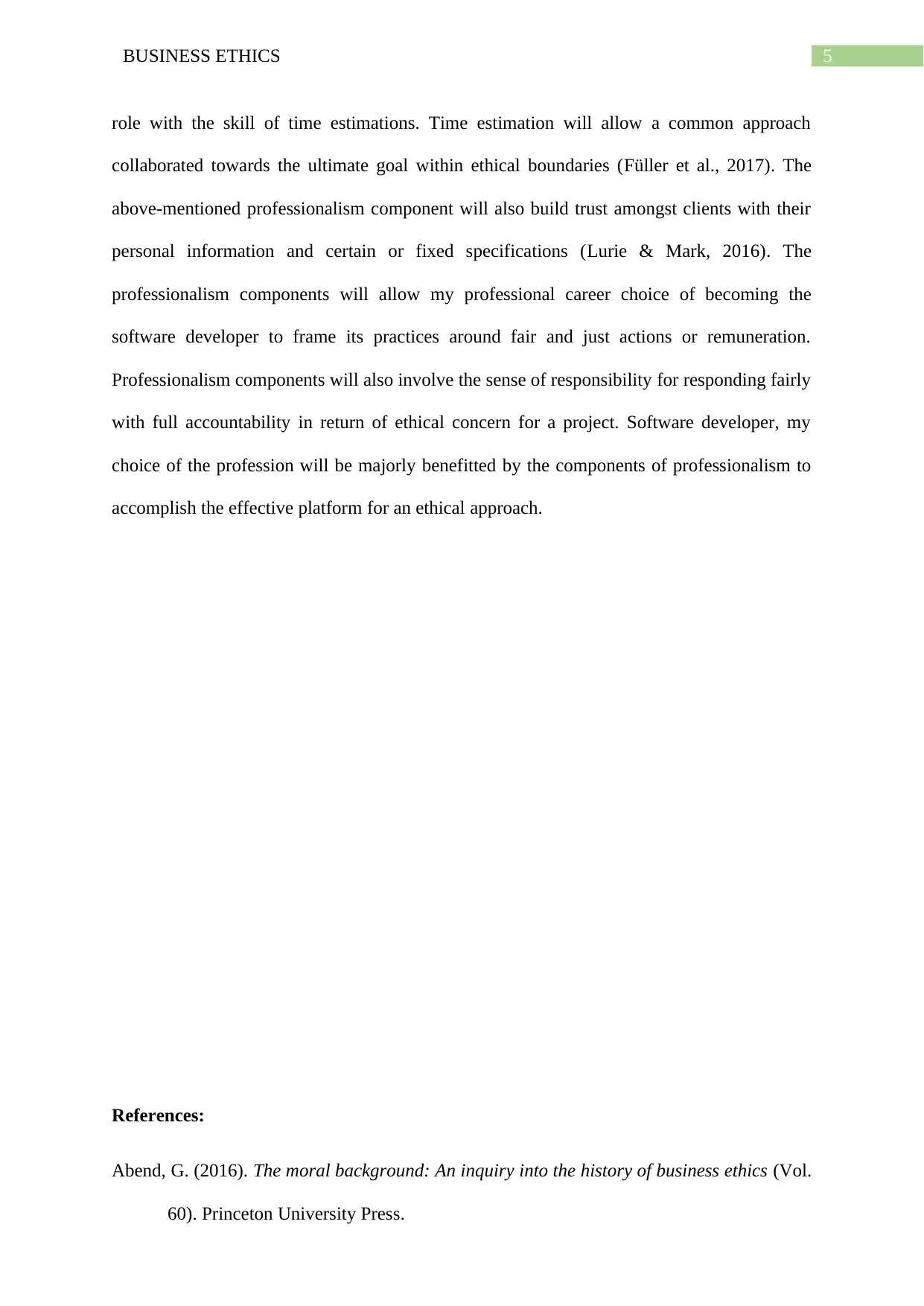
role with the skill of time estimations. Time estimation will allow a common approach
collaborated towards the ultimate goal within ethical boundaries (Füller et al., 2017). The
above-mentioned professionalism component will also build trust amongst clients with their
personal information and certain or fixed specifications (Lurie & Mark, 2016). The
professionalism components will allow my professional career choice of becoming the
software developer to frame its practices around fair and just actions or remuneration.
Professionalism components will also involve the sense of responsibility for responding fairly
with full accountability in return of ethical concern for a project. Software developer, my
choice of the profession will be majorly benefitted by the components of professionalism to
accomplish the effective platform for an ethical approach.
References:
Abend, G. (2016). The moral background: An inquiry into the history of business ethics (Vol.
60). Princeton University Press.
role with the skill of time estimations. Time estimation will allow a common approach
collaborated towards the ultimate goal within ethical boundaries (Füller et al., 2017). The
above-mentioned professionalism component will also build trust amongst clients with their
personal information and certain or fixed specifications (Lurie & Mark, 2016). The
professionalism components will allow my professional career choice of becoming the
software developer to frame its practices around fair and just actions or remuneration.
Professionalism components will also involve the sense of responsibility for responding fairly
with full accountability in return of ethical concern for a project. Software developer, my
choice of the profession will be majorly benefitted by the components of professionalism to
accomplish the effective platform for an ethical approach.
References:
Abend, G. (2016). The moral background: An inquiry into the history of business ethics (Vol.
60). Princeton University Press.
⊘ This is a preview!⊘
Do you want full access?
Subscribe today to unlock all pages.

Trusted by 1+ million students worldwide

6BUSINESS ETHICS
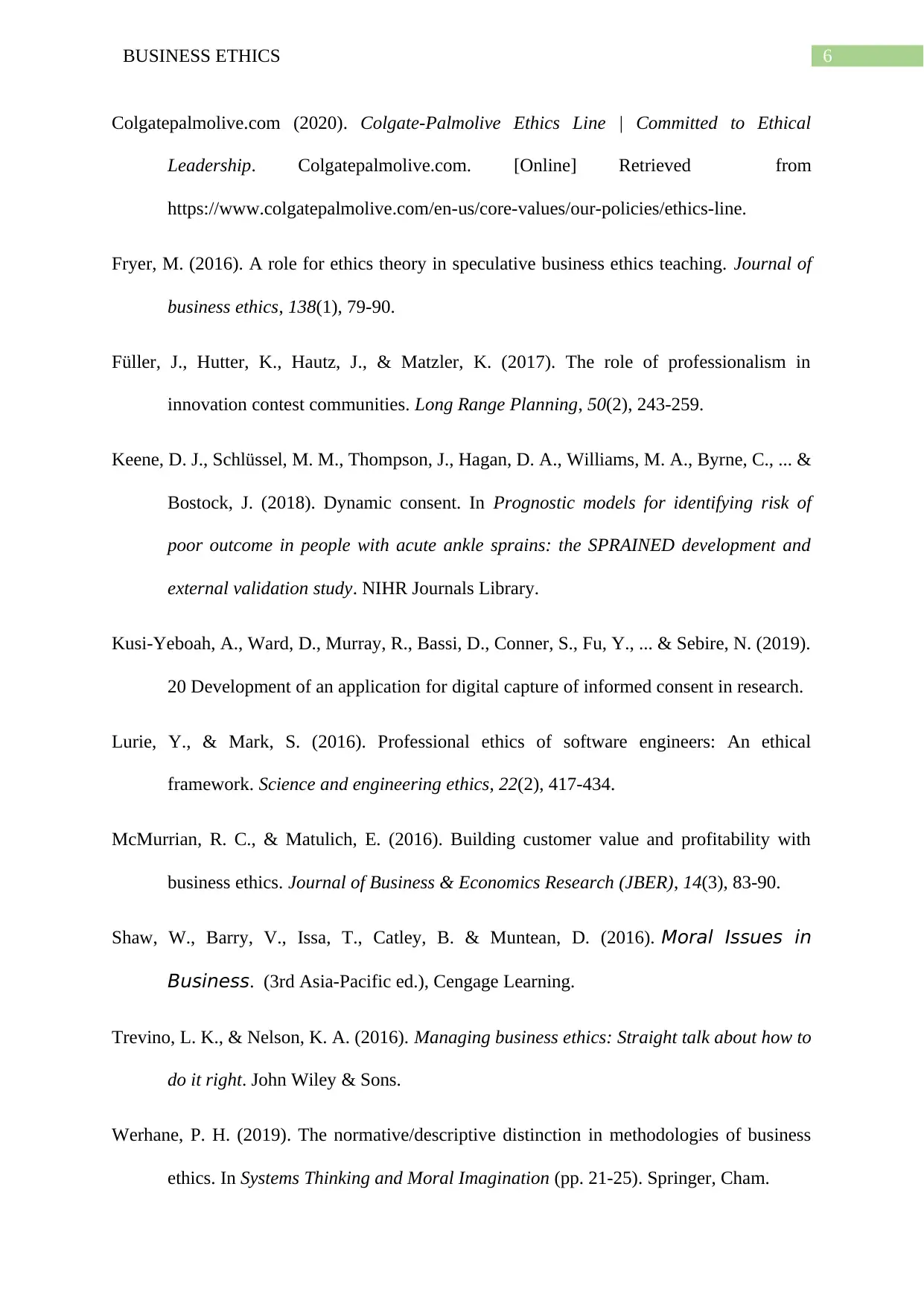
Colgatepalmolive.com (2020). Colgate-Palmolive Ethics Line | Committed to Ethical
Leadership. Colgatepalmolive.com. [Online] Retrieved from
https://www.colgatepalmolive.com/en-us/core-values/our-policies/ethics-line.
Fryer, M. (2016). A role for ethics theory in speculative business ethics teaching. Journal of
business ethics, 138(1), 79-90.
Füller, J., Hutter, K., Hautz, J., & Matzler, K. (2017). The role of professionalism in
innovation contest communities. Long Range Planning, 50(2), 243-259.
Keene, D. J., Schlüssel, M. M., Thompson, J., Hagan, D. A., Williams, M. A., Byrne, C., ... &
Bostock, J. (2018). Dynamic consent. In Prognostic models for identifying risk of
poor outcome in people with acute ankle sprains: the SPRAINED development and
external validation study. NIHR Journals Library.
Kusi-Yeboah, A., Ward, D., Murray, R., Bassi, D., Conner, S., Fu, Y., ... & Sebire, N. (2019).
20 Development of an application for digital capture of informed consent in research.
Lurie, Y., & Mark, S. (2016). Professional ethics of software engineers: An ethical
framework. Science and engineering ethics, 22(2), 417-434.
McMurrian, R. C., & Matulich, E. (2016). Building customer value and profitability with
business ethics. Journal of Business & Economics Research (JBER), 14(3), 83-90.
Shaw, W., Barry, V., Issa, T., Catley, B. & Muntean, D. (2016). Moral Issues in
Business. (3rd Asia-Pacific ed.), Cengage Learning.
Trevino, L. K., & Nelson, K. A. (2016). Managing business ethics: Straight talk about how to
do it right. John Wiley & Sons.
Werhane, P. H. (2019). The normative/descriptive distinction in methodologies of business
ethics. In Systems Thinking and Moral Imagination (pp. 21-25). Springer, Cham.
Colgatepalmolive.com (2020). Colgate-Palmolive Ethics Line | Committed to Ethical
Leadership. Colgatepalmolive.com. [Online] Retrieved from
https://www.colgatepalmolive.com/en-us/core-values/our-policies/ethics-line.
Fryer, M. (2016). A role for ethics theory in speculative business ethics teaching. Journal of
business ethics, 138(1), 79-90.
Füller, J., Hutter, K., Hautz, J., & Matzler, K. (2017). The role of professionalism in
innovation contest communities. Long Range Planning, 50(2), 243-259.
Keene, D. J., Schlüssel, M. M., Thompson, J., Hagan, D. A., Williams, M. A., Byrne, C., ... &
Bostock, J. (2018). Dynamic consent. In Prognostic models for identifying risk of
poor outcome in people with acute ankle sprains: the SPRAINED development and
external validation study. NIHR Journals Library.
Kusi-Yeboah, A., Ward, D., Murray, R., Bassi, D., Conner, S., Fu, Y., ... & Sebire, N. (2019).
20 Development of an application for digital capture of informed consent in research.
Lurie, Y., & Mark, S. (2016). Professional ethics of software engineers: An ethical
framework. Science and engineering ethics, 22(2), 417-434.
McMurrian, R. C., & Matulich, E. (2016). Building customer value and profitability with
business ethics. Journal of Business & Economics Research (JBER), 14(3), 83-90.
Shaw, W., Barry, V., Issa, T., Catley, B. & Muntean, D. (2016). Moral Issues in
Business. (3rd Asia-Pacific ed.), Cengage Learning.
Trevino, L. K., & Nelson, K. A. (2016). Managing business ethics: Straight talk about how to
do it right. John Wiley & Sons.
Werhane, P. H. (2019). The normative/descriptive distinction in methodologies of business
ethics. In Systems Thinking and Moral Imagination (pp. 21-25). Springer, Cham.
Paraphrase This Document
Need a fresh take? Get an instant paraphrase of this document with our AI Paraphraser

7BUSINESS ETHICS
1 out of 8
Related Documents
Your All-in-One AI-Powered Toolkit for Academic Success.
+13062052269
info@desklib.com
Available 24*7 on WhatsApp / Email
Unlock your academic potential
Copyright © 2020–2025 A2Z Services. All Rights Reserved. Developed and managed by ZUCOL.