University Business Ethics Reflective Journal Report
VerifiedAdded on 2022/08/16
|9
|2476
|13
Report
AI Summary
This report is a reflective journal on business ethics, detailing the student's learning journey throughout a business ethics course. It comprises three journal entries, each focusing on key topics such as ethical decision-making frameworks, ethical business culture, and the importance of business ethics. The first entry discusses ethical awareness, ethical intensity, moral intensity, and the utilitarian and rights-based approaches to business ethics. The second entry examines the creation and implementation of ethical business culture, including legal compliance and best practices. The third entry explores the reasons for advocating an ethical business culture, including preventing misconduct and maintaining a positive reputation. The journal reflects on lectures, discussions, and practical examples, providing a comprehensive overview of the subject matter.
Running head: REFLECTIVE JOURNAL ON BUSINESS ETHICS
Reflective Journal on Business Ethics
Name of the Student
Name of the University
Author Note
Reflective Journal on Business Ethics
Name of the Student
Name of the University
Author Note

Paraphrase This Document
Need a fresh take? Get an instant paraphrase of this document with our AI Paraphraser
1REFLECTIVE JOURNAL ON BUSINESS ETHICS
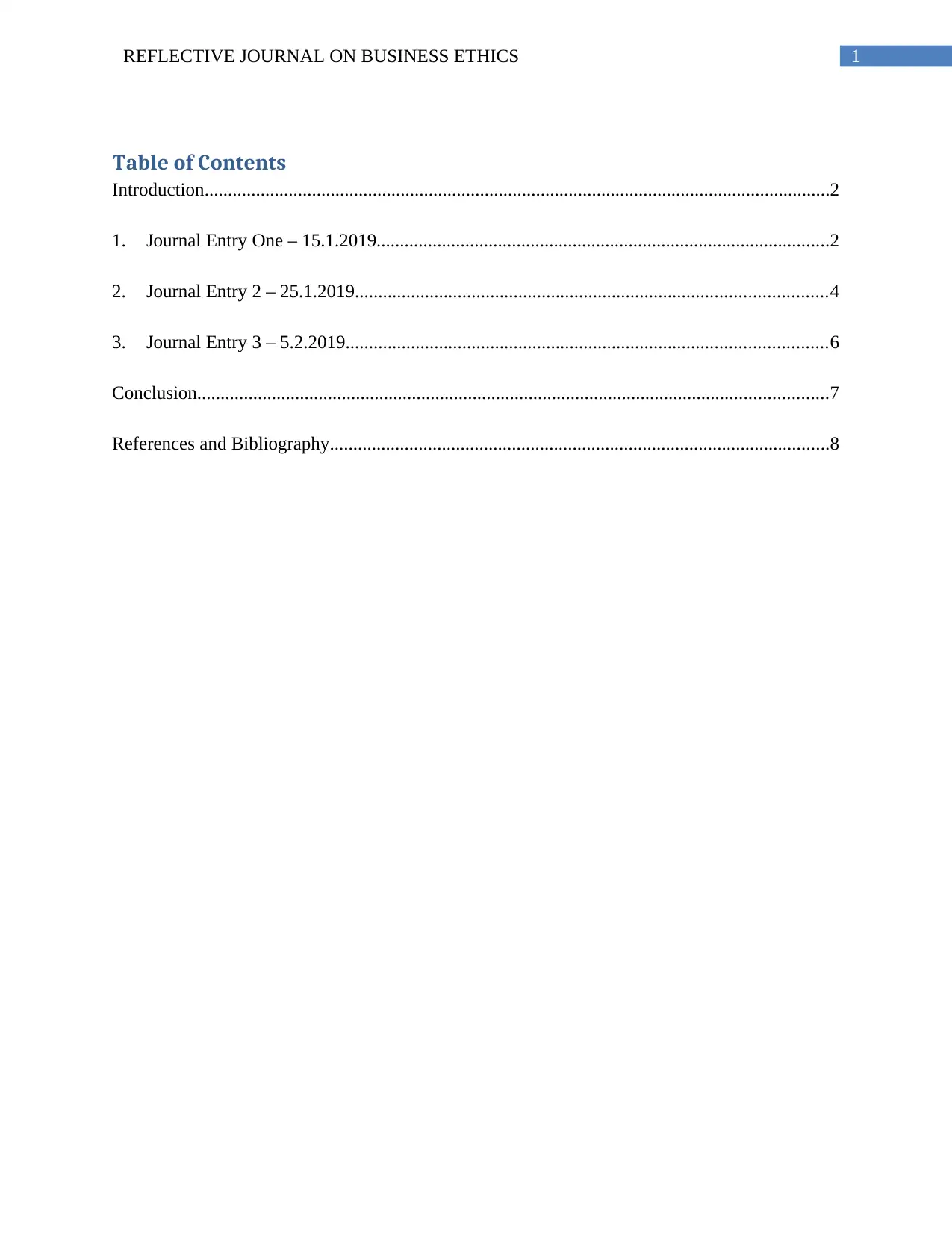
Table of Contents
Introduction......................................................................................................................................2
1. Journal Entry One – 15.1.2019.................................................................................................2
2. Journal Entry 2 – 25.1.2019.....................................................................................................4
3. Journal Entry 3 – 5.2.2019.......................................................................................................6
Conclusion.......................................................................................................................................7
References and Bibliography...........................................................................................................8
Table of Contents
Introduction......................................................................................................................................2
1. Journal Entry One – 15.1.2019.................................................................................................2
2. Journal Entry 2 – 25.1.2019.....................................................................................................4
3. Journal Entry 3 – 5.2.2019.......................................................................................................6
Conclusion.......................................................................................................................................7
References and Bibliography...........................................................................................................8
2REFLECTIVE JOURNAL ON BUSINESS ETHICS
Introduction
Business ethics is a term that refers to the implementation of appropriate business
practices and policies with respect to subjects that are arguably controversial. Business ethics is
seen to span a wide range of issues such as insider trading, corporate governance, responsibility,
discrimination, bribery, as well as various types of fiduciary responsibilities (Bowie, 2017).
Business ethics is something that is applicable to various aspects of business operation and
business conduct and as such it applies to the people who are working for business organizations,
in particular those who are engaged in the act of administrating business organizations. Business
ethics is very important for an organization to implement as it helps in drawing customers or
clients to business while convincing stakeholders about the prospects of the business enterprise
at the same given time (Chell et al., 2016). This assignment will engage in a reflection of three
important topics pertaining to the subject of business ethics that were taught during the weeks
numbered three to five. The reflection will be penned down in the form of journal entries with
each journal entry analyzing the most important takeaways or learning associated with each
topic.
1. Journal Entry One – 15.1.2019
One important topic that we got to study as part of the business ethics course is the
ethical decision making framework. An important element of this framework is the concept of
ethical awareness, as well as ethical intensity and the moral intensity associated with a particular
decision. Ethical awareness is something that we learnt to be the consciousness that people have
about the right and wrongs of a given business situation or scenario. Ethical issue intensity refers
Introduction
Business ethics is a term that refers to the implementation of appropriate business
practices and policies with respect to subjects that are arguably controversial. Business ethics is
seen to span a wide range of issues such as insider trading, corporate governance, responsibility,
discrimination, bribery, as well as various types of fiduciary responsibilities (Bowie, 2017).
Business ethics is something that is applicable to various aspects of business operation and
business conduct and as such it applies to the people who are working for business organizations,
in particular those who are engaged in the act of administrating business organizations. Business
ethics is very important for an organization to implement as it helps in drawing customers or
clients to business while convincing stakeholders about the prospects of the business enterprise
at the same given time (Chell et al., 2016). This assignment will engage in a reflection of three
important topics pertaining to the subject of business ethics that were taught during the weeks
numbered three to five. The reflection will be penned down in the form of journal entries with
each journal entry analyzing the most important takeaways or learning associated with each
topic.
1. Journal Entry One – 15.1.2019
One important topic that we got to study as part of the business ethics course is the
ethical decision making framework. An important element of this framework is the concept of
ethical awareness, as well as ethical intensity and the moral intensity associated with a particular
decision. Ethical awareness is something that we learnt to be the consciousness that people have
about the right and wrongs of a given business situation or scenario. Ethical issue intensity refers
⊘ This is a preview!⊘
Do you want full access?
Subscribe today to unlock all pages.

Trusted by 1+ million students worldwide
3REFLECTIVE JOURNAL ON BUSINESS ETHICS
to the level of importance that is normally attached by the people who are working in a business
organization to the ethical issues that arise in the course of day to day operations while moral
intensity is the innate sense of right and wrong that lies within the people who work for a
business organization while also referring to the perceptions that people have of social pressure
and the type of harm that can be caused or felt on others, based on the decisions that they take.
We also learnt about the five important sources of business ethics, namely the utilitarian
approach to business ethics, the common good approach, the justice or fairness approach, the
rights based approach and the virtue approach. To learn about all of these different ethical
theories was undoubtedly quite an interesting experience as I was not familiar with any of them
before I attended this course. The lecturer not only provided us with an overview of the theories
but also informed us about the manner by which the theories can be applied in practical real
world situations. To sit in the class and to attend talks and discussions about such theories was
something that proved to be quite an exciting experience for me and I was eager to attend each
and every one of these classes because of the fact that my teacher was articulate and taught so
well.
Of all of the topics, concepts and theories that were taught to me as part of the course on
business ethics, the one that I found to be the most engaging was the theory on utilitarianism.
The lecture on utilitarianism was one where the whole class appeared to be divided into two
sections in terms of opinion. There was one group that agreed with this theory and its proposed
outcomes while another group was against the theory and everything that it happens to stand for.
I belonged to the latter group. I find myself unable to come to terms with utilitarianism, a theory
according to which violent or unethical actions are justified if these are designed and
implemented for the greatest good. I found myself disagreeing with my peers quite a lot about
to the level of importance that is normally attached by the people who are working in a business
organization to the ethical issues that arise in the course of day to day operations while moral
intensity is the innate sense of right and wrong that lies within the people who work for a
business organization while also referring to the perceptions that people have of social pressure
and the type of harm that can be caused or felt on others, based on the decisions that they take.
We also learnt about the five important sources of business ethics, namely the utilitarian
approach to business ethics, the common good approach, the justice or fairness approach, the
rights based approach and the virtue approach. To learn about all of these different ethical
theories was undoubtedly quite an interesting experience as I was not familiar with any of them
before I attended this course. The lecturer not only provided us with an overview of the theories
but also informed us about the manner by which the theories can be applied in practical real
world situations. To sit in the class and to attend talks and discussions about such theories was
something that proved to be quite an exciting experience for me and I was eager to attend each
and every one of these classes because of the fact that my teacher was articulate and taught so
well.
Of all of the topics, concepts and theories that were taught to me as part of the course on
business ethics, the one that I found to be the most engaging was the theory on utilitarianism.
The lecture on utilitarianism was one where the whole class appeared to be divided into two
sections in terms of opinion. There was one group that agreed with this theory and its proposed
outcomes while another group was against the theory and everything that it happens to stand for.
I belonged to the latter group. I find myself unable to come to terms with utilitarianism, a theory
according to which violent or unethical actions are justified if these are designed and
implemented for the greatest good. I found myself disagreeing with my peers quite a lot about
Paraphrase This Document
Need a fresh take? Get an instant paraphrase of this document with our AI Paraphraser
4REFLECTIVE JOURNAL ON BUSINESS ETHICS
this particular theory and found myself to instead be inclined towards the rights based theory or
approach, which gives far more value to human dignity and ethical behavior compared to what
utilitarianism does. I could not help but agree with my peers and lecturers on one fact, however,
and that is, that a theory like utilitarianism is well suited for the world of business, a place where
unethical behavior is often considered to be legitimate if it ensures a decent or profitable
outcome for an enterprise. By and large though, it was the rights based theory that went down
well with me and which I found myself to be able to relate to, compared to all of the other ethical
theories that were taught as a part of this course.
2. Journal Entry 2 – 25.1.2019
Another interesting feature of the course that I attended on business ethics and which I
am able to reflect on, on a positive note is the lecture that was taught on ethical business culture.
As part of this lecture I got to understand how an ethical culture can be created and imposed by a
business enterprise, in both a voluntary and an externally mandated way. I got to learn that some
of the important aspects of the ethical culture of a business enterprise are the norms, the values,
the artifacts and the type of behavior that is exhibited by the employees who form a part of the
business in addition to core practices, voluntary action and governance and the matter of legal
compliance. The last is I believe the most important out of all the aspects of business culture and
business ethical culture at that, which I got to study as part of this course, as it establishes the
rules, regulations, provisions and terms and conditions according to which the ethical culture of a
business is to be drawn up and implemented. Any violation of such terms and conditions can
lead to employees of the business being reprimanded and in extreme situations they can end up
having punitive action taken against them, as the act the violating a law or a regulation is
this particular theory and found myself to instead be inclined towards the rights based theory or
approach, which gives far more value to human dignity and ethical behavior compared to what
utilitarianism does. I could not help but agree with my peers and lecturers on one fact, however,
and that is, that a theory like utilitarianism is well suited for the world of business, a place where
unethical behavior is often considered to be legitimate if it ensures a decent or profitable
outcome for an enterprise. By and large though, it was the rights based theory that went down
well with me and which I found myself to be able to relate to, compared to all of the other ethical
theories that were taught as a part of this course.
2. Journal Entry 2 – 25.1.2019
Another interesting feature of the course that I attended on business ethics and which I
am able to reflect on, on a positive note is the lecture that was taught on ethical business culture.
As part of this lecture I got to understand how an ethical culture can be created and imposed by a
business enterprise, in both a voluntary and an externally mandated way. I got to learn that some
of the important aspects of the ethical culture of a business enterprise are the norms, the values,
the artifacts and the type of behavior that is exhibited by the employees who form a part of the
business in addition to core practices, voluntary action and governance and the matter of legal
compliance. The last is I believe the most important out of all the aspects of business culture and
business ethical culture at that, which I got to study as part of this course, as it establishes the
rules, regulations, provisions and terms and conditions according to which the ethical culture of a
business is to be drawn up and implemented. Any violation of such terms and conditions can
lead to employees of the business being reprimanded and in extreme situations they can end up
having punitive action taken against them, as the act the violating a law or a regulation is
5REFLECTIVE JOURNAL ON BUSINESS ETHICS
something that counts as a legal offence. As part of the course I learnt that some of the
mandatory requirements for legal compliance are regulations and laws that are established not
only under the tents of criminal law in the country of Australia but civil law as well, with the
former being the type of law that prohibits certain types of actions from taking place, such as
fraud, theft and trading violations while the latter defines the duties and the rights of Australian
citizens as wells as organizations including the business organizations that operate in different
parts of Australia. Particularly, I gained a lot of insight and valuable information about the
Australian Corporations Act, which is the key legislation based on which ethical conduct is
formulated and implemented in business organizations in Australia.
The core or the best practices for the implementation of an ethical business culture which
I studied as part of this course on business ethics are likely to remain etched in my mind for a
long period of time. The lecture taught me about the various types of voluntary responsibilities
that can be undertaken by a business in order to improve upon the quality of life for its
employees and also for the people in the society where it runs its operations. I learnt how it is
that the role of the government can be reduced in this respect, by a business enterprise by
according more responsibilities, duties and rights to the stakeholders of a business. I also learnt
about the various ways by which leadership skills can be developed in employees and how
ethical culture may be created in a way that it prevents organizational misconduct from taking
place in any given form. In the process of studying the way by which the ethical culture of a
business is created or implemented I learnt also about the worst forms of ethical behavior that
can transpire in a business environment. These include employee theft, where employees steal
valuable resources of the business organization for their own personal gain, abusive behavior,
where employees engage in active or passive violence against one another and the misuse of
something that counts as a legal offence. As part of the course I learnt that some of the
mandatory requirements for legal compliance are regulations and laws that are established not
only under the tents of criminal law in the country of Australia but civil law as well, with the
former being the type of law that prohibits certain types of actions from taking place, such as
fraud, theft and trading violations while the latter defines the duties and the rights of Australian
citizens as wells as organizations including the business organizations that operate in different
parts of Australia. Particularly, I gained a lot of insight and valuable information about the
Australian Corporations Act, which is the key legislation based on which ethical conduct is
formulated and implemented in business organizations in Australia.
The core or the best practices for the implementation of an ethical business culture which
I studied as part of this course on business ethics are likely to remain etched in my mind for a
long period of time. The lecture taught me about the various types of voluntary responsibilities
that can be undertaken by a business in order to improve upon the quality of life for its
employees and also for the people in the society where it runs its operations. I learnt how it is
that the role of the government can be reduced in this respect, by a business enterprise by
according more responsibilities, duties and rights to the stakeholders of a business. I also learnt
about the various ways by which leadership skills can be developed in employees and how
ethical culture may be created in a way that it prevents organizational misconduct from taking
place in any given form. In the process of studying the way by which the ethical culture of a
business is created or implemented I learnt also about the worst forms of ethical behavior that
can transpire in a business environment. These include employee theft, where employees steal
valuable resources of the business organization for their own personal gain, abusive behavior,
where employees engage in active or passive violence against one another and the misuse of
⊘ This is a preview!⊘
Do you want full access?
Subscribe today to unlock all pages.
Trusted by 1+ million students worldwide
6REFLECTIVE JOURNAL ON BUSINESS ETHICS
company resources as well as company time, with employees sitting around and chatting when
they could otherwise get some valuable work done.
3. Journal Entry 3 – 5.2.2019
The need and important of business ethics and why an ethical business culture must be
advocated is yet another valuable takeaway that I can write about, with respect to the course that
I attended on business ethics. The lecture briefed us on the various reasons why ethical business
culture needs to be incorporated within an organizational setting, such as the need to remove bad
apples or employees who are detrimental for the wellbeing of an organization, the need to avoid
the business becoming a bad barrel or the type of organization that does not command respect
from people living in society and the need to keep employees from engaging in the type of
misconduct that can cause the firm to incur legal violations and lose investment. A bad ethical
culture can lead to a business wrapping up sooner rather than later, as no enterprise can function
for a long period of time in any market or industry, if it has got a bad reputation and if it is not
trusted by shareholders and stakeholders. The lecturer did a thorough job of teaching us each and
every reason why business ethics is a must and the ways by which businesses can monitor and
evaluate the ethical culture of its enterprise so as to make sure of the fact that its employees are
not bad apples and that the organization does not turn into a bad barrel. This by far was one of
the most enlightening courses that I attended and the discussion that ensued as part of this lecture
in the class is something that I am going to remember for the rest of my life. I got to understand
why being a part of this lecture about the many ways by which misconduct can take place in an
organization and how some employees can prove to be truly bad for the organization that they
end up working for, whether for the short or the long term. The negative impact that a bad
company resources as well as company time, with employees sitting around and chatting when
they could otherwise get some valuable work done.
3. Journal Entry 3 – 5.2.2019
The need and important of business ethics and why an ethical business culture must be
advocated is yet another valuable takeaway that I can write about, with respect to the course that
I attended on business ethics. The lecture briefed us on the various reasons why ethical business
culture needs to be incorporated within an organizational setting, such as the need to remove bad
apples or employees who are detrimental for the wellbeing of an organization, the need to avoid
the business becoming a bad barrel or the type of organization that does not command respect
from people living in society and the need to keep employees from engaging in the type of
misconduct that can cause the firm to incur legal violations and lose investment. A bad ethical
culture can lead to a business wrapping up sooner rather than later, as no enterprise can function
for a long period of time in any market or industry, if it has got a bad reputation and if it is not
trusted by shareholders and stakeholders. The lecturer did a thorough job of teaching us each and
every reason why business ethics is a must and the ways by which businesses can monitor and
evaluate the ethical culture of its enterprise so as to make sure of the fact that its employees are
not bad apples and that the organization does not turn into a bad barrel. This by far was one of
the most enlightening courses that I attended and the discussion that ensued as part of this lecture
in the class is something that I am going to remember for the rest of my life. I got to understand
why being a part of this lecture about the many ways by which misconduct can take place in an
organization and how some employees can prove to be truly bad for the organization that they
end up working for, whether for the short or the long term. The negative impact that a bad
Paraphrase This Document
Need a fresh take? Get an instant paraphrase of this document with our AI Paraphraser
7REFLECTIVE JOURNAL ON BUSINESS ETHICS
business ethics can have on society, and on the type of market or industry in which a business
operates, is also something that was established with clarity on the part of the lecturer when
teaching this course. There were practical real life examples provided by the lecturer to prove
this point and the classroom discussion that took place, led us all to contemplate and analyze the
ways by which people can do harm for a business, the ways by which such harm can be detected
and the measures that can be undertaken to prevent unethical business actions from taking place
again in an organizational setting.
Conclusion
To conclude, the course that I attended on business ethics is one of the most vibrant and
enlightening courses that I have enrolled for in university. Everything that I have learnt as part of
this course is going to remain with me for the rest of my life. I am always going to remember the
things that have been taught to me as part of the course, including the theories and concepts
pertaining to business ethics, the types of laws and regulations that can be implemented to ensure
that an ethical culture is fostered and maintained by a business enterprise and the forms of
behavior that can be detected and taken action against, in order to prevent a business
organization from falling victim to the negative consequences of bad business ethics. I will
always remember the innovative forms of teaching and lecturing that was adopted by the
professor who taught this course and I will also remember in great detail, the practical and real
life examples that were discussed in the class by the professor in order to drive home the
concepts and ideas of business ethics with the greatest degree of clarity.
business ethics can have on society, and on the type of market or industry in which a business
operates, is also something that was established with clarity on the part of the lecturer when
teaching this course. There were practical real life examples provided by the lecturer to prove
this point and the classroom discussion that took place, led us all to contemplate and analyze the
ways by which people can do harm for a business, the ways by which such harm can be detected
and the measures that can be undertaken to prevent unethical business actions from taking place
again in an organizational setting.
Conclusion
To conclude, the course that I attended on business ethics is one of the most vibrant and
enlightening courses that I have enrolled for in university. Everything that I have learnt as part of
this course is going to remain with me for the rest of my life. I am always going to remember the
things that have been taught to me as part of the course, including the theories and concepts
pertaining to business ethics, the types of laws and regulations that can be implemented to ensure
that an ethical culture is fostered and maintained by a business enterprise and the forms of
behavior that can be detected and taken action against, in order to prevent a business
organization from falling victim to the negative consequences of bad business ethics. I will
always remember the innovative forms of teaching and lecturing that was adopted by the
professor who taught this course and I will also remember in great detail, the practical and real
life examples that were discussed in the class by the professor in order to drive home the
concepts and ideas of business ethics with the greatest degree of clarity.
8REFLECTIVE JOURNAL ON BUSINESS ETHICS
References and Bibliography
Bowie, N. E. (2017). Business ethics: A Kantian perspective. Cambridge University Press
Chell, E., Spence, L. J., Perrini, F., & Harris, J. D. (2016). Social entrepreneurship and business
ethics: Does social equal ethical?. Journal of business ethics, 133(4), 619-625.
Connelly, S., Mumford, M., Steele, L., Mulhearn, T., Watts, L., & Medeiros, K. (2017). What is
Working, What is Not, and What We Need to Know: a Meta-Analytic Review of
Business Ethics Instruction.
Crane, A., Matten, D., Glozer, S., & Spence, L. (2019). Business ethics: Managing corporate
citizenship and sustainability in the age of globalization. Oxford University Press, USA.
Pearson, R. (2017). Business ethics as communication ethics: Public relations practice and the
idea of dialogue. In Public relations theory (pp. 111-131). Routledge
Shaw, W. H. (2016). Business ethics: A textbook with cases. Nelson Education.
Trevino, L. K., & Nelson, K. A. (2016). Managing business ethics: Straight talk about how to do
it right. John Wiley & Sons
Werhane, P. H., Freeman, R. E., & Dmytriyev, S. (Eds.). (2017). Cambridge handbook of
research approaches to business ethics and corporate responsibility. Cambridge
University Press
References and Bibliography
Bowie, N. E. (2017). Business ethics: A Kantian perspective. Cambridge University Press
Chell, E., Spence, L. J., Perrini, F., & Harris, J. D. (2016). Social entrepreneurship and business
ethics: Does social equal ethical?. Journal of business ethics, 133(4), 619-625.
Connelly, S., Mumford, M., Steele, L., Mulhearn, T., Watts, L., & Medeiros, K. (2017). What is
Working, What is Not, and What We Need to Know: a Meta-Analytic Review of
Business Ethics Instruction.
Crane, A., Matten, D., Glozer, S., & Spence, L. (2019). Business ethics: Managing corporate
citizenship and sustainability in the age of globalization. Oxford University Press, USA.
Pearson, R. (2017). Business ethics as communication ethics: Public relations practice and the
idea of dialogue. In Public relations theory (pp. 111-131). Routledge
Shaw, W. H. (2016). Business ethics: A textbook with cases. Nelson Education.
Trevino, L. K., & Nelson, K. A. (2016). Managing business ethics: Straight talk about how to do
it right. John Wiley & Sons
Werhane, P. H., Freeman, R. E., & Dmytriyev, S. (Eds.). (2017). Cambridge handbook of
research approaches to business ethics and corporate responsibility. Cambridge
University Press
⊘ This is a preview!⊘
Do you want full access?
Subscribe today to unlock all pages.
Trusted by 1+ million students worldwide

1 out of 9


Related Documents


Your All-in-One AI-Powered Toolkit for Academic Success.
+13062052269
info@desklib.com
Available 24*7 on WhatsApp / Email
![[object Object]](/_next/static/media/star-bottom.7253800d.svg)
Unlock your academic potential
Copyright © 2020–2026 A2Z Services. All Rights Reserved. Developed and managed by ZUCOL.