MOD003319 Business Finance: Management vs. Financial Accounts
VerifiedAdded on 2023/01/12
|7
|1289
|85
Report
AI Summary
This report delves into the core distinctions between financial and management accounting, providing a comprehensive overview of their respective roles and applications within a business context. The report highlights the fundamental differences in their objectives, regulatory requirements, and the types of information they provide. Financial accounting is presented as a historical record intended for external stakeholders, while management accounting is geared towards internal use for planning and decision-making. The report further explores the usefulness of each type of accounting for various users of financial information, such as investors, creditors, and management. It emphasizes how these users leverage accounting data to make informed decisions about a company's performance and future prospects. The conclusion summarizes the key takeaways, reinforcing the complementary roles of financial and management accounting in providing a holistic view of a business's financial health and operational effectiveness.

BUSINESS FINANCE
Paraphrase This Document
Need a fresh take? Get an instant paraphrase of this document with our AI Paraphraser

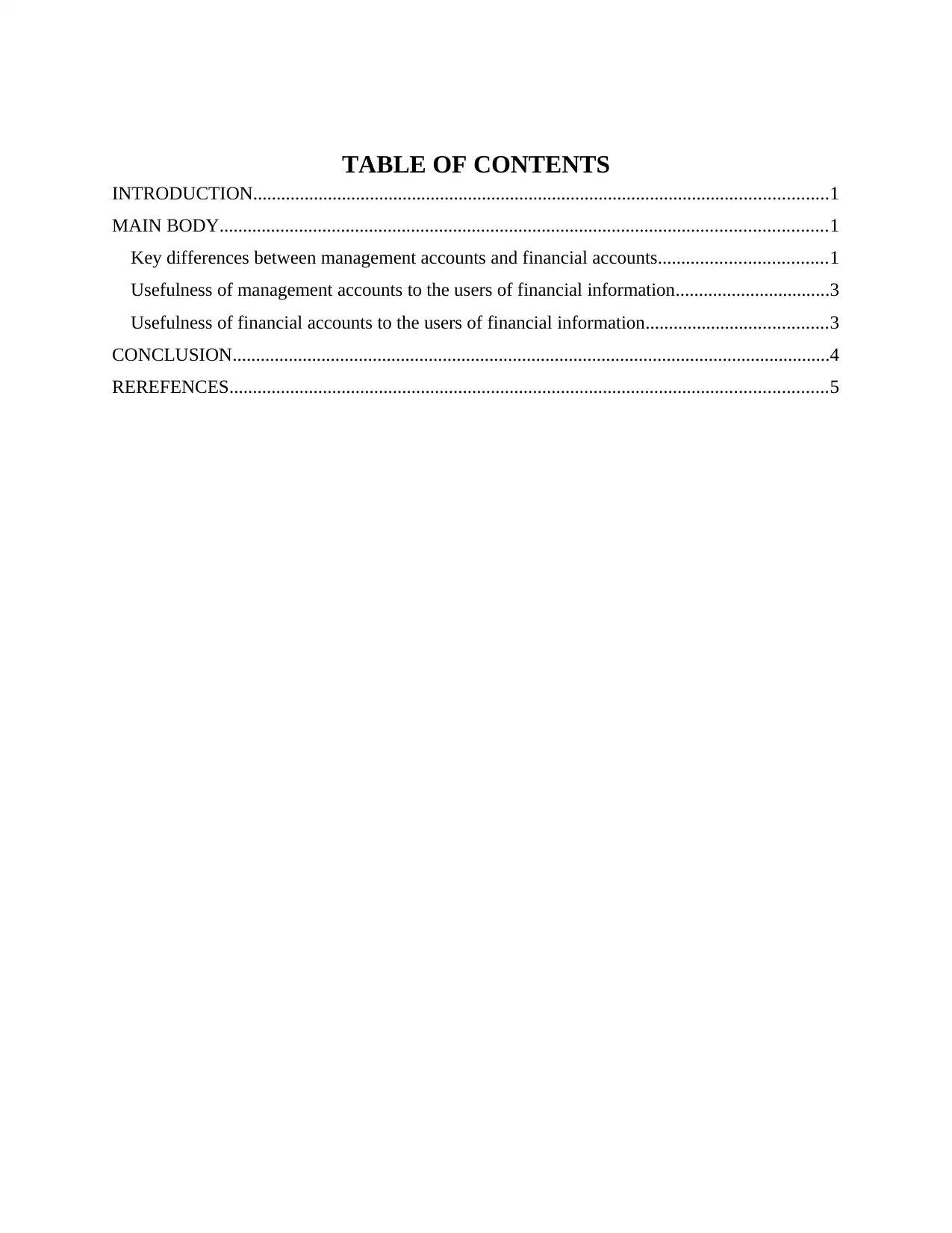
TABLE OF CONTENTS
INTRODUCTION...........................................................................................................................1
MAIN BODY..................................................................................................................................1
Key differences between management accounts and financial accounts....................................1
Usefulness of management accounts to the users of financial information.................................3
Usefulness of financial accounts to the users of financial information.......................................3
CONCLUSION................................................................................................................................4
REREFENCES................................................................................................................................5
INTRODUCTION...........................................................................................................................1
MAIN BODY..................................................................................................................................1
Key differences between management accounts and financial accounts....................................1
Usefulness of management accounts to the users of financial information.................................3
Usefulness of financial accounts to the users of financial information.......................................3
CONCLUSION................................................................................................................................4
REREFENCES................................................................................................................................5

INTRODUCTION
Accounts can be defined as a systematic process of identifying, recording, measuring,
verifying financial information. It helps organizations to reveal their overall profit or loss of a
certain time period, nature of firm’s assets, liabilities and owner’s equity (Martin, 2016).
Whereas Accounting is a kind of measurement both financial and non- financial information
about economic equities. There are two major types of accounting information: financial
accounts and management accounts. Financial accounts are used to keep historical records of a
business whereas, management accounts are used for doing planning in business. This
assessment will lay emphasis on key differences between management accounts and financial
accounts as well as their usefulness for users of financial information.
MAIN BODY
Key differences between management accounts and financial accounts
There are majorly to types of accounting: financial accounts and management accounts.
Both of them are completely different from each other and is used in a different manner.
Financial accounts intend to disclose right information to the stakeholders so that correct and
appropriate information can be delivered to them so that they can make appropriate and informed
decisions (Yao and Deng, 2018). Whereas management accounts is majorly limited and
confidential to the management of the management of the company and is utilized by the
management so that efficiency and effectiveness of the organization and its working can be
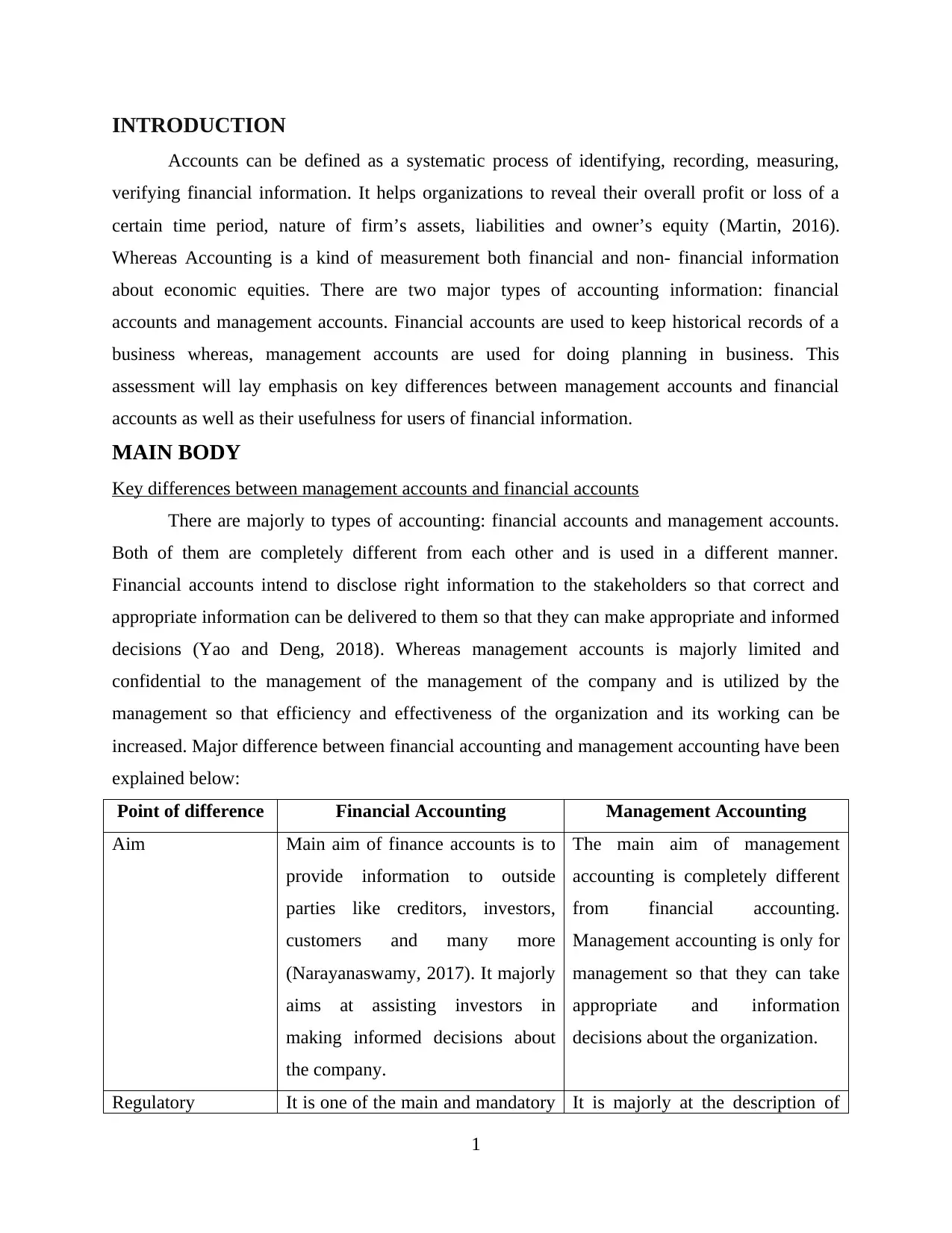
increased. Major difference between financial accounting and management accounting have been
explained below:
Point of difference Financial Accounting Management Accounting
Aim Main aim of finance accounts is to
provide information to outside
parties like creditors, investors,
customers and many more
(Narayanaswamy, 2017). It majorly
aims at assisting investors in
making informed decisions about
the company.
The main aim of management
accounting is completely different
from financial accounting.
Management accounting is only for
management so that they can take
appropriate and information
decisions about the organization.
Regulatory It is one of the main and mandatory It is majorly at the description of
1
Accounts can be defined as a systematic process of identifying, recording, measuring,
verifying financial information. It helps organizations to reveal their overall profit or loss of a
certain time period, nature of firm’s assets, liabilities and owner’s equity (Martin, 2016).
Whereas Accounting is a kind of measurement both financial and non- financial information
about economic equities. There are two major types of accounting information: financial
accounts and management accounts. Financial accounts are used to keep historical records of a
business whereas, management accounts are used for doing planning in business. This
assessment will lay emphasis on key differences between management accounts and financial
accounts as well as their usefulness for users of financial information.
MAIN BODY
Key differences between management accounts and financial accounts
There are majorly to types of accounting: financial accounts and management accounts.
Both of them are completely different from each other and is used in a different manner.
Financial accounts intend to disclose right information to the stakeholders so that correct and
appropriate information can be delivered to them so that they can make appropriate and informed
decisions (Yao and Deng, 2018). Whereas management accounts is majorly limited and
confidential to the management of the management of the company and is utilized by the
management so that efficiency and effectiveness of the organization and its working can be
increased. Major difference between financial accounting and management accounting have been
explained below:
Point of difference Financial Accounting Management Accounting
Aim Main aim of finance accounts is to
provide information to outside
parties like creditors, investors,
customers and many more
(Narayanaswamy, 2017). It majorly
aims at assisting investors in
making informed decisions about
the company.
The main aim of management
accounting is completely different
from financial accounting.
Management accounting is only for
management so that they can take
appropriate and information
decisions about the organization.
Regulatory It is one of the main and mandatory It is majorly at the description of
1
⊘ This is a preview!⊘
Do you want full access?
Subscribe today to unlock all pages.

Trusted by 1+ million students worldwide

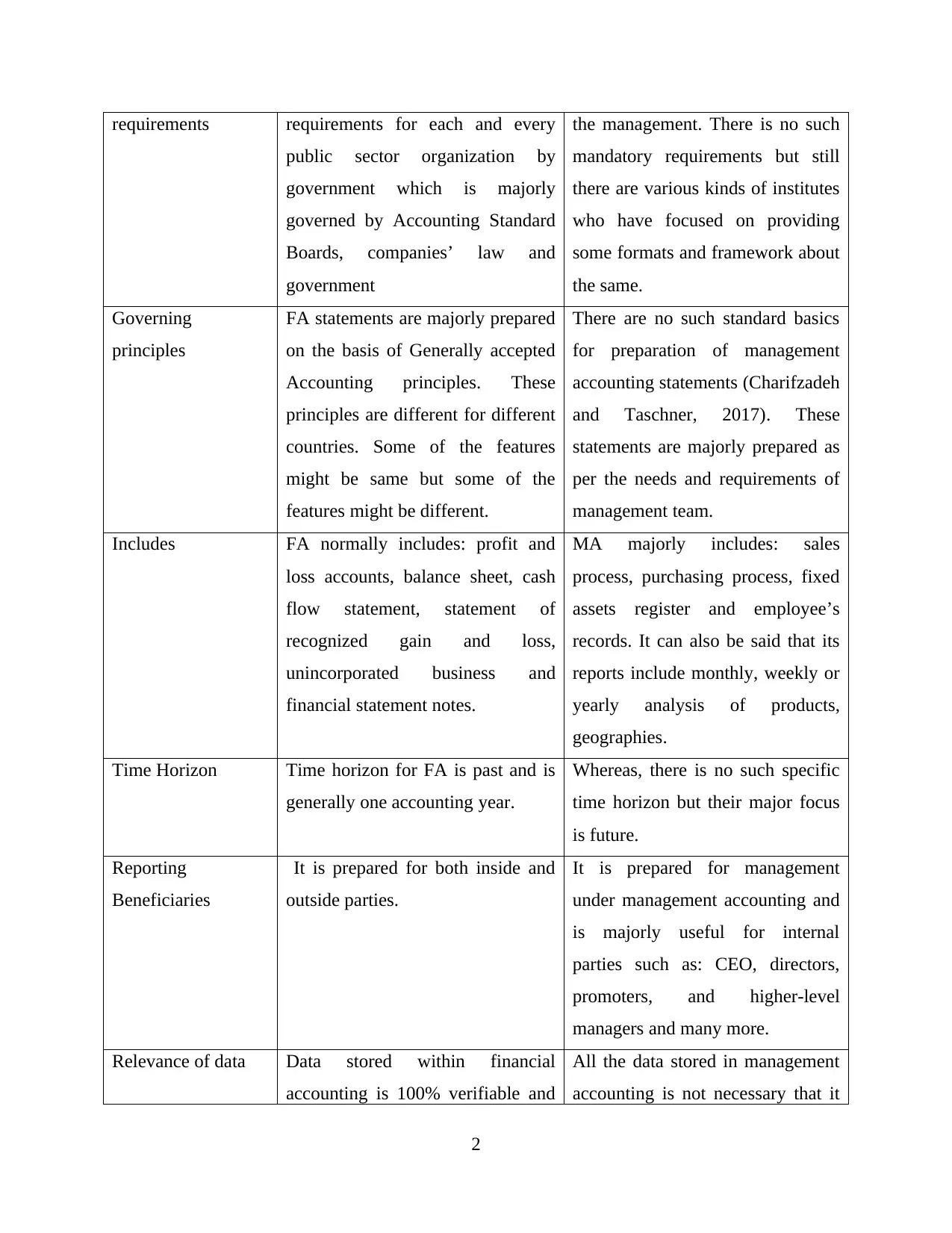
requirements requirements for each and every
public sector organization by
government which is majorly
governed by Accounting Standard
Boards, companies’ law and
government
the management. There is no such
mandatory requirements but still
there are various kinds of institutes
who have focused on providing
some formats and framework about
the same.
Governing
principles
FA statements are majorly prepared
on the basis of Generally accepted
Accounting principles. These
principles are different for different
countries. Some of the features
might be same but some of the
features might be different.
There are no such standard basics
for preparation of management
accounting statements (Charifzadeh
and Taschner, 2017). These
statements are majorly prepared as
per the needs and requirements of
management team.
Includes FA normally includes: profit and
loss accounts, balance sheet, cash
flow statement, statement of
recognized gain and loss,
unincorporated business and
financial statement notes.
MA majorly includes: sales
process, purchasing process, fixed
assets register and employee’s
records. It can also be said that its
reports include monthly, weekly or
yearly analysis of products,
geographies.
Time Horizon Time horizon for FA is past and is
generally one accounting year.
Whereas, there is no such specific
time horizon but their major focus
is future.
Reporting
Beneficiaries
It is prepared for both inside and
outside parties.
It is prepared for management
under management accounting and
is majorly useful for internal
parties such as: CEO, directors,
promoters, and higher-level
managers and many more.
Relevance of data Data stored within financial
accounting is 100% verifiable and
All the data stored in management
accounting is not necessary that it
2
public sector organization by
government which is majorly
governed by Accounting Standard
Boards, companies’ law and
government
the management. There is no such
mandatory requirements but still
there are various kinds of institutes
who have focused on providing
some formats and framework about
the same.
Governing
principles
FA statements are majorly prepared
on the basis of Generally accepted
Accounting principles. These
principles are different for different
countries. Some of the features
might be same but some of the
features might be different.
There are no such standard basics
for preparation of management
accounting statements (Charifzadeh
and Taschner, 2017). These
statements are majorly prepared as
per the needs and requirements of
management team.
Includes FA normally includes: profit and
loss accounts, balance sheet, cash
flow statement, statement of
recognized gain and loss,
unincorporated business and
financial statement notes.
MA majorly includes: sales
process, purchasing process, fixed
assets register and employee’s
records. It can also be said that its
reports include monthly, weekly or
yearly analysis of products,
geographies.
Time Horizon Time horizon for FA is past and is
generally one accounting year.
Whereas, there is no such specific
time horizon but their major focus
is future.
Reporting
Beneficiaries
It is prepared for both inside and
outside parties.
It is prepared for management
under management accounting and
is majorly useful for internal
parties such as: CEO, directors,
promoters, and higher-level
managers and many more.
Relevance of data Data stored within financial
accounting is 100% verifiable and
All the data stored in management
accounting is not necessary that it
2
Paraphrase This Document
Need a fresh take? Get an instant paraphrase of this document with our AI Paraphraser

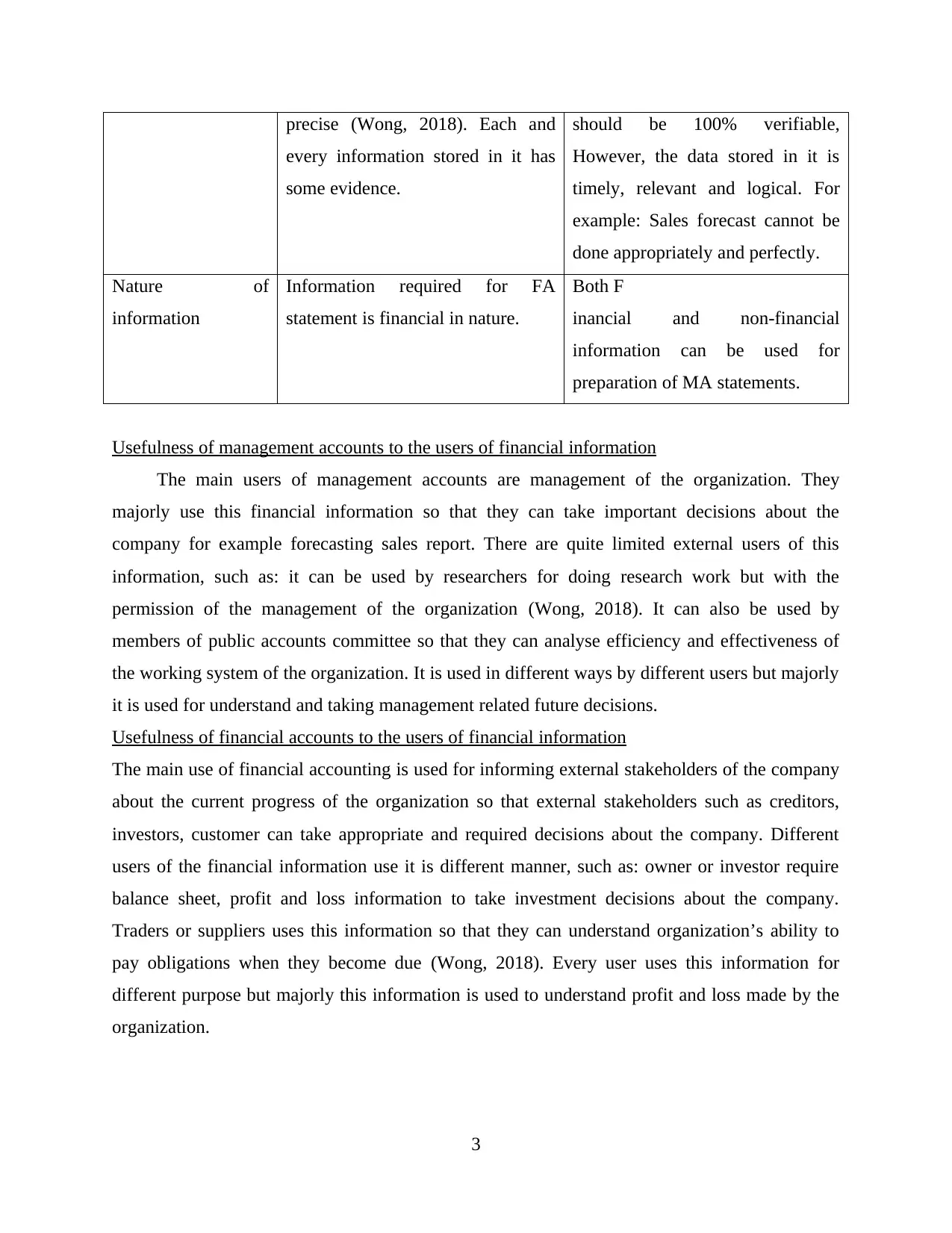
precise (Wong, 2018). Each and
every information stored in it has
some evidence.
should be 100% verifiable,
However, the data stored in it is
timely, relevant and logical. For
example: Sales forecast cannot be
done appropriately and perfectly.
Nature of
information
Information required for FA
statement is financial in nature.
Both F
inancial and non-financial
information can be used for
preparation of MA statements.
Usefulness of management accounts to the users of financial information
The main users of management accounts are management of the organization. They
majorly use this financial information so that they can take important decisions about the
company for example forecasting sales report. There are quite limited external users of this
information, such as: it can be used by researchers for doing research work but with the
permission of the management of the organization (Wong, 2018). It can also be used by
members of public accounts committee so that they can analyse efficiency and effectiveness of
the working system of the organization. It is used in different ways by different users but majorly
it is used for understand and taking management related future decisions.
Usefulness of financial accounts to the users of financial information
The main use of financial accounting is used for informing external stakeholders of the company
about the current progress of the organization so that external stakeholders such as creditors,
investors, customer can take appropriate and required decisions about the company. Different
users of the financial information use it is different manner, such as: owner or investor require
balance sheet, profit and loss information to take investment decisions about the company.
Traders or suppliers uses this information so that they can understand organization’s ability to
pay obligations when they become due (Wong, 2018). Every user uses this information for
different purpose but majorly this information is used to understand profit and loss made by the
organization.
3
every information stored in it has
some evidence.
should be 100% verifiable,
However, the data stored in it is
timely, relevant and logical. For
example: Sales forecast cannot be
done appropriately and perfectly.
Nature of
information
Information required for FA
statement is financial in nature.
Both F
inancial and non-financial
information can be used for
preparation of MA statements.
Usefulness of management accounts to the users of financial information
The main users of management accounts are management of the organization. They
majorly use this financial information so that they can take important decisions about the
company for example forecasting sales report. There are quite limited external users of this
information, such as: it can be used by researchers for doing research work but with the
permission of the management of the organization (Wong, 2018). It can also be used by
members of public accounts committee so that they can analyse efficiency and effectiveness of
the working system of the organization. It is used in different ways by different users but majorly
it is used for understand and taking management related future decisions.
Usefulness of financial accounts to the users of financial information
The main use of financial accounting is used for informing external stakeholders of the company
about the current progress of the organization so that external stakeholders such as creditors,
investors, customer can take appropriate and required decisions about the company. Different
users of the financial information use it is different manner, such as: owner or investor require
balance sheet, profit and loss information to take investment decisions about the company.
Traders or suppliers uses this information so that they can understand organization’s ability to
pay obligations when they become due (Wong, 2018). Every user uses this information for
different purpose but majorly this information is used to understand profit and loss made by the
organization.
3

CONCLUSION
From the above assessment it has been summarized that there are various kind of differences
between finance accounts and management accounts. Both of them are used for completely
different purposes. It has been analysed that financial accounts is prepared as per the financial
year every year and is made is accessible by both internal and external stakeholders. External
stakeholders such as customers, investors, creditors and many more. Whereas management
accounts are prepared for the management of the organization only so that they can make
strategic plans or take important decisions. It has also been summarized that both financial and
management accounts are used by many users for different purposes.
4
From the above assessment it has been summarized that there are various kind of differences
between finance accounts and management accounts. Both of them are used for completely
different purposes. It has been analysed that financial accounts is prepared as per the financial
year every year and is made is accessible by both internal and external stakeholders. External
stakeholders such as customers, investors, creditors and many more. Whereas management
accounts are prepared for the management of the organization only so that they can make
strategic plans or take important decisions. It has also been summarized that both financial and
management accounts are used by many users for different purposes.
4
⊘ This is a preview!⊘
Do you want full access?
Subscribe today to unlock all pages.

Trusted by 1+ million students worldwide

REREFENCES
Books and journals
Charifzadeh, M. and Taschner, A., 2017. Management accounting and control: tools and
concepts in a Central European context. John Wiley & Sons.
Martin, L.L., 2016. Financial management for human service administrators. Waveland Press.
Narayanaswamy, R., 2017. Financial accounting: a managerial perspective. PHI Learning Pvt.
Ltd..
Wong, I., 2018. Managerial Accounting Strategies for Optimal Costs.
Yao, H. and Deng, Y., 2018. Managerial incentives and accounts receivable management
policy. Managerial Finance.
5
Books and journals
Charifzadeh, M. and Taschner, A., 2017. Management accounting and control: tools and
concepts in a Central European context. John Wiley & Sons.
Martin, L.L., 2016. Financial management for human service administrators. Waveland Press.
Narayanaswamy, R., 2017. Financial accounting: a managerial perspective. PHI Learning Pvt.
Ltd..
Wong, I., 2018. Managerial Accounting Strategies for Optimal Costs.
Yao, H. and Deng, Y., 2018. Managerial incentives and accounts receivable management
policy. Managerial Finance.
5
1 out of 7
Related Documents
Your All-in-One AI-Powered Toolkit for Academic Success.
+13062052269
info@desklib.com
Available 24*7 on WhatsApp / Email
Unlock your academic potential
Copyright © 2020–2025 A2Z Services. All Rights Reserved. Developed and managed by ZUCOL.