Business Finance Report: Analysis of EEL's Financial Issues
VerifiedAdded on 2020/01/21
|12
|4283
|41
Report
AI Summary
This report provides a comprehensive analysis of business finance, focusing on key concepts such as profitability versus cash flow, and the significance of working capital management within an organization. It examines the financial challenges faced by Excellence Electrics Ltd. (EEL), including issues related to debt and working capital. The report delves into the steps involved in improving EEL's working capital, offering practical strategies for enhancing financial health. Furthermore, it explores the capital budgeting process, outlining the stages involved and analyzing various methods for making informed investment decisions. The report aims to provide a clear understanding of the financial issues and potential solutions for EEL, helping them to navigate their financial challenges effectively.

Business Finance

Paraphrase This Document
Need a fresh take? Get an instant paraphrase of this document with our AI Paraphraser
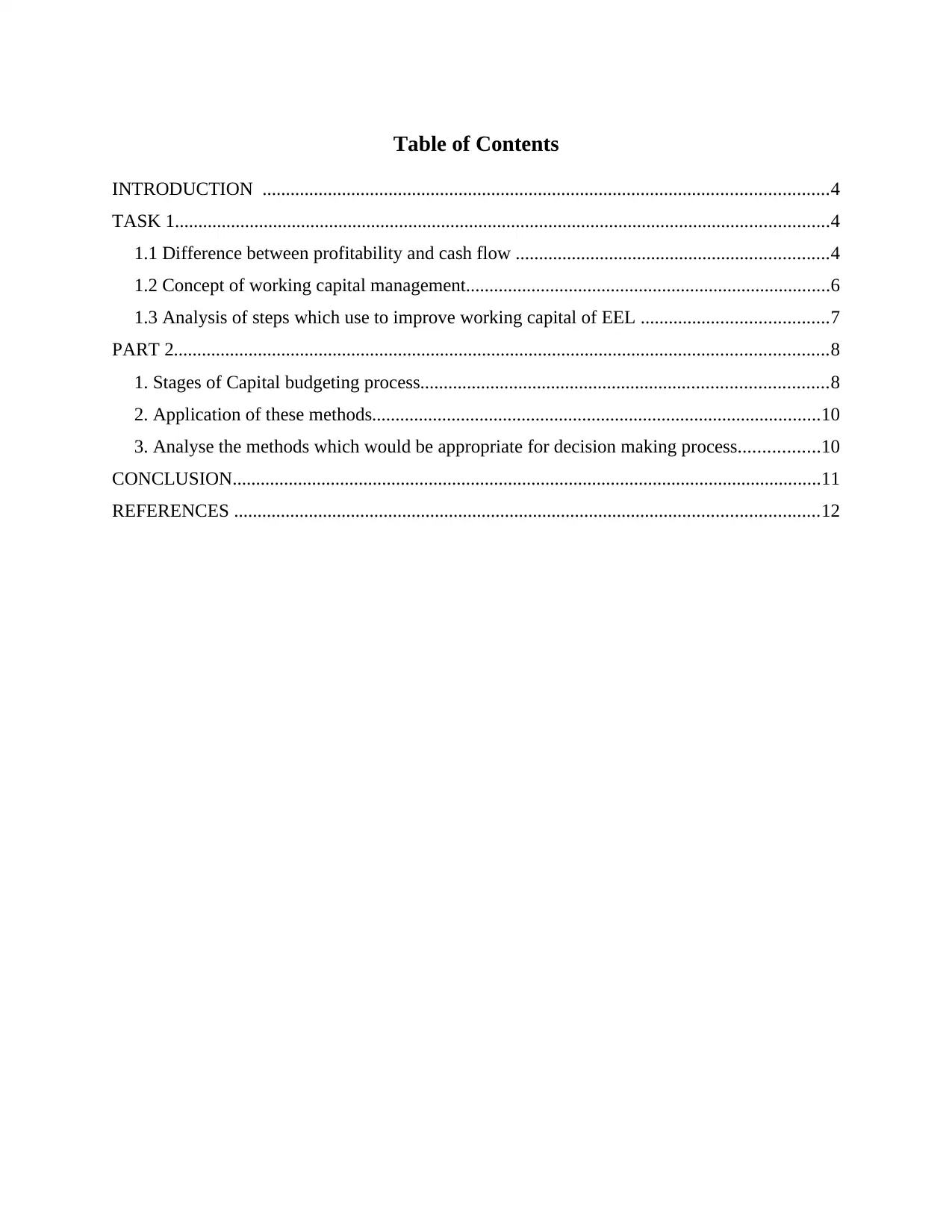
Table of Contents
INTRODUCTION .........................................................................................................................4
TASK 1............................................................................................................................................4
1.1 Difference between profitability and cash flow ...................................................................4
1.2 Concept of working capital management..............................................................................6
1.3 Analysis of steps which use to improve working capital of EEL ........................................7
PART 2............................................................................................................................................8
1. Stages of Capital budgeting process.......................................................................................8
2. Application of these methods................................................................................................10
3. Analyse the methods which would be appropriate for decision making process.................10
CONCLUSION..............................................................................................................................11
REFERENCES .............................................................................................................................12
INTRODUCTION .........................................................................................................................4
TASK 1............................................................................................................................................4
1.1 Difference between profitability and cash flow ...................................................................4
1.2 Concept of working capital management..............................................................................6
1.3 Analysis of steps which use to improve working capital of EEL ........................................7
PART 2............................................................................................................................................8
1. Stages of Capital budgeting process.......................................................................................8
2. Application of these methods................................................................................................10
3. Analyse the methods which would be appropriate for decision making process.................10
CONCLUSION..............................................................................................................................11
REFERENCES .............................................................................................................................12
INTRODUCTION
Business finance encompasses many activities which are related with an organisation.
And provide a disciplinary revolving of money and valuable assets of the firm (Abor and
Quartey, 2010). An individual have to get fully aware about this concept because it helps in
facilitating about the accounting methodologies, investing strategies and effective debt
management. Finance in business is not a new term because every start up and old enterprises
needed some money to execute their activities. The different forms of finance are borrowings,
loans etc. all such are elements which assist an organisation to perform certain number of
activities. Present reports is based on the excellence electrics ltd. which are producing electrical
appliances for household. Company face so much issues while conducting their business hence,
owner decide to review the situation for this they told to accountant to prepare a research report
in this concern which helps them in understanding all the factors which affect the business most.
TASK 1
1.1 Difference between profitability and cash flow
Profitability: The state of condition of yielding a financial profit or gain. It is a ability of
a business to earn profit. Profitability is made with comprises of two words in which profit
means the revenue which is generated by the business after deducting and paying all of its
expenses(Adjaoud and Ben‐Amar, 2010). It is a remaining portion which left from the revenue.
And ability means the capability of a firm to generate profit. It shows that does really an
organisation able to generate high revenue.
Another term which is concerned in this regard is the profitability analysis it signifies the
ability of generating profit by a proposal so that it can get adopted by the business. Profitability
get calculated with the help of methods or system which are termed the ratios.
Cash-flow: It is a estimation of the money which get inflow and outflow in a company. It
helps in calculating that how much amount of money a organisation has invested and how much
Business finance encompasses many activities which are related with an organisation.
And provide a disciplinary revolving of money and valuable assets of the firm (Abor and
Quartey, 2010). An individual have to get fully aware about this concept because it helps in
facilitating about the accounting methodologies, investing strategies and effective debt
management. Finance in business is not a new term because every start up and old enterprises
needed some money to execute their activities. The different forms of finance are borrowings,
loans etc. all such are elements which assist an organisation to perform certain number of
activities. Present reports is based on the excellence electrics ltd. which are producing electrical
appliances for household. Company face so much issues while conducting their business hence,
owner decide to review the situation for this they told to accountant to prepare a research report
in this concern which helps them in understanding all the factors which affect the business most.
TASK 1
1.1 Difference between profitability and cash flow
Profitability: The state of condition of yielding a financial profit or gain. It is a ability of
a business to earn profit. Profitability is made with comprises of two words in which profit
means the revenue which is generated by the business after deducting and paying all of its
expenses(Adjaoud and Ben‐Amar, 2010). It is a remaining portion which left from the revenue.
And ability means the capability of a firm to generate profit. It shows that does really an
organisation able to generate high revenue.
Another term which is concerned in this regard is the profitability analysis it signifies the
ability of generating profit by a proposal so that it can get adopted by the business. Profitability
get calculated with the help of methods or system which are termed the ratios.
Cash-flow: It is a estimation of the money which get inflow and outflow in a company. It
helps in calculating that how much amount of money a organisation has invested and how much
⊘ This is a preview!⊘
Do you want full access?
Subscribe today to unlock all pages.

Trusted by 1+ million students worldwide
amount of money it get by generating revenue. It leads in affecting the liquidity of a business.
Positive cash flows helps a firm top settle out all of its debt properly and reinvest in business for
making any project successful(Ayyagari, Demirgüç-Kunt and Maksimovic, 2010). Another
important thing which get fascinated by the positive cash inflow is that in increasing the assets of
a business.
It enables an organisation tom prepare them for future financial challenges so that their
working remain smooth and proper. Further more it also leads in overcoming a business entity
from financial crises.
Where as on the other hand negative cash flow distracts the business from its path. It
complete removed the business activities from its track and an organisation start facing many
financial ups and downs. It shows that company liquid assets are decreasing and getting reduced
day after day. Net cash flow is distinguish from net income and shows that how much amount is
have to get received by the company and what amount is still to get covered.
This process is used by the company for the outside stakeholders which helps in running
the operation of business successfully. So, that they can get aware about the company solvency.
If an entity is not being so capable in paying all of its debts it is clearly identify that its get
solvent in the near future.
So both the concept are use by EEL to identify that how to deal with their financial
issues. They have to control their debts by using appropriate profitability ratio through which
they can control that. Their debts are increasing day by day so they have to control that and also
work on all the financial issues which they face.
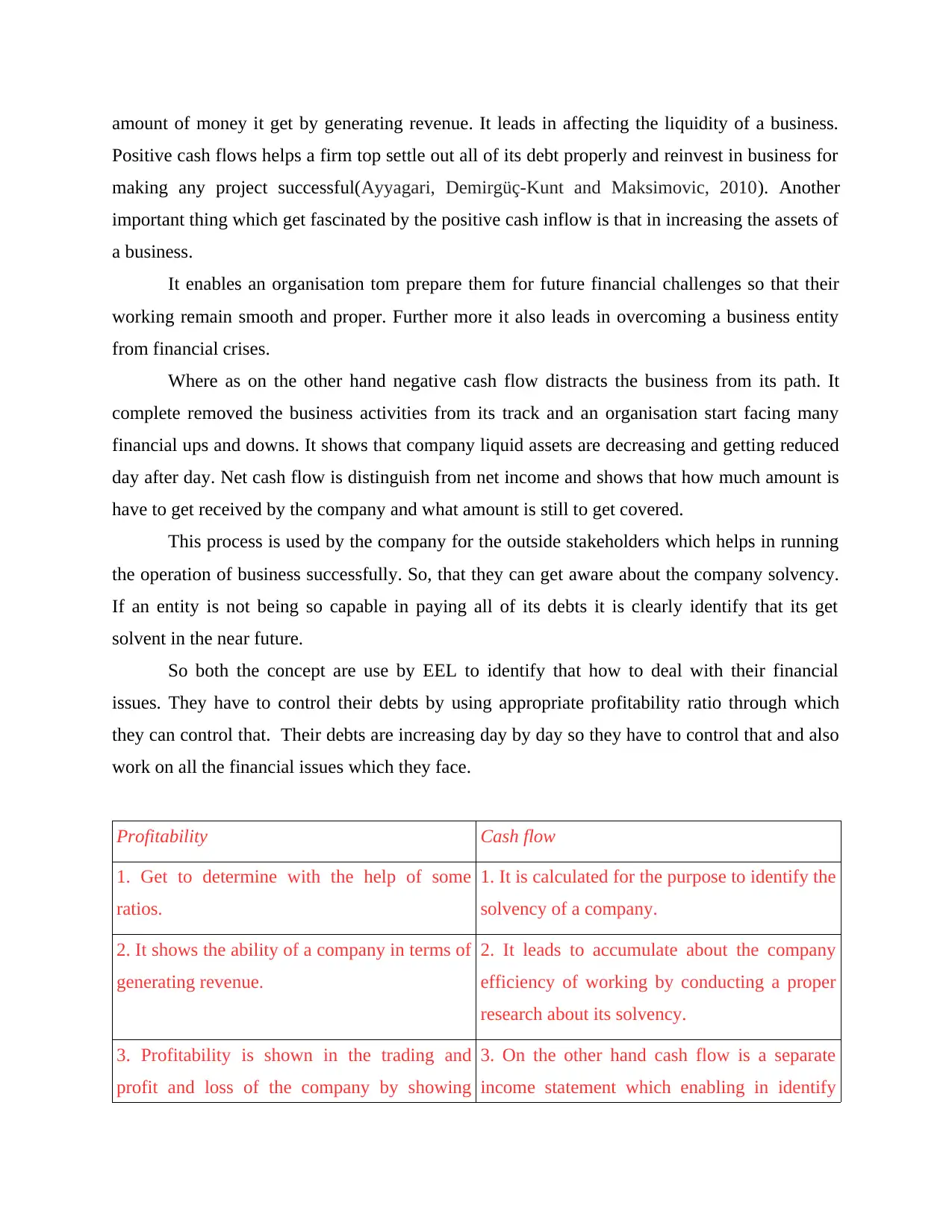
Profitability Cash flow
1. Get to determine with the help of some
ratios.
1. It is calculated for the purpose to identify the
solvency of a company.
2. It shows the ability of a company in terms of
generating revenue.
2. It leads to accumulate about the company
efficiency of working by conducting a proper
research about its solvency.
3. Profitability is shown in the trading and
profit and loss of the company by showing
3. On the other hand cash flow is a separate
income statement which enabling in identify
Positive cash flows helps a firm top settle out all of its debt properly and reinvest in business for
making any project successful(Ayyagari, Demirgüç-Kunt and Maksimovic, 2010). Another
important thing which get fascinated by the positive cash inflow is that in increasing the assets of
a business.
It enables an organisation tom prepare them for future financial challenges so that their
working remain smooth and proper. Further more it also leads in overcoming a business entity
from financial crises.
Where as on the other hand negative cash flow distracts the business from its path. It
complete removed the business activities from its track and an organisation start facing many
financial ups and downs. It shows that company liquid assets are decreasing and getting reduced
day after day. Net cash flow is distinguish from net income and shows that how much amount is
have to get received by the company and what amount is still to get covered.
This process is used by the company for the outside stakeholders which helps in running
the operation of business successfully. So, that they can get aware about the company solvency.
If an entity is not being so capable in paying all of its debts it is clearly identify that its get
solvent in the near future.
So both the concept are use by EEL to identify that how to deal with their financial
issues. They have to control their debts by using appropriate profitability ratio through which
they can control that. Their debts are increasing day by day so they have to control that and also
work on all the financial issues which they face.
Profitability Cash flow
1. Get to determine with the help of some
ratios.
1. It is calculated for the purpose to identify the
solvency of a company.
2. It shows the ability of a company in terms of
generating revenue.
2. It leads to accumulate about the company
efficiency of working by conducting a proper
research about its solvency.
3. Profitability is shown in the trading and
profit and loss of the company by showing
3. On the other hand cash flow is a separate
income statement which enabling in identify
Paraphrase This Document
Need a fresh take? Get an instant paraphrase of this document with our AI Paraphraser
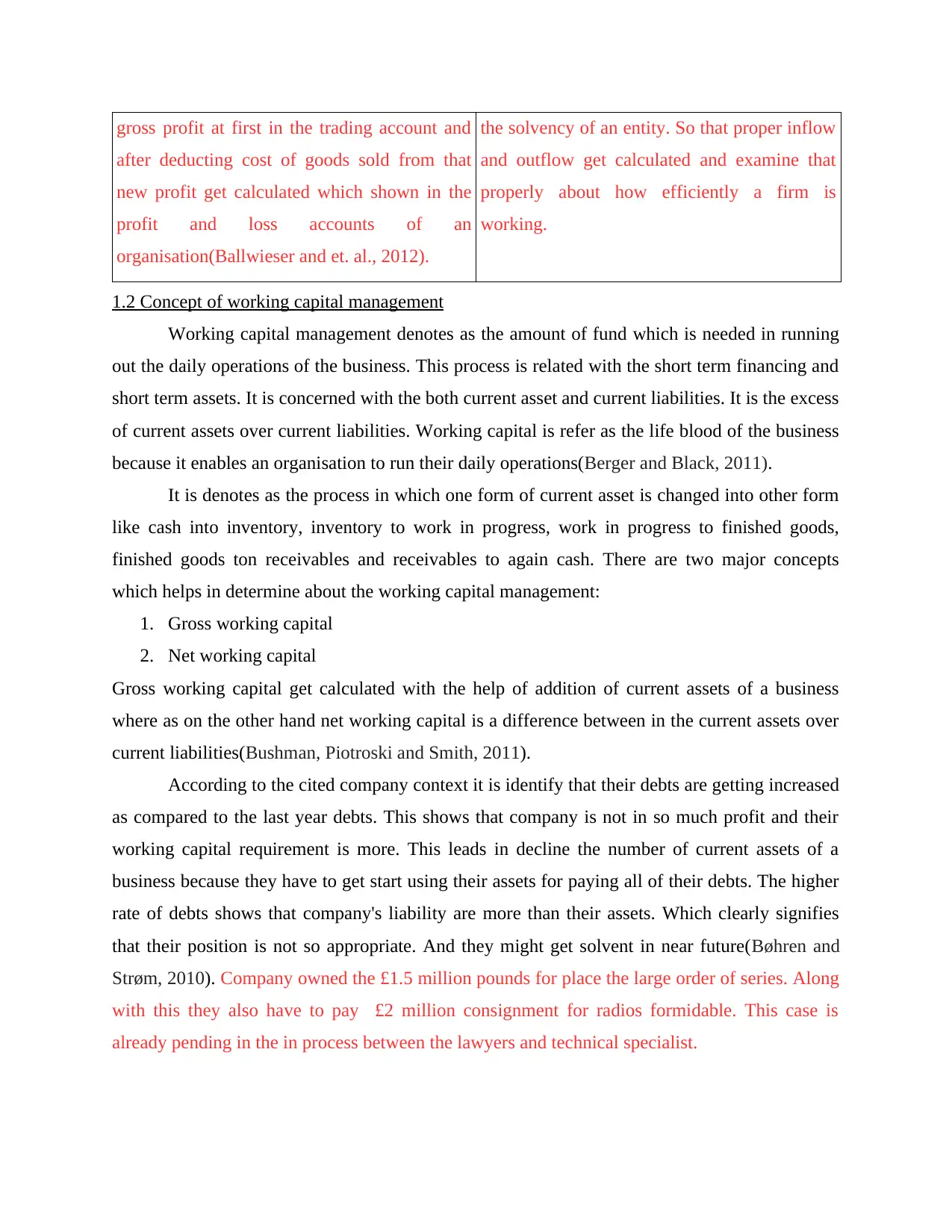
gross profit at first in the trading account and
after deducting cost of goods sold from that
new profit get calculated which shown in the
profit and loss accounts of an
organisation(Ballwieser and et. al., 2012).
the solvency of an entity. So that proper inflow
and outflow get calculated and examine that
properly about how efficiently a firm is
working.
1.2 Concept of working capital management
Working capital management denotes as the amount of fund which is needed in running
out the daily operations of the business. This process is related with the short term financing and
short term assets. It is concerned with the both current asset and current liabilities. It is the excess
of current assets over current liabilities. Working capital is refer as the life blood of the business
because it enables an organisation to run their daily operations(Berger and Black, 2011).
It is denotes as the process in which one form of current asset is changed into other form
like cash into inventory, inventory to work in progress, work in progress to finished goods,
finished goods ton receivables and receivables to again cash. There are two major concepts
which helps in determine about the working capital management:
1. Gross working capital
2. Net working capital
Gross working capital get calculated with the help of addition of current assets of a business
where as on the other hand net working capital is a difference between in the current assets over
current liabilities(Bushman, Piotroski and Smith, 2011).
According to the cited company context it is identify that their debts are getting increased
as compared to the last year debts. This shows that company is not in so much profit and their
working capital requirement is more. This leads in decline the number of current assets of a
business because they have to get start using their assets for paying all of their debts. The higher
rate of debts shows that company's liability are more than their assets. Which clearly signifies
that their position is not so appropriate. And they might get solvent in near future(Bøhren and
Strøm, 2010). Company owned the £1.5 million pounds for place the large order of series. Along
with this they also have to pay £2 million consignment for radios formidable. This case is
already pending in the in process between the lawyers and technical specialist.
after deducting cost of goods sold from that
new profit get calculated which shown in the
profit and loss accounts of an
organisation(Ballwieser and et. al., 2012).
the solvency of an entity. So that proper inflow
and outflow get calculated and examine that
properly about how efficiently a firm is
working.
1.2 Concept of working capital management
Working capital management denotes as the amount of fund which is needed in running
out the daily operations of the business. This process is related with the short term financing and
short term assets. It is concerned with the both current asset and current liabilities. It is the excess
of current assets over current liabilities. Working capital is refer as the life blood of the business
because it enables an organisation to run their daily operations(Berger and Black, 2011).
It is denotes as the process in which one form of current asset is changed into other form
like cash into inventory, inventory to work in progress, work in progress to finished goods,
finished goods ton receivables and receivables to again cash. There are two major concepts
which helps in determine about the working capital management:
1. Gross working capital
2. Net working capital
Gross working capital get calculated with the help of addition of current assets of a business
where as on the other hand net working capital is a difference between in the current assets over
current liabilities(Bushman, Piotroski and Smith, 2011).
According to the cited company context it is identify that their debts are getting increased
as compared to the last year debts. This shows that company is not in so much profit and their
working capital requirement is more. This leads in decline the number of current assets of a
business because they have to get start using their assets for paying all of their debts. The higher
rate of debts shows that company's liability are more than their assets. Which clearly signifies
that their position is not so appropriate. And they might get solvent in near future(Bøhren and
Strøm, 2010). Company owned the £1.5 million pounds for place the large order of series. Along
with this they also have to pay £2 million consignment for radios formidable. This case is
already pending in the in process between the lawyers and technical specialist.
Organisation debts get increase to £18 million from £15 million which is high in nature
and their profit of the last year is £5 million before paying interest and tax. This shows that
company is not in favourable position.
Hence, it is clearly identify that they have to get more and more investment by using
appropriate strategy for their business. Working capital is necessary because it helps in
determine about an organisation ability to pay their short term debts.
1.3 Analysis of steps which use to improve working capital of EEL
Working capital is treated as the life of a business which helps in accomplishing the daily
routine operations of the business. If a company have insufficient amount of working capital then
their operations will not get working properly in a systematic manner along with this it also leads
in decline their current assets. So organisations have to use some steps through which their
working capital get improved(Britten‐Jones, Neuberger and Nolte, 2011).
The simplest formula which helps in improving the working capital is just to collect all
the receivables on time and reduce the amount of payables. So companies have to maintain
proper reserve which leads in meeting the short term objectives. Hence, for this concern firms
have to monitor their cash flow properly which aid them in completing their requirement of
working capital. Following are some of the steps which a business firms have to adopt so that
their working capital management get improved and they easily meet their obligations about
short run goals and objectives without harming the current assets of business(Chortare,
Girardone and Ventouri, 2011).
1. Try to avoid doing business with such customers who delay in payment and take prompt
actions against such people who fail to pay the amount on time.
2. Meet all the debts on time so that creditors trust and faith remain same. This helps a firm
to take loan in near future with effective payment system. Use electronic payment system
to pay whole amount on time.
3. Choose such vendors who provide discount. This helps in saving some amount of
finance.
4. Analysing the fixed and variable cost which further helps in eliminating such expenses
which are wasteful for a company.
and their profit of the last year is £5 million before paying interest and tax. This shows that
company is not in favourable position.
Hence, it is clearly identify that they have to get more and more investment by using
appropriate strategy for their business. Working capital is necessary because it helps in
determine about an organisation ability to pay their short term debts.
1.3 Analysis of steps which use to improve working capital of EEL
Working capital is treated as the life of a business which helps in accomplishing the daily
routine operations of the business. If a company have insufficient amount of working capital then
their operations will not get working properly in a systematic manner along with this it also leads
in decline their current assets. So organisations have to use some steps through which their
working capital get improved(Britten‐Jones, Neuberger and Nolte, 2011).
The simplest formula which helps in improving the working capital is just to collect all
the receivables on time and reduce the amount of payables. So companies have to maintain
proper reserve which leads in meeting the short term objectives. Hence, for this concern firms
have to monitor their cash flow properly which aid them in completing their requirement of
working capital. Following are some of the steps which a business firms have to adopt so that
their working capital management get improved and they easily meet their obligations about
short run goals and objectives without harming the current assets of business(Chortare,
Girardone and Ventouri, 2011).
1. Try to avoid doing business with such customers who delay in payment and take prompt
actions against such people who fail to pay the amount on time.
2. Meet all the debts on time so that creditors trust and faith remain same. This helps a firm
to take loan in near future with effective payment system. Use electronic payment system
to pay whole amount on time.
3. Choose such vendors who provide discount. This helps in saving some amount of
finance.
4. Analysing the fixed and variable cost which further helps in eliminating such expenses
which are wasteful for a company.
⊘ This is a preview!⊘
Do you want full access?
Subscribe today to unlock all pages.
Trusted by 1+ million students worldwide
5. Manage inventory properly so that overstock get reduced and such quantity get produced
which is really needed.
6. Try to resolve all the issues as early as possible. If they went in the court it get delay in
justice(Cole, 2013).
7. Use up to date financial information which helps in making the clear picture of an
organisation financial reports.
By conducting all such steps it provide benefits to EEL. They can prevent them for doing
business with such debtors who failed to meet the payment obligations. This help them in
making their future better. Also they have to pay their debts on time which further helps them in
gaining the faith and trust of their creditors.
They have to search such type of vendors who can provide them best quality items on
discount. Prepare their budgets through which they can control their waste. Also they have to
manage their inventory in this concern so that their stock can properly managed. And use
managerial accounting technique which help them in attain their regular reports.
PART 2
1. Stages of Capital budgeting process
Capital budgeting is the planning process which is used to determining whether the
business entity is doing the investment which includes new machinery, new plants, new products
as well as projects related to research development which helps in providing the proper funding
via cash by using the capitalization structure of the firm (Columba, Gambacorta and Mistrulli,
2010). Capital budgeting is a process which succour in determining whether company have to do
bid expenditure so that they can attain the best interest. It helps the employees as well as firms so
that they can make the best decisions by utilising its limited capital. By using the capital
budgeting, the employees of Excellence Electrics Ltd. can expand its warehouse facilities,
investment can be done by purchasing the new equipments as well as they have to spend money
by providing the training on the employees. It includes the different steps which are:
Identify as well as analysis of the potential opportunities: This step helps in exploring the
opportunities which are available in the market. They have to choose appropriate option among
multiple options. A company have to determine the right time so that they can pursue which they
which is really needed.
6. Try to resolve all the issues as early as possible. If they went in the court it get delay in
justice(Cole, 2013).
7. Use up to date financial information which helps in making the clear picture of an
organisation financial reports.
By conducting all such steps it provide benefits to EEL. They can prevent them for doing
business with such debtors who failed to meet the payment obligations. This help them in
making their future better. Also they have to pay their debts on time which further helps them in
gaining the faith and trust of their creditors.
They have to search such type of vendors who can provide them best quality items on
discount. Prepare their budgets through which they can control their waste. Also they have to
manage their inventory in this concern so that their stock can properly managed. And use
managerial accounting technique which help them in attain their regular reports.
PART 2
1. Stages of Capital budgeting process
Capital budgeting is the planning process which is used to determining whether the
business entity is doing the investment which includes new machinery, new plants, new products
as well as projects related to research development which helps in providing the proper funding
via cash by using the capitalization structure of the firm (Columba, Gambacorta and Mistrulli,
2010). Capital budgeting is a process which succour in determining whether company have to do
bid expenditure so that they can attain the best interest. It helps the employees as well as firms so
that they can make the best decisions by utilising its limited capital. By using the capital
budgeting, the employees of Excellence Electrics Ltd. can expand its warehouse facilities,
investment can be done by purchasing the new equipments as well as they have to spend money
by providing the training on the employees. It includes the different steps which are:
Identify as well as analysis of the potential opportunities: This step helps in exploring the
opportunities which are available in the market. They have to choose appropriate option among
multiple options. A company have to determine the right time so that they can pursue which they
Paraphrase This Document
Need a fresh take? Get an instant paraphrase of this document with our AI Paraphraser
have to keep in the mind factors which includes business need and upfront costs (Cuthbertson,
Nitzsche and O'Sullivan, 2010).
Estimate operating and implementation costs: It is the next step which includes the
estimating the cost which will bring to the project to the fruition. It requires the internal as well
as external research by using the upgraded equipment. They have to new tools and techniques so
that they can do more manufacturing of the products and services which helps in managing and
reducing the products and services. They have to choose the appropriate cost so that they can do
implement can control the cost.
Estimate cash flow or benefit: The employees of Excellence Electrics Ltd. have to do
proper estimation that how much of the cash flow so that they can put more expectations and on
the basis of that they can generate more revenue. They have to generate more cash flow so that
they can review the data on the similar projects so that they can proved to be successful. They
have to use upgraded technologies by doing the proper and appropriate operations which will
help in estimating the cost so that employees can do the savings (Drake and Fabozzi, 2010).
Assess risk: This includes the estimation of the risk which is associated with the project
and by that they can manage their money so that they can maintain their standard in the market
by producing the best products. One the risk is determined, the employees of Excellence
Electrics Ltd. can evaluate the estimated cash flow and on the basis of that they can attain the
maximum advantage which helps in attaining by doing the implementation. They have to choose
the right project mix for the company. They have to do proper evaluation by doing the proper
combination of the projects so that they can attain the goals and objectives (Ryan, Buchholtz and
Kolb, 2010).
Implement: The employees of Excellence Electrics Ltd. Have to choose appropriate
projects and on the basis of that they have to use the appropriate plan for doing the
implementation. The plan which was made for the implementation they have to includes the
payment for the project and it should be in hand. Along with this they have to use a correct
method for tracking costs as well as they have to use a process so that they can record the cash
flow and attain the advantage for the project so that they can generate. They have to make the
appropriate decisions by taking appropriate time to complete the project. All the corrections
which they have to made should be done in a specified time with a proper finance (Ghosh and
Moon, 2010).
Nitzsche and O'Sullivan, 2010).
Estimate operating and implementation costs: It is the next step which includes the
estimating the cost which will bring to the project to the fruition. It requires the internal as well
as external research by using the upgraded equipment. They have to new tools and techniques so
that they can do more manufacturing of the products and services which helps in managing and
reducing the products and services. They have to choose the appropriate cost so that they can do
implement can control the cost.
Estimate cash flow or benefit: The employees of Excellence Electrics Ltd. have to do
proper estimation that how much of the cash flow so that they can put more expectations and on
the basis of that they can generate more revenue. They have to generate more cash flow so that
they can review the data on the similar projects so that they can proved to be successful. They
have to use upgraded technologies by doing the proper and appropriate operations which will
help in estimating the cost so that employees can do the savings (Drake and Fabozzi, 2010).
Assess risk: This includes the estimation of the risk which is associated with the project
and by that they can manage their money so that they can maintain their standard in the market
by producing the best products. One the risk is determined, the employees of Excellence
Electrics Ltd. can evaluate the estimated cash flow and on the basis of that they can attain the
maximum advantage which helps in attaining by doing the implementation. They have to choose
the right project mix for the company. They have to do proper evaluation by doing the proper
combination of the projects so that they can attain the goals and objectives (Ryan, Buchholtz and
Kolb, 2010).
Implement: The employees of Excellence Electrics Ltd. Have to choose appropriate
projects and on the basis of that they have to use the appropriate plan for doing the
implementation. The plan which was made for the implementation they have to includes the
payment for the project and it should be in hand. Along with this they have to use a correct
method for tracking costs as well as they have to use a process so that they can record the cash
flow and attain the advantage for the project so that they can generate. They have to make the
appropriate decisions by taking appropriate time to complete the project. All the corrections
which they have to made should be done in a specified time with a proper finance (Ghosh and
Moon, 2010).
The main capital investment appraisal method are:
Net present value: This technique helps in measuring or analysing the cash flow whether
it is excess or shortfall. NPV is a mathematical calculation which involve the net cash
flow at a particular time “t” at discount rate and also at a same time.
Accounting rate of return: It compares the profit that can be earned by the concerned
project so that the amount of the initial investment would be required for a project.
Internal rate of return: It is a discount rate which provides the value of zero to the Net
present value. By using this technique IRR can be included helps in measuring the
efficiency of the capital investment (Gitman and Zutter, 2012).
Profitability index: It helps in evaluating a project which is based on the calculation of
the value per unit of investment. Along with this it is also known as value investment
ration and profit investment ration. It helps in identifying the profit for doing the
investment.
Pay back period: This technique is based on time and it would be done on the basis of
initial investment . It is one of the easiest methods of the capital investment appraisal
techniques.
Discounted pay back period: This method is just similar to the pay back method which
includes the time value of money as well as discounted value of cash flow which is to be
considered on the calculation of payback period (Greenidge and Grosvenor, 2010).
2. Application of these methods
The tools and techniques of capital investment appraisal helps in attaining the goals and
objectives and also assist in increasing the investment which they can use to attain the success in
the market. The employees of Excellence Electrics Ltd. have to use different methods which
includes average rate of return, internal rate of return, profitability index, pay back period,
discounted pay back period etc. These method help the firm in making the correct and
appropriate decisions (Hill, Perry and Andes, 2011). The staff members of Excellence Electrics
Ltd. can expand the business as these instruments helps in finding the profitability so that they
can do more investment and for that they have to use appropriate resources and on the basis of
that they can assess the financial viability of the new projects so that they can improve the
performance along with the productivity. The internal rate of return (IRR) is a method which
helps in evaluating the investment projects which is used because it employs a percentage rate of
Net present value: This technique helps in measuring or analysing the cash flow whether
it is excess or shortfall. NPV is a mathematical calculation which involve the net cash
flow at a particular time “t” at discount rate and also at a same time.
Accounting rate of return: It compares the profit that can be earned by the concerned
project so that the amount of the initial investment would be required for a project.
Internal rate of return: It is a discount rate which provides the value of zero to the Net
present value. By using this technique IRR can be included helps in measuring the
efficiency of the capital investment (Gitman and Zutter, 2012).
Profitability index: It helps in evaluating a project which is based on the calculation of
the value per unit of investment. Along with this it is also known as value investment
ration and profit investment ration. It helps in identifying the profit for doing the
investment.
Pay back period: This technique is based on time and it would be done on the basis of
initial investment . It is one of the easiest methods of the capital investment appraisal
techniques.
Discounted pay back period: This method is just similar to the pay back method which
includes the time value of money as well as discounted value of cash flow which is to be
considered on the calculation of payback period (Greenidge and Grosvenor, 2010).
2. Application of these methods
The tools and techniques of capital investment appraisal helps in attaining the goals and
objectives and also assist in increasing the investment which they can use to attain the success in
the market. The employees of Excellence Electrics Ltd. have to use different methods which
includes average rate of return, internal rate of return, profitability index, pay back period,
discounted pay back period etc. These method help the firm in making the correct and
appropriate decisions (Hill, Perry and Andes, 2011). The staff members of Excellence Electrics
Ltd. can expand the business as these instruments helps in finding the profitability so that they
can do more investment and for that they have to use appropriate resources and on the basis of
that they can assess the financial viability of the new projects so that they can improve the
performance along with the productivity. The internal rate of return (IRR) is a method which
helps in evaluating the investment projects which is used because it employs a percentage rate of
⊘ This is a preview!⊘
Do you want full access?
Subscribe today to unlock all pages.
Trusted by 1+ million students worldwide
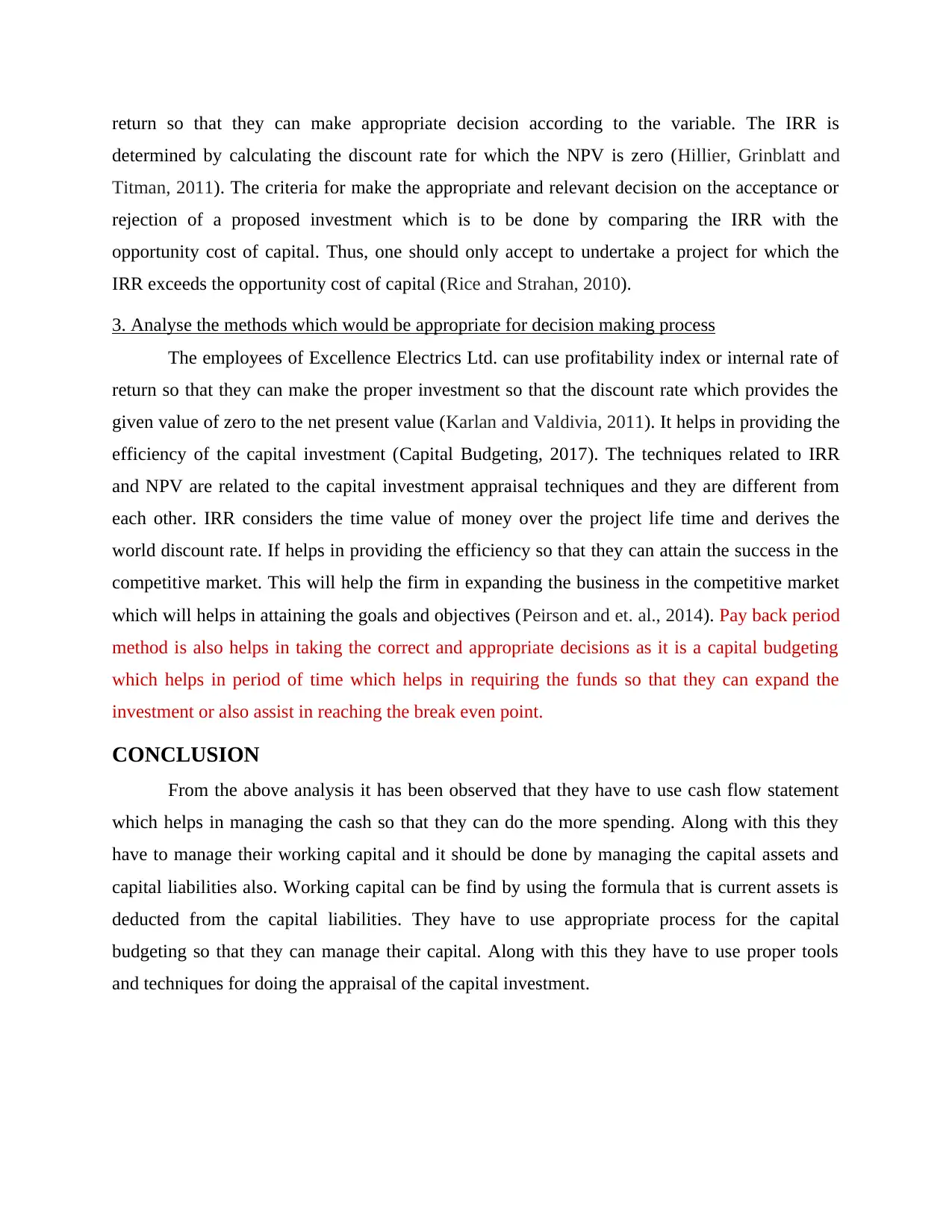
return so that they can make appropriate decision according to the variable. The IRR is
determined by calculating the discount rate for which the NPV is zero (Hillier, Grinblatt and
Titman, 2011). The criteria for make the appropriate and relevant decision on the acceptance or
rejection of a proposed investment which is to be done by comparing the IRR with the
opportunity cost of capital. Thus, one should only accept to undertake a project for which the
IRR exceeds the opportunity cost of capital (Rice and Strahan, 2010).
3. Analyse the methods which would be appropriate for decision making process
The employees of Excellence Electrics Ltd. can use profitability index or internal rate of
return so that they can make the proper investment so that the discount rate which provides the
given value of zero to the net present value (Karlan and Valdivia, 2011). It helps in providing the
efficiency of the capital investment (Capital Budgeting, 2017). The techniques related to IRR
and NPV are related to the capital investment appraisal techniques and they are different from
each other. IRR considers the time value of money over the project life time and derives the
world discount rate. If helps in providing the efficiency so that they can attain the success in the
competitive market. This will help the firm in expanding the business in the competitive market
which will helps in attaining the goals and objectives (Peirson and et. al., 2014). Pay back period
method is also helps in taking the correct and appropriate decisions as it is a capital budgeting
which helps in period of time which helps in requiring the funds so that they can expand the
investment or also assist in reaching the break even point.
CONCLUSION
From the above analysis it has been observed that they have to use cash flow statement
which helps in managing the cash so that they can do the more spending. Along with this they
have to manage their working capital and it should be done by managing the capital assets and
capital liabilities also. Working capital can be find by using the formula that is current assets is
deducted from the capital liabilities. They have to use appropriate process for the capital
budgeting so that they can manage their capital. Along with this they have to use proper tools
and techniques for doing the appraisal of the capital investment.
determined by calculating the discount rate for which the NPV is zero (Hillier, Grinblatt and
Titman, 2011). The criteria for make the appropriate and relevant decision on the acceptance or
rejection of a proposed investment which is to be done by comparing the IRR with the
opportunity cost of capital. Thus, one should only accept to undertake a project for which the
IRR exceeds the opportunity cost of capital (Rice and Strahan, 2010).
3. Analyse the methods which would be appropriate for decision making process
The employees of Excellence Electrics Ltd. can use profitability index or internal rate of
return so that they can make the proper investment so that the discount rate which provides the
given value of zero to the net present value (Karlan and Valdivia, 2011). It helps in providing the
efficiency of the capital investment (Capital Budgeting, 2017). The techniques related to IRR
and NPV are related to the capital investment appraisal techniques and they are different from
each other. IRR considers the time value of money over the project life time and derives the
world discount rate. If helps in providing the efficiency so that they can attain the success in the
competitive market. This will help the firm in expanding the business in the competitive market
which will helps in attaining the goals and objectives (Peirson and et. al., 2014). Pay back period
method is also helps in taking the correct and appropriate decisions as it is a capital budgeting
which helps in period of time which helps in requiring the funds so that they can expand the
investment or also assist in reaching the break even point.
CONCLUSION
From the above analysis it has been observed that they have to use cash flow statement
which helps in managing the cash so that they can do the more spending. Along with this they
have to manage their working capital and it should be done by managing the capital assets and
capital liabilities also. Working capital can be find by using the formula that is current assets is
deducted from the capital liabilities. They have to use appropriate process for the capital
budgeting so that they can manage their capital. Along with this they have to use proper tools
and techniques for doing the appraisal of the capital investment.
Paraphrase This Document
Need a fresh take? Get an instant paraphrase of this document with our AI Paraphraser
REFERENCES
Books and Journals
Abor, J and Quartey, P., 2010. Issues in SME development in Ghana and South Africa.
International Research Journal of Finance and Economics. 39(6). pp.215-228.
Adjaoud, F and Ben‐Amar, W., 2010. Corporate governance and dividend policy: shareholders’
protection or expropriation?. Journal of business finance & accounting. 37(5‐6). pp.648-
667.
Anandarajan, M., Anandarajan, A and Srinivasan, C.A. Eds., 2012. Business intelligence
techniques: a perspective from accounting and finance. Springer Science & Business
Media.
Ayyagari, M., Demirgüç-Kunt, A and Maksimovic, V., 2010. Formal versus informal finance:
Evidence from China. Review of Financial Studies. 23(8). pp.3048-3097.
Ballwieser, W., and et. al., 2012. Agency theory, information, and incentives. Springer Science
& Business Media.
Berger, A.N and Black, L.K., 2011. Bank size, lending technologies, and small business finance.
Journal of Banking & Finance. 35(3). pp.724-735.
Bøhren, Ø and Strøm, R.Ø., 2010. Governance and politics: Regulating independence and
diversity in the board room. Journal of Business Finance & Accounting. 37(9‐10).
pp.1281-1308.
Britten‐Jones, M., Neuberger, A5 and Nolte, I., 2011. Improved inference in regression with
overlapping observations. Journal of Business Finance & Accounting. 38(5‐6). pp.657-
683.
Bushman, R.M., Piotroski, J.D and Smith, A.J., 2011. Capital allocation and timely accounting
recognition of economic losses. Journal of Business Finance & Accounting. 38(1‐2).
pp.1-33.
Chortareas, G.E., Girardone, C and Ventouri, A., 2011. Financial frictions, bank efficiency and
risk: Evidence from the Eurozone. Journal of Business Finance & Accounting. 38(1‐2).
pp.259-287.
Cole, R.A., 2013. What do we know about the capital structure of privately held US firms?
Evidence from the surveys of small business finance. Financial Management. 42(4).
pp.777-813.
Columba, F., Gambacorta, L and Mistrulli, P.E., 2010. Mutual Guarantee institutions and small
business finance. Journal of Financial stability. 6(1). pp.45-54.
Cuthbertson, K., Nitzsche, D and O'Sullivan, N., 2010. The market timing ability of UK mutual
funds. Journal of Business Finance & Accounting. 37(1‐2). pp.270-289.
Drake, P.P and Fabozzi, F.J., 2010. The basics of finance: an introduction to financial markets,
business finance, and portfolio management (Vol. 192). John Wiley & Sons.
Ghosh, A.A and Moon, D., 2010. Corporate debt financing and earnings quality. Journal of
Business Finance & Accounting. 37(5‐6). pp.538-559.
Books and Journals
Abor, J and Quartey, P., 2010. Issues in SME development in Ghana and South Africa.
International Research Journal of Finance and Economics. 39(6). pp.215-228.
Adjaoud, F and Ben‐Amar, W., 2010. Corporate governance and dividend policy: shareholders’
protection or expropriation?. Journal of business finance & accounting. 37(5‐6). pp.648-
667.
Anandarajan, M., Anandarajan, A and Srinivasan, C.A. Eds., 2012. Business intelligence
techniques: a perspective from accounting and finance. Springer Science & Business
Media.
Ayyagari, M., Demirgüç-Kunt, A and Maksimovic, V., 2010. Formal versus informal finance:
Evidence from China. Review of Financial Studies. 23(8). pp.3048-3097.
Ballwieser, W., and et. al., 2012. Agency theory, information, and incentives. Springer Science
& Business Media.
Berger, A.N and Black, L.K., 2011. Bank size, lending technologies, and small business finance.
Journal of Banking & Finance. 35(3). pp.724-735.
Bøhren, Ø and Strøm, R.Ø., 2010. Governance and politics: Regulating independence and
diversity in the board room. Journal of Business Finance & Accounting. 37(9‐10).
pp.1281-1308.
Britten‐Jones, M., Neuberger, A5 and Nolte, I., 2011. Improved inference in regression with
overlapping observations. Journal of Business Finance & Accounting. 38(5‐6). pp.657-
683.
Bushman, R.M., Piotroski, J.D and Smith, A.J., 2011. Capital allocation and timely accounting
recognition of economic losses. Journal of Business Finance & Accounting. 38(1‐2).
pp.1-33.
Chortareas, G.E., Girardone, C and Ventouri, A., 2011. Financial frictions, bank efficiency and
risk: Evidence from the Eurozone. Journal of Business Finance & Accounting. 38(1‐2).
pp.259-287.
Cole, R.A., 2013. What do we know about the capital structure of privately held US firms?
Evidence from the surveys of small business finance. Financial Management. 42(4).
pp.777-813.
Columba, F., Gambacorta, L and Mistrulli, P.E., 2010. Mutual Guarantee institutions and small
business finance. Journal of Financial stability. 6(1). pp.45-54.
Cuthbertson, K., Nitzsche, D and O'Sullivan, N., 2010. The market timing ability of UK mutual
funds. Journal of Business Finance & Accounting. 37(1‐2). pp.270-289.
Drake, P.P and Fabozzi, F.J., 2010. The basics of finance: an introduction to financial markets,
business finance, and portfolio management (Vol. 192). John Wiley & Sons.
Ghosh, A.A and Moon, D., 2010. Corporate debt financing and earnings quality. Journal of
Business Finance & Accounting. 37(5‐6). pp.538-559.
Gitman, L.J and Zutter, C.J., 2012. Principles of managerial finance. Prentice Hall.
Greenidge, K and Grosvenor, T., 2010. Forecasting non-performing loans in Barbados. Journal
of Business, Finance and Economics in Emerging Economies. 5(1). pp.79-108.
Hill, N.T., Perry, S.E and Andes, S., 2011. Evaluating firms in financial distress: An event
history analysis. Journal of Applied Business Research (JABR). 12(3). pp.60-71.
Hillier, D., Grinblatt, M and Titman, S., 2011. Financial markets and corporate strategy.
McGraw Hill.
Karlan, D and Valdivia, M., 2011. Teaching entrepreneurship: Impact of business training on
microfinance clients and institutions. Review of Economics and statistics. 93(2). pp.510-
527.
Peirson, G., and et. al., 2014. Business finance. McGraw-Hill Education Australia.
Rice, T and Strahan, P.E., 2010. Does Credit Competition Affect Small‐Firm Finance?. The
Journal of Finance. 65(3). pp.861-889.
Ryan, L.V., Buchholtz, A.K and Kolb, R.W., 2010. New directions in corporate governance and
finance: Implications for business ethics research. Business Ethics Quarterly. 20(04).
pp.673-694.
Online
Capital Budgeting. 2017. [Online]. Available through:
<http://accountingexplained.com/managerial/capital-budgeting/>. [Accessed on 4th May
2017]
Greenidge, K and Grosvenor, T., 2010. Forecasting non-performing loans in Barbados. Journal
of Business, Finance and Economics in Emerging Economies. 5(1). pp.79-108.
Hill, N.T., Perry, S.E and Andes, S., 2011. Evaluating firms in financial distress: An event
history analysis. Journal of Applied Business Research (JABR). 12(3). pp.60-71.
Hillier, D., Grinblatt, M and Titman, S., 2011. Financial markets and corporate strategy.
McGraw Hill.
Karlan, D and Valdivia, M., 2011. Teaching entrepreneurship: Impact of business training on
microfinance clients and institutions. Review of Economics and statistics. 93(2). pp.510-
527.
Peirson, G., and et. al., 2014. Business finance. McGraw-Hill Education Australia.
Rice, T and Strahan, P.E., 2010. Does Credit Competition Affect Small‐Firm Finance?. The
Journal of Finance. 65(3). pp.861-889.
Ryan, L.V., Buchholtz, A.K and Kolb, R.W., 2010. New directions in corporate governance and
finance: Implications for business ethics research. Business Ethics Quarterly. 20(04).
pp.673-694.
Online
Capital Budgeting. 2017. [Online]. Available through:
<http://accountingexplained.com/managerial/capital-budgeting/>. [Accessed on 4th May
2017]
⊘ This is a preview!⊘
Do you want full access?
Subscribe today to unlock all pages.
Trusted by 1+ million students worldwide

1 out of 12


Related Documents


Your All-in-One AI-Powered Toolkit for Academic Success.
+13062052269
info@desklib.com
Available 24*7 on WhatsApp / Email
![[object Object]](/_next/static/media/star-bottom.7253800d.svg)
Unlock your academic potential
Copyright © 2020–2025 A2Z Services. All Rights Reserved. Developed and managed by ZUCOL.