ACC3004 Business Finance: Portfolio Analysis of CBA and Lez Foxwell
VerifiedAdded on 2023/06/07
|19
|2826
|361
Report
AI Summary
This report provides a comprehensive analysis of several business finance issues. It begins with a case study on CBA (Commonwealth Bank of Australia) valuation, calculating market capitalization, forecasting cash flows, determining return on shares, and analyzing remuneration policies. It further examines CBA's dividend policy, calculating growth rates in EPS and prospective P/E ratios. The report then transitions to a capital budgeting case study involving Lez Foxwell, evaluating project viability using payback period and discounted payback period methods, and comparing these with net present value (NPV) analysis under different cost of capital scenarios. The report concludes by providing detailed calculations and justifications for investment decisions based on the financial metrics assessed.

RUNNING HEAD: BUSINESS FINANCE
Business finance
Business finance

Paraphrase This Document
Need a fresh take? Get an instant paraphrase of this document with our AI Paraphraser

Business finance 2
Contents
Requirement 1.............................................................................................................................................3
Question 1...............................................................................................................................................3
Question 2...............................................................................................................................................3
Question 3...............................................................................................................................................4
Question 4...............................................................................................................................................4
Question 5...............................................................................................................................................5
Question 6...............................................................................................................................................6
Requirement 2.............................................................................................................................................6
Question 4...............................................................................................................................................6
Requirement 3.............................................................................................................................................7
Question 1...............................................................................................................................................7
Question 2...............................................................................................................................................8
Question 3.............................................................................................................................................10
Requirement 4...........................................................................................................................................12
Question 4.............................................................................................................................................12
Question 5.............................................................................................................................................13
Question 7.............................................................................................................................................15
Requirement 5...........................................................................................................................................16
References.................................................................................................................................................18
Contents
Requirement 1.............................................................................................................................................3
Question 1...............................................................................................................................................3
Question 2...............................................................................................................................................3
Question 3...............................................................................................................................................4
Question 4...............................................................................................................................................4
Question 5...............................................................................................................................................5
Question 6...............................................................................................................................................6
Requirement 2.............................................................................................................................................6
Question 4...............................................................................................................................................6
Requirement 3.............................................................................................................................................7
Question 1...............................................................................................................................................7
Question 2...............................................................................................................................................8
Question 3.............................................................................................................................................10
Requirement 4...........................................................................................................................................12
Question 4.............................................................................................................................................12
Question 5.............................................................................................................................................13
Question 7.............................................................................................................................................15
Requirement 5...........................................................................................................................................16
References.................................................................................................................................................18
Business finance 3
Requirement 1
Question 1
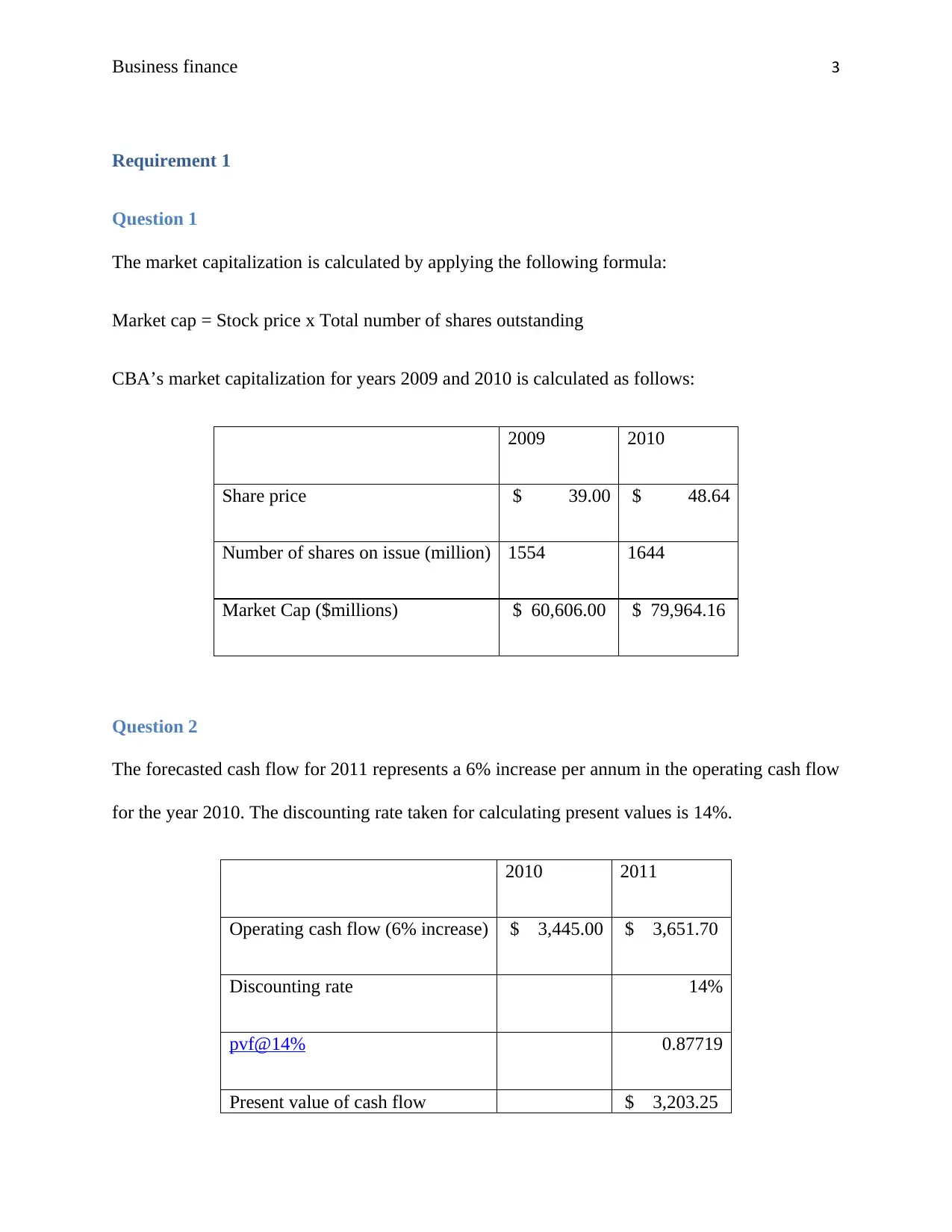
The market capitalization is calculated by applying the following formula:
Market cap = Stock price x Total number of shares outstanding
CBA’s market capitalization for years 2009 and 2010 is calculated as follows:
2009 2010
Share price $ 39.00 $ 48.64
Number of shares on issue (million) 1554 1644
Market Cap ($millions) $ 60,606.00 $ 79,964.16
Question 2
The forecasted cash flow for 2011 represents a 6% increase per annum in the operating cash flow
for the year 2010. The discounting rate taken for calculating present values is 14%.
2010 2011
Operating cash flow (6% increase) $ 3,445.00 $ 3,651.70
Discounting rate 14%
pvf@14% 0.87719
Present value of cash flow $ 3,203.25
Requirement 1
Question 1
The market capitalization is calculated by applying the following formula:
Market cap = Stock price x Total number of shares outstanding
CBA’s market capitalization for years 2009 and 2010 is calculated as follows:
2009 2010
Share price $ 39.00 $ 48.64
Number of shares on issue (million) 1554 1644
Market Cap ($millions) $ 60,606.00 $ 79,964.16
Question 2
The forecasted cash flow for 2011 represents a 6% increase per annum in the operating cash flow
for the year 2010. The discounting rate taken for calculating present values is 14%.
2010 2011
Operating cash flow (6% increase) $ 3,445.00 $ 3,651.70
Discounting rate 14%
pvf@14% 0.87719
Present value of cash flow $ 3,203.25
⊘ This is a preview!⊘
Do you want full access?
Subscribe today to unlock all pages.

Trusted by 1+ million students worldwide
Business finance 4
Question 3
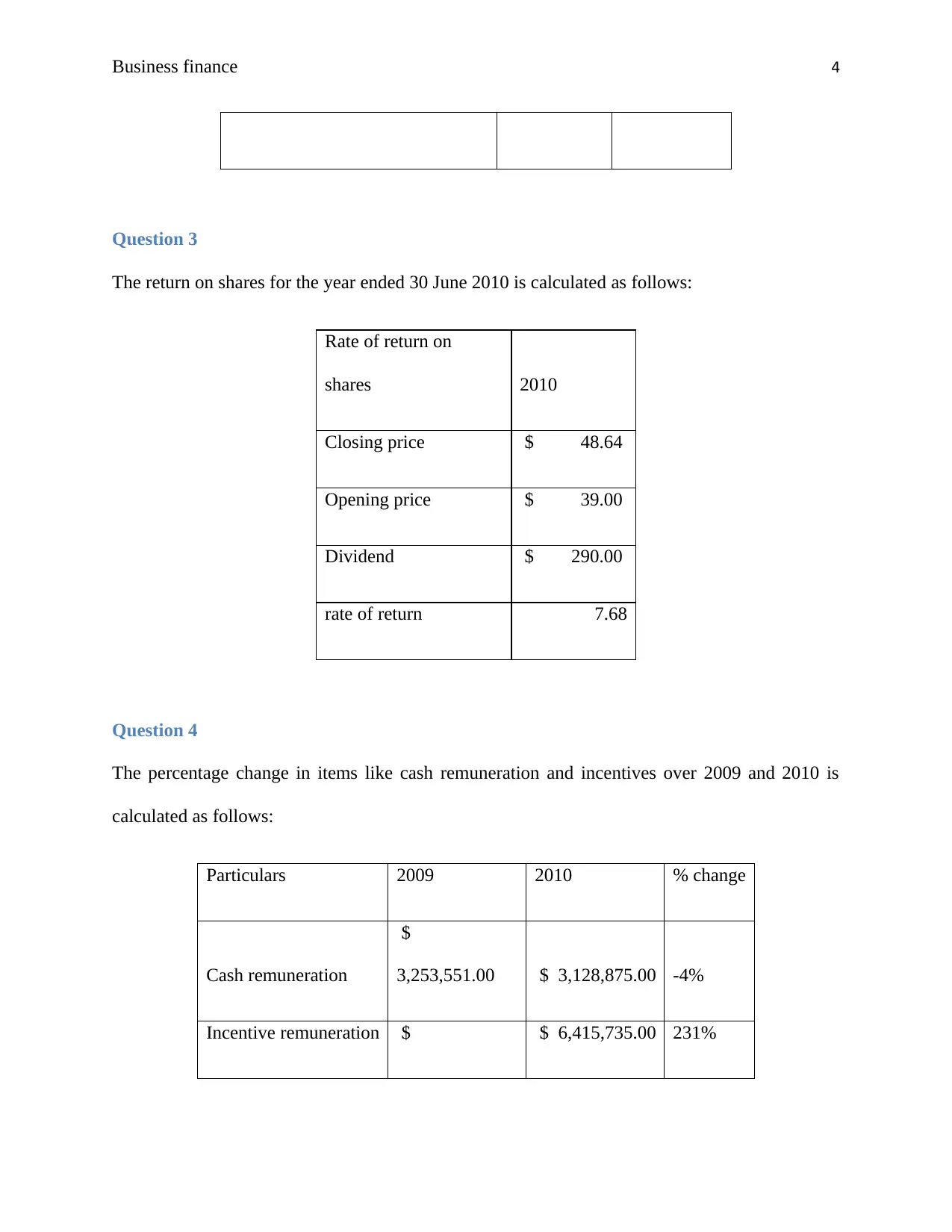
The return on shares for the year ended 30 June 2010 is calculated as follows:
Rate of return on
shares 2010
Closing price $ 48.64
Opening price $ 39.00
Dividend $ 290.00
rate of return 7.68
Question 4
The percentage change in items like cash remuneration and incentives over 2009 and 2010 is
calculated as follows:
Particulars 2009 2010 % change
Cash remuneration
$
3,253,551.00 $ 3,128,875.00 -4%
Incentive remuneration $ $ 6,415,735.00 231%
Question 3
The return on shares for the year ended 30 June 2010 is calculated as follows:
Rate of return on
shares 2010
Closing price $ 48.64
Opening price $ 39.00
Dividend $ 290.00
rate of return 7.68
Question 4
The percentage change in items like cash remuneration and incentives over 2009 and 2010 is
calculated as follows:
Particulars 2009 2010 % change
Cash remuneration
$
3,253,551.00 $ 3,128,875.00 -4%
Incentive remuneration $ $ 6,415,735.00 231%
Paraphrase This Document
Need a fresh take? Get an instant paraphrase of this document with our AI Paraphraser
Business finance 5
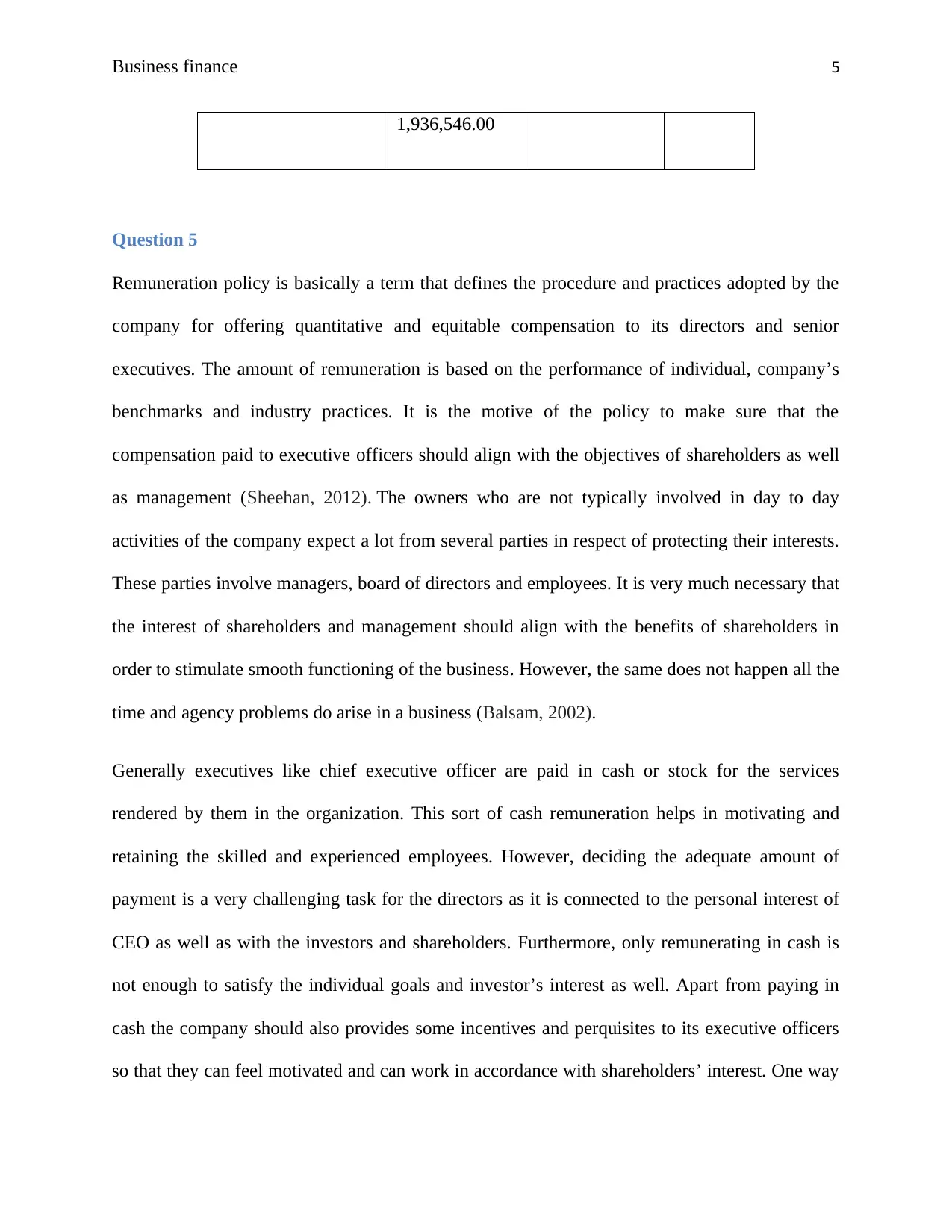
1,936,546.00
Question 5
Remuneration policy is basically a term that defines the procedure and practices adopted by the
company for offering quantitative and equitable compensation to its directors and senior
executives. The amount of remuneration is based on the performance of individual, company’s
benchmarks and industry practices. It is the motive of the policy to make sure that the
compensation paid to executive officers should align with the objectives of shareholders as well
as management (Sheehan, 2012). The owners who are not typically involved in day to day
activities of the company expect a lot from several parties in respect of protecting their interests.
These parties involve managers, board of directors and employees. It is very much necessary that
the interest of shareholders and management should align with the benefits of shareholders in
order to stimulate smooth functioning of the business. However, the same does not happen all the
time and agency problems do arise in a business (Balsam, 2002).
Generally executives like chief executive officer are paid in cash or stock for the services
rendered by them in the organization. This sort of cash remuneration helps in motivating and
retaining the skilled and experienced employees. However, deciding the adequate amount of
payment is a very challenging task for the directors as it is connected to the personal interest of
CEO as well as with the investors and shareholders. Furthermore, only remunerating in cash is
not enough to satisfy the individual goals and investor’s interest as well. Apart from paying in
cash the company should also provides some incentives and perquisites to its executive officers
so that they can feel motivated and can work in accordance with shareholders’ interest. One way
1,936,546.00
Question 5
Remuneration policy is basically a term that defines the procedure and practices adopted by the
company for offering quantitative and equitable compensation to its directors and senior
executives. The amount of remuneration is based on the performance of individual, company’s
benchmarks and industry practices. It is the motive of the policy to make sure that the
compensation paid to executive officers should align with the objectives of shareholders as well
as management (Sheehan, 2012). The owners who are not typically involved in day to day
activities of the company expect a lot from several parties in respect of protecting their interests.
These parties involve managers, board of directors and employees. It is very much necessary that
the interest of shareholders and management should align with the benefits of shareholders in
order to stimulate smooth functioning of the business. However, the same does not happen all the
time and agency problems do arise in a business (Balsam, 2002).
Generally executives like chief executive officer are paid in cash or stock for the services
rendered by them in the organization. This sort of cash remuneration helps in motivating and
retaining the skilled and experienced employees. However, deciding the adequate amount of
payment is a very challenging task for the directors as it is connected to the personal interest of
CEO as well as with the investors and shareholders. Furthermore, only remunerating in cash is
not enough to satisfy the individual goals and investor’s interest as well. Apart from paying in
cash the company should also provides some incentives and perquisites to its executive officers
so that they can feel motivated and can work in accordance with shareholders’ interest. One way
Business finance 6
to do the same is to give some percentage of shareholdings to managers and employees so that
they can also think from the perspective of shareholders and are promoted to protect the same.
Therefore, it can be said that cash remuneration alone does not align with the interest and
benefits of CEO and shareholders (Bolton, Mehran and Shapiro, 2015).
Question 6
Other types of remuneration policies include paying the compensation that contains two elements
that are fixed and variable. The fixed element comprises of allowances, salary, provident fund,
gratuity and other perquisites. On the other side, the variable should include the pay based on the
annual performance of the executives that may be a fixed amount or a percentage of profits
(Bettis, Bizjak, Coles and Kalpathy, 2018). Along with this, various stock options and different
types of allowances should also be included in the remuneration of the chief executive officer.
Furthermore, providing various retirement, medical, insurance benefits will anyway motivate
them to work in the best interest of the organization. Once the personal goals of CEO will be
satisfied, the will eventually result in alignment of shareholders’ interest also.
Requirement 2
Question 4
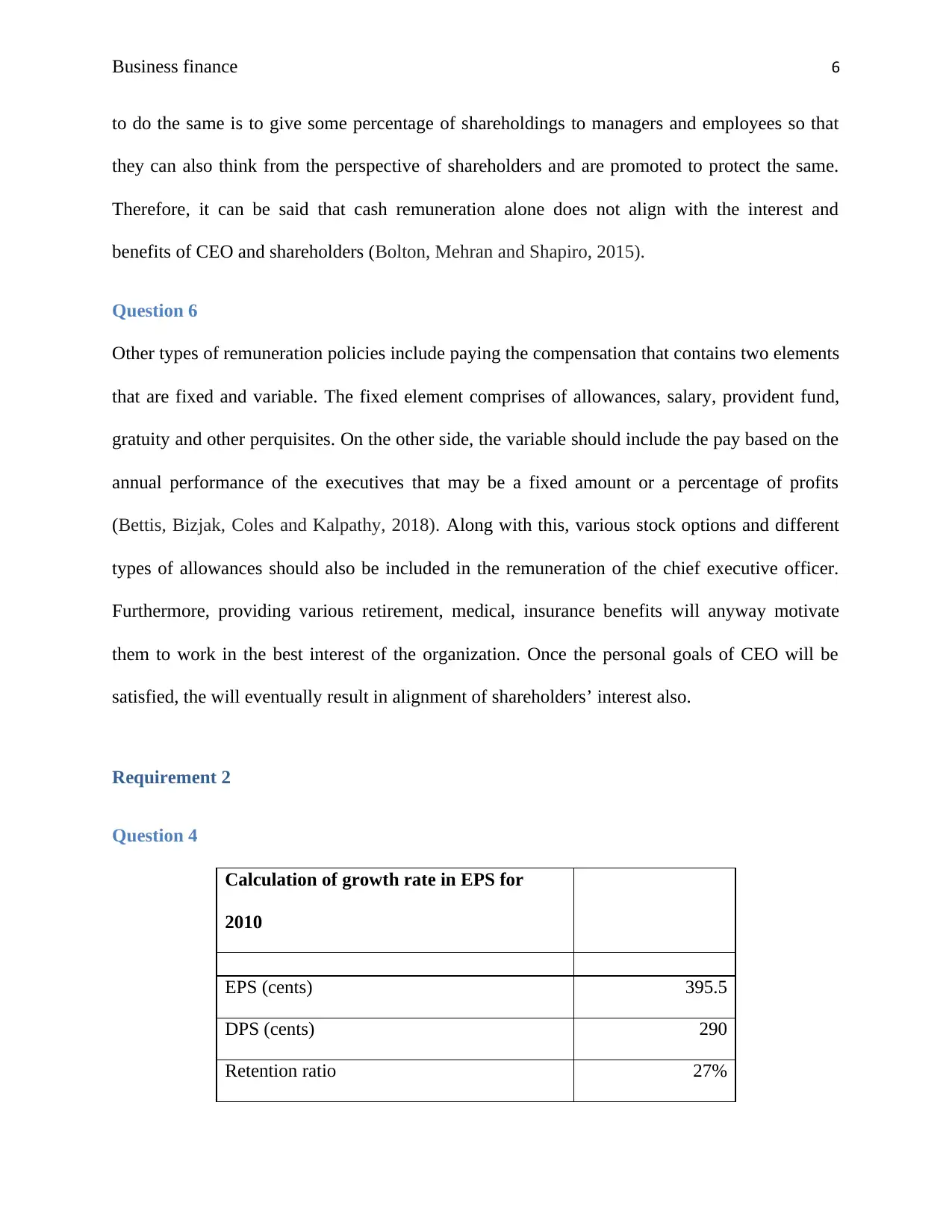
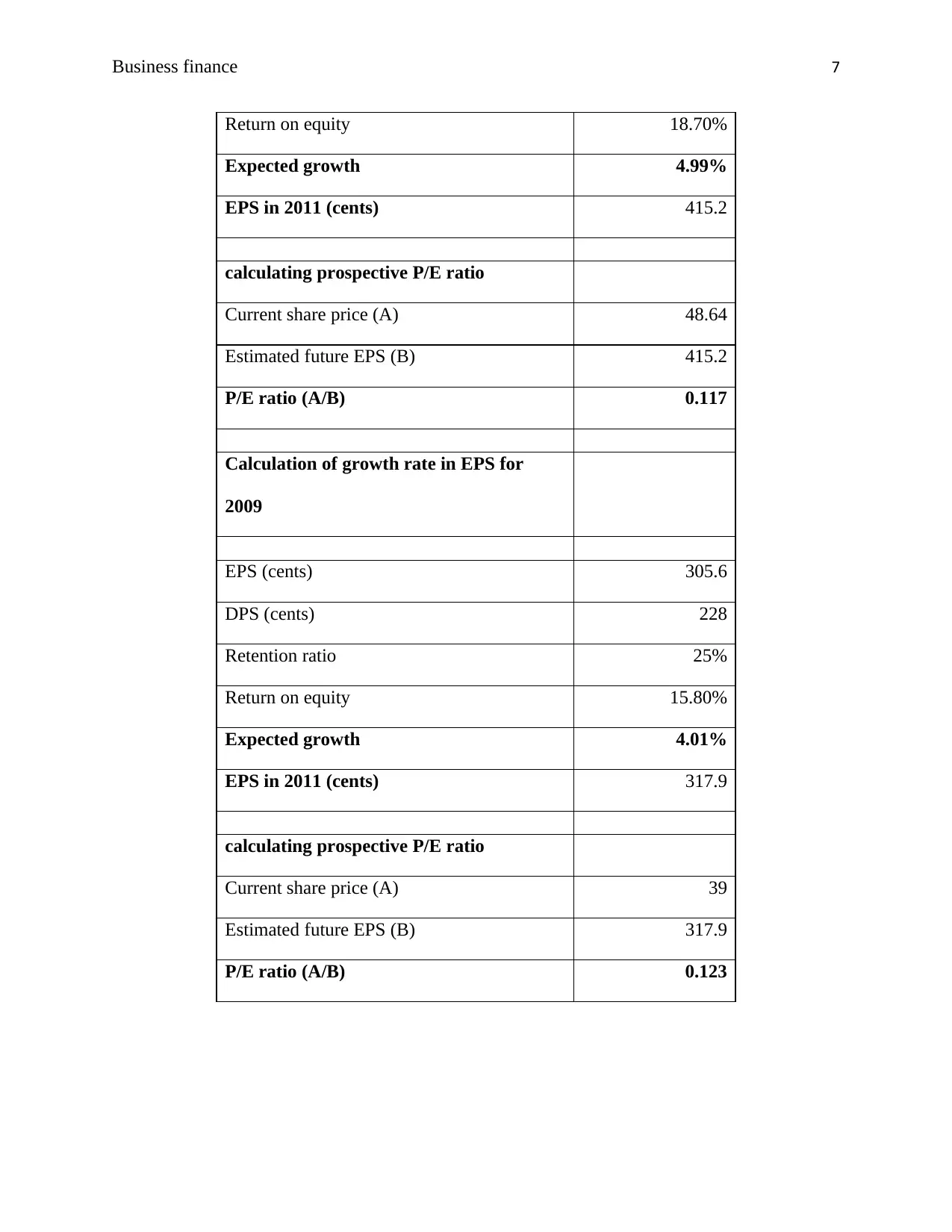
Calculation of growth rate in EPS for
2010
EPS (cents) 395.5
DPS (cents) 290
Retention ratio 27%
to do the same is to give some percentage of shareholdings to managers and employees so that
they can also think from the perspective of shareholders and are promoted to protect the same.
Therefore, it can be said that cash remuneration alone does not align with the interest and
benefits of CEO and shareholders (Bolton, Mehran and Shapiro, 2015).
Question 6
Other types of remuneration policies include paying the compensation that contains two elements
that are fixed and variable. The fixed element comprises of allowances, salary, provident fund,
gratuity and other perquisites. On the other side, the variable should include the pay based on the
annual performance of the executives that may be a fixed amount or a percentage of profits
(Bettis, Bizjak, Coles and Kalpathy, 2018). Along with this, various stock options and different
types of allowances should also be included in the remuneration of the chief executive officer.
Furthermore, providing various retirement, medical, insurance benefits will anyway motivate
them to work in the best interest of the organization. Once the personal goals of CEO will be
satisfied, the will eventually result in alignment of shareholders’ interest also.
Requirement 2
Question 4
Calculation of growth rate in EPS for
2010
EPS (cents) 395.5
DPS (cents) 290
Retention ratio 27%
⊘ This is a preview!⊘
Do you want full access?
Subscribe today to unlock all pages.
Trusted by 1+ million students worldwide
Business finance 7
Return on equity 18.70%
Expected growth 4.99%
EPS in 2011 (cents) 415.2
calculating prospective P/E ratio
Current share price (A) 48.64
Estimated future EPS (B) 415.2
P/E ratio (A/B) 0.117
Calculation of growth rate in EPS for
2009
EPS (cents) 305.6
DPS (cents) 228
Retention ratio 25%
Return on equity 15.80%
Expected growth 4.01%
EPS in 2011 (cents) 317.9
calculating prospective P/E ratio
Current share price (A) 39
Estimated future EPS (B) 317.9
P/E ratio (A/B) 0.123
Return on equity 18.70%
Expected growth 4.99%
EPS in 2011 (cents) 415.2
calculating prospective P/E ratio
Current share price (A) 48.64
Estimated future EPS (B) 415.2
P/E ratio (A/B) 0.117
Calculation of growth rate in EPS for
2009
EPS (cents) 305.6
DPS (cents) 228
Retention ratio 25%
Return on equity 15.80%
Expected growth 4.01%
EPS in 2011 (cents) 317.9
calculating prospective P/E ratio
Current share price (A) 39
Estimated future EPS (B) 317.9
P/E ratio (A/B) 0.123
Paraphrase This Document
Need a fresh take? Get an instant paraphrase of this document with our AI Paraphraser
Business finance 8
Requirement 3
Question 1
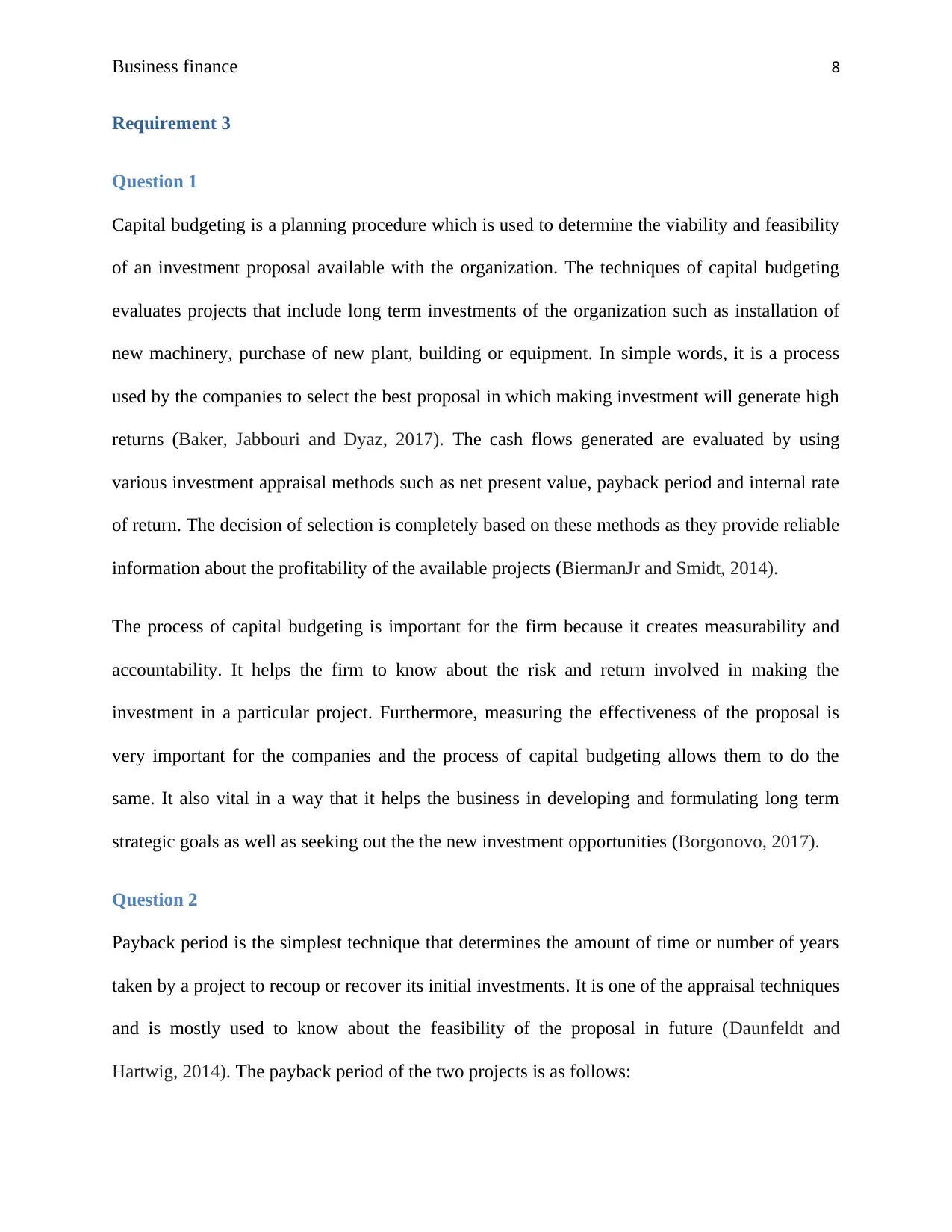
Capital budgeting is a planning procedure which is used to determine the viability and feasibility
of an investment proposal available with the organization. The techniques of capital budgeting
evaluates projects that include long term investments of the organization such as installation of
new machinery, purchase of new plant, building or equipment. In simple words, it is a process
used by the companies to select the best proposal in which making investment will generate high
returns (Baker, Jabbouri and Dyaz, 2017). The cash flows generated are evaluated by using
various investment appraisal methods such as net present value, payback period and internal rate
of return. The decision of selection is completely based on these methods as they provide reliable
information about the profitability of the available projects (BiermanJr and Smidt, 2014).
The process of capital budgeting is important for the firm because it creates measurability and
accountability. It helps the firm to know about the risk and return involved in making the
investment in a particular project. Furthermore, measuring the effectiveness of the proposal is
very important for the companies and the process of capital budgeting allows them to do the
same. It also vital in a way that it helps the business in developing and formulating long term
strategic goals as well as seeking out the the new investment opportunities (Borgonovo, 2017).
Question 2
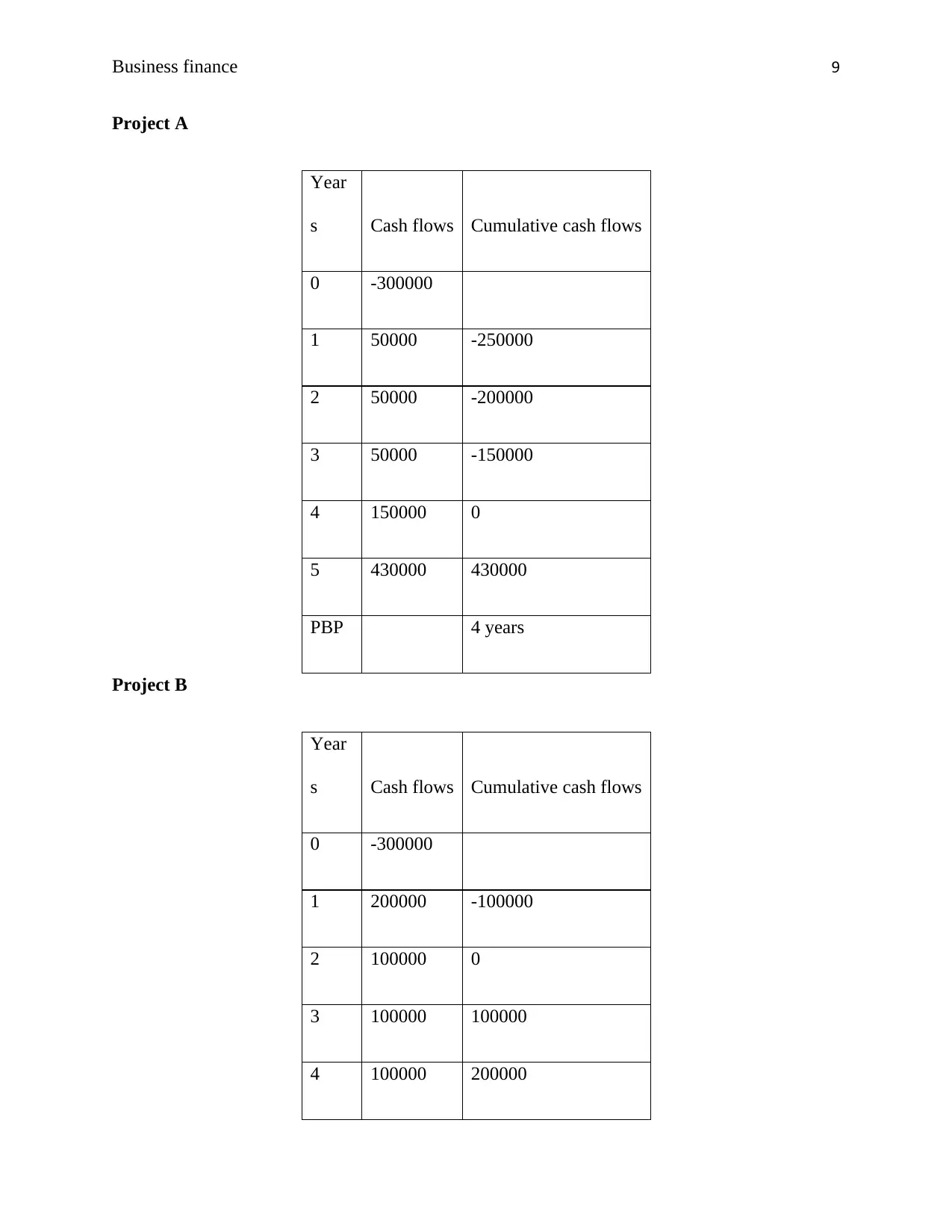
Payback period is the simplest technique that determines the amount of time or number of years
taken by a project to recoup or recover its initial investments. It is one of the appraisal techniques
and is mostly used to know about the feasibility of the proposal in future (Daunfeldt and
Hartwig, 2014). The payback period of the two projects is as follows:
Requirement 3
Question 1
Capital budgeting is a planning procedure which is used to determine the viability and feasibility
of an investment proposal available with the organization. The techniques of capital budgeting
evaluates projects that include long term investments of the organization such as installation of
new machinery, purchase of new plant, building or equipment. In simple words, it is a process
used by the companies to select the best proposal in which making investment will generate high
returns (Baker, Jabbouri and Dyaz, 2017). The cash flows generated are evaluated by using
various investment appraisal methods such as net present value, payback period and internal rate
of return. The decision of selection is completely based on these methods as they provide reliable
information about the profitability of the available projects (BiermanJr and Smidt, 2014).
The process of capital budgeting is important for the firm because it creates measurability and
accountability. It helps the firm to know about the risk and return involved in making the
investment in a particular project. Furthermore, measuring the effectiveness of the proposal is
very important for the companies and the process of capital budgeting allows them to do the
same. It also vital in a way that it helps the business in developing and formulating long term
strategic goals as well as seeking out the the new investment opportunities (Borgonovo, 2017).
Question 2
Payback period is the simplest technique that determines the amount of time or number of years
taken by a project to recoup or recover its initial investments. It is one of the appraisal techniques
and is mostly used to know about the feasibility of the proposal in future (Daunfeldt and
Hartwig, 2014). The payback period of the two projects is as follows:
Business finance 9
Project A
Year
s Cash flows Cumulative cash flows
0 -300000
1 50000 -250000
2 50000 -200000
3 50000 -150000
4 150000 0
5 430000 430000
PBP 4 years
Project B
Year
s Cash flows Cumulative cash flows
0 -300000
1 200000 -100000
2 100000 0
3 100000 100000
4 100000 200000
Project A
Year
s Cash flows Cumulative cash flows
0 -300000
1 50000 -250000
2 50000 -200000
3 50000 -150000
4 150000 0
5 430000 430000
PBP 4 years
Project B
Year
s Cash flows Cumulative cash flows
0 -300000
1 200000 -100000
2 100000 0
3 100000 100000
4 100000 200000
⊘ This is a preview!⊘
Do you want full access?
Subscribe today to unlock all pages.
Trusted by 1+ million students worldwide
Business finance 10
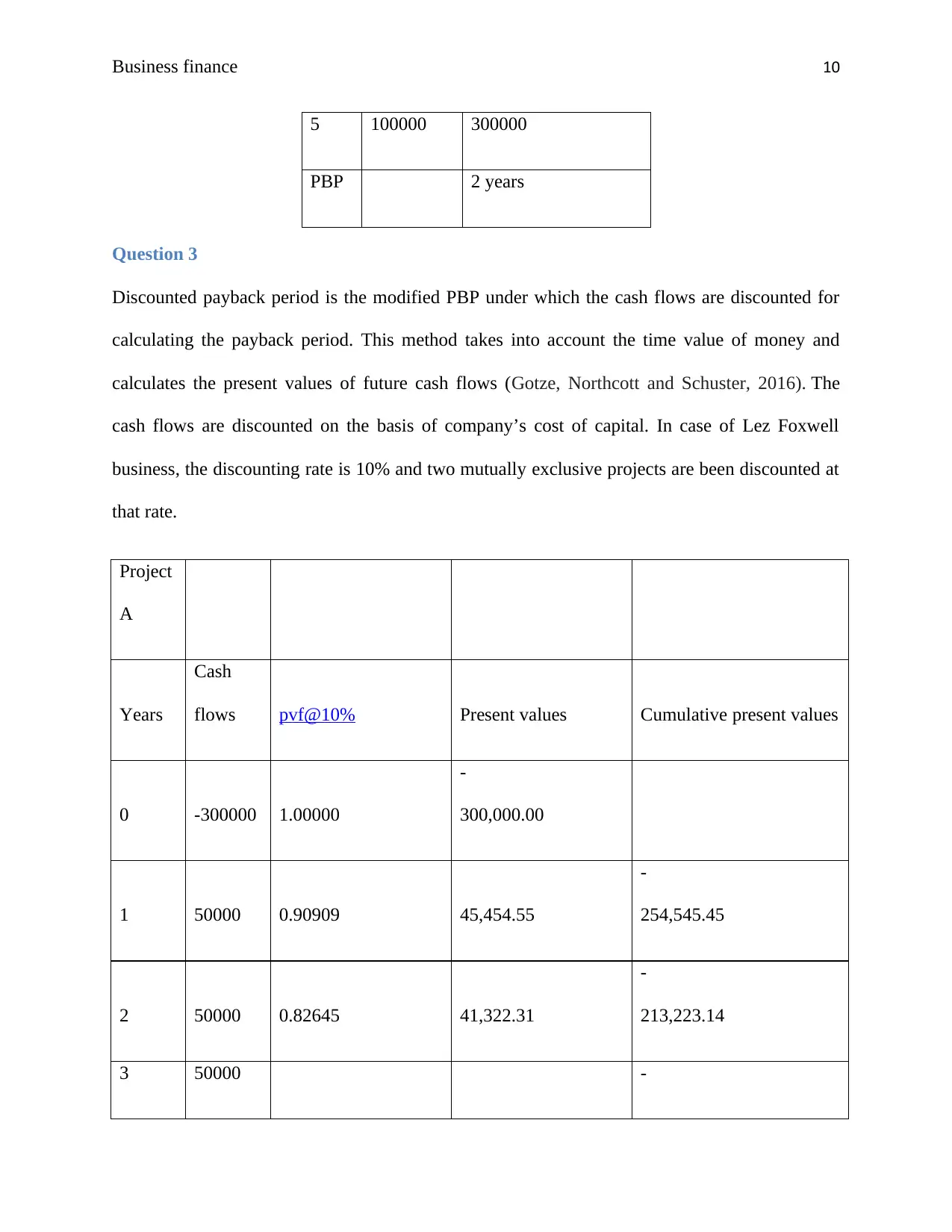
5 100000 300000
PBP 2 years
Question 3
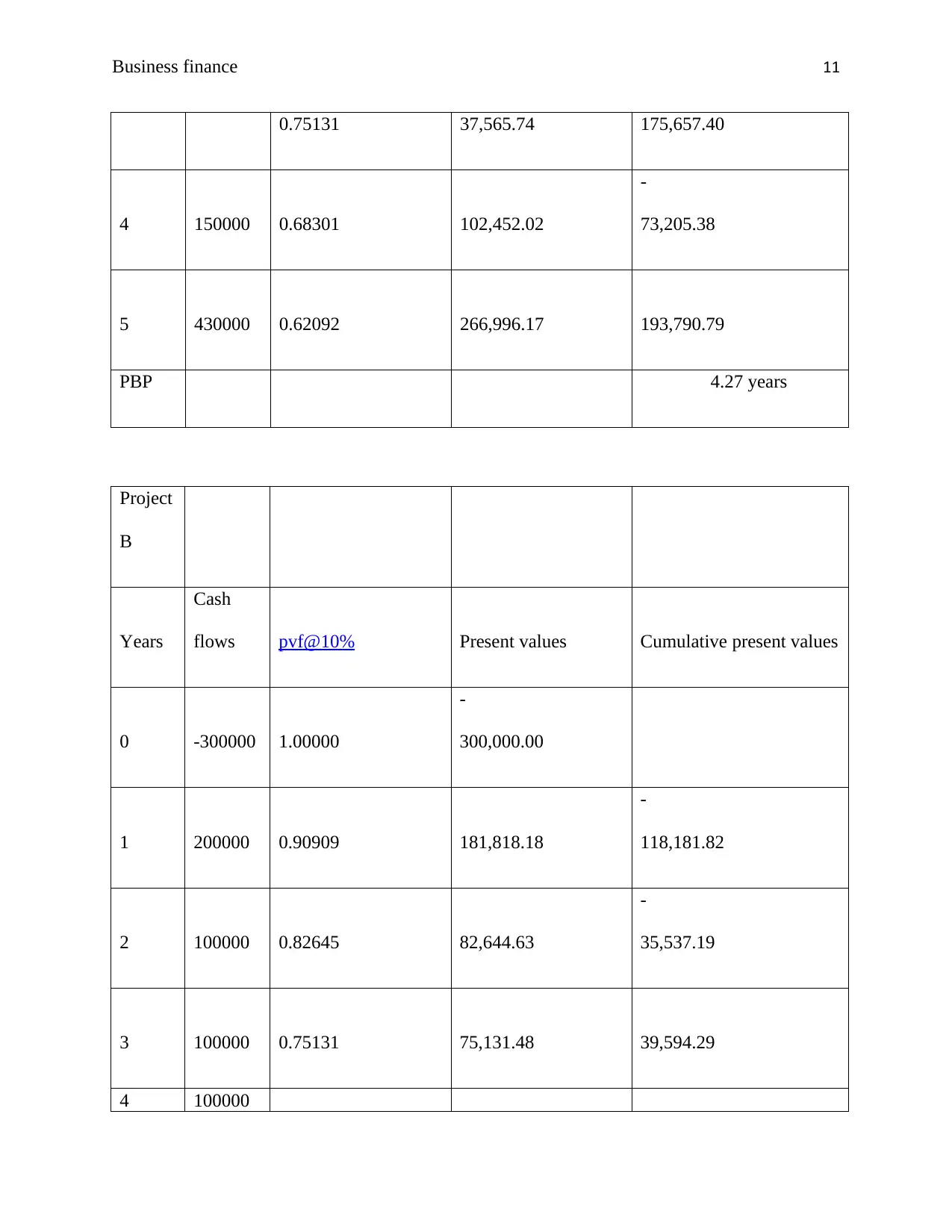
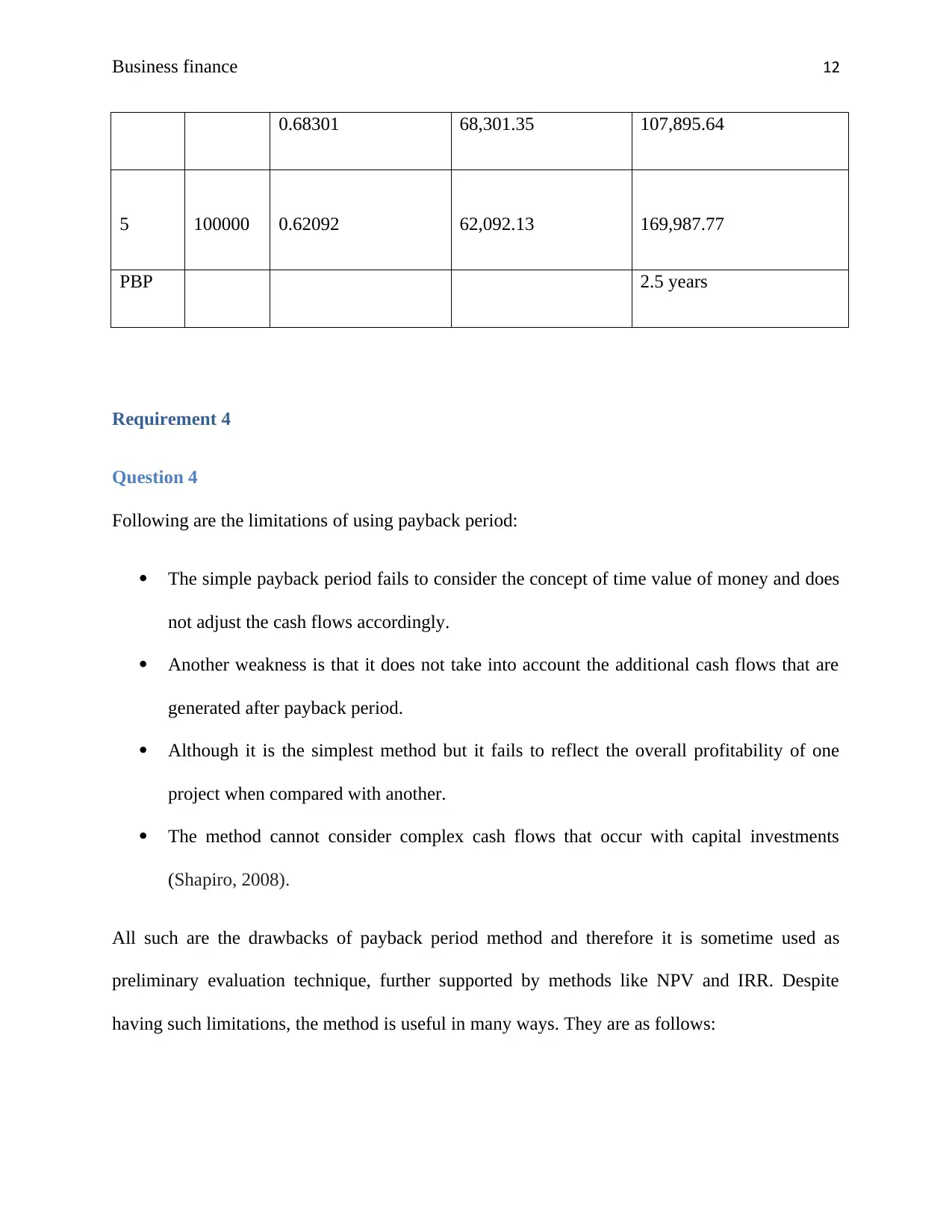
Discounted payback period is the modified PBP under which the cash flows are discounted for
calculating the payback period. This method takes into account the time value of money and
calculates the present values of future cash flows (Gotze, Northcott and Schuster, 2016). The
cash flows are discounted on the basis of company’s cost of capital. In case of Lez Foxwell
business, the discounting rate is 10% and two mutually exclusive projects are been discounted at
that rate.
Project
A
Years
Cash
flows pvf@10% Present values Cumulative present values
0 -300000 1.00000
-
300,000.00
1 50000 0.90909 45,454.55
-
254,545.45
2 50000 0.82645 41,322.31
-
213,223.14
3 50000 -
5 100000 300000
PBP 2 years
Question 3
Discounted payback period is the modified PBP under which the cash flows are discounted for
calculating the payback period. This method takes into account the time value of money and
calculates the present values of future cash flows (Gotze, Northcott and Schuster, 2016). The
cash flows are discounted on the basis of company’s cost of capital. In case of Lez Foxwell
business, the discounting rate is 10% and two mutually exclusive projects are been discounted at
that rate.
Project
A
Years
Cash
flows pvf@10% Present values Cumulative present values
0 -300000 1.00000
-
300,000.00
1 50000 0.90909 45,454.55
-
254,545.45
2 50000 0.82645 41,322.31
-
213,223.14
3 50000 -
Paraphrase This Document
Need a fresh take? Get an instant paraphrase of this document with our AI Paraphraser
Business finance 11
0.75131 37,565.74 175,657.40
4 150000 0.68301 102,452.02
-
73,205.38
5 430000 0.62092 266,996.17 193,790.79
PBP 4.27 years
Project
B
Years
Cash
flows pvf@10% Present values Cumulative present values
0 -300000 1.00000
-
300,000.00
1 200000 0.90909 181,818.18
-
118,181.82
2 100000 0.82645 82,644.63
-
35,537.19
3 100000 0.75131 75,131.48 39,594.29
4 100000
0.75131 37,565.74 175,657.40
4 150000 0.68301 102,452.02
-
73,205.38
5 430000 0.62092 266,996.17 193,790.79
PBP 4.27 years
Project
B
Years
Cash
flows pvf@10% Present values Cumulative present values
0 -300000 1.00000
-
300,000.00
1 200000 0.90909 181,818.18
-
118,181.82
2 100000 0.82645 82,644.63
-
35,537.19
3 100000 0.75131 75,131.48 39,594.29
4 100000
Business finance 12
0.68301 68,301.35 107,895.64
5 100000 0.62092 62,092.13 169,987.77
PBP 2.5 years
Requirement 4
Question 4
Following are the limitations of using payback period:
The simple payback period fails to consider the concept of time value of money and does
not adjust the cash flows accordingly.
Another weakness is that it does not take into account the additional cash flows that are
generated after payback period.
Although it is the simplest method but it fails to reflect the overall profitability of one
project when compared with another.
The method cannot consider complex cash flows that occur with capital investments
(Shapiro, 2008).
All such are the drawbacks of payback period method and therefore it is sometime used as
preliminary evaluation technique, further supported by methods like NPV and IRR. Despite
having such limitations, the method is useful in many ways. They are as follows:
0.68301 68,301.35 107,895.64
5 100000 0.62092 62,092.13 169,987.77
PBP 2.5 years
Requirement 4
Question 4
Following are the limitations of using payback period:
The simple payback period fails to consider the concept of time value of money and does
not adjust the cash flows accordingly.
Another weakness is that it does not take into account the additional cash flows that are
generated after payback period.
Although it is the simplest method but it fails to reflect the overall profitability of one
project when compared with another.
The method cannot consider complex cash flows that occur with capital investments
(Shapiro, 2008).
All such are the drawbacks of payback period method and therefore it is sometime used as
preliminary evaluation technique, further supported by methods like NPV and IRR. Despite
having such limitations, the method is useful in many ways. They are as follows:
⊘ This is a preview!⊘
Do you want full access?
Subscribe today to unlock all pages.
Trusted by 1+ million students worldwide

1 out of 19


Related Documents


Your All-in-One AI-Powered Toolkit for Academic Success.
+13062052269
info@desklib.com
Available 24*7 on WhatsApp / Email
![[object Object]](/_next/static/media/star-bottom.7253800d.svg)
Unlock your academic potential
Copyright © 2020–2026 A2Z Services. All Rights Reserved. Developed and managed by ZUCOL.