Business Finance Report: Excellence Electronic Ltd (EEL) Analysis
VerifiedAdded on 2020/01/07
|14
|3939
|204
Report
AI Summary
This report delves into the core concepts of business finance, specifically examining the differences between profitability and cash flow and their respective impacts on a company's financial accounts. It explores the critical concept of working capital management, outlining its significance and detailing strategies for improvement. Furthermore, the report provides a comprehensive understanding of the capital budgeting process, including investment appraisal methods, and analyzes their practical application to potential projects. The report uses Excellence Electronic Ltd (EEL) as a case study to illustrate the practical application of these concepts, offering insights into financial decision-making and strategic planning. The analysis covers the stages of capital budgeting, from opportunity identification to risk assessment, and emphasizes the importance of informed financial choices for achieving organizational goals. The report concludes with a discussion on the most appropriate capital budgeting method for the given case, providing a well-rounded overview of essential business finance principles.

BUSINESS FINANCE

Paraphrase This Document
Need a fresh take? Get an instant paraphrase of this document with our AI Paraphraser
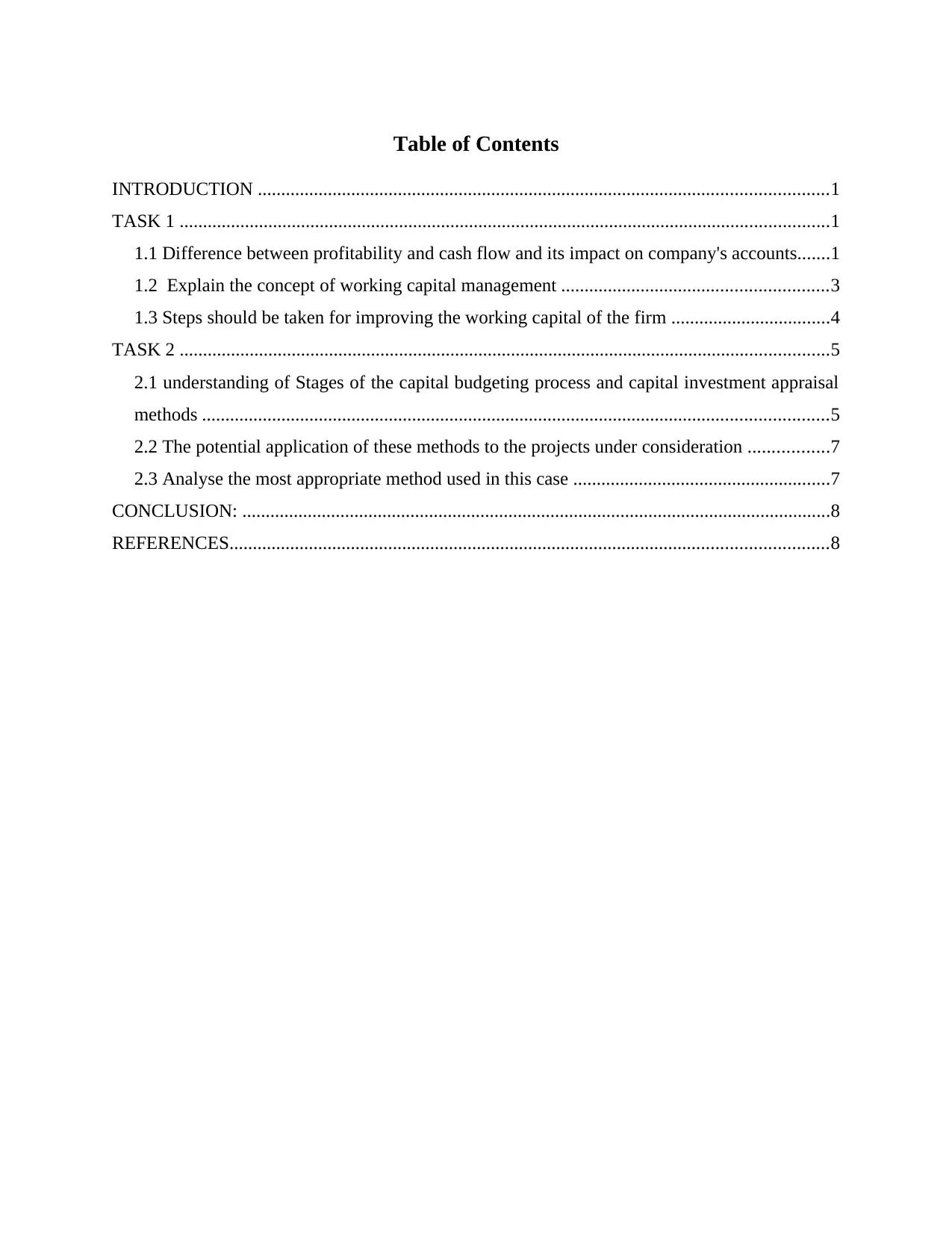
Table of Contents
INTRODUCTION ..........................................................................................................................1
TASK 1 ...........................................................................................................................................1
1.1 Difference between profitability and cash flow and its impact on company's accounts.......1
1.2 Explain the concept of working capital management .........................................................3
1.3 Steps should be taken for improving the working capital of the firm ..................................4
TASK 2 ...........................................................................................................................................5
2.1 understanding of Stages of the capital budgeting process and capital investment appraisal
methods ......................................................................................................................................5
2.2 The potential application of these methods to the projects under consideration .................7
2.3 Analyse the most appropriate method used in this case .......................................................7
CONCLUSION: ..............................................................................................................................8
REFERENCES................................................................................................................................8
INTRODUCTION ..........................................................................................................................1
TASK 1 ...........................................................................................................................................1
1.1 Difference between profitability and cash flow and its impact on company's accounts.......1
1.2 Explain the concept of working capital management .........................................................3
1.3 Steps should be taken for improving the working capital of the firm ..................................4
TASK 2 ...........................................................................................................................................5
2.1 understanding of Stages of the capital budgeting process and capital investment appraisal
methods ......................................................................................................................................5
2.2 The potential application of these methods to the projects under consideration .................7
2.3 Analyse the most appropriate method used in this case .......................................................7
CONCLUSION: ..............................................................................................................................8
REFERENCES................................................................................................................................8

⊘ This is a preview!⊘
Do you want full access?
Subscribe today to unlock all pages.

Trusted by 1+ million students worldwide
INTRODUCTION
Business finance consists of all the activities related to the finance and how company can
manage its money and and other assets in a manner so that they can effectively achieve the
organisation goals. Business finance includes all the accounting methods, financial terminologies
and debt management(Hillier, Grinblatt and Titman., 2011). Every company has the separate
finance department which takes the investment decisions, budget decision and other important
financial decision for the company. The main aim to understand the principal of business finance
is to earn profits.
In this report the company which is considered is excellence electronic Ltd (EEL). Which
produce the house hold appliances and the company is having the 3 factories in London(Berger
and Black., 2011). The have the large manufacturing clients like Canterbury Cookers Ltd and
Radios Formidables SA.
In this report the profitability and cash flow difference is mention and its affect on the
company accounts. The concept of working capital has been discuss in the report. The steps of
the capital budgeting and how it is implement on the particular project is mention in this report.
TASK 1
1.1 Difference between profitability and cash flow and its impact on company's accounts
Cash flow and profits are two different factors of finance they have different impact on
the company accounts. But these two has equal important to run a business. They face their
different issues while growing the company. The difference between cash flow and profits are as
follow.
Cash flow
cash flow consist the money money which is out flow and in flow into the firm. Cash is
prepared to analyse the flow of money inside and outside the organisation. It only involves the
transaction which is done in cash form. No transaction are include which are non cash-able.
Cash flow is prepared to meet the daily requirement of the money like paying the money to the
suppliers and receive the money from the customers. There are different scenario in cash flow
like it is not necessary the company earning the high profits has the adequate cash flow. In
context to the company if the EEL is selling its product to the customers and having the high
profits but the have the long supply chain as the money is receive the customers in longer period
1
Business finance consists of all the activities related to the finance and how company can
manage its money and and other assets in a manner so that they can effectively achieve the
organisation goals. Business finance includes all the accounting methods, financial terminologies
and debt management(Hillier, Grinblatt and Titman., 2011). Every company has the separate
finance department which takes the investment decisions, budget decision and other important
financial decision for the company. The main aim to understand the principal of business finance
is to earn profits.
In this report the company which is considered is excellence electronic Ltd (EEL). Which
produce the house hold appliances and the company is having the 3 factories in London(Berger
and Black., 2011). The have the large manufacturing clients like Canterbury Cookers Ltd and
Radios Formidables SA.
In this report the profitability and cash flow difference is mention and its affect on the
company accounts. The concept of working capital has been discuss in the report. The steps of
the capital budgeting and how it is implement on the particular project is mention in this report.
TASK 1
1.1 Difference between profitability and cash flow and its impact on company's accounts
Cash flow and profits are two different factors of finance they have different impact on
the company accounts. But these two has equal important to run a business. They face their
different issues while growing the company. The difference between cash flow and profits are as
follow.
Cash flow
cash flow consist the money money which is out flow and in flow into the firm. Cash is
prepared to analyse the flow of money inside and outside the organisation. It only involves the
transaction which is done in cash form. No transaction are include which are non cash-able.
Cash flow is prepared to meet the daily requirement of the money like paying the money to the
suppliers and receive the money from the customers. There are different scenario in cash flow
like it is not necessary the company earning the high profits has the adequate cash flow. In
context to the company if the EEL is selling its product to the customers and having the high
profits but the have the long supply chain as the money is receive the customers in longer period
1
Paraphrase This Document
Need a fresh take? Get an instant paraphrase of this document with our AI Paraphraser
but the company has to pay its suppliers in short period this leads to the inadequate flow of cash
and company face problem to face for daily expenses.
So company make sure to receive the amount from its client in a manner to they can pay
to suppliers on time. In send scenario the sales of the company increase but the profits are not.
Company is borrowing the money for solve its cash flow problem the debts also increase and it
leads to high cost and insolvency for the company.
Profitability
while the cash flow records the inflow and out flow. Profitability includes the revenues
and expenses of the company(Anandarajan, Anandarajan and Srinivasan., 2012). Profitability is
an accounting concept is doesn't deal take receivable and payable in profitability concept it only
deals with the revenues are coming and the expenses which are made. Profitability records all
those revenues and expenses which have to been done in the future. While cash flow includes
only current cash transactions.
The differences between cash flow and profitability on basis of the following points. Operating cash flow: operating activities include the cash transaction generating in the
business without considering the revenue and expenses. When company gets the advance
payment it effect on the company cash flow that they can pay the suppliers on time. But it
doesn't have any impact on the profitability. Non operating cash flow: cash flow is not only generate by the operating activities but
other activities also like selling the financial investment which increase the cash holding
but it has no impact on the revenue and expenses of company(Cole., 2013). Thus
purchasing and selling of investment doesn't have direct impact on the profitability of the
company. Non cash revenue: companies earn revenues which are not money related but it increase
the revenues in the company but has no impact on the receivable and payable of
company. When company get the money in future it increase the cash holding but have
no impact on the profitability.
Non cash expenses: as the company is facing the non cash expenses it decrease the
profitability but has no impact on the cash holding of company.
According to the case as the faulty workman refused to pay the amount the cash flow of
the company may affect by this as they have to pay the suppliers for the raw material. So they
2
and company face problem to face for daily expenses.
So company make sure to receive the amount from its client in a manner to they can pay
to suppliers on time. In send scenario the sales of the company increase but the profits are not.
Company is borrowing the money for solve its cash flow problem the debts also increase and it
leads to high cost and insolvency for the company.
Profitability
while the cash flow records the inflow and out flow. Profitability includes the revenues
and expenses of the company(Anandarajan, Anandarajan and Srinivasan., 2012). Profitability is
an accounting concept is doesn't deal take receivable and payable in profitability concept it only
deals with the revenues are coming and the expenses which are made. Profitability records all
those revenues and expenses which have to been done in the future. While cash flow includes
only current cash transactions.
The differences between cash flow and profitability on basis of the following points. Operating cash flow: operating activities include the cash transaction generating in the
business without considering the revenue and expenses. When company gets the advance
payment it effect on the company cash flow that they can pay the suppliers on time. But it
doesn't have any impact on the profitability. Non operating cash flow: cash flow is not only generate by the operating activities but
other activities also like selling the financial investment which increase the cash holding
but it has no impact on the revenue and expenses of company(Cole., 2013). Thus
purchasing and selling of investment doesn't have direct impact on the profitability of the
company. Non cash revenue: companies earn revenues which are not money related but it increase
the revenues in the company but has no impact on the receivable and payable of
company. When company get the money in future it increase the cash holding but have
no impact on the profitability.
Non cash expenses: as the company is facing the non cash expenses it decrease the
profitability but has no impact on the cash holding of company.
According to the case as the faulty workman refused to pay the amount the cash flow of
the company may affect by this as they have to pay the suppliers for the raw material. So they
2
lack of holding cash by the company which cause the problem to face daily expenses incurred by
company.
1.2 Explain the concept of working capital management
Working capital refers to the amount and fund at is to be need to meet day to day
expenses(Sengupta., 2011). Company has to make multiple of transaction in their daily routine
and the capital which is required for that is called working capital. It can be calculate by
following formula.
( Working capital = current assets – current liabilities)
working capital is required for the short term assets and short term liabilities. Working capital
treated as the blood in the organisation which circulate money inside and outside the
organisation. It is very important concept for every organisation. It shows the liquidity of the
firm. How effectively company can pay its creditors. Working capital is needed in very
department of the company to do its operations whether its human resources or it marketing
working capital is required for every level of the organisation.
Concept of working capital
Gross working capital: it includes the current assets of the company such as cash, stock,
debtors etc. It is fund which is required for the current assets of the company such as raw
material, work in progress, finished goods etc.
Net working capital: it studies the excess of the current assets over the current liability
Current assets includes the debtor, stock and cash where current liability consists of creditors,
payables etc.
In context to EEL the debt is increased by the last year. And this impact the working
capital of company as they need to more and if they doesn't get the receivable on time the
company can face the problem to pay its debts and it can impact on the image of company(Hill,
Perry and Andes., 2011). So company has decided to spend their investment in order to pay the
debts. It impact on the cash flow of the company because of imbalance in the payables and
receivables. The amount is also out standing from the faulty workman who is refused to pay the
amount and the case is files on the person so company has to make strategy by which they can
increase the level of holding money. So company can manage its working capital by investing in
other financial sources to get increase the sources of money. The company can use the cash flow
statement to examine where they need to invest and what is the current liquidity situation.
3
company.
1.2 Explain the concept of working capital management
Working capital refers to the amount and fund at is to be need to meet day to day
expenses(Sengupta., 2011). Company has to make multiple of transaction in their daily routine
and the capital which is required for that is called working capital. It can be calculate by
following formula.
( Working capital = current assets – current liabilities)
working capital is required for the short term assets and short term liabilities. Working capital
treated as the blood in the organisation which circulate money inside and outside the
organisation. It is very important concept for every organisation. It shows the liquidity of the
firm. How effectively company can pay its creditors. Working capital is needed in very
department of the company to do its operations whether its human resources or it marketing
working capital is required for every level of the organisation.
Concept of working capital
Gross working capital: it includes the current assets of the company such as cash, stock,
debtors etc. It is fund which is required for the current assets of the company such as raw
material, work in progress, finished goods etc.
Net working capital: it studies the excess of the current assets over the current liability
Current assets includes the debtor, stock and cash where current liability consists of creditors,
payables etc.
In context to EEL the debt is increased by the last year. And this impact the working
capital of company as they need to more and if they doesn't get the receivable on time the
company can face the problem to pay its debts and it can impact on the image of company(Hill,
Perry and Andes., 2011). So company has decided to spend their investment in order to pay the
debts. It impact on the cash flow of the company because of imbalance in the payables and
receivables. The amount is also out standing from the faulty workman who is refused to pay the
amount and the case is files on the person so company has to make strategy by which they can
increase the level of holding money. So company can manage its working capital by investing in
other financial sources to get increase the sources of money. The company can use the cash flow
statement to examine where they need to invest and what is the current liquidity situation.
3
⊘ This is a preview!⊘
Do you want full access?
Subscribe today to unlock all pages.
Trusted by 1+ million students worldwide
According to that company take the decision. Company should contacts its customers to collect
the money. Company also can get the more projects and take the advance from the customers to
pay the debts.
1.3 Steps should be taken for improving the working capital of the firm
Maintaining the proper working capital important for the company to need its daily
expenses. For this company has to maintain the proper balance between the current assets and
current liabilities. There are different ways by which company can mange its working capital
effectively and efficiently. Following are the ways to improve the company's working capital. Prepare proper cash flow forecast: In this company can prepare the cash flow for the
future so that they can get the idea of future uncertainties and how it can impact on the
business performances. It also gives the anticipated demand of the cash flow. Create the plans for future unexpected events: company should make the strategies to
prevent from the future uncertainty risks. If the company is making the profits then also
it is important to make future plans. Company can adopt the risk management process to
prevent the unexpected events. Prepare effective procedure for the disputes: this step include the customer. The
company should properly establish the procedure for any disputes which can take place
in the future. The company should regular records the cash collection, sales entry in the
books to have the transparency. The customer also collect money from the customer
with work has been done. So that it reduce the blockage of money.
Good information system: by having the good information system company can
improve its working capital the system such as customer payment tracker, ERP system
and also company should design the software system according to the nature of the
company and its structure.
These are ways by which company can improve its working capital EEL can adopt effective
procedure for the disputes in this case because they are customers who are not paying the amount
after completion of project(Kotz, Kozubowski and Podgorski 2012).
4
the money. Company also can get the more projects and take the advance from the customers to
pay the debts.
1.3 Steps should be taken for improving the working capital of the firm
Maintaining the proper working capital important for the company to need its daily
expenses. For this company has to maintain the proper balance between the current assets and
current liabilities. There are different ways by which company can mange its working capital
effectively and efficiently. Following are the ways to improve the company's working capital. Prepare proper cash flow forecast: In this company can prepare the cash flow for the
future so that they can get the idea of future uncertainties and how it can impact on the
business performances. It also gives the anticipated demand of the cash flow. Create the plans for future unexpected events: company should make the strategies to
prevent from the future uncertainty risks. If the company is making the profits then also
it is important to make future plans. Company can adopt the risk management process to
prevent the unexpected events. Prepare effective procedure for the disputes: this step include the customer. The
company should properly establish the procedure for any disputes which can take place
in the future. The company should regular records the cash collection, sales entry in the
books to have the transparency. The customer also collect money from the customer
with work has been done. So that it reduce the blockage of money.
Good information system: by having the good information system company can
improve its working capital the system such as customer payment tracker, ERP system
and also company should design the software system according to the nature of the
company and its structure.
These are ways by which company can improve its working capital EEL can adopt effective
procedure for the disputes in this case because they are customers who are not paying the amount
after completion of project(Kotz, Kozubowski and Podgorski 2012).
4
Paraphrase This Document
Need a fresh take? Get an instant paraphrase of this document with our AI Paraphraser
TASK 2
2.1 understanding of Stages of the capital budgeting process and capital investment appraisal
methods
Capital budgeting is very important decision in the marketing where company has to
choose the most profitable project and this profitability can measure on the basis of returns of the
project(Yazdipour., 2012). The company choose the project on the basis of return and time of the
project if the project is not profitable in long duration so company company should not go for
that project. Sometime to minimizing the risk company opt both project according to capital
availability. Following are the capital budgeting process stages. Identify and evaluate the potential opportunities: first step is to identify the
opportunities companies have the many choices and company has to identify the best
project for company profitability. In this case there are two project Leeds and Bristol
which is treated as the opportunities for the company to get invest. After this company
has to choose the right project according to the company needs and finance available
with company. Estimate the cost: after identify the projects company need to estimate the operation
and implementation cost of the project. For this company has to do more internal and
external research the company has to evaluate the cost incurred on the project. In
context to the EEL the company has two project and company has the finance to execute
only one of them so they have to decide which project they want to go. Estimate cash flow and benefit: after estimate the cost now the company see the cash
flow which can generate from the projects. What is the excepted return the company
gets by choosing the particular project. Company has to choose the project according to
need of the company in this EEL has a need of profitability so they can choose the
project with the high returns that is Leeds project which give high return. And if the
company want to choose the project which take less time then company can go for the
Bristol project having the less duration. Assess risk: next step is to asses the risk involve in the project the company should not
go for the project which is having the high risk. This can cause the loose of profits and
increase in debts.
5
2.1 understanding of Stages of the capital budgeting process and capital investment appraisal
methods
Capital budgeting is very important decision in the marketing where company has to
choose the most profitable project and this profitability can measure on the basis of returns of the
project(Yazdipour., 2012). The company choose the project on the basis of return and time of the
project if the project is not profitable in long duration so company company should not go for
that project. Sometime to minimizing the risk company opt both project according to capital
availability. Following are the capital budgeting process stages. Identify and evaluate the potential opportunities: first step is to identify the
opportunities companies have the many choices and company has to identify the best
project for company profitability. In this case there are two project Leeds and Bristol
which is treated as the opportunities for the company to get invest. After this company
has to choose the right project according to the company needs and finance available
with company. Estimate the cost: after identify the projects company need to estimate the operation
and implementation cost of the project. For this company has to do more internal and
external research the company has to evaluate the cost incurred on the project. In
context to the EEL the company has two project and company has the finance to execute
only one of them so they have to decide which project they want to go. Estimate cash flow and benefit: after estimate the cost now the company see the cash
flow which can generate from the projects. What is the excepted return the company
gets by choosing the particular project. Company has to choose the project according to
need of the company in this EEL has a need of profitability so they can choose the
project with the high returns that is Leeds project which give high return. And if the
company want to choose the project which take less time then company can go for the
Bristol project having the less duration. Assess risk: next step is to asses the risk involve in the project the company should not
go for the project which is having the high risk. This can cause the loose of profits and
increase in debts.
5
Implementation:by following the above steps the last step is to implement the project.
All the resources should allocate in a proper manner so that they can save the cost and
also delver the quality of project. Company records the every year cash flow from the
project and cost incurred in each year. The company also record the time taken for
completion of project(Kennickell, Kwast and Pogach., 2016).
To evaluate the return and to choose the best project company adopt the capital appraisal
method which shows which project gives the high return and in how much duration. Following
are the different appraisal methods. Net present value method: the company measure the cash flow of projects whether it is a
short and excess. The project is chosen by the company which is having the positive
NPV. NPV is most relevant method used by the company to choose the project. In this
the cash flow is given and company evaluate the cash flow to have the returns. The
method is involving the mathematical calculation. In some case there is discount rates
and another there is no discount rate take into consideration. Accounting rate of return: In this method the earned profit is compare with the initial
cost of the project. Project which have the higher returns is preferably chosen then the
project which has less return. AAR method do not take NPV into consideration. There is
no discounting in this method. Profitability index: it is calculated by the formula. It calculate the value per investment.
This method is shows the ratio money investment to the profits earn by the project. Internal rate of return: in this method the discounting rate can be measure. The project
can be select when the discounting rate of return make the NPV zero. This method
measure the efficiency of the project. Is cost of the capital is higher than IRR value then
project should be rejected. Both IRR AND NPV both are related to the capital techniques.
But they are different from each other. Adjusted present value: this method evaluate the risk that is involved in the both of the
project. The company has to choose the project having the lesser risk. Payback period: this method study about the time taken for the particular investment to
get the returns. It is the easiest method among the all the method to calculate the most
effective project. The project which having the shortest period has to be decided. In this
6
All the resources should allocate in a proper manner so that they can save the cost and
also delver the quality of project. Company records the every year cash flow from the
project and cost incurred in each year. The company also record the time taken for
completion of project(Kennickell, Kwast and Pogach., 2016).
To evaluate the return and to choose the best project company adopt the capital appraisal
method which shows which project gives the high return and in how much duration. Following
are the different appraisal methods. Net present value method: the company measure the cash flow of projects whether it is a
short and excess. The project is chosen by the company which is having the positive
NPV. NPV is most relevant method used by the company to choose the project. In this
the cash flow is given and company evaluate the cash flow to have the returns. The
method is involving the mathematical calculation. In some case there is discount rates
and another there is no discount rate take into consideration. Accounting rate of return: In this method the earned profit is compare with the initial
cost of the project. Project which have the higher returns is preferably chosen then the
project which has less return. AAR method do not take NPV into consideration. There is
no discounting in this method. Profitability index: it is calculated by the formula. It calculate the value per investment.
This method is shows the ratio money investment to the profits earn by the project. Internal rate of return: in this method the discounting rate can be measure. The project
can be select when the discounting rate of return make the NPV zero. This method
measure the efficiency of the project. Is cost of the capital is higher than IRR value then
project should be rejected. Both IRR AND NPV both are related to the capital techniques.
But they are different from each other. Adjusted present value: this method evaluate the risk that is involved in the both of the
project. The company has to choose the project having the lesser risk. Payback period: this method study about the time taken for the particular investment to
get the returns. It is the easiest method among the all the method to calculate the most
effective project. The project which having the shortest period has to be decided. In this
6
⊘ This is a preview!⊘
Do you want full access?
Subscribe today to unlock all pages.
Trusted by 1+ million students worldwide
case according to this method company should choose the second project which is bistro
it incurred the less cost and the duration time is also less.
Modified internal rate of return: MIRR method is another technique in the capital
budgeting. This method doesn't take cash flow into the consideration. Its calculate the
capital investment assuming that reinvestment rate are equal to the cost of capital of the
company.
2.2 The potential application of these methods to the projects under consideration
Company can use these methods to choose the the profitable project. Different company
can use different method according to their needs. Company also use the multiple method to
chose the correct project. Because it is very important to choose right project as it incurred lot of
cost and time(Covas and Den Haan., 2012). EEL can use the NPV method to evaluate the both of
the project because the main aim of the company is to earn profits and this method show the
project which can give high returns to company and it also help to pay the debt which company
has.
In the above methods the most easiest one is pay back period in which the company can
choose the most shortest duration project without having the any mathematical formulas. The
most complex one is IRR method in which the company have to calculate the and assume the
rate of returns again and again still the time the NPV becomes zero. This method takes more time
and cost for the company(Brealey and et. al., 2012). One mistake can tends to repeat the same
procedure. Among all the methods the more relevant one is NPV it gives the systematic frame
work to the organisation and in advance only the company get its annual cash flows. This can
help the company to prevent the uncertainty risks. As per the ARR method the companies how
needs the higher profit can use this method. Because this method is help the company to choose
the most profitable project. In PI method this method used to compare the cost of the project and
the profit earn by the project. This tends to accept the project which has high profits over the
cost.
2.3 Analyse the most appropriate method used in this case
The company can use multiple methods like NPV. ARR, IRR, PI etc. to get more relevant
method and correct decision. EEL has the 2 project lees and Bristol . Leeds if incurring high cost
with long run period. Whether bistro incurred the low investment cost with less time. On the
basic of profitability the company should go for Leeds as its having the high cost with high
7
it incurred the less cost and the duration time is also less.
Modified internal rate of return: MIRR method is another technique in the capital
budgeting. This method doesn't take cash flow into the consideration. Its calculate the
capital investment assuming that reinvestment rate are equal to the cost of capital of the
company.
2.2 The potential application of these methods to the projects under consideration
Company can use these methods to choose the the profitable project. Different company
can use different method according to their needs. Company also use the multiple method to
chose the correct project. Because it is very important to choose right project as it incurred lot of
cost and time(Covas and Den Haan., 2012). EEL can use the NPV method to evaluate the both of
the project because the main aim of the company is to earn profits and this method show the
project which can give high returns to company and it also help to pay the debt which company
has.
In the above methods the most easiest one is pay back period in which the company can
choose the most shortest duration project without having the any mathematical formulas. The
most complex one is IRR method in which the company have to calculate the and assume the
rate of returns again and again still the time the NPV becomes zero. This method takes more time
and cost for the company(Brealey and et. al., 2012). One mistake can tends to repeat the same
procedure. Among all the methods the more relevant one is NPV it gives the systematic frame
work to the organisation and in advance only the company get its annual cash flows. This can
help the company to prevent the uncertainty risks. As per the ARR method the companies how
needs the higher profit can use this method. Because this method is help the company to choose
the most profitable project. In PI method this method used to compare the cost of the project and
the profit earn by the project. This tends to accept the project which has high profits over the
cost.
2.3 Analyse the most appropriate method used in this case
The company can use multiple methods like NPV. ARR, IRR, PI etc. to get more relevant
method and correct decision. EEL has the 2 project lees and Bristol . Leeds if incurring high cost
with long run period. Whether bistro incurred the low investment cost with less time. On the
basic of profitability the company should go for Leeds as its having the high cost with high
7
Paraphrase This Document
Need a fresh take? Get an instant paraphrase of this document with our AI Paraphraser
returns. The company can evaluate the very year cash flow to see the efficiency of the projects.
When the company generate the high cash flow from the project it can simultaneously pay the its
debts. Also by having the generating the cash flows by this company can hold more money
which improves the liquidity of the firm(Quinn., 2012). So from the above discussion it is clear
that the company should use the NPV. To solve this case because it give more relevant results to
the company. The second preferable method is ARR which give clear understanding to the
organisation to choose the project which has the higher return over its cost. APV method
indicates to choose the project which has the lesser risk. Company can use the one or two method
to choose the right project. So that they can achieve their goals set by the company.
CONCLUSION:
This project is based upon the business finance where the company has to make the
decision which can increase the profit of the company. All the activities related to the finance has
been taken into the consideration. In first part of the report difference between profit and cash
flow has been mention(Li., 2015). After the concept of working capital has been discuss and how
working capital play important role in the organisation and how company can improve its
working capital by using different steps. In second part of the report the discussion has been
made on capital budgeting. What are the techniques of capital budgeting as been discuss and
which method should company used to choose the right project.
8
When the company generate the high cash flow from the project it can simultaneously pay the its
debts. Also by having the generating the cash flows by this company can hold more money
which improves the liquidity of the firm(Quinn., 2012). So from the above discussion it is clear
that the company should use the NPV. To solve this case because it give more relevant results to
the company. The second preferable method is ARR which give clear understanding to the
organisation to choose the project which has the higher return over its cost. APV method
indicates to choose the project which has the lesser risk. Company can use the one or two method
to choose the right project. So that they can achieve their goals set by the company.
CONCLUSION:
This project is based upon the business finance where the company has to make the
decision which can increase the profit of the company. All the activities related to the finance has
been taken into the consideration. In first part of the report difference between profit and cash
flow has been mention(Li., 2015). After the concept of working capital has been discuss and how
working capital play important role in the organisation and how company can improve its
working capital by using different steps. In second part of the report the discussion has been
made on capital budgeting. What are the techniques of capital budgeting as been discuss and
which method should company used to choose the right project.
8
REFERENCES
Books and journals
Anandarajan, M., Anandarajan, A. and Srinivasan, C.A. eds., 2012. Business intelligence
techniques: a perspective from accounting and finance. Springer Science & Business
Media.
Berger, A.N. and Black, L.K., 2011. Bank size, lending technologies, and small business finance.
Journal of Banking & Finance. 35(3). pp.724-735.
Brealey, R.A and et. al., 2012. Principles of corporate finance. Tata McGraw-Hill Education.
Cole, R.A., 2013. What do we know about the capital structure of privately held US firms
Evidence from the surveys of small business finance. Financial Management. 42(4).
pp.777-813.
Covas, F. and Den Haan, W.J., 2012. The role of debt and equity finance over the business cycle.
The Economic Journal. 122(565). pp.1262-1286.
Hill, N.T., Perry, S.E. and Andes, S., 2011. Evaluating firms in financial distress: An event
history analysis. Journal of Applied Business Research (JABR). 12(3). pp.60-71.
Hillier, D., Grinblatt, M. and Titman, S., 2011. Financial markets and corporate strategy.
McGraw Hill.
Kennickell, A.B., Kwast, M.L. and Pogach, J., 2016. Small businesses and small business
finance during the financial crisis and the Great Recession: New evidence from the
survey of consumer finances. In Measuring Entrepreneurial Businesses: Current
Knowledge and Challenges. University of Chicago Press.
Kotz, S., Kozubowski, T. and Podgorski, K., 2012. The Laplace distribution and generalizations:
a revisit with applications to communications, economics, engineering, and finance.
Springer Science & Business Media.
Li, X., 2015. Accounting conservatism and the cost of capital: An international analysis. Journal
of Business Finance & Accounting. 42(5-6). pp.555-582.
Quinn, K.G., 2012. Introduction. In The Economics of the National Football League (pp. 1-3).
Springer New York.
Sengupta, A., 2011. Network strategy and access to business finance: Indian entrepreneurs in the
information and communication technology industry. The Journal of Entrepreneurship.
20(1). pp.103-126.
Yazdipour, R. ed., 2012. Advances in small business finance (Vol. 21). Springer Science &
Business Media.
Online
5 Steps Of Capital Budgeting. 1995-17. [online]. Available
Through:<www.fool.com/knowledge-center/the-5-steps-to-capital-budgeting.aspx>.
[Acessed on 8th may 2017].
Difference Between Cash Flow And Profitability. 2017. [online]. Available
Through:<https://www.commercebank.com/.../the-difference-between-cash-flow-and-
profit.asp>. [Acessed on 8th may 2017].
Working Capital: Meaning, Concept & Nature – Explained. 2016 .[ online]. Available
Through:<www.yourarticlelibrary.com/...management/working-capital/working-capital-
meaning...>. [Acessed on 8th may 2017].
9
Books and journals
Anandarajan, M., Anandarajan, A. and Srinivasan, C.A. eds., 2012. Business intelligence
techniques: a perspective from accounting and finance. Springer Science & Business
Media.
Berger, A.N. and Black, L.K., 2011. Bank size, lending technologies, and small business finance.
Journal of Banking & Finance. 35(3). pp.724-735.
Brealey, R.A and et. al., 2012. Principles of corporate finance. Tata McGraw-Hill Education.
Cole, R.A., 2013. What do we know about the capital structure of privately held US firms
Evidence from the surveys of small business finance. Financial Management. 42(4).
pp.777-813.
Covas, F. and Den Haan, W.J., 2012. The role of debt and equity finance over the business cycle.
The Economic Journal. 122(565). pp.1262-1286.
Hill, N.T., Perry, S.E. and Andes, S., 2011. Evaluating firms in financial distress: An event
history analysis. Journal of Applied Business Research (JABR). 12(3). pp.60-71.
Hillier, D., Grinblatt, M. and Titman, S., 2011. Financial markets and corporate strategy.
McGraw Hill.
Kennickell, A.B., Kwast, M.L. and Pogach, J., 2016. Small businesses and small business
finance during the financial crisis and the Great Recession: New evidence from the
survey of consumer finances. In Measuring Entrepreneurial Businesses: Current
Knowledge and Challenges. University of Chicago Press.
Kotz, S., Kozubowski, T. and Podgorski, K., 2012. The Laplace distribution and generalizations:
a revisit with applications to communications, economics, engineering, and finance.
Springer Science & Business Media.
Li, X., 2015. Accounting conservatism and the cost of capital: An international analysis. Journal
of Business Finance & Accounting. 42(5-6). pp.555-582.
Quinn, K.G., 2012. Introduction. In The Economics of the National Football League (pp. 1-3).
Springer New York.
Sengupta, A., 2011. Network strategy and access to business finance: Indian entrepreneurs in the
information and communication technology industry. The Journal of Entrepreneurship.
20(1). pp.103-126.
Yazdipour, R. ed., 2012. Advances in small business finance (Vol. 21). Springer Science &
Business Media.
Online
5 Steps Of Capital Budgeting. 1995-17. [online]. Available
Through:<www.fool.com/knowledge-center/the-5-steps-to-capital-budgeting.aspx>.
[Acessed on 8th may 2017].
Difference Between Cash Flow And Profitability. 2017. [online]. Available
Through:<https://www.commercebank.com/.../the-difference-between-cash-flow-and-
profit.asp>. [Acessed on 8th may 2017].
Working Capital: Meaning, Concept & Nature – Explained. 2016 .[ online]. Available
Through:<www.yourarticlelibrary.com/...management/working-capital/working-capital-
meaning...>. [Acessed on 8th may 2017].
9
⊘ This is a preview!⊘
Do you want full access?
Subscribe today to unlock all pages.
Trusted by 1+ million students worldwide

1 out of 14


Related Documents


Your All-in-One AI-Powered Toolkit for Academic Success.
+13062052269
info@desklib.com
Available 24*7 on WhatsApp / Email
![[object Object]](/_next/static/media/star-bottom.7253800d.svg)
Unlock your academic potential
Copyright © 2020–2025 A2Z Services. All Rights Reserved. Developed and managed by ZUCOL.