Financial Management Report: Financial Statement Analysis and Methods
VerifiedAdded on 2022/11/24
|13
|2838
|494
Report
AI Summary
This report provides an in-depth analysis of financial management, beginning with an introduction to the core concepts and its importance within a business context. It then delves into the preparation and significance of financial statements, including income statements, cash flow statements, balance sheets, and statements of shareholders' equity. The report emphasizes the use of financial ratios, such as profitability, liquidity, and solvency ratios, to evaluate a company's financial health and performance. Practical templates and examples are incorporated to demonstrate the application of these concepts. Furthermore, the report offers recommendations on methods to improve financial performance, including strategies to enhance customer relationships, optimize cash flow, and boost profitability through expense control and revenue generation. The conclusion summarizes the key findings and underscores the crucial role of financial management in achieving business objectives.

BUSINESS FINANCE

Paraphrase This Document
Need a fresh take? Get an instant paraphrase of this document with our AI Paraphraser
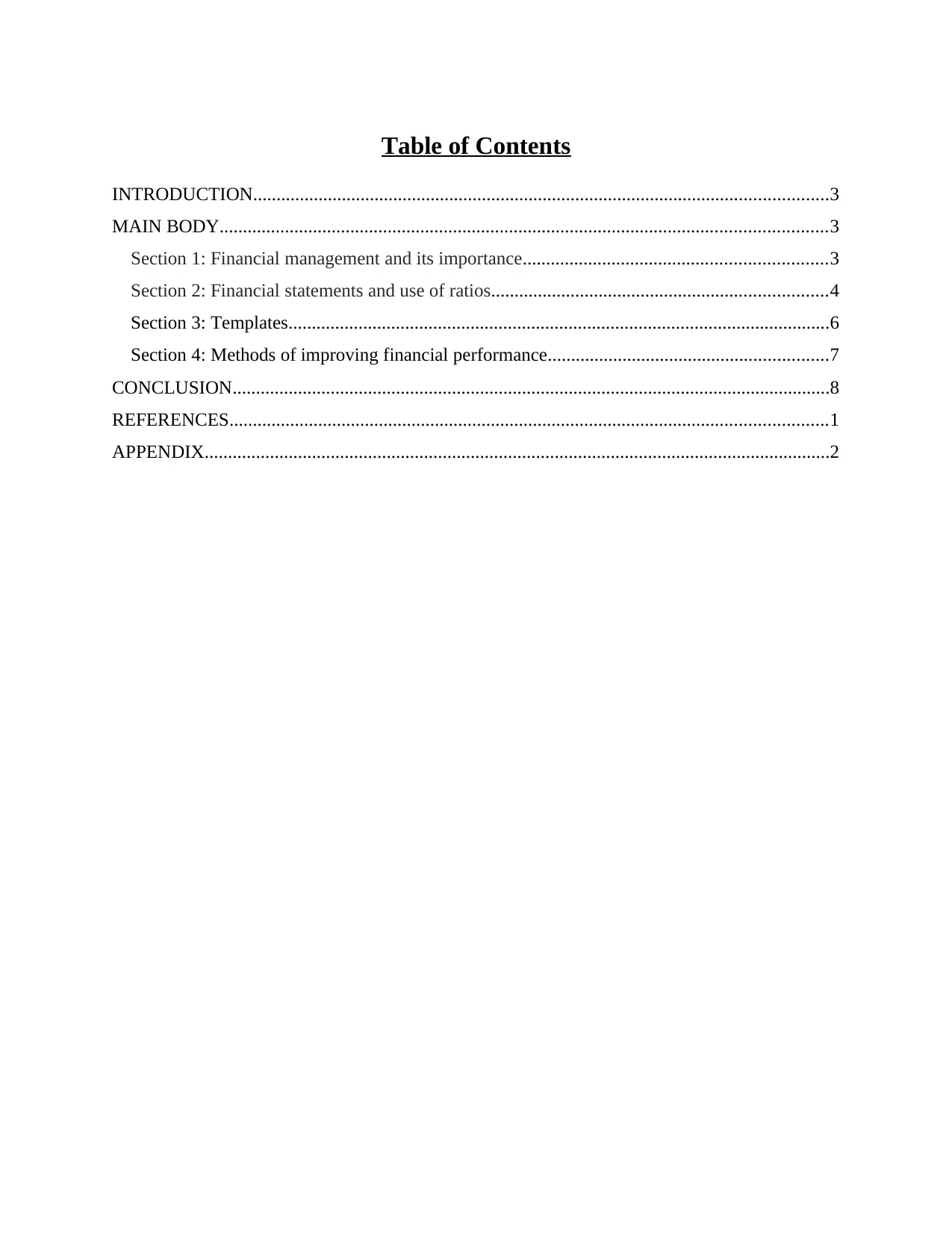
Table of Contents
INTRODUCTION...........................................................................................................................3
MAIN BODY..................................................................................................................................3
Section 1: Financial management and its importance.................................................................3
Section 2: Financial statements and use of ratios........................................................................4
Section 3: Templates....................................................................................................................6
Section 4: Methods of improving financial performance............................................................7
CONCLUSION................................................................................................................................8
REFERENCES................................................................................................................................1
APPENDIX......................................................................................................................................2
INTRODUCTION...........................................................................................................................3
MAIN BODY..................................................................................................................................3
Section 1: Financial management and its importance.................................................................3
Section 2: Financial statements and use of ratios........................................................................4
Section 3: Templates....................................................................................................................6
Section 4: Methods of improving financial performance............................................................7
CONCLUSION................................................................................................................................8
REFERENCES................................................................................................................................1
APPENDIX......................................................................................................................................2

INTRODUCTION
Finance refers to the blood the company that will lead to the running and operation of the
company's operation. It is the major aspect with regard to company that will lead to have actual
performance of business operation. Financial management refers to a process of finance
management that will ensure availability and utilization of finance. This report will discuss about
the concept of financial management, its importance along with financial statement preparation
and ratio analysis. A practical approach is also presented within this report regarding financial
statement's preparation.
MAIN BODY
Section 1: Financial management and its importance
Financial management:
It refers to a process under which various activities related with planning, organizing,
directing and controlling related with financial activities are undertaken. This will lead to
efficiently utilization of funds (Brigham and Houston, 2021). It would also be right to said that
under the concept of financial management various concepts and aspects of management are
applied so that better utilization of finance will take place.
In orders words financial management means the management and utilization of finance
with the involvement of decision-making concept so that organization will be directed towards
the direction of its objectives in terms of the better grabbing of profits and revenues.
Importance:
Financial planning:
Financial management will lead to have a making of appropriate financial plan. Under
this necessary financial activities with respect to company's finance are undertaken.\
Fund allocation:
This is also a major importance of financial management. This concept will lead to have
adequate allocation of finance among various assets and parts of business (Siekelova and et.al.,
2017). This will further lead to growth enhancement.
Financial decision:
As the financial management involves the preparation of financial statement so with the
help of those statements, company's position can be determined and as a result most appropriate
Finance refers to the blood the company that will lead to the running and operation of the
company's operation. It is the major aspect with regard to company that will lead to have actual
performance of business operation. Financial management refers to a process of finance
management that will ensure availability and utilization of finance. This report will discuss about
the concept of financial management, its importance along with financial statement preparation
and ratio analysis. A practical approach is also presented within this report regarding financial
statement's preparation.
MAIN BODY
Section 1: Financial management and its importance
Financial management:
It refers to a process under which various activities related with planning, organizing,
directing and controlling related with financial activities are undertaken. This will lead to
efficiently utilization of funds (Brigham and Houston, 2021). It would also be right to said that
under the concept of financial management various concepts and aspects of management are
applied so that better utilization of finance will take place.
In orders words financial management means the management and utilization of finance
with the involvement of decision-making concept so that organization will be directed towards
the direction of its objectives in terms of the better grabbing of profits and revenues.
Importance:
Financial planning:
Financial management will lead to have a making of appropriate financial plan. Under
this necessary financial activities with respect to company's finance are undertaken.\
Fund allocation:
This is also a major importance of financial management. This concept will lead to have
adequate allocation of finance among various assets and parts of business (Siekelova and et.al.,
2017). This will further lead to growth enhancement.
Financial decision:
As the financial management involves the preparation of financial statement so with the
help of those statements, company's position can be determined and as a result most appropriate
⊘ This is a preview!⊘
Do you want full access?
Subscribe today to unlock all pages.

Trusted by 1+ million students worldwide
and better decision with respect to company betterment will be taken (Damayanti, Murtaqi and
Pradana, 2018).
Utilization of funds:
As financial management involves decision-making so it will lead to have a better
utilization of funds that will direct the company towards the direction of its goal
accomplishment.
Importance to public:
As these statements are the reflection of the company's financial performance so it will
play an important role with regard to public. This is because through these statements public can
know the company and its financial efficiency.
Section 2: Financial statements and use of ratios
Financial statements:
These are the statements that depicts the financial position of the company. It includes
those statements and activities that will lead to have depiction of the financial performance of the
company (Osadchy and et.al., 2018).
Importance:
Important to stakeholders:
Financial statements plays an important role with respect to stakeholders. This will assist
them to take adequate decision with respect to company. As these statements depict the financial
position so with the help of these statements financial and various other decisions are taken by
concerned stakeholders.
Analyse company's performance:
With the use of financial statements the company's performance in terms of financial
condition can be analysed easily. This will assist the management to determine whether they are
moving in right direction towards company's goal or not.
Controlling and monitoring:
Financial statements also act as a base that will lead to have monitoring of the company's
financial performance. Also, these statements enable the management to take adequate decisions
so that loopholes and deviation with respect to financial performance of the company can be
improvised.
Pradana, 2018).
Utilization of funds:
As financial management involves decision-making so it will lead to have a better
utilization of funds that will direct the company towards the direction of its goal
accomplishment.
Importance to public:
As these statements are the reflection of the company's financial performance so it will
play an important role with regard to public. This is because through these statements public can
know the company and its financial efficiency.
Section 2: Financial statements and use of ratios
Financial statements:
These are the statements that depicts the financial position of the company. It includes
those statements and activities that will lead to have depiction of the financial performance of the
company (Osadchy and et.al., 2018).
Importance:
Important to stakeholders:
Financial statements plays an important role with respect to stakeholders. This will assist
them to take adequate decision with respect to company. As these statements depict the financial
position so with the help of these statements financial and various other decisions are taken by
concerned stakeholders.
Analyse company's performance:
With the use of financial statements the company's performance in terms of financial
condition can be analysed easily. This will assist the management to determine whether they are
moving in right direction towards company's goal or not.
Controlling and monitoring:
Financial statements also act as a base that will lead to have monitoring of the company's
financial performance. Also, these statements enable the management to take adequate decisions
so that loopholes and deviation with respect to financial performance of the company can be
improvised.
Paraphrase This Document
Need a fresh take? Get an instant paraphrase of this document with our AI Paraphraser
Types of financial statements:
Income statement:
It is an important statement which shows the income and expenditure associated with the
company (Statements, 2020). Through this statement company can analyse that whether it is
making profit or loss. In short financial health of the company can be determined with these
statements.
Statement of cash flow:
This statement is used to analyse the company's cash flow position. This means that
through this statement company can determine its cash inflows and outflows.
Balance sheet:
It refers to that statement by which adequate reporting related with company's assets,
liabilities and shareholder equity related details can be analysed. It is usually prepared at the end
of the financial year (Daniel, Marioara and Isabela, 2017).
Statements of shareholders' equity:
It is part of balance sheet which shows changes in the share value of stockholders and the
equity shareholders. Changes in ownership interest will also be analysed with this statements.
Financial ratio:
These are the ratio which are financially evolved and related. These ratios are the
depiction of the company financial performance. Ratios are calculated on the basis of analysis of
the financial statements.
Importance:
Financial ratios are very important with respect to company and analysis of its
performance. These can also be used as benchmark with respect to measurement of company's
performance. As there are various kinds of financial ratio including profitability, liquidity,
solvency and various other so with the analysis of these ratios financial position of the company
can be determined easily (Kadim, Sunardi and Husain, 2020). As liquidity ratio including current
and quick ratio enable the company to determine its liquidity in terms of payment of short term
obligations will be determined. Likewise, with the calculation of profitability ratio including net
or gross profit, company's capability in terms of profitability will be analysed. However, with the
calculation of solvency ratio like debt to equity, interest coverage and various others, company
can determine its capacity with respect to the repayment of its long term obligations. In addition,
Income statement:
It is an important statement which shows the income and expenditure associated with the
company (Statements, 2020). Through this statement company can analyse that whether it is
making profit or loss. In short financial health of the company can be determined with these
statements.
Statement of cash flow:
This statement is used to analyse the company's cash flow position. This means that
through this statement company can determine its cash inflows and outflows.
Balance sheet:
It refers to that statement by which adequate reporting related with company's assets,
liabilities and shareholder equity related details can be analysed. It is usually prepared at the end
of the financial year (Daniel, Marioara and Isabela, 2017).
Statements of shareholders' equity:
It is part of balance sheet which shows changes in the share value of stockholders and the
equity shareholders. Changes in ownership interest will also be analysed with this statements.
Financial ratio:
These are the ratio which are financially evolved and related. These ratios are the
depiction of the company financial performance. Ratios are calculated on the basis of analysis of
the financial statements.
Importance:
Financial ratios are very important with respect to company and analysis of its
performance. These can also be used as benchmark with respect to measurement of company's
performance. As there are various kinds of financial ratio including profitability, liquidity,
solvency and various other so with the analysis of these ratios financial position of the company
can be determined easily (Kadim, Sunardi and Husain, 2020). As liquidity ratio including current
and quick ratio enable the company to determine its liquidity in terms of payment of short term
obligations will be determined. Likewise, with the calculation of profitability ratio including net
or gross profit, company's capability in terms of profitability will be analysed. However, with the
calculation of solvency ratio like debt to equity, interest coverage and various others, company
can determine its capacity with respect to the repayment of its long term obligations. In addition,
of this with the help of ratio analysis, company can make measurement of its performance with
regard to other companies and in case of any discrepancies corrective actions will be taken.
Thus, it would not be wrong to said that the financial ratios plays an important role with
respect to financial management. This is because it will act as base that will lead to have
financial planning and management of finance as per derived outcome of the financial ratio.
Section 3: Templates
(iv) Analysis:
Profitability:
It is an important aspect with regard to company and its performance. A company with a
good percentage of profitability and profit percentage would indicate efficient performance. This
means that the company is running its business in profitability state. As the main objective of
every company is to earn profits and if the company's profitability state is showing a rising phase
then it means that the company is grabbing and directing towards its objectives. This can further
be understood with the profitability ratio that may include the gross profit and net profit ratio. As
the gross profit is the ratio of gross profit and turnover which shows that the amount of money
which is being left after having a deduction of cost of production. However, in case of net profit,
it is an indication of the actual and net profit which is being left after having a deduction of all
the expenses.
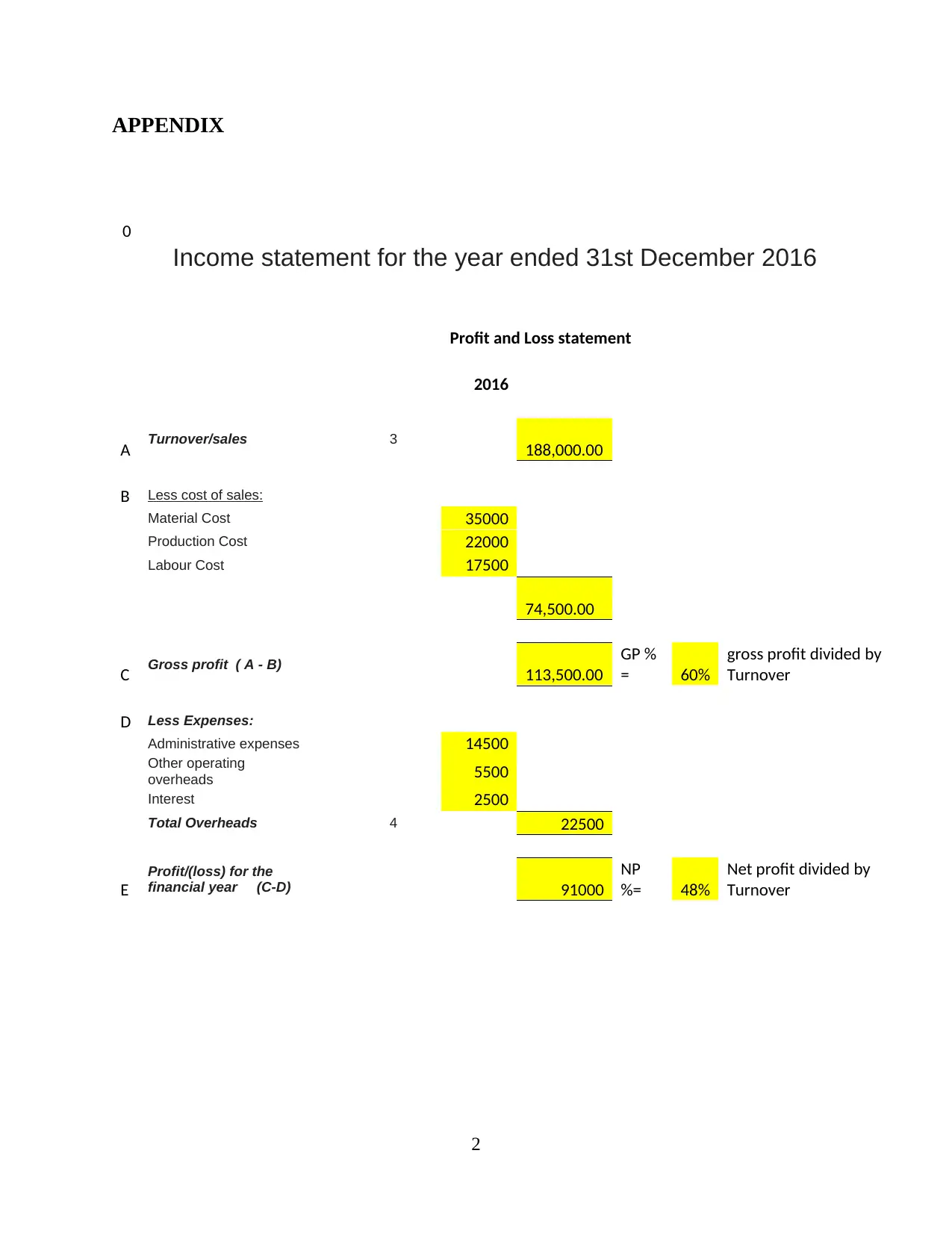
From the information and analysis of the case study it is being found that the gross profit of the
company is 60% while its net profit is 48%. This means that the profitability of the company is
showing a positive indication.
Liquidity:
This is also an important aspect with regard to company. This aspect shows the amount of
cash and cash condition which is possessed by the company. Existence of cash enable the
company to have a capacity of meeting short term obligations. It is usually determined by
working capital efficiency amount. Working capital shows the amount of money which is
required in daily operation and business. the liquidity of the company will be determined with
the help of current ratio which is a percentage of current asset by current liabilities (Nuryani and
Sunarsi, 2020). In current case it is 1.46 (87400/59800). As the ideal ratio is 1 and the current
regard to other companies and in case of any discrepancies corrective actions will be taken.
Thus, it would not be wrong to said that the financial ratios plays an important role with
respect to financial management. This is because it will act as base that will lead to have
financial planning and management of finance as per derived outcome of the financial ratio.
Section 3: Templates
(iv) Analysis:
Profitability:
It is an important aspect with regard to company and its performance. A company with a
good percentage of profitability and profit percentage would indicate efficient performance. This
means that the company is running its business in profitability state. As the main objective of
every company is to earn profits and if the company's profitability state is showing a rising phase
then it means that the company is grabbing and directing towards its objectives. This can further
be understood with the profitability ratio that may include the gross profit and net profit ratio. As
the gross profit is the ratio of gross profit and turnover which shows that the amount of money
which is being left after having a deduction of cost of production. However, in case of net profit,
it is an indication of the actual and net profit which is being left after having a deduction of all
the expenses.
From the information and analysis of the case study it is being found that the gross profit of the
company is 60% while its net profit is 48%. This means that the profitability of the company is
showing a positive indication.
Liquidity:
This is also an important aspect with regard to company. This aspect shows the amount of
cash and cash condition which is possessed by the company. Existence of cash enable the
company to have a capacity of meeting short term obligations. It is usually determined by
working capital efficiency amount. Working capital shows the amount of money which is
required in daily operation and business. the liquidity of the company will be determined with
the help of current ratio which is a percentage of current asset by current liabilities (Nuryani and
Sunarsi, 2020). In current case it is 1.46 (87400/59800). As the ideal ratio is 1 and the current
⊘ This is a preview!⊘
Do you want full access?
Subscribe today to unlock all pages.
Trusted by 1+ million students worldwide
case shows 1.46 this means that the company has enough cash with regard to meeting its short-
term obligations.
Efficiency:
In order to determine the efficiency, various ratio related with efficiency are determined.
These ratio shows the company’s ability towards the use of assets with regard to income
generation. This means that how efficiently company may use its assets in order to generate
income. It can be best determined with the use of asset turnover ratio which shows the
company’s sales and revenue with company’s total assets. The higher the ratio would be it will
be indicating that the company is generating efficient revenue from its asset. In the current case
the value of this ratio is 1.34 (188000/139400). As the ideal ratio shows that its value must be
more than 2.5 in case of retail sector, however, in case of other companies it lies between 0.25 to
0.5. and in the current case as it is 1.34 which itself shows quite good. This means that the
company is efficiently utilizing its assets with respect to revenue generation.
Likewise, the efficiency of the company can also be determined through the accounts
receivable turnover ratio. As this ratio indicate the efficiency of the company with respect to
collection of debts from the market (Wajo, 2021). It can be calculated by net credit sales divided
by accounts receivable for a period by. In the current case this ratio is 5.87 (188000/32000). As
the ratio shows high values this means that the company efficiency with regard to debt collection
is not good and need to be improved.
Section 4: Methods of improving financial performance
As the financial performance with regard to company is is moderate and in declining state so in
order to improve its financial performance and the concerned ratio following aspects need to be
considered.
Well directed focus towards the improvement of relationship with the customers,
enabling early payment discounts and policies, improving efficiency related with billing,
inculcation of system related with reminders are some methods that will assist the
company to improve its performance and accounts receivable ratio. As this is a ratio
related with company's efficiency so with an improvised ratio, company can also puts a
positive brand image in the market.
term obligations.
Efficiency:
In order to determine the efficiency, various ratio related with efficiency are determined.
These ratio shows the company’s ability towards the use of assets with regard to income
generation. This means that how efficiently company may use its assets in order to generate
income. It can be best determined with the use of asset turnover ratio which shows the
company’s sales and revenue with company’s total assets. The higher the ratio would be it will
be indicating that the company is generating efficient revenue from its asset. In the current case
the value of this ratio is 1.34 (188000/139400). As the ideal ratio shows that its value must be
more than 2.5 in case of retail sector, however, in case of other companies it lies between 0.25 to
0.5. and in the current case as it is 1.34 which itself shows quite good. This means that the
company is efficiently utilizing its assets with respect to revenue generation.
Likewise, the efficiency of the company can also be determined through the accounts
receivable turnover ratio. As this ratio indicate the efficiency of the company with respect to
collection of debts from the market (Wajo, 2021). It can be calculated by net credit sales divided
by accounts receivable for a period by. In the current case this ratio is 5.87 (188000/32000). As
the ratio shows high values this means that the company efficiency with regard to debt collection
is not good and need to be improved.
Section 4: Methods of improving financial performance
As the financial performance with regard to company is is moderate and in declining state so in
order to improve its financial performance and the concerned ratio following aspects need to be
considered.
Well directed focus towards the improvement of relationship with the customers,
enabling early payment discounts and policies, improving efficiency related with billing,
inculcation of system related with reminders are some methods that will assist the
company to improve its performance and accounts receivable ratio. As this is a ratio
related with company's efficiency so with an improvised ratio, company can also puts a
positive brand image in the market.
Paraphrase This Document
Need a fresh take? Get an instant paraphrase of this document with our AI Paraphraser
As it is analysed that the current ratio of company is more than 1, which means excess of
cash available for business will need to be improved and rectified with the making of
investment in the best available option. As when the funds will be invested in the best
alternatives then it will not only lead to improvement in ratio but it will further assist the
company to raise its earnings.
This means that with the improvement in current ratio and cash efficiency the company's
efficiency with regard to profitability will also be raised. Since the profitability of the
company is determining good indicators but with the controlling over expenses and
increasing the source of earning profits, the profitability situation and its net profit ratio
will be improvised.
In addition to this, with regard to improving the net profit percentage of the company, it
may focus over either raising of sales of its products or increasing the existing prices.
This means that with a raise in its sales volume company may earn more profit margin
while an increase in prices will also offer a good percentage of profits.
Along with the above steps adoption of certain strategies including making of correct
invoicing while making purchase, collection of debts as soon as possible, reduction of
expenses that are not required will also lead to have an improvement in financial
performance (Karami, Samimi and Jafari, 2020). Likewise, availing raw material,
consolidation of debts at better rate, availing periodic payments will further lead to have
an improvement in its performance.
CONCLUSION
From the above report it is analysed that the financial management and its implication
along with preparation of financial statement's plays an important role with respect to company
and its directed activities towards its objectives. With the preparation of financial statement's,
financial ability and position of the company will be determined and accordingly most
appropriate actions with respect tom raising and improvising the company existing position will
be taken. Like the preparation of financial statements, ratio analysis also enable the company to
have an analysis of its financial performance.
cash available for business will need to be improved and rectified with the making of
investment in the best available option. As when the funds will be invested in the best
alternatives then it will not only lead to improvement in ratio but it will further assist the
company to raise its earnings.
This means that with the improvement in current ratio and cash efficiency the company's
efficiency with regard to profitability will also be raised. Since the profitability of the
company is determining good indicators but with the controlling over expenses and
increasing the source of earning profits, the profitability situation and its net profit ratio
will be improvised.
In addition to this, with regard to improving the net profit percentage of the company, it
may focus over either raising of sales of its products or increasing the existing prices.
This means that with a raise in its sales volume company may earn more profit margin
while an increase in prices will also offer a good percentage of profits.
Along with the above steps adoption of certain strategies including making of correct
invoicing while making purchase, collection of debts as soon as possible, reduction of
expenses that are not required will also lead to have an improvement in financial
performance (Karami, Samimi and Jafari, 2020). Likewise, availing raw material,
consolidation of debts at better rate, availing periodic payments will further lead to have
an improvement in its performance.
CONCLUSION
From the above report it is analysed that the financial management and its implication
along with preparation of financial statement's plays an important role with respect to company
and its directed activities towards its objectives. With the preparation of financial statement's,
financial ability and position of the company will be determined and accordingly most
appropriate actions with respect tom raising and improvising the company existing position will
be taken. Like the preparation of financial statements, ratio analysis also enable the company to
have an analysis of its financial performance.

⊘ This is a preview!⊘
Do you want full access?
Subscribe today to unlock all pages.
Trusted by 1+ million students worldwide
REFERENCES
Books and journals
Brigham, E.F. and Houston, J.F., 2021. Fundamentals of financial management. Cengage
Learning.
Damayanti, S.M., Murtaqi, I. and Pradana, H.A., 2018. The importance of financial literacy in a
global economic era. The Business & Management Review. 9(3). pp.435-441.
Daniel, A.C., Marioara, A. and Isabela, D., 2017. Annual Financial Statements as a Financial
Communication Support. Ovidius University Annals, Economic Sciences Series. 17(1).
pp.403-406.
Kadim, A., Sunardi, N. and Husain, T., 2020. The modeling firm's value based on financial
ratios, intellectual capital and dividend policy. Accounting. 6(5). pp.859-870.
Karami, M., Samimi, A. and Jafari, M., 2020. The impact of effective risk management on
corporate financial performance. Advanced Journal of Chemistry-Section B. 2(3).
pp.144-150.
Nuryani, Y. and Sunarsi, D., 2020. The Effect of Current Ratio and Debt to Equity Ratio on
Deviding Growth. JASa (Jurnal Akuntansi, Audit dan Sistem Informasi Akuntansi). 4(2).
pp.304-312.
Osadchy, and et.al., 2018. Financial statements of a company as an information base for
decision-making in a transforming economy.
Siekelova, and et.al., 2017. Receivables management: the importance of financial indicators in
assessing the creditworthiness. Polish Journal of Management Studies. 15.
Statements, W.F., 2020. Introduction to Financial Statements Analysis.
Wajo, A.R., 2021. Effect of Cash Turnover, Receivable Turnover, Inventory Turnover and
Growth Opportunity on Profitability. ATESTASI: Jurnal Ilmiah Akuntansi. 4(1). pp.61-
69.
1
Books and journals
Brigham, E.F. and Houston, J.F., 2021. Fundamentals of financial management. Cengage
Learning.
Damayanti, S.M., Murtaqi, I. and Pradana, H.A., 2018. The importance of financial literacy in a
global economic era. The Business & Management Review. 9(3). pp.435-441.
Daniel, A.C., Marioara, A. and Isabela, D., 2017. Annual Financial Statements as a Financial
Communication Support. Ovidius University Annals, Economic Sciences Series. 17(1).
pp.403-406.
Kadim, A., Sunardi, N. and Husain, T., 2020. The modeling firm's value based on financial
ratios, intellectual capital and dividend policy. Accounting. 6(5). pp.859-870.
Karami, M., Samimi, A. and Jafari, M., 2020. The impact of effective risk management on
corporate financial performance. Advanced Journal of Chemistry-Section B. 2(3).
pp.144-150.
Nuryani, Y. and Sunarsi, D., 2020. The Effect of Current Ratio and Debt to Equity Ratio on
Deviding Growth. JASa (Jurnal Akuntansi, Audit dan Sistem Informasi Akuntansi). 4(2).
pp.304-312.
Osadchy, and et.al., 2018. Financial statements of a company as an information base for
decision-making in a transforming economy.
Siekelova, and et.al., 2017. Receivables management: the importance of financial indicators in
assessing the creditworthiness. Polish Journal of Management Studies. 15.
Statements, W.F., 2020. Introduction to Financial Statements Analysis.
Wajo, A.R., 2021. Effect of Cash Turnover, Receivable Turnover, Inventory Turnover and
Growth Opportunity on Profitability. ATESTASI: Jurnal Ilmiah Akuntansi. 4(1). pp.61-
69.
1
Paraphrase This Document
Need a fresh take? Get an instant paraphrase of this document with our AI Paraphraser
APPENDIX
0
Income statement for the year ended 31st December 2016
Profit and Loss statement
2016
A Turnover/sales 3 188,000.00
B Less cost of sales:
Material Cost 35000
Production Cost 22000
Labour Cost 17500
74,500.00
C Gross profit ( A - B) 113,500.00
GP %
= 60%
gross profit divided by
Turnover
D Less Expenses:
Administrative expenses 14500
Other operating
overheads 5500
Interest 2500
Total Overheads 4 22500
E
Profit/(loss) for the
financial year (C-D) 91000
NP
%= 48%
Net profit divided by
Turnover
2
0
Income statement for the year ended 31st December 2016
Profit and Loss statement
2016
A Turnover/sales 3 188,000.00
B Less cost of sales:
Material Cost 35000
Production Cost 22000
Labour Cost 17500
74,500.00
C Gross profit ( A - B) 113,500.00
GP %
= 60%
gross profit divided by
Turnover
D Less Expenses:
Administrative expenses 14500
Other operating
overheads 5500
Interest 2500
Total Overheads 4 22500
E
Profit/(loss) for the
financial year (C-D) 91000
NP
%= 48%
Net profit divided by
Turnover
2
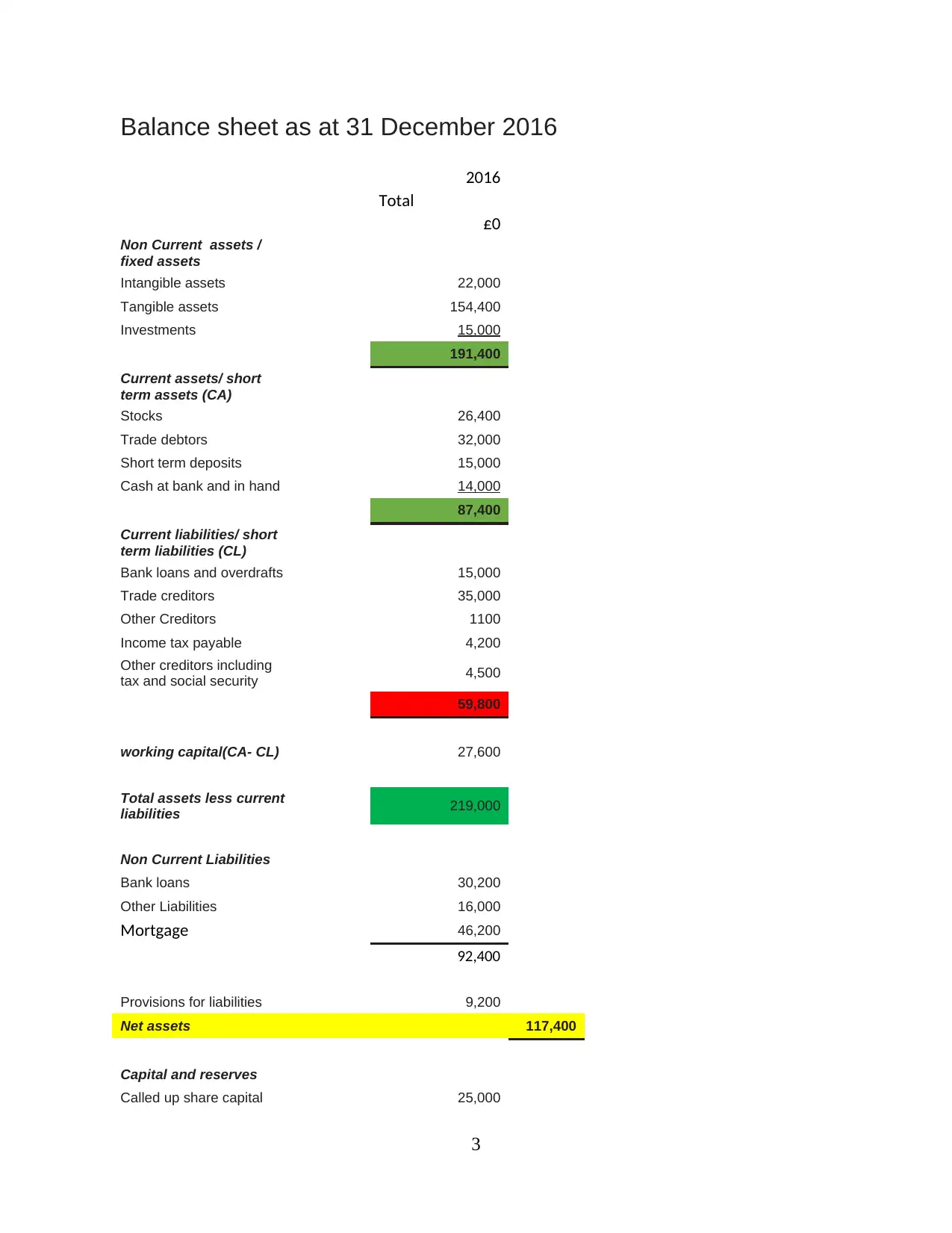
Balance sheet as at 31 December 2016
2016
Total
£0
Non Current assets /
fixed assets
Intangible assets 22,000
Tangible assets 154,400
Investments 15,000
191,400
Current assets/ short
term assets (CA)
Stocks 26,400
Trade debtors 32,000
Short term deposits 15,000
Cash at bank and in hand 14,000
87,400
Current liabilities/ short
term liabilities (CL)
Bank loans and overdrafts 15,000
Trade creditors 35,000
Other Creditors 1100
Income tax payable 4,200
Other creditors including
tax and social security 4,500
59,800
working capital(CA- CL) 27,600
Total assets less current
liabilities 219,000
Non Current Liabilities
Bank loans 30,200
Other Liabilities 16,000
Mortgage 46,200
92,400
Provisions for liabilities 9,200
Net assets 117,400
Capital and reserves
Called up share capital 25,000
3
2016
Total
£0
Non Current assets /
fixed assets
Intangible assets 22,000
Tangible assets 154,400
Investments 15,000
191,400
Current assets/ short
term assets (CA)
Stocks 26,400
Trade debtors 32,000
Short term deposits 15,000
Cash at bank and in hand 14,000
87,400
Current liabilities/ short
term liabilities (CL)
Bank loans and overdrafts 15,000
Trade creditors 35,000
Other Creditors 1100
Income tax payable 4,200
Other creditors including
tax and social security 4,500
59,800
working capital(CA- CL) 27,600
Total assets less current
liabilities 219,000
Non Current Liabilities
Bank loans 30,200
Other Liabilities 16,000
Mortgage 46,200
92,400
Provisions for liabilities 9,200
Net assets 117,400
Capital and reserves
Called up share capital 25,000
3
⊘ This is a preview!⊘
Do you want full access?
Subscribe today to unlock all pages.
Trusted by 1+ million students worldwide

1 out of 13


Related Documents


Your All-in-One AI-Powered Toolkit for Academic Success.
+13062052269
info@desklib.com
Available 24*7 on WhatsApp / Email
![[object Object]](/_next/static/media/star-bottom.7253800d.svg)
Unlock your academic potential
Copyright © 2020–2026 A2Z Services. All Rights Reserved. Developed and managed by ZUCOL.