Fit Food: Business Structure, Finance, UK Sectors and HR Policies
VerifiedAdded on 2022/11/25
|13
|3993
|58
Report
AI Summary
This report analyzes the business structure of 'Fit Food,' a company in the food industry specializing in organic and healthy dietary options. It begins by examining different legal statuses for the organization, including PLC, LTD, and charity, evaluating their strengths and weaknesses and recommending PLC as the most suitable structure. The report then identifies and evaluates various sources of business finance, such as commercial bank loans, equity capital, and retained earnings, assessing their advantages and disadvantages for Fit Food. Furthermore, the report explores the three main sectors within the UK business company: primary, secondary, and tertiary. Finally, it discusses the importance of HR policies in the workplace, providing a comprehensive overview of the business operations and its key aspects.

Structure of Business
.
.

Paraphrase This Document
Need a fresh take? Get an instant paraphrase of this document with our AI Paraphraser
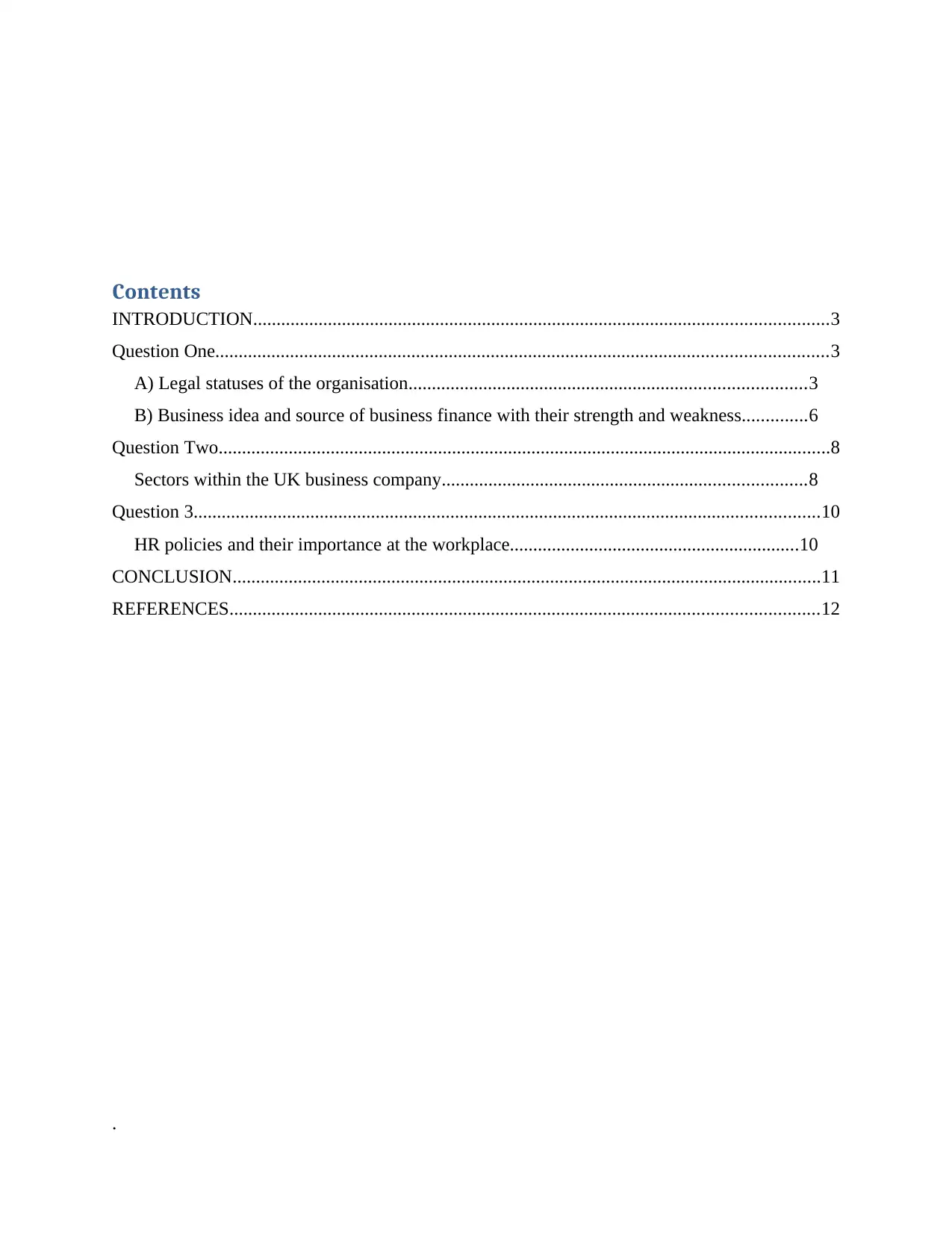
Contents
INTRODUCTION...........................................................................................................................3
Question One...................................................................................................................................3
A) Legal statuses of the organisation.....................................................................................3
B) Business idea and source of business finance with their strength and weakness..............6
Question Two...................................................................................................................................8
Sectors within the UK business company..............................................................................8
Question 3......................................................................................................................................10
HR policies and their importance at the workplace..............................................................10
CONCLUSION..............................................................................................................................11
REFERENCES..............................................................................................................................12
.
INTRODUCTION...........................................................................................................................3
Question One...................................................................................................................................3
A) Legal statuses of the organisation.....................................................................................3
B) Business idea and source of business finance with their strength and weakness..............6
Question Two...................................................................................................................................8
Sectors within the UK business company..............................................................................8
Question 3......................................................................................................................................10
HR policies and their importance at the workplace..............................................................10
CONCLUSION..............................................................................................................................11
REFERENCES..............................................................................................................................12
.
INTRODUCTION
The business structure refers to the type and setup which an investor required for
performing and operating their operations and functions. The primary factors of business
structure are based on type of business, tax-incentive and organisation operations. In simple
terms, business structure refers to the steps or methods by which organisation manage their legal
status. With setup of an appropriate business structure management enable an organisation for
acknowledge and provide legal guidelines for run the business operation in an ethical manner
(Atterton, 2016). Moreover, this report highlights on different legal statuses of business and their
strength and weakness. Identify and evaluate finance sources and their roles will also include in
the report. In the last, three sectors of UK economy and the differences between them is focused
in the upcoming report. For the perspective of this report, new business which is named as “Fit
Food” is selected and this operate business in the food industry. Fit Food is well-known for their
organic dietary and healthy food.
Question One
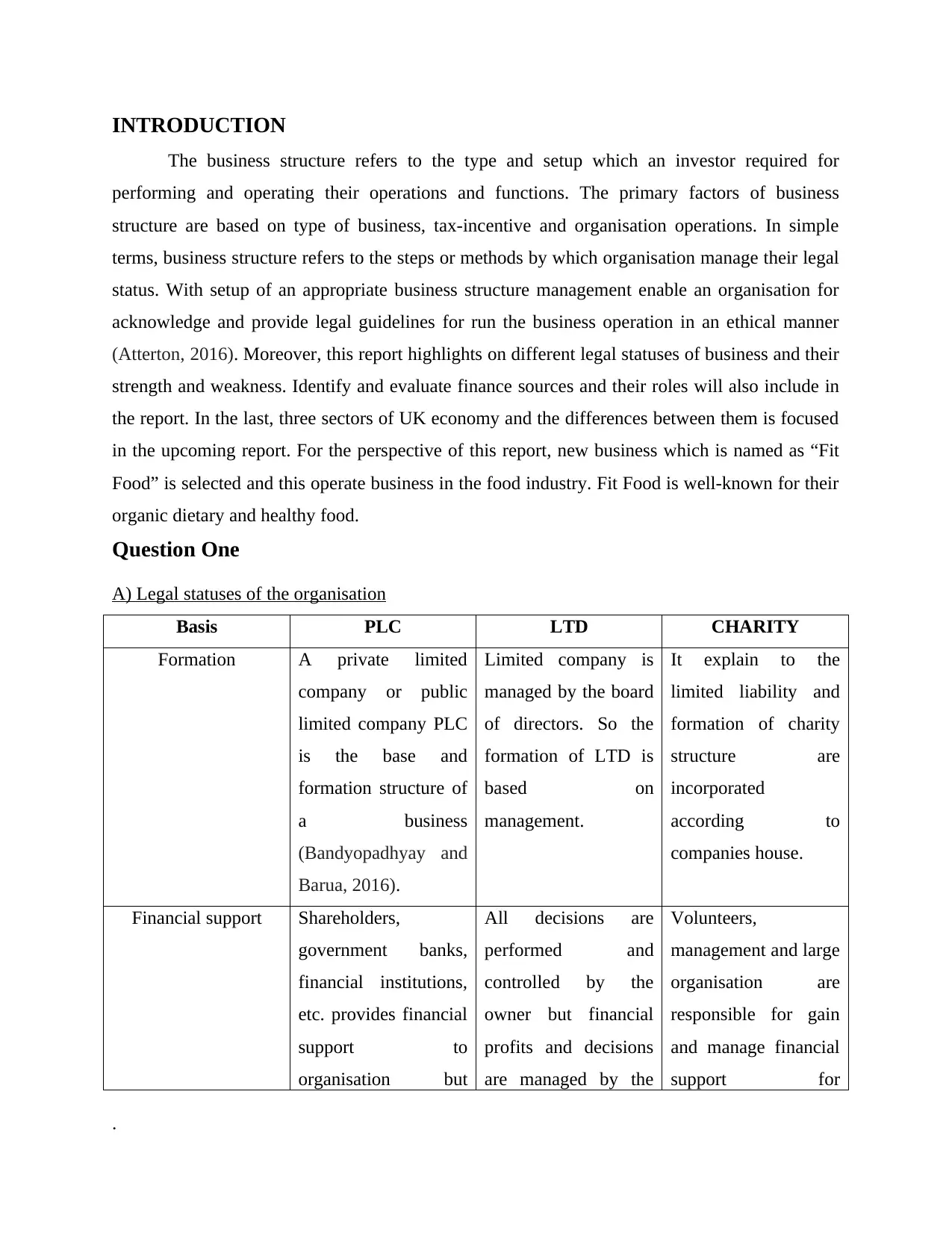
A) Legal statuses of the organisation
Basis PLC LTD CHARITY
Formation A private limited
company or public
limited company PLC
is the base and
formation structure of
a business
(Bandyopadhyay and
Barua, 2016).
Limited company is
managed by the board
of directors. So the
formation of LTD is
based on
management.
It explain to the
limited liability and
formation of charity
structure are
incorporated
according to
companies house.
Financial support Shareholders,
government banks,
financial institutions,
etc. provides financial
support to
organisation but
All decisions are
performed and
controlled by the
owner but financial
profits and decisions
are managed by the
Volunteers,
management and large
organisation are
responsible for gain
and manage financial
support for
.
The business structure refers to the type and setup which an investor required for
performing and operating their operations and functions. The primary factors of business
structure are based on type of business, tax-incentive and organisation operations. In simple
terms, business structure refers to the steps or methods by which organisation manage their legal
status. With setup of an appropriate business structure management enable an organisation for
acknowledge and provide legal guidelines for run the business operation in an ethical manner
(Atterton, 2016). Moreover, this report highlights on different legal statuses of business and their
strength and weakness. Identify and evaluate finance sources and their roles will also include in
the report. In the last, three sectors of UK economy and the differences between them is focused
in the upcoming report. For the perspective of this report, new business which is named as “Fit
Food” is selected and this operate business in the food industry. Fit Food is well-known for their
organic dietary and healthy food.
Question One
A) Legal statuses of the organisation
Basis PLC LTD CHARITY
Formation A private limited
company or public
limited company PLC
is the base and
formation structure of
a business
(Bandyopadhyay and
Barua, 2016).
Limited company is
managed by the board
of directors. So the
formation of LTD is
based on
management.
It explain to the
limited liability and
formation of charity
structure are
incorporated
according to
companies house.
Financial support Shareholders,
government banks,
financial institutions,
etc. provides financial
support to
organisation but
All decisions are
performed and
controlled by the
owner but financial
profits and decisions
are managed by the
Volunteers,
management and large
organisation are
responsible for gain
and manage financial
support for
.
⊘ This is a preview!⊘
Do you want full access?
Subscribe today to unlock all pages.

Trusted by 1+ million students worldwide
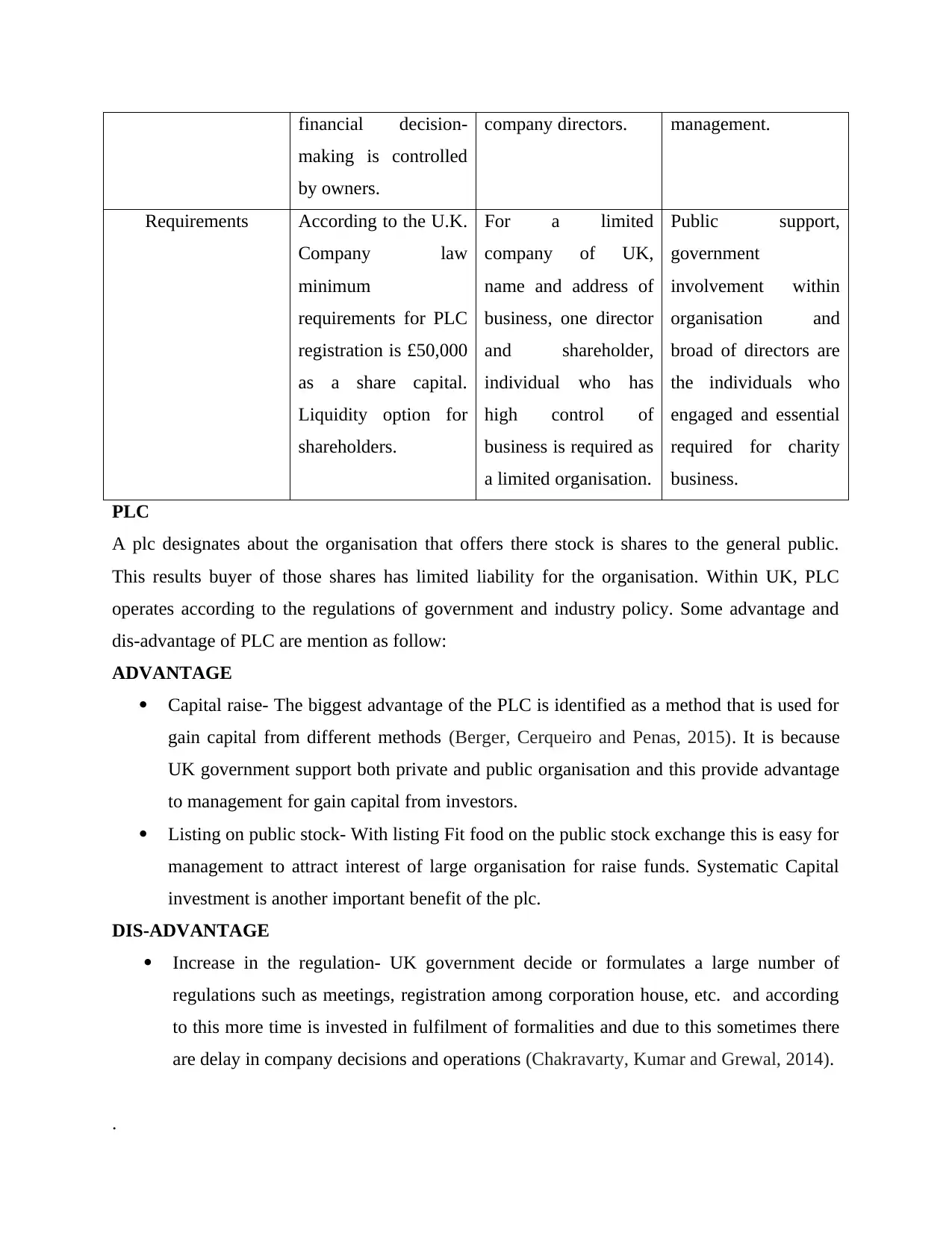
financial decision-
making is controlled
by owners.
company directors. management.
Requirements According to the U.K.
Company law
minimum
requirements for PLC
registration is £50,000
as a share capital.
Liquidity option for
shareholders.
For a limited
company of UK,
name and address of
business, one director
and shareholder,
individual who has
high control of
business is required as
a limited organisation.
Public support,
government
involvement within
organisation and
broad of directors are
the individuals who
engaged and essential
required for charity
business.
PLC
A plc designates about the organisation that offers there stock is shares to the general public.
This results buyer of those shares has limited liability for the organisation. Within UK, PLC
operates according to the regulations of government and industry policy. Some advantage and
dis-advantage of PLC are mention as follow:
ADVANTAGE
Capital raise- The biggest advantage of the PLC is identified as a method that is used for
gain capital from different methods (Berger, Cerqueiro and Penas, 2015). It is because
UK government support both private and public organisation and this provide advantage
to management for gain capital from investors.
Listing on public stock- With listing Fit food on the public stock exchange this is easy for
management to attract interest of large organisation for raise funds. Systematic Capital
investment is another important benefit of the plc.
DIS-ADVANTAGE
Increase in the regulation- UK government decide or formulates a large number of
regulations such as meetings, registration among corporation house, etc. and according
to this more time is invested in fulfilment of formalities and due to this sometimes there
are delay in company decisions and operations (Chakravarty, Kumar and Grewal, 2014).
.
making is controlled
by owners.
company directors. management.
Requirements According to the U.K.
Company law
minimum
requirements for PLC
registration is £50,000
as a share capital.
Liquidity option for
shareholders.
For a limited
company of UK,
name and address of
business, one director
and shareholder,
individual who has
high control of
business is required as
a limited organisation.
Public support,
government
involvement within
organisation and
broad of directors are
the individuals who
engaged and essential
required for charity
business.
PLC
A plc designates about the organisation that offers there stock is shares to the general public.
This results buyer of those shares has limited liability for the organisation. Within UK, PLC
operates according to the regulations of government and industry policy. Some advantage and
dis-advantage of PLC are mention as follow:
ADVANTAGE
Capital raise- The biggest advantage of the PLC is identified as a method that is used for
gain capital from different methods (Berger, Cerqueiro and Penas, 2015). It is because
UK government support both private and public organisation and this provide advantage
to management for gain capital from investors.
Listing on public stock- With listing Fit food on the public stock exchange this is easy for
management to attract interest of large organisation for raise funds. Systematic Capital
investment is another important benefit of the plc.
DIS-ADVANTAGE
Increase in the regulation- UK government decide or formulates a large number of
regulations such as meetings, registration among corporation house, etc. and according
to this more time is invested in fulfilment of formalities and due to this sometimes there
are delay in company decisions and operations (Chakravarty, Kumar and Grewal, 2014).
.
Paraphrase This Document
Need a fresh take? Get an instant paraphrase of this document with our AI Paraphraser
Maximise in accountability- With providing access to the government and shareholders
accountability of management is also increased. Due to this sometimes this is difficult
for organisation to perform their work in an organised manner. It defines that
organisation face challenges at time of risk-related decisions because a lot of individuals
ask questions from management for such difficult decisions.
LTD
The term LTD. stands as a standard abbreviation for the word limited. According to the present
market conditions limited is identified as a form of corporate structure which is available at all
places among the world where business exists (Du and et. al., 2018). In simple words, limited
company features limited liability of an organisation.
Advantage
Spread of liability- Due to involvement of multiple shareholders in share capital liability
of organisation is spread among multiple persons. This work owner or management face
less complexity at the time of insolvency.
Tax-advantage- In the UK boundary region, government offer different policies and
most of them provide advantage to organisation for save the tax amount. These results an
entrepreneur is able to maximise their profits by performing work according to the tax-
saving policy.
Dis-advantage
Sale of shares- The shares are sold by shareholders on private basis and it define that
shares are sold outside the organisation. So in simple terms, an organisation borrow
amount from outside the business. But to gain funds from outside places director put
personal asset for gain funds.
No protection for shareholders- From the perspective of LTD rules and regulations
sometimes this is challenging for organisation to provide protected rights to shareholders
because entrepreneur take risk to start a business so they are less focused towards
offering rights to shareholders (Engelmann, 2014).
CHARITY
Within the charity there is more number of individuals engaged in business and according to this
it is identified that charity identified income supports from various persons. This considered that
.
accountability of management is also increased. Due to this sometimes this is difficult
for organisation to perform their work in an organised manner. It defines that
organisation face challenges at time of risk-related decisions because a lot of individuals
ask questions from management for such difficult decisions.
LTD
The term LTD. stands as a standard abbreviation for the word limited. According to the present
market conditions limited is identified as a form of corporate structure which is available at all
places among the world where business exists (Du and et. al., 2018). In simple words, limited
company features limited liability of an organisation.
Advantage
Spread of liability- Due to involvement of multiple shareholders in share capital liability
of organisation is spread among multiple persons. This work owner or management face
less complexity at the time of insolvency.
Tax-advantage- In the UK boundary region, government offer different policies and
most of them provide advantage to organisation for save the tax amount. These results an
entrepreneur is able to maximise their profits by performing work according to the tax-
saving policy.
Dis-advantage
Sale of shares- The shares are sold by shareholders on private basis and it define that
shares are sold outside the organisation. So in simple terms, an organisation borrow
amount from outside the business. But to gain funds from outside places director put
personal asset for gain funds.
No protection for shareholders- From the perspective of LTD rules and regulations
sometimes this is challenging for organisation to provide protected rights to shareholders
because entrepreneur take risk to start a business so they are less focused towards
offering rights to shareholders (Engelmann, 2014).
CHARITY
Within the charity there is more number of individuals engaged in business and according to this
it is identified that charity identified income supports from various persons. This considered that
.
organisation engage an individual or people who give money with a motive of no return against
their money.
Advantage
Public recognition and trust- Charities are well-known factors and they are adopted by
an individual or organisation for completion of task in an easy manner. This results
funds rising and promotion is easily done through adopt and induce charity actions in
business.
Tax-relief- Charity provide benefits to the Fit Food and other organisation for gain tax-
relief or exemption from corporate and government tax (Geerken and et. al., 2019).
Donations also provide support to an entrepreneur for get relief from stamp duty and
other property taxes.
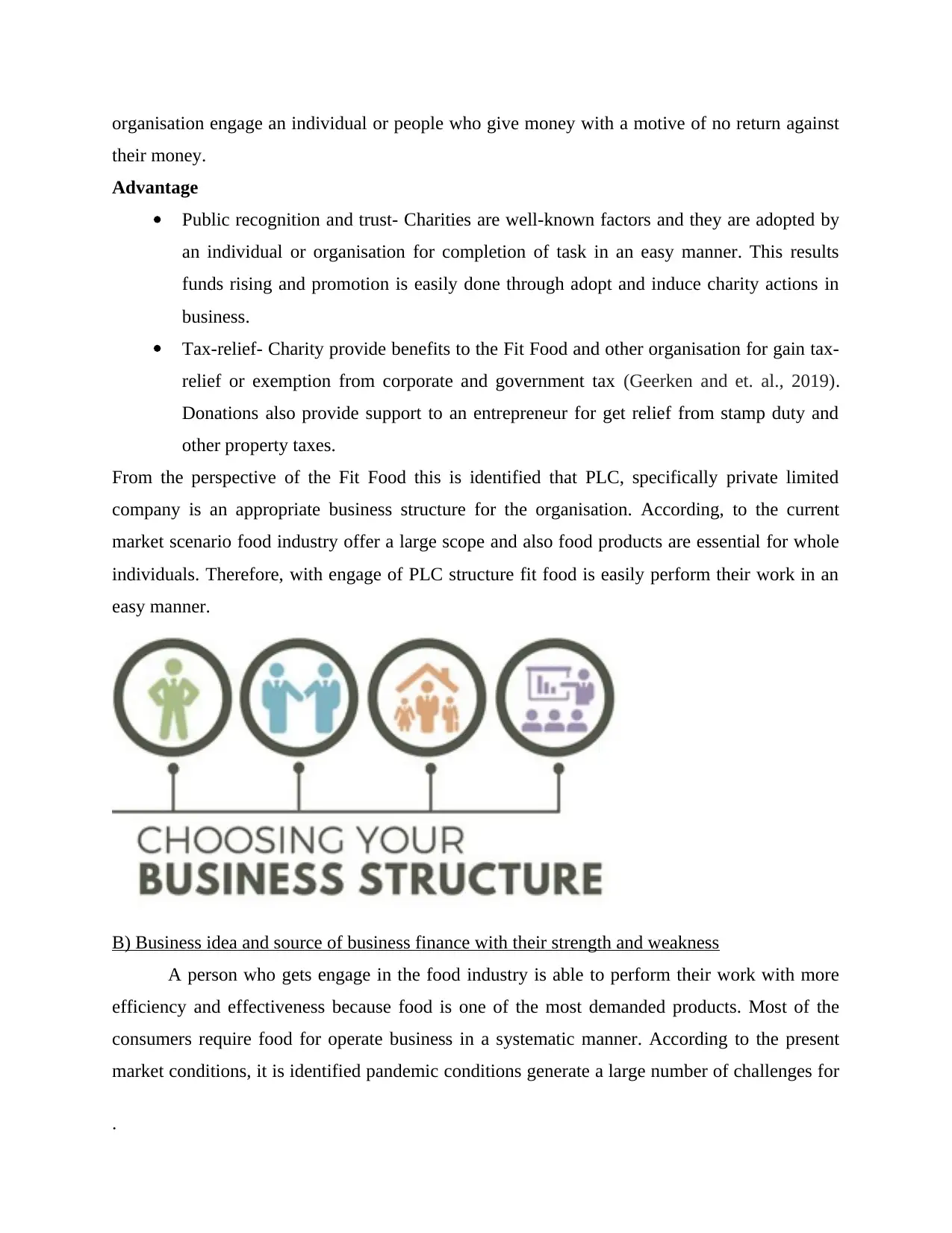
From the perspective of the Fit Food this is identified that PLC, specifically private limited
company is an appropriate business structure for the organisation. According, to the current
market scenario food industry offer a large scope and also food products are essential for whole
individuals. Therefore, with engage of PLC structure fit food is easily perform their work in an
easy manner.
B) Business idea and source of business finance with their strength and weakness
A person who gets engage in the food industry is able to perform their work with more
efficiency and effectiveness because food is one of the most demanded products. Most of the
consumers require food for operate business in a systematic manner. According to the present
market conditions, it is identified pandemic conditions generate a large number of challenges for
.
their money.
Advantage
Public recognition and trust- Charities are well-known factors and they are adopted by
an individual or organisation for completion of task in an easy manner. This results
funds rising and promotion is easily done through adopt and induce charity actions in
business.
Tax-relief- Charity provide benefits to the Fit Food and other organisation for gain tax-
relief or exemption from corporate and government tax (Geerken and et. al., 2019).
Donations also provide support to an entrepreneur for get relief from stamp duty and
other property taxes.
From the perspective of the Fit Food this is identified that PLC, specifically private limited
company is an appropriate business structure for the organisation. According, to the current
market scenario food industry offer a large scope and also food products are essential for whole
individuals. Therefore, with engage of PLC structure fit food is easily perform their work in an
easy manner.
B) Business idea and source of business finance with their strength and weakness
A person who gets engage in the food industry is able to perform their work with more
efficiency and effectiveness because food is one of the most demanded products. Most of the
consumers require food for operate business in a systematic manner. According to the present
market conditions, it is identified pandemic conditions generate a large number of challenges for
.
⊘ This is a preview!⊘
Do you want full access?
Subscribe today to unlock all pages.
Trusted by 1+ million students worldwide
organisation and entrepreneur. Local individual of London are focused towards all those factors
which is related with food safety and hygiene. Due to pandemic conditions this is mandatory for
Fit Food to perform all work with high quality. Moreover, business idea of Fit Food considered
organic pizza, fresh and baked corn items, organic juice, etc. that all task are performed in an
appropriate manner. Equity, Debt, Retained earnings, terms loan, etc. are different sources
related with finance (Horner and et. al., 2015). From the perspective of Fit Food an estimated
monetary amount is £100,000 so to invest huge amount management is focused to raise funds
from different sources and they are mention as follow:
Commercial Bank- One of the most important source that is related with raise of working
capital is to provide loans and this helps management to match with all requirements of an
industry. Along with this commercial bank provide bank loan, cash-credit, over-draft and many
other methods and all of them are focused towards offering loans to new entrepreneur and
organisation. On the other side, security such as agreement, property paper, etc. is kept to assured
that loans are repay by the organisation.
Strength of commercial bank loan
Keep control of an organisation- A commercial bank loan provide only monetary amount to the
organisation and it means that decision-making control is hold by the management (Lyubareva,
Benghozi and Fidele, 2014). So this result this is easy for management to make decisions at right
time.
Weakness
Complex to qualify- From the greatest perspective of Fit food this is identified that management
face challenges because this is complex to qualify the bank loan. According to present market
conditions it is identified benchmarks to obtain loan are hard to achieve.
Equity capital
Companies are able to raise funds from the public and it defines that Fit Food and other
organisation exchanges the ownership stake with individuals in return of monetary funds. After
purchase of the shares investor who becomes shareholder provide funds to support capital.
Strength
Long term financing- The major focus of equity investor is to maximise their future earnings
and also to enhance the value of business. From the perspective of Fit Food company immediate
.
which is related with food safety and hygiene. Due to pandemic conditions this is mandatory for
Fit Food to perform all work with high quality. Moreover, business idea of Fit Food considered
organic pizza, fresh and baked corn items, organic juice, etc. that all task are performed in an
appropriate manner. Equity, Debt, Retained earnings, terms loan, etc. are different sources
related with finance (Horner and et. al., 2015). From the perspective of Fit Food an estimated
monetary amount is £100,000 so to invest huge amount management is focused to raise funds
from different sources and they are mention as follow:
Commercial Bank- One of the most important source that is related with raise of working
capital is to provide loans and this helps management to match with all requirements of an
industry. Along with this commercial bank provide bank loan, cash-credit, over-draft and many
other methods and all of them are focused towards offering loans to new entrepreneur and
organisation. On the other side, security such as agreement, property paper, etc. is kept to assured
that loans are repay by the organisation.
Strength of commercial bank loan
Keep control of an organisation- A commercial bank loan provide only monetary amount to the
organisation and it means that decision-making control is hold by the management (Lyubareva,
Benghozi and Fidele, 2014). So this result this is easy for management to make decisions at right
time.
Weakness
Complex to qualify- From the greatest perspective of Fit food this is identified that management
face challenges because this is complex to qualify the bank loan. According to present market
conditions it is identified benchmarks to obtain loan are hard to achieve.
Equity capital
Companies are able to raise funds from the public and it defines that Fit Food and other
organisation exchanges the ownership stake with individuals in return of monetary funds. After
purchase of the shares investor who becomes shareholder provide funds to support capital.
Strength
Long term financing- The major focus of equity investor is to maximise their future earnings
and also to enhance the value of business. From the perspective of Fit Food company immediate
.
Paraphrase This Document
Need a fresh take? Get an instant paraphrase of this document with our AI Paraphraser
interest related with business depends on provided capital amount (Mamman and Somantri,
2014). Along with this finance project provide better return to investor.
Weakness
Financial return distribution- Each investor who invest funds perform their work with motive
of increase in funds. Along with this it defines major disadvantage related with business is that
management face challenges because no equity is equally achieved on the sale of organisation
asset and business.
Retained earnings
The main aim or motive of each organisation is to enhance and maximise their profits. In simple
terms retained earning demonstrate portion of equity earnings. With understand of overall
products and rendering their methods it is identified that to generate profits. A company decide
method of earned capital and systems for manage work in an efficient manner. Fit Food sells
organic pizza to enhance their earnings as it also in demand because of its healthy nature.
Strength
Direct earning- The earnings related with business operations are considered towards
completion of task with more efficiency. According to the present market conditions, firms
perform their work in an effective manner because money is not lender by shareholder or any
other party. So this is directly used by the manager for perform and manage task in case of
emergency.
Weakness
Limited earning- All amount which is raised through the use of retained earnings is considered
towards completion of task in an efficient manner (Merika and et. al., 2015). From perspective of
Fit Food organisation focus on all those important perspectives which engage sustainability but
due to less amount of retained earning it is not possible.
Question Two
Sectors within the UK business company
One of the recent data that is related with the UK economy considered towards completion
of task and project with more efficiency. It refers that the economy of the United Kingdom is
well-developed and it helps Fit Food to perform their work within the social market. According
.
2014). Along with this finance project provide better return to investor.
Weakness
Financial return distribution- Each investor who invest funds perform their work with motive
of increase in funds. Along with this it defines major disadvantage related with business is that
management face challenges because no equity is equally achieved on the sale of organisation
asset and business.
Retained earnings
The main aim or motive of each organisation is to enhance and maximise their profits. In simple
terms retained earning demonstrate portion of equity earnings. With understand of overall
products and rendering their methods it is identified that to generate profits. A company decide
method of earned capital and systems for manage work in an efficient manner. Fit Food sells
organic pizza to enhance their earnings as it also in demand because of its healthy nature.
Strength
Direct earning- The earnings related with business operations are considered towards
completion of task with more efficiency. According to the present market conditions, firms
perform their work in an effective manner because money is not lender by shareholder or any
other party. So this is directly used by the manager for perform and manage task in case of
emergency.
Weakness
Limited earning- All amount which is raised through the use of retained earnings is considered
towards completion of task in an efficient manner (Merika and et. al., 2015). From perspective of
Fit Food organisation focus on all those important perspectives which engage sustainability but
due to less amount of retained earning it is not possible.
Question Two
Sectors within the UK business company
One of the recent data that is related with the UK economy considered towards completion
of task and project with more efficiency. It refers that the economy of the United Kingdom is
well-developed and it helps Fit Food to perform their work within the social market. According
.
to UK economy, there are three major sectors exists in which established business perform their
work to support the country.
Primary Sector
The essential area is at times known as the extraction area – on the grounds that it includes taking
raw materials. These can be inexhaustible assets, like fish, fleece and wind power. Or then again
it tends to be the utilization of non-inexhaustible assets, for example, oil extraction, digging for
natural sources. During the 1920s, approximate more than 1,000,000 individuals were utilized in
the UK coal industry. It's anything but a vital piece of the economy. Be that as it may, improved
innovation and the development of other fuel sources have seen a sensational decrease in this
essential area industry. In easy words primary materials are those which is directly used by the
organisation.
Secondary Sector
The assembling business takes crude materials and joins them to deliver a higher worth added
completed item. For instance, crude sheep fleece can be turned to frame a superior quality wool
clothes. This fleece would then be able to be strung and weaved to create a jumper that can be
worn. At first, the assembling business depended on work concentrated 'house industry' for
example hand turning. Nonetheless, the advancement of improved innovation, like turning
machines, empowered the development of bigger production lines. Profiting with economies of
scale, they had the option to lessen the expense of creation and increment work efficiency.
Secondary sector gain support from the machines and they are used to make better products
instead to use directly.
Tertiary Sector
The help area is worried about the theoretical part of offering administrations to purchasers and
business. It includes retail of fabricated products. It likewise offers types of assistance, like
protection and banking. In the 20th century, the assistance area has become because of improved
work usefulness and higher extra cash. More discretionary cash flow empowers more spending
on 'extravagance' administration things, like the travel industry and eateries (Mirfakhar, Trullen
and Valverde, 2018). From the perspective of Fit Food it is identified that they are engaged in
territory sector for perform their work in proper manner.
Difference between the respective sectors
Basis Primary Secondary Tertiary
.
work to support the country.
Primary Sector
The essential area is at times known as the extraction area – on the grounds that it includes taking
raw materials. These can be inexhaustible assets, like fish, fleece and wind power. Or then again
it tends to be the utilization of non-inexhaustible assets, for example, oil extraction, digging for
natural sources. During the 1920s, approximate more than 1,000,000 individuals were utilized in
the UK coal industry. It's anything but a vital piece of the economy. Be that as it may, improved
innovation and the development of other fuel sources have seen a sensational decrease in this
essential area industry. In easy words primary materials are those which is directly used by the
organisation.
Secondary Sector
The assembling business takes crude materials and joins them to deliver a higher worth added
completed item. For instance, crude sheep fleece can be turned to frame a superior quality wool
clothes. This fleece would then be able to be strung and weaved to create a jumper that can be
worn. At first, the assembling business depended on work concentrated 'house industry' for
example hand turning. Nonetheless, the advancement of improved innovation, like turning
machines, empowered the development of bigger production lines. Profiting with economies of
scale, they had the option to lessen the expense of creation and increment work efficiency.
Secondary sector gain support from the machines and they are used to make better products
instead to use directly.
Tertiary Sector
The help area is worried about the theoretical part of offering administrations to purchasers and
business. It includes retail of fabricated products. It likewise offers types of assistance, like
protection and banking. In the 20th century, the assistance area has become because of improved
work usefulness and higher extra cash. More discretionary cash flow empowers more spending
on 'extravagance' administration things, like the travel industry and eateries (Mirfakhar, Trullen
and Valverde, 2018). From the perspective of Fit Food it is identified that they are engaged in
territory sector for perform their work in proper manner.
Difference between the respective sectors
Basis Primary Secondary Tertiary
.
⊘ This is a preview!⊘
Do you want full access?
Subscribe today to unlock all pages.
Trusted by 1+ million students worldwide
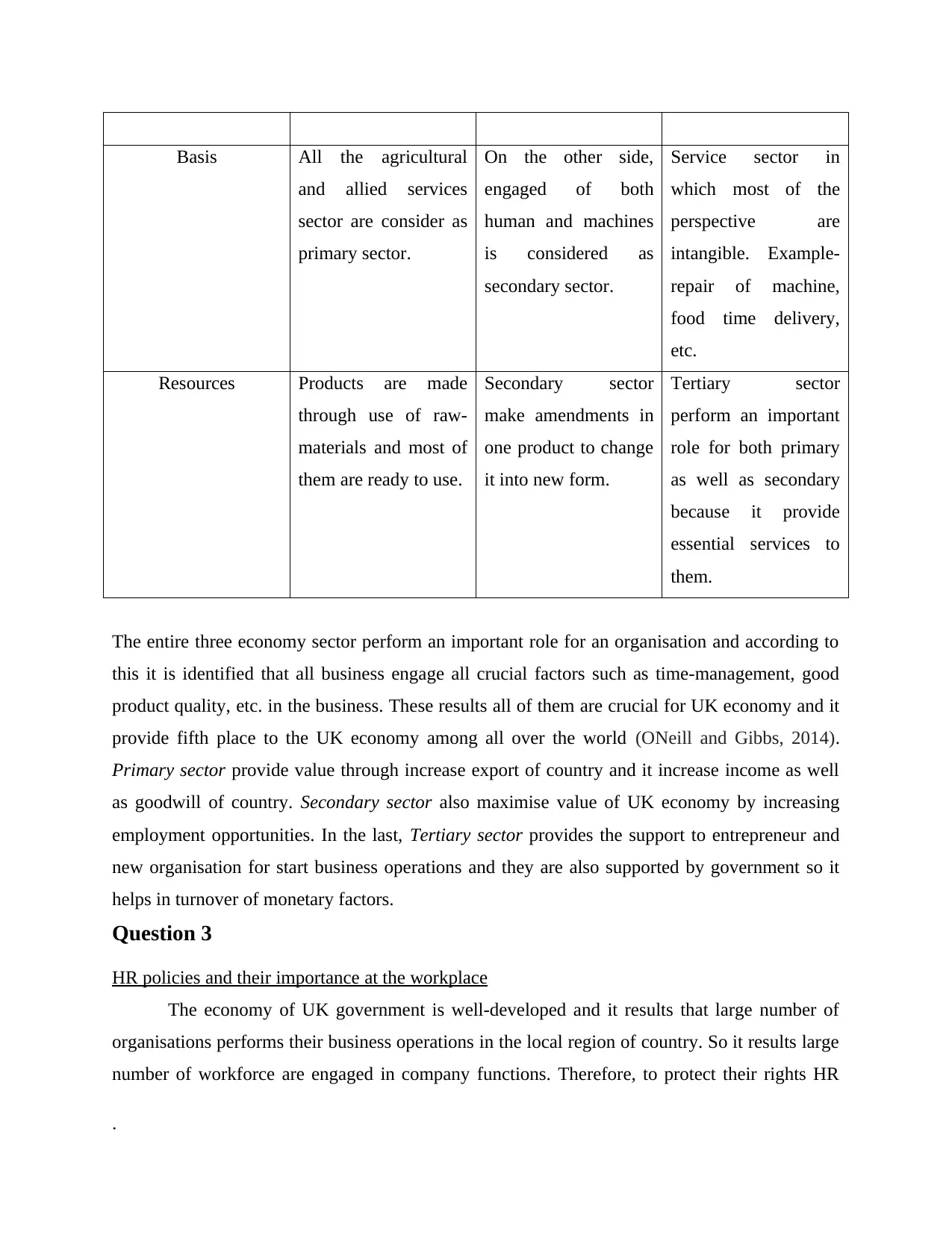
Basis All the agricultural
and allied services
sector are consider as
primary sector.
On the other side,
engaged of both
human and machines
is considered as
secondary sector.
Service sector in
which most of the
perspective are
intangible. Example-
repair of machine,
food time delivery,
etc.
Resources Products are made
through use of raw-
materials and most of
them are ready to use.
Secondary sector
make amendments in
one product to change
it into new form.
Tertiary sector
perform an important
role for both primary
as well as secondary
because it provide
essential services to
them.
The entire three economy sector perform an important role for an organisation and according to
this it is identified that all business engage all crucial factors such as time-management, good
product quality, etc. in the business. These results all of them are crucial for UK economy and it
provide fifth place to the UK economy among all over the world (ONeill and Gibbs, 2014).
Primary sector provide value through increase export of country and it increase income as well
as goodwill of country. Secondary sector also maximise value of UK economy by increasing
employment opportunities. In the last, Tertiary sector provides the support to entrepreneur and
new organisation for start business operations and they are also supported by government so it
helps in turnover of monetary factors.
Question 3
HR policies and their importance at the workplace
The economy of UK government is well-developed and it results that large number of
organisations performs their business operations in the local region of country. So it results large
number of workforce are engaged in company functions. Therefore, to protect their rights HR
.
and allied services
sector are consider as
primary sector.
On the other side,
engaged of both
human and machines
is considered as
secondary sector.
Service sector in
which most of the
perspective are
intangible. Example-
repair of machine,
food time delivery,
etc.
Resources Products are made
through use of raw-
materials and most of
them are ready to use.
Secondary sector
make amendments in
one product to change
it into new form.
Tertiary sector
perform an important
role for both primary
as well as secondary
because it provide
essential services to
them.
The entire three economy sector perform an important role for an organisation and according to
this it is identified that all business engage all crucial factors such as time-management, good
product quality, etc. in the business. These results all of them are crucial for UK economy and it
provide fifth place to the UK economy among all over the world (ONeill and Gibbs, 2014).
Primary sector provide value through increase export of country and it increase income as well
as goodwill of country. Secondary sector also maximise value of UK economy by increasing
employment opportunities. In the last, Tertiary sector provides the support to entrepreneur and
new organisation for start business operations and they are also supported by government so it
helps in turnover of monetary factors.
Question 3
HR policies and their importance at the workplace
The economy of UK government is well-developed and it results that large number of
organisations performs their business operations in the local region of country. So it results large
number of workforce are engaged in company functions. Therefore, to protect their rights HR
.
Paraphrase This Document
Need a fresh take? Get an instant paraphrase of this document with our AI Paraphraser
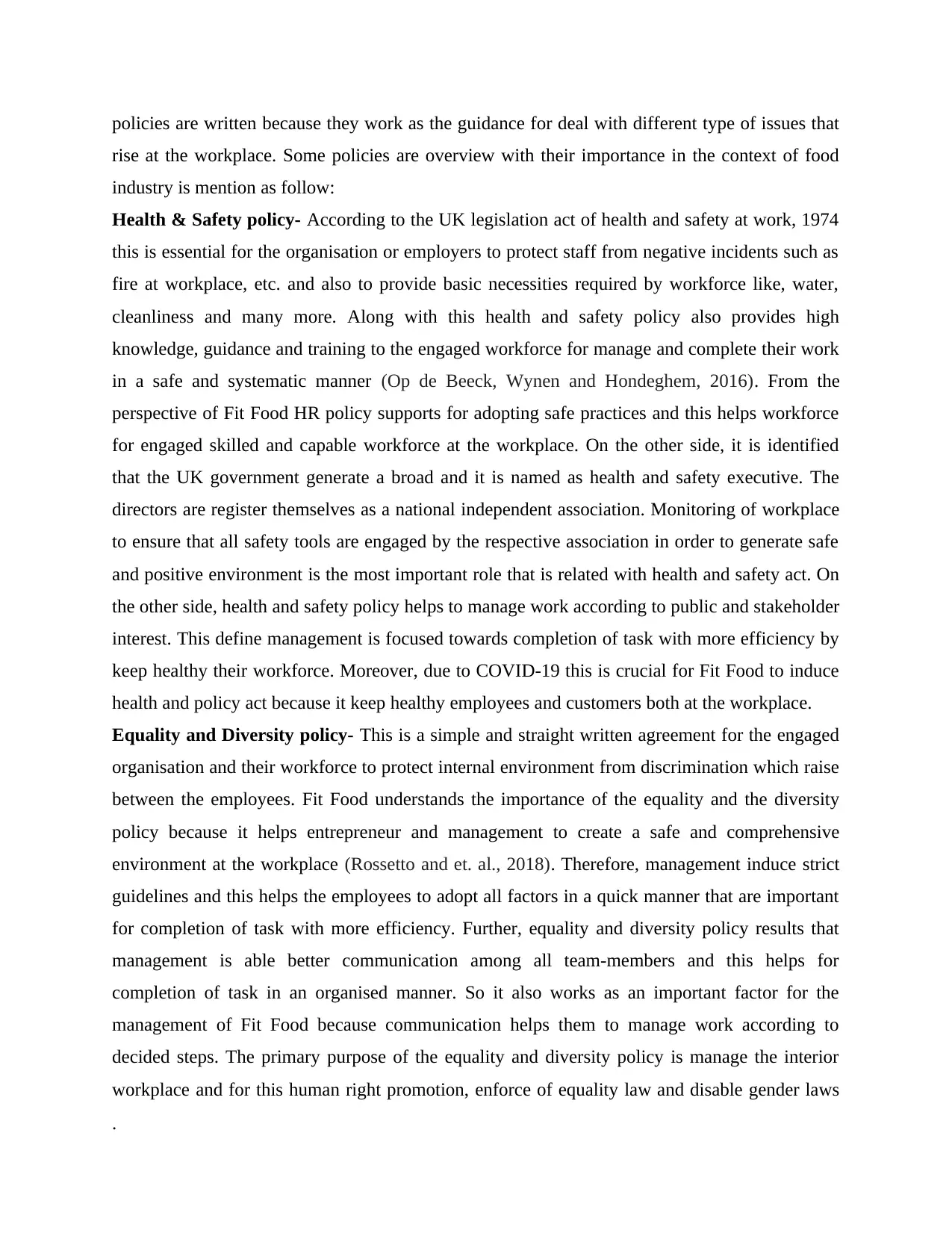
policies are written because they work as the guidance for deal with different type of issues that
rise at the workplace. Some policies are overview with their importance in the context of food
industry is mention as follow:
Health & Safety policy- According to the UK legislation act of health and safety at work, 1974
this is essential for the organisation or employers to protect staff from negative incidents such as
fire at workplace, etc. and also to provide basic necessities required by workforce like, water,
cleanliness and many more. Along with this health and safety policy also provides high
knowledge, guidance and training to the engaged workforce for manage and complete their work
in a safe and systematic manner (Op de Beeck, Wynen and Hondeghem, 2016). From the
perspective of Fit Food HR policy supports for adopting safe practices and this helps workforce
for engaged skilled and capable workforce at the workplace. On the other side, it is identified
that the UK government generate a broad and it is named as health and safety executive. The
directors are register themselves as a national independent association. Monitoring of workplace
to ensure that all safety tools are engaged by the respective association in order to generate safe
and positive environment is the most important role that is related with health and safety act. On
the other side, health and safety policy helps to manage work according to public and stakeholder
interest. This define management is focused towards completion of task with more efficiency by
keep healthy their workforce. Moreover, due to COVID-19 this is crucial for Fit Food to induce
health and policy act because it keep healthy employees and customers both at the workplace.
Equality and Diversity policy- This is a simple and straight written agreement for the engaged
organisation and their workforce to protect internal environment from discrimination which raise
between the employees. Fit Food understands the importance of the equality and the diversity
policy because it helps entrepreneur and management to create a safe and comprehensive
environment at the workplace (Rossetto and et. al., 2018). Therefore, management induce strict
guidelines and this helps the employees to adopt all factors in a quick manner that are important
for completion of task with more efficiency. Further, equality and diversity policy results that
management is able better communication among all team-members and this helps for
completion of task in an organised manner. So it also works as an important factor for the
management of Fit Food because communication helps them to manage work according to
decided steps. The primary purpose of the equality and diversity policy is manage the interior
workplace and for this human right promotion, enforce of equality law and disable gender laws
.
rise at the workplace. Some policies are overview with their importance in the context of food
industry is mention as follow:
Health & Safety policy- According to the UK legislation act of health and safety at work, 1974
this is essential for the organisation or employers to protect staff from negative incidents such as
fire at workplace, etc. and also to provide basic necessities required by workforce like, water,
cleanliness and many more. Along with this health and safety policy also provides high
knowledge, guidance and training to the engaged workforce for manage and complete their work
in a safe and systematic manner (Op de Beeck, Wynen and Hondeghem, 2016). From the
perspective of Fit Food HR policy supports for adopting safe practices and this helps workforce
for engaged skilled and capable workforce at the workplace. On the other side, it is identified
that the UK government generate a broad and it is named as health and safety executive. The
directors are register themselves as a national independent association. Monitoring of workplace
to ensure that all safety tools are engaged by the respective association in order to generate safe
and positive environment is the most important role that is related with health and safety act. On
the other side, health and safety policy helps to manage work according to public and stakeholder
interest. This define management is focused towards completion of task with more efficiency by
keep healthy their workforce. Moreover, due to COVID-19 this is crucial for Fit Food to induce
health and policy act because it keep healthy employees and customers both at the workplace.
Equality and Diversity policy- This is a simple and straight written agreement for the engaged
organisation and their workforce to protect internal environment from discrimination which raise
between the employees. Fit Food understands the importance of the equality and the diversity
policy because it helps entrepreneur and management to create a safe and comprehensive
environment at the workplace (Rossetto and et. al., 2018). Therefore, management induce strict
guidelines and this helps the employees to adopt all factors in a quick manner that are important
for completion of task with more efficiency. Further, equality and diversity policy results that
management is able better communication among all team-members and this helps for
completion of task in an organised manner. So it also works as an important factor for the
management of Fit Food because communication helps them to manage work according to
decided steps. The primary purpose of the equality and diversity policy is manage the interior
workplace and for this human right promotion, enforce of equality law and disable gender laws
.
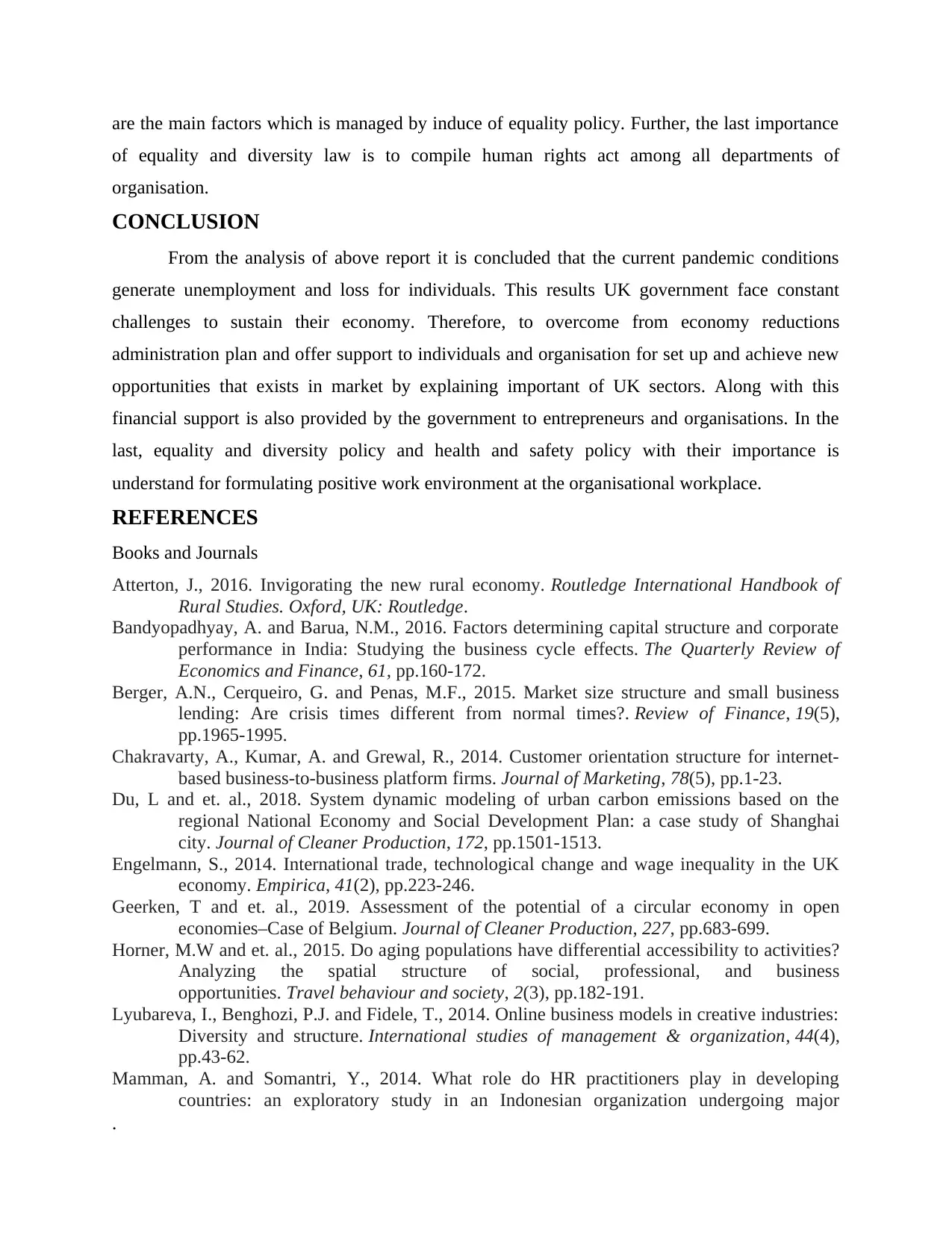
are the main factors which is managed by induce of equality policy. Further, the last importance
of equality and diversity law is to compile human rights act among all departments of
organisation.
CONCLUSION
From the analysis of above report it is concluded that the current pandemic conditions
generate unemployment and loss for individuals. This results UK government face constant
challenges to sustain their economy. Therefore, to overcome from economy reductions
administration plan and offer support to individuals and organisation for set up and achieve new
opportunities that exists in market by explaining important of UK sectors. Along with this
financial support is also provided by the government to entrepreneurs and organisations. In the
last, equality and diversity policy and health and safety policy with their importance is
understand for formulating positive work environment at the organisational workplace.
REFERENCES
Books and Journals
Atterton, J., 2016. Invigorating the new rural economy. Routledge International Handbook of
Rural Studies. Oxford, UK: Routledge.
Bandyopadhyay, A. and Barua, N.M., 2016. Factors determining capital structure and corporate
performance in India: Studying the business cycle effects. The Quarterly Review of
Economics and Finance, 61, pp.160-172.
Berger, A.N., Cerqueiro, G. and Penas, M.F., 2015. Market size structure and small business
lending: Are crisis times different from normal times?. Review of Finance, 19(5),
pp.1965-1995.
Chakravarty, A., Kumar, A. and Grewal, R., 2014. Customer orientation structure for internet-
based business-to-business platform firms. Journal of Marketing, 78(5), pp.1-23.
Du, L and et. al., 2018. System dynamic modeling of urban carbon emissions based on the
regional National Economy and Social Development Plan: a case study of Shanghai
city. Journal of Cleaner Production, 172, pp.1501-1513.
Engelmann, S., 2014. International trade, technological change and wage inequality in the UK
economy. Empirica, 41(2), pp.223-246.
Geerken, T and et. al., 2019. Assessment of the potential of a circular economy in open
economies–Case of Belgium. Journal of Cleaner Production, 227, pp.683-699.
Horner, M.W and et. al., 2015. Do aging populations have differential accessibility to activities?
Analyzing the spatial structure of social, professional, and business
opportunities. Travel behaviour and society, 2(3), pp.182-191.
Lyubareva, I., Benghozi, P.J. and Fidele, T., 2014. Online business models in creative industries:
Diversity and structure. International studies of management & organization, 44(4),
pp.43-62.
Mamman, A. and Somantri, Y., 2014. What role do HR practitioners play in developing
countries: an exploratory study in an Indonesian organization undergoing major
.
of equality and diversity law is to compile human rights act among all departments of
organisation.
CONCLUSION
From the analysis of above report it is concluded that the current pandemic conditions
generate unemployment and loss for individuals. This results UK government face constant
challenges to sustain their economy. Therefore, to overcome from economy reductions
administration plan and offer support to individuals and organisation for set up and achieve new
opportunities that exists in market by explaining important of UK sectors. Along with this
financial support is also provided by the government to entrepreneurs and organisations. In the
last, equality and diversity policy and health and safety policy with their importance is
understand for formulating positive work environment at the organisational workplace.
REFERENCES
Books and Journals
Atterton, J., 2016. Invigorating the new rural economy. Routledge International Handbook of
Rural Studies. Oxford, UK: Routledge.
Bandyopadhyay, A. and Barua, N.M., 2016. Factors determining capital structure and corporate
performance in India: Studying the business cycle effects. The Quarterly Review of
Economics and Finance, 61, pp.160-172.
Berger, A.N., Cerqueiro, G. and Penas, M.F., 2015. Market size structure and small business
lending: Are crisis times different from normal times?. Review of Finance, 19(5),
pp.1965-1995.
Chakravarty, A., Kumar, A. and Grewal, R., 2014. Customer orientation structure for internet-
based business-to-business platform firms. Journal of Marketing, 78(5), pp.1-23.
Du, L and et. al., 2018. System dynamic modeling of urban carbon emissions based on the
regional National Economy and Social Development Plan: a case study of Shanghai
city. Journal of Cleaner Production, 172, pp.1501-1513.
Engelmann, S., 2014. International trade, technological change and wage inequality in the UK
economy. Empirica, 41(2), pp.223-246.
Geerken, T and et. al., 2019. Assessment of the potential of a circular economy in open
economies–Case of Belgium. Journal of Cleaner Production, 227, pp.683-699.
Horner, M.W and et. al., 2015. Do aging populations have differential accessibility to activities?
Analyzing the spatial structure of social, professional, and business
opportunities. Travel behaviour and society, 2(3), pp.182-191.
Lyubareva, I., Benghozi, P.J. and Fidele, T., 2014. Online business models in creative industries:
Diversity and structure. International studies of management & organization, 44(4),
pp.43-62.
Mamman, A. and Somantri, Y., 2014. What role do HR practitioners play in developing
countries: an exploratory study in an Indonesian organization undergoing major
.
⊘ This is a preview!⊘
Do you want full access?
Subscribe today to unlock all pages.
Trusted by 1+ million students worldwide

1 out of 13


Related Documents


Your All-in-One AI-Powered Toolkit for Academic Success.
+13062052269
info@desklib.com
Available 24*7 on WhatsApp / Email
![[object Object]](/_next/static/media/star-bottom.7253800d.svg)
Unlock your academic potential
Copyright © 2020–2026 A2Z Services. All Rights Reserved. Developed and managed by ZUCOL.