Collin's ATM System: A Business Information System Case Study Analysis
VerifiedAdded on 2021/04/21
|11
|2418
|156
Case Study
AI Summary
This case study analyzes Collin's ATM system using a business information system approach. It begins with an introduction to business information systems and their importance, followed by a system vision document that includes a problem description focusing on the need for easy access to banking services. The proposed outcome outlines the key requirements of the ATM system, such as card recognition, PIN verification, and various transaction options. The report then details the system's capabilities, including 24/7 availability and reduced human effort, while also acknowledging potential issues like card cloning and network outages. Business benefits such as increased foot traffic and reduced card fees are highlighted. The resources required, including card readers, display screens, keypads, and printers, are described. A stakeholder map identifies primary, secondary, and tertiary stakeholders, and the risks associated with the project, such as fraud and security breaches, are discussed. The case study concludes by emphasizing the necessity of a business information system for organizational projects, summarizing the analysis of the ATM system's development, and providing an overview of its effectiveness.
Running head: CASE STUDY-COLLIN’S ATM SYSTEM
Case Study-Collin’s ATM System
Name of the Student
Name of the University
Author Note
Table of Contents
Case Study-Collin’s ATM System
Name of the Student
Name of the University
Author Note
Table of Contents

Paraphrase This Document
Need a fresh take? Get an instant paraphrase of this document with our AI Paraphraser
1CASE STUDY-COLLIN’S ATM SYSTEM
Introduction......................................................................................................................................0
Discussion........................................................................................................................................1
System Vision Document............................................................................................................1
Problem Description................................................................................................................1
Proposed Outcome...................................................................................................................1
System Capabilities.................................................................................................................2
Business Benefits.....................................................................................................................3
Resources Required.....................................................................................................................3
Stakeholder Map..........................................................................................................................4
Risks of the project......................................................................................................................5
Conclusion.......................................................................................................................................5
References........................................................................................................................................7
Introduction......................................................................................................................................0
Discussion........................................................................................................................................1
System Vision Document............................................................................................................1
Problem Description................................................................................................................1
Proposed Outcome...................................................................................................................1
System Capabilities.................................................................................................................2
Business Benefits.....................................................................................................................3
Resources Required.....................................................................................................................3
Stakeholder Map..........................................................................................................................4
Risks of the project......................................................................................................................5
Conclusion.......................................................................................................................................5
References........................................................................................................................................7
2CASE STUDY-COLLIN’S ATM SYSTEM
Introduction
The business information system is described as a system that integrates information
technology components, people and overall business functions. The business information system
helps to bring information technology components and business functions together to establish
effective interaction among the components to provide organizational growth (Kharchenko &
Chynchenko, 2013). The effectiveness of business information system in this report is discussed
in this report with reference to a case study. The chosen case study is Collin’s ATM system. The
description of Collin’s ATM system through system vision document is provided in this report.
The purpose of this report is to analyse the given cases study using business information system
approach.
The outline of this report is system vision document, resources required, stakeholder map
and risks of the project. The system vision document consists of problem description, proposed
outcome, system capabilities and business benefits.
Discussion
System Vision Document
Problem Description
The problem descriptions of Collin’s ATM Bank are given as follows. There are different
kinds of consumers who want easy access to banking system and services such as deposit or
withdrawal, from any part of the world. This service is provided by a system called ATM which
is used commonly in today’s scenario (Kamal et al., 2015). ATM is commonly used for
withdrawal, mini statements and balance checking for an individual account reducing the human
Introduction
The business information system is described as a system that integrates information
technology components, people and overall business functions. The business information system
helps to bring information technology components and business functions together to establish
effective interaction among the components to provide organizational growth (Kharchenko &
Chynchenko, 2013). The effectiveness of business information system in this report is discussed
in this report with reference to a case study. The chosen case study is Collin’s ATM system. The
description of Collin’s ATM system through system vision document is provided in this report.
The purpose of this report is to analyse the given cases study using business information system
approach.
The outline of this report is system vision document, resources required, stakeholder map
and risks of the project. The system vision document consists of problem description, proposed
outcome, system capabilities and business benefits.
Discussion
System Vision Document
Problem Description
The problem descriptions of Collin’s ATM Bank are given as follows. There are different
kinds of consumers who want easy access to banking system and services such as deposit or
withdrawal, from any part of the world. This service is provided by a system called ATM which
is used commonly in today’s scenario (Kamal et al., 2015). ATM is commonly used for
withdrawal, mini statements and balance checking for an individual account reducing the human
⊘ This is a preview!⊘
Do you want full access?
Subscribe today to unlock all pages.

Trusted by 1+ million students worldwide
3CASE STUDY-COLLIN’S ATM SYSTEM
effort. Hence, Collin’s ATM Bank requires an ATM system to facilitate their customers by
providing easy banking activities. The Collin’s ATM Bank requires the ATM to have a card
reader for reading ATM cards. The other requirements are a cash dispenser, a display, a printing
feature to print details of transaction and to deposit cash/cheques a chute feature is required.
Proposed Outcome
The proposed outcome of Collin’s ATM system is the key requirements, the company
needs. The key requirements of the Collin’s ATM system are as follows. The first is to assist one
customer at a single time. The second is recognition of card by the corresponding bank. The third
is to verify the entered pin. The fourth is to select the type of account; customer has (Montefusco
et al., 2016). The fifth is to select the type of transaction such as withdrawal, deposit, transfer,
checking account balance or printing mini statements. The sixth is to generate report after
transaction and facilitate the corresponding bank to provide regular updates to identify the flow
of cash from a corresponding bank.
System Capabilities
The system capabilities of ATM system are various and hence, the ATM system is the
most common one for every banking industry. The capabilities are as follows. The ATM system
provides benefit of doing transaction 24/7 hours (Ahmad, Rifen & Wahab, 2016). The human
effort is reduced which is the most beneficial capability of this system. The bank customers
leverage convenience to use this system without the need of going to bank. This system requires
small place to install and hence more convenient in farther and remote areas where customers
have to travel to the bank (De Gramatica et al., 2015). The ATM system provides new notes
rather than the soiled ones to the customer. This system minimizes the hassle in transaction
effort. Hence, Collin’s ATM Bank requires an ATM system to facilitate their customers by
providing easy banking activities. The Collin’s ATM Bank requires the ATM to have a card
reader for reading ATM cards. The other requirements are a cash dispenser, a display, a printing
feature to print details of transaction and to deposit cash/cheques a chute feature is required.
Proposed Outcome
The proposed outcome of Collin’s ATM system is the key requirements, the company
needs. The key requirements of the Collin’s ATM system are as follows. The first is to assist one
customer at a single time. The second is recognition of card by the corresponding bank. The third
is to verify the entered pin. The fourth is to select the type of account; customer has (Montefusco
et al., 2016). The fifth is to select the type of transaction such as withdrawal, deposit, transfer,
checking account balance or printing mini statements. The sixth is to generate report after
transaction and facilitate the corresponding bank to provide regular updates to identify the flow
of cash from a corresponding bank.
System Capabilities
The system capabilities of ATM system are various and hence, the ATM system is the
most common one for every banking industry. The capabilities are as follows. The ATM system
provides benefit of doing transaction 24/7 hours (Ahmad, Rifen & Wahab, 2016). The human
effort is reduced which is the most beneficial capability of this system. The bank customers
leverage convenience to use this system without the need of going to bank. This system requires
small place to install and hence more convenient in farther and remote areas where customers
have to travel to the bank (De Gramatica et al., 2015). The ATM system provides new notes
rather than the soiled ones to the customer. This system minimizes the hassle in transaction
Paraphrase This Document
Need a fresh take? Get an instant paraphrase of this document with our AI Paraphraser
4CASE STUDY-COLLIN’S ATM SYSTEM
process to provide a quick and fast transaction. The ATM system provides paperless process
until and unless customers need a paper receipt or mini statement.
The ATM system is beneficial for making customer’s daily work easy. However, this
system too comes with some major issues and their as follows. There are issue with ATM card
that it can be cloned for fraud activities. There are some cases regarding fake ATM systems. The
ATM operates on a network and hence if the ATM is out of service then no transaction process
can occur (Patriarca, 2016). There is no guarantee that ATM system will have cash when a
customer needs. The shortage of amount is handled by the bank if no amount of cash is left in the
system.
Business Benefits
The above paragraph shows the system capabilities of ATM system which is beneficial
for the business growth of a bank such as Collin’s ATM Bank (Ball et al., 2017). Therefore, the
below points shows the benefits of ATM system provide for organizational growth.
There is an increase in foot traffic which will provide an opportunity to convert
potential customers into leads.
The increased sales in combination with foot traffic will provide major benefits to
the bank.
The card fess is reduced which provides saving of money for banks.
The surcharge revenue is added revenue that goes to bank when customers do
transactions.
The customer retention is another benefit for business which provides new leads.
process to provide a quick and fast transaction. The ATM system provides paperless process
until and unless customers need a paper receipt or mini statement.
The ATM system is beneficial for making customer’s daily work easy. However, this
system too comes with some major issues and their as follows. There are issue with ATM card
that it can be cloned for fraud activities. There are some cases regarding fake ATM systems. The
ATM operates on a network and hence if the ATM is out of service then no transaction process
can occur (Patriarca, 2016). There is no guarantee that ATM system will have cash when a
customer needs. The shortage of amount is handled by the bank if no amount of cash is left in the
system.
Business Benefits
The above paragraph shows the system capabilities of ATM system which is beneficial
for the business growth of a bank such as Collin’s ATM Bank (Ball et al., 2017). Therefore, the
below points shows the benefits of ATM system provide for organizational growth.
There is an increase in foot traffic which will provide an opportunity to convert
potential customers into leads.
The increased sales in combination with foot traffic will provide major benefits to
the bank.
The card fess is reduced which provides saving of money for banks.
The surcharge revenue is added revenue that goes to bank when customers do
transactions.
The customer retention is another benefit for business which provides new leads.
5CASE STUDY-COLLIN’S ATM SYSTEM
Resources Required
The resources for the ATM system are of various kinds of activities that the system offers
such as transaction, insertion of pin number, screen and other activities (De Gramatica et al.,
2015). The resources required as per the need of Collin’s ATM system requirements along with
some additional resources are given below.
Card Reader- The card reader is an essential requirement for the system. The card
reader is used to read the various kinds of cards to access its information (Onyesolu & Okpala,
2017). The various kinds of cards are processed by the card reader to get information and
proceed according to the action provided by the card holder. The card is swiped in the system to
be accessed by the card reader.
Display Screen- The display screen is similar to a television or computer screen where
information or menus are shown to the customers (Mandari & Koloseni, 2016). The steps for
transaction process whether it is withdrawal or deposit, both are shown in the screen to facilitate
the process for the customer. The most widely used display screens are CRT or LCD screen.
Keypad- The keypad in the system provides insertion of details such as personal
identification number (pin) of the card or amount of cash whether for depositing or withdrawal.
The keypad generally consists of 48 keys (Verma, 2014). The pin number in the system is
entered in an encrypted form through keypad to prevent any fraud activities. The keypad comes
with this feature of encryption which is used only for pin number details.
Speaker- The speaker in the system provides information when any error occurs or any
wrong key is pressed against the activity shown in the display screen.
Resources Required
The resources for the ATM system are of various kinds of activities that the system offers
such as transaction, insertion of pin number, screen and other activities (De Gramatica et al.,
2015). The resources required as per the need of Collin’s ATM system requirements along with
some additional resources are given below.
Card Reader- The card reader is an essential requirement for the system. The card
reader is used to read the various kinds of cards to access its information (Onyesolu & Okpala,
2017). The various kinds of cards are processed by the card reader to get information and
proceed according to the action provided by the card holder. The card is swiped in the system to
be accessed by the card reader.
Display Screen- The display screen is similar to a television or computer screen where
information or menus are shown to the customers (Mandari & Koloseni, 2016). The steps for
transaction process whether it is withdrawal or deposit, both are shown in the screen to facilitate
the process for the customer. The most widely used display screens are CRT or LCD screen.
Keypad- The keypad in the system provides insertion of details such as personal
identification number (pin) of the card or amount of cash whether for depositing or withdrawal.
The keypad generally consists of 48 keys (Verma, 2014). The pin number in the system is
entered in an encrypted form through keypad to prevent any fraud activities. The keypad comes
with this feature of encryption which is used only for pin number details.
Speaker- The speaker in the system provides information when any error occurs or any
wrong key is pressed against the activity shown in the display screen.
⊘ This is a preview!⊘
Do you want full access?
Subscribe today to unlock all pages.
Trusted by 1+ million students worldwide
6CASE STUDY-COLLIN’S ATM SYSTEM
Printers- The printers are used only for the purpose of printing receipts of transactions,
mini statements and balance enquiry (Sharma et al., 2017). The receipt provides information
regarding the transaction occurred. An example is, a receipt for withdrawal generally contains
date and time of transaction, account number (in encrypted format), amount withdrawn and total
balance.
Stakeholder Map
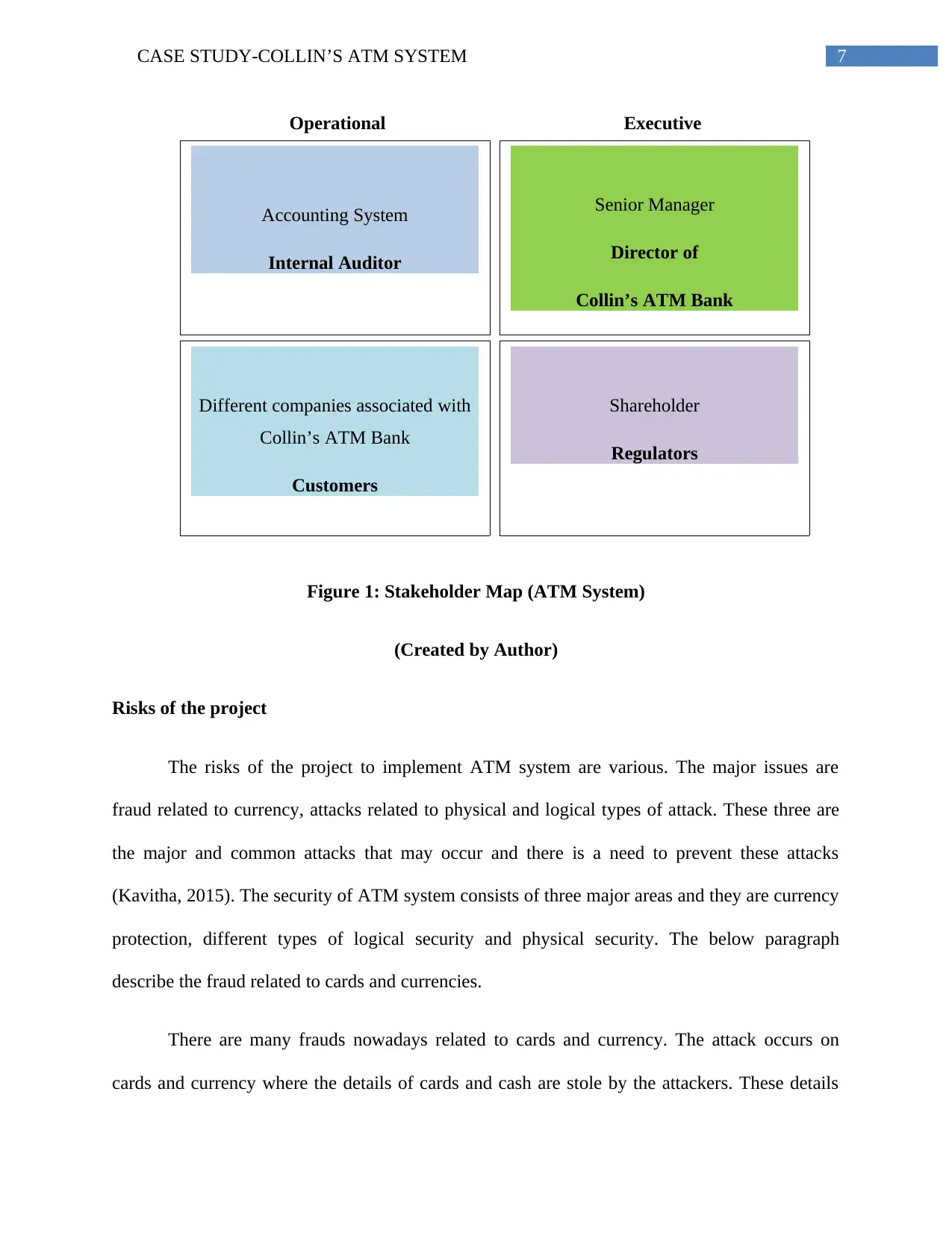
There are three major stakeholders related to ATM system and they are are primary,
secondary and tertiary. The primary stakeholders are the customers who do transaction using the
ATM system. The banks are considered as secondary stakeholder because bank act as a platform
through which transaction occurs. The tertiary stakeholders are manufacturer of ATM system
who deals with the different kinds of issues related with ATM system (Kavitha, 2015). These
stakeholders have large number of advantages and limitations regarding the ATM system. The
benefits are using ATM for regular transactions at high speed and technical errors are reduced
through this system. This benefit is related to customers who are responsible for using the ATM
for transaction. The benefit for secondary customer is that they can easily get extra amount of
cash as interest from several customers when they do transaction. The easy and fast transaction is
an essential part of generating revenue for banks. The customers will also likely to suggest it to
other customers and recommend to the banks to build more ATM systems.
Printers- The printers are used only for the purpose of printing receipts of transactions,
mini statements and balance enquiry (Sharma et al., 2017). The receipt provides information
regarding the transaction occurred. An example is, a receipt for withdrawal generally contains
date and time of transaction, account number (in encrypted format), amount withdrawn and total
balance.
Stakeholder Map
There are three major stakeholders related to ATM system and they are are primary,
secondary and tertiary. The primary stakeholders are the customers who do transaction using the
ATM system. The banks are considered as secondary stakeholder because bank act as a platform
through which transaction occurs. The tertiary stakeholders are manufacturer of ATM system
who deals with the different kinds of issues related with ATM system (Kavitha, 2015). These
stakeholders have large number of advantages and limitations regarding the ATM system. The
benefits are using ATM for regular transactions at high speed and technical errors are reduced
through this system. This benefit is related to customers who are responsible for using the ATM
for transaction. The benefit for secondary customer is that they can easily get extra amount of
cash as interest from several customers when they do transaction. The easy and fast transaction is
an essential part of generating revenue for banks. The customers will also likely to suggest it to
other customers and recommend to the banks to build more ATM systems.
Paraphrase This Document
Need a fresh take? Get an instant paraphrase of this document with our AI Paraphraser
7CASE STUDY-COLLIN’S ATM SYSTEM
Operational Executive
Figure 1: Stakeholder Map (ATM System)
(Created by Author)
Risks of the project
The risks of the project to implement ATM system are various. The major issues are
fraud related to currency, attacks related to physical and logical types of attack. These three are
the major and common attacks that may occur and there is a need to prevent these attacks
(Kavitha, 2015). The security of ATM system consists of three major areas and they are currency
protection, different types of logical security and physical security. The below paragraph
describe the fraud related to cards and currencies.
There are many frauds nowadays related to cards and currency. The attack occurs on
cards and currency where the details of cards and cash are stole by the attackers. These details
Accounting System
Internal Auditor
Senior Manager
Director of
Collin’s ATM Bank
Different companies associated with
Collin’s ATM Bank
Customers
Shareholder
Regulators
Operational Executive
Figure 1: Stakeholder Map (ATM System)
(Created by Author)
Risks of the project
The risks of the project to implement ATM system are various. The major issues are
fraud related to currency, attacks related to physical and logical types of attack. These three are
the major and common attacks that may occur and there is a need to prevent these attacks
(Kavitha, 2015). The security of ATM system consists of three major areas and they are currency
protection, different types of logical security and physical security. The below paragraph
describe the fraud related to cards and currencies.
There are many frauds nowadays related to cards and currency. The attack occurs on
cards and currency where the details of cards and cash are stole by the attackers. These details
Accounting System
Internal Auditor
Senior Manager
Director of
Collin’s ATM Bank
Different companies associated with
Collin’s ATM Bank
Customers
Shareholder
Regulators
8CASE STUDY-COLLIN’S ATM SYSTEM
are then misused for fraud activities of withdrawal (Martins, Oliveira & Popovič, 2014). The
type of attacks in ATM occurs are skimming, fishing of cards and currency tapping which are
common nowadays. The stealing of card and currency details affects the customers badly
resulting in financial loss for customers as well as banks.
Conclusion
The above discussions conclude that a business information system is a necessary part for
an organization before starting of any project. The report shows the analysis of business
information systems through a case study of an ATM system. The development of ATM system
is thoroughly analysed to provide an overview of the effectiveness of the business information
system. The system vision document briefly describes the aspects of ATM system that will be
required to develop the system. The report focuses on how ATM system can be built with the
provided resources, associate stakeholders and considered risks to prevent. Therefore, it can be
concluded that system vision document with reference to business information system provides
an overview of any project.
are then misused for fraud activities of withdrawal (Martins, Oliveira & Popovič, 2014). The
type of attacks in ATM occurs are skimming, fishing of cards and currency tapping which are
common nowadays. The stealing of card and currency details affects the customers badly
resulting in financial loss for customers as well as banks.
Conclusion
The above discussions conclude that a business information system is a necessary part for
an organization before starting of any project. The report shows the analysis of business
information systems through a case study of an ATM system. The development of ATM system
is thoroughly analysed to provide an overview of the effectiveness of the business information
system. The system vision document briefly describes the aspects of ATM system that will be
required to develop the system. The report focuses on how ATM system can be built with the
provided resources, associate stakeholders and considered risks to prevent. Therefore, it can be
concluded that system vision document with reference to business information system provides
an overview of any project.
⊘ This is a preview!⊘
Do you want full access?
Subscribe today to unlock all pages.
Trusted by 1+ million students worldwide
9CASE STUDY-COLLIN’S ATM SYSTEM
References
Ahmad, N., Rifen, A. A. M., & Wahab, M. H. A. (2016, November). AES Cardless Automatic
Teller Machine (ATM) Biometric Security System Design Using FPGA Implementation.
In IOP Conference Series: Materials Science and Engineering (Vol. 160, No. 1, p.
012113). IOP Publishing.
Ball, M., Swaroop, P., Barnhart, C., Yan, C., Hansen, M., Kang, L., ... & Vaze, V. (2017).
Service level expectation setting for air traffic flow management: Practical challenges
and benefits assessment. In USA/Europe Air Traffic Management Research &
Development Seminar, Seattle, WA.
De Gramatica, M., Labunets, K., Massacci, F., Paci, F., &Tedeschi, A. (2015, March). The role
of catalogues of threats and security controls in security risk assessment: an empirical
study with ATM professionals. In International Working Conference on Requirements
Engineering: Foundation for Software Quality (pp. 98-114). Springer, Cham.
Kamal, A. M., Chowdhury, K. A. A., Chy, M. M., Shill, L. K., Chowdhury, S., Chy, M. A. H., &
Habib, M. Z. (2015). Evaluation of anthelmintic activity of seeds of Sesamumindicum L.
and fruits of Capsicum frutescens L. Journal of Pharmacognosy and
Phytochemistry, 3(6), 256-259.
Kavitha, K. (2015). Mobile Banking Supervising System-Issues, Challenges and Suggestions to
improve Mobile Banking Services. Advances in Computer Science: an International
Journal, 4(4), 65-67.
References
Ahmad, N., Rifen, A. A. M., & Wahab, M. H. A. (2016, November). AES Cardless Automatic
Teller Machine (ATM) Biometric Security System Design Using FPGA Implementation.
In IOP Conference Series: Materials Science and Engineering (Vol. 160, No. 1, p.
012113). IOP Publishing.
Ball, M., Swaroop, P., Barnhart, C., Yan, C., Hansen, M., Kang, L., ... & Vaze, V. (2017).
Service level expectation setting for air traffic flow management: Practical challenges
and benefits assessment. In USA/Europe Air Traffic Management Research &
Development Seminar, Seattle, WA.
De Gramatica, M., Labunets, K., Massacci, F., Paci, F., &Tedeschi, A. (2015, March). The role
of catalogues of threats and security controls in security risk assessment: an empirical
study with ATM professionals. In International Working Conference on Requirements
Engineering: Foundation for Software Quality (pp. 98-114). Springer, Cham.
Kamal, A. M., Chowdhury, K. A. A., Chy, M. M., Shill, L. K., Chowdhury, S., Chy, M. A. H., &
Habib, M. Z. (2015). Evaluation of anthelmintic activity of seeds of Sesamumindicum L.
and fruits of Capsicum frutescens L. Journal of Pharmacognosy and
Phytochemistry, 3(6), 256-259.
Kavitha, K. (2015). Mobile Banking Supervising System-Issues, Challenges and Suggestions to
improve Mobile Banking Services. Advances in Computer Science: an International
Journal, 4(4), 65-67.
Paraphrase This Document
Need a fresh take? Get an instant paraphrase of this document with our AI Paraphraser
10CASE STUDY-COLLIN’S ATM SYSTEM
Kharchenko, V., &Chynchenko, Y. (2013). Integrated risk picture methodology for air traffic
management in Europe. Proсeedings of the National Aviation University, (1), 15-20.
Mandari, H., &Koloseni, D. (2016). Biometric Authentication in Financial Institutions: The
intention of Banks to Adopt Biometric Powered ATM. Advances in Computer Science:
an International Journal, 5(4), 9-17.
Montefusco, P., Casar, R., Stelkens-Kobsch, T. H., &Koelle, R. (2016). Addressing security in
the ATM environment.
Onyesolu, M. O., & Okpala, A. C. (2017). Improving Security Using a Three-Tier
Authentication for Automated Teller Machine (ATM). International Journal of Computer
Network and Information Security, 9(10), 50.
Sharma, S. P. G., Nayak, P. S., Siddarth, V., Santhosh, K., & Shilpa, S. G. (2017). Blind
Friendly ATM Software System.
Verma, K. (2014). Measuring Customer Satisfaction Towards ATM Services-A Comparative
Study of Union Bank of India and Yes Bank. Abhinav National Monthly Referred
Journal of Research in Commerce and Management, 3(7), 33-38.
Kharchenko, V., &Chynchenko, Y. (2013). Integrated risk picture methodology for air traffic
management in Europe. Proсeedings of the National Aviation University, (1), 15-20.
Mandari, H., &Koloseni, D. (2016). Biometric Authentication in Financial Institutions: The
intention of Banks to Adopt Biometric Powered ATM. Advances in Computer Science:
an International Journal, 5(4), 9-17.
Montefusco, P., Casar, R., Stelkens-Kobsch, T. H., &Koelle, R. (2016). Addressing security in
the ATM environment.
Onyesolu, M. O., & Okpala, A. C. (2017). Improving Security Using a Three-Tier
Authentication for Automated Teller Machine (ATM). International Journal of Computer
Network and Information Security, 9(10), 50.
Sharma, S. P. G., Nayak, P. S., Siddarth, V., Santhosh, K., & Shilpa, S. G. (2017). Blind
Friendly ATM Software System.
Verma, K. (2014). Measuring Customer Satisfaction Towards ATM Services-A Comparative
Study of Union Bank of India and Yes Bank. Abhinav National Monthly Referred
Journal of Research in Commerce and Management, 3(7), 33-38.

1 out of 11


Related Documents


Your All-in-One AI-Powered Toolkit for Academic Success.
+13062052269
info@desklib.com
Available 24*7 on WhatsApp / Email
![[object Object]](/_next/static/media/star-bottom.7253800d.svg)
Unlock your academic potential
Copyright © 2020–2026 A2Z Services. All Rights Reserved. Developed and managed by ZUCOL.