BMGT1101: Comparative Analysis of Salon and Fitness Center Ventures
VerifiedAdded on  2023/06/14
|6
|826
|355
Report
AI Summary
This report presents a comparative analysis of two potential business ventures: a hair salon and a small-scale fitness center. It includes a break-even analysis for each option, considering fixed and variable costs, average sales, and membership fees. The analysis suggests that the fitness center, requiring fewer weekly enrollments to reach the break-even point, is the more viable investment. The report also discusses the importance of market research, competitive pricing strategies, and promotional activities to attract customers, particularly targeting the 16-32 age group. It highlights the need to consider utility expenses and other operational costs for a comprehensive evaluation. The four P's (product, price, place, and promotion) are discussed in the context of the fitness center venture.
Running head: BUSINESS MANAGEMENT
Business Management
Name of the Student:
Name of the University:
Authors Note:
Business Management
Name of the Student:
Name of the University:
Authors Note:
Paraphrase This Document
Need a fresh take? Get an instant paraphrase of this document with our AI Paraphraser

BUSINESS MANAGEMENT
1
Table of Contents
Executive Summary:..................................................................................................................2
Reference and Bibliography:......................................................................................................5
1
Table of Contents
Executive Summary:..................................................................................................................2
Reference and Bibliography:......................................................................................................5

BUSINESS MANAGEMENT
2
Executive Summary:
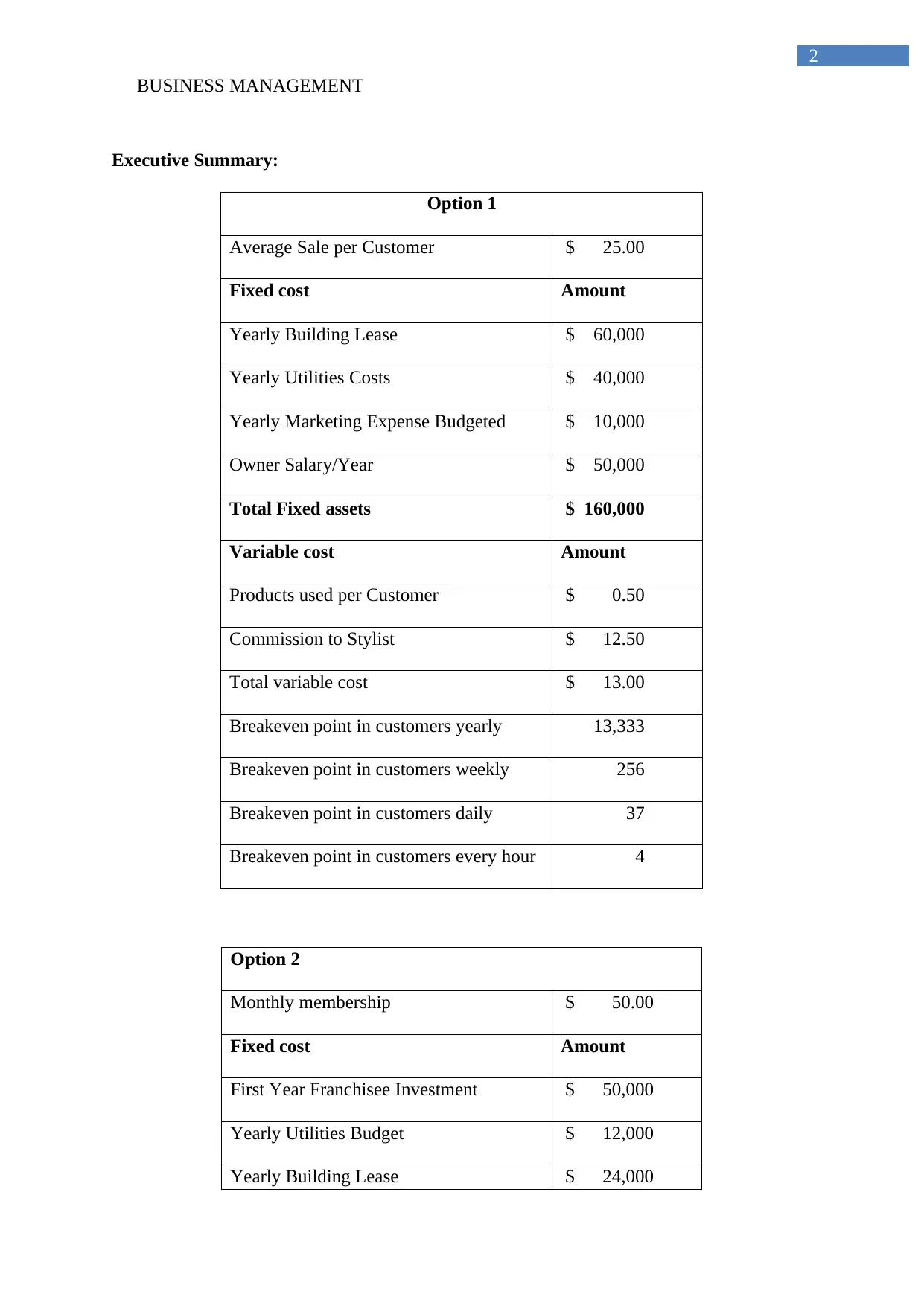
Option 1
Average Sale per Customer $ 25.00
Fixed cost Amount
Yearly Building Lease $ 60,000
Yearly Utilities Costs $ 40,000
Yearly Marketing Expense Budgeted $ 10,000
Owner Salary/Year $ 50,000
Total Fixed assets $ 160,000
Variable cost Amount
Products used per Customer $ 0.50
Commission to Stylist $ 12.50
Total variable cost $ 13.00
Breakeven point in customers yearly 13,333
Breakeven point in customers weekly 256
Breakeven point in customers daily 37
Breakeven point in customers every hour 4
Option 2
Monthly membership $ 50.00
Fixed cost Amount
First Year Franchisee Investment $ 50,000
Yearly Utilities Budget $ 12,000
Yearly Building Lease $ 24,000
2
Executive Summary:
Option 1
Average Sale per Customer $ 25.00
Fixed cost Amount
Yearly Building Lease $ 60,000
Yearly Utilities Costs $ 40,000
Yearly Marketing Expense Budgeted $ 10,000
Owner Salary/Year $ 50,000
Total Fixed assets $ 160,000
Variable cost Amount
Products used per Customer $ 0.50
Commission to Stylist $ 12.50
Total variable cost $ 13.00
Breakeven point in customers yearly 13,333
Breakeven point in customers weekly 256
Breakeven point in customers daily 37
Breakeven point in customers every hour 4
Option 2
Monthly membership $ 50.00
Fixed cost Amount
First Year Franchisee Investment $ 50,000
Yearly Utilities Budget $ 12,000
Yearly Building Lease $ 24,000
⊘ This is a preview!⊘
Do you want full access?
Subscribe today to unlock all pages.

Trusted by 1+ million students worldwide

BUSINESS MANAGEMENT
3
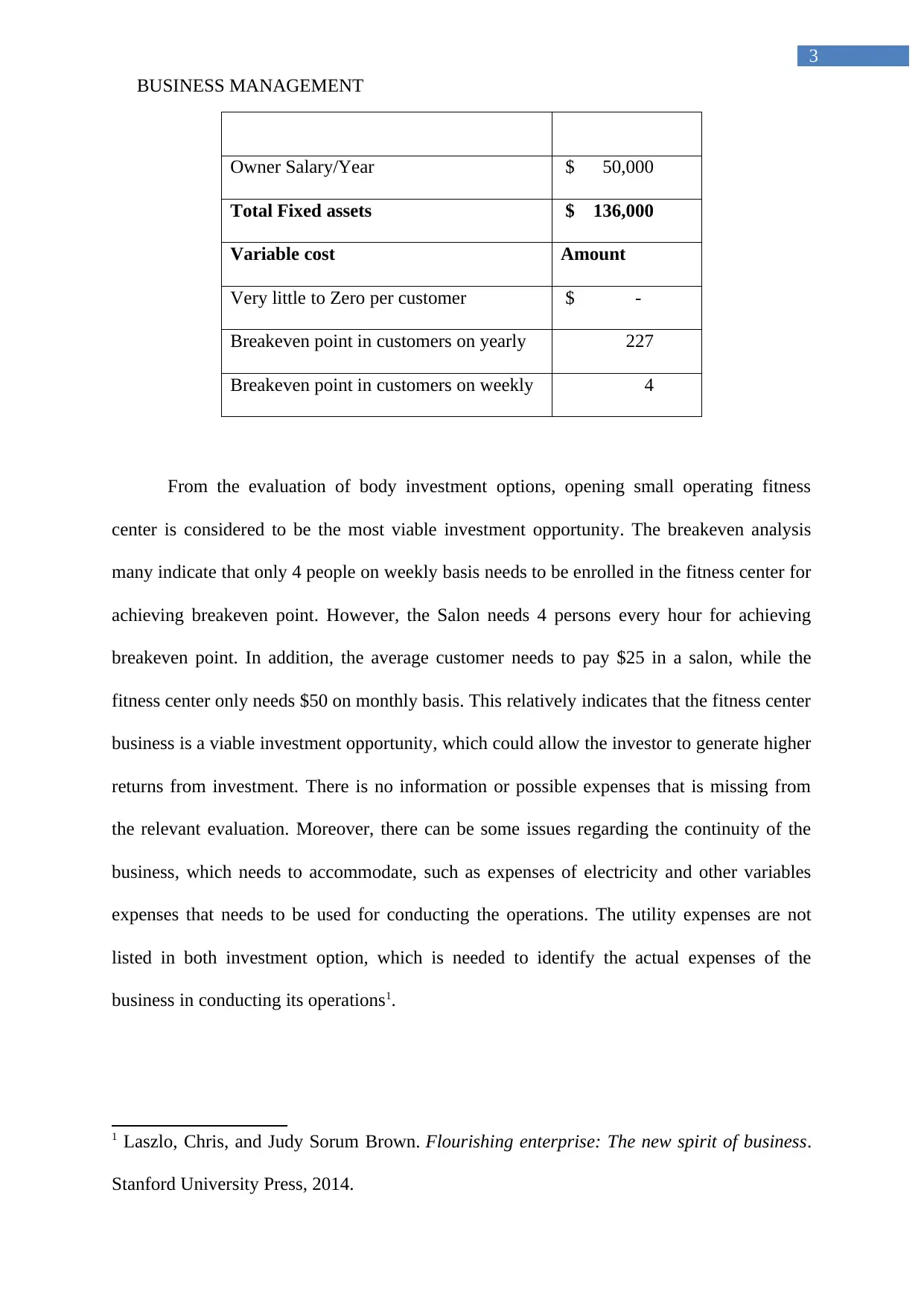
Owner Salary/Year $ 50,000
Total Fixed assets $ 136,000
Variable cost Amount
Very little to Zero per customer $ -
Breakeven point in customers on yearly 227
Breakeven point in customers on weekly 4
From the evaluation of body investment options, opening small operating fitness
center is considered to be the most viable investment opportunity. The breakeven analysis
many indicate that only 4 people on weekly basis needs to be enrolled in the fitness center for
achieving breakeven point. However, the Salon needs 4 persons every hour for achieving
breakeven point. In addition, the average customer needs to pay $25 in a salon, while the
fitness center only needs $50 on monthly basis. This relatively indicates that the fitness center
business is a viable investment opportunity, which could allow the investor to generate higher
returns from investment. There is no information or possible expenses that is missing from
the relevant evaluation. Moreover, there can be some issues regarding the continuity of the
business, which needs to accommodate, such as expenses of electricity and other variables
expenses that needs to be used for conducting the operations. The utility expenses are not
listed in both investment option, which is needed to identify the actual expenses of the
business in conducting its operations1.
1 Laszlo, Chris, and Judy Sorum Brown. Flourishing enterprise: The new spirit of business.
Stanford University Press, 2014.
3
Owner Salary/Year $ 50,000
Total Fixed assets $ 136,000
Variable cost Amount
Very little to Zero per customer $ -
Breakeven point in customers on yearly 227
Breakeven point in customers on weekly 4
From the evaluation of body investment options, opening small operating fitness
center is considered to be the most viable investment opportunity. The breakeven analysis
many indicate that only 4 people on weekly basis needs to be enrolled in the fitness center for
achieving breakeven point. However, the Salon needs 4 persons every hour for achieving
breakeven point. In addition, the average customer needs to pay $25 in a salon, while the
fitness center only needs $50 on monthly basis. This relatively indicates that the fitness center
business is a viable investment opportunity, which could allow the investor to generate higher
returns from investment. There is no information or possible expenses that is missing from
the relevant evaluation. Moreover, there can be some issues regarding the continuity of the
business, which needs to accommodate, such as expenses of electricity and other variables
expenses that needs to be used for conducting the operations. The utility expenses are not
listed in both investment option, which is needed to identify the actual expenses of the
business in conducting its operations1.
1 Laszlo, Chris, and Judy Sorum Brown. Flourishing enterprise: The new spirit of business.
Stanford University Press, 2014.
Paraphrase This Document
Need a fresh take? Get an instant paraphrase of this document with our AI Paraphraser

BUSINESS MANAGEMENT
4
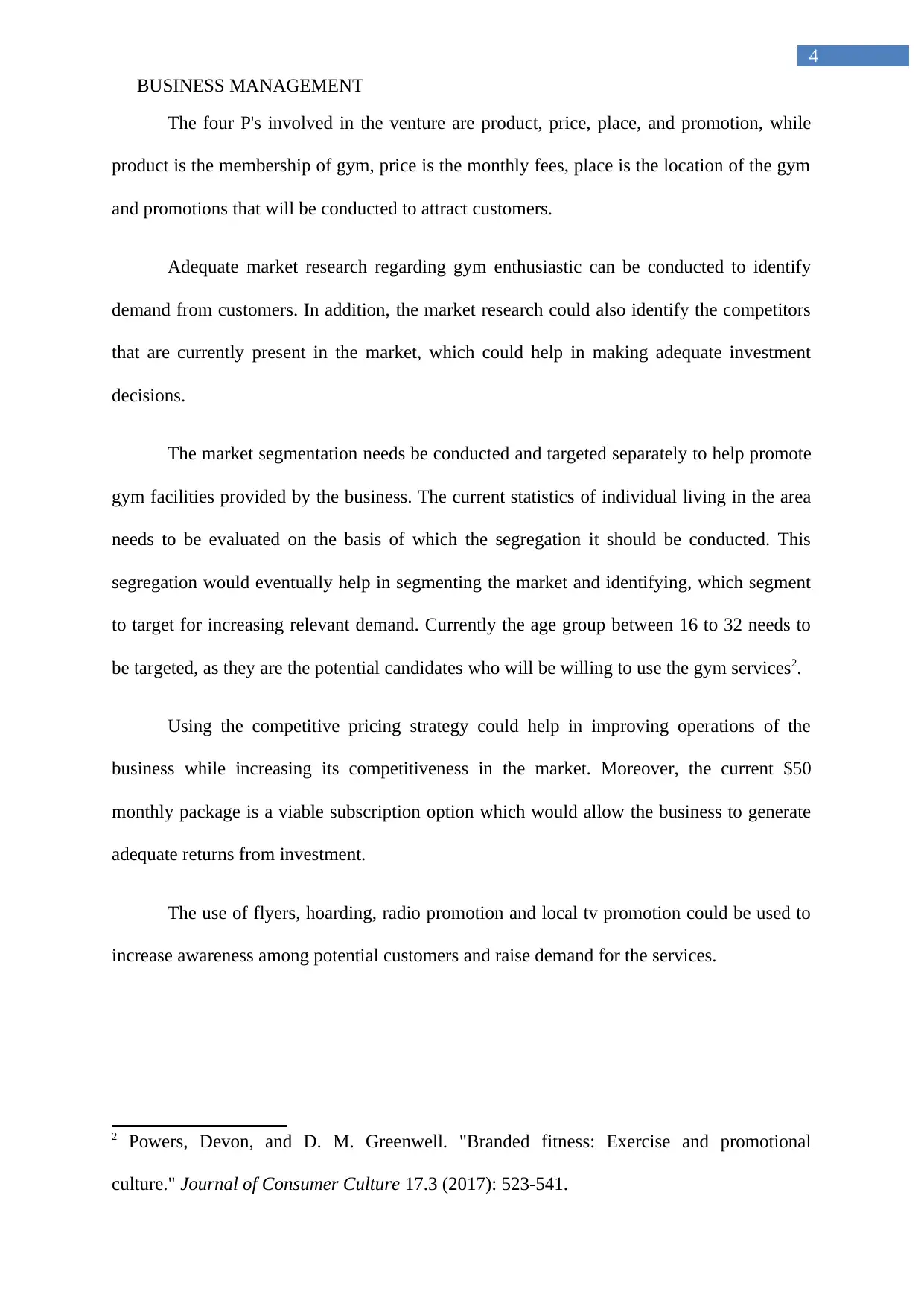
The four P's involved in the venture are product, price, place, and promotion, while
product is the membership of gym, price is the monthly fees, place is the location of the gym
and promotions that will be conducted to attract customers.
Adequate market research regarding gym enthusiastic can be conducted to identify
demand from customers. In addition, the market research could also identify the competitors
that are currently present in the market, which could help in making adequate investment
decisions.
The market segmentation needs be conducted and targeted separately to help promote
gym facilities provided by the business. The current statistics of individual living in the area
needs to be evaluated on the basis of which the segregation it should be conducted. This
segregation would eventually help in segmenting the market and identifying, which segment
to target for increasing relevant demand. Currently the age group between 16 to 32 needs to
be targeted, as they are the potential candidates who will be willing to use the gym services2.
Using the competitive pricing strategy could help in improving operations of the
business while increasing its competitiveness in the market. Moreover, the current $50
monthly package is a viable subscription option which would allow the business to generate
adequate returns from investment.
The use of flyers, hoarding, radio promotion and local tv promotion could be used to
increase awareness among potential customers and raise demand for the services.
2 Powers, Devon, and D. M. Greenwell. "Branded fitness: Exercise and promotional
culture." Journal of Consumer Culture 17.3 (2017): 523-541.
4
The four P's involved in the venture are product, price, place, and promotion, while
product is the membership of gym, price is the monthly fees, place is the location of the gym
and promotions that will be conducted to attract customers.
Adequate market research regarding gym enthusiastic can be conducted to identify
demand from customers. In addition, the market research could also identify the competitors
that are currently present in the market, which could help in making adequate investment
decisions.
The market segmentation needs be conducted and targeted separately to help promote
gym facilities provided by the business. The current statistics of individual living in the area
needs to be evaluated on the basis of which the segregation it should be conducted. This
segregation would eventually help in segmenting the market and identifying, which segment
to target for increasing relevant demand. Currently the age group between 16 to 32 needs to
be targeted, as they are the potential candidates who will be willing to use the gym services2.
Using the competitive pricing strategy could help in improving operations of the
business while increasing its competitiveness in the market. Moreover, the current $50
monthly package is a viable subscription option which would allow the business to generate
adequate returns from investment.
The use of flyers, hoarding, radio promotion and local tv promotion could be used to
increase awareness among potential customers and raise demand for the services.
2 Powers, Devon, and D. M. Greenwell. "Branded fitness: Exercise and promotional
culture." Journal of Consumer Culture 17.3 (2017): 523-541.

BUSINESS MANAGEMENT
5
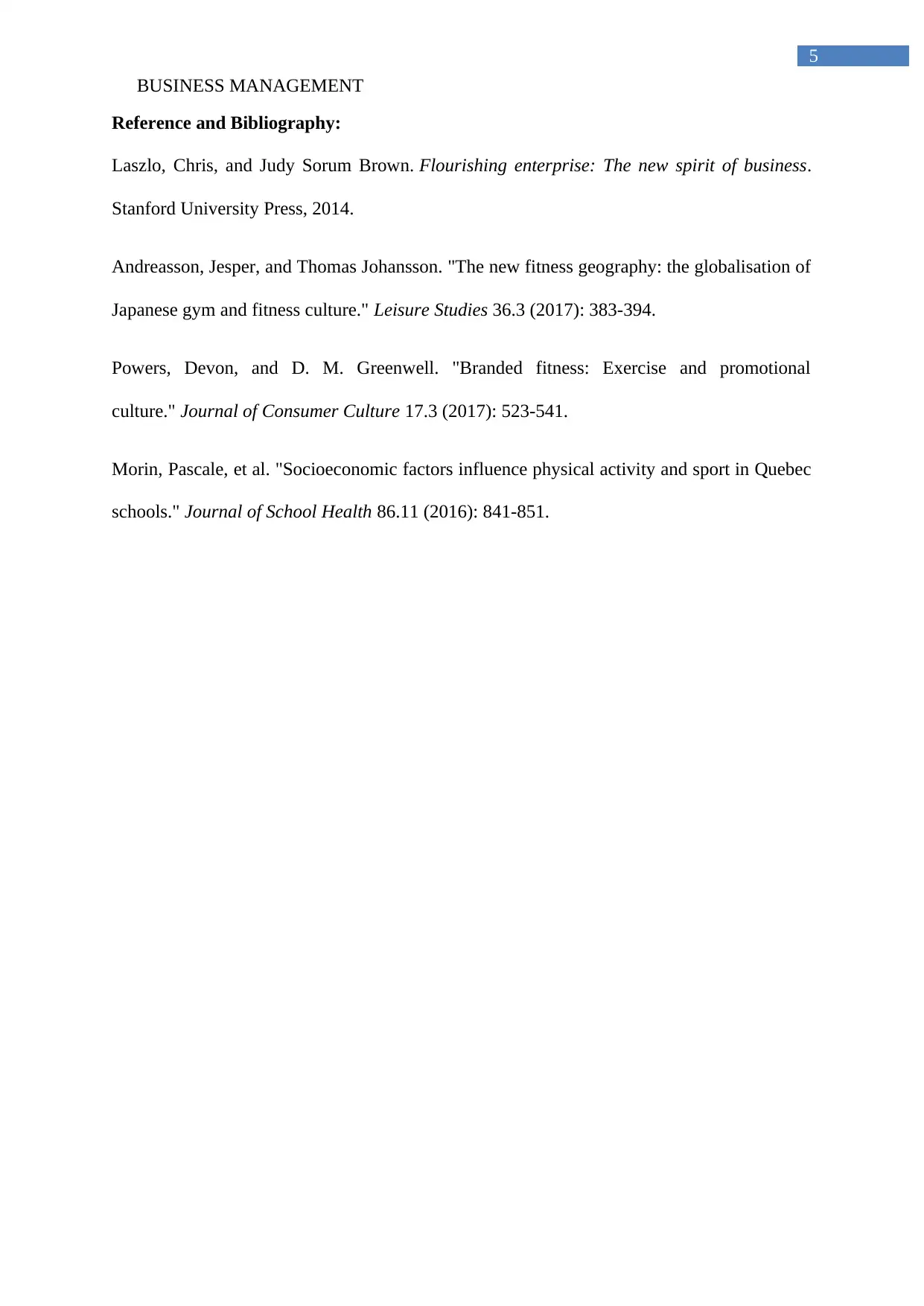
Reference and Bibliography:
Laszlo, Chris, and Judy Sorum Brown. Flourishing enterprise: The new spirit of business.
Stanford University Press, 2014.
Andreasson, Jesper, and Thomas Johansson. "The new fitness geography: the globalisation of
Japanese gym and fitness culture." Leisure Studies 36.3 (2017): 383-394.
Powers, Devon, and D. M. Greenwell. "Branded fitness: Exercise and promotional
culture." Journal of Consumer Culture 17.3 (2017): 523-541.
Morin, Pascale, et al. "Socioeconomic factors influence physical activity and sport in Quebec
schools." Journal of School Health 86.11 (2016): 841-851.
5
Reference and Bibliography:
Laszlo, Chris, and Judy Sorum Brown. Flourishing enterprise: The new spirit of business.
Stanford University Press, 2014.
Andreasson, Jesper, and Thomas Johansson. "The new fitness geography: the globalisation of
Japanese gym and fitness culture." Leisure Studies 36.3 (2017): 383-394.
Powers, Devon, and D. M. Greenwell. "Branded fitness: Exercise and promotional
culture." Journal of Consumer Culture 17.3 (2017): 523-541.
Morin, Pascale, et al. "Socioeconomic factors influence physical activity and sport in Quebec
schools." Journal of School Health 86.11 (2016): 841-851.
⊘ This is a preview!⊘
Do you want full access?
Subscribe today to unlock all pages.

Trusted by 1+ million students worldwide
1 out of 6
Related Documents
Your All-in-One AI-Powered Toolkit for Academic Success.
 +13062052269
info@desklib.com
Available 24*7 on WhatsApp / Email
Unlock your academic potential
Copyright © 2020–2025 A2Z Services. All Rights Reserved. Developed and managed by ZUCOL.