Business Decision Making Essay: Analyzing Investment Projects at X plc
VerifiedAdded on 2023/01/16
|8
|1494
|75
Essay
AI Summary
This essay delves into the realm of business decision-making, focusing on investment appraisal techniques. It analyzes two projects, technological (A) and mechanical (B), for a company named X plc, operating in the vehicle parts sector. The essay employs two key methods: the payback period and Net Present Value (NPV). The payback period analysis reveals that Project A recovers its cost in 2 years and 2 months, while Project B takes 2 years and 3 months. In contrast, the NPV method indicates Project B's superiority with a higher NPV. The essay also explores the benefits and drawbacks of both techniques, including factors like uncertainty, simplicity, and the consideration of all cash flows. Furthermore, it examines financial factors such as profit, interest rates, and share value, along with non-financial factors like political, social, and technological influences. The essay concludes that, overall, Project B is the more viable investment option for X plc.

BUSINESS DECISION-
MAKING
MAKING
Paraphrase This Document
Need a fresh take? Get an instant paraphrase of this document with our AI Paraphraser

INTRODUCTION
In the aspect of business entities, it is necessary to take suitable decisions in an effective
manner. The term business decision-making can be defined as course of action that is related to
choosing a suitable alternative to achieve overall goals (Black, 2019). In order to take correct
financial decisions there are different range of techniques such as payback period method, net
present value etc. The project report is based on a company, X plc which operates in vehicle
parts sector. Company is going to invest in new projects which are technological or mechanical.
For this purpose of assessing effectiveness of both projects, two investment appraisal techniques
has been applied.
MAIN BODY
1. Calculation of payback period.
For project A (Technological project)
Payback period = Years before recovery + UN-recovered cost at start of year/ cash flow during
year x 12 months
= 2 years + (2000/12000) x 12 months
= 2 years + 0.17 x 12 months
= 2 years + 2 months
So, cost of this project will be recovered within 2 years and 2 months.
For project B (Mechanical project)
In the aspect of business entities, it is necessary to take suitable decisions in an effective
manner. The term business decision-making can be defined as course of action that is related to
choosing a suitable alternative to achieve overall goals (Black, 2019). In order to take correct
financial decisions there are different range of techniques such as payback period method, net
present value etc. The project report is based on a company, X plc which operates in vehicle
parts sector. Company is going to invest in new projects which are technological or mechanical.
For this purpose of assessing effectiveness of both projects, two investment appraisal techniques
has been applied.
MAIN BODY
1. Calculation of payback period.
For project A (Technological project)
Payback period = Years before recovery + UN-recovered cost at start of year/ cash flow during
year x 12 months
= 2 years + (2000/12000) x 12 months
= 2 years + 0.17 x 12 months
= 2 years + 2 months
So, cost of this project will be recovered within 2 years and 2 months.
For project B (Mechanical project)

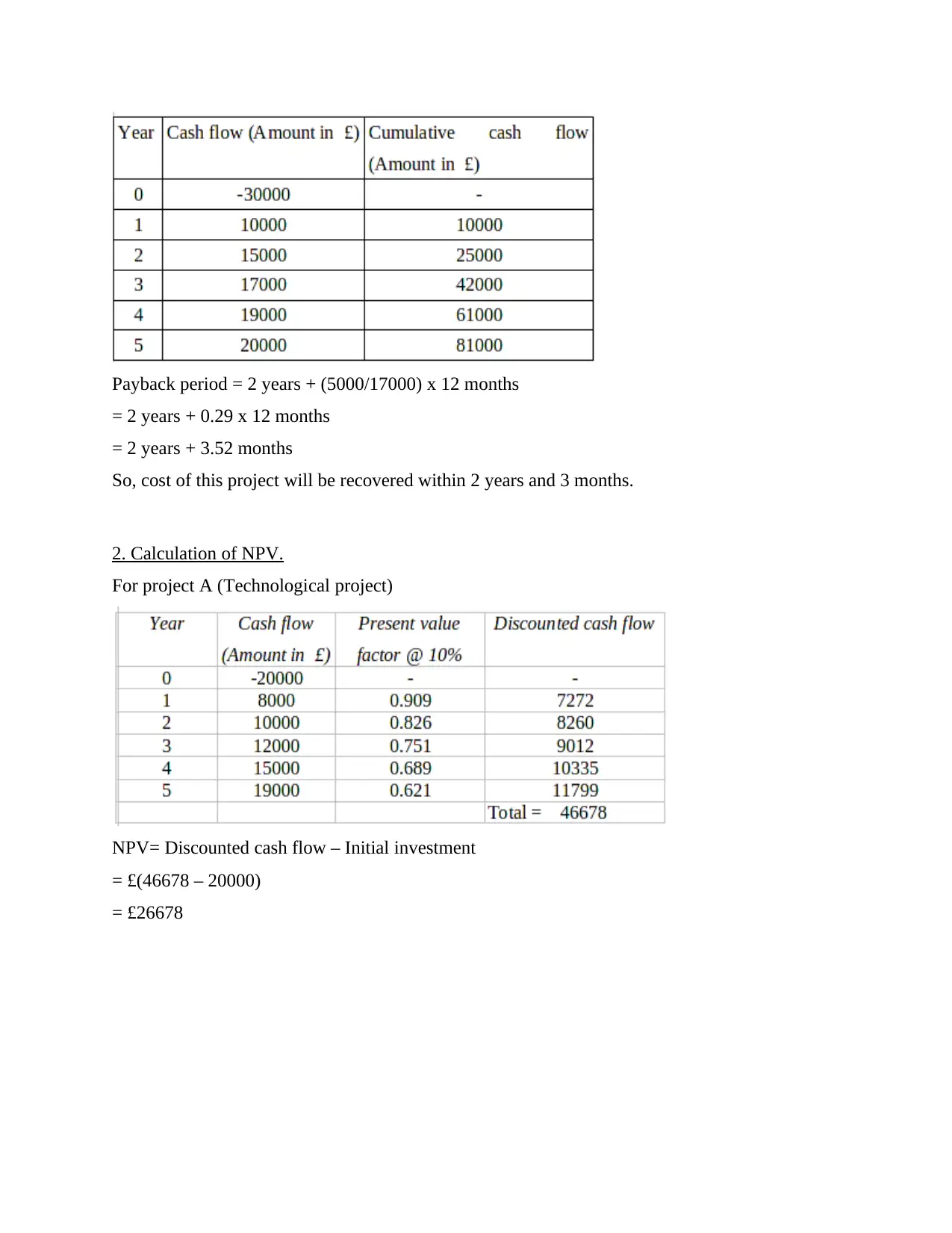
Payback period = 2 years + (5000/17000) x 12 months
= 2 years + 0.29 x 12 months
= 2 years + 3.52 months
So, cost of this project will be recovered within 2 years and 3 months.
2. Calculation of NPV.
For project A (Technological project)
NPV= Discounted cash flow – Initial investment
= £(46678 – 20000)
= £26678
= 2 years + 0.29 x 12 months
= 2 years + 3.52 months
So, cost of this project will be recovered within 2 years and 3 months.
2. Calculation of NPV.
For project A (Technological project)
NPV= Discounted cash flow – Initial investment
= £(46678 – 20000)
= £26678
⊘ This is a preview!⊘
Do you want full access?
Subscribe today to unlock all pages.

Trusted by 1+ million students worldwide

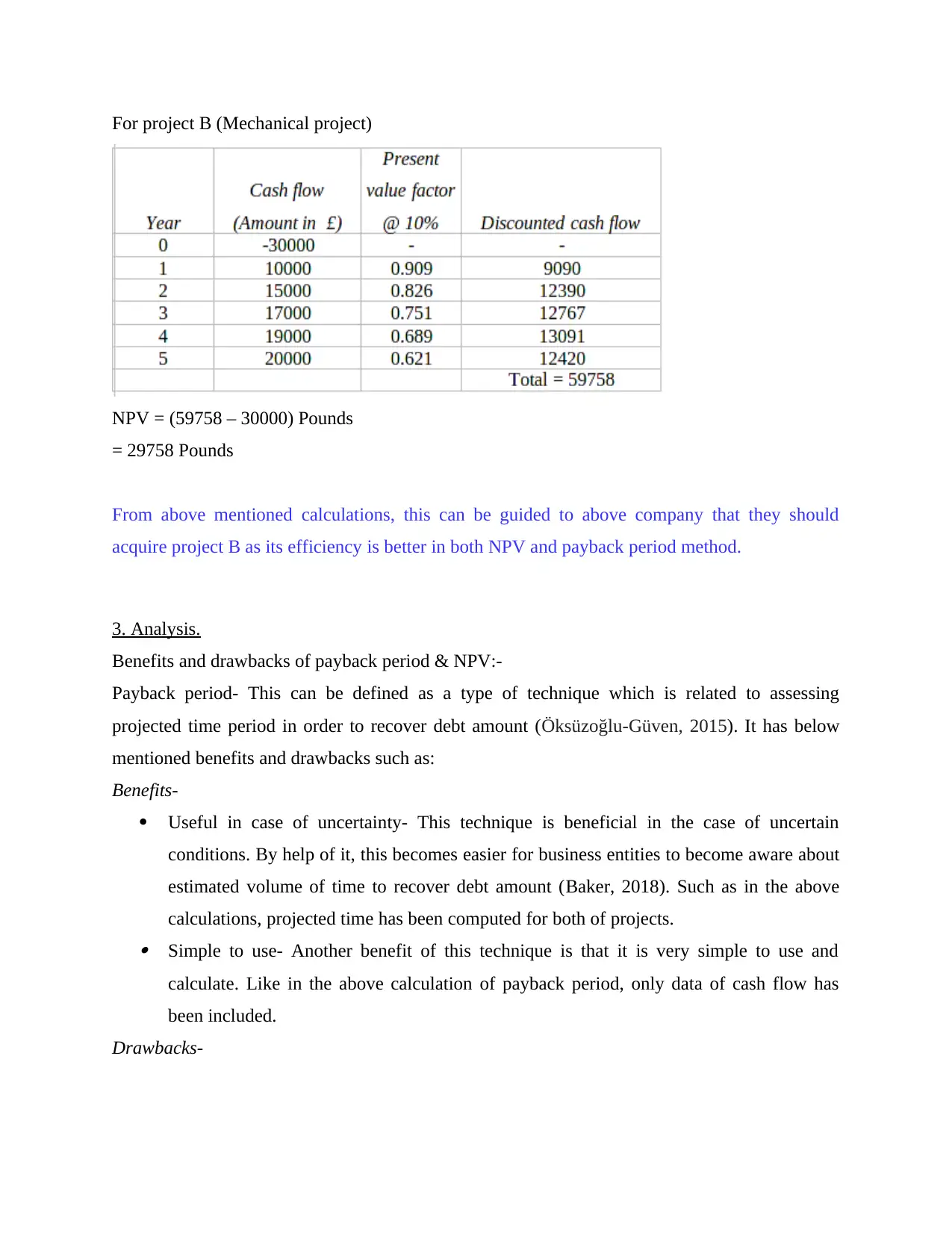
For project B (Mechanical project)
NPV = (59758 – 30000) Pounds
= 29758 Pounds
From above mentioned calculations, this can be guided to above company that they should
acquire project B as its efficiency is better in both NPV and payback period method.
3. Analysis.
Benefits and drawbacks of payback period & NPV:-
Payback period- This can be defined as a type of technique which is related to assessing
projected time period in order to recover debt amount (Öksüzoğlu-Güven, 2015). It has below
mentioned benefits and drawbacks such as:
Benefits-
Useful in case of uncertainty- This technique is beneficial in the case of uncertain
conditions. By help of it, this becomes easier for business entities to become aware about
estimated volume of time to recover debt amount (Baker, 2018). Such as in the above
calculations, projected time has been computed for both of projects. Simple to use- Another benefit of this technique is that it is very simple to use and
calculate. Like in the above calculation of payback period, only data of cash flow has
been included.
Drawbacks-
NPV = (59758 – 30000) Pounds
= 29758 Pounds
From above mentioned calculations, this can be guided to above company that they should
acquire project B as its efficiency is better in both NPV and payback period method.
3. Analysis.
Benefits and drawbacks of payback period & NPV:-
Payback period- This can be defined as a type of technique which is related to assessing
projected time period in order to recover debt amount (Öksüzoğlu-Güven, 2015). It has below
mentioned benefits and drawbacks such as:
Benefits-
Useful in case of uncertainty- This technique is beneficial in the case of uncertain
conditions. By help of it, this becomes easier for business entities to become aware about
estimated volume of time to recover debt amount (Baker, 2018). Such as in the above
calculations, projected time has been computed for both of projects. Simple to use- Another benefit of this technique is that it is very simple to use and
calculate. Like in the above calculation of payback period, only data of cash flow has
been included.
Drawbacks-
Paraphrase This Document
Need a fresh take? Get an instant paraphrase of this document with our AI Paraphraser

Does not cover all cash flows- The payback period method consists cash flow till time of
investment amount recovered. Like in the above calculation cash flow till 2 years has
been used.
Not realistic- This technique of investment appraisal is not realistic in nature as it focuses
on cash flows and rest of factors are ignored such as time value of money.
Net present value- It is a type of technique which is used in capital budgeting in order to analyse
the profitability of project (Alkaraan, 2015). This is computed by making variation between
discounted cash flow and initial investment. Herein, underneath its benefits and drawbacks are
mentioned in such way:
Benefits-
Comprehensive tool- This is one of the comprehensive tool as it consider all cash in and
outflows. It indicates that this focuses on entire aspects of investment. Time value of money- In addition, under it time value of money factor is also considered
in a detailed manner which makes its result more reliable and useful.
Drawbacks-
Discounting rate- Main issue of net present value technique is that under this rate of
return needed to be determined. In the case when higher rate of return is assumed then it
computes negative NPV.
Various assumptions- Along with, NPV makes different types of assumptions in the
context of in and out flows (Schlegel, Frank and Britzelmaier, 2016). Due to this,
produced outcomes become unrealistic and wrong.
Financial and non financial factors-
Financial factor:.
Profit- This is defined as excess of revenues over cost. It is an important financial factor
which is needed to be considered before choosing any project (Spetzler, Winter and
Meyer, 2016).
Interest rate- It is a type of rate at which financial institutions provide financial
assistance. This rate can affect any project because if rate will be higher then it can be
difficult for companies to make more invest on project.
investment amount recovered. Like in the above calculation cash flow till 2 years has
been used.
Not realistic- This technique of investment appraisal is not realistic in nature as it focuses
on cash flows and rest of factors are ignored such as time value of money.
Net present value- It is a type of technique which is used in capital budgeting in order to analyse
the profitability of project (Alkaraan, 2015). This is computed by making variation between
discounted cash flow and initial investment. Herein, underneath its benefits and drawbacks are
mentioned in such way:
Benefits-
Comprehensive tool- This is one of the comprehensive tool as it consider all cash in and
outflows. It indicates that this focuses on entire aspects of investment. Time value of money- In addition, under it time value of money factor is also considered
in a detailed manner which makes its result more reliable and useful.
Drawbacks-
Discounting rate- Main issue of net present value technique is that under this rate of
return needed to be determined. In the case when higher rate of return is assumed then it
computes negative NPV.
Various assumptions- Along with, NPV makes different types of assumptions in the
context of in and out flows (Schlegel, Frank and Britzelmaier, 2016). Due to this,
produced outcomes become unrealistic and wrong.
Financial and non financial factors-
Financial factor:.
Profit- This is defined as excess of revenues over cost. It is an important financial factor
which is needed to be considered before choosing any project (Spetzler, Winter and
Meyer, 2016).
Interest rate- It is a type of rate at which financial institutions provide financial
assistance. This rate can affect any project because if rate will be higher then it can be
difficult for companies to make more invest on project.

Share value of invested project- If share of project will be high then it will be easier to
companies to achieve higher return on invested money on project (Siddik and Kabiraj,
2018).
Non financial factors-
Political- This factor has a significant impact on efficiency of projects. It is so because if
political condition in a nation will be favourable then this can be beneficial for companies
to manage projects more effectively.
Social factor- Under it, cultural, regional, traditional aspects of a country are included.
Due to which it becomes essential for companies to prepare their policies of projects in
accordance of these aspects.
Technological factor- It becomes essential for companies to follow new and advanced
techniques in operations of project so that efficiency of project can be raise (Liang, Jiang
and Kong, 2015).
4. Practical implications.
In the above part of report payback period and NPV techniques have been applied in
order to evaluate effectiveness of two projects which are technological (A) and mechanical (B)
project. Both projects have different amount of initial investment that is of £20000 and £30000.
In the aspect of payback period, it can be find out that cost of project A will recovered in 2 years
and 2 months. While project B's cost will be covered in 2 years and 3 months. Hence, project A
seems better in compare to project B. In the aspect of NPV method, it can be find out that project
A & B have net present value of £26678 and £29758. It indicates that project B is better in
compare to project A.
CONCLUSION
On the basis of above project report, it has been concluded that business decision-making
is one of the critical process that is based on vital range of techniques. Under the report two
techniques are applied which are NPV and payback period. In accordance of NPV method, it can
be articulated that project B is better while in the aspect of payback period this may be concluded
that project A is better. Though, in this method outcomes are almost similar for both of projects.
So overall, it can be concluded that company should go with project B.
companies to achieve higher return on invested money on project (Siddik and Kabiraj,
2018).
Non financial factors-
Political- This factor has a significant impact on efficiency of projects. It is so because if
political condition in a nation will be favourable then this can be beneficial for companies
to manage projects more effectively.
Social factor- Under it, cultural, regional, traditional aspects of a country are included.
Due to which it becomes essential for companies to prepare their policies of projects in
accordance of these aspects.
Technological factor- It becomes essential for companies to follow new and advanced
techniques in operations of project so that efficiency of project can be raise (Liang, Jiang
and Kong, 2015).
4. Practical implications.
In the above part of report payback period and NPV techniques have been applied in
order to evaluate effectiveness of two projects which are technological (A) and mechanical (B)
project. Both projects have different amount of initial investment that is of £20000 and £30000.
In the aspect of payback period, it can be find out that cost of project A will recovered in 2 years
and 2 months. While project B's cost will be covered in 2 years and 3 months. Hence, project A
seems better in compare to project B. In the aspect of NPV method, it can be find out that project
A & B have net present value of £26678 and £29758. It indicates that project B is better in
compare to project A.
CONCLUSION
On the basis of above project report, it has been concluded that business decision-making
is one of the critical process that is based on vital range of techniques. Under the report two
techniques are applied which are NPV and payback period. In accordance of NPV method, it can
be articulated that project B is better while in the aspect of payback period this may be concluded
that project A is better. Though, in this method outcomes are almost similar for both of projects.
So overall, it can be concluded that company should go with project B.
⊘ This is a preview!⊘
Do you want full access?
Subscribe today to unlock all pages.

Trusted by 1+ million students worldwide

Paraphrase This Document
Need a fresh take? Get an instant paraphrase of this document with our AI Paraphraser

REFERENCES
Books and journal:
Black, K. U., 2019. Business statistics: for contemporary decision making. Wiley.
Baker, A .J., 2018. Business decision making. Routledge.
Alkaraan, F., 2015. Strategic investment decision-making perspectives. In Advances in mergers
and acquisitions (pp. 53-66). Emerald Group Publishing Limited.
Schlegel, D., Frank, F. and Britzelmaier, B., 2016. Investment decisions and capital budgeting
practices in German manufacturing companies. International Journal of Business and
Globalisation. 16(1). pp.66-78.
Spetzler, C., Winter, H. and Meyer, J., 2016. Decision quality: Value creation from better
business decisions. John Wiley & Sons.
Siddik, M. N. A. and Kabiraj, S., 2018. Factors influencing consumer's decision making towards
selecting credit cards: an exploratory study. International Journal of Business
Innovation and Research. 16(3). pp.372-387.
Liang, H. M., Jiang, Y. P. and Kong, D. C., 2015. Decision-making method on multiple targets
of satisfied and stable two-sided matching considering the preference ordering. Systems
Engineering-Theory & Practice. 35. pp.1535-1546.
Öksüzoğlu-Güven, G., 2015. Decision Making in SMEs: Insights from Business Ethics and
Entrepreneurship. In Human Rights and Ethics: Concepts, Methodologies, Tools, and
Applications. (pp. 1049-1062). IGI Global.
Books and journal:
Black, K. U., 2019. Business statistics: for contemporary decision making. Wiley.
Baker, A .J., 2018. Business decision making. Routledge.
Alkaraan, F., 2015. Strategic investment decision-making perspectives. In Advances in mergers
and acquisitions (pp. 53-66). Emerald Group Publishing Limited.
Schlegel, D., Frank, F. and Britzelmaier, B., 2016. Investment decisions and capital budgeting
practices in German manufacturing companies. International Journal of Business and
Globalisation. 16(1). pp.66-78.
Spetzler, C., Winter, H. and Meyer, J., 2016. Decision quality: Value creation from better
business decisions. John Wiley & Sons.
Siddik, M. N. A. and Kabiraj, S., 2018. Factors influencing consumer's decision making towards
selecting credit cards: an exploratory study. International Journal of Business
Innovation and Research. 16(3). pp.372-387.
Liang, H. M., Jiang, Y. P. and Kong, D. C., 2015. Decision-making method on multiple targets
of satisfied and stable two-sided matching considering the preference ordering. Systems
Engineering-Theory & Practice. 35. pp.1535-1546.
Öksüzoğlu-Güven, G., 2015. Decision Making in SMEs: Insights from Business Ethics and
Entrepreneurship. In Human Rights and Ethics: Concepts, Methodologies, Tools, and
Applications. (pp. 1049-1062). IGI Global.
1 out of 8
Related Documents
Your All-in-One AI-Powered Toolkit for Academic Success.
+13062052269
info@desklib.com
Available 24*7 on WhatsApp / Email
Unlock your academic potential
Copyright © 2020–2026 A2Z Services. All Rights Reserved. Developed and managed by ZUCOL.