University HR Management Report on Business Issues and Contexts
VerifiedAdded on 2022/08/15
|18
|5859
|13
Report
AI Summary
This report examines the evolving role of Human Resources (HR) in contemporary business, focusing on key contemporary issues like corporate responsibility and conflict of interest. It analyzes external factors impacting organizational performance, including political, economic, social, technological, legal, and environmental influences, and their effects on HR functions. The report delves into organizational and HR strategies, including the forces shaping the HR agenda such as increased competition, agility, and stakeholder expectations, and compares SWOT and PESTLE analysis tools. It outlines the key stages of strategy formulation and implementation, emphasizing HR's contribution to business ethics and accountability. Furthermore, the report explores how to identify and respond to changes in the business environment, evaluates business performance, and assesses the use of internal and external data for planning purposes. The report highlights the importance of HR in business planning and change management, providing a comprehensive overview of the dynamic relationship between HR and business issues.
Running Head: HUMAN RESOURCE MANAGEMENT
0
Business Issues and the Contexts of Human Resources
Student Name:
Student University:
0
Business Issues and the Contexts of Human Resources
Student Name:
Student University:

Paraphrase This Document
Need a fresh take? Get an instant paraphrase of this document with our AI Paraphraser
HUMAN RESOURCE MANAGEMENT 1
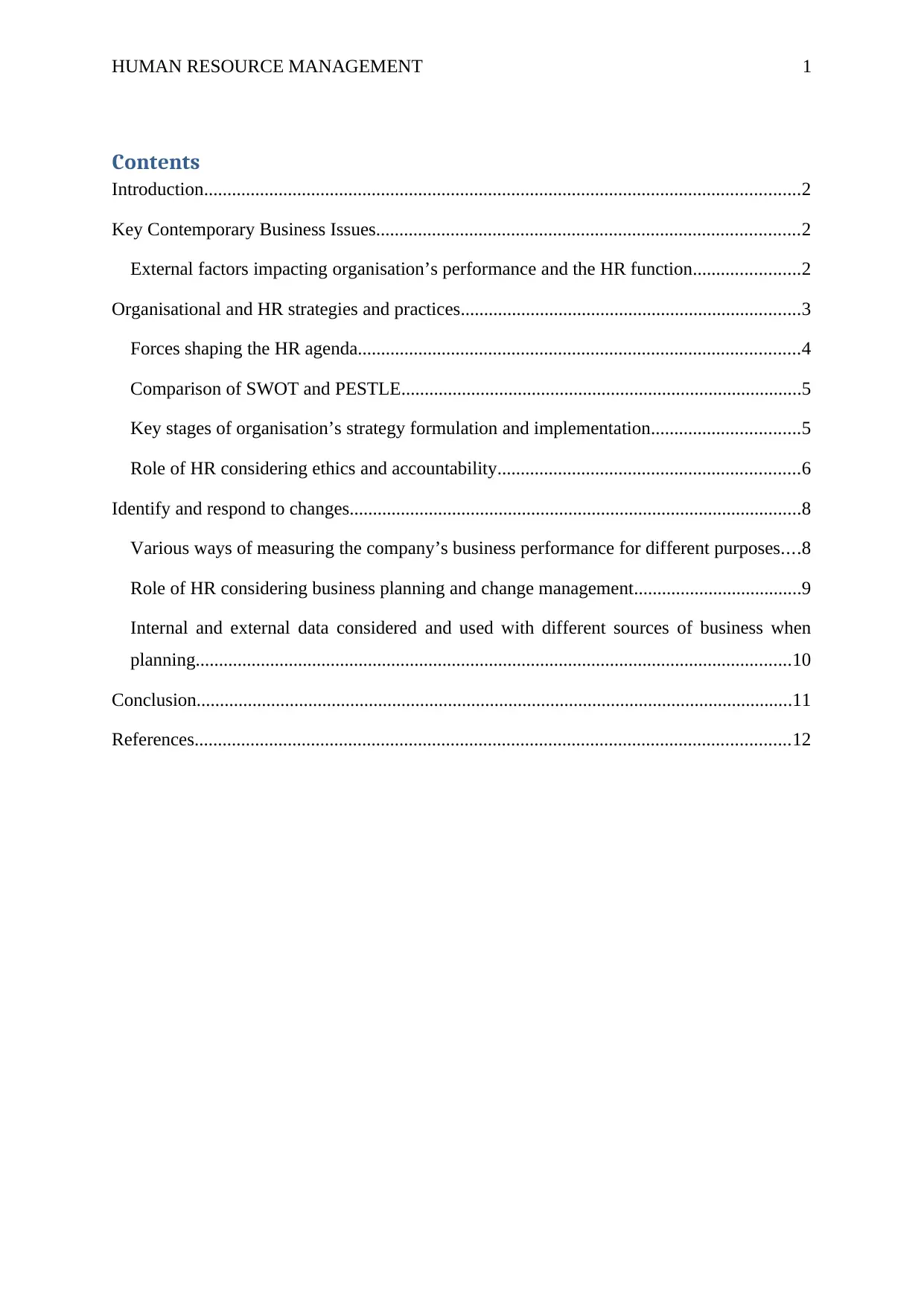
Contents
Introduction................................................................................................................................2
Key Contemporary Business Issues...........................................................................................2
External factors impacting organisation’s performance and the HR function.......................2
Organisational and HR strategies and practices.........................................................................3
Forces shaping the HR agenda...............................................................................................4
Comparison of SWOT and PESTLE......................................................................................5
Key stages of organisation’s strategy formulation and implementation................................5
Role of HR considering ethics and accountability.................................................................6
Identify and respond to changes.................................................................................................8
Various ways of measuring the company’s business performance for different purposes....8
Role of HR considering business planning and change management....................................9
Internal and external data considered and used with different sources of business when
planning................................................................................................................................10
Conclusion................................................................................................................................11
References................................................................................................................................12
Contents
Introduction................................................................................................................................2
Key Contemporary Business Issues...........................................................................................2
External factors impacting organisation’s performance and the HR function.......................2
Organisational and HR strategies and practices.........................................................................3
Forces shaping the HR agenda...............................................................................................4
Comparison of SWOT and PESTLE......................................................................................5
Key stages of organisation’s strategy formulation and implementation................................5
Role of HR considering ethics and accountability.................................................................6
Identify and respond to changes.................................................................................................8
Various ways of measuring the company’s business performance for different purposes....8
Role of HR considering business planning and change management....................................9
Internal and external data considered and used with different sources of business when
planning................................................................................................................................10
Conclusion................................................................................................................................11
References................................................................................................................................12
HUMAN RESOURCE MANAGEMENT 2
Introduction
In business, it is important for the company to have expertise and skills in the workforce or
members for negotiating benefit packages necessary within group for maintaining budget and
economic conditions constantly to make it easy for an organisation to retain and attract
employees in future with growth (Perucci, 2018). In this report, the CEO asked an employee
of the company to compile the developing role of HR (human resource) within present day
business. The discussion covers analysing the key contemporary issues and various external
factors impacting performance of an organisation and the reason of affecting the HR function.
This report is also based on understanding the development and shaping of organisational and
HR strategies and practices. Lastly, this report considers the response and identification of
changes in the business environment to fulfil the purpose within the contexts of human
resources and business issues.
Key Contemporary Business Issues
In business, there are issues of corporate responsibility in terms ethics using leadership or
management training in the company. There are HR-related and operational issues where the
company fails to address it sometimes. It is the duty of HR to identify the key contemporary
issues in business with the help of HR and business strategy at the time of making decision.
These issues affect directly while achieving the goals of business that are interest conflict and
accountability in terms of corporate governance. The conflict of interest comes between
shareholders and managers having higher control over resources and power in terms of
information they are accountable for than shareholders (Goyal, 2013). Thus, CSR (corporate
social responsibility) is seen primarily as a cultural issue within the HR function. In
competitive environment, the company based on the organisational structure needs to deal
with issues for maintaining position in the market.
External factors impacting organisation’s performance and the HR function
HR function works as a background in the company for understanding its nature having a
great impact on the way of individuals managing the business (Jessee, 2020). It is essential to
understand the various external factors impact performance of the company and affecting the
HR function.
Introduction
In business, it is important for the company to have expertise and skills in the workforce or
members for negotiating benefit packages necessary within group for maintaining budget and
economic conditions constantly to make it easy for an organisation to retain and attract
employees in future with growth (Perucci, 2018). In this report, the CEO asked an employee
of the company to compile the developing role of HR (human resource) within present day
business. The discussion covers analysing the key contemporary issues and various external
factors impacting performance of an organisation and the reason of affecting the HR function.
This report is also based on understanding the development and shaping of organisational and
HR strategies and practices. Lastly, this report considers the response and identification of
changes in the business environment to fulfil the purpose within the contexts of human
resources and business issues.
Key Contemporary Business Issues
In business, there are issues of corporate responsibility in terms ethics using leadership or
management training in the company. There are HR-related and operational issues where the
company fails to address it sometimes. It is the duty of HR to identify the key contemporary
issues in business with the help of HR and business strategy at the time of making decision.
These issues affect directly while achieving the goals of business that are interest conflict and
accountability in terms of corporate governance. The conflict of interest comes between
shareholders and managers having higher control over resources and power in terms of
information they are accountable for than shareholders (Goyal, 2013). Thus, CSR (corporate
social responsibility) is seen primarily as a cultural issue within the HR function. In
competitive environment, the company based on the organisational structure needs to deal
with issues for maintaining position in the market.
External factors impacting organisation’s performance and the HR function
HR function works as a background in the company for understanding its nature having a
great impact on the way of individuals managing the business (Jessee, 2020). It is essential to
understand the various external factors impact performance of the company and affecting the
HR function.
⊘ This is a preview!⊘
Do you want full access?
Subscribe today to unlock all pages.

Trusted by 1+ million students worldwide
HUMAN RESOURCE MANAGEMENT 3
Political: In an organisation, changes are obvious as introduced by the government, trade
union, the EU (European Union) and other bodies regulating business sectors. However, the
HR department is to make sure as a responsibility in the company for remaining compliant
along with changing regulations (Friedman, 2013).
Economic: There is a huge impact of economic climate on the company’s operations
determining inflation, employment levels, interest rates, general demand and exchange rate.
Further, there is increase of competition due to globalisation where most of the UK (United
Kingdom) based companies are cutting costs and outsourcing their work in other countries
across the globe with the reason of lowered labour costs. The assistance of management by
HR is for providing awareness about happening in the current market and getting prepared
about coping with changes in the economy.
Social: In today’s time, there is importance of workforce in terms of social factors along with
changing family structures, ageing population and immigrant workers. There are some issues
need to addressed by the HR taking into account of attracting new candidates and retaining
existing employees.
Technological: In technology, making developments have a continuous effect externally on
companies. There is improvement in new systems and machinery that enhances the
business’s performance but leads toward downsizing the employees as well (Yusoff &
Hussain, 2013). Here, the company saves money and make profit increment. In this process,
HR assistance is for looking at making redundancies.
Legal: There is necessity of compliance with all regulations, rules and statutes by the
company. It is essential for the HR departments to update company procedure and policies
due to consistent pressure with staying compliant in a legal way. All areas have these
regulations applied of HR consisting compensation, hiring, termination, and training. There is
heavy imposing of fines if any company breaks the regulations.
Environmental: In the environment, factors affecting are ethics and sustainability such as
issues of used products recycling, industrial waste disposal and change in climate. In
business, changes are made as seen in the environment with practices affecting it (Friedman,
2017).
Political: In an organisation, changes are obvious as introduced by the government, trade
union, the EU (European Union) and other bodies regulating business sectors. However, the
HR department is to make sure as a responsibility in the company for remaining compliant
along with changing regulations (Friedman, 2013).
Economic: There is a huge impact of economic climate on the company’s operations
determining inflation, employment levels, interest rates, general demand and exchange rate.
Further, there is increase of competition due to globalisation where most of the UK (United
Kingdom) based companies are cutting costs and outsourcing their work in other countries
across the globe with the reason of lowered labour costs. The assistance of management by
HR is for providing awareness about happening in the current market and getting prepared
about coping with changes in the economy.
Social: In today’s time, there is importance of workforce in terms of social factors along with
changing family structures, ageing population and immigrant workers. There are some issues
need to addressed by the HR taking into account of attracting new candidates and retaining
existing employees.
Technological: In technology, making developments have a continuous effect externally on
companies. There is improvement in new systems and machinery that enhances the
business’s performance but leads toward downsizing the employees as well (Yusoff &
Hussain, 2013). Here, the company saves money and make profit increment. In this process,
HR assistance is for looking at making redundancies.
Legal: There is necessity of compliance with all regulations, rules and statutes by the
company. It is essential for the HR departments to update company procedure and policies
due to consistent pressure with staying compliant in a legal way. All areas have these
regulations applied of HR consisting compensation, hiring, termination, and training. There is
heavy imposing of fines if any company breaks the regulations.
Environmental: In the environment, factors affecting are ethics and sustainability such as
issues of used products recycling, industrial waste disposal and change in climate. In
business, changes are made as seen in the environment with practices affecting it (Friedman,
2017).
Paraphrase This Document
Need a fresh take? Get an instant paraphrase of this document with our AI Paraphraser
HUMAN RESOURCE MANAGEMENT 4
Organisational and HR strategies and practices
In business environment, transformation is radical where ever company is focusing on
attaining sustainability for meeting the challenges of climate change, social inequality,
globalisation, demographics, technology and competition (Get Smarter, 2019). Here, an
organisation needs to look more than the bottom line of the loss and profit account. It is
essential for the company to be aware about the environmental and social responsibilities
along with making sure about the scarce resources usage that are sustainable.
Forces shaping the HR agenda
These changes are anticipated by the HR where decision is taken appropriately through
change management strategies. HR supports the delivery of the company’s objectives and
strategy through aligning its activities and strategy within the business and its stakeholders.
Moreover, stakeholders’ expectations are considered by the HR such as managers, employees
and shareholders. It is not easy for the HR to plan strategically when there is increased
competition which shows unpredictability and uncertainty. So, companies are becoming more
agile that requires regular change, downsizing, offshoring and outsourcing, upsizing, and
mergers and acquisitions (Kehr, 2016). In companies, procedures and policies are required to
be more agile as well for being able to respond rapidly when compared to competitors. In the
business environment, there is change in circumstances where HR tries to meet the
expectations of stakeholder.
Further, there is terms and conditions flexibility concerning as central to HR practice offering
employment. During change, short-term contracts help in avoiding making redundancies for
being common where sub-contracting increases along with agency workers, self-employed
professionals and zero-hour contracts. The way of employing people traditionally has been
changed by HR with individuals on permanent and full time contracts that shows ‘job for life’
(Freedman, 2010). There is increase in development of approaches HR is associated with to
manage the performance of the company among the adoption of “high commitment working
practices” in the form of pay related to profit and performance. Also, it consists of employee
engagement, accelerated management development programmes and employer branding. In a
structural and cultural way of organisational change, success is dependent on managing
employee (Boada-Cuerva, et al., 2018). There is a possibility of change causing conflict
where HR plays a key role while culture building management for embracing change.
Organisational and HR strategies and practices
In business environment, transformation is radical where ever company is focusing on
attaining sustainability for meeting the challenges of climate change, social inequality,
globalisation, demographics, technology and competition (Get Smarter, 2019). Here, an
organisation needs to look more than the bottom line of the loss and profit account. It is
essential for the company to be aware about the environmental and social responsibilities
along with making sure about the scarce resources usage that are sustainable.
Forces shaping the HR agenda
These changes are anticipated by the HR where decision is taken appropriately through
change management strategies. HR supports the delivery of the company’s objectives and
strategy through aligning its activities and strategy within the business and its stakeholders.
Moreover, stakeholders’ expectations are considered by the HR such as managers, employees
and shareholders. It is not easy for the HR to plan strategically when there is increased
competition which shows unpredictability and uncertainty. So, companies are becoming more
agile that requires regular change, downsizing, offshoring and outsourcing, upsizing, and
mergers and acquisitions (Kehr, 2016). In companies, procedures and policies are required to
be more agile as well for being able to respond rapidly when compared to competitors. In the
business environment, there is change in circumstances where HR tries to meet the
expectations of stakeholder.
Further, there is terms and conditions flexibility concerning as central to HR practice offering
employment. During change, short-term contracts help in avoiding making redundancies for
being common where sub-contracting increases along with agency workers, self-employed
professionals and zero-hour contracts. The way of employing people traditionally has been
changed by HR with individuals on permanent and full time contracts that shows ‘job for life’
(Freedman, 2010). There is increase in development of approaches HR is associated with to
manage the performance of the company among the adoption of “high commitment working
practices” in the form of pay related to profit and performance. Also, it consists of employee
engagement, accelerated management development programmes and employer branding. In a
structural and cultural way of organisational change, success is dependent on managing
employee (Boada-Cuerva, et al., 2018). There is a possibility of change causing conflict
where HR plays a key role while culture building management for embracing change.
HUMAN RESOURCE MANAGEMENT 5
The way HR function is affected by the increased competition while organising and making
approaches toward objectives. The privately owned private sector and large companies
concentrates on generating revenue along with having a large HR function and styles
adoption. Also, it consists of HR shared service centre for regular transactional services
management through the company. It binds with the whole team of HR specialists in learning
and development, and reward areas (Amin, et al., 2014). It is the responsibility of change
agents to make sure about the value and vision of the company for following. The business
partners of HR works with line managers and leaders closely by influencing and assisting
business implementation and strategy. HR function provides various benefits such as
customer service quality improvisation and costs reduction. Moreover, the HR function of
SMEs (small and medium sized enterprise) includes working of HR generalist together with
operational management. Here, there are HR consultants works for both small and large
companies dealing with specific projects until it is done (Martí-Audí, et al., 2013). Thus, they
bring expertise and knowledge wealth by working with different organisations.
Comparison of SWOT and PESTLE
SWOT PESTLE
This tool to analyse the business environment
help the company to comprehend the
“strengths, weaknesses, opportunities and
threats” both externally and internally.
This tool is used in business environment for
examining the external macro-environment
within the existence of business consisting
factors that are “political, economic, social,
technological, legal and environmental”.
SWOT does not provide information but
collects it with no offering of solutions.
PESTLE is able to examine the entering
implications into a new market or industry.
SWOT helps in identifying the current
company’s position of the market.
PESTLE helps in competitive strategies
development of the companies and identifies
the factors affecting the competitive position
and expansion of the company.
Source: ( (Admin, 2014).
In business, the environmental tool used to analyse the external and internal environment
concerning the development of company. SWOT and PESTLE tools in the business are used
as methods for the implementation in projects of dynamic business environment. The
analysing of external environment for helping in an organisation along with HR department is
The way HR function is affected by the increased competition while organising and making
approaches toward objectives. The privately owned private sector and large companies
concentrates on generating revenue along with having a large HR function and styles
adoption. Also, it consists of HR shared service centre for regular transactional services
management through the company. It binds with the whole team of HR specialists in learning
and development, and reward areas (Amin, et al., 2014). It is the responsibility of change
agents to make sure about the value and vision of the company for following. The business
partners of HR works with line managers and leaders closely by influencing and assisting
business implementation and strategy. HR function provides various benefits such as
customer service quality improvisation and costs reduction. Moreover, the HR function of
SMEs (small and medium sized enterprise) includes working of HR generalist together with
operational management. Here, there are HR consultants works for both small and large
companies dealing with specific projects until it is done (Martí-Audí, et al., 2013). Thus, they
bring expertise and knowledge wealth by working with different organisations.
Comparison of SWOT and PESTLE
SWOT PESTLE
This tool to analyse the business environment
help the company to comprehend the
“strengths, weaknesses, opportunities and
threats” both externally and internally.
This tool is used in business environment for
examining the external macro-environment
within the existence of business consisting
factors that are “political, economic, social,
technological, legal and environmental”.
SWOT does not provide information but
collects it with no offering of solutions.
PESTLE is able to examine the entering
implications into a new market or industry.
SWOT helps in identifying the current
company’s position of the market.
PESTLE helps in competitive strategies
development of the companies and identifies
the factors affecting the competitive position
and expansion of the company.
Source: ( (Admin, 2014).
In business, the environmental tool used to analyse the external and internal environment
concerning the development of company. SWOT and PESTLE tools in the business are used
as methods for the implementation in projects of dynamic business environment. The
analysing of external environment for helping in an organisation along with HR department is
⊘ This is a preview!⊘
Do you want full access?
Subscribe today to unlock all pages.
Trusted by 1+ million students worldwide
HUMAN RESOURCE MANAGEMENT 6
done through the PESTLE tool to understand the business influenced with performing HR
activities as well. However, SWOT is used for both internal and external environment
compromising the factors consisting trade picture at large based mainly on the regional or
national level. This locating of level is also describes the use of PESTLE tool by the company
in terms of trade at large along with trends considered for long-term (Shtal, et al., 2018).
Across the globe, these tools have an effect on some industries particular after a realisation.
When engaging in strategic planning, environmental scanning is essential to get prepared for
future by the company examining external factors. In the company, it is important to showing
the process from both outside and inside and analyse through SWOT while engaging likely
framework for developing organised information.
Key stages of organisation’s strategy formulation and implementation
The formulation and implementation involvement along with major initiatives and goals is
strategic management taken by top management of the company based on the resources
consideration and internal and external environments assessment on the behalf of owners in
which the company competes. It is also termed as strategic planning enabled for resources
evaluation, budgets allocation, and determining effective plan for ROI (return on investment)
maximisation. Also, it requires employees to be focused and directed providing for the
development of strategic plan. The key stages for effective implementation and strategy
formulation of the company include defining an organisation, its strategic mission and
objectives, competitive strategy along with strategies implementation, and progress
evaluation (Engert & Baumgartner, 2016). The alternative approaches used for strategy
formulation are rational approach also known as classical approach where senior managers
determine the action plan along with monitoring internal and external environments. Other is
an emergent strategies’ that are incremental and can emerge over time whenever the company
requires responding to changing circumstances. However, this is not planned top-down but
more of error and trial. Lastly, symbolic approach is where companies keep on trying
different approaches with usual business continuity when needed (Moore, 2011). Here, the
company’s success depends on luck instead of judgement. The company determines about its
future through strategy formulation and processing the way to get there.
In the company, the company needs to set realistic and clear objectives for effective strategy
that helps in permitting some flexibility. In business, the existence of strategy is at various
levels consisting competitive, corporate and operational strategies. All strategies help the
done through the PESTLE tool to understand the business influenced with performing HR
activities as well. However, SWOT is used for both internal and external environment
compromising the factors consisting trade picture at large based mainly on the regional or
national level. This locating of level is also describes the use of PESTLE tool by the company
in terms of trade at large along with trends considered for long-term (Shtal, et al., 2018).
Across the globe, these tools have an effect on some industries particular after a realisation.
When engaging in strategic planning, environmental scanning is essential to get prepared for
future by the company examining external factors. In the company, it is important to showing
the process from both outside and inside and analyse through SWOT while engaging likely
framework for developing organised information.
Key stages of organisation’s strategy formulation and implementation
The formulation and implementation involvement along with major initiatives and goals is
strategic management taken by top management of the company based on the resources
consideration and internal and external environments assessment on the behalf of owners in
which the company competes. It is also termed as strategic planning enabled for resources
evaluation, budgets allocation, and determining effective plan for ROI (return on investment)
maximisation. Also, it requires employees to be focused and directed providing for the
development of strategic plan. The key stages for effective implementation and strategy
formulation of the company include defining an organisation, its strategic mission and
objectives, competitive strategy along with strategies implementation, and progress
evaluation (Engert & Baumgartner, 2016). The alternative approaches used for strategy
formulation are rational approach also known as classical approach where senior managers
determine the action plan along with monitoring internal and external environments. Other is
an emergent strategies’ that are incremental and can emerge over time whenever the company
requires responding to changing circumstances. However, this is not planned top-down but
more of error and trial. Lastly, symbolic approach is where companies keep on trying
different approaches with usual business continuity when needed (Moore, 2011). Here, the
company’s success depends on luck instead of judgement. The company determines about its
future through strategy formulation and processing the way to get there.
In the company, the company needs to set realistic and clear objectives for effective strategy
that helps in permitting some flexibility. In business, the existence of strategy is at various
levels consisting competitive, corporate and operational strategies. All strategies help the
Paraphrase This Document
Need a fresh take? Get an instant paraphrase of this document with our AI Paraphraser
HUMAN RESOURCE MANAGEMENT 7
company to gain competitive advantage that can be horizontal or vertical integrated. So, the
focus is mainly on strategies and missions identification in the companies along with giving
attention to the required resources for success creation. Strategies implementation is possible
by taking action through strategic plan along with desired outcomes achievement involving
tasks consisting organisational structure, resource planning, change management techniques
and systems (Skidelsky, 2017). It is essential to evaluate strategy within the levels of
feasibility, suitability and acceptability that is required to be monitored so that it can get
revised as necessary or there can be development of new strategies.
Role of HR considering ethics and accountability
In today’s competitive business environment, there are varied employees entering in the
company where it is essential for the company to understand their importance in terms of
success by providing job satisfaction and engagement level. HR is the one while handling
issues of the company in relation to employee’s engagement or culture and turns up to
implement solutions. They have the ability to influence and impact change in engagement
and culture of an employee based on their shifting towards strategic function for attaining
company’s success (Page, 2017). The role of HR is to assist senior management for
implementing and formulating change management. Here, the duty is also to research
environmental weaknesses and strengths internally along with benchmarking against the
company’s competitors and other techniques of environment scanning. It is essential for them
to organise and prepare teams for carrying out problem’s analysis and identification along
with providing necessary training. Also, the role of HR consists of understanding the
company’s culture and makes it easier to develop a shared vision. Lastly, helps in building a
consensual culture by change champions’ appointment for levels increment of engaging
employee during this process to be followed (Conway, 2020). Thus, it is essential for HR to
communicate changes along with the implementation within the company and helping staff to
overcome resistance by culture creation embracing change.
In terms of Business Ethics and Accountability, there is a contribution of HR by identifying
various approaches to work. HR’s ethics shows helping company upholding and embedding
its values for increasing and maintaining trust at all levels. However, there is a major role
played by accountability that can be mentioned as taking responsibility. The approach of
absolutism defines underpinned ethics along with absolute values applying in all situations
and societies. Further, relativism is ethics depending on the cultural and situation prevailing
company to gain competitive advantage that can be horizontal or vertical integrated. So, the
focus is mainly on strategies and missions identification in the companies along with giving
attention to the required resources for success creation. Strategies implementation is possible
by taking action through strategic plan along with desired outcomes achievement involving
tasks consisting organisational structure, resource planning, change management techniques
and systems (Skidelsky, 2017). It is essential to evaluate strategy within the levels of
feasibility, suitability and acceptability that is required to be monitored so that it can get
revised as necessary or there can be development of new strategies.
Role of HR considering ethics and accountability
In today’s competitive business environment, there are varied employees entering in the
company where it is essential for the company to understand their importance in terms of
success by providing job satisfaction and engagement level. HR is the one while handling
issues of the company in relation to employee’s engagement or culture and turns up to
implement solutions. They have the ability to influence and impact change in engagement
and culture of an employee based on their shifting towards strategic function for attaining
company’s success (Page, 2017). The role of HR is to assist senior management for
implementing and formulating change management. Here, the duty is also to research
environmental weaknesses and strengths internally along with benchmarking against the
company’s competitors and other techniques of environment scanning. It is essential for them
to organise and prepare teams for carrying out problem’s analysis and identification along
with providing necessary training. Also, the role of HR consists of understanding the
company’s culture and makes it easier to develop a shared vision. Lastly, helps in building a
consensual culture by change champions’ appointment for levels increment of engaging
employee during this process to be followed (Conway, 2020). Thus, it is essential for HR to
communicate changes along with the implementation within the company and helping staff to
overcome resistance by culture creation embracing change.
In terms of Business Ethics and Accountability, there is a contribution of HR by identifying
various approaches to work. HR’s ethics shows helping company upholding and embedding
its values for increasing and maintaining trust at all levels. However, there is a major role
played by accountability that can be mentioned as taking responsibility. The approach of
absolutism defines underpinned ethics along with absolute values applying in all situations
and societies. Further, relativism is ethics depending on the cultural and situation prevailing
HUMAN RESOURCE MANAGEMENT 8
at some place and time particularly. Lastly, utilitarianism examines the right or wrong by
focusing on results (Changeboard, 2019). In businesses, it is expected to be concerned about
the bottom line but with a broader aspect where the CSR is considered by the companies as
well along with reporting triple bottom line. It is essential for the companies to adopt ethical
policies while complying with social and legal expectations. However, taking it in a corporate
sense defines setting of ethics with moral values and principles examining decision making
and activities of the company as well while interacting with stakeholders all over and at all
levels. Here, HR monitors, devises and implements each and every procedures and policies
concerning ethics (Schoeman, 2013). Also, culture promotion is done to favouring business’s
moral values along with embedding an ethical culture among various approaches.
HR contribution is affected by legislation to ethics by legal responsibilities imposed along
with ethical pressure and duties expected to act in a way but not forced by the law. It is the
ethical and moral duty of HR to handle the personal data of employees where the restriction
was there further with the consent assumption in a contract typically. In the company, HR’s
ethics and accountability are questioned when issues such as of gender equality raises. But, at
the time of The Equality Act 2010 was established, discrimination between women and men
were prohibited concerning employment conditions and pay (Chamberlain, 2010). There is a
full compliance of the companies with legislation but considered to be accountable at the time
of exceptions. There can be presence of hurdles for the company and HR due to raise in
M&A (merger and acquisition). It is essential for the HR to make sure about meeting the
legal obligations and following the duty of treating both the broad stakeholders and
employees equally aligning with the company’s ethical values.
Identify and respond to changes
In recent times, it is being important for the company to adapt change that is easy when small
and difficult to process when large as it is inevitable. Changes are done to attain positive
outcomes in the business environment but require individuals to get out of their comfort zone
for adapting change where they have to face traumatising effects created sometimes. It is
essential to take everything positively and work towards adaption and acceptance (Livingsta,
2017).
at some place and time particularly. Lastly, utilitarianism examines the right or wrong by
focusing on results (Changeboard, 2019). In businesses, it is expected to be concerned about
the bottom line but with a broader aspect where the CSR is considered by the companies as
well along with reporting triple bottom line. It is essential for the companies to adopt ethical
policies while complying with social and legal expectations. However, taking it in a corporate
sense defines setting of ethics with moral values and principles examining decision making
and activities of the company as well while interacting with stakeholders all over and at all
levels. Here, HR monitors, devises and implements each and every procedures and policies
concerning ethics (Schoeman, 2013). Also, culture promotion is done to favouring business’s
moral values along with embedding an ethical culture among various approaches.
HR contribution is affected by legislation to ethics by legal responsibilities imposed along
with ethical pressure and duties expected to act in a way but not forced by the law. It is the
ethical and moral duty of HR to handle the personal data of employees where the restriction
was there further with the consent assumption in a contract typically. In the company, HR’s
ethics and accountability are questioned when issues such as of gender equality raises. But, at
the time of The Equality Act 2010 was established, discrimination between women and men
were prohibited concerning employment conditions and pay (Chamberlain, 2010). There is a
full compliance of the companies with legislation but considered to be accountable at the time
of exceptions. There can be presence of hurdles for the company and HR due to raise in
M&A (merger and acquisition). It is essential for the HR to make sure about meeting the
legal obligations and following the duty of treating both the broad stakeholders and
employees equally aligning with the company’s ethical values.
Identify and respond to changes
In recent times, it is being important for the company to adapt change that is easy when small
and difficult to process when large as it is inevitable. Changes are done to attain positive
outcomes in the business environment but require individuals to get out of their comfort zone
for adapting change where they have to face traumatising effects created sometimes. It is
essential to take everything positively and work towards adaption and acceptance (Livingsta,
2017).
⊘ This is a preview!⊘
Do you want full access?
Subscribe today to unlock all pages.
Trusted by 1+ million students worldwide
HUMAN RESOURCE MANAGEMENT 9
Various ways of measuring the company’s business performance for
different purposes
In business, the process of measuring performance is a key issue where the companies are
challenged to achieve efficient and effective outcomes. The business strategy is aligned with
performance measurement models applied to make sure about the purpose and choosing
performance indicators as dependent on the company (Looy & Shafagatova, 2016). The
performance in business is measured for reviewing the company’s progress by helping in
assessing current market, new customers’ accessibility and finding opportunities for new
business. These are the different purposes where the performance can help to assess for
making business stronger by changing weaker factors for better (Veyrat, 2016). It is essential
to measure performance efficiently and proactively by considering both financial and non-
financial targets. The different areas considered are the customers and their services,
employees and the market share. Thus, the way of measuring business performance of the
company is setting key performance indicators and targets by providing idea to achieve for
aiming to help in making the business successful (Mayhew & Seidel, 2019). Moreover, the
performance can be measured through methods such as employee performance standards,
graphic rating scales, forced ranking of employees and management by objectives. Hence, the
techniques used for measuring performance in business considered are financial, non-
financial, balance scorecard and benchmarking. Further, it consist of four perspectives that to
be growth, customer, internal process and financial. Thus, this defines the different purpose
of measuring performance that are transparency about outcomes, accountability, and value
for money (Marr, 2019).
Role of HR considering business planning and change management
In business, planning defines the operations and development of the company within a time
period while focusing on making profit and risks identification for prevention. It is an on-
going process to prepare and anticipate changes necessary for implementation along with
progress in business planning. Change aims for growth, market forces alteration or the new
technology and product development need (Adam, 2019). HR plays an important role in side-
by-side working along with senior management to make sure about planning consists of
participation and involvement of HR’s relevant areas. Further, the HR function alignment
with business planning makes sure about the workforce potential realised to benefit the
company. In the process of business planning, HR plays a crucial role for ensuring executive
focus consisting the vision and values of business. The position of HR professional is aligned
Various ways of measuring the company’s business performance for
different purposes
In business, the process of measuring performance is a key issue where the companies are
challenged to achieve efficient and effective outcomes. The business strategy is aligned with
performance measurement models applied to make sure about the purpose and choosing
performance indicators as dependent on the company (Looy & Shafagatova, 2016). The
performance in business is measured for reviewing the company’s progress by helping in
assessing current market, new customers’ accessibility and finding opportunities for new
business. These are the different purposes where the performance can help to assess for
making business stronger by changing weaker factors for better (Veyrat, 2016). It is essential
to measure performance efficiently and proactively by considering both financial and non-
financial targets. The different areas considered are the customers and their services,
employees and the market share. Thus, the way of measuring business performance of the
company is setting key performance indicators and targets by providing idea to achieve for
aiming to help in making the business successful (Mayhew & Seidel, 2019). Moreover, the
performance can be measured through methods such as employee performance standards,
graphic rating scales, forced ranking of employees and management by objectives. Hence, the
techniques used for measuring performance in business considered are financial, non-
financial, balance scorecard and benchmarking. Further, it consist of four perspectives that to
be growth, customer, internal process and financial. Thus, this defines the different purpose
of measuring performance that are transparency about outcomes, accountability, and value
for money (Marr, 2019).
Role of HR considering business planning and change management
In business, planning defines the operations and development of the company within a time
period while focusing on making profit and risks identification for prevention. It is an on-
going process to prepare and anticipate changes necessary for implementation along with
progress in business planning. Change aims for growth, market forces alteration or the new
technology and product development need (Adam, 2019). HR plays an important role in side-
by-side working along with senior management to make sure about planning consists of
participation and involvement of HR’s relevant areas. Further, the HR function alignment
with business planning makes sure about the workforce potential realised to benefit the
company. In the process of business planning, HR plays a crucial role for ensuring executive
focus consisting the vision and values of business. The position of HR professional is aligned
Paraphrase This Document
Need a fresh take? Get an instant paraphrase of this document with our AI Paraphraser
HUMAN RESOURCE MANAGEMENT 10
with the values and vision of business for its solid foundation for strategy (Walcroft, 2017).
Though, it is guaranteed that aspects are highlighted where the business’s values drives
behaviours and motivations of individuals. It is essential for HR to understand the importance
of business culture as this function is the only one looking towards broad-view of employee’s
productivity, performance and effectiveness. Hence, HR considers elements in the planning
process of business and that are resource planning, organisational development and design,
and training and development where all the key functions of HR are important (Lavoie,
2015).
In change management, company uses models for making change such as transitional model
of Lewin consisting unfreezing, movement and refreezing. Another is benchmarking used for
business planning by the HR and BSC (balance scorecard) as well for combining quantitative
and qualitative performance indicators for knowing competitiveness of the company aligning
with stakeholders’ expectations with strategy goals achievement and business performance
(Wayland, 2019).
In terms of change management, it is the key challenge for HR due to business’s fast-paced
nature. Change in the company considers putting people first and then look for the impact
along with giving everyone the change ownership, open and constant communication, and
different thinking. It is done for managing change effectively to result in positive adoption.
The role of HR in managing change is to implement it with the requirement of outside forces
(Parkes & Davis, 2013). Also, they need to facilitate change as per requested by the internal
stakeholders other than employees sometimes. Moreover, enabling change by HR is the right
thing to do as based on the future and current conditions of the company. It is essential for the
HR to identify, carry and develop change in a right way along with behavioural competencies
needed by experts allowing them by managing relationship, consulting, evaluating critically,
navigating and leadership for employees’ engagement in the required change (Cohen, 2016).
Moreover, it is vital to manage change that is continuous by outsourcing HR’s responsibility
and tasks that needs collaboration, focus, finesse and expert communication for measuring
change initiatives success. There are structural changes occurs in HR described as long-term
where its principles remain the same. The implementation of HR has changed and will keep
on changing continuously where the driving forces are going to be organisational leadership
and need (Changeboard, 2016). Also, it is essential to make sure about changes taking place
in real where transformation is required to be one from the bottom up. Hence, change in HR
has to be effective where its role ensures the organisational culture and strategy alignment.
with the values and vision of business for its solid foundation for strategy (Walcroft, 2017).
Though, it is guaranteed that aspects are highlighted where the business’s values drives
behaviours and motivations of individuals. It is essential for HR to understand the importance
of business culture as this function is the only one looking towards broad-view of employee’s
productivity, performance and effectiveness. Hence, HR considers elements in the planning
process of business and that are resource planning, organisational development and design,
and training and development where all the key functions of HR are important (Lavoie,
2015).
In change management, company uses models for making change such as transitional model
of Lewin consisting unfreezing, movement and refreezing. Another is benchmarking used for
business planning by the HR and BSC (balance scorecard) as well for combining quantitative
and qualitative performance indicators for knowing competitiveness of the company aligning
with stakeholders’ expectations with strategy goals achievement and business performance
(Wayland, 2019).
In terms of change management, it is the key challenge for HR due to business’s fast-paced
nature. Change in the company considers putting people first and then look for the impact
along with giving everyone the change ownership, open and constant communication, and
different thinking. It is done for managing change effectively to result in positive adoption.
The role of HR in managing change is to implement it with the requirement of outside forces
(Parkes & Davis, 2013). Also, they need to facilitate change as per requested by the internal
stakeholders other than employees sometimes. Moreover, enabling change by HR is the right
thing to do as based on the future and current conditions of the company. It is essential for the
HR to identify, carry and develop change in a right way along with behavioural competencies
needed by experts allowing them by managing relationship, consulting, evaluating critically,
navigating and leadership for employees’ engagement in the required change (Cohen, 2016).
Moreover, it is vital to manage change that is continuous by outsourcing HR’s responsibility
and tasks that needs collaboration, focus, finesse and expert communication for measuring
change initiatives success. There are structural changes occurs in HR described as long-term
where its principles remain the same. The implementation of HR has changed and will keep
on changing continuously where the driving forces are going to be organisational leadership
and need (Changeboard, 2016). Also, it is essential to make sure about changes taking place
in real where transformation is required to be one from the bottom up. Hence, change in HR
has to be effective where its role ensures the organisational culture and strategy alignment.
HUMAN RESOURCE MANAGEMENT 11
Lastly, it is required to make changes in the company and HR successful along with positive
outcomes through driving value and organisational effectiveness improvisation. It also
consists of helping while culture and strategy alignment with making change consistent and
embracing the role of HR needed for facilitating change effectively in the company (Dirani,
et al., 2019).
Internal and external data considered and used with different sources of
business when planning
In business planning, collection of data can be termed as primary or secondary also named as
qualitative or quantitative. Primary data is basically for the study area that is collated and
secondary data is information researched before and used in current statistics for comparison.
In qualitative data, HR considers surveys that are questionnaires for evaluating and collating
data, and interviews that is conducted one to one or in groups for the purpose of using data
while planning in business (Marr, 2018). However, employee turnover is measured in
quantitative based on their retaining skills, cost and performance, and absenteeism for
knowing variations in business’s different areas to detect and solve problems makes it easy
for HR. Also, it helps HR to show trends and patterns in absence of data for identification.
Thus, quantitative data is objective and qualitative is subjective where quantitative helps in
giving accurate and precise analysis to the HR and qualitative can give misleading results
sometimes if not applied attention (Houghton, 2019). The HR metrics shows about the
employees leaving the company as researched in timeframe along with providing information
and trends. Also, benchmarking helps in analysing and collecting information that can be of
industry, government or competitive for fulfilling gaps while predicting trends in future of the
company and HR.
Conclusion
To conclude, it is essential in business to get aware of external factors impacting on the HR
function as well. They are required to be assessed and identified if there are any opportunities
or risk also having an impact on the company’s strategy specifically which requires strategic
planning. The role of HR function is important along with its structure for giving solutions,
generating positive outcomes and making right decisions by doing the right way. It also
makes sure to fulfil the stakeholders’ expectations with employee engagement and helping in
the development of business considering organisational accountability and business ethics.
Also, change is necessary where it is the duty of HR to manage along with maintaining
Lastly, it is required to make changes in the company and HR successful along with positive
outcomes through driving value and organisational effectiveness improvisation. It also
consists of helping while culture and strategy alignment with making change consistent and
embracing the role of HR needed for facilitating change effectively in the company (Dirani,
et al., 2019).
Internal and external data considered and used with different sources of
business when planning
In business planning, collection of data can be termed as primary or secondary also named as
qualitative or quantitative. Primary data is basically for the study area that is collated and
secondary data is information researched before and used in current statistics for comparison.
In qualitative data, HR considers surveys that are questionnaires for evaluating and collating
data, and interviews that is conducted one to one or in groups for the purpose of using data
while planning in business (Marr, 2018). However, employee turnover is measured in
quantitative based on their retaining skills, cost and performance, and absenteeism for
knowing variations in business’s different areas to detect and solve problems makes it easy
for HR. Also, it helps HR to show trends and patterns in absence of data for identification.
Thus, quantitative data is objective and qualitative is subjective where quantitative helps in
giving accurate and precise analysis to the HR and qualitative can give misleading results
sometimes if not applied attention (Houghton, 2019). The HR metrics shows about the
employees leaving the company as researched in timeframe along with providing information
and trends. Also, benchmarking helps in analysing and collecting information that can be of
industry, government or competitive for fulfilling gaps while predicting trends in future of the
company and HR.
Conclusion
To conclude, it is essential in business to get aware of external factors impacting on the HR
function as well. They are required to be assessed and identified if there are any opportunities
or risk also having an impact on the company’s strategy specifically which requires strategic
planning. The role of HR function is important along with its structure for giving solutions,
generating positive outcomes and making right decisions by doing the right way. It also
makes sure to fulfil the stakeholders’ expectations with employee engagement and helping in
the development of business considering organisational accountability and business ethics.
Also, change is necessary where it is the duty of HR to manage along with maintaining
⊘ This is a preview!⊘
Do you want full access?
Subscribe today to unlock all pages.
Trusted by 1+ million students worldwide

1 out of 18


Related Documents


Your All-in-One AI-Powered Toolkit for Academic Success.
+13062052269
info@desklib.com
Available 24*7 on WhatsApp / Email
![[object Object]](/_next/static/media/star-bottom.7253800d.svg)
Unlock your academic potential
Copyright © 2020–2026 A2Z Services. All Rights Reserved. Developed and managed by ZUCOL.